Adhyaya 45
Kṛṣṇa Comforts His Parents, Restores Ugrasena, Studies with Sāndīpani, and Returns the Guru’s Son
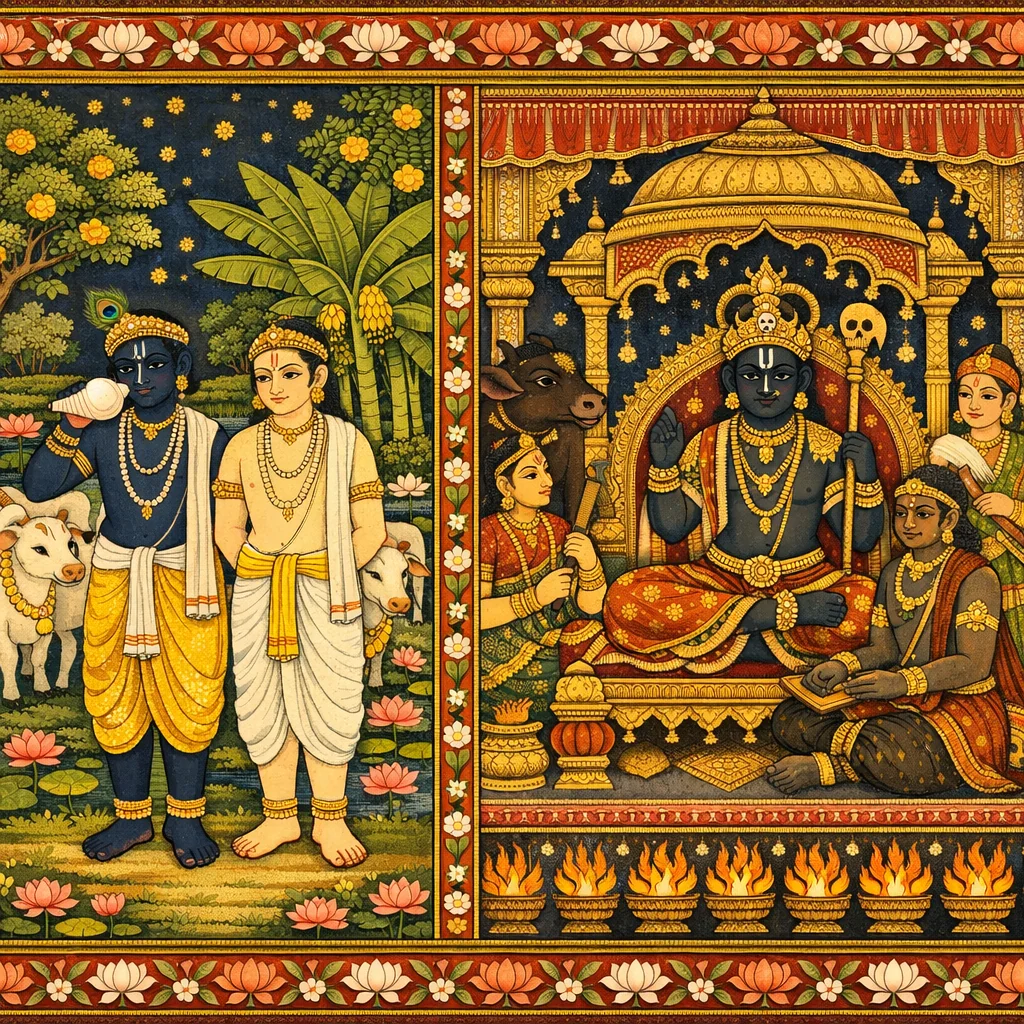
After Kaṁsa’s fall and the stabilization of Mathurā’s political order, Kṛṣṇa perceives that Devakī and Vasudeva are awakening to His divine opulence; to preserve parental intimacy, He extends Yoga-māyā and speaks as a remorseful son, teaching the irredeemable debt to parents and the gravity of neglecting dependents. His parents, overwhelmed by vātsalya-bhāva, embrace Him. Kṛṣṇa then installs Ugrasena as Yadu king, honoring dynastic constraints (Yayāti’s curse) while positioning Himself as a servant-subject, thereby legitimizing rule and restoring displaced clans to their homes. Turning from royal consolidation to dharma and education, Vasudeva arranges the upanayana; Kṛṣṇa and Balarāma accept brahmacarya and demonstrate ideal guru-sevā under Sāndīpani Muni, mastering Vedas, arts, and statecraft with superhuman ease. For guru-dakṣiṇā, They retrieve the guru’s lost son—killing Pañcajana, confronting Yamarāja, and restoring the boy—then return to Mathurā, greeted with public jubilation. The chapter bridges household/royal duties with the forthcoming mature public mission of the Lords.
Shlokas
Verse 1
श्रीशुक उवाच पितरावुपलब्धार्थौ विदित्वा पुरुषोत्तम: । मा भूदिति निजां मायां ततान जनमोहिनीम् ॥ १ ॥
Śukadeva Gosvāmī said: Understanding that His parents were becoming aware of His transcendental opulences, the Supreme Personality of Godhead thought that this should not be allowed to happen. Thus He expanded His Yoga-māyā, which bewilders His devotees.
Verse 2
उवाच पितरावेत्य साग्रज: सात्वतर्षभ: । प्रश्रयावनत: प्रीणन्नम्ब तातेति सादरम् ॥ २ ॥
Lord Kṛṣṇa, the greatest of the Sātvatas, approached His parents with His elder brother. Humbly bowing His head and gratifying them by respectfully addressing them as “My dear mother” and “My dear father,” Kṛṣṇa spoke as follows.
Verse 3
नास्मत्तो युवयोस्तात नित्योत्कण्ठितयोरपि । बाल्यपौगण्डकैशोरा: पुत्राभ्यामभवन्क्वचित् ॥ ३ ॥
[Lord Kṛṣṇa said:] Dear Father, because of Us, your two sons, you and mother Devakī always remained in anxiety and could never enjoy Our childhood, boyhood or youth.
Verse 4
न लब्धो दैवहतयोर्वासो नौ भवदन्तिके । यां बाला: पितृगेहस्था विन्दन्ते लालिता मुदम् ॥ ४ ॥
Deprived by fate, We could not live with you and enjoy the pampered happiness most children enjoy in their parents’ home.
Verse 5
सर्वार्थसम्भवो देहो जनित: पोषितो यत: । न तयोर्याति निर्वेशं पित्रोर्मर्त्य: शतायुषा ॥ ५ ॥
With one’s body one can acquire all goals of life, and it is one’s parents who give the body birth and sustenance. Therefore no mortal man can repay his debt to his parents, even if he serves them for a full lifetime of a hundred years.
Verse 6
यस्तयोरात्मज: कल्प आत्मना च धनेन च । वृत्तिं न दद्यात्तं प्रेत्य स्वमांसं खादयन्ति हि ॥ ६ ॥
A son who, though able to do so, fails to provide for his parents with his physical resources and wealth is forced after his death to eat his own flesh.
Verse 7
मातरं पितरं वृद्धं भार्यां साध्वीं सुतं शिशुम् । गुरुं विप्रं प्रपन्नं च कल्पोऽबिभ्रच्छ्वसन् मृत: ॥ ७ ॥
A man who, though able to do so, fails to support his elderly parents, chaste wife, young child or spiritual master, or who neglects a brāhmaṇa or anyone who comes to him for shelter, is considered dead, though breathing.
Verse 8
तन्नावकल्पयो: कंसान्नित्यमुद्विग्नचेतसो: । मोघमेते व्यतिक्रान्ता दिवसा वामनर्चतो: ॥ ८ ॥
Thus We have wasted all these days, unable as We were to properly honor you because Our minds were always disturbed by fear of Kaṁsa.
Verse 9
तत् क्षन्तुमर्हथस्तात मातर्नौ परतन्त्रयो: । अकुर्वतोर्वां शुश्रूषां क्लिष्टयोर्दुर्हृदा भृशम् ॥ ९ ॥
Dear Father and Mother, please forgive Us for not serving you. We are not independent and have been greatly frustrated by cruel Kaṁsa.
Verse 10
श्रीशुक उवाच इति मायामनुष्यस्य हरेर्विश्वात्मनो गिरा । मोहितावङ्कमारोप्य परिष्वज्यापतुर्मुदम् ॥ १० ॥
Śukadeva Gosvāmī said: Thus beguiled by the words of Lord Hari, the Supreme Soul of the universe, who by His internal illusory potency appeared to be a human, His parents joyfully raised Him up on their laps and embraced Him.
Verse 11
सिञ्चन्तावश्रुधाराभि: स्नेहपाशेन चावृतौ । न किञ्चिदूचतू राजन्बाष्पकण्ठौ विमोहितौ ॥ ११ ॥
Pouring out a shower of tears upon the Lord, His parents, who were bound up by the rope of affection, could not speak. They were overwhelmed, O King, and their throats choked up with tears.
Verse 12
एवमाश्वास्य पितरौ भगवान्देवकीसुत: । मातामहं तूग्रसेनं यदूनामकरोन्नृपम् ॥ १२ ॥
Thus having comforted His mother and father, the Supreme Personality of Godhead, appearing as the son of Devakī, installed His maternal grandfather, Ugrasena, as King of the Yadus.
Verse 13
आह चास्मान् महाराज प्रजाश्चाज्ञप्तुमर्हसि । ययातिशापाद् यदुभिर्नासितव्यं नृपासने ॥ १३ ॥
The Lord told him: O mighty King, We are your subjects, so please command Us. Indeed, because of the curse of Yayāti, no Yadu may sit on the royal throne.
Verse 14
मयि भृत्य उपासीने भवतो विबुधादय: । बलिं हरन्त्यवनता: किमुतान्ये नराधिपा: ॥ १४ ॥
Since I am present in your entourage as your personal attendant, all the demigods and other exalted personalities will come with heads bowed to offer you tribute. What, then, to speak of the rulers of men?
Verse 15
सर्वान्स्वान्ज्ञतिसम्बन्धान्दिग्भ्य: कंसभयाकुलान् । यदुवृष्ण्यन्धकमधुदाशार्हकुकुरादिकान् ॥ १५ ॥ सभाजितान् समाश्वास्य विदेशावासकर्शितान् । न्यवासयत् स्वगेहेषु वित्तै: सन्तर्प्य विश्वकृत् ॥ १६ ॥
The Lord then brought all His close family members and other relatives back from the various places to which they had fled in fear of Kaṁsa. He received the Yadus, Vṛṣṇis, Andhakas, Madhus, Dāśārhas, Kukuras and other clans with due honor, and He also consoled them, for they were weary of living in foreign lands. Then Lord Kṛṣṇa, the creator of the universe, resettled them in their homes and gratified them with valuable gifts.
Verse 16
सर्वान्स्वान्ज्ञतिसम्बन्धान्दिग्भ्य: कंसभयाकुलान् । यदुवृष्ण्यन्धकमधुदाशार्हकुकुरादिकान् ॥ १५ ॥ सभाजितान् समाश्वास्य विदेशावासकर्शितान् । न्यवासयत् स्वगेहेषु वित्तै: सन्तर्प्य विश्वकृत् ॥ १६ ॥
The Lord then brought all His close family members and other relatives back from the various places to which they had fled in fear of Kaṁsa. He received the Yadus, Vṛṣṇis, Andhakas, Madhus, Dāśārhas, Kukuras and other clans with due honor, and He also consoled them, for they were weary of living in foreign lands. Then Lord Kṛṣṇa, the creator of the universe, resettled them in their homes and gratified them with valuable gifts.
Verse 17
कृष्णसङ्कर्षणभुजैर्गुप्ता लब्धमनोरथा: । गृहेषु रेमिरे सिद्धा: कृष्णरामगतज्वरा: ॥ १७ ॥ वीक्षन्तोऽहरह: प्रीता मुकुन्दवदनाम्बुजम् । नित्यं प्रमुदितं श्रीमत्सदयस्मितवीक्षणम् ॥ १८ ॥
The members of these clans, protected by the arms of Lord Kṛṣṇa and Lord Saṅkarṣaṇa, felt that all their desires were fulfilled. Thus they enjoyed perfect happiness while living at home with their families. Because of the presence of Kṛṣṇa and Balarāma, they no longer suffered from the fever of material existence. Every day these loving devotees could see Mukunda’s ever-cheerful lotus face, which was decorated with beautiful, merciful smiling glances.
Verse 18
कृष्णसङ्कर्षणभुजैर्गुप्ता लब्धमनोरथा: । गृहेषु रेमिरे सिद्धा: कृष्णरामगतज्वरा: ॥ १७ ॥ वीक्षन्तोऽहरह: प्रीता मुकुन्दवदनाम्बुजम् । नित्यं प्रमुदितं श्रीमत्सदयस्मितवीक्षणम् ॥ १८ ॥
The members of these clans, protected by the arms of Lord Kṛṣṇa and Lord Saṅkarṣaṇa, felt that all their desires were fulfilled. Thus they enjoyed perfect happiness while living at home with their families. Because of the presence of Kṛṣṇa and Balarāma, they no longer suffered from the fever of material existence. Every day these loving devotees could see Mukunda’s ever-cheerful lotus face, which was decorated with beautiful, merciful smiling glances.
Verse 19
तत्र प्रवयसोऽप्यासन् युवानोऽतिबलौजस: । पिबन्तोऽक्षैर्मुकुन्दस्य मुखाम्बुजसुधां मुहु: ॥ १९ ॥
Even the most elderly inhabitants of the city appeared youthful, full of strength and vitality, for with their eyes they constantly drank the elixir of Lord Mukunda’s lotus face.
Verse 20
अथ नन्दं समसाद्य भगवान् देवकीसुत: । सङ्कर्षणश्च राजेन्द्र परिष्वज्येदमूचतु: ॥ २० ॥
Then, O exalted Parīkṣit, the Supreme Lord Kṛṣṇa, the son of Devakī, along with Lord Balarāma, approached Nanda Mahārāja. The two Lords embraced him and then addressed him as follows.
Verse 21
पितर्युवाभ्यां स्निग्धाभ्यां पोषितौ लालितौ भृशम् । पित्रोरभ्यधिका प्रीतिरात्मजेष्वात्मनोऽपि हि ॥ २१ ॥
[Kṛṣṇa and Balarāma said:] O Father, you and mother Yaśodā have affectionately maintained Us and cared for Us so much! Indeed, parents love their children more than their own lives.
Verse 22
स पिता सा च जननी यौ पुष्णीतां स्वपुत्रवत् । शिशून् बन्धुभिरुत्सृष्टानकल्पै: पोषरक्षणे ॥ २२ ॥
They are the real father and mother who care for, as they would their own sons, children abandoned by relatives unable to maintain and protect them.
Verse 23
यात यूयं व्रजं तात वयं च स्नेहदु:खितान् । ज्ञातीन् वो द्रष्टुमेष्यामो विधाय सुहृदां सुखम् ॥ २३ ॥
Now you should all return to Vraja, dear Father. We shall come to see you, Our dear relatives who suffer in separation from Us, as soon as We have given some happiness to your well-wishing friends.
Verse 24
एवं सान्त्वय्य भगवान् नन्दं सव्रजमच्युत: । वासोऽलङ्कारकुप्याद्यैरर्हयामास सादरम् ॥ २४ ॥
Thus consoling Nanda Mahārāja and the other men of Vraja, the infallible Supreme Lord respectfully honored them with gifts of clothing, jewelry, household utensils and so on.
Verse 25
इत्युक्तस्तौ परिष्वज्य नन्द: प्रणयविह्वल: । पूरयन्नश्रुभिर्नेत्रे सह गोपैर्व्रजं ययौ ॥ २५ ॥
Nanda Mahārāja was overwhelmed with affection upon hearing Kṛṣṇa’s words, and his eyes brimmed with tears as he embraced the two Lords. Then he went back to Vraja with the cowherd men.
Verse 26
अथ शूरसुतो राजन् पुत्रयो: समकारयत् । पुरोधसा ब्राह्मणैश्च यथावद् द्विजसंस्कृतिम् ॥ २६ ॥
My dear King, then Vasudeva, the son of Śūrasena, arranged for a priest and other brāhmaṇas to perform his two sons’ second-birth initiation.
Verse 27
तेभ्योऽदाद्दक्षिणा गावो रुक्ममाला: स्वलङ्कृता: । स्वलङ्कृतेभ्य: सम्पूज्य सवत्सा: क्षौममालिनी: ॥ २७ ॥
Vasudeva honored these brāhmaṇas by worshiping them and giving them fine ornaments and well-ornamented cows with their calves. All these cows wore gold necklaces and linen wreaths.
Verse 28
या: कृष्णरामजन्मर्क्षे मनोदत्ता महामति: । ताश्चाददादनुस्मृत्य कंसेनाधर्मतो हृता: ॥ २८ ॥
The magnanimous Vasudeva then remembered the cows he had mentally given away on the occasion of Kṛṣṇa’s and Balarāma’s birth. Kaṁsa had stolen those cows, and Vasudeva now recovered them and gave them away in charity also.
Verse 29
ततश्च लब्धसंस्कारौ द्विजत्वं प्राप्य सुव्रतौ । गर्गाद् यदुकुलाचार्याद्गायत्रं व्रतमास्थितौ ॥ २९ ॥
After attaining twice-born status through initiation, the Lords, sincere in Their vows, took the further vow of celibacy from Garga Muni, the spiritual master of the Yadus.
Verse 30
प्रभवौ सर्वविद्यानां सर्वज्ञौ जगदीश्वरौ । नान्यसिद्धामलं ज्ञानं गूहमानौ नरेहितै: ॥ ३० ॥ अथो गुरुकुले वासमिच्छन्तावुपजग्मतु: । काश्यं सान्दीपनिं नाम ह्यवन्तिपुरवासिनम् ॥ ३१ ॥
Concealing Their innately perfect knowledge by Their humanlike activities, those two omniscient Lords of the universe, Themselves the origin of all branches of knowledge, next desired to reside at the school of a spiritual master. Thus They approached Sāndīpani Muni, a native of Kāsī living in the city of Avantī.
Verse 31
प्रभवौ सर्वविद्यानां सर्वज्ञौ जगदीश्वरौ । नान्यसिद्धामलं ज्ञानं गूहमानौ नरेहितै: ॥ ३० ॥ अथो गुरुकुले वासमिच्छन्तावुपजग्मतु: । काश्यं सान्दीपनिं नाम ह्यवन्तिपुरवासिनम् ॥ ३१ ॥
Concealing Their innately perfect knowledge by Their humanlike activities, those two omniscient Lords of the universe, Themselves the origin of all branches of knowledge, next desired to reside at the school of a spiritual master. Thus They approached Sāndīpani Muni, a native of Kāsī living in the city of Avantī.
Verse 32
यथोपसाद्य तौ दान्तौ गुरौ वृत्तिमनिन्दिताम् । ग्राहयन्तावुपेतौ स्म भक्त्या देवमिवादृतौ ॥ ३२ ॥
Sāndīpani thought very highly of these two self-controlled disciples, whom he had obtained so fortuitously. By serving him as devotedly as one would serve the Supreme Lord Himself, They showed others an irreproachable example of how to worship the spiritual master.
Verse 33
तयोर्द्विजवरस्तुष्ट: शुद्धभावानुवृत्तिभि: । प्रोवाच वेदानखिलान्सङ्गोपनिषदो गुरु: ॥ ३३ ॥
That best of brāhmaṇas, the spiritual master Sāndīpani, was satisfied with Their submissive behavior, and thus he taught Them the entire Vedas, together with their six corollaries and the Upaniṣads.
Verse 34
सरहस्यं धनुर्वेदं धर्मान् न्यायपथांस्तथा । तथा चान्वीक्षिकीं विद्यां राजनीतिं च षड्विधाम् ॥ ३४ ॥
He also taught Them the Dhanur-veda, with its most confidential secrets; the standard books of law; the methods of logical reasoning and philosophical debate; and the sixfold science of politics.
Verse 35
सर्वं नरवरश्रेष्ठौ सर्वविद्याप्रवर्तकौ । सकृन्निगदमात्रेण तौ सञ्जगृहतुर्नृप ॥ ३५ ॥ अहोरात्रैश्चतु:षष्ट्या संयत्तौ तावती: कला: । गुरुदक्षिणयाचार्यं छन्दयामासतुर्नृप ॥ ३६ ॥
O King, those best of persons, Kṛṣṇa and Balarāma, being Themselves the original promulgators of all varieties of knowledge, could immediately assimilate each and every subject after hearing it explained just once. Thus with fixed concentration They learned the sixty-four arts and skills in as many days and nights. Thereafter, O King, They satisfied Their spiritual master by offering him guru-dakṣiṇā.
Verse 36
सर्वं नरवरश्रेष्ठौ सर्वविद्याप्रवर्तकौ । सकृन्निगदमात्रेण तौ सञ्जगृहतुर्नृप ॥ ३५ ॥ अहोरात्रैश्चतु:षष्ट्या संयत्तौ तावती: कला: । गुरुदक्षिणयाचार्यं छन्दयामासतुर्नृप ॥ ३६ ॥
O King, those best of persons, Kṛṣṇa and Balarāma, being Themselves the original promulgators of all varieties of knowledge, could immediately assimilate each and every subject after hearing it explained just once. Thus with fixed concentration They learned the sixty-four arts and skills in as many days and nights. Thereafter, O King, They satisfied Their spiritual master by offering him guru-dakṣiṇā.
Verse 37
द्विजस्तयोस्तं महिमानमद्भुतं संलक्ष्य राजन्नतिमानुषीं मतिम् । सम्मन्त्र्य पत्न्या स महार्णवे मृतं बालं प्रभासे वरयां बभूव ह ॥ ३७ ॥
O King, the learned brāhmaṇa Sāndīpani carefully considered the two Lords’ glorious and amazing qualities and Their superhuman intelligence. Then, after consulting with his wife, he chose as his remuneration the return of his young son, who had died in the ocean at Prabhāsa.
Verse 38
तथेत्यथारुह्य महारथौ रथं प्रभासमासाद्य दुरन्तविक्रमौ । वेलामुपव्रज्य निषीदतु: क्षणं सिन्धुर्विदित्वार्हणमाहरत्तयो: ॥ ३८ ॥
“So be it,” replied those two great chariot warriors of limitless might, and They at once mounted Their chariot and set off for Prabhāsa. When They reached that place, They walked up to the shore and sat down. In a moment the deity of the ocean, recognizing Them to be the Supreme Lords, approached Them with offerings of tribute.
Verse 39
तमाह भगवानाशु गुरुपुत्र: प्रदीयताम् । योऽसाविह त्वया ग्रस्तो बालको महतोर्मिणा ॥ ३९ ॥
The Supreme Lord Kṛṣṇa addressed the lord of the ocean: Let the son of My guru be presented at once — the one you seized here with your mighty waves.
Verse 40
श्रीसमुद्र उवाच न चाहार्षमहं देव दैत्य: पञ्चजनो महान् । अन्तर्जलचर: कृष्ण शङ्खरूपधरोऽसुर: ॥ ४० ॥
The ocean replied: O Lord Kṛṣṇa, it was not I who abducted him, but a demonic descendant of Diti named Pañcajana, who travels in the water in the form of a conch.
Verse 41
आस्ते तेनाहृतो नूनं तच्छ्रुत्वा सत्वरं प्रभु: । जलमाविश्य तं हत्वा नापश्यदुदरेऽर्भकम् ॥ ४१ ॥
“Indeed,” the ocean said, “that demon has taken him away.” Hearing this, Lord Kṛṣṇa entered the ocean, found Pañcajana and killed him. But the Lord did not find the boy within the demon’s belly.
Verse 42
तदङ्गप्रभवं शङ्खमादाय रथमागमत् । तत: संयमनीं नाम यमस्य दयितां पुरीम् ॥ ४२ ॥ गत्वा जनार्दन: शङ्खं प्रदध्मौ सहलायुध: । शङ्खनिर्ह्रादमाकर्ण्य प्रजासंयमनो यम: ॥ ४३ ॥ तयो: सपर्यां महतीं चक्रे भक्त्युपबृंहिताम् । उवाचावनत: कृष्णं सर्वभूताशयालयम् । लीलामनुष्ययोर्विष्णो युवयो: करवाम किम् ॥ ४४ ॥
Lord Janārdana took the conchshell that had grown around the demon’s body and went back to the chariot. Then He proceeded to Saṁyamanī, the beloved capital of Yamarāja, the lord of death. Upon arriving there with Lord Balarāma, He loudly blew His conchshell, and Yamarāja, who keeps the conditioned souls in check, came as soon as he heard the resounding vibration. Yamarāja elaborately worshiped the two Lords with great devotion, and then he addressed Lord Kṛṣṇa, who lives in everyone’s heart: “O Supreme Lord Viṣṇu, what shall I do for You and Lord Balarāma, who are playing the part of ordinary humans?”
Verse 43
तदङ्गप्रभवं शङ्खमादाय रथमागमत् । तत: संयमनीं नाम यमस्य दयितां पुरीम् ॥ ४२ ॥ गत्वा जनार्दन: शङ्खं प्रदध्मौ सहलायुध: । शङ्खनिर्ह्रादमाकर्ण्य प्रजासंयमनो यम: ॥ ४३ ॥ तयो: सपर्यां महतीं चक्रे भक्त्युपबृंहिताम् । उवाचावनत: कृष्णं सर्वभूताशयालयम् । लीलामनुष्ययोर्विष्णो युवयो: करवाम किम् ॥ ४४ ॥
Lord Janārdana took the conchshell that had grown around the demon’s body and went back to the chariot. Then He proceeded to Saṁyamanī, the beloved capital of Yamarāja, the lord of death. Upon arriving there with Lord Balarāma, He loudly blew His conchshell, and Yamarāja, who keeps the conditioned souls in check, came as soon as he heard the resounding vibration. Yamarāja elaborately worshiped the two Lords with great devotion, and then he addressed Lord Kṛṣṇa, who lives in everyone’s heart: “O Supreme Lord Viṣṇu, what shall I do for You and Lord Balarāma, who are playing the part of ordinary humans?”
Verse 44
तदङ्गप्रभवं शङ्खमादाय रथमागमत् । तत: संयमनीं नाम यमस्य दयितां पुरीम् ॥ ४२ ॥ गत्वा जनार्दन: शङ्खं प्रदध्मौ सहलायुध: । शङ्खनिर्ह्रादमाकर्ण्य प्रजासंयमनो यम: ॥ ४३ ॥ तयो: सपर्यां महतीं चक्रे भक्त्युपबृंहिताम् । उवाचावनत: कृष्णं सर्वभूताशयालयम् । लीलामनुष्ययोर्विष्णो युवयो: करवाम किम् ॥ ४४ ॥
Lord Janārdana took the conchshell that had grown around the demon’s body and went back to the chariot. Then He proceeded to Saṁyamanī, the beloved capital of Yamarāja, the lord of death. Upon arriving there with Lord Balarāma, He loudly blew His conchshell, and Yamarāja, who keeps the conditioned souls in check, came as soon as he heard the resounding vibration. Yamarāja elaborately worshiped the two Lords with great devotion, and then he addressed Lord Kṛṣṇa, who lives in everyone’s heart: “O Supreme Lord Viṣṇu, what shall I do for You and Lord Balarāma, who are playing the part of ordinary humans?”
Verse 45
श्रीभगवानुवाच गुरुपुत्रमिहानीतं निजकर्मनिबन्धनम् । आनयस्व महाराज मच्छासनपुरस्कृत: ॥ ४५ ॥
The Supreme Personality of Godhead said: Suffering the bondage of his past activity, My spiritual master’s son was brought here to you. O great King, obey My command and bring this boy to Me without delay.
Verse 46
तथेति तेनोपानीतं गुरुपुत्रं यदूत्तमौ । दत्त्वा स्वगुरवे भूयो वृणीष्वेति तमूचतु: ॥ ४६ ॥
Yamarāja said, “So be it,” and brought forth the guru’s son. Then those two most exalted Yadus presented the boy to Their spiritual master and said to him, “Please select another boon.”
Verse 47
श्रीगुरुरुवाच सम्यक् सम्पादितो वत्स भवद्भयां गुरुनिष्क्रय: । को नु युष्मद्विधगुरो: कामानामवशिष्यते ॥ ४७ ॥
The spiritual master said: My dear boys, You two have completely fulfilled the disciple’s obligation to reward his spiritual master. Indeed, with disciples like You, what further desires could a guru have?
Verse 48
गच्छतं स्वगृहं वीरौ कीर्तिर्वामस्तु पावनी । छन्दांस्ययातयामानि भवन्त्विह परत्र च ॥ ४८ ॥
O heroes, now please return home. May Your fame sanctify the world, and may the Vedic hymns be ever fresh in Your minds, both in this life and the next.
Verse 49
गुरुणैवमनुज्ञातौ रथेनानिलरंहसा । आयातौ स्वपुरं तात पर्जन्यनिनदेन वै ॥ ४९ ॥
Thus receiving Their guru’s permission to leave, the two Lords returned to Their city on Their chariot, which moved as swiftly as the wind and resounded like a cloud.
Verse 50
समनन्दन् प्रजा: सर्वा दृष्ट्वा रामजनार्दनौ । अपश्यन्त्यो बह्वहानि नष्टलब्धधना इव ॥ ५० ॥
All the citizens rejoiced upon seeing Kṛṣṇa and Balarāma, whom they had not seen for many days. The people felt just like those who have lost their wealth and then regained it.
Frequently Asked Questions
Because parental love (vātsalya-rasa) thrives on intimacy, not awe. If Vasudeva and Devakī relate to Kṛṣṇa primarily as the Supreme Lord, the spontaneous dynamics of parenthood—nurturing, scolding, protecting—diminish. Yoga-māyā therefore preserves the sweetness (mādhurya) of līlā by softening direct awareness of aiśvarya, while still allowing the Bhāgavata to teach His supremacy through narrative context.
Kṛṣṇa states that since the body is the instrument for all puruṣārthas (dharma, artha, kāma, mokṣa), and parents give birth and sustenance to that body, the obligation to them is practically unrepayable. The chapter intensifies this ethic by warning that neglecting parents and other dependents—spouse, child, guru, brāhmaṇas, and those seeking shelter—is a form of living death, underscoring dharma as the social ground on which bhakti is practiced.
The narrative frames Kṛṣṇa as honoring righteous political order and dynastic law: due to Yayāti’s curse, no Yadu may sit on the throne. By restoring Ugrasena, Kṛṣṇa repairs the legitimacy broken by Kaṁsa’s usurpation, models the principle that divine power need not displace lawful governance, and positions Himself as protector and servant of dharma rather than a claimant to worldly sovereignty.
Sāndīpani Muni is presented as the Lords’ ācārya in Avantī. Although Kṛṣṇa and Balarāma are omniscient, They adopt humanlike discipline to establish maryādā—proper conduct—showing that spiritual and worldly knowledge should be received through guru-paramparā and service. Their rapid mastery of Veda, Vedāṅgas, Dhanur-veda, nīti-śāstra, and the sixty-four arts demonstrates that learning is sanctified by humility and guru-bhakti, not merely by talent.
They first go to Prabhāsa, where the ocean clarifies that the boy was taken by the water-demon Pañcajana. Kṛṣṇa kills the demon, takes the conch that forms around him, then proceeds to Yamarāja’s capital and commands the return of the boy. The episode reveals Kṛṣṇa’s sovereignty over cosmic administrators (like Yama) and over death itself, while framing that supreme power as being exercised in the service of guru-dakṣiṇā—devotional obligation rather than self-display.