Adhyaya 64
The Deliverance of King Nṛga and the Warning Against Taking Brāhmaṇa Property
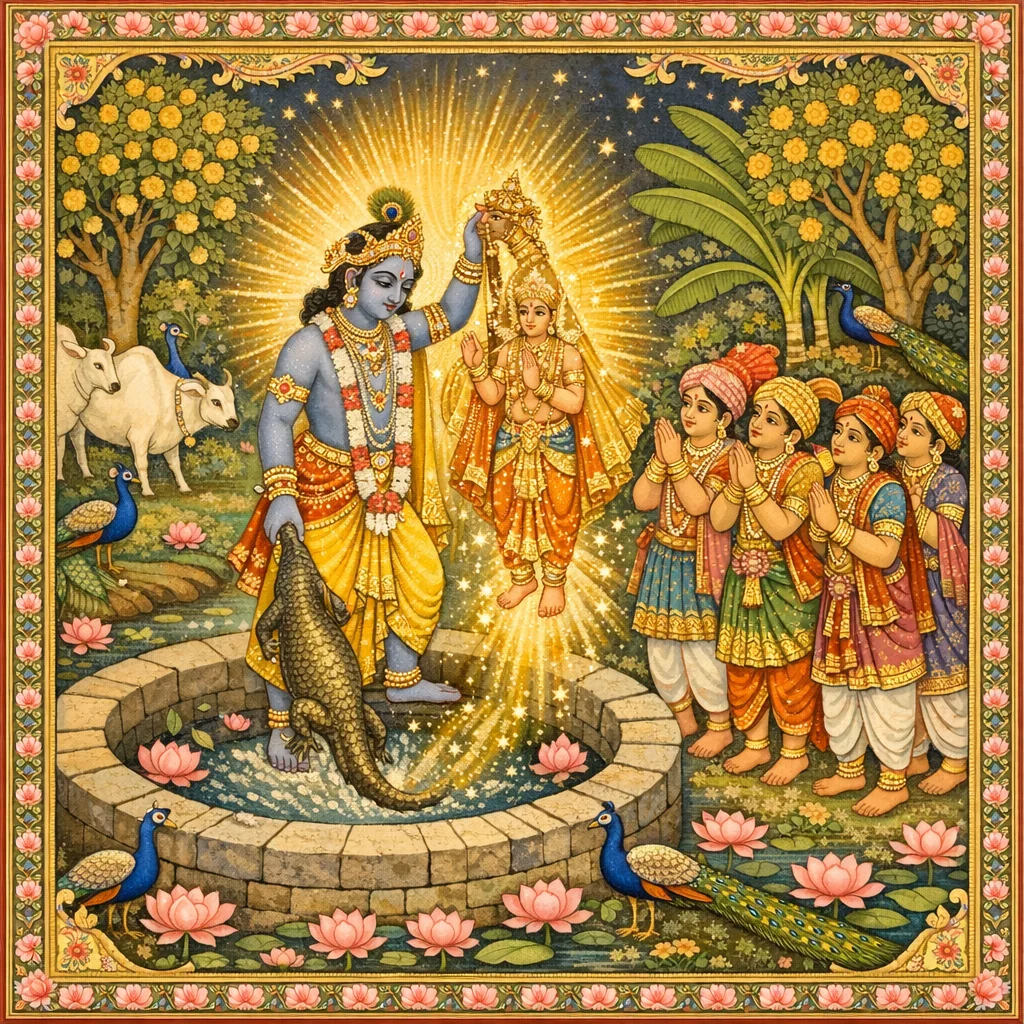
In Dvārakā, after the preceding royal and social episodes that highlight Kṛṣṇa’s governance and protection of dharma, the narrative turns to a didactic wonder-story. Sāmba and other Yadu youths, playing in a forest, discover a massive lizard trapped in a dry well. Unable to rescue it, they bring Kṛṣṇa, who effortlessly lifts the creature out with His left hand. Upon the Lord’s touch, the lizard becomes a radiant celestial person—King Nṛga—who recounts how, despite vast charity, he fell due to an inadvertent offense involving a brāhmaṇa’s cow given to another brāhmaṇa. The two brāhmaṇas refuse compensation; Yamarāja offers Nṛga the choice of enjoying piety first or suffering sin first, and Nṛga chooses to suffer, falling into the lizard body until liberated by Kṛṣṇa. After granting him permission to ascend, Kṛṣṇa instructs His associates and the royal class: brāhmaṇa property is “indigestible,” theft or misuse brings multigenerational ruin and hellish consequence, and even a sinful brāhmaṇa should not be treated harshly. The chapter thus bridges narrative marvel with public ethics, preparing the reader for subsequent Dvārakā teachings on righteous kingship and social order under bhakti.
Shlokas
Verse 1
श्रीबादरायणिरुवाच एकदोपवनं राजन् जग्मुर्यदुकुमारका: । विहर्तुं साम्बप्रद्युम्नचारुभानुगदादय: ॥ १ ॥
Śrī Bādarāyaṇi said: O King, one day Sāmba, Pradyumna, Cāru, Bhānu, Gada and other young boys of the Yadu dynasty went to a small forest to play.
Verse 2
क्रीडित्वा सुचिरं तत्र विचिन्वन्त: पिपासिता: । जलं निरुदके कूपे ददृशु: सत्त्वमद्भुतम् ॥ २ ॥
After playing for a long time, they became thirsty. As they searched for water, they looked inside a dry well and saw a peculiar creature.
Verse 3
कृकलासं गिरिनिभं वीक्ष्य विस्मितमानसा: । तस्य चोद्धरणे यत्नं चक्रुस्ते कृपयान्विता: ॥ ३ ॥
The boys were astonished to behold this creature, a lizard who looked like a hill. They felt sorry for it and tried to lift it out of the well.
Verse 4
चर्मजैस्तान्तवै: पाशैर्बद्ध्वा पतितमर्भका: । नाशक्नुरन् समुद्धर्तुं कृष्णायाचख्युरुत्सुका: ॥ ४ ॥
They caught on to the trapped lizard with leather thongs and then with woven ropes, but still they could not lift it out. So they went to Lord Kṛṣṇa and excitedly told Him about the creature.
Verse 5
तत्रागत्यारविन्दाक्षो भगवान् विश्वभावन: । वीक्ष्योज्जहार वामेन तं करेण स लीलया ॥ ५ ॥
The lotus-eyed Supreme Lord, maintainer of the universe, went to the well and saw the lizard. Then with His left hand He easily lifted it out.
Verse 6
स उत्तम:श्लोककराभिमृष्टो विहाय सद्य: कृकलासरूपम् । सन्तप्तचामीकरचारुवर्ण: स्वर्ग्यद्भुतालङ्करणाम्बरस्रक् ॥ ६ ॥
Touched by the hand of the glorious Supreme Lord, the being at once gave up its lizard form and assumed that of a resident of heaven. His complexion was beautifully colored like molten gold, and he was adorned with wonderful ornaments, clothes and garlands.
Verse 7
पप्रच्छ विद्वानपि तन्निदानं जनेषु विख्यापयितुं मुकुन्द: । कस्त्वं महाभाग वरेण्यरूपो देवोत्तमं त्वां गणयामि नूनम् ॥ ७ ॥
Lord Kṛṣṇa understood the situation, but to inform people in general He inquired as follows: “Who are you, O greatly fortunate one? Seeing your excellent form, I think you must surely be an exalted demigod.
Verse 8
सम्प्रापितोऽस्यतदर्ह: सुभद्र । आत्मानमाख्याहि विवित्सतां नो यन्मन्यसे न: क्षममत्र वक्तुम् ॥ ८ ॥
“By what past activity were you brought to this condition? It seems you did not deserve such a fate, O good soul. We are eager to know about you, so please inform us about yourself — if, that is, you think this the proper time and place to tell us.”
Verse 9
श्रीशुक उवाच इति स्म राजा सम्पृष्ट: कृष्णेनानन्तमूर्तिना । माधवं प्रणिपत्याह किरीटेनार्कवर्चसा ॥ ९ ॥
Śukadeva Gosvāmī said: Thus questioned by Kṛṣṇa, whose forms are unlimited, the King, his helmet as dazzling as the sun, bowed down to Lord Mādhava and replied as follows.
Verse 10
नृग उवाच नृगो नाम नरेन्द्रोऽहमिक्ष्वाकुतनय: प्रभो । दानिष्वाख्यायमानेषु यदि ते कर्णमस्पृशम् ॥ १० ॥
King Nṛga said: I am a king known as Nṛga, the son of Ikṣvāku. Perhaps, Lord, You have heard of me when lists of charitable men were recited.
Verse 11
किं नु तेऽविदितं नाथ सर्वभूतात्मसाक्षिण: । कालेनाव्याहतदृशो वक्ष्येऽथापि तवाज्ञया ॥ ११ ॥
What could possibly be unknown to You, O master? With vision undisturbed by time, You witness the minds of all living beings. Nevertheless, on Your order I will speak.
Verse 12
यावत्य: सिकता भूमेर्यावत्यो दिवि तारका: । यावत्यो वर्षधाराश्च तावतीरददं स्म गा: ॥ १२ ॥
I gave in charity as many cows as there are grains of sand on the earth, stars in the heavens, or drops in a rain shower.
Verse 13
पयस्विनीस्तरुणी: शीलरूप- गुणोपपन्ना: कपिला हेमशृङ्गी: । न्यायार्जिता रूप्यखुरा: सवत्सा दुकूलमालाभरणा ददावहम् ॥ १३ ॥
Young, brown, milk-laden cows, who were well-behaved, beautiful and endowed with good qualities, who were all acquired honestly, and who had gilded horns, silver-plated hooves and decorations of fine ornamental cloths and garlands — such were the cows, along with their calves, that I gave in charity.
Verse 14
स्वलङ्कृतेभ्यो गुणशीलवद्भ्य: सीदत्कुटुम्बेभ्य ऋतव्रतेभ्य: । तप:श्रुतब्रह्मवदान्यसद्भ्य: प्रादां युवभ्यो द्विजपुङ्गवेभ्य: ॥ १४ ॥ गोभूहिरण्यायतनाश्वहस्तिन: कन्या: सदासीस्तिलरूप्यशय्या: । वासांसि रत्नानि परिच्छदान् रथा- निष्टं च यज्ञैश्चरितं च पूर्तम् ॥ १५ ॥
I first honored the brāhmaṇas who were recipients of my charity by decorating them with fine ornaments. Those most exalted brāhmaṇas, whose families were in need, were young and possessed of excellent character and qualities. They were dedicated to truth, famous for their austerity, vastly learned in the Vedic scriptures and saintly in their behavior. I gave them cows, land, gold and houses, along with horses, elephants and marriageable girls with maidservants, as well as sesame, silver, fine beds, clothing, jewels, furniture and chariots. In addition, I performed Vedic sacrifices and executed various pious welfare activities.
Verse 15
स्वलङ्कृतेभ्यो गुणशीलवद्भ्य: सीदत्कुटुम्बेभ्य ऋतव्रतेभ्य: । तप:श्रुतब्रह्मवदान्यसद्भ्य: प्रादां युवभ्यो द्विजपुङ्गवेभ्य: ॥ १४ ॥ गोभूहिरण्यायतनाश्वहस्तिन: कन्या: सदासीस्तिलरूप्यशय्या: । वासांसि रत्नानि परिच्छदान् रथा- निष्टं च यज्ञैश्चरितं च पूर्तम् ॥ १५ ॥
I first honored the brāhmaṇas who were recipients of my charity by decorating them with fine ornaments. Those most exalted brāhmaṇas, whose families were in need, were young and possessed of excellent character and qualities. They were dedicated to truth, famous for their austerity, vastly learned in the Vedic scriptures and saintly in their behavior. I gave them cows, land, gold and houses, along with horses, elephants and marriageable girls with maidservants, as well as sesame, silver, fine beds, clothing, jewels, furniture and chariots. In addition, I performed Vedic sacrifices and executed various pious welfare activities.
Verse 16
कस्यचिद् द्विजमुख्यस्य भ्रष्टा गौर्मम गोधने । सम्पृक्ताविदुषा सा च मया दत्ता द्विजातये ॥ १६ ॥
Once a cow belonging to a certain first-class brāhmaṇa wandered away and entered my herd. Unaware of this, I gave that cow in charity to a different brāhmaṇa.
Verse 17
तां नीयमानां तत्स्वामी दृष्ट्वोवाच ममेति तम् । ममेति परिग्राह्याह नृगो मे दत्तवानिति ॥ १७ ॥
When the cow’s first owner saw her being led away, he said, “She is mine!” The second brāhmaṇa, who had accepted her as a gift, replied, “No, she’s mine! Nṛga gave her to me.”
Verse 18
विप्रौ विवदमानौ मामूचतु: स्वार्थसाधकौ । भवान् दातापहर्तेति तच्छ्रुत्वा मेऽभवद् भ्रम: ॥ १८ ॥
As the two brāhmaṇas argued, each trying to fulfill his own purpose, they came to me. One of them said, “You gave me this cow,” and the other said, “But you stole her from me.” Hearing this, I was bewildered.
Verse 19
अनुनीतावुभौ विप्रौ धर्मकृच्छ्रगतेन वै । गवां लक्षं प्रकृष्टानां दास्याम्येषा प्रदीयताम् ॥ १९ ॥ भवन्तावनुगृह्णीतां किङ्करस्याविजानत: । समुद्धरतं मां कृच्छ्रात् पतन्तं निरयेऽशुचौ ॥ २० ॥
Finding myself in a terrible dilemma concerning my duty in the situation, I humbly entreated both the brāhmaṇas: “I will give one hundred thousand of the best cows in exchange for this one. Please give her back to me. Your good selves should be merciful to me, your servant. I did not know what I was doing. Please save me from this difficult situation, or I’ll surely fall into a filthy hell.”
Verse 20
अनुनीतावुभौ विप्रौ धर्मकृच्छ्रगतेन वै । गवां लक्षं प्रकृष्टानां दास्याम्येषा प्रदीयताम् ॥ १९ ॥ भवन्तावनुगृह्णीतां किङ्करस्याविजानत: । समुद्धरतं मां कृच्छ्रात् पतन्तं निरयेऽशुचौ ॥ २० ॥
Finding myself in a terrible dilemma concerning my duty in the situation, I humbly entreated both the brāhmaṇas: “I will give one hundred thousand of the best cows in exchange for this one. Please give her back to me. Your good selves should be merciful to me, your servant. I did not know what I was doing. Please save me from this difficult situation, or I’ll surely fall into a filthy hell.”
Verse 21
नाहं प्रतीच्छे वै राजन्नित्युक्त्वा स्वाम्यपाक्रमत् । नान्यद् गवामप्ययुतमिच्छामीत्यपरो ययौ ॥ २१ ॥
The present owner of the cow said, “I don’t want anything in exchange for this cow, O King,” and went away. The other brāhmaṇa declared, “I don’t want even ten thousand more cows [than you are offering],” and he too went away.
Verse 22
एतस्मिन्नन्तरे यामैर्दूतैर्नीतो यमक्षयम् । यमेन पृष्टस्तत्राहं देवदेव जगत्पते ॥ २२ ॥
O Lord of lords, O master of the universe, the agents of Yamarāja, taking advantage of the opportunity thus created, later carried me to his abode. There Yamarāja himself questioned me.
Verse 23
पूर्वं त्वमशुभं भुङ्क्ष उताहो नृपते शुभम् । नान्तं दानस्य धर्मस्य पश्ये लोकस्य भास्वत: ॥ २३ ॥
[Yamarāja said:] My dear King, do you wish to experience the results of your sins first, or those of your piety? Indeed, I see no end to the dutiful charity you have performed, or to your consequent enjoyment in the radiant heavenly planets.
Verse 24
पूर्वं देवाशुभं भुञ्ज इति प्राह पतेति स: । तावदद्राक्षमात्मानं कृकलासं पतन् प्रभो ॥ २४ ॥
I replied, “First, my lord, let me suffer my sinful reactions,” and Yamarāja said, “Then fall!” At once I fell, and while falling I saw myself becoming a lizard, O master.
Verse 25
ब्रह्मण्यस्य वदान्यस्य तव दासस्य केशव । स्मृतिर्नाद्यापि विध्वस्ता भवत्सन्दर्शनार्थिन: ॥ २५ ॥
O Keśava, as Your servant I was devoted to the brāhmaṇas and generous to them, and I always hankered for Your audience. Therefore even till now I have never forgotten [my past life].
Verse 26
स त्वं कथं मम विभोऽक्षिपथ: परात्मा योगेश्वरै: श्रुतिदृशामलहृद्विभाव्य: । साक्षादधोक्षज उरुव्यसनान्धबुद्धे: स्यान्मेऽनुदृश्य इह यस्य भवापवर्ग: ॥ २६ ॥
O almighty one, how is it that my eyes see You here before me? You are the Supreme Soul, whom the greatest masters of mystic yoga can meditate upon within their pure hearts only by employing the spiritual eye of the Vedas. Then how, O transcendental Lord, are You directly visible to me, since my intelligence has been blinded by the severe tribulations of material life? Only one who has finished his material entanglement in this world should be able to see You.
Verse 27
देवदेव जगन्नाथ गोविन्द पुरुषोत्तम । नारायण हृषीकेश पुण्यश्लोकाच्युताव्यय ॥ २७ ॥ अनुजानीहि मां कृष्ण यान्तं देवगतिं प्रभो । यत्र क्वापि सतश्चेतो भूयान्मे त्वत्पदास्पदम् ॥ २८ ॥
O Devadeva, Jagannātha, Govinda, Puruṣottama, Nārāyaṇa, Hṛṣīkeśa, Puṇyaśloka, Acyuta, Avyaya! O Kṛṣṇa, please permit me to depart for the world of the demigods. Wherever I live, O master, may my mind always take shelter of Your feet.
Verse 28
देवदेव जगन्नाथ गोविन्द पुरुषोत्तम । नारायण हृषीकेश पुण्यश्लोकाच्युताव्यय ॥ २७ ॥ अनुजानीहि मां कृष्ण यान्तं देवगतिं प्रभो । यत्र क्वापि सतश्चेतो भूयान्मे त्वत्पदास्पदम् ॥ २८ ॥
O Devadeva, Jagannātha, Govinda, Puruṣottama, Nārāyaṇa, Hṛṣīkeśa, Puṇyaśloka, Acyuta, Avyaya! O Kṛṣṇa, please permit me to depart for the world of the demigods. Wherever I live, O master, may my mind always take shelter of Your feet.
Verse 29
नमस्ते सर्वभावाय ब्रह्मणेऽनन्तशक्तये । कृष्णाय वासुदेवाय योगानां पतये नम: ॥ २९ ॥
I offer my repeated obeisances unto You, Kṛṣṇa, the son of Vasudeva. You are the source of all beings, the Supreme Absolute Truth, the possessor of unlimited potencies, the master of all spiritual disciplines.
Verse 30
इत्युक्त्वा तं परिक्रम्य पादौ स्पृष्ट्वा स्वमौलिना । अनुज्ञातो विमानाग्र्यमारुहत् पश्यतां नृणाम् ॥ ३० ॥
Having spoken thus, Mahārāja Nṛga circumambulated Lord Kṛṣṇa and touched his crown to the Lord’s feet. Granted permission to depart, King Nṛga then boarded a wonderful celestial airplane as all the people present looked on.
Verse 31
कृष्ण: परिजनं प्राह भगवान् देवकीसुत: । ब्रह्मण्यदेवो धर्मात्मा राजन्याननुशिक्षयन् ॥ ३१ ॥
The Supreme Personality of Godhead — Lord Kṛṣṇa, the son of Devakī — who is especially devoted to the brāhmaṇas and who embodies the essence of religion, then spoke to His personal associates and thus instructed the royal class in general.
Verse 32
दुर्जरं बत ब्रह्मस्वं भुक्तमग्नेर्मनागपि । तेजीयसोऽपि किमुत राज्ञां ईश्वरमानिनाम् ॥ ३२ ॥
[Lord Kṛṣṇa said:] How indigestible is the property of a brāhmaṇa, even when enjoyed just slightly and by one more potent than fire! What then to speak of kings who try to enjoy it, presuming themselves lords.
Verse 33
नाहं हालाहलं मन्ये विषं यस्य प्रतिक्रिया । ब्रह्मस्वं हि विषं प्रोक्तं नास्य प्रतिविधिर्भुवि ॥ ३३ ॥
I do not consider hālāhala to be real poison, because it has an antidote. But a brāhmaṇa’s property, when stolen, can truly be called poison, for it has no antidote in this world.
Verse 34
हिनस्ति विषमत्तारं वह्निरद्भि: प्रशाम्यति । कुलं समूलं दहति ब्रह्मस्वारणिपावक: ॥ ३४ ॥
Poison kills only the person who ingests it, and an ordinary fire may be extinguished with water. But the fire generated from the kindling wood of a brāhmaṇa’s property burns the thief’s entire family down to the root.
Verse 35
ब्रह्मस्वं दुरनुज्ञातं भुक्तं हन्ति त्रिपूरुषम् । प्रसह्य तु बलाद् भुक्तं दश पूर्वान् दशापरान् ॥ ३५ ॥
If a person enjoys a brāhmaṇa’s property without receiving due permission, that property destroys three generations of his family. But if he takes it by force or gets the government or other outsiders to help him usurp it, then ten generations of his ancestors and ten generations of his descendants are all destroyed.
Verse 36
राजानो राजलक्ष्म्यान्धा नात्मपातं विचक्षते । निरयं येऽभिमन्यन्ते ब्रह्मस्वं साधु बालिशा: ॥ ३६ ॥
Members of the royal order, blinded by royal opulence, fail to foresee their own downfall. Childishly hankering to enjoy a brāhmaṇa’s property, they are actually hankering to go to hell.
Verse 37
गृह्णन्ति यावत: पांशून् क्रन्दतामश्रुबिन्दव: । विप्राणां हृतवृत्तीनां वदान्यानां कुटुम्बिनाम् ॥ ३७ ॥ राजानो राजकुल्याश्च तावतोऽब्दान्निरङ्कुशा: । कुम्भीपाकेषु पच्यन्ते ब्रह्मदायापहारिण: ॥ ३८ ॥
For as many years as there are particles of dust touched by the tears of generous brāhmaṇas who have dependent families and whose property is stolen, uncontrolled kings who usurp a brāhmaṇa’s property are cooked, along with their royal families, in the hell known as Kumbhīpāka.
Verse 38
गृह्णन्ति यावत: पांशून् क्रन्दतामश्रुबिन्दव: । विप्राणां हृतवृत्तीनां वदान्यानां कुटुम्बिनाम् ॥ ३७ ॥ राजानो राजकुल्याश्च तावतोऽब्दान्निरङ्कुशा: । कुम्भीपाकेषु पच्यन्ते ब्रह्मदायापहारिण: ॥ ३८ ॥
For as many years as there are particles of dust touched by the tears of generous brāhmaṇas who have dependent families and whose property is stolen, uncontrolled kings who usurp a brāhmaṇa’s property are cooked, along with their royal families, in the hell known as Kumbhīpāka.
Verse 39
स्वदत्तां परदत्तां वा ब्रह्मवृत्तिं हरेच्च य: । षष्टिवर्षसहस्राणि विष्ठायां जायते कृमि: ॥ ३९ ॥
Whether it be his own gift or someone else’s, a person who steals a brāhmaṇa’s property will take birth as a worm in feces for sixty thousand years.
Verse 40
न मे ब्रह्मधनं भूयाद् यद् गृध्वाल्पायुषो नरा: । पराजिताश्च्युता राज्याद् भवन्त्युद्वेजिनोऽहय: ॥ ४० ॥
I do not desire brāhmaṇas’ wealth. Those who lust after it become short-lived and are defeated. They lose their kingdoms and become snakes, who trouble others.
Verse 41
विप्रं कृतागसमपि नैव द्रुह्यत मामका: । घ्नन्तं बहु शपन्तं वा नमस्कुरुत नित्यश: ॥ ४१ ॥
My dear followers, never treat a learned brāhmaṇa harshly, even if he has sinned. Even if he attacks you physically or repeatedly curses you, always continue to offer him obeisances.
Verse 42
यथाहं प्रणमे विप्राननुकालं समाहित: । तथा नमत यूयं च योऽन्यथा मे स दण्डभाक् ॥ ४२ ॥
Just us I always carefully bow down to brāhmaṇas, so all of you should likewise bow down to them. I will punish anyone who acts otherwise.
Verse 43
ब्राह्मणार्थो ह्यपहृतो हर्तारं पातयत्यध: । अजानन्तमपि ह्येनं नृगं ब्राह्मणगौरिव ॥ ४३ ॥
When a brāhmaṇa’s property is stolen, even unknowingly, it certainly causes the person who takes it to fall down, just as the brāhmaṇa’s cow did to Nṛga.
Verse 44
एवं विश्राव्य भगवान् मुकुन्दो द्वारकौकस: । पावन: सर्वलोकानां विवेश निजमन्दिरम् ॥ ४४ ॥
Having thus instructed the residents of Dvārakā, Lord Mukunda, purifier of all the worlds, entered His palace.
Frequently Asked Questions
The act dramatizes Bhagavān’s role as āśraya: karma can bind a jīva to degradation, but the Lord’s direct intervention can release him instantly. The “well” functions as a narrative emblem of saṁsāra, while Kṛṣṇa’s effortless rescue shows that liberation is ultimately granted by divine grace, not merely by accumulated piety.
Nṛga, son of Ikṣvāku, was famed for extraordinary charity, especially cow-gifts to qualified brāhmaṇas. He became a lizard due to an inadvertent but unresolved offense: a brāhmaṇa’s cow wandered into his herd and was donated to another brāhmaṇa. Because neither claimant accepted restitution, the karmic fault matured, and upon choosing to suffer sinful reactions first before enjoying his piety, Nṛga fell to a lizard body until delivered by Kṛṣṇa.
Kṛṣṇa frames brāhmaṇa-dhana as spiritually “indigestible” because it is tied to sacred trust and dharma. Ordinary poison may have an antidote and harms mainly the consumer, but misappropriating brāhmaṇa property generates severe, far-reaching consequences—socially and karmically—affecting family lines and leading to hellish suffering, especially for rulers who abuse power.
The chapter implies that rulers must act with extreme caution in dāna (charity), verify rightful ownership, and seek dharmic resolution with humility. When a mistake occurs, sincere restitution should be offered, but the narrative warns that some harms cannot be “priced away” if sacred parties refuse settlement—therefore prevention, reverence, and restraint are essential in rāja-dharma.
Because the brāhmaṇa represents the social embodiment of śāstra, yajña, and spiritual learning; disrespect destabilizes dharma itself. Kṛṣṇa’s instruction is not a blanket endorsement of wrongdoing, but a mandate for kings and citizens to maintain reverence and non-violence toward sacred authority, addressing faults through proper dharmic mechanisms rather than retaliation.