Adhyaya 36
The Killing of Ariṣṭāsura and Kaṁsa’s Plot to Summon Kṛṣṇa
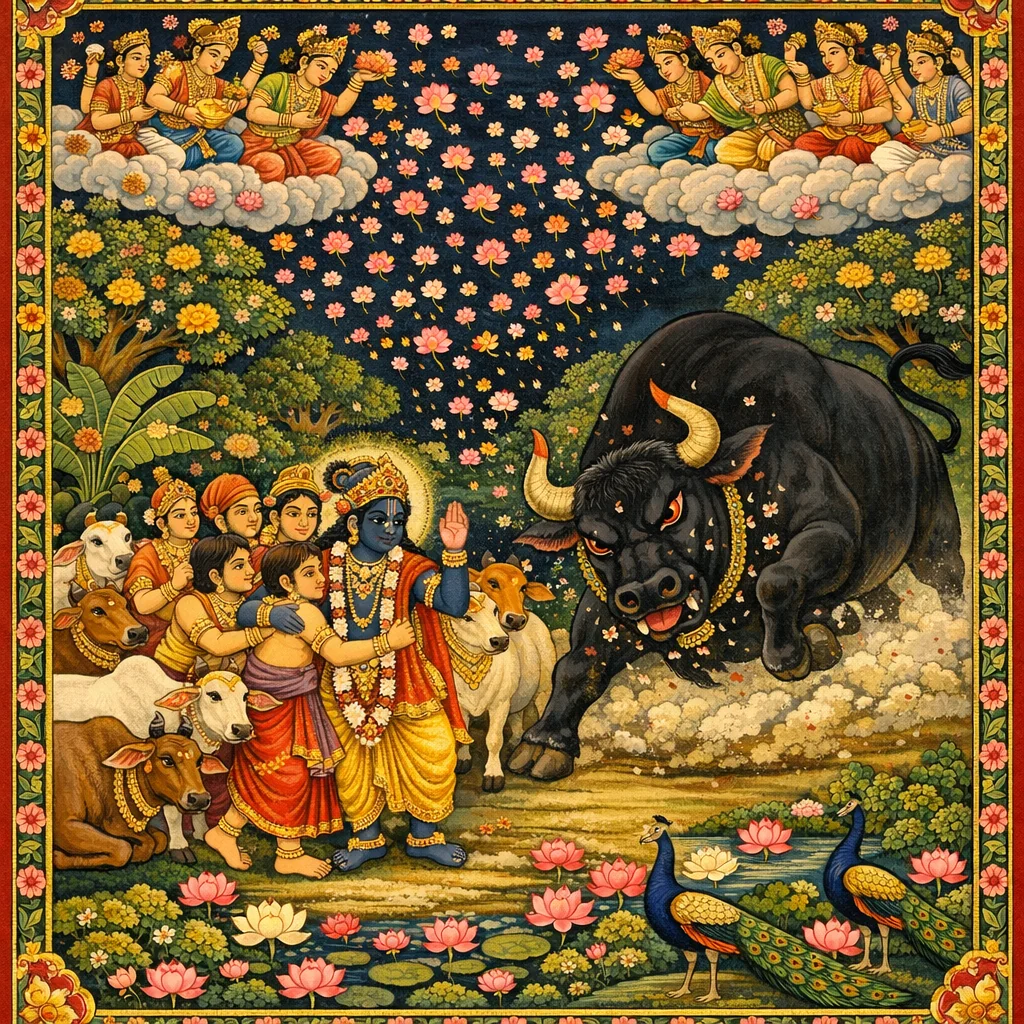
Continuing the Vraja-cycle of repeated assaults on the cowherd settlement, Ariṣṭāsura arrives as a terrifying bull whose roars and violence destabilize the land and panic Vraja’s residents. The gopas, gopīs, and animals rush to Govinda for shelter, illustrating poṣaṇa as lived dependence. Kṛṣṇa confronts the demon directly—provoking him, receiving his charge, and subduing him through decisive physical mastery, finally killing him and receiving the devas’ पुष्प-वृष्टि (flower-shower). With Ariṣṭa’s fall, the narrative pivots from local Vraja threats toward Mathurā’s political center: Nārada visits Kaṁsa and reveals Kṛṣṇa’s true parentage and identity connections (Devakī, Rohiṇī), intensifying Kaṁsa’s fear. Kaṁsa attempts violence against Vasudeva, then imprisons Vasudeva and Devakī, and escalates a multi-layered assassination plan—Keśī, Kuvalayāpīḍa, and wrestlers (Cāṇūra, Muṣṭika). He orders the bow-sacrifice festival and commands Akrūra to bring Kṛṣṇa and Balarāma to Mathurā, setting up the next chapters’ transition from pastoral Vraja līlā to the public confrontation that culminates in Kaṁsa’s destruction.
Shlokas
Verse 1
श्री बादरायणिरुवाच अथ तर्ह्यागतो गोष्ठमरिष्टो वृषभासुर: । महींमहाककुत्काय: कम्पयन्खुरविक्षताम् ॥ १ ॥
Śukadeva Goswāmī said: The demon Ariṣṭa then came to the cowherd village. Appearing in the form of a bull with a large hump, he made the earth tremble as he tore it apart with his hooves.
Verse 2
रम्भमाण: खरतरं पदा च विलिखन् महीम् । उद्यम्य पुच्छं वप्राणि विषाणाग्रेण चोद्धरन् । किञ्चित्किञ्चिच्छकृन् मुञ्चन्मूत्रयन्स्तब्धलोचन: ॥ २ ॥
Ariṣṭāsura bellowed very harshly and pawed the ground. With his tail raised and his eyes glaring, he began to tear up the embankments with the tips of his horns, every now and then passing a little stool and urine.
Verse 3
यस्य निर्ह्रादितेनाङ्ग निष्ठुरेण गवां नृणाम् । पतन्त्यकालतो गर्भा: स्रवन्ति स्म भयेन वै ॥ ३ ॥ निर्विशन्ति घना यस्य ककुद्यचलशङ्कया । तं तीक्ष्णशृङ्गमुद्वीक्ष्य गोप्यो गोपाश्च तत्रसु: ॥ ४ ॥
My dear King, clouds hovered about sharp-horned Ariṣṭāsura’s hump, mistaking it for a mountain, and when the cowherd men and ladies caught sight of the demon, they were struck with terror. Indeed, the strident reverberation of his roar so frightened the pregnant cows and women that they lost their fetuses in miscarriages.
Verse 4
यस्य निर्ह्रादितेनाङ्ग निष्ठुरेण गवां नृणाम् । पतन्त्यकालतो गर्भा: स्रवन्ति स्म भयेन वै ॥ ३ ॥ निर्विशन्ति घना यस्य ककुद्यचलशङ्कया । तं तीक्ष्णशृङ्गमुद्वीक्ष्य गोप्यो गोपाश्च तत्रसु: ॥ ४ ॥
My dear King, clouds hovered about sharp-horned Ariṣṭāsura’s hump, mistaking it for a mountain, and when the cowherd men and ladies caught sight of the demon, they were struck with terror. Indeed, the strident reverberation of his roar so frightened the pregnant cows and women that they lost their fetuses in miscarriages.
Verse 5
पशवो दुद्रुवुर्भीता राजन्सन्त्यज्य गोकुलम् । कृष्ण कृष्णेति ते सर्वे गोविन्दं शरणं ययु: ॥ ५ ॥
The domestic animals fled the pasture in fear, O King, and all the inhabitants rushed to Lord Govinda for shelter, crying, “Kṛṣṇa, Kṛṣṇa!”
Verse 6
भगवानपि तद् वीक्ष्य गोकुलं भयविद्रुतम् । मा भैष्टेति गिराश्वास्य वृषासुरमुपाह्वयत् ॥ ६ ॥
When the Supreme Lord saw the cowherd community distraught and fleeing in fear, He calmed them, saying, “Don’t be afraid.” Then He called out to the bull demon as follows.
Verse 7
गोपालै: पशुभिर्मन्द त्रासितै: किमसत्तम । मयि शास्तरि दुष्टानां त्वद्विधानां दुरात्मनाम् ॥ ७ ॥
You fool! What do you think you’re doing, you wicked rascal, frightening the cowherd community and their animals when I am here just to punish corrupt miscreants like you!
Verse 8
इत्यास्फोत्याच्युतोऽरिष्टं तलशब्देन कोपयन् । सख्युरंसे भुजाभोगं प्रसार्यावस्थितो हरि: ॥ ८ ॥
Having spoken these words, the infallible Lord Hari slapped His arms with His palms, further angering Ariṣṭa with the loud sound. The Lord then casually threw His mighty, serpentine arm over the shoulder of a friend and stood facing the demon.
Verse 9
सोऽप्येवं कोपितोऽरिष्ट: खुरेणावनिमुल्लिखन् । उद्यत्पुच्छभ्रमन्मेघ: क्रुद्ध: कृष्णमुपाद्रवत् ॥ ९ ॥
Thus provoked, Ariṣṭa pawed the ground with one of his hooves and then, with the clouds hovering around his upraised tail, furiously charged Kṛṣṇa.
Verse 10
अग्रन्यस्तविषाणाग्र: स्तब्धासृग्लोचनोऽच्युतम् । कटाक्षिप्याद्रवत्तूर्णमिन्द्रमुक्तोऽशनिर्यथा ॥ १० ॥
Pointing the tips of his horns straight ahead and glaring menacingly at Lord Kṛṣṇa from the corners of his bloodshot eyes, Ariṣṭa rushed toward Him at full speed, like a thunderbolt hurled by Indra.
Verse 11
गृहीत्वा शृङ्गयोस्तं वा अष्टादश पदानि स: । प्रत्यपोवाह भगवान् गज: प्रतिगजं यथा ॥ ११ ॥
The Supreme Lord Kṛṣṇa seized Ariṣṭāsura by the horns and threw him back eighteen steps, just as an elephant might do when fighting a rival elephant.
Verse 12
सोऽपविद्धो भगवता पुनरुत्थाय सत्वरम् । आपतत् स्विन्नसर्वाङ्गो नि:श्वसन्क्रोधमूर्च्छित: ॥ १२ ॥
Thus repulsed by the Supreme Lord, the bull demon got up and, breathing hard and sweating all over his body, again charged Him in a mindless rage.
Verse 13
तमापतन्तं स निगृह्य शृङ्गयो: पदा समाक्रम्य निपात्य भूतले । निष्पीडयामास यथार्द्रमम्बरं कृत्वा विषाणेन जघान सोऽपतत् ॥ १३ ॥
As Ariṣṭa attacked, Lord Kṛṣṇa seized him by the horns and knocked him to the ground with His foot. The Lord then thrashed him as if he were a wet cloth, and finally He yanked out one of the demon’s horns and struck him with it until he lay prostrate.
Verse 14
असृग् वमन् मूत्रशकृत् समुत्सृजन् क्षिपंश्च पादाननवस्थितेक्षण: । जगाम कृच्छ्रं निऋर्तेरथ क्षयं पुष्पै: किरन्तो हरिमीडिरे सुरा: ॥ १४ ॥
Vomiting blood and profusely excreting stool and urine, kicking his legs and rolling his eyes about, Ariṣṭāsura thus went painfully to the abode of Death. The demigods honored Lord Kṛṣṇa by scattering flowers upon Him.
Verse 15
एवं कुकुद्मिनं हत्वा स्तूयमान: द्विजातिभि: । विवेश गोष्ठं सबलो गोपीनां नयनोत्सव: ॥ १५ ॥
Having thus killed the bull demon Ariṣṭa, He who is a festival for the gopīs’ eyes entered the cowherd village with Balarāma.
Verse 16
अरिष्टे निहते दैत्ये कृष्णेनाद्भुतकर्मणा । कंसायाथाह भगवान् नारदो देवदर्शन: ॥ १६ ॥
After Ariṣṭāsura had been killed by Kṛṣṇa, who acts wonderfully, Nārada Muni went to speak to King Kaṁsa. That powerful sage of godly vision addressed the King as follows.
Verse 17
यशोदाया: सुतां कन्यां देवक्या: कृष्णमेव च । रामं च रोहिणीपुत्रं वसुदेवेन बिभ्यता । न्यस्तौ स्वमित्रे नन्दे वै याभ्यां ते पुरुषा हता: ॥ १७ ॥
[Nārada told Kaṁsa:] Yaśodā’s child was actually a daughter, and Kṛṣṇa is the son of Devakī. Also, Rāma is the son of Rohiṇī. Out of fear, Vasudeva entrusted Kṛṣṇa and Balarāma to his friend Nanda Mahārāja, and it is these two boys who have killed your men.
Verse 18
निशम्य तद्भोजपति: कोपात्प्रचलितेन्द्रिय: । निशातमसिमादत्त वसुदेवजिघांसया ॥ १८ ॥
Upon hearing this, the master of the Bhojas became furious and lost control of his senses. He picked up a sharp sword to kill Vasudeva.
Verse 19
निवारितो नारदेन तत्सुतौ मृत्युमात्मन: । ज्ञात्वा लोहमयै: पाशैर्बबन्ध सह भार्यया ॥ १९ ॥
But Nārada restrained Kaṁsa by reminding him that it was the two sons of Vasudeva who would cause his death. Kaṁsa then had Vasudeva and his wife shackled in iron chains.
Verse 20
प्रतियाते तु देवर्षौ कंस आभाष्य केशिनम् । प्रेषयामास हन्येतां भवता रामकेशवौ ॥ २० ॥
After Nārada left, King Kaṁsa summoned Keśī and ordered him, “Go kill Rāma and Kṛṣṇa.”
Verse 21
ततो मुष्टिकचाणूरशलतोशलकादिकान् । अमात्यान् हस्तिपांश्चैव समाहूयाह भोजराट् ॥ २१ ॥
The King of the Bhojas next called for his ministers, headed by Muṣṭika, Cāṇūra, Śala and Tośala, and also for his elephant-keepers. The King addressed them as follows.
Verse 22
भो भो निशम्यतामेतद् वीरचाणूरमुष्टिकौ । नन्दव्रजे किलासाते सुतावानकदुन्दुभे: ॥ २२ ॥ रामकृष्णौ ततो मह्यं मृत्यु: किल निदर्शित: । भवद्भ्यामिह सम्प्राप्तौ हन्येतां मल्ललीलया ॥ २३ ॥
My dear heroic Cāṇūra and Muṣṭika, please hear this. Rāma and Kṛṣṇa, the sons of Ānakadundubhi [Vasudeva], are living in Nanda’s cowherd village. It has been predicted that these two boys will be the cause of my death. When They are brought here, kill Them on the pretext of engaging Them in a wrestling match.
Verse 23
भो भो निशम्यतामेतद् वीरचाणूरमुष्टिकौ । नन्दव्रजे किलासाते सुतावानकदुन्दुभे: ॥ २२ ॥ रामकृष्णौ ततो मह्यं मृत्यु: किल निदर्शित: । भवद्भ्यामिह सम्प्राप्तौ हन्येतां मल्ललीलया ॥ २३ ॥
My dear heroic Cāṇūra and Muṣṭika, please hear this. Rāma and Kṛṣṇa, the sons of Ānakadundubhi [Vasudeva], are living in Nanda’s cowherd village. It has been predicted that these two boys will be the cause of my death. When They are brought here, kill Them on the pretext of engaging Them in a wrestling match.
Verse 24
मञ्चा: क्रियन्तां विविधा मल्लरङ्गपरिश्रिता: । पौरा जानपदा: सर्वे पश्यन्तु स्वैरसंयुगम् ॥ २४ ॥
Erect a wrestling ring with many surrounding viewing stands, and bring all the residents of the city and the outlying districts to see the open competition.
Verse 25
महामात्र त्वया भद्र रङ्गद्वार्युपनीयताम् । द्विप: कुवलयापीडो जहि तेन ममाहितौ ॥ २५ ॥
You, elephant-keeper, my good man, should position the elephant Kuvalayāpīḍa at the entrance to the wrestling arena and have him kill my two enemies.
Verse 26
आरभ्यतां धनुर्यागश्चतुर्दश्यां यथाविधि । विशसन्तु पशून्मेध्यान् भूतराजाय मीढुषे ॥ २६ ॥
Commence the bow sacrifice on the Caturdaśī day in accordance with the relevant Vedic injunctions. In ritual slaughter offer the appropriate kinds of animals to the magnanimous Lord Śiva.
Verse 27
इत्याज्ञाप्यार्थतन्त्रज्ञ आहूय यदुपुङ्गवम् । गृहीत्वा पाणिना पाणिं ततोऽक्रूरमुवाच ह ॥ २७ ॥
Having thus commanded his ministers, Kaṁsa next called for Akrūra, the most eminent of the Yadus. Kaṁsa knew the art of securing personal advantage, and thus he took Akrūra’s hand in his own and spoke to him as follows.
Verse 28
भो भो दानपते मह्यं क्रियतां मैत्रमादृत: । नान्यस्त्वत्तो हिततमो विद्यते भोजवृष्णिषु ॥ २८ ॥
My dear Akrūra, most charitable one, please do me a friendly favor out of respect. Among the Bhojas and Vṛṣṇis, there is no one else as kind to us as you.
Verse 29
अतस्त्वामाश्रित: सौम्य कार्यगौरवसाधनम् । यथेन्द्रो विष्णुमाश्रित्य स्वार्थमध्यगमद् विभु: ॥ २९ ॥
Gentle Akrūra, you always carry out your duties soberly, and therefore I am depending on you, just as powerful Indra took shelter of Lord Viṣṇu to achieve his goals.
Verse 30
गच्छ नन्दव्रजं तत्र सुतावानकदुन्दुभे: । आसाते ताविहानेन रथेनानय मा चिरम् ॥ ३० ॥
Please go to Nanda’s village, where the two sons of Ānakadundubhi are living, and without delay bring Them here on this chariot.
Verse 31
निसृष्ट: किल मे मृत्युर्देवैर्वैकुण्ठसंश्रयै: । तावानय समं गोपैर्नन्दाद्यै: साभ्युपायनै: ॥ ३१ ॥
The demigods, who are under the protection of Viṣṇu, have sent these two boys as my death. Bring Them here, and also have Nanda and the other cowherd men come with gifts of tribute.
Verse 32
घातयिष्य इहानीतौ कालकल्पेन हस्तिना । यदि मुक्तौ ततो मल्लैर्घातये वैद्युतोपमै: ॥ ३२ ॥
After you bring Kṛṣṇa and Balarāma, I will have Them killed by my elephant, who is as powerful as death itself. And if by chance They escape from him, I will have Them killed by my wrestlers, who are as strong as lightning.
Verse 33
तयोर्निहतयोस्तप्तान् वसुदेवपुरोगमान् । तद्बन्धून् निहनिष्यामि वृष्णिभोजदशार्हकान् ॥ ३३ ॥
When these two have been killed, I will kill Vasudeva and all Their lamenting relatives — the Vṛṣṇis, Bhojas and Daśārhas.
Verse 34
उग्रसेनं च पितरं स्थविरं राज्यकामुकं । तद्भ्रातरं देवकं च ये चान्ये विद्विषो मम ॥ ३४ ॥
I will also kill my old father, Ugrasena, who is greedy for my kingdom, and I will kill his brother Devaka and all my other enemies as well.
Verse 35
ततश्चैषा मही मित्र भवित्री नष्टकण्टका ॥ ३५ ॥
Then, my friend, this earth will be free of thorns.
Verse 36
जरासन्धो मम गुरुर्द्विविदो दयित: सखा । शम्बरो नरको बाणो मय्येव कृतसौहृदा: । तैरहं सुरपक्षीयान् हत्वा भोक्ष्ये महीं नृपान् ॥ ३६ ॥
My elder relative Jarāsandha and my dear friend Dvivida are solid well-wishers of mine, as are Śambara, Naraka and Bāṇa. I will use them all to kill off those kings who are allied with the demigods, and then I will rule the earth.
Verse 37
एतज्ज्ञात्वानय क्षिप्रं रामकृष्णाविहार्भकौ । धनुर्मखनिरीक्षार्थं द्रष्टुं यदुपुरश्रियम् ॥ ३७ ॥
Now that you understand my intentions, please go at once and bring Kṛṣṇa and Balarāma to watch the bow sacrifice and see the opulence of the Yadus’ capital.
Verse 38
श्रीअक्रूर उवाच राजन् मनीषितं सध्र्यक् तव स्वावद्यमार्जनम् । सिद्ध्यसिद्ध्यो: समं कुर्याद्दैवं हि फलसाधनम् ॥ ३८ ॥
Śrī Akrūra said: O King, you have expertly devised a process to free yourself of misfortune. Still, one should be equal in success and failure, since it is certainly destiny that produces the results of one’s work.
Verse 39
मनोरथान् करोत्युच्चैर्जनो दैवहतानपि । युज्यते हर्षशोकाभ्यां तथाप्याज्ञां करोमि ते ॥ ३९ ॥
An ordinary person is determined to act on his desires even when fate prevents their fulfillment. Therefore he encounters both happiness and distress. Yet even though such is the case, I will execute your order.
Verse 40
श्रीशुक उवाच एवमादिश्य चाक्रूरं मन्त्रिणश्च विसृज्य स: । प्रविवेश गृहं कंसस्तथाक्रूर: स्वमालयम् ॥ ४० ॥
Śukadeva Gosvāmī said: Having thus instructed Akrūra, King Kaṁsa dismissed his ministers and retired to his quarters, and Akrūra returned home.
Frequently Asked Questions
On the narrative level, Ariṣṭāsura embodies a direct threat to Vraja’s life and livelihood, and Kṛṣṇa’s act is poṣaṇa—protecting those who have taken shelter of Him. Symbolically, the bull can represent distorted strength and violent religiosity: power without dharma. The Lord’s effortless subjugation teaches that fear dissolves when one turns to Bhagavān as the true refuge, and that adharma—however massive—cannot stand before Him.
Nārada converts Kaṁsa’s vague dread into targeted certainty by identifying Kṛṣṇa and Balarāma as Vasudeva’s sons and the agents of Kaṁsa’s foretold death. Kaṁsa responds with layered contingency planning—imprisoning Vasudeva and Devakī, deploying Keśī, stationing Kuvalayāpīḍa at the arena gate, arranging lethal wrestling ‘on a pretext,’ and using the bow-sacrifice festival as political cover to draw the brothers into Mathurā.
Akrūra is a leading Yadu noble summoned by Kaṁsa to bring Kṛṣṇa and Balarāma to Mathurā. His compliance—framed by his sober reflection on destiny and duty—becomes the narrative hinge that transports the story from Vraja to Mathurā. By ordering Akrūra’s chariot mission, Kaṁsa unintentionally facilitates the very sequence that will culminate in his own downfall.
Akrūra articulates a classical Bhāgavata tension: people act from desire and agency (puruṣakāra), yet outcomes manifest under daiva (destiny/supreme arrangement). His counsel implies equanimity in success and failure, but it also foreshadows the Bhāgavata’s theological view that Bhagavān’s plan operates through human decisions—Kaṁsa’s schemes and Akrūra’s obedience both become instruments in the Lord’s larger līlā.