Adhyaya 24
Govardhana-pūjā: Kṛṣṇa Redirects Indra-yajña to Worship of Govardhana, Cows, and Brāhmaṇas
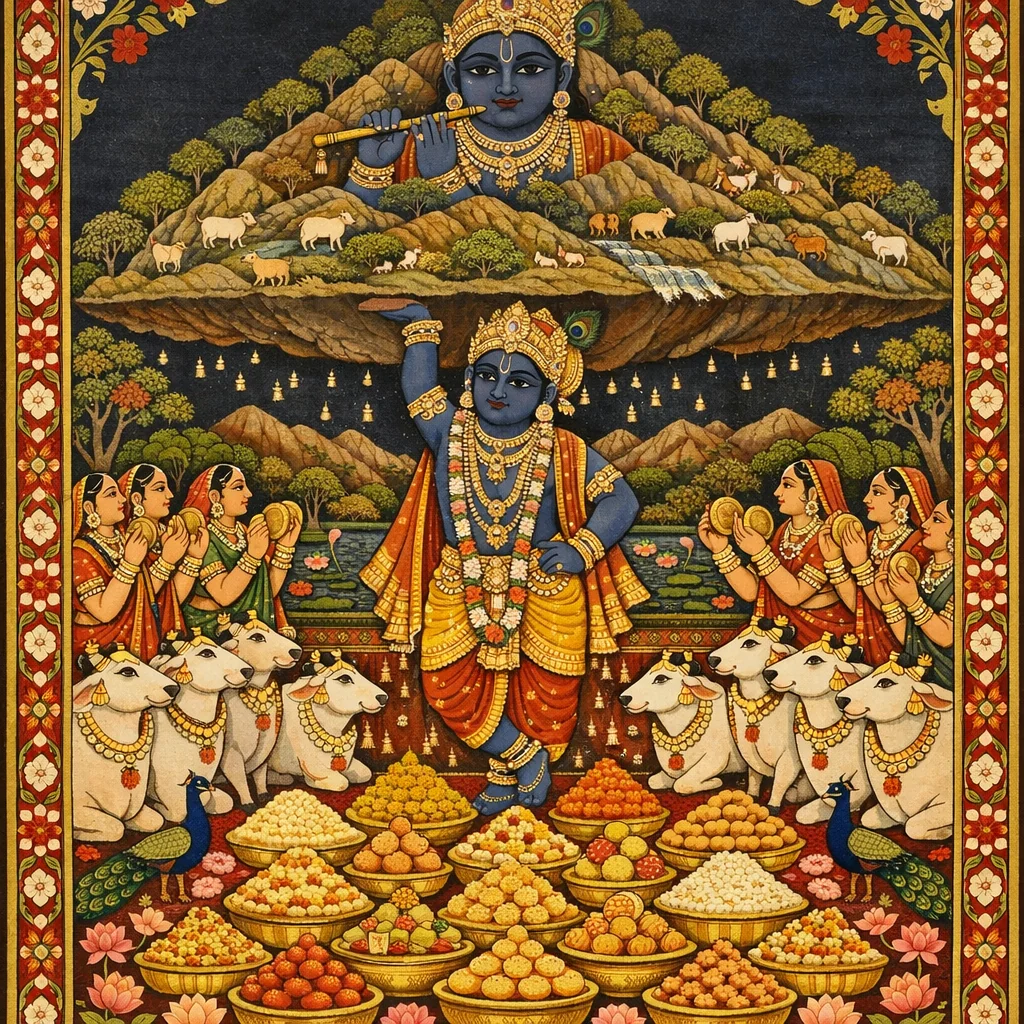
In Vraja, Kṛṣṇa notices the cowherds preparing an Indra-yajña and, though omniscient, respectfully questions Nanda and the elders to draw out their rationale. Nanda explains the traditional dependence on Indra as rain-giver and the social-religious custom of offering grains and oblations for prosperity and the three goals of life. Kṛṣṇa then advances a deliberate, karma-centered critique: results arise from one’s own work and conditioned nature; even a controller’s dispensing presupposes action, so worship should align with one’s actual sustenance and svadharma. He reframes Vraja’s identity as forest-and-hill dwellers whose livelihood is cow protection, and proposes a sacrifice dedicated to Govardhana Hill, the cows, and the brāhmaṇas using the same paraphernalia. The community follows His plan—feeding all beings, honoring priests with gifts, circumambulating Govardhana with their herds, while the gopīs sing Kṛṣṇa’s glories. Kṛṣṇa manifests a विशाल (unprecedented) form as “Govardhana,” consumes the offerings, and inspires reverence and fear of neglecting the hill. This chapter intentionally sets up the next development: Indra’s pride is provoked, leading to the retaliatory storm and Kṛṣṇa’s protective lifting of Govardhana in the ensuing narrative.
Shlokas
Verse 1
श्रीशुक उवाच भगवानपि तत्रैव बलदेवेन संयुत: । अपश्यन्निवसन्गोपानिन्द्रयागकृतोद्यमान् ॥ १ ॥
Śukadeva Gosvāmī said: While staying in that very place with His brother Baladeva, Lord Kṛṣṇa happened to see the cowherd men busily arranging for a sacrifice to Indra.
Verse 2
तदभिज्ञोऽपि भगवान् सर्वात्मा सर्वदर्शन: । प्रश्रयावनतोऽपृच्छद् वृद्धान् नन्दपुरोगमान् ॥ २ ॥
Being the omniscient Supersoul, the Supreme Lord Kṛṣṇa already understood the situation, yet He still humbly inquired from the elders, headed by His father, Nanda Mahārāja.
Verse 3
कथ्यतां मे पित: कोऽयं सम्भ्रमो व उपागत: । किं फलं कस्य वोद्देश: केन वा साध्यते मख: ॥ ३ ॥
[Lord Kṛṣṇa said:] My dear father, kindly explain to Me what this great endeavor of yours is all about. What is it meant to accomplish? If this is a ritual sacrifice, then for whose satisfaction is it intended and by what means is it going to be executed?
Verse 4
एतद् ब्रूहि महान् कामो मह्यं शुश्रूषवे पित: । न हि गोप्यं हि साधूनां कृत्यं सर्वात्मनामिह । अस्त्यस्वपरदृष्टीनाममित्रोदास्तविद्विषाम् ॥ ४ ॥
Please tell Me about it, O father. I have a great desire to know and am ready to hear in good faith. Certainly, no secrets are to be kept by saintly personalities, who see all others as equal to themselves, who have no conception of “mine” or “another’s” and who do not consider who is a friend, who is an enemy and who is neutral.
Verse 5
उदासीनोऽरिवद् वर्ज्य आत्मवत् सुहृदुच्यते ॥ ५ ॥
One who is neutral may be avoided like an enemy, but a friend should be considered like one’s own self.
Verse 6
ज्ञात्वाज्ञात्वा च कर्माणि जनोऽयमनुतिष्ठति । विदुष: कर्मसिद्धि: स्याद् यथा नाविदुषो भवेत् ॥ ६ ॥
When people in this world perform activities, sometimes they understand what they are doing and sometimes they don’t. Those who know what they are doing achieve success in their work, whereas ignorant people do not.
Verse 7
तत्र तावत् क्रियायोगो भवतां किं विचारित: । अथवा लौकिकस्तन्मे पृच्छत: साधु भण्यताम् ॥ ७ ॥
Such being the case, this ritualistic endeavor of yours should be clearly explained to Me. Is it a ceremony based on scriptural injunction, or simply a custom of ordinary society?
Verse 8
श्रीनन्द उवाच पर्जन्यो भगवानिन्द्रो मेघास्तस्यात्ममूर्तय: । तेऽभिवर्षन्ति भूतानां प्रीणनं जीवनं पय: ॥ ८ ॥
Nanda Mahārāja replied: The great Lord Indra is the controller of the rain. The clouds are his personal representatives, and they directly provide rainwater, which gives happiness and sustenance to all creatures.
Verse 9
तं तात वयमन्ये च वार्मुचां पतिमीश्वरम् । द्रव्यैस्तद्रेतसा सिद्धैर्यजन्ते क्रतुभिर्नरा: ॥ ९ ॥
Not only we, my dear son, but also many other men worship him, the lord and master of the rain-giving clouds. We offer him grain and other paraphernalia of worship produced through his own discharge in the form of rain.
Verse 10
तच्छेषेणोपजीवन्ति त्रिवर्गफलहेतवे । पुंसां पुरुषकाराणां पर्जन्य: फलभावन: ॥ १० ॥
By accepting the remnants of sacrifices performed to Indra, people sustain their lives and accomplish the threefold aims of religiosity, economic development and sense gratification. Thus Lord Indra is the agent responsible for the fruitive success of industrious people.
Verse 11
य एनं विसृजेद् धर्मं परम्पर्यागतं नर: । कामाद् द्वेषाद्भयाल्लोभात्स वै नाप्नोति शोभनम् ॥ ११ ॥
This religious principle is based on sound tradition. Anyone who rejects it out of lust, enmity, fear or greed will certainly fail to achieve good fortune.
Verse 12
श्रीशुक उवाच वचो निशम्य नन्दस्य तथान्येषां व्रजौकसाम् । इन्द्राय मन्युं जनयन् पितरं प्राह केशव: ॥ १२ ॥
Śukadeva Gosvāmī said: When Lord Keśava [Kṛṣṇa] heard the statements of His father, Nanda, and other senior residents of Vraja, He addressed His father as follows, to arouse anger in Lord Indra.
Verse 13
श्रीभगवानुवाच कर्मणा जायते जन्तु: कर्मणैव प्रलीयते । सुखं दु:खं भयं क्षेमं कर्मणैवाभिपद्यते ॥ १३ ॥
Lord Kṛṣṇa said: It is by the force of karma that a living entity takes birth, and it is by karma alone that he meets his destruction. His happiness, distress, fear and sense of security all arise as the effects of karma.
Verse 14
अस्ति चेदीश्वर: कश्चित्फलरूप्यन्यकर्मणाम् । कर्तारं भजते सोऽपि न ह्यकर्तु: प्रभुर्हि स: ॥ १४ ॥
Even if there is some supreme controller who awards all others the results of their activities, He must also depend upon a performer’s engaging in activity. After all, there is no question of being the bestower of fruitive results unless fruitive activities have actually been performed.
Verse 15
किमिन्द्रेणेह भूतानां स्वस्वकर्मानुवर्तिनाम् । अनीशेनान्यथा कर्तुं स्वभावविहितं नृणाम् ॥ १५ ॥
Living beings in this world are forced to experience the consequences of their own particular previous work. Since Lord Indra cannot in any way change the destiny of human beings, which is born of their own nature, why should people worship him?
Verse 16
स्वभावतन्त्रो हि जन: स्वभावमनुवर्तते । स्वभावस्थमिदं सर्वं सदेवासुरमानुषम् ॥ १६ ॥
Every individual is under the control of his own conditioned nature, and thus he must follow that nature. This entire universe, with all its demigods, demons and human beings, is based on the conditioned nature of the living entities.
Verse 17
देहानुच्चावचाञ्जन्तु: प्राप्योत्सृजति कर्मणा । शत्रुर्मित्रमुदासीन: कर्मैव गुरुरीश्वर: ॥ १७ ॥
Because it is karma that causes the conditioned living entity to accept and then give up different high- and low-grade material bodies, this karma is his enemy, friend and neutral witness, his spiritual master and controlling lord.
Verse 18
तस्मात्सम्पूजयेत्कर्म स्वभावस्थ: स्वकर्मकृत् । अञ्जसा येन वर्तेत तदेवास्य हि दैवतम् ॥ १८ ॥
Therefore one should seriously worship work itself. A person should remain in the position corresponding to his nature and should perform his own duty. Indeed, that by which we may live nicely is really our worshipable deity.
Verse 19
आजीव्यैकतरं भावं यस्त्वन्यमुपजीवति । न तस्माद् विन्दते क्षेमं जारान् नार्यसती यथा ॥ १९ ॥
If one thing is actually sustaining our life but we take shelter of something else, how can we achieve any real benefit? We would be like an unfaithful woman, who can never achieve any actual benefit by consorting with her paramour.
Verse 20
वर्तेत ब्रह्मणा विप्रो राजन्यो रक्षया भुव: । वैश्यस्तु वार्तया जीवेच्छूद्रस्तु द्विजसेवया ॥ २० ॥
The brāhmaṇa maintains his life by studying and teaching the Vedas, the member of the royal order by protecting the earth, the vaiśya by trade, and the śūdra by serving the higher, twice-born classes.
Verse 21
कृषिवाणिज्यगोरक्षा कुसीदं तूर्यमुच्यते । वार्ता चतुर्विधा तत्र वयं गोवृत्तयोऽनिशम् ॥ २१ ॥
The occupational duties of the vaiśya are conceived in four divisions: farming, commerce, cow protection and moneylending. Out of these, we as a community are always engaged in cow protection.
Verse 22
सत्त्वं रजस्तम इति स्थित्युत्पत्त्यन्तहेतव: । रजसोत्पद्यते विश्वमन्योन्यं विविधं जगत् ॥ २२ ॥
The causes of creation, maintenance and destruction are the three modes of nature — namely goodness, passion and ignorance. In particular, the mode of passion creates this universe and through sexual combination causes it to become full of variety.
Verse 23
रजसा चोदिता मेघा वर्षन्त्यम्बूनि सर्वत: । प्रजास्तैरेव सिध्यन्ति महेन्द्र: किं करिष्यति ॥ २३ ॥
Impelled by the material mode of passion, the clouds pour down their rain everywhere, and by this rain all creatures gain their sustenance. What has the great Indra to do with this arrangement?
Verse 24
न न: पुरो जनपदा न ग्रामा न गृहा वयम् । वनौकसस्तात नित्यं वनशैलनिवासिन: ॥ २४ ॥
My dear father, our home is not in the cities or towns or villages. Being forest dwellers, we always live in the forest and on the hills.
Verse 25
तस्माद् गवां ब्राह्मणानामद्रेश्चारभ्यतां मख: । य इन्द्रयागसम्भारास्तैरयं साध्यतां मख: ॥ २५ ॥
Therefore may a sacrifice for the pleasure of the cows, the brāhmaṇas and Govardhana Hill begin! With all the paraphernalia collected for worshiping Indra, let this sacrifice be performed instead.
Verse 26
पच्यन्तां विविधा: पाका: सूपान्ता: पायसादय: । संयावापूपशष्कुल्य: सर्वदोहश्च गृह्यताम् ॥ २६ ॥
Let many different kinds of food be cooked, from sweet rice to vegetable soups! Many kinds of fancy cakes, both baked and fried, should be prepared. And all the available milk products should be taken for this sacrifice.
Verse 27
हूयन्तामग्नय: सम्यग्ब्राह्मणैर्ब्रह्मवादिभि: । अन्नं बहुगुणं तेभ्यो देयं वो धेनुदक्षिणा: ॥ २७ ॥
The brāhmaṇas who are learned in the Vedic mantras must properly invoke the sacrificial fires. Then you should feed the priests with nicely prepared food and reward them with cows and other gifts.
Verse 28
अन्येभ्यश्चाश्वचाण्डालपतितेभ्यो यथार्हत: । यवसं च गवां दत्त्वा गिरये दीयतां बलि: ॥ २८ ॥
After giving the appropriate food to everyone else, including such fallen souls as dogs and dog-eaters, you should give grass to the cows and then present your respectful offerings to Govardhana Hill.
Verse 29
स्वलङ्कृता भुक्तवन्त: स्वनुलिप्ता: सुवासस: । प्रदक्षिणां च कुरुत गोविप्रानलपर्वतान् ॥ २९ ॥
After everyone has eaten to his satisfaction, you should all dress and decorate yourselves handsomely, smear your bodies with sandalwood paste and then circumambulate the cows, the brāhmaṇas, the sacrificial fires and Govardhana Hill.
Verse 30
एतन्मम मतं तात क्रियतां यदि रोचते । अयं गोब्राह्मणाद्रीणां मह्यं च दयितो मख: ॥ ३० ॥
This is My idea, O father, and you may carry it out if it appeals to you. Such a sacrifice will be very dear to the cows, the brāhmaṇas and Govardhana Hill, and also to Me.
Verse 31
श्रीशुक उवाच कालात्मना भगवता शक्रदर्प जिघांसया । प्रोक्तं निशम्य नन्दाद्या: साध्वगृह्णन्त तद्वच: ॥ ३१ ॥
Śukadeva Gosvāmī said: Lord Kṛṣṇa, who is Himself powerful time, desired to destroy the false pride of Lord Indra. When Nanda and the other senior men of Vṛndāvana heard Śrī Kṛṣṇa’s statement, they accepted His words as proper.
Verse 32
तथा च व्यदधु: सर्वं यथाह मधुसूदन: । वाचयित्वा स्वस्त्ययनं तद्द्रव्येण गिरिद्विजान् ॥ ३२ ॥ उपहृत्य बलीन् सम्यगादृता यवसं गवाम् । गोधनानि पुरस्कृत्य गिरिं चक्रु: प्रदक्षिणम् ॥ ३३ ॥
The cowherd community then did all that Madhusūdana had suggested. They arranged for the brāhmaṇas to recite the auspicious Vedic mantras, and using the paraphernalia that had been intended for Indra’s sacrifice, they presented offerings to Govardhana Hill and the brāhmaṇas with reverential respect. They also gave grass to the cows. Then, placing the cows, bulls and calves in front of them, they circumambulated Govardhana.
Verse 33
तथा च व्यदधु: सर्वं यथाह मधुसूदन: । वाचयित्वा स्वस्त्ययनं तद्द्रव्येण गिरिद्विजान् ॥ ३२ ॥ उपहृत्य बलीन् सम्यगादृता यवसं गवाम् । गोधनानि पुरस्कृत्य गिरिं चक्रु: प्रदक्षिणम् ॥ ३३ ॥
The cowherd community then did all that Madhusūdana had suggested. They arranged for the brāhmaṇas to recite the auspicious Vedic mantras, and using the paraphernalia that had been intended for Indra’s sacrifice, they presented offerings to Govardhana Hill and the brāhmaṇas with reverential respect. They also gave grass to the cows. Then, placing the cows, bulls and calves in front of them, they circumambulated Govardhana.
Verse 34
अनांस्यनडुद्युक्तानि ते चारुह्य स्वलङ्कृता: । गोप्यश्च कृष्णवीर्याणि गायन्त्य: सद्विजाशिष: ॥ ३४ ॥
As the beautifully ornamented cowherd ladies followed along, riding on wagons drawn by oxen, they sang the glories of Lord Kṛṣṇa, and their songs mingled with the brāhmaṇas’ chanting of benedictions.
Verse 35
कृष्णस्त्वन्यतमं रूपं गोपविश्रम्भणं गत: । शैलोऽस्मीति ब्रुवन् भूरि बलिमादद् बृहद्वपु: ॥ ३५ ॥
Kṛṣṇa then assumed an unprecedented, huge form to instill faith in the cowherd men. Declaring “I am Govardhana Mountain!” He ate the abundant offerings.
Verse 36
तस्मै नमो व्रजजनै: सह चक्र आत्मनात्मने । अहो पश्यत शैलोऽसौ रूपी नोऽनुग्रहं व्यधात् ॥ ३६ ॥
Together with the people of Vraja, the Lord bowed down to this form of Govardhana Hill, thus in effect offering obeisances to Himself. Then He said, “Just see how this hill has appeared in person and bestowed mercy upon us!
Verse 37
एषोऽवजानतो मर्त्यान् कामरूपी वनौकस: । हन्ति ह्यस्मै नमस्याम: शर्मणे आत्मनो गवाम् ॥ ३७ ॥
“This Govardhana Hill, assuming any form he wishes, will kill any residents of the forest who neglect him. Therefore let us pay our obeisances to him for the safety of ourselves and our cows.”
Verse 38
इत्यद्रिगोद्विजमखं वासुदेवप्रचोदिता: । यथा विधाय ते गोपा सहकृष्णा व्रजं ययु: ॥ ३८ ॥
The members of the cowherd community, having thus been inspired by Lord Vāsudeva to properly execute the sacrifice to Govardhana Hill, the cows and the brāhmaṇas, returned with Lord Kṛṣṇa to their village, Vraja.
Frequently Asked Questions
Kṛṣṇa’s purpose is twofold: (1) to protect and purify Vraja-bhakti by redirecting worship from demigod-centered ritualism to gratitude and service toward the true sustainer of their life—Govardhana, cows, and brāhmaṇas—under His own guidance; and (2) to break Indra’s false pride (darpaharaṇa). In Bhāgavata theology, devas administer nature, but Bhagavān is the ultimate Āśraya; worship becomes complete when aligned with devotion and one’s actual dharma in service to Him.
In this dialogue Kṛṣṇa employs karma-vāda strategically to detach the cowherds from fear-based dependence on Indra and to justify a dharmic, locally grounded worship. The Bhāgavata’s final siddhānta is not impersonal karma as supreme, but bhakti to Bhagavān as Āśraya. The chapter’s narrative confirms this by having Kṛṣṇa personally become “Govardhana,” accept offerings, and orchestrate events that culminate in His direct protection—demonstrating that nature and its administrators ultimately serve His will.
Both are presented in integrated form: the Vrajavāsīs offer worship to Govardhana Hill as their immediate benefactor and shelter, and Kṛṣṇa reveals that He is non-different in purpose and control by manifesting a विशाल form declaring, “I am Govardhana.” The Bhāgavata thus teaches that honoring the Lord’s dhāma (sacred abode) and His devotees’ sustenance is simultaneously an act of devotion to Kṛṣṇa, the ultimate recipient and arranger of all sacrifice.
It highlights yajña as a dharmic act of shared sanctified nourishment rather than elite exclusivity. The chapter frames the offering as comprehensive social and ecological harmony: brāhmaṇas are honored, cows are fed, and even the marginalized receive food. This expresses the Bhāgavata’s ethos that true religiosity culminates in compassion and service, and that prosperity is not merely extracted from nature but returned through gratitude, distribution, and reverence.