Adhyaya 83
Draupadī Meets Kṛṣṇa’s Queens — Narratives of the Lord’s Marriages and the Queens’ Bhakti
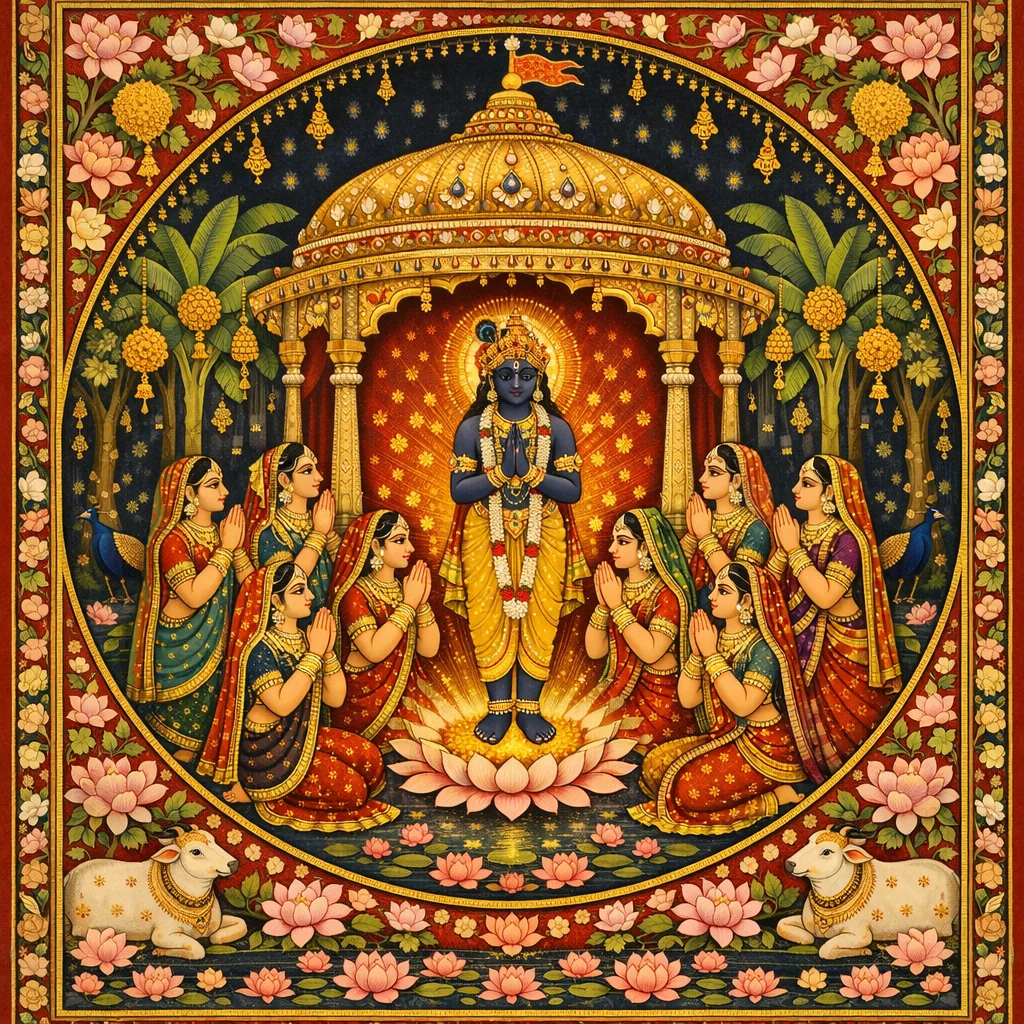
Following Kṛṣṇa’s affectionate dealings with the Vraja-gopīs, the narrative shifts to His interactions with the Kuru-Pāṇḍava world: Kṛṣṇa meets Yudhiṣṭhira and relatives, who glorify Him as the remover of material miseries and the protector of the Vedas through Yoga-māyā. In a parallel domestic-social sphere, the women of the Andhaka and Kaurava clans gather, and Draupadī requests Kṛṣṇa’s principal queens to recount how Acyuta—appearing as a human—married each of them. Rukmiṇī recalls her abduction from Śiśupāla’s party; Satyabhāmā and Jāmbavatī narrate the Syamantaka episode and Jāmbavān’s eventual surrender; Kālindī describes her austerities rewarded by marriage; Mitravindā and Satyā describe svayaṁvara-like contests (including the seven bulls); Bhadrā tells of a family-offered marriage; Lakṣmaṇā gives an extended account of her fish-target svayaṁvara and Kṛṣṇa’s martial protection while departing to Dvārakā. Rohiṇī speaks for the many rescued queens freed from Bhaumāsura’s prison, culminating in their shared aspiration: not sovereignty or siddhi, but the dust of Kṛṣṇa’s lotus feet—an explicit bhakti-rasa conclusion that sets up continued glorification of the Lord’s household pastimes and devotees’ single-pointed desire.
Shlokas
Verse 1
श्रीशुक उवाच तथानुगृह्य भगवान् गोपीनां स गुरुर्गति: । युधिष्ठिरमथापृच्छत् सर्वांश्च सुहृदोऽव्ययम् ॥ १ ॥
Śukadeva Gosvāmī said: Thus Lord Kṛṣṇa, the spiritual master of the gopīs and the very purpose of their life, showed them His mercy. He then met with Yudhiṣṭhira and all His other relatives and inquired from them about their welfare.
Verse 2
त एवं लोकनाथेन परिपृष्टा: सुसत्कृता: । प्रत्यूचुर्हृष्टमनसस्तत्पादेक्षाहतांहस: ॥ २ ॥
Feeling greatly honored, King Yudhiṣṭhira and the others, freed of all sinful reactions by seeing the feet of the Lord of the universe, gladly answered His inquiries.
Verse 3
कुतोऽशिवं त्वच्चरणाम्बुजासवं महन्मनस्तो मुखनि:सृतं क्वचित् । पिबन्ति ये कर्णपुटैरलं प्रभो देहंभृतां देहकृदस्मृतिच्छिदम् ॥ ३ ॥
[Lord Kṛṣṇa’s relatives said:] O master, how can misfortune arise for those who have even once freely drunk the nectar coming from Your lotus feet? This intoxicating liquor pours into the drinking cups of their ears, having flowed from the minds of great devotees through their mouths. It destroys the embodied souls’ forgetfulness of the creator of their bodily existence.
Verse 4
हि त्वात्मधामविधुतात्मकृतत्र्यवस्था- मानन्दसम्प्लवमखण्डमकुण्ठबोधम् । कालोपसृष्टनिगमावन आत्तयोग- मायाकृतिं परमहंसगतिं नता: स्म ॥ ४ ॥
The radiance of Your personal form dispels the threefold effects of material consciousness, and by Your grace we become immersed in total happiness. Your knowledge is indivisible and unrestricted. By Your Yoga-māyā potency You have assumed this human form for protecting the Vedas, which had been threatened by time. We bow down to You, the final destination of perfect saints.
Verse 5
श्रीऋषिरुवाच इत्युत्तम:श्लोकशिखामणिं जने- ष्वभिष्टुवत्स्वन्धककौरवस्त्रिय: । समेत्य गोविन्दकथा मिथोऽगृणं- स्त्रिलोकगीता: शृणु वर्णयामि ते ॥ ५ ॥
The great sage Śukadeva Gosvāmī said: As Yudhiṣṭhira and the others were thus praising Lord Kṛṣṇa, the crest jewel of all sublimely glorified personalities, the women of the Andhaka and Kaurava clans met with one another and began discussing topics about Govinda that are sung throughout the three worlds. Please listen as I relate these to you.
Verse 6
श्रीद्रौपद्युवाच हे वैदर्भ्यच्युतो भद्रे हे जाम्बवति कौशले । हे सत्यभामे कालिन्दि शैब्ये रोहिणि लक्ष्मणे ॥ ६ ॥ हे कृष्णपत्न्य एतन्नो ब्रूते वो भगवान् स्वयम् । उपयेमे यथा लोकमनुकुर्वन् स्वमायया ॥ ७ ॥
Śrī Draupadī said: O Vaidarbhī, Bhadrā and Jāmbavatī, O Kauśalā, Satyabhāmā and Kālindī, O Śaibyā, Rohiṇī, Lakṣmaṇā and other wives of Lord Kṛṣṇa, please tell me how the Supreme Lord Acyuta, imitating the ways of this world by His mystic power, came to marry each of you.
Verse 7
श्रीद्रौपद्युवाच हे वैदर्भ्यच्युतो भद्रे हे जाम्बवति कौशले । हे सत्यभामे कालिन्दि शैब्ये रोहिणि लक्ष्मणे ॥ ६ ॥ हे कृष्णपत्न्य एतन्नो ब्रूते वो भगवान् स्वयम् । उपयेमे यथा लोकमनुकुर्वन् स्वमायया ॥ ७ ॥
Śrī Draupadī said: O Vaidarbhī, Bhadrā and Jāmbavatī, O Kauśalā, Satyabhāmā and Kālindī, O Śaibyā, Rohiṇī, Lakṣmaṇā and other wives of Lord Kṛṣṇa, please tell me how the Supreme Lord Acyuta, imitating the ways of this world by His mystic power, came to marry each of you.
Verse 8
श्रीरुक्मिण्युवाच चैद्याय मार्पयितुमुद्यतकार्मुकेषु राजस्वजेयभटशेखरिताङ्घ्रिरेणु: । निन्ये मृगेन्द्र इव भागमजावियूथात् तच्छ्रीनिकेतचरणोऽस्तु ममार्चनाय ॥ ८ ॥
Śrī Rukmiṇī said: When all the kings held their bows at the ready to assure that I would be presented to Śiśupāla, He who puts the dust of His feet on the heads of invincible warriors took me from their midst, as a lion forcibly takes his prey from the midst of goats and sheep. May I always be allowed to worship those feet of Lord Kṛṣṇa, the abode of Goddess Śrī.
Verse 9
श्रीसत्यभामोवाच यो मे सनाभिवधतप्तहृदा ततेन लिप्ताभिशापमपमार्ष्टुमुपाजहार । जित्वर्क्षराजमथ रत्नमदात् स तेन भीत: पितादिशत मां प्रभवेऽपि दत्ताम् ॥ ९ ॥
Śrī Satyabhāmā said: My father, his heart tormented by his brother’s death, accused Kṛṣṇa of killing him. To remove the stain on His reputation, the Lord defeated the king of the bears and took back the Syamantaka jewel, which He then returned to my father. Fearing the consequences of his offense, my father offered me to the Lord, even though I had already been promised to others.
Verse 10
श्रीजाम्बवत्युवाच प्राज्ञाय देहकृदमुं निजनाथदैवं सीतापतिं त्रिनवहान्यमुनाभ्ययुध्यत् । ज्ञात्वा परीक्षित उपाहरदर्हणं मां पादौ प्रगृह्य मणिनाहममुष्य दासी ॥ १० ॥
Śrī Jāmbavatī said: Unaware that Lord Kṛṣṇa was none other than his own master and worshipable Deity, the husband of Goddess Sītā, my father fought with Him for twenty-seven days. When my father finally came to his senses and recognized the Lord, he took hold of His feet and presented Him with both me and the Syamantaka jewel as tokens of his reverence. I am simply the Lord’s maidservant.
Verse 11
श्रीकालिन्द्युवाच तपश्चरन्तीमाज्ञाय स्वपादस्पर्शनाशया । सख्योपेत्याग्रहीत् पाणिं योऽहं तद्गृहमार्जनी ॥ ११ ॥
Śrī Kālindī said: The Lord knew I was performing severe austerities and penances with the hope of one day touching His lotus feet. So He came to me in the company of His friend and took my hand in marriage. Now I am engaged as a sweeper in His palace.
Verse 12
श्रीमित्रविन्दोवाच यो मां स्वयंवर उपेत्य विजित्य भूपान् निन्ये श्वयूथगमिवात्मबलिं द्विपारि: । भ्रातृंश्च मेऽपकुरुत: स्वपुरं श्रियौक- स्तस्यास्तु मेऽनुभवमङ्घ्रयवनेजनत्वम् ॥ १२ ॥
Śrī Mitravindā said: At my svayaṁvara ceremony He came forward, defeated all the kings present — including my brothers, who dared insult Him — and took me away just as a lion removes his prey from amidst a pack of dogs. Thus Lord Kṛṣṇa, the shelter of the goddess of fortune, brought me to His capital city. May I be allowed to serve Him by washing His feet, life after life.
Verse 13
श्रीसत्योवाच सप्तोक्षणोऽतिबलवीर्यसुतीक्ष्णशृङ्गान् पित्रा कृतान् क्षितिपवीर्यपरीक्षणाय । तान् वीरदुर्मदहनस्तरसा निगृह्य क्रीडन् बबन्ध ह यथा शिशवोऽजतोकान् ॥ १३ ॥ य इत्थं वीर्यशुल्कां मां दासीभिश्चतुरङ्गिणीम् । पथि निर्जित्य राजन्यान् निन्ये तद्दास्यमस्तु मे ॥ १४ ॥
Śrī Satyā said: My father arranged for seven extremely powerful and vigorous bulls with deadly sharp horns to test the prowess of the kings who desired my hand in marriage. Although these bulls destroyed the false pride of many heroes, Lord Kṛṣṇa subdued them effortlessly, tying them up in the same way that children playfully tie up a goat’s kids. He thus purchased me with His valor. Then He took me away with my maidservants and a full army of four divisions, defeating all the kings who opposed Him along the road. May I be granted the privilege of serving that Lord.
Verse 14
श्रीसत्योवाच सप्तोक्षणोऽतिबलवीर्यसुतीक्ष्णशृङ्गान् पित्रा कृतान् क्षितिपवीर्यपरीक्षणाय । तान् वीरदुर्मदहनस्तरसा निगृह्य क्रीडन् बबन्ध ह यथा शिशवोऽजतोकान् ॥ १३ ॥ य इत्थं वीर्यशुल्कां मां दासीभिश्चतुरङ्गिणीम् । पथि निर्जित्य राजन्यान् निन्ये तद्दास्यमस्तु मे ॥ १४ ॥
Śrī Satyā said: My father arranged for seven extremely powerful and vigorous bulls with deadly sharp horns to test the prowess of the kings who desired my hand in marriage. Although these bulls destroyed the false pride of many heroes, Lord Kṛṣṇa subdued them effortlessly, tying them up in the same way that children playfully tie up a goat’s kids. He thus purchased me with His valor. Then He took me away with my maidservants and a full army of four divisions, defeating all the kings who opposed Him along the road. May I be granted the privilege of serving that Lord.
Verse 15
श्रीभद्रोवाच पिता मे मातुलेयाय स्वयमाहूय दत्तवान् । कृष्णे कृष्णाय तच्चित्तामक्षौहिण्या सखीजनै: ॥ १५ ॥ अस्य मे पादसंस्पर्शो भवेज्जन्मनि जन्मनि । कर्मभिर्भ्राम्यमाणाया येन तच्छ्रेय आत्मन: ॥ १६ ॥
Śrī Bhadrā said: My dear Draupadī, of his own free will my father invited his nephew Kṛṣṇa, to whom I had already dedicated my heart, and offered me to Him as His bride. My father presented me to the Lord with an akṣauhiṇi military guard and a retinue of my female companions. My ultimate perfection is this: to always be allowed to touch Lord Kṛṣṇa’s lotus feet as I wander from life to life, bound by my karma.
Verse 16
श्रीभद्रोवाच पिता मे मातुलेयाय स्वयमाहूय दत्तवान् । कृष्णे कृष्णाय तच्चित्तामक्षौहिण्या सखीजनै: ॥ १५ ॥ अस्य मे पादसंस्पर्शो भवेज्जन्मनि जन्मनि । कर्मभिर्भ्राम्यमाणाया येन तच्छ्रेय आत्मन: ॥ १६ ॥
Śrī Bhadrā said: My dear Draupadī, of his own free will my father invited his nephew Kṛṣṇa, to whom I had already dedicated my heart, and offered me to Him as His bride. My father presented me to the Lord with an akṣauhiṇi military guard and a retinue of my female companions. My ultimate perfection is this: to always be allowed to touch Lord Kṛṣṇa’s lotus feet as I wander from life to life, bound by my karma.
Verse 17
श्रीलक्ष्मणोवाच ममापि राज्ञ्यच्युतजन्मकर्म श्रुत्वा मुहुर्नारदगीतमास ह । चित्तं मुकुन्दे किल पद्महस्तया वृत: सुसम्मृश्य विहाय लोकपान् ॥ १७ ॥
Śrī Lakṣmaṇā said: O Queen, I repeatedly heard Nārada Muni glorify the appearances and activities of Acyuta, and thus my heart also became attached to that Lord, Mukunda. Indeed, even Goddess Padmahastā chose Him as her husband after careful consideration, rejecting the great demigods who rule various planets.
Verse 18
ज्ञात्वा मम मतं साध्वि पिता दुहितृवत्सल: । बृहत्सेन इति ख्यातस्तत्रोपायमचीकरत् ॥ १८ ॥
My father, Bṛhatsena, was by nature compassionate to his daughter, and knowing how I felt, O saintly lady, he arranged to fulfill my desire.
Verse 19
यथा स्वयंवरे राज्ञि मत्स्य: पार्थेप्सया कृत: । अयं तु बहिराच्छन्नो दृश्यते स जले परम् ॥ १९ ॥
Just as a fish was used as a target in your svayaṁvara ceremony, O Queen, to assure that you would obtain Arjuna as your husband, so a fish was also used in my ceremony. In my case, however, it was concealed on all sides, and only its reflection could be seen in a pot of water below.
Verse 20
श्रुत्वैतत् सर्वतो भूपा आययुर्मत्पितु: पुरम् । सर्वास्त्रशस्त्रतत्त्वज्ञा: सोपाध्याया: सहस्रश: ॥ २० ॥
Hearing of this, thousands of kings expert in shooting arrows and in wielding other weapons converged from all directions on my father’s city, accompanied by their military teachers.
Verse 21
पित्रा सम्पूजिता: सर्वे यथावीर्यं यथावय: । आददु: सशरं चापं वेद्धुं पर्षदि मद्धिय: ॥ २१ ॥
My father properly honored each king according to his strength and seniority. Then those whose minds were fixed on me took up the bow and arrow and one by one tried to pierce the target in the midst of the assembly.
Verse 22
आदाय व्यसृजन् केचित् सज्यं कर्तुमनीश्वरा: । आकोष्ठं ज्यां समुत्कृष्य पेतुरेकेऽमुना हता: ॥ २२ ॥
Some of them picked up the bow but could not string it, and so they threw it aside in frustration. Some managed to pull the bowstring toward the tip of the bow, only to have the bow spring back and knock them to the ground.
Verse 23
सज्यं कृत्वापरे वीरा मागधाम्बष्ठचेदिपा: । भीमो दुर्योधन: कर्णो नाविदंस्तदवस्थितिम् ॥ २३ ॥
A few heroes — namely Jarāsandha, Śiśupāla, Bhīma, Duryodhana, Karṇa and the King of Ambaṣṭha — succeeded in stringing the bow, but none of them could find the target.
Verse 24
मत्स्याभासं जले वीक्ष्य ज्ञात्वा च तदवस्थितिम् । पार्थो यत्तोऽसृजद् बाणं नाच्छिनत् पस्पृशे परम् ॥ २४ ॥
Then Arjuna looked at the reflection of the fish in the water and determined its position. When he carefully shot his arrow at it, however, he did not pierce the target but merely grazed it.
Verse 25
राजन्येषु निवृत्तेषु भग्नमानेषु मानिषु । भगवान् धनुरादाय सज्यं कृत्वाथ लीलया ॥ २५ ॥ तस्मिन् सन्धाय विशिखं मत्स्यं वीक्ष्य सकृज्जले । छित्त्वेषुणापातयत्तं सूर्ये चाभिजिति स्थिते ॥ २६ ॥
After all the arrogant kings had given up, their pride broken, the Supreme Personality of Godhead picked up the bow, easily strung it and then fixed His arrow upon it. As the sun stood in the constellation Abhijit, He looked at the fish in the water only once and then pierced it with the arrow, knocking it to the ground.
Verse 26
राजन्येषु निवृत्तेषु भग्नमानेषु मानिषु । भगवान् धनुरादाय सज्यं कृत्वाथ लीलया ॥ २५ ॥ तस्मिन् सन्धाय विशिखं मत्स्यं वीक्ष्य सकृज्जले । छित्त्वेषुणापातयत्तं सूर्ये चाभिजिति स्थिते ॥ २६ ॥
After all the arrogant kings had given up, their pride broken, the Supreme Personality of Godhead picked up the bow, easily strung it and then fixed His arrow upon it. As the sun stood in the constellation Abhijit, He looked at the fish in the water only once and then pierced it with the arrow, knocking it to the ground.
Verse 27
दिवि दुन्दुभयो नेदुर्जयशब्दयुता भुवि । देवाश्च कुसुमासारान् मुमुचुर्हर्षविह्वला: ॥ २७ ॥
Kettledrums resounded in the sky, and on the earth people shouted “Jaya! Jaya!” Overjoyed, demigods showered flowers.
Verse 28
तद् रङ्गमाविशमहं कलनूपुराभ्यां पद्भ्यां प्रगृह्य कनकोज्ज्वलरत्नमालाम् । नूत्ने निवीय परिधाय च कौशिकाग्र्ये सव्रीडहासवदना कवरीधृतस्रक् ॥ २८ ॥
Just then I walked onto the ceremonial ground, the ankle bells on my feet gently tinkling. I was wearing new garments of the finest silk, tied with a belt, and I carried a brilliant necklace fashioned of gold and jewels. There was a shy smile on my face and a wreath of flowers in my hair.
Verse 29
उन्नीय वक्त्रमुरुकुन्तलकुण्डलत्विड् गण्डस्थलं शिशिरहासकटाक्षमोक्षै: । राज्ञो निरीक्ष्य परित: शनकैर्मुरारे- रंसेऽनुरक्तहृदया निदधे स्वमालाम् ॥ २९ ॥
I lifted my face, which was encircled by my abundant locks and effulgent from the glow of my earrings reflected from my cheeks. Smiling coolly, I glanced about. Then, looking around at all the kings, I slowly placed the necklace on the shoulder of Murāri, who had captured my heart.
Verse 30
तावन्मृदङ्गपटहा: शङ्खभेर्यानकादय: । निनेदुर्नटनर्तक्यो ननृतुर्गायका जगु: ॥ ३० ॥
Just then there were loud sounds of conchshells and mṛdaṅga, paṭaha, bherī and ānaka drums, as well as other instruments. Men and women began to dance, and singers began to sing.
Verse 31
एवं वृते भगवति मयेशे नृपयूथपा: । न सेहिरे याज्ञसेनि स्पर्धन्तो हृच्छयातुरा: ॥ ३१ ॥
The leading kings there could not tolerate my having chosen the Supreme Personality of Godhead, O Draupadī. Burning with lust, they became quarrelsome.
Verse 32
मां तावद् रथमारोप्य हयरत्नचतुष्टयम् । शार्ङ्गमुद्यम्य सन्नद्धस्तस्थावाजौ चतुर्भुज: ॥ ३२ ॥
The Lord then placed me on His chariot, drawn by four most excellent horses. Donning His armor and readying His bow Śārṅga, He stood on the chariot, and there on the battleground He manifested His four arms.
Verse 33
दारुकश्चोदयामास काञ्चनोपस्करं रथम् । मिषतां भूभुजां राज्ञि मृगाणां मृगराडिव ॥ ३३ ॥
Dāruka drove the Lord’s gold-trimmed chariot as the kings looked on, O Queen, like small animals helplessly watching a lion.
Verse 34
तेऽन्वसज्जन्त राजन्या निषेद्धुं पथि केचन । संयत्ता उद्धृतेष्वासा ग्रामसिंहा यथा हरिम् ॥ ३४ ॥
The kings pursued the Lord like village dogs chasing a lion. Some kings, raising their bows, stationed themselves on the road to stop Him as He passed by.
Verse 35
ते शार्ङ्गच्युतबाणौघै: कृत्तबाह्वङ्घ्रिकन्धरा: । निपेतु: प्रधने केचिदेके सन्त्यज्य दुद्रुवु: ॥ ३५ ॥
These warriors were deluged by arrows shot from the Lord’s bow, Śārṅga. Some of the kings fell on the battlefield with severed arms, legs and necks; the rest gave up the fight and fled.
Verse 36
तत: पुरीं यदुपतिरत्यलङ्कृतां रविच्छदध्वजपटचित्रतोरणाम् । कुशस्थलीं दिवि भुवि चाभिसंस्तुतां समाविशत्तरणिरिव स्वकेतनम् ॥ ३६ ॥
The Lord of the Yadus then entered His capital city, Kuśasthalī [Dvārakā], which is glorified in heaven and on earth. The city was elaborately decorated with flagpoles carrying banners that blocked the sun, and also with splendid archways. As Lord Kṛṣṇa entered, He appeared like the sun-god entering his abode.
Verse 37
पिता मे पूजयामास सुहृत्सम्बन्धिबान्धवान् । महार्हवासोऽलङ्कारै: शय्यासनपरिच्छदै: ॥ ३७ ॥
My father honored his friends, family and in-laws with priceless clothing and jewelry and with royal beds, thrones and other furnishings.
Verse 38
दासीभि: सर्वसम्पद्भिर्भटेभरथवाजिभि: । आयुधानि महार्हाणि ददौ पूर्णस्य भक्तित: ॥ ३८ ॥
With devotion he presented the perfectly complete Lord with a number of maidservants bedecked with precious ornaments. Accompanying these maidservants were guards walking on foot and others riding elephants, chariots and horses. He also gave the Lord extremely valuable weapons.
Verse 39
आत्मारामस्य तस्येमा वयं वै गृहदासिका: । सर्वसङ्गनिवृत्त्याद्धा तपसा च बभूविम ॥ ३९ ॥
Thus, by renouncing all material association and practicing austere penances, we queens have all become personal maidservants of the self-satisfied Supreme Lord.
Verse 40
महिष्य ऊचु: भौमं निहत्य सगणं युधि तेन रुद्धा ज्ञात्वाथ न: क्षितिजये जितराजकन्या: । निर्मुच्य संसृतिविमोक्षमनुस्मरन्ती: पादाम्बुजं परिणिनाय य आप्तकाम: ॥ ४० ॥
Rohiṇī-devi, speaking for the other queens, said: After killing Bhaumāsura and his followers, the Lord found us in the demon’s prison and could understand that we were the daughters of the kings whom Bhauma had defeated during his conquest of the earth. The Lord set us free, and because we had been constantly meditating upon His lotus feet, the source of liberation from material entanglement, He agreed to marry us, though His every desire is already fulfilled.
Verse 41
न वयं साध्वि साम्राज्यं स्वाराज्यं भौज्यमप्युत । वैराज्यं पारमेष्ठ्यं च आनन्त्यं वा हरे: पदम् ॥ ४१ ॥ कामयामह एतस्य श्रीमत्पादरज: श्रिय: । कुचकुङ्कुमगन्धाढ्यं मूर्ध्ना वोढुं गदाभृत: ॥ ४२ ॥
O saintly lady, we do not desire dominion over the earth, the sovereignty of the King of heaven, unlimited facility for enjoyment, mystic power, the position of Lord Brahmā, immortality or even attainment of the kingdom of God. We simply desire to carry on our heads the glorious dust of Lord Kṛṣṇa’s feet, enriched by the fragrance of kuṅkuma from His consort’s bosom.
Verse 42
न वयं साध्वि साम्राज्यं स्वाराज्यं भौज्यमप्युत । वैराज्यं पारमेष्ठ्यं च आनन्त्यं वा हरे: पदम् ॥ ४१ ॥ कामयामह एतस्य श्रीमत्पादरज: श्रिय: । कुचकुङ्कुमगन्धाढ्यं मूर्ध्ना वोढुं गदाभृत: ॥ ४२ ॥
O saintly lady, we do not desire dominion over the earth, the sovereignty of the King of heaven, unlimited facility for enjoyment, mystic power, the position of Lord Brahmā, immortality or even attainment of the kingdom of God. We simply desire to carry on our heads the glorious dust of Lord Kṛṣṇa’s feet, enriched by the fragrance of kuṅkuma from His consort’s bosom.
Verse 43
व्रजस्त्रियो यद् वाञ्छन्ति पुलिन्द्यस्तृणवीरुध: । गावश्चारयतो गोपा: पदस्पर्शं महात्मन: ॥ ४३ ॥
We desire the same contact with the Supreme Lord’s feet that the young women of Vraja, the cowherd boys and even the aborigine Pulinda women desire — the touch of the dust He leaves on the plants and grass as He tends His cows.
Frequently Asked Questions
Her question frames Kṛṣṇa’s royal household līlā as a vehicle for siddhānta: the Lord’s “worldly” marriages, performed through Yoga-māyā, reveal how bhakti transforms social institutions (svayaṁvara, alliances, warfare, rescue) into occasions for surrender. The queens’ testimonies also establish that their ultimate identity is not political status but dāsī-bhāva—aspiring to serve the Lord’s lotus feet.
The chapter explicitly states that Kṛṣṇa assumes a human form by His Yoga-māyā to protect the Vedas and benefit the world, while the queens’ narratives show superhuman mastery (defeating kings, subduing bulls, enduring prolonged combat) alongside intimate domestic devotion. The effect is theological: His nara-līlā is not limitation but a deliberate revelation of the Supreme Person in approachable relational forms.
Rukmiṇī emphasizes divine rescue and exclusive refuge at His feet; Satyabhāmā and Jāmbavatī emphasize the Syamantaka episode and repentance/surrender; Kālindī emphasizes austerity rewarded; Mitravindā and Satyā emphasize svayaṁvara trials and Kṛṣṇa’s protection; Bhadrā emphasizes familial offering aligned with her heart’s dedication; Lakṣmaṇā emphasizes the fish-target contest and Kṛṣṇa’s martial safeguarding; Rohiṇī speaks for the rescued queens, emphasizing liberation through remembrance of His feet.
It expresses the Bhāgavata’s hierarchy of aims: bhakti is independent and superior to bhukti (enjoyment) and mukti (liberation). Their prayer to bear the dust of Kṛṣṇa’s feet—fragrant with kuṅkuma from Śrī—signals prema-centered devotion, where the highest attainment is relational service (sevā) rather than cosmic status or impersonal release.