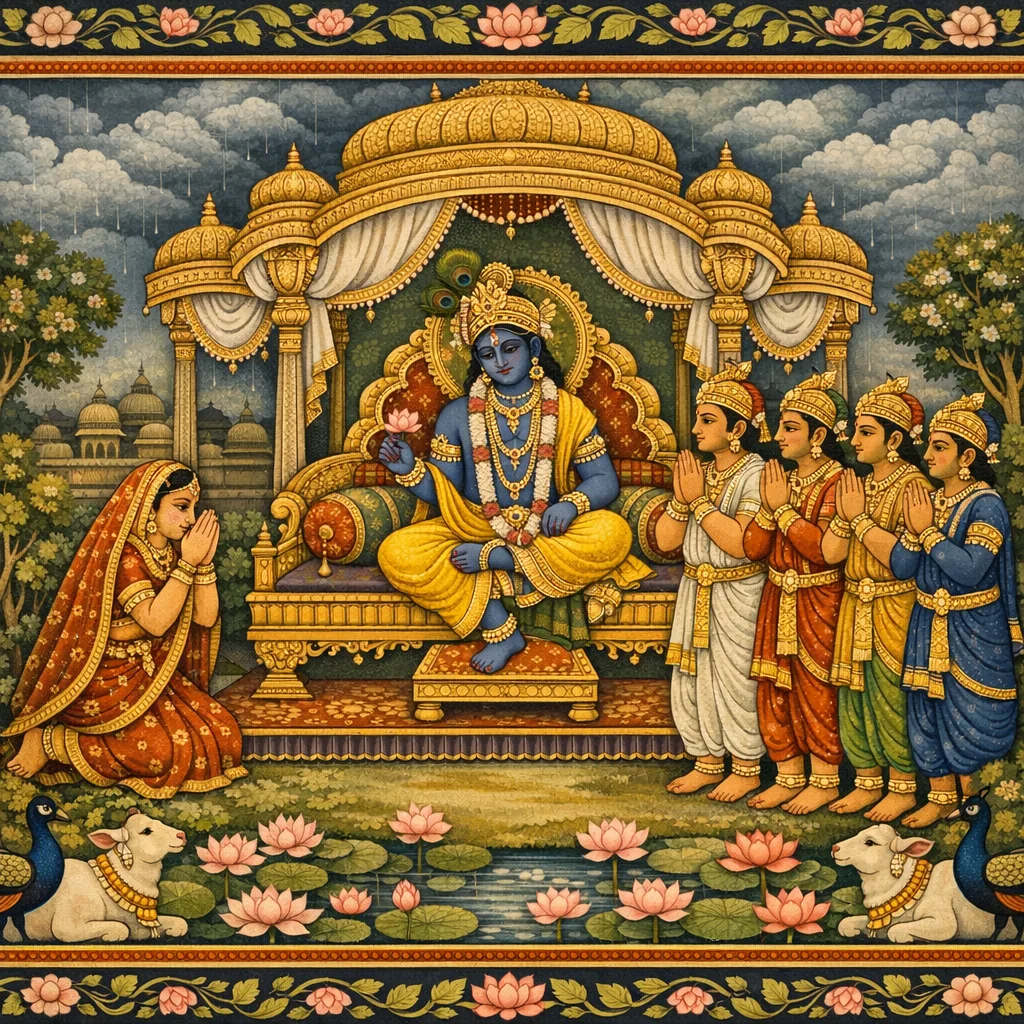
Adhyaya 58
Kṛṣṇa Visits Indraprastha; Kuntī’s Remembrance; Kālindī and Further Marriages
Following Kṛṣṇa’s expanding royal responsibilities in Dvārakā, this chapter shifts to His affectionate diplomacy and kinship with the Pāṇḍavas in Indraprastha. The brothers welcome Mukunda with reverence; Draupadī offers shy obeisances, and Kṛṣṇa consoles and inquires after Kuntī, whose tearful remembrance frames Kṛṣṇa as the devotees’ visible refuge who removes distress when remembered. Yudhiṣṭhira marvels that the rarely attainable Lord is personally present, and Kṛṣṇa stays through the rainy season, delighting the city. The narrative then pivots to Arjuna’s forest outing with Kṛṣṇa, leading to the meeting with Kālindī, who performs austerities to attain Viṣṇu as husband; Kṛṣṇa accepts her and later marries her at an auspicious time. A retrospective bridge recalls the Khāṇḍava episode, Agni’s gifts, and Maya’s hall—linking Indraprastha’s splendor to Kṛṣṇa’s earlier interventions. Returning to Dvārakā, the chapter catalogs additional marriages: Mitravindā’s abduction from rival kings, Satyā (Nāgnajitī) won by subduing seven bulls through divine expansion, and subsequent marriages to Bhadrā, Lakṣmaṇā, and many liberated princesses—setting up the next arc of Kṛṣṇa’s household pastimes and the political ramifications of His alliances.
Shlokas
Verse 1
श्रीशुक उवाच एकदा पाण्डवान् द्रष्टुं प्रतीतान् पुरुषोत्तम: । इन्द्रप्रस्थं गत: श्रीमान् युयुधानादिभिर्वृत: ॥ १ ॥
Śukadeva Gosvāmī said: Once, the supremely opulent Personality of Godhead went to Indraprastha to visit the Pāṇḍavas, who had again appeared in public. Accompanying the Lord were Yuyudhāna and other associates.
Verse 2
दृष्ट्वा तमागतं पार्था मुकुन्दमखिलेश्वरम् । उत्तस्थुर्युगपद् वीरा: प्राणा मुख्यमिवागतम् ॥ २ ॥
When the Pāṇḍavas saw that Lord Mukunda had arrived, those heroic sons of Pṛthā all stood up at once, like the senses responding to the return of the life air.
Verse 3
परिष्वज्याच्युतं वीरा अङ्गसङ्गहतैनस: । सानुरागस्मितं वक्त्रं वीक्ष्य तस्य मुदं ययु: ॥ ३ ॥
The heroes embraced Lord Acyuta, and the touch of His body freed them of sin. Looking at His affectionate, smiling face, they were overwhelmed with joy.
Verse 4
युधिष्ठिरस्य भीमस्य कृत्वा पादाभिवन्दनम् । फाल्गुनं परिरभ्याथ यमाभ्यां चाभिवन्दित: ॥ ४ ॥
After the Lord bowed down at the feet of Yudhiṣṭhira and Bhīma and firmly embraced Arjuna, He accepted obeisances from the twin brothers, Nakula and Sahadeva.
Verse 5
परमासन आसीनं कृष्णा कृष्णमनिन्दिता । नवोढा व्रीडिता किञ्चिच्छनैरेत्याभ्यवन्दत ॥ ५ ॥
Faultless Draupadī, the Pāṇḍavas’ newly married wife, slowly and somewhat timidly approached Lord Kṛṣṇa, who sat on an exalted seat, and offered Him her obeisances.
Verse 6
तथैव सात्यकि: पार्थै: पूजितश्चाभिवन्दित: । निषसादासनेऽन्ये च पूजिता: पर्युपासत ॥ ६ ॥
Sātyaki also accepted a seat of honor after receiving worship and welcome from the Pāṇḍavas, and the Lord’s other companions, being duly honored, sat down in various places.
Verse 7
पृथां समागत्य कृताभिवादन- स्तयातिहार्दार्द्रदृशाभिरम्भित: । आपृष्टवांस्तां कुशलं सहस्नुषां पितृष्वसारं परिपृष्टबान्धव: ॥ ७ ॥
The Lord then went to see His aunt, Queen Kuntī. He bowed down to her and she embraced Him, her eyes moist with great affection. Lord Kṛṣṇa inquired from her and her daughter-in-law, Draupadī, about their welfare, and they in turn questioned Him at length about His relatives [in Dvārakā].
Verse 8
तमाह प्रेमवैक्लव्यरुद्धकण्ठाश्रुलोचना । स्मरन्ती तान् बहून् क्लेशान् क्लेशापायात्मदर्शनम् ॥ ८ ॥
So overcome by love that her throat choked up and her eyes filled with tears, Queen Kuntī remembered the many troubles she and her sons had endured. Thus she addressed Lord Kṛṣṇa, who appears before His devotees to drive away their distress
Verse 9
तदैव कुशलं नोऽभूत् सनाथास्ते कृता वयम् । ज्ञतीन् न: स्मरता कृष्ण भ्राता मे प्रेषितस्त्वया ॥ ९ ॥
[Queen Kuntī said:] My dear Kṛṣṇa, our welfare was assured only when You remembered us, Your relatives, and gave us Your protection by sending my brother to visit us.
Verse 10
न तेऽस्ति स्वपरभ्रान्तिर्विश्वस्य सुहृदात्मन: । तथापि स्मरतां शश्वत् क्लेशान् हंसि हृदि स्थित: ॥ १० ॥
For You, the well-wishing friend and Supreme Soul of the universe, there is never any illusion of “us” and “them.” Yet even so, residing within the hearts of all, You eradicate the sufferings of those who remember You constantly.
Verse 11
युधिष्ठिर उवाच किं न आचरितं श्रेयो न वेदाहमधीश्वर । योगेश्वराणां दुर्दर्शो यन्नो दृष्ट: कुमेधसाम् ॥ ११ ॥
King Yudhiṣṭhira said: O supreme controller, I do not know what pious deeds we fools have done so that we can see You, whom the masters of yogic perfection rarely see.
Verse 12
इति वै वार्षिकान् मासान् राज्ञा सोऽभ्यर्थित: सुखम् । जनयन् नयनानन्दमिन्द्रप्रस्थौकसां विभु: ॥ १२ ॥
Requested by the King to stay with them, the almighty Lord remained happily in Indraprastha during the months of the rainy season, giving joy to the eyes of the city’s residents.
Verse 13
एकदा रथमारुह्य विजयो वानरध्वजम् । गाण्डीवं धनुरादाय तूणौ चाक्षयसायकौ ॥ १३ ॥ साकं कृष्णेन सन्नद्धो विहर्तुं विपिनं महत् । बहुव्यालमृगाकीर्णं प्राविशत् परवीरहा ॥ १४ ॥
Once Arjuna, the slayer of powerful enemies, donned his armor, mounted his chariot flying the flag of Hanumān, took up his bow and his two inexhaustible quivers, and went to sport with Lord Kṛṣṇa in a large forest filled with fierce animals.
Verse 14
एकदा रथमारुह्य विजयो वानरध्वजम् । गाण्डीवं धनुरादाय तूणौ चाक्षयसायकौ ॥ १३ ॥ साकं कृष्णेन सन्नद्धो विहर्तुं विपिनं महत् । बहुव्यालमृगाकीर्णं प्राविशत् परवीरहा ॥ १४ ॥
Once Arjuna, the slayer of powerful enemies, donned his armor, mounted his chariot flying the flag of Hanumān, took up his bow and his two inexhaustible quivers, and went to sport with Lord Kṛṣṇa in a large forest filled with fierce animals.
Verse 15
तत्राविध्यच्छरैर्व्याघ्रान् शूकरान् महिषान् रुरून् । शरभान् गवयान् खड्गान् हरिणान् शशशल्लकान् ॥ १५ ॥
With his arrows Arjuna shot tigers, boars and buffalo in that forest, along with rurus, śarabhas, gavayas, rhinoceroses, black deer, rabbits and porcupines.
Verse 16
तान् निन्यु: किङ्करा राज्ञे मेध्यान् पर्वण्युपागते । तृट्परीत: परिश्रान्तो बिभत्सुर्यमुनामगात् ॥ १६ ॥
A crew of servants carried to King Yudhiṣṭhira the slain animals fit to be offered in sacrifice on some special occasion. Then, feeling thirsty and tired, Arjuna went to the bank of the Yamunā.
Verse 17
तत्रोपस्पृश्य विशदं पीत्वा वारि महारथौ । कृष्णौ ददृशतु: कन्यां चरन्तीं चारुदर्शनाम् ॥ १७ ॥
After the two Kṛṣṇas bathed there, they drank the river’s clear water. The great warriors then saw an attractive young girl walking nearby.
Verse 18
तामासाद्य वरारोहां सुद्विजां रुचिराननाम् । पप्रच्छ प्रेषित: सख्या फाल्गुन: प्रमदोत्तमाम् ॥ १८ ॥
Sent by his friend, Arjuna approached the exceptional young woman, who possessed beautiful hips, fine teeth and a lovely face, and inquired from her as follows.
Verse 19
का त्वं कस्यासि सुश्रोणि कुतो वा किं चिकीर्षसि । मन्ये त्वां पतिमिच्छन्तीं सर्वं कथय शोभने ॥ १९ ॥
[Arjuna said:] Who are you, O fine-waisted lady? Whose daughter are you, and where do you come from? What are you doing here? I think you must be looking for a husband. Please explain everything, O beautiful one.
Verse 20
श्रीकालिन्द्युवाच अहं देवस्य सवितुर्दुहिता पतिमिच्छती । विष्णुं वरेण्यं वरदं तप: परममास्थित: ॥ २० ॥
Śrī Kālindī said: I am the daughter of the sun-god. I desire to get as my husband the most excellent and munificent Lord Viṣṇu, and to that end I am performing severe penances.
Verse 21
नान्यं पतिं वृणे वीर तमृते श्रीनिकेतनम् । तुष्यतां मे स भगवान् मुकुन्दोऽनाथसंश्रय: ॥ २१ ॥
I will accept no husband other than Him, the abode of the goddess of fortune. May that Mukunda, the Supreme Personality, the shelter of the helpless, be pleased with me.
Verse 22
कालिन्दीति समाख्याता वसामि यमुनाजले । निर्मिते भवने पित्रा यावदच्युतदर्शनम् ॥ २२ ॥
I am known as Kālindī, and I live in a mansion my father built for me within the water of the Yamunā. There I will stay until I meet Lord Acyuta.
Verse 23
तथावदद् गुडाकेशो वासुदेवाय सोऽपि ताम् । रथमारोप्य तद् विद्वान् धर्मराजमुपागमत् ॥ २३ ॥
[Śukadeva Gosvāmī continued:] Arjuna repeated all this to Lord Vāsudeva, who was already aware of it. The Lord then took Kālindī onto His chariot and went back to see King Yudhiṣṭhira.
Verse 24
यदैव कृष्ण: सन्दिष्ट: पार्थानां परमाद्भुतम् । कारयामास नगरं विचित्रं विश्वकर्मणा ॥ २४ ॥
[Describing a previous incident, Śukadeva Gosvāmī said:] Upon the request of the Pāṇḍavas, Lord Kṛṣṇa had Viśvakarmā build them a most wonderful and amazing city.
Verse 25
भगवांस्तत्र निवसन् स्वानां प्रियचिकीर्षया । अग्नये खाण्डवं दातुमर्जुनस्यास सारथि: ॥ २५ ॥
The Supreme Lord stayed in that city for some time to please His devotees. On one occasion, Śrī Kṛṣṇa wanted to give the Khāṇḍava forest as a gift to Agni, and so the Lord became Arjuna’s charioteer.
Verse 26
सोऽग्निस्तुष्टो धनुरदाद्धयान् श्वेतान् रथं नृप । अर्जुनायाक्षयौ तूणौ वर्म चाभेद्यमस्त्रिभि: ॥ २६ ॥
Being pleased, O King, Lord Agni presented Arjuna with a bow, a set of white horses, a chariot, a pair of inexhaustible quivers, and armor that no fighter could pierce with weapons.
Verse 27
मयश्च मोचितो वह्ने: सभां सख्य उपाहरत् । यस्मिन् दुर्योधनस्यासीज्जलस्थलदृशिभ्रम: ॥ २७ ॥
When the demon Maya was saved from the fire by his friend Arjuna, Maya presented him with an assembly hall, in which Duryodhana would later mistake water for a solid floor.
Verse 28
स तेन समनुज्ञात: सुहृद्भिश्चानुमोदित: । आययौ द्वारकां भूय: सात्यकिप्रमुखैर्वृत: ॥ २८ ॥
Then Lord Kṛṣṇa, given leave by Arjuna and other well-wishing relatives and friends, returned to Dvārakā with Sātyaki and the rest of His entourage.
Verse 29
अथोपयेमे कालिन्दीं सुपुण्यर्त्वृक्ष ऊर्जिते । वितन्वन् परमानन्दं स्वानां परममङ्गल: ॥ २९ ॥
The supremely auspicious Lord then married Kālindī on a day when the season, the lunar asterism and the configurations of the sun and other heavenly bodies were all propitious. In this way He brought the greatest pleasure to His devotees.
Verse 30
विन्द्यानुविन्द्यावावन्त्यौ दुर्योधनवशानुगौ । स्वयंवरे स्वभगिनीं कृष्णे सक्तां न्यषेधताम् ॥ ३० ॥
Vindya and Anuvindya, who shared the throne of Avantī, were followers of Duryodhana’s. When the time came for their sister [Mitravindā] to select her husband in the svayaṁvara ceremony, they forbade her to choose Kṛṣṇa, although she was attracted to Him.
Verse 31
राजाधिदेव्यास्तनयां मित्रविन्दां पितृष्वसु: । प्रसह्य हृतवान् कृष्णो राजन् राज्ञां प्रपश्यताम् ॥ ३१ ॥
My dear King, Lord Kṛṣṇa forcibly took away Princess Mitravindā, the daughter of His aunt Rājādhidevī, before the eyes of the rival kings.
Verse 32
नग्नजिन्नाम कौशल्य आसीद् राजातिधार्मिक: । तस्य सत्याभवत् कन्या देवी नाग्नजिती नृप ॥ ३२ ॥
O King, Nagnajit, the very pious King of Kośala, had a lovely daughter named Satyā, or Nāgnajitī.
Verse 33
न तां शेकुर्नृपा वोढुमजित्वा सप्त गोवृषान् । तीक्ष्णशृङ्गान् सुदुर्धर्षान् वीर्यगन्धासहान् खलान् ॥ ३३ ॥
The kings who came as suitors were not allowed to marry her unless they could subdue seven sharp-horned bulls. These bulls were extremely vicious and uncontrollable, and they could not tolerate even the smell of warriors.
Verse 34
तां श्रुत्वा वृषजिल्लभ्यां भगवान् सात्वतां पति: । जगाम कौशल्यपुरं सैन्येन महता वृत: ॥ ३४ ॥
When the Supreme Personality of Godhead, the master of the Vaiṣṇavas, heard of the princess who was to be won by the conqueror of the bulls, He went to the capital of Kauśalya with a large army.
Verse 35
स कोशलपति: प्रीत: प्रत्युत्थानासनादिभि: । अर्हणेनापि गुरुणा पूजयन् प्रतिनन्दित: ॥ ३५ ॥
The King of Kośala, pleased to see Lord Kṛṣṇa, worshiped Him by rising from his throne and offering Him a seat of honor and substantial gifts. Lord Kṛṣṇa also greeted the King respectfully.
Verse 36
वरं विलोक्याभिमतं समागतं नरेन्द्रकन्या चकमे रमापतिम् । भूयादयं मे पतिराशिषोऽनल: करोतु सत्या यदि मे धृतो व्रत: ॥ ३६ ॥
When the King’s daughter saw that most agreeable suitor arrive, she immediately desired to have Him, the Lord of Goddess Rāma. She prayed, “May He become my husband. If I have kept my vows, may the sacred fire bring about the fulfillment of my hopes.
Verse 37
यत्पादपङ्कजरज: शिरसा बिभर्ति श्रीरब्जज: सगिरिश: सहलोकपालै: । लीलातनु: स्वकृतसेतुपरीप्सया य: कालेऽदधत्स भगवान् मम केन तुष्येत् ॥ ३७ ॥
“Goddess Lakṣmī, Lord Brahma, Lord Śiva and the rulers of the various planets place the dust of His lotus feet on their heads, and to protect the codes of religion, which He has created, He assumes pastime incarnations at various times. How may that Supreme Personality of Godhead become pleased with me?”
Verse 38
अर्चितं पुनरित्याह नारायण जगत्पते । आत्मानन्देन पूर्णस्य करवाणि किमल्पक: ॥ ३८ ॥
King Nagnajit first worshiped the Lord properly and then addressed Him: “O Nārāyaṇa, Lord of the universe, You are full in Your own spiritual pleasure. Therefore what can this insignificant person do for You?”
Verse 39
श्रीशुक उवाच तमाह भगवान् हृष्ट: कृतासनपरिग्रह: । मेघगम्भीरया वाचा सस्मितं कुरुनन्दन ॥ ३९ ॥
Śukadeva Gosvāmī said: O beloved descendant of Kuru, the Supreme Lord was pleased, and after accepting a comfortable seat He smiled and addressed the King in a voice as deep as the rumbling of a cloud.
Verse 40
श्रीभगवानुवाच नरेन्द्र याच्ञा कविभिर्विगर्हिता राजन्यबन्धोर्निजधर्मवर्तिन: । तथापि याचे तव सौहृदेच्छया कन्यां त्वदीयां न हि शुल्कदा वयम् ॥ ४० ॥
The Supreme Lord said: O ruler of men, learned authorities condemn begging for a person in the royal order who is executing his religious duties. Even so, desiring your friendship, I ask you for your daughter, though We offer no gifts in exchange.
Verse 41
श्रीराजोवाच कोऽन्यस्तेऽभ्यधिको नाथ कन्यावर इहेप्सित: । गुणैकधाम्नो यस्याङ्गे श्रीर्वसत्यनपायिनी ॥ ४१ ॥
The King said: My Lord, who could be a better husband for my daughter than You, the exclusive abode of all transcendental qualities? On Your body the goddess of fortune herself resides, never leaving You for any reason.
Verse 42
किन्त्वस्माभि: कृत: पूर्वं समय: सात्वतर्षभ । पुंसां वीर्यपरीक्षार्थं कन्यावरपरीप्सया ॥ ४२ ॥
But to ascertain the proper husband for my daughter, O chief of the Sātvatas, we previously set a condition to test the prowess of her suitors.
Verse 43
सप्तैते गोवृषा वीर दुर्दान्ता दुरवग्रहा: । एतैर्भग्ना: सुबहवो भिन्नगात्रा नृपात्मजा: ॥ ४३ ॥
These seven wild bulls are impossible to tame, O hero. They have defeated many princes, breaking their limbs.
Verse 44
यदिमे निगृहीता: स्युस्त्वयैव यदुनन्दन । वरो भवानभिमतो दुहितुर्मे श्रिय:पते ॥ ४४ ॥
If You can subdue them, O descendant of Yadu, You will certainly be the appropriate bridegroom for my daughter, O Lord of Śrī.
Verse 45
एवं समयमाकर्ण्य बद्ध्वा परिकरं प्रभु: । आत्मानं सप्तधा कृत्वा न्यगृह्णाल्लीलयैव तान् ॥ ४५ ॥
Upon hearing these terms, the Lord tightened His clothing, expanded Himself into seven forms and easily subdued the bulls.
Verse 46
बद्ध्वा तान् दामभि: शौरिर्भग्नदर्पान् हतौजस: । व्यकर्षल्लीलया बद्धान् बालो दारुमयान् यथा ॥ ४६ ॥
Lord Śauri tied up the bulls, whose pride and strength were now broken, and pulled them with ropes just as a child playfully pulls wooden toy bulls.
Verse 47
तत: प्रीत: सुतां राजा ददौ कृष्णाय विस्मित: । तां प्रत्यगृह्णाद् भगवान् विधिवत् सदृशीं प्रभु: ॥ ४७ ॥
Then King Nagnajit, pleased and astonished, presented his daughter to Lord Kṛṣṇa. The Supreme Personality of Godhead accepted this suitable bride in the proper Vedic fashion.
Verse 48
राजपत्न्यश्च दुहितु: कृष्णं लब्ध्वा प्रियं पतिम् । लेभिरे परमानन्दं जातश्च परमोत्सव: ॥ ४८ ॥
The King’s wives felt the greatest ecstasy upon attaining Lord Kṛṣṇa as the dear husband of the royal princess, and a mood of great festivity arose.
Verse 49
शङ्खभेर्यानका नेदुर्गीतवाद्यद्विजाशिष: । नरा नार्य: प्रमुदिता: सुवास:स्रगलङ्कृता: ॥ ४९ ॥
Conchshells, horns and drums resounded, along with vocal and instrumental music and the sounds of brāhmaṇas, invoking blessings. The joyful men and women adorned themselves with fine clothing and garlands.
Verse 50
दशधेनुसहस्राणि पारिबर्हमदाद् विभु: । युवतीनां त्रिसाहस्रं निष्कग्रीवसुवाससम् ॥ ५० ॥ नवनागसहस्राणि नागाच्छतगुणान् रथान् । रथाच्छतगुणानश्वानश्वाच्छतगुणान् नरान् ॥ ५१ ॥
As the dowry, powerful King Nagnajit gave ten thousand cows, three thousand young maidservants wearing golden ornaments on their necks and bedecked in fine clothing, nine thousand elephants, a hundred times as many chariots as elephants, a hundred times as many horses as chariots, and a hundred times as many manservants as horses.
Verse 51
दशधेनुसहस्राणि पारिबर्हमदाद् विभु: । युवतीनां त्रिसाहस्रं निष्कग्रीवसुवाससम् ॥ ५० ॥ नवनागसहस्राणि नागाच्छतगुणान् रथान् । रथाच्छतगुणानश्वानश्वाच्छतगुणान् नरान् ॥ ५१ ॥
As the dowry, powerful King Nagnajit gave ten thousand cows, three thousand young maidservants wearing golden ornaments on their necks and bedecked in fine clothing, nine thousand elephants, a hundred times as many chariots as elephants, a hundred times as many horses as chariots, and a hundred times as many manservants as horses.
Verse 52
दम्पती रथमारोप्य महत्या सेनया वृतौ । स्नेहप्रक्लिन्नहृदयो यापयामास कोशल: ॥ ५२ ॥
The King of Kośala, his heart melting with affection, had the bride and groom seated on their chariot, and then he sent them on their way surrounded by a great army.
Verse 53
श्रुत्वैतद् रुरुधुर्भूपा नयन्तं पथि कन्यकाम् । भग्नवीर्या: सुदुर्मर्षा यदुभिर्गोवृषै: पुरा ॥ ५३ ॥
When the intolerant kings who had been rival suitors heard what had happened, they tried to stop Lord Kṛṣṇa on the road as He took His bride home. But just as the bulls had broken the kings’ strength before, the Yadu warriors broke it now.
Verse 54
तानस्यत: शरव्रातान् बन्धुप्रियकृदर्जुन: । गाण्डीवी कालयामास सिंह: क्षुद्रमृगानिव ॥ ५४ ॥
Arjuna, wielder of the Gāṇḍīva bow, was always eager to please his friend Kṛṣṇa, and thus he drove back those opponents, who were shooting torrents of arrows at the Lord. He did this just as a lion drives away insignificant animals.
Verse 55
पारिबर्हमुपागृह्य द्वारकामेत्य सत्यया । रेमे यदूनामृषभो भगवान् देवकीसुत: ॥ ५५ ॥
Lord Devakī-suta, the chief of the Yadus, then took His dowry and Satyā to Dvārakā and continued to live there happily.
Verse 56
श्रुतकीर्ते: सुतां भद्रां उपयेमे पितृष्वसु: । कैकेयीं भ्रातृभिर्दत्तां कृष्ण: सन्तर्दनादिभि: ॥ ५६ ॥
Bhadrā was a princess of the Kaikeya kingdom and the daughter of Lord Kṛṣṇa’s paternal aunt Śrutakīrti. The Lord married Bhadrā when her brothers, headed by Santardana, offered her to Him.
Verse 57
सुतां च मद्राधिपतेर्लक्ष्मणां लक्षणैर्युताम् । स्वयंवरे जहारैक: स सुपर्ण: सुधामिव ॥ ५७ ॥
Then the Lord married Lakṣmaṇā, the daughter of the King of Madra. Kṛṣṇa appeared alone at her svayaṁvara ceremony and took her away, just as Garuḍa once stole the demigods’ nectar.
Verse 58
अन्याश्चैवंविधा भार्या: कृष्णस्यासन् सहस्रश: । भौमं हत्वा तन्निरोधादाहृताश्चारुदर्शना: ॥ ५८ ॥
Lord Kṛṣṇa also acquired thousands of other wives equal to these when He killed Bhaumāsura and freed the beautiful maidens the demon was holding captive.
Frequently Asked Questions
Kuntī articulates the Bhāgavata principle of poṣaṇa: the Lord’s protection operates through His grace, invoked by remembrance (smaraṇa) and relationship. Though Kṛṣṇa is the impartial Supersoul of all, the text emphasizes His special responsiveness to devotees who take shelter of Him, making His ‘remembering’ the devotional way of describing His active guardianship and intervention.
The chapter contrasts attainment-by-effort with attainment-by-grace. Yogic perfection may grant vision of the Lord as Paramātmā, but intimate access to Bhagavān’s personal presence is depicted as bhakti-prasāda—bestowed upon devotees bound to Him by loving service and surrender, as exemplified by the Pāṇḍavas’ familial devotion.
Kālindī is described as the daughter of the sun-god who performs severe penances to obtain Lord Viṣṇu/Kṛṣṇa as her husband, residing in a Yamunā-water mansion until meeting Him. Her account highlights the Bhāgavata motif that sincere vow and single-minded desire for Bhagavān culminate in divine acceptance, integrating ascetic aspiration into household dharma through sacred marriage.
The expansion displays aiśvarya (sovereign divinity) while fulfilling a kṣatriya test of prowess without delay or harm. The episode also functions as a theological sign: the Lord is one yet unlimited, capable of manifesting multiple forms to protect dharma and honor social vows, thereby legitimizing the marriage in the eyes of the royal assembly.
Within the epic kṣatriya context, this is framed as a righteous assertion aligned with the bride’s inclination and the Lord’s dharmic purpose, especially when rival parties obstruct a legitimate choice due to political hostility. The narrative emphasizes that Kṛṣṇa’s actions dismantle adharmic opposition while establishing alliances that support devotee welfare and regional stability.