Adhyaya 46
Uddhava Sent to Vraja: Consolation to Nanda-Yaśodā and the Gopīs’ Separation
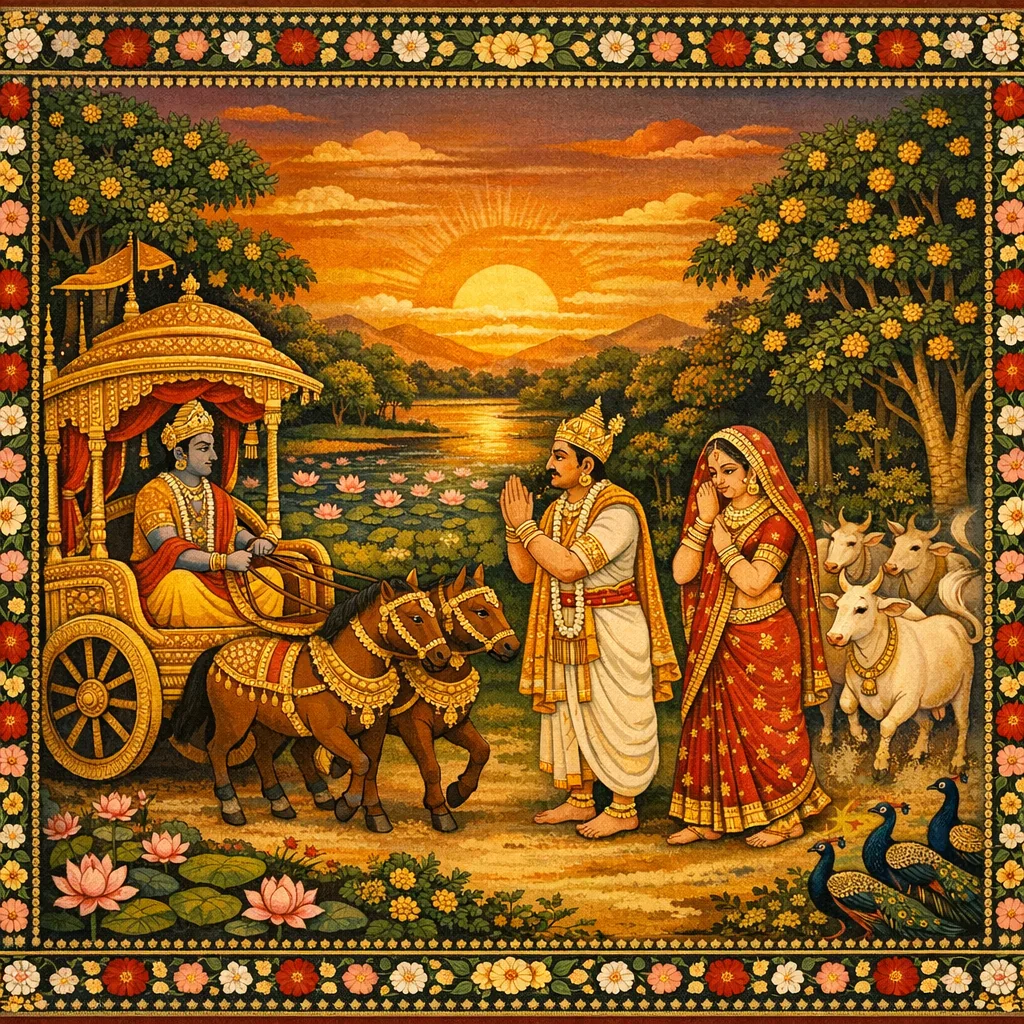
Following Kṛṣṇa’s establishment in Mathurā/Dvārakā affairs, the narrative pivots back to Vraja to reveal the inner cost of His apparent departure. Kṛṣṇa commissions Uddhava—His most intelligent counselor and dear friend—to go to Nanda-gokula, please His parents, and deliver a message meant to sustain the gopīs, whose lives persist only by His promise to return (vv.1–6). Uddhava arrives at sunset, and the text dwells on Gokula’s sensory sacredness—cows, flutes, worship, and the forest-lakes—framing Vraja as a living altar of bhakti (vv.8–13). Welcomed and honored by Nanda, Uddhava hears Nanda’s aching questions: does Kṛṣṇa remember them, Vṛndāvana, Govardhana, and the cows; will He return; how He saved them from calamities; and how His deeds absorb their minds (vv.16–27). Yaśodā’s maternal love overflows physically (v.28). Uddhava replies with siddhānta: Kṛṣṇa-Balarāma as the primeval Supreme, beyond guṇas and birth, yet manifest for līlā and protection; He is impartial yet attentive, the Self of all, and will soon return (vv.30–43). Dawn breaks with Vraja’s women singing while churning butter—devotion embedded in daily life—until villagers see Uddhava’s chariot and suspect Akrūra’s return, setting up the gopīs’ forthcoming confrontation with the messenger (vv.44–49).
Shlokas
Verse 1
श्रीशुक उवाच वृष्णीनां प्रवरो मन्त्री कृष्णस्य दयित: सखा । शिष्यो बृहस्पते: साक्षादुद्धवो बुद्धिसत्तम: ॥ १ ॥
Śukadeva Gosvāmī said: The supremely intelligent Uddhava was the best counselor of the Vṛṣṇi dynasty, a beloved friend of Lord Śrī Kṛṣṇa and a direct disciple of Bṛhaspati.
Verse 2
तमाह भगवान्प्रेष्ठं भक्तमेकान्तिनं क्वचित् । गृहीत्वा पाणिना पाणिं प्रपन्नार्तिहरो हरि: ॥ २ ॥
The Supreme Lord Hari, who relieves the distress of all who surrender to Him, once took the hand of His fully devoted, dearmost friend Uddhava and addressed him as follows.
Verse 3
गच्छोद्धव व्रजं सौम्य पित्रोर्नौ प्रीतिमावह । गोपीनां मद्वियोगाधिं मत्सन्देशैर्विमोचय ॥ ३ ॥
[Lord Kṛṣṇa said:] Dear gentle Uddhava, go to Vraja and give pleasure to Our parents. And also relieve the gopīs, suffering in separation from Me, by giving them My message.
Verse 4
ता मन्मनस्का मत्प्राणा मतर्थे त्यक्तदैहिका: । मामेव दयितं प्रेष्ठमात्मानं मनसा गता: । ये त्यक्तलोकधर्माश्च मदर्थे तान्बिभर्म्यहम् ॥ ४ ॥
The minds of those gopīs are always absorbed in Me, and their very lives are ever devoted to Me. For My sake they have abandoned everything related to their bodies, renouncing ordinary happiness in this life, as well as religious duties necessary for such happiness in the next life. I alone am their dearmost beloved and, indeed, their very Self. I personally sustain such devotees, who for My sake give up all worldly duties.
Verse 5
मयि ता: प्रेयसां प्रेष्ठे दूरस्थे गोकुलस्त्रिय: । स्मरन्त्योऽङ्ग विमुह्यन्ति विरहौत्कण्ठ्यविह्वला: ॥ ५ ॥
My dear Uddhava, for those women of Gokula I am the most cherished object of love. Thus when they remember Me, who am so far away, they are overwhelmed by the anxiety of separation.
Verse 6
धारयन्त्यतिकृच्छ्रेण प्राय: प्राणान् कथञ्चन । प्रत्यागमनसन्देशैर्बल्लव्यो मे मदात्मिका: ॥ ६ ॥
Simply because I have promised to return to them, My fully devoted cowherd girlfriends struggle to maintain their lives somehow or other.
Verse 7
श्रीशुक उवाच इत्युक्त उद्धवो राजन्सन्देशं भर्तुरादृत: । आदाय रथमारुह्य प्रययौ नन्दगोकुलम् ॥ ७ ॥
Śukadeva Gosvāmī said: Thus addressed, O King, Uddhava respectfully accepted his master’s message, mounted his chariot and set off for Nanda-gokula.
Verse 8
प्राप्तो नन्दव्रजं श्रीमान् निम्लोचति विभावसौ । छन्नयान: प्रविशतां पशूनां खुररेणुभि: ॥ ८ ॥
The fortunate Uddhava reached Nanda Mahārāja’s pastures just as the sun was setting, and since the returning cows and other animals were raising dust with their hooves, his chariot passed unnoticed.
Verse 9
वासितार्थेऽभियुध्यद्भिर्नादितं शुश्मिभिर्वृषै: । धावन्तीभिश्च वास्राभिरुधोभारै: स्ववत्सकान् ॥ ९ ॥ इतस्ततो विलङ्घद्भिर्गोवत्सैर्मण्डितं सितै: । गोदोहशब्दाभिरवं वेणूनां नि:स्वनेन च ॥ १० ॥ गायन्तीभिश्च कर्माणि शुभानि बलकृष्णयो: । स्वलङ्कृताभिर्गोपीभिर्गोपैश्च सुविराजितम् ॥ ११ ॥ अग्न्यर्कातिथिगोविप्रपितृदेवार्चनान्वितै: । धूपदीपैश्च माल्यैश्च गोपावासैर्मनोरमम् ॥ १२ ॥ सर्वत: पुष्पितवनं द्विजालिकुलनादितम् । हंसकारण्डवाकीर्णै: पद्मषण्डैश्च मण्डितम् ॥ १३ ॥
Gokula resounded on all sides with the sounds of bulls in rut fighting with one another for fertile cows; with the mooing of cows, burdened by their udders, chasing after their calves; with the noise of milking and of the white calves jumping here and there; with the loud reverberation of flute-playing; and with the singing of the all-auspicious deeds of Kṛṣṇa and Balarāma by the cowherd men and women, who made the village resplendent with their wonderfully ornamented attire. The cowherds’ homes in Gokula appeared most charming with their abundant paraphernalia for worship of the sacrificial fire, the sun, unexpected guests, the cows, the brāhmaṇas, the forefathers and the demigods. On all sides lay the flowering forest, echoing with flocks of birds and swarms of bees and beautified by its lakes crowded with swans, kāraṇḍava ducks and bowers of lotuses.
Verse 10
वासितार्थेऽभियुध्यद्भिर्नादितं शुश्मिभिर्वृषै: । धावन्तीभिश्च वास्राभिरुधोभारै: स्ववत्सकान् ॥ ९ ॥ इतस्ततो विलङ्घद्भिर्गोवत्सैर्मण्डितं सितै: । गोदोहशब्दाभिरवं वेणूनां नि:स्वनेन च ॥ १० ॥ गायन्तीभिश्च कर्माणि शुभानि बलकृष्णयो: । स्वलङ्कृताभिर्गोपीभिर्गोपैश्च सुविराजितम् ॥ ११ ॥ अग्न्यर्कातिथिगोविप्रपितृदेवार्चनान्वितै: । धूपदीपैश्च माल्यैश्च गोपावासैर्मनोरमम् ॥ १२ ॥ सर्वत: पुष्पितवनं द्विजालिकुलनादितम् । हंसकारण्डवाकीर्णै: पद्मषण्डैश्च मण्डितम् ॥ १३ ॥
Gokula resounded on all sides with the sounds of bulls in rut fighting with one another for fertile cows; with the mooing of cows, burdened by their udders, chasing after their calves; with the noise of milking and of the white calves jumping here and there; with the loud reverberation of flute-playing; and with the singing of the all-auspicious deeds of Kṛṣṇa and Balarāma by the cowherd men and women, who made the village resplendent with their wonderfully ornamented attire. The cowherds’ homes in Gokula appeared most charming with their abundant paraphernalia for worship of the sacrificial fire, the sun, unexpected guests, the cows, the brāhmaṇas, the forefathers and the demigods. On all sides lay the flowering forest, echoing with flocks of birds and swarms of bees and beautified by its lakes crowded with swans, kāraṇḍava ducks and bowers of lotuses.
Verse 11
वासितार्थेऽभियुध्यद्भिर्नादितं शुश्मिभिर्वृषै: । धावन्तीभिश्च वास्राभिरुधोभारै: स्ववत्सकान् ॥ ९ ॥ इतस्ततो विलङ्घद्भिर्गोवत्सैर्मण्डितं सितै: । गोदोहशब्दाभिरवं वेणूनां नि:स्वनेन च ॥ १० ॥ गायन्तीभिश्च कर्माणि शुभानि बलकृष्णयो: । स्वलङ्कृताभिर्गोपीभिर्गोपैश्च सुविराजितम् ॥ ११ ॥ अग्न्यर्कातिथिगोविप्रपितृदेवार्चनान्वितै: । धूपदीपैश्च माल्यैश्च गोपावासैर्मनोरमम् ॥ १२ ॥ सर्वत: पुष्पितवनं द्विजालिकुलनादितम् । हंसकारण्डवाकीर्णै: पद्मषण्डैश्च मण्डितम् ॥ १३ ॥
Gokula resounded on all sides with the sounds of bulls in rut fighting with one another for fertile cows; with the mooing of cows, burdened by their udders, chasing after their calves; with the noise of milking and of the white calves jumping here and there; with the loud reverberation of flute-playing; and with the singing of the all-auspicious deeds of Kṛṣṇa and Balarāma by the cowherd men and women, who made the village resplendent with their wonderfully ornamented attire. The cowherds’ homes in Gokula appeared most charming with their abundant paraphernalia for worship of the sacrificial fire, the sun, unexpected guests, the cows, the brāhmaṇas, the forefathers and the demigods. On all sides lay the flowering forest, echoing with flocks of birds and swarms of bees and beautified by its lakes crowded with swans, kāraṇḍava ducks and bowers of lotuses.
Verse 12
वासितार्थेऽभियुध्यद्भिर्नादितं शुश्मिभिर्वृषै: । धावन्तीभिश्च वास्राभिरुधोभारै: स्ववत्सकान् ॥ ९ ॥ इतस्ततो विलङ्घद्भिर्गोवत्सैर्मण्डितं सितै: । गोदोहशब्दाभिरवं वेणूनां नि:स्वनेन च ॥ १० ॥ गायन्तीभिश्च कर्माणि शुभानि बलकृष्णयो: । स्वलङ्कृताभिर्गोपीभिर्गोपैश्च सुविराजितम् ॥ ११ ॥ अग्न्यर्कातिथिगोविप्रपितृदेवार्चनान्वितै: । धूपदीपैश्च माल्यैश्च गोपावासैर्मनोरमम् ॥ १२ ॥ सर्वत: पुष्पितवनं द्विजालिकुलनादितम् । हंसकारण्डवाकीर्णै: पद्मषण्डैश्च मण्डितम् ॥ १३ ॥
Gokula resounded on all sides with the sounds of bulls in rut fighting with one another for fertile cows; with the mooing of cows, burdened by their udders, chasing after their calves; with the noise of milking and of the white calves jumping here and there; with the loud reverberation of flute-playing; and with the singing of the all-auspicious deeds of Kṛṣṇa and Balarāma by the cowherd men and women, who made the village resplendent with their wonderfully ornamented attire. The cowherds’ homes in Gokula appeared most charming with their abundant paraphernalia for worship of the sacrificial fire, the sun, unexpected guests, the cows, the brāhmaṇas, the forefathers and the demigods. On all sides lay the flowering forest, echoing with flocks of birds and swarms of bees and beautified by its lakes crowded with swans, kāraṇḍava ducks and bowers of lotuses.
Verse 13
वासितार्थेऽभियुध्यद्भिर्नादितं शुश्मिभिर्वृषै: । धावन्तीभिश्च वास्राभिरुधोभारै: स्ववत्सकान् ॥ ९ ॥ इतस्ततो विलङ्घद्भिर्गोवत्सैर्मण्डितं सितै: । गोदोहशब्दाभिरवं वेणूनां नि:स्वनेन च ॥ १० ॥ गायन्तीभिश्च कर्माणि शुभानि बलकृष्णयो: । स्वलङ्कृताभिर्गोपीभिर्गोपैश्च सुविराजितम् ॥ ११ ॥ अग्न्यर्कातिथिगोविप्रपितृदेवार्चनान्वितै: । धूपदीपैश्च माल्यैश्च गोपावासैर्मनोरमम् ॥ १२ ॥ सर्वत: पुष्पितवनं द्विजालिकुलनादितम् । हंसकारण्डवाकीर्णै: पद्मषण्डैश्च मण्डितम् ॥ १३ ॥
Gokula resounded on all sides with the sounds of bulls in rut fighting with one another for fertile cows; with the mooing of cows, burdened by their udders, chasing after their calves; with the noise of milking and of the white calves jumping here and there; with the loud reverberation of flute-playing; and with the singing of the all-auspicious deeds of Kṛṣṇa and Balarāma by the cowherd men and women, who made the village resplendent with their wonderfully ornamented attire. The cowherds’ homes in Gokula appeared most charming with their abundant paraphernalia for worship of the sacrificial fire, the sun, unexpected guests, the cows, the brāhmaṇas, the forefathers and the demigods. On all sides lay the flowering forest, echoing with flocks of birds and swarms of bees and beautified by its lakes crowded with swans, kāraṇḍava ducks and bowers of lotuses.
Verse 14
तमागतं समागम्य कृष्णस्यानुचरं प्रियम् । नन्द: प्रीत: परिष्वज्य वासुदेवधियार्चयत् ॥ १४ ॥
As soon as Uddhava arrived at Nanda Mahārāja’s home, Nanda came forward to meet him. The cowherd King embraced him in great happiness and worshiped him as nondifferent from Lord Vāsudeva.
Verse 15
भोजितं परमान्नेन संविष्टं कशिपौ सुखम् । गतश्रमं पर्यपृच्छत् पादसंवाहनादिभि: ॥ १५ ॥
After Uddhava had eaten first-class food, been seated comfortably on a bed and been relieved of his fatigue by a foot massage and other means, Nanda inquired from him as follows.
Verse 16
कच्चिदङ्ग महाभाग सखा न: शूरनन्दन: । आस्ते कुशल्यपत्याद्यैर्युक्तो मुक्त: सुहृद्व्रत: ॥ १६ ॥
[Nanda Mahārāja said:] My dear most fortunate one, does the son of Śūra fare well, now that he is free and has rejoined his children and other relatives?
Verse 17
दिष्ट्या कंसो हत: पाप: सानुग: स्वेन पाप्मना । साधूनां धर्मशीलानां यदूनां द्वेष्टि य: सदा ॥ १७ ॥
Fortunately, because of his own sins, the sinful Kaṁsa has been killed, along with all his brothers. He always hated the saintly and righteous Yadus.
Verse 18
अपि स्मरति न: कृष्णो मातरं सुहृद: सखीन् । गोपान् व्रजं चात्मनाथं गावो वृन्दावनं गिरिम् ॥ १८ ॥
Does Kṛṣṇa remember us? Does He remember His mother and His friends and well-wishers? Does He remember the cowherds and their village of Vraja, of which He is the master? Does He remember the cows, Vṛndāvana forest and Govardhana Hill?
Verse 19
अप्यायास्यति गोविन्द: स्वजनान्सकृदीक्षितुम् । तर्हि द्रक्ष्याम तद्वक्त्रं सुनसं सुस्मितेक्षणम् ॥ १९ ॥
Will Govinda return even once to see His family? If He ever does, we may then glance upon His beautiful face, with its beautiful eyes, nose and smile.
Verse 20
दावाग्नेर्वातवर्षाच्च वृषसर्पाच्च रक्षिता: । दुरत्ययेभ्यो मृत्युभ्य: कृष्णेन सुमहात्मना ॥ २० ॥
We were saved from the forest fire, the wind and rain, the bull and serpent demons — from all such insurmountable, deadly dangers — by that very great soul, Kṛṣṇa.
Verse 21
स्मरतां कृष्णवीर्याणि लीलापाङ्गनिरीक्षितम् । हसितं भाषितं चाङ्ग सर्वा न: शिथिला: क्रिया: ॥ २१ ॥
As we remember the wonderful deeds Kṛṣṇa performed, His playful sidelong glances, His smiles and His words, O Uddhava, we forget all our material engagements.
Verse 22
सरिच्छैलवनोद्देशान् मुकुन्दपदभूषितान् । आक्रीडानीक्ष्यमाणानां मनो याति तदात्मताम् ॥ २२ ॥
When we see the places where Mukunda enjoyed His sporting pastimes — the rivers, hills and forests He decorated with His feet — our minds become totally absorbed in Him.
Verse 23
मन्ये कृष्णं च रामं च प्राप्ताविह सुरोत्तमौ । सुराणां महदर्थाय गर्गस्य वचनं यथा ॥ २३ ॥
In my opinion, Kṛṣṇa and Balarāma must be two exalted demigods who have come to this planet to fulfill some great mission of the demigods. Such was foretold by Garga Ṛṣi.
Verse 24
कंसं नागायुतप्राणं मल्लौ गजपतिं यथा । अवधिष्टां लीलयैव पशूनिव मृगाधिप: ॥ २४ ॥
After all, Kṛṣṇa and Balarāma killed Kaṁsa, who was as strong as ten thousand elephants, as well as the wrestlers Cāṇūra and Muṣṭika and the elephant Kuvalayāpīḍa. They killed them all sportingly, as easily as a lion disposes of small animals.
Verse 25
तालत्रयं महासारं धनुर्यष्टिमिवेभराट् । बभञ्जैकेन हस्तेन सप्ताहमदधाद् गिरिम् ॥ २५ ॥
With the ease of a royal elephant breaking a stick, Kṛṣṇa broke a powerful, giant bow three tālas long. He also held a mountain aloft for seven days with just one hand.
Verse 26
प्रलम्बो धेनुकोऽरिष्टस्तृणावर्तो बकादय: । दैत्या: सुरासुरजितो हता येनेह लीलया ॥ २६ ॥
Here in Vṛndāvana, Kṛṣṇa and Balarāma easily destroyed demons like Pralamba, Dhenuka, Arista, Tṛṇāvarta and Baka, who had themselves defeated both demigods and other demons.
Verse 27
श्रीशुक उवाच इति संस्मृत्य संस्मृत्य नन्द: कृष्णानुरक्तधी: । अत्युत्कण्ठोऽभवत्तूष्णीं प्रेमप्रसरविह्वल: ॥ २७ ॥
Śukadeva Gosvāmī said: Thus intensely remembering Kṛṣṇa again and again, Nanda Mahārāja, his mind completely attached to the Lord, felt extreme anxiety and fell silent, overcome by the strength of his love.
Verse 28
यशोदा वर्ण्यमानानि पुत्रस्य चरितानि च । शृण्वन्त्यश्रूण्यवास्राक्षीत् स्नेहस्नुतपयोधरा ॥ २८ ॥
As mother Yaśodā heard the descriptions of her son’s activities, she poured out her tears, and milk flowed from her breasts out of love.
Verse 29
तयोरित्थं भगवति कृष्णे नन्दयशोदयो: । वीक्ष्यानुरागं परमं नन्दमाहोद्धवो मुदा ॥ २९ ॥
Uddhava then joyfully addressed Nanda Mahārāja, having clearly seen the supreme loving attraction he and Yaśodā felt for Kṛṣṇa, the Supreme Personality of Godhead .
Verse 30
श्रीउद्धव उवाच युवां श्लाघ्यतमौ नूनं देहिनामिह मानद । नारायणेऽखिलगुरौ यत्कृता मतिरीदृशी ॥ ३० ॥
Śrī Uddhava said: O respectful Nanda, certainly you and mother Yaśodā are the most praiseworthy persons in the entire world, since you have developed such a loving attitude toward Lord Nārāyaṇa, the spiritual master of all living beings.
Verse 31
एतौ हि विश्वस्य च बीजयोनी रामो मुकुन्द: पुरुष: प्रधानम् । अन्वीय भूतेषु विलक्षणस्य ज्ञानस्य चेशात इमौ पुराणौ ॥ ३१ ॥
These two Lords, Mukunda and Balarāma, are each the seed and womb of the universe, the creator and His creative potency. They enter the hearts of living beings and control their conditioned awareness. They are the primeval Supreme.
Verse 32
यस्मिन् जन: प्राणवियोगकाले क्षणं समावेश्य मनोऽविशुद्धम् । निर्हृत्य कर्माशयमाशु याति परां गतिं ब्रह्ममयोऽर्कवर्ण: ॥ ३२ ॥ तस्मिन् भवन्तावखिलात्महेतौ नारायणे कारणमर्त्यमूर्तौ । भावं विधत्तां नितरां महात्मन् किं वावशिष्टं युवयो: सुकृत्यम् ॥ ३३ ॥
Anyone, even a person in an impure state, who absorbs his mind in Him for just a moment at the time of death burns up all traces of sinful reactions and immediately attains the supreme transcendental destination in a pure, spiritual form as effulgent as the sun. You two have rendered exceptional loving service to Him, Lord Nārāyaṇa, the Supersoul of all and the cause of all existence, the great soul who, although the original cause of everything, has a humanlike form. What pious deeds could still be required of you?
Verse 33
यस्मिन् जन: प्राणवियोगकाले क्षणं समावेश्य मनोऽविशुद्धम् । निर्हृत्य कर्माशयमाशु याति परां गतिं ब्रह्ममयोऽर्कवर्ण: ॥ ३२ ॥ तस्मिन् भवन्तावखिलात्महेतौ नारायणे कारणमर्त्यमूर्तौ । भावं विधत्तां नितरां महात्मन् किं वावशिष्टं युवयो: सुकृत्यम् ॥ ३३ ॥
Anyone, even a person in an impure state, who absorbs his mind in Him for just a moment at the time of death burns up all traces of sinful reactions and immediately attains the supreme transcendental destination in a pure, spiritual form as effulgent as the sun. You two have rendered exceptional loving service to Him, Lord Nārāyaṇa, the Supersoul of all and the cause of all existence, the great soul who, although the original cause of everything, has a humanlike form. What pious deeds could still be required of you?
Verse 34
आगमिष्यत्यदीर्घेण कालेन व्रजमच्युत: । प्रियं विधास्यते पित्रोर्भगवान् सात्वतां पति: ॥ ३४ ॥
Infallible Kṛṣṇa, the Lord of the devotees, will soon return to Vraja to satisfy His parents.
Verse 35
हत्वा कंसं रङ्गमध्ये प्रतीपं सर्वसात्वताम् । यदाह व: समागत्य कृष्ण: सत्यं करोति तत् ॥ ३५ ॥
Having killed Kaṁsa, the enemy of all the Yadus, in the wrestling arena, Kṛṣṇa will now surely fulfill His promise to you by coming back.
Verse 36
मा खिद्यतं महाभागौ द्रक्ष्यथ: कृष्णमन्तिके । अन्तर्हृदि स भूतानामास्ते ज्योतिरिवैधसि ॥ ३६ ॥
O most fortunate ones, do not lament. You will see Kṛṣṇa again very soon. He is present in the hearts of all living beings, just as fire lies dormant in wood.
Verse 37
न ह्यस्यास्ति प्रिय: कश्चिन्नाप्रियो वास्त्यमानिन: । नोत्तमो नाधमो वापि समानस्यासमोऽपि वा ॥ ३७ ॥
For Him no one is especially dear or despicable, superior or inferior, and yet He is not indifferent to anyone. He is free from all desire for respect and yet gives respect to all others.
Verse 38
न माता न पिता तस्य न भार्या न सुतादय: । नात्मीयो न परश्चापि न देहो जन्म एव च ॥ ३८ ॥
He has no mother, no father, no wife, children or other relatives. No one is related to Him, and yet no one is a stranger to Him. He has no material body and no birth.
Verse 39
न चास्य कर्म वा लोके सदसन्मिश्रयोनिषु । क्रीडार्थं सोऽपि साधूनां परित्राणाय कल्पते ॥ ३९ ॥
He has no work to do in this world that would oblige Him to take birth in pure, impure or mixed species of life. Yet to enjoy His pastimes and deliver His saintly devotees, He manifests Himself.
Verse 40
सत्त्वं रजस्तम इति भजते निर्गुणो गुणान् । क्रीडन्नतीतोऽपि गुणै: सृजत्यवति हन्त्यज: ॥ ४० ॥
Although beyond the three modes of material nature — goodness, passion and ignorance — the transcendental Lord accepts association with them as His play. Thus the unborn Supreme Lord utilizes the material modes to create, maintain and destroy.
Verse 41
यथा भ्रमरिकादृष्ट्या भ्राम्यतीव महीयते । चित्ते कर्तरि तत्रात्मा कर्तेवाहंधिया स्मृत: ॥ ४१ ॥
Just as a person who is whirling around perceives the ground to be turning, one who is affected by false ego thinks himself the doer, when actually only his mind is acting.
Verse 42
युवयोरेव नैवायमात्मजो भगवान् हरि: । सर्वेषामात्मजो ह्यात्मा पिता माता स ईश्वर: ॥ ४२ ॥
The Supreme Lord Hari is certainly not your son alone. Rather, being the Lord, He is the son, Soul, father and mother of everyone.
Verse 43
दृष्टं श्रुतं भूतभवद् भविष्यत् स्थास्नुश्चरिष्णुर्महदल्पकं च । विनाच्युताद् वस्तु तरां न वाच्यं स एव सर्वं परमात्मभूत: ॥ ४३ ॥
Nothing can be said to exist independent of Lord Acyuta — nothing heard or seen, nothing in the past, present or future, nothing moving or unmoving, great or small. He indeed is everything, for He is the Supreme Soul.
Verse 44
एवं निशा सा ब्रुवतोर्व्यतीता नन्दस्य कृष्णानुचरस्य राजन् । गोप्य: समुत्थाय निरूप्य दीपान् वास्तून् समभ्यर्च्य दधीन्यमन्थन् ॥ ४४ ॥
While Kṛṣṇa’s messenger continued speaking with Nanda, the night ended, O King. The women of the cowherd village rose from bed and, lighting lamps, worshiped their household deities. Then they began churning the yogurt into butter.
Verse 45
ता दीपदीप्तैर्मणिभिर्विरेजू रज्जूर्विकर्षद्भुजकङ्कणस्रज: । चलन्नितम्बस्तनहारकुण्डल- त्विषत्कपोलारुणकुङ्कुमानना: ॥ ४५ ॥
As they pulled on the churning ropes with their bangled arms, the women of Vraja shone with the splendor of their jewels, which reflected the lamps’ light. Their hips, breasts and necklaces moved about, and their faces, anointed with reddish kuṅkuma, glowed radiantly with the luster of their earrings reflecting from their cheeks.
Verse 46
उद्गायतीनामरविन्दलोचनं व्रजाङ्गनानां दिवमस्पृशद् ध्वनि: । दध्नश्च निर्मन्थनशब्दमिश्रितो निरस्यते येन दिशाममङ्गलम् ॥ ४६ ॥
As the ladies of Vraja loudly sang the glories of lotus-eyed Kṛṣṇa, their songs blended with the sound of their churning, ascended to the sky and dissipated all inauspiciousness in every direction.
Verse 47
भगवत्युदिते सूर्ये नन्दद्वारि व्रजौकस: । दृष्ट्वा रथं शातकौम्भं कस्यायमिति चाब्रुवन् ॥ ४७ ॥
When the godly sun had risen, the people of Vraja noticed the golden chariot in front of Nanda Mahārāja’s doorway. “Who does this belong to?” they asked.
Verse 48
अक्रूर आगत: किं वा य: कंसस्यार्थसाधक: । येन नीतो मधुपुरीं कृष्ण: कमललोचन: ॥ ४८ ॥
“Perhaps Akrūra has returned — he who fulfilled Kaṁsa’s desire by taking lotus-eyed Kṛṣṇa to Mathurā.
Verse 49
किं साधयिष्यत्यस्माभिर्भर्तु: प्रीतस्य निष्कृतिम् । तत: स्त्रीणां वदन्तीनामुद्धवोऽगात् कृताह्निक: ॥ ४९ ॥
“Is he going to use our flesh to offer funeral oblations for his master, who was so satisfied with his service?” As the women were speaking in this way, Uddhava appeared, having finished his early-morning duties.
Frequently Asked Questions
Kṛṣṇa sends Uddhava to nourish and stabilize Vraja-bhakti in separation: to honor Nanda-Yaśodā, and to sustain the gopīs whose lives depend on remembrance and His promise to return. The chapter shows that divine “absence” intensifies exclusive surrender, and that the Lord protects devotees not only by physical rescue but by preserving their inner life through message and remembrance (smaraṇa).
Kṛṣṇa states the gopīs have abandoned everything—bodily concerns, worldly happiness, and even duties aimed at future reward—because their minds and lives are absorbed in Him (vv.4–6). Theologically, this depicts ananyā-bhakti (exclusive devotion), where Kṛṣṇa becomes their very Self (ātman), illustrating the Bhagavata’s ideal of bhakti surpassing ritual merit as the direct path to the Supreme Shelter.
Uddhava is Kṛṣṇa’s beloved friend and the Vṛṣṇis’ foremost counselor, described as supremely intelligent and a direct disciple of Bṛhaspati (v.1). His qualification combines intimacy (sakhya) with scriptural discernment (jñāna), enabling him to convey both consolation and siddhānta—yet his encounter with Vraja will also reveal the limits of intellectual excellence before pure prema.
Nanda’s questions externalize Vraja’s theology of relationship: Kṛṣṇa is not approached primarily as cosmic ruler but as beloved child and protector. His remembrance becomes the measure of reality for the devotees. The repeated recollection of Kṛṣṇa’s rescues and playful glances shows smaraṇa transforming ordinary life into continuous worship and demonstrates poṣaṇa as emotional and existential protection.
Uddhava presents Kṛṣṇa as unborn, beyond the guṇas, without material kinship or obligation, yet voluntarily manifesting for līlā and to deliver devotees (vv.37–40). He states Kṛṣṇa is the Self of all and nothing exists independent of Him (vv.42–43). This preserves both truths: Kṛṣṇa is the Absolute (tattva) and the intimate beloved (rasa), with His humanlike form serving compassion and play rather than limitation.
The butter-churning scene (vv.44–46) depicts bhakti embedded in daily rhythms: domestic work becomes kīrtana, and sound (nāma/glorification) is portrayed as purifying the directions. Literarily, it transitions from Nanda’s private grief to the collective mood of Vraja’s women, preparing the next episode where the gopīs respond to the messenger and intensify the theology of separation.