Adhyaya 39
Akrūra’s Mission: The Departure from Vraja and the Yamunā Vision of Viṣṇu-Ananta
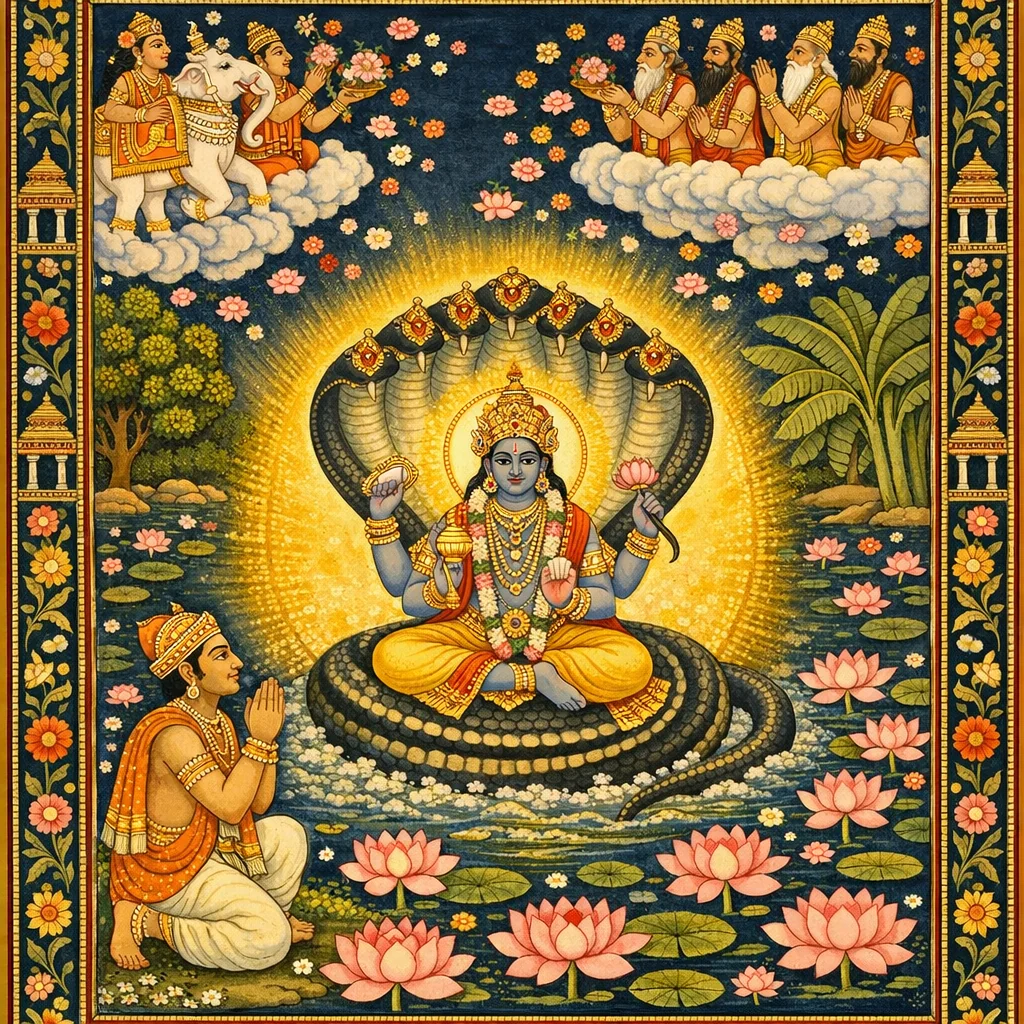
Continuing from the prior movement toward Mathurā under Kaṁsa’s summons, this chapter begins with Akrūra being warmly honored by Kṛṣṇa and Balarāma and then questioned about Kaṁsa’s intentions and the condition of their relatives. Akrūra reports Kaṁsa’s hostility toward the Yadus and his murderous designs, confirming Nārada’s disclosure that Kṛṣṇa is Devakī’s son. Nanda arranges a caravan of Vraja offerings for the Mathurā festival, but the emotional axis shifts to the gopīs’ intense vipralambha (anticipated separation): they lament fate, criticize Akrūra’s ‘cruelty,’ recall rāsa and Kṛṣṇa’s daily return from the forest, and finally cry out the names Govinda, Dāmodara, Mādhava. As the chariot departs at sunrise, Kṛṣṇa consoles them with glances and a promise conveyed by messenger—“I will return.” En route the party reaches the Yamunā (Kālindī), where Akrūra bathes and receives a revelatory darśana: Ananta Śeṣa and the four-armed Supreme Lord worshiped by devas, sages, and divine potencies. Overwhelmed with bhakti, Akrūra begins his prayers, setting up the next chapter’s stuti and the onward journey to Mathurā’s decisive confrontation.
Shlokas
Verse 1
श्रीशुक उवाच सुखोपविष्ट: पर्यङ्के रामकृष्णोरुमानित: । लेभे मनोरथान्सर्वान्पथि यन् स चकार ह ॥ १ ॥
Śukadeva Gosvāmī said: Having been honored so much by Lord Balarāma and Lord Kṛṣṇa, Akrūra, seated comfortably on a couch, felt that all the desires he had contemplated on the road were now fulfilled.
Verse 2
किमलभ्यं भगवति प्रसन्ने श्रीनिकेतने । तथापि तत्परा राजन्न हि वाञ्छन्ति किञ्चन ॥ २ ॥
My dear King, what is unattainable for one who has satisfied the Supreme Personality of Godhead, the shelter of the goddess of fortune? Even so, those who are dedicated to His devotional service never want anything from Him.
Verse 3
सायन्तनाशनं कृत्वा भगवान् देवकीसुत: । सुहृत्सु वृत्तं कंसस्य पप्रच्छान्यच्चिकीर्षितम् ॥ ३ ॥
After the evening meal, Lord Kṛṣṇa, the son of Devakī, asked Akrūra how Kaṁsa was treating their dear relatives and friends and what the King was planning to do.
Verse 4
श्रीभगवानुवाच तात सौम्यागत: कच्च्त्स्विगतं भद्रमस्तु व: । अपि स्वज्ञातिबन्धूनामनमीवमनामयम् ॥ ४ ॥
The Supreme Lord said: My dear, gentle Uncle Akrūra, was your trip here comfortable? May all good fortune be yours. Are our well-wishing friends and our relatives, both close and distant, happy and in good health?
Verse 5
किं नु न: कुशलं पृच्छे एधमाने कुलामये । कंसे मातुलनाम्नाङ्ग स्वानां नस्तत्प्रजासु च ॥ ५ ॥
But, my dear Akrūra, as long as King Kaṁsa — that disease of our family who goes by the name “maternal uncle” — is still prospering, why should I even bother to ask about the well-being of our family members and his other subjects?
Verse 6
अहो अस्मदभूद् भूरि पित्रोर्वृजिनमार्ययो: । यद्धेतो: पुत्रमरणं यद्धेतोर्बन्धनं तयो: ॥ ६ ॥
Just see how much suffering I have caused My offenseless parents! Because of Me their sons were killed and they themselves imprisoned.
Verse 7
दिष्ट्याद्य दर्शनं स्वानां मह्यं व: सौम्य काङ्क्षितम् । सञ्जातं वर्ण्यतां तात तवागमनकारणम् ॥ ७ ॥
By good fortune We have today fulfilled Our desire to see you, Our dear relative. O gentle uncle, please tell Us why you have come.
Verse 8
श्रीशुक उवाच पृष्टो भगवता सर्वं वर्णयामास माधव: । वैरानुबन्धं यदुषु वसुदेववधोद्यमम् ॥ ८ ॥
Śukadeva Gosvāmī said: In response to the Supreme Lord’s request, Akrūra, the descendant of Madhu, described the whole situation, including King Kaṁsa’s enmity toward the Yadus and his attempt to murder Vasudeva.
Verse 9
यत्सन्देशो यदर्थं वा दूत: सम्प्रेषित: स्वयम् । यदुक्तं नारदेनास्य स्वजन्मानकदुन्दुभे: ॥ ९ ॥
Akrūra relayed the message he had been sent to deliver. He also described Kaṁsa’s real intentions and how Nārada had informed Kaṁsa that Kṛṣṇa had been born as the son of Vasudeva.
Verse 10
श्रुत्वाक्रूरवच: कृष्णो बलश्च परवीरहा । प्रहस्य नन्दं पितरं राज्ञा दिष्टं विजज्ञतु: ॥ १० ॥
Lord Kṛṣṇa and Lord Balarāma, the vanquisher of heroic opponents, laughed when They heard Akrūra’s words. The Lords then informed Their father, Nanda Mahārāja, of King Kaṁsa’s orders.
Verse 11
गोपान् समादिशत्सोऽपि गृह्यतां सर्वगोरस: । उपायनानि गृह्णीध्वं युज्यन्तां शकटानि च ॥ ११ ॥ यास्याम: श्वो मधुपुरीं दास्यामो नृपते रसान् । द्रक्ष्याम: सुमहत्पर्व यान्ति जानपदा: किल । एवमाघोषयत् क्षत्रा नन्दगोप: स्वगोकुले ॥ १२ ॥
Nanda Mahārāja then issued orders to the cowherd men by having the village constable make the following announcement throughout Nanda’s domain of Vraja: “Go collect all the available milk products. Bring valuable gifts and yoke your wagons. Tomorrow we shall go to Mathurā, present our milk products to the King and see a very great festival. The residents of all the outlying districts are also going.”
Verse 12
गोपान् समादिशत्सोऽपि गृह्यतां सर्वगोरस: । उपायनानि गृह्णीध्वं युज्यन्तां शकटानि च ॥ ११ ॥ यास्याम: श्वो मधुपुरीं दास्यामो नृपते रसान् । द्रक्ष्याम: सुमहत्पर्व यान्ति जानपदा: किल । एवमाघोषयत् क्षत्रा नन्दगोप: स्वगोकुले ॥ १२ ॥
Nanda Mahārāja then issued orders to the cowherd men by having the village constable make the following announcement throughout Nanda’s domain of Vraja: “Go collect all the available milk products. Bring valuable gifts and yoke your wagons. Tomorrow we shall go to Mathurā, present our milk products to the King and see a very great festival. The residents of all the outlying districts are also going.”
Verse 13
गोप्यस्तास्तदुपश्रुत्य बभूवुर्व्यथिता भृशम् । रामकृष्णौ पुरीं नेतुमक्रूरं व्रजमागतम् ॥ १३ ॥
When the young gopīs heard that Akrūra had come to Vraja to take Kṛṣṇa and Balarāma to the city, they became extremely distressed.
Verse 14
काश्चित्तत्कृतहृत्तापश्वासम्लानमुखश्रिय: । स्रंसद्दुकूलवलयकेशग्रन्थ्यश्च काश्चन ॥ १४ ॥
Some gopīs felt so pained at heart that their faces turned pale from their heavy breathing. Others were so anguished that their dresses, bracelets and braids became loose.
Verse 15
अन्याश्च तदनुध्याननिवृत्ताशेषवृत्तय: । नाभ्यजानन्निमं लोकमात्मलोकं गता इव ॥ १५ ॥
Other gopīs entirely stopped their sensory activities and became fixed in meditation on Kṛṣṇa. They lost all awareness of the external world, just like those who attain the platform of self-realization.
Verse 16
स्मरन्त्यश्चापरा: शौरेरनुरागस्मितेरिता: । हृदिस्पृशश्चित्रपदा गिर: सम्मुमुहु: स्त्रिय: ॥ १६ ॥
And still other young women fainted simply by remembering the words of Lord Śauri [Kṛṣṇa]. These words, decorated with wonderful phrases and expressed with affectionate smiles, would deeply touch the young girls’ hearts.
Verse 17
गतिं सुललितां चेष्टां स्निग्धहासावलोकनम् । शोकापहानि नर्माणि प्रोद्दामचरितानि च ॥ १७ ॥ चिन्तयन्त्यो मुकुन्दस्य भीता विरहकातरा: । समेता: सङ्घश: प्रोचुरश्रुमुख्योऽच्युताशया: ॥ १८ ॥
The gopīs were frightened at the prospect of even the briefest separation from Lord Mukunda, so now, as they remembered His graceful gait, His pastimes, His affectionate, smiling glances, His heroic deeds and His joking words, which would relieve their distress, they were beside themselves with anxiety at the thought of the great separation about to come. They gathered in groups and spoke to one another, their faces covered with tears and their minds fully absorbed in Acyuta.
Verse 18
गतिं सुललितां चेष्टां स्निग्धहासावलोकनम् । शोकापहानि नर्माणि प्रोद्दामचरितानि च ॥ १७ ॥ चिन्तयन्त्यो मुकुन्दस्य भीता विरहकातरा: । समेता: सङ्घश: प्रोचुरश्रुमुख्योऽच्युताशया: ॥ १८ ॥
The gopīs were frightened at the prospect of even the briefest separation from Lord Mukunda, so now, as they remembered His graceful gait, His pastimes, His affectionate, smiling glances, His heroic deeds and His joking words, which would relieve their distress, they were beside themselves with anxiety at the thought of the great separation about to come. They gathered in groups and spoke to one another, their faces covered with tears and their minds fully absorbed in Acyuta.
Verse 19
श्रीगोप्य ऊचु: अहो विधातस्तव न क्वचिद् दया संयोज्य मैत्र्या प्रणयेन देहिन: । तांश्चाकृतार्थान् वियुनङ्क्ष्यपार्थकं विक्रीडितं तेऽर्भकचेष्टितं यथा ॥ १९ ॥
The gopīs said: O Providence, you have no mercy! You bring embodied creatures together in friendship and love and then senselessly separate them before they fulfill their desires. This whimsical play of yours is like a child’s game.
Verse 20
यस्त्वं प्रदर्श्यासितकुन्तलावृतं मुकुन्दवक्त्रं सुकपोलमुन्नसम् । शोकापनोदस्मितलेशसुन्दरं करोषि पारोक्ष्यमसाधु ते कृतम् ॥ २० ॥
Having shown us Mukunda’s face, framed by dark locks and beautified by His fine cheeks, raised nose and gentle smiles, which eradicate all misery, you are now making that face invisible. This behavior of yours is not at all good.
Verse 21
क्रूरस्त्वमक्रूरसमाख्यया स्म न- श्चक्षुर्हि दत्तं हरसे बताज्ञवत् । येनैकदेशेऽखिलसर्गसौष्ठवं त्वदीयमद्राक्ष्म वयं मधुद्विष: ॥ २१ ॥
O Providence, though you come here with the name Akrūra, you are indeed cruel, for like a fool you are taking away what you once gave us — those eyes with which we have seen, even in one feature of Lord Madhudviṣa’s form, the perfection of your entire creation.
Verse 22
न नन्दसूनु: क्षणभङ्गसौहृद: समीक्षते न: स्वकृतातुरा बत । विहाय गेहान् स्वजनान् सुतान्पतीं- स्तद्दास्यमद्धोपगता नवप्रिय: ॥ २२ ॥
Alas, Nanda’s son, who breaks loving friendships in a second, will not even look directly at us. Forcibly brought under His control, we abandoned our homes, relatives, children and husbands just to serve Him, but He is always looking for new lovers.
Verse 23
सुखं प्रभाता रजनीयमाशिष: सत्या बभूवु: पुरयोषितां ध्रुवम् । या: संप्रविष्टस्य मुखं व्रजस्पते: पास्यन्त्यपाङ्गोत्कलितस्मितासवम् ॥ २३ ॥
The dawn following this night will certainly be auspicious for the women of Mathurā. All their hopes will now be fulfilled, for as the Lord of Vraja enters their city, they will be able to drink from His face the nectar of the smile emanating from the corners of His eyes.
Verse 24
तासां मुकुन्दो मधुमञ्जुभाषितै- र्गृहीतचित्त: परवान् मनस्व्यपि । कथं पुनर्न: प्रतियास्यतेऽबला ग्राम्या: सलज्जस्मितविभ्रमैर्भ्रमन् ॥ २४ ॥
O gopīs, although our Mukunda is intelligent and very obedient to His parents, once He has fallen under the spell of the honey-sweet words of the women of Mathurā and been enchanted by their alluring, shy smiles, how will He ever return to us unsophisticated village girls?
Verse 25
अद्य ध्रुवं तत्र दृशो भविष्यते दाशार्हभोजान्धकवृष्णिसात्वताम् । महोत्सव: श्रीरमणं गुणास्पदं द्रक्ष्यन्ति ये चाध्वनि देवकीसुतम् ॥ २५ ॥
When the Dāśārhas, Bhojas, Andhakas, Vṛṣṇis and Sātvatas see the son of Devakī in Mathurā, they will certainly enjoy a great festival for their eyes, as will all those who see Him traveling along the road to the city. After all, He is the darling of the goddess of fortune and the reservoir of all transcendental qualities.
Verse 26
मैतद्विधस्याकरुणस्य नाम भू- दक्रूर इत्येतदतीव दारुण: । योऽसावनाश्वास्य सुदु:खितं जनं प्रियात्प्रियं नेष्यति पारमध्वन: ॥ २६ ॥
He who is doing this merciless deed should not be called Akrūra. He is so extremely cruel that without even trying to console the sorrowful residents of Vraja, he is taking away Kṛṣṇa, who is more dear to us than life itself.
Verse 27
अनार्द्रधीरेष समास्थितो रथं तमन्वमी च त्वरयन्ति दुर्मदा: । गोपा अनोभि: स्थविरैरुपेक्षितं दैवं च नोऽद्य प्रतिकूलमीहते ॥ २७ ॥
Hard-hearted Kṛṣṇa has already mounted the chariot, and now the foolish cowherds are hurrying after Him in their bullock carts. Even the elders are saying nothing to stop Him. Today fate is working against us.
Verse 28
निवारयाम: समुपेत्य माधवं किं नोऽकरिष्यन् कुलवृद्धबान्धवा: । मुकुन्दसङ्गान्निमिषार्धदुस्त्यजाद् दैवेन विध्वंसितदीनचेतसाम् ॥ २८ ॥
Let us directly approach Mādhava and stop Him from going. What can our family elders and other relatives do to us? Now that fate is separating us from Mukunda, our hearts are already wretched, for we cannot bear to give up His association even for a fraction of a second.
Verse 29
यस्यानुरागललितस्मितवल्गुमन्त्र- लीलावलोकपरिरम्भणरासगोष्ठाम् । नीता: स्म न: क्षणमिव क्षणदा विना तं गोप्य: कथं न्वतितरेम तमो दुरन्तम् ॥ २९ ॥
When He brought us to the assembly of the rāsa dance, where we enjoyed His affectionate and charming smiles, His delightful secret talks, His playful glances and His embraces, we passed many nights as if they were a single moment. O gopīs, how can we possibly cross over the insurmountable darkness of His absence?
Verse 30
योऽह्न: क्षये व्रजमनन्तसख: परीतो गोपैर्विशन् खुररजश्छुरितालकस्रक् । वेणुं क्वणन् स्मितकटाक्षनिरीक्षणेन चित्तं क्षिणोत्यमुमृते नु कथं भवेम ॥ ३० ॥
How can we exist without Ananta’s friend Kṛṣṇa, who in the evening would return to Vraja in the company of the cowherd boys, His hair and garland powdered with the dust raised by the cows’ hooves? As He played His flute, He would captivate our minds with His smiling sidelong glances.
Verse 31
श्रीशुक उवाच एवं ब्रुवाणा विरहातुरा भृशं व्रजस्त्रिय: कृष्णविषक्तमानसा: । विसृज्य लज्जां रुरुदु: स्म सुस्वरं गोविन्द दामोदर माधवेति ॥ ३१ ॥
Śukadeva Gosvāmī said: After speaking these words, the ladies of Vraja, who were so attached to Kṛṣṇa, felt extremely agitated by their imminent separation from Him. They forgot all shame and loudly cried out, “O Govinda! O Dāmodara! O Mādhava!”
Verse 32
स्त्रीणामेवं रुदन्तीनामुदिते सवितर्यथ । अक्रूरश्चोदयामास कृतमैत्रादिको रथम् ॥ ३२ ॥
But even as the gopīs cried out in this way, Akrūra, having at sunrise performed His morning worship and other duties, began to drive the chariot.
Verse 33
गोपास्तमन्वसज्जन्त नन्दाद्या: शकटैस्तत: । आदायोपायनं भूरि कुम्भान् गोरससम्भृतान् ॥ ३३ ॥
Led by Nanda Mahārāja, the cowherd men followed behind Lord Kṛṣṇa in their wagons. The men brought along many offerings for the King, including clay pots filled with ghee and other milk products.
Verse 34
गोप्यश्च दयितं कृष्णमनुव्रज्यानुरञ्जिता: । प्रत्यादेशं भगवत: काङ्क्षन्त्यश्चावतस्थिरे ॥ ३४ ॥
[With His glances] Lord Kṛṣṇa somewhat pacified the gopīs, and they also followed behind for some time. Then, hoping He would give them some instruction, they stood still.
Verse 35
तास्तथा तप्यतीर्वीक्ष्य स्वप्रस्थाने यदूत्तम: । सान्त्वयामास सप्रेमैरायास्य इति दौत्यकै: ॥ ३५ ॥
As He departed, that best of the Yadus saw how the gopīs were lamenting, and thus He consoled them by sending a messenger with this loving promise: “I will return.”
Verse 36
यावदालक्ष्यते केतुर्यावद् रेणू रथस्य च । अनुप्रस्थापितात्मानो लेख्यानीवोपलक्षिता: ॥ ३६ ॥
Sending their minds after Kṛṣṇa, the gopīs stood as motionless as figures in a painting. They remained there as long as the flag atop the chariot was visible, and even until they could no longer see the dust raised by the chariot wheels.
Verse 37
ता निराशा निववृतुर्गोविन्दविनिवर्तने । विशोका अहनी निन्युर्गायन्त्य: प्रियचेष्टितम् ॥ ३७ ॥
The gopīs then turned back, without hope that Govinda would ever return to them. Full of sorrow, they began to spend their days and nights chanting about the pastimes of their beloved.
Verse 38
भगवानपि सम्प्राप्तो रामाक्रूरयुतो नृप । रथेन वायुवेगेन कालिन्दीमघनाशिनीम् ॥ ३८ ॥
My dear King, the Supreme Lord Kṛṣṇa, traveling as swiftly as the wind in that chariot with Lord Balarāma and Akrūra, arrived at the river Kālindī, which destroys all sins.
Verse 39
तत्रोपस्पृश्य पानीयं पीत्वा मृष्टं मणिप्रभम् । वृक्षषण्डमुपव्रज्य सरामो रथमाविशत् ॥ ३९ ॥
The river’s sweet water was more effulgent than brilliant jewels. After Lord Kṛṣṇa had touched it for purification, He drank some from His hand. Then He had the chariot moved near a grove of trees and climbed back on, along with Balarāma.
Verse 40
अक्रूरस्तावुपामन्त्र्य निवेश्य च रथोपरि । कालिन्द्या ह्रदमागत्य स्नानं विधिवदाचरत् ॥ ४० ॥
Akrūra asked the two Lords to take Their seats on the chariot. Then, taking Their permission, he went to a pool in the Yamunā and took his bath as enjoined in the scriptures.
Verse 41
निमज्ज्य तस्मिन्सलिले जपन्ब्रह्म सनातनम् । तावेव ददृशेऽक्रूरो रामकृष्णौ समन्वितौ ॥ ४१ ॥
While immersing himself in the water and reciting eternal mantras from the Vedas, Akrūra suddenly saw Balarāma and Kṛṣṇa before him.
Verse 42
तौ रथस्थौ कथमिह सुतावानकदुन्दुभे: । तर्हि स्वित्स्यन्दने न स्त इत्युन्मज्ज्य व्यचष्ट स: ॥ ४२ ॥ तत्रापि च यथापूर्वमासीनौ पुनरेव स: । न्यमज्जद् दर्शनं यन्मे मृषा किं सलिले तयो: ॥ ४३ ॥
Akrūra thought, “How can the two sons of Ānakadundubhi, who are sitting in the chariot, be standing here in the water? They must have left the chariot.” But when he came out of the river, there They were on the chariot, just as before. Asking himself “Was the vision I had of Them in the water an illusion?” Akrūra reentered the pool.
Verse 43
तौ रथस्थौ कथमिह सुतावानकदुन्दुभे: । तर्हि स्वित्स्यन्दने न स्त इत्युन्मज्ज्य व्यचष्ट स: ॥ ४२ ॥ तत्रापि च यथापूर्वमासीनौ पुनरेव स: । न्यमज्जद् दर्शनं यन्मे मृषा किं सलिले तयो: ॥ ४३ ॥
Akrūra thought, “How can the two sons of Ānakadundubhi, who are sitting in the chariot, be standing here in the water? They must have left the chariot.” But when he came out of the river, there They were on the chariot, just as before. Asking himself “Was the vision I had of Them in the water an illusion?” Akrūra reentered the pool.
Verse 44
भूयस्तत्रापि सोऽद्राक्षीत्स्तूयमानमहीश्वरम् । सिद्धचारणगन्धर्वैरसुरैर्नतकन्धरै: ॥ ४४ ॥ सहस्रशिरसं देवं सहस्रफणमौलिनम् । नीलाम्बरं विसश्वेतं शृङ्गै: श्वेतमिव स्थितम् ॥ ४५ ॥
There Akrūra now saw Ananta Śeṣa, the Lord of the serpents, receiving praise from Siddhas, Cāraṇas, Gandharvas and demons, who all had their heads bowed. The Personality of Godhead whom Akrūra saw had thousands of heads, thousands of hoods and thousands of helmets. His blue garment and His fair complexion, as white as the filaments of a lotus stem, made Him appear like white Kailāsa Mountain with its many peaks.
Verse 45
भूयस्तत्रापि सोऽद्राक्षीत्स्तूयमानमहीश्वरम् । सिद्धचारणगन्धर्वैरसुरैर्नतकन्धरै: ॥ ४४ ॥ सहस्रशिरसं देवं सहस्रफणमौलिनम् । नीलाम्बरं विसश्वेतं शृङ्गै: श्वेतमिव स्थितम् ॥ ४५ ॥
There Akrūra now saw Ananta Śeṣa, the Lord of the serpents, receiving praise from Siddhas, Cāraṇas, Gandharvas and demons, who all had their heads bowed. The Personality of Godhead whom Akrūra saw had thousands of heads, thousands of hoods and thousands of helmets. His blue garment and His fair complexion, as white as the filaments of a lotus stem, made Him appear like white Kailāsa Mountain with its many peaks.
Verse 46
तस्योत्सङ्गे घनश्यामं पीतकौशेयवाससम् । पुरुषं चतुर्भुजं शान्तं पद्मपत्रारुणेक्षणम् ॥ ४६ ॥ चारुप्रसन्नवदनं चारुहासनिरीक्षणम् । सुभ्रून्नसं चारुकर्णं सुकपोलारुणाधरम् ॥ ४७ ॥ प्रलम्बपीवरभुजं तुङ्गांसोर:स्थलश्रियम् । कम्बुकण्ठं निम्ननाभिं वलिमत्पल्लवोदरम् ॥ ४८ ॥
Akrūra then saw the Supreme Personality of Godhead lying peacefully on the lap of Lord Ananta Śeṣa. The complexion of that Supreme Person was like a dark-blue cloud. He wore yellow garments and had four arms and reddish lotus-petal eyes. His face looked attractive and cheerful with its smiling, endearing glance and lovely eyebrows, its raised nose and finely formed ears, and its beautiful cheeks and reddish lips. The Lord’s broad shoulders and expansive chest were beautiful, and His arms long and stout. His neck resembled a conchshell, His navel was deep, and His abdomen bore lines like those on a banyan leaf.
Verse 47
तस्योत्सङ्गे घनश्यामं पीतकौशेयवाससम् । पुरुषं चतुर्भुजं शान्तं पद्मपत्रारुणेक्षणम् ॥ ४६ ॥ चारुप्रसन्नवदनं चारुहासनिरीक्षणम् । सुभ्रून्नसं चारुकर्णं सुकपोलारुणाधरम् ॥ ४७ ॥ प्रलम्बपीवरभुजं तुङ्गांसोर:स्थलश्रियम् । कम्बुकण्ठं निम्ननाभिं वलिमत्पल्लवोदरम् ॥ ४८ ॥
Akrūra then saw the Supreme Personality of Godhead lying peacefully on the lap of Lord Ananta Śeṣa. The complexion of that Supreme Person was like a dark-blue cloud. He wore yellow garments and had four arms and reddish lotus-petal eyes. His face looked attractive and cheerful with its smiling, endearing glance and lovely eyebrows, its raised nose and finely formed ears, and its beautiful cheeks and reddish lips. The Lord’s broad shoulders and expansive chest were beautiful, and His arms long and stout. His neck resembled a conchshell, His navel was deep, and His abdomen bore lines like those on a banyan leaf.
Verse 48
तस्योत्सङ्गे घनश्यामं पीतकौशेयवाससम् । पुरुषं चतुर्भुजं शान्तं पद्मपत्रारुणेक्षणम् ॥ ४६ ॥ चारुप्रसन्नवदनं चारुहासनिरीक्षणम् । सुभ्रून्नसं चारुकर्णं सुकपोलारुणाधरम् ॥ ४७ ॥ प्रलम्बपीवरभुजं तुङ्गांसोर:स्थलश्रियम् । कम्बुकण्ठं निम्ननाभिं वलिमत्पल्लवोदरम् ॥ ४८ ॥
Akrūra then saw the Supreme Personality of Godhead lying peacefully on the lap of Lord Ananta Śeṣa. The complexion of that Supreme Person was like a dark-blue cloud. He wore yellow garments and had four arms and reddish lotus-petal eyes. His face looked attractive and cheerful with its smiling, endearing glance and lovely eyebrows, its raised nose and finely formed ears, and its beautiful cheeks and reddish lips. The Lord’s broad shoulders and expansive chest were beautiful, and His arms long and stout. His neck resembled a conchshell, His navel was deep, and His abdomen bore lines like those on a banyan leaf.
Verse 49
बृहत्कटितटश्रोणिकरभोरुद्वयान्वितम् । चारुजानुयुगं चारुजङ्घायुगलसंयुतम् ॥ ४९ ॥ तुङ्गगुल्फारुणनखव्रातदीधितिभिर्वृतम् । नवाङ्गुल्यङ्गुष्ठदलैर्विलसत् पादपङ्कजम् ॥ ५० ॥
He had large loins and hips, thighs like an elephant’s trunk, and shapely knees and shanks. His raised ankles reflected the brilliant effulgence emanating from the nails on His petallike toes, which beautified His lotus feet.
Verse 50
बृहत्कटितटश्रोणिकरभोरुद्वयान्वितम् । चारुजानुयुगं चारुजङ्घायुगलसंयुतम् ॥ ४९ ॥ तुङ्गगुल्फारुणनखव्रातदीधितिभिर्वृतम् । नवाङ्गुल्यङ्गुष्ठदलैर्विलसत् पादपङ्कजम् ॥ ५० ॥
He had large loins and hips, thighs like an elephant’s trunk, and shapely knees and shanks. His raised ankles reflected the brilliant effulgence emanating from the nails on His petallike toes, which beautified His lotus feet.
Verse 51
सुमहार्हमणिव्रातकिरीटकटकाङ्गदै: । कटिसूत्रब्रह्मसूत्रहारनूपुरकुण्डलै: ॥ ५१ ॥ भ्राजमानं पद्मकरं शङ्खचक्रगदाधरम् । श्रीवत्सवक्षसं भ्राजत्कौस्तुभं वनमालिनम् ॥ ५२ ॥
Adorned with a helmet, bracelets and armlets, which were all bedecked with many priceless jewels, and also with a belt, a sacred thread, necklaces, ankle bells and earrings, the Lord shone with dazzling effulgence. In one hand He held a lotus flower, in the others a conchshell, discus and club. Gracing His chest were the Śrīvatsa mark, the brilliant Kaustubha gem and a flower garland.
Verse 52
सुमहार्हमणिव्रातकिरीटकटकाङ्गदै: । कटिसूत्रब्रह्मसूत्रहारनूपुरकुण्डलै: ॥ ५१ ॥ भ्राजमानं पद्मकरं शङ्खचक्रगदाधरम् । श्रीवत्सवक्षसं भ्राजत्कौस्तुभं वनमालिनम् ॥ ५२ ॥
Adorned with a helmet, bracelets and armlets, which were all bedecked with many priceless jewels, and also with a belt, a sacred thread, necklaces, ankle bells and earrings, the Lord shone with dazzling effulgence. In one hand He held a lotus flower, in the others a conchshell, discus and club. Gracing His chest were the Śrīvatsa mark, the brilliant Kaustubha gem and a flower garland.
Verse 53
सुनन्दनन्दप्रमुखै: पर्षदै: सनकादिभि: । सुरेशैर्ब्रह्मरुद्राद्यैर्नवभिश्च द्विजोत्तमै: ॥ ५३ ॥ प्रह्रादनारदवसुप्रमुखैर्भागवतोत्तमै: । स्तूयमानं पृथग्भावैर्वचोभिरमलात्मभि: ॥ ५४ ॥ श्रिया पुष्ट्या गिरा कान्त्या कीर्त्या तुष्ट्येलयोर्जया । विद्ययाविद्यया शक्त्या मायया च निषेवितम् ॥ ५५ ॥
Encircling the Lord and worshiping Him were Nanda, Sunanda and His other personal attendants; Sanaka and the other Kumāras; Brahmā, Rudra and other chief demigods; the nine chief brāhmaṇas; and the best of the saintly devotees, headed by Prahlāda, Nārada and Uparicara Vasu. Each of these great personalities was worshiping the Lord by chanting sanctified words of praise in his own unique mood. Also in attendance were the Lord’s principal internal potencies — Śrī, Puṣṭi, Gīr, Kānti, Kīrti, Tuṣṭi, Ilā and Ūrjā — as were His material potencies Vidyā, Avidyā and Māyā, and His internal pleasure potency, Śakti.
Verse 54
सुनन्दनन्दप्रमुखै: पर्षदै: सनकादिभि: । सुरेशैर्ब्रह्मरुद्राद्यैर्नवभिश्च द्विजोत्तमै: ॥ ५३ ॥ प्रह्रादनारदवसुप्रमुखैर्भागवतोत्तमै: । स्तूयमानं पृथग्भावैर्वचोभिरमलात्मभि: ॥ ५४ ॥ श्रिया पुष्ट्या गिरा कान्त्या कीर्त्या तुष्ट्येलयोर्जया । विद्ययाविद्यया शक्त्या मायया च निषेवितम् ॥ ५५ ॥
Encircling the Lord and worshiping Him were Nanda, Sunanda and His other personal attendants; Sanaka and the other Kumāras; Brahmā, Rudra and other chief demigods; the nine chief brāhmaṇas; and the best of the saintly devotees, headed by Prahlāda, Nārada and Uparicara Vasu. Each of these great personalities was worshiping the Lord by chanting sanctified words of praise in his own unique mood. Also in attendance were the Lord’s principal internal potencies — Śrī, Puṣṭi, Gīr, Kānti, Kīrti, Tuṣṭi, Ilā and Ūrjā — as were His material potencies Vidyā, Avidyā and Māyā, and His internal pleasure potency, Śakti.
Verse 55
सुनन्दनन्दप्रमुखै: पर्षदै: सनकादिभि: । सुरेशैर्ब्रह्मरुद्राद्यैर्नवभिश्च द्विजोत्तमै: ॥ ५३ ॥ प्रह्रादनारदवसुप्रमुखैर्भागवतोत्तमै: । स्तूयमानं पृथग्भावैर्वचोभिरमलात्मभि: ॥ ५४ ॥ श्रिया पुष्ट्या गिरा कान्त्या कीर्त्या तुष्ट्येलयोर्जया । विद्ययाविद्यया शक्त्या मायया च निषेवितम् ॥ ५५ ॥
Encircling the Lord and worshiping Him were Nanda, Sunanda and His other personal attendants; Sanaka and the other Kumāras; Brahmā, Rudra and other chief demigods; the nine chief brāhmaṇas; and the best of the saintly devotees, headed by Prahlāda, Nārada and Uparicara Vasu. Each of these great personalities was worshiping the Lord by chanting sanctified words of praise in his own unique mood. Also in attendance were the Lord’s principal internal potencies — Śrī, Puṣṭi, Gīr, Kānti, Kīrti, Tuṣṭi, Ilā and Ūrjā — as were His material potencies Vidyā, Avidyā and Māyā, and His internal pleasure potency, Śakti.
Verse 56
विलोक्य सुभृशं प्रीतो भक्त्या परमया युत: । हृष्यत्तनूरुहो भावपरिक्लिन्नात्मलोचन: ॥ ५६ ॥ गिरा गद्गदयास्तौषीत् सत्त्वमालम्ब्य सात्वत: । प्रणम्य मूर्ध्नावहित: कृताञ्जलिपुट: शनै: ॥ ५७ ॥
As the great devotee Akrūra beheld all this, he became extremely pleased and felt enthused with transcendental devotion. His intense ecstasy caused His bodily hairs to stand on end and tears to flow from his eyes, drenching his entire body. Somehow managing to steady himself, Akrūra bowed his head to the ground. Then he joined his palms in supplication and, in a voice choked with emotion, very slowly and attentively began to pray.
Verse 57
विलोक्य सुभृशं प्रीतो भक्त्या परमया युत: । हृष्यत्तनूरुहो भावपरिक्लिन्नात्मलोचन: ॥ ५६ ॥ गिरा गद्गदयास्तौषीत् सत्त्वमालम्ब्य सात्वत: । प्रणम्य मूर्ध्नावहित: कृताञ्जलिपुट: शनै: ॥ ५७ ॥
As the great devotee Akrūra beheld all this, he became extremely pleased and felt enthused with transcendental devotion. His intense ecstasy caused His bodily hairs to stand on end and tears to flow from his eyes, drenching his entire body. Somehow managing to steady himself, Akrūra bowed his head to the ground. Then he joined his palms in supplication and, in a voice choked with emotion, very slowly and attentively began to pray.
Frequently Asked Questions
In rāsa-śāstra, the gopīs’ speech expresses the extremity of vipralambha: their love interprets every cause of separation as unbearable. Their wordplay on “Akrūra” (a-krūra) highlights how separation distorts ordinary judgment; it is not a literal ethical verdict but a devotional intensification (bhāva) that magnifies Kṛṣṇa’s value and their exclusive dependence on Him.
It exemplifies poṣaṇa—Bhagavān’s protective care for surrendered devotees—by sustaining their prāṇa (life-force) through hope and remembrance. The promise also preserves the līlā’s pedagogy: Kṛṣṇa’s public mission in Mathurā proceeds, while Vraja-bhakti deepens through separation, turning remembrance (smaraṇa) and kīrtana into the devotees’ continuous sādhana.
Akrūra beholds Ananta Śeṣa and the four-armed Supreme Lord (Nārāyaṇa/Viṣṇu) attended by devas, sages (Sanakaādi), exalted bhaktas (Prahlāda, Nārada), and divine potencies (Śrī, Puṣṭi, etc.). The vision reveals Kṛṣṇa-Balarāma’s supreme ontological status: the same cowherd youths of Vraja are the Lord of Vaikuṇṭha and His cosmic support (Ananta). It integrates mādhurya (sweetness) with aiśvarya (majesty), preventing a merely sentimental reading of Vraja-līlā.
Narratively, it transitions from Kaṁsa’s summons to the actual departure and travel, while emotionally it establishes the cost of Kṛṣṇa’s mission—Vraja’s separation. The Yamunā darśana then frames the impending political confrontation in Mathurā as divine orchestration: Kṛṣṇa is not compelled by Kaṁsa but freely enacts dharma-restoration while simultaneously intensifying His devotees’ bhakti through vipralambha.