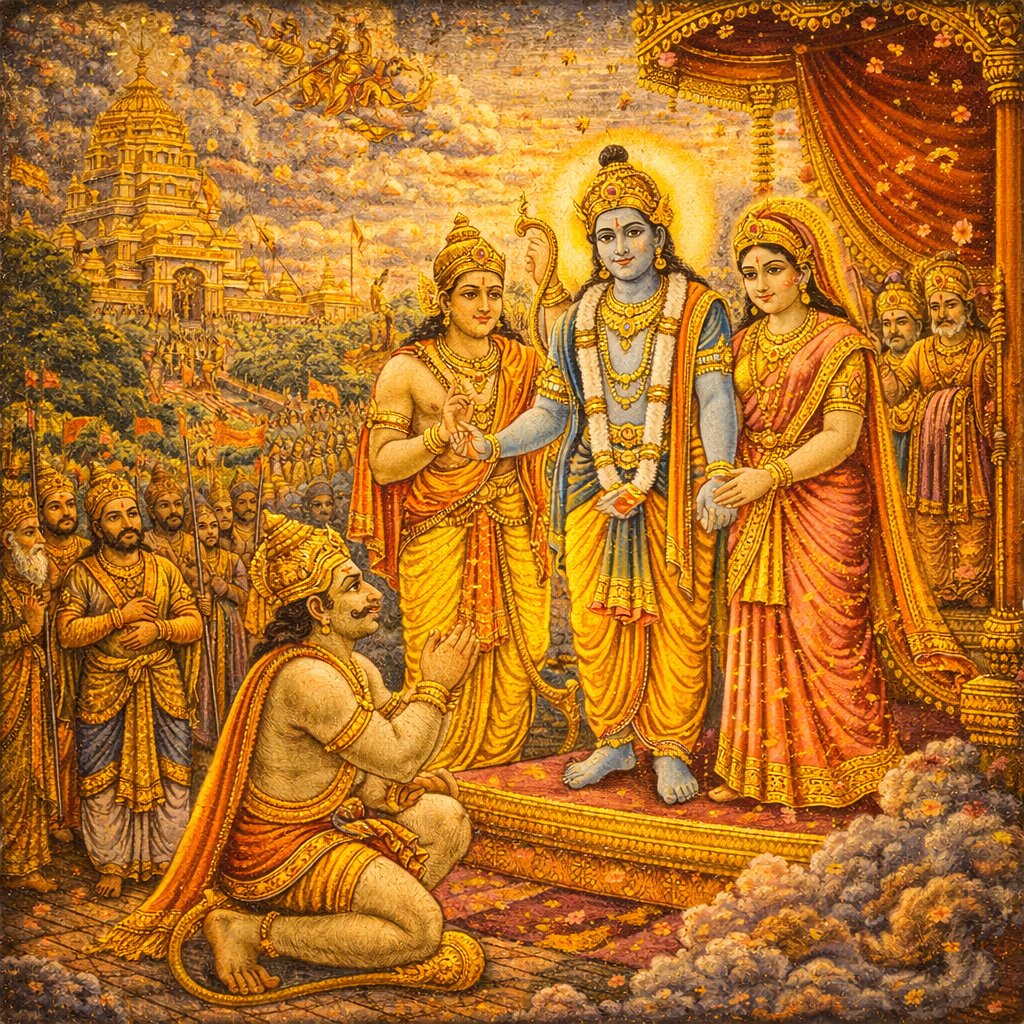
Canto 9 — Dynasties of Kings (Vaṁśānucarita) and the Preservation of Dharma
नवमः स्कन्धः (Navamaḥ Skandhaḥ)
Liberation
Traces the dynasties of the Sun and Moon -- the lineages of Rama, the Yadavas, and other great kings, leading up to the appearance of Krishna.
Adhyayas in Navama Skandha
Adhyaya 1
The Dynasty of Vaivasvata Manu Begins — Ilā/Sudyumna and the Birth of Purūravā
Responding to Parīkṣit’s request for a focused account of Vaivasvata Manu’s descendants, Śukadeva frames the impossibility of fully recounting Manu’s dynasty even in centuries, signaling an expansive vaṁśānucarita arc. He briefly re-anchors the lineage cosmologically—Supreme Person → Brahmā → Marīci → Kaśyapa → Aditi → Vivasvān → Śrāddhadeva (Vaivasvata) Manu—then names Manu’s ten sons, establishing the Solar line’s root (notably Ikṣvāku). The chapter then pivots to a mantra-and-intent episode: Vasiṣṭha performs a sacrifice for Manu’s son, but Manu’s wife Śraddhā requests a daughter; due to the priest’s diversion, Ilā is born. By Vasiṣṭha’s prayers to Viṣṇu, Ilā becomes the male Sudyumna. While hunting, Sudyumna enters Śiva’s Sukumāra forest (near Meru), where a prior decree—made to please Pārvatī—forces any male to become female; Sudyumna transforms and later unites with Budha, producing Purūravā. Vasiṣṭha petitions Śiva, who grants alternating months of male/female embodiment, enabling rule but unsettling citizens. Sudyumna later installs Purūravā as heir and retires, setting up the Lunar dynasty expansion in subsequent narration.
Adhyaya 2
Śrāddhadeva Manu’s Sons: Pṛṣadhra’s Curse and Renunciation; Genealogies of Nariṣyanta and Diṣṭa
Following Sudyumna’s departure to the forest for vānaprastha, Vaivasvata Manu (Śrāddhadeva), desiring more heirs, performs long austerities on the Yamunā and worships the Supreme Lord, obtaining ten sons, led by Ikṣvāku. The chapter then highlights Pṛṣadhra: while guarding cows at night, he mistakenly kills a cow in darkness, and Vasiṣṭha curses him to lose kṣatriya status and be born a śūdra. Accepting the guru’s word without resentment, Pṛṣadhra adopts brahmacarya, becomes equipoised and God-centered, attains pure devotional service, and finally enters a forest fire to reach the spiritual realm. The narrative then briefly notes other sons (e.g., Kavi’s early renunciation; Karūṣa’s line; Dhṛṣṭa’s social transformation) and expands into genealogical sequences—Nariṣyanta’s descendants leading to Agniveśya and the Āgniveśyāyana brāhmaṇas, and Diṣṭa’s line culminating in Marutta’s extraordinary golden sacrifice and the Vaiśālī dynasty through Tṛṇabindu. This chapter bridges personal moral exempla (sin, curse, surrender, bhakti) with the canto’s wider dynastic architecture, setting up further lineage narratives ahead.
Adhyaya 3
Śaryāti, Sukanyā, Cyavana Muni, the Aśvinī-kumāras, and Kakudmī-Revatī (Baladeva Marriage)
Continuing the dynastic narration of Manu’s descendants, this chapter spotlights King Śaryāti’s encounter with Cyavana Muni, illustrating how royal power is checked by brāhmaṇical tapas and how dharma is restored through humility and right action. Sukanyā’s inadvertent offense (piercing Cyavana’s eyes) results in a collective bodily obstruction for the king’s soldiers, revealing the social consequences of āśrama pollution and the immediacy of sage’s curse. Śaryāti appeases the sage by giving Sukanyā in marriage; her steadfast service becomes the ethical center of the episode. The Aśvinī-kumāras rejuvenate Cyavana, leading to a soma-yajña dispute where Cyavana secures soma rights for the Aśvins and restrains Indra’s violence—showing yajña as both ritual and cosmic politics. The narrative then transitions back to lineage: Śaryāti’s descendants include Revata and Kakudmī, whose visit to Brahmā illustrates time dilation (27 catur-yugas). Brahmā directs Revatī’s marriage to Baladeva, linking dynastic history to the Lord’s descent and preparing the next genealogical continuations.
Adhyaya 4
Nābhāga’s Inheritance, Śiva’s Verdict, and the Rise of Ambarīṣa—Prelude to Durvāsā’s Offense
This chapter advances the dynastic thread by moving from Nābhāga’s disrupted inheritance to the emergence of Mahārāja Ambarīṣa. Nābhāga returns from his guru’s āśrama to find his brothers have divided the estate and cynically assign their father as his ‘share.’ His father redirects him to the Aṅgirasa sages’ sacrifice, predicting their periodic confusion and instructing Nābhāga to recite Vaiśvadeva-related Vedic hymns. By correct mantra application and obedience to paternal/guru counsel, Nābhāga receives the sacrificial wealth. A dark figure then claims the arena’s riches; the dispute is adjudicated by Nābhāga’s father, who identifies the claimant as Lord Śiva’s right, since Dakṣa-yajña remnants were allotted to Śiva. Nābhāga surrenders; Śiva affirms the truth, grants him the wealth, and imparts transcendental instruction—establishing poṣaṇa through humility and proper recognition of divine shares (bhāga). The narrative then transitions to Ambarīṣa’s birth and character: his detachment from imperial opulence, total sense-engagement in bhakti, and disciplined Ekādaśī vow. The chapter culminates in the narrative hinge: Durvāsā Muni arrives as an uninvited guest precisely when the Dvādaśī fast must be broken, setting up the coming conflict between ritual timing, hospitality, and the gravity of vaiṣṇava-aparādha in the next progression of events.
Adhyaya 5
Ambarīṣa’s Prayers to Sudarśana and the Deliverance of Durvāsā
Continuing from the prior tension—Durvāsā Muni pursued by the Sudarśana cakra after offending the devotee-king—this chapter opens with the sage’s return to Mahārāja Ambarīṣa in distress, falling at the king’s feet. Ambarīṣa, rather than retaliating, feels shame and compassion and offers a theologically rich stuti to Sudarśana, identifying it as the Lord’s all-pervading, cosmic principle and invincible protector. He petitions the cakra to grant shelter to the brāhmaṇa, grounding his request in the merit of his family’s dharma, yajña, charity, and—above all—the Lord’s pleasure. The Sudarśana becomes pacified and ceases burning Durvāsā, who then praises the greatness of devotees and acknowledges the purifying power of the Lord’s name. The king, having fasted until the sage’s return, honors him with food; Durvāsā blesses him and departs. The chapter concludes by affirming Ambarīṣa’s perfected devotion, his renunciation into vānaprastha, and the phala-śruti: hearing or remembering this narration grants devotion and liberation—setting a devotional model for what follows in dynastic history.
Adhyaya 6
Ikṣvāku Dynasty: Vikukṣi’s Offense, Purañjaya’s Victory, Māndhātā’s Birth, and Saubhari’s Fall and Renunciation
Śukadeva continues the dynastic narration by first closing the Ambarīṣa line through Virūpa → Pṛṣadaśva → Rathītara, then explaining Rathītara’s sonless state and the niyoga-like begetting of sons by Aṅgirā, producing offspring famed for brāhmaṇical prowess and a dual identity (Rathītara/Aṅgirā line). The focus then shifts to Manu’s son Ikṣvāku—born from Manu’s nostrils—and the spread of his hundred sons across Āryāvarta. A ritual crisis occurs during aṣṭakā-śrāddha: Vikukṣi brings flesh but eats a rabbit, rendering the offering impure; Vasiṣṭha detects the breach, leading to Vikukṣi’s exile and Ikṣvāku’s subsequent renunciation and yogic perfection. Vikukṣi returns as king (Śaśāda), whose son Purañjaya (Indravāha/Kakutstha) defeats the demons with Indra as his bull-carrier by Viṣṇu’s order, earning multiple epithets through action. The genealogy proceeds to Kuvalayāśva (Dhundhumāra) and then to another Yuvanāśva, whose childlessness prompts sages to perform an Indra-yajña; providentially, the king drinks the sanctified water, and Māndhātā is miraculously born from his abdomen and nourished by Indra—becoming the world-emperor Trasaddasyu. The chapter culminates in Saubhari Ṛṣi’s temptation after seeing mating fish, his marriage to Māndhātā’s fifty daughters, opulence, dissatisfaction, self-critique on saṅga (association), and eventual vānaprastha and liberation—setting a moral bridge toward subsequent dynastic continuations and the recurring Bhāgavata warning against sense-driven association.
Adhyaya 7
Purukutsa’s Rasātala Victory; Triśaṅku and Hariścandra; Rohita and Śunaḥśepha
Continuing the Sūrya-vaṁśa succession after Māndhātā, the chapter first situates Ambarīṣa and his notable descendants, then shifts to Purukutsa, who is guided by Narmadā into Rasātala on Vāsuki’s request. Empowered by Lord Viṣṇu, Purukutsa destroys hostile Gandharvas, and the Nāgas grant a protective phala-śruti: remembrance of this episode safeguards one from snake attacks. The genealogy proceeds through Trasaddasyu to Triśaṅku (Satyavrata), whose transgression and curse lead to the paradoxical ‘hanging in the sky’ episode through Viśvāmitra’s power. From Triśaṅku comes Hariścandra, whose vow to Varuṇa for a son becomes a moral crisis: repeated postponements of the promised sacrifice bring Varuṇa’s affliction, while Rohita flees and is repeatedly redirected by Indra toward tīrtha-wandering. The arc culminates in Rohita purchasing Śunaḥśepha as the substitute victim, enabling Hariścandra’s sacrifice under major ṛṣis. The chapter ends with Hariścandra’s purification and a compact sāṅkhya-like dissolution sequence, preparing the text to expand Śunaḥśepha/Viśvāmitra-related narratives in the next progression.
Adhyaya 8
Mahārāja Sagara, Kapila Muni, and the Deliverance of the Sixty Thousand Sons
Continuing the Sūryavaṁśa succession, Śukadeva outlines the descent from Rohita to Bāhuka, whose loss of kingdom leads to vānaprastha. After Bāhuka’s death, a pregnant queen is saved from satī by Aurva Muni; despite co-wives’ poisoning, a son is born “with poison,” named Sagara. As emperor, Sagara—obeying Aurva—restrains from slaughtering frontier tribes (Yavanas, Śakas, etc.), instead marking them by distinctive appearances, and he performs aśvamedha. Indra steals the sacrificial horse, prompting Sagara’s sixty thousand sons to excavate the earth in search; they find the horse near Kapila Muni’s āśrama and, deluded by Indra, accuse the sage. Their offense results in their own fiery destruction. The text clarifies Kapila’s transcendence and his role as teacher of Sāṅkhya. Sagara’s grandson Aṁśumān, unlike the rash uncles, approaches Kapila with prayers on the Lord’s unknowability and the bondage of the guṇas. Kapila instructs that only Gaṅgā water can deliver the ancestors. Aṁśumān returns the horse; Sagara completes the rite, hands the kingdom to Aṁśumān, and attains the supreme destination—setting up the next narrative movement toward bringing Gaṅgā for ancestral liberation.
Adhyaya 9
Bhagīratha Brings Gaṅgā; Saudāsa’s Curse; Khaṭvāṅga’s Instant Renunciation
Continuing the Sūryavaṁśa succession, Śukadeva describes how Aṁśumān and Dilīpa fail to bring Gaṅgā to earth, and how Bhagīratha’s severe tapas succeeds. Gaṅgā raises two concerns—her destructive force upon descent and the burden of absorbing people’s sins—both answered through bhakti-logic: Śiva can bear her momentum, and the bathing of pure devotees neutralizes accumulated impurity. Śiva accepts and sustains Gaṅgā, who follows Bhagīratha to the ashes of Sagara’s sons, granting them elevation. The narrative then resumes genealogy from Bhagīratha to Saudāsa (Mitrasaha/Kalmāṣapāda), explaining how a vengeful Rākṣasa causes Vasiṣṭha to curse the king into man-eating, leading to the brāhmaṇī’s counter-curse that blocks conjugal life and heirs until Vasiṣṭha begets Aśmaka. The lineage proceeds to Khaṭvāṅga, who learns he has only a moment to live and immediately fixes his mind on the Lord—bridging royal history into the chapter’s culminating teaching: swift, decisive surrender to Vāsudeva is the highest achievement, surpassing all worldly benedictions and even celestial rewards, preparing the reader for further dynastic continuations and devotional exemplars ahead.
Adhyaya 10
Śrī Rāmacandra-avatāra — Vow, Exile, Laṅkā-vijaya, and Rāma-rājya (Concise Bhāgavata Account)
Continuing the Solar dynasty (vaṁśa) sequence, Śukadeva connects Raghu’s line to Aja and Daśaratha, then introduces the divinely petitioned descent of Bhagavān as four brothers—Rāma with His expansions. Because Parīkṣit has heard Rāma-kathā repeatedly, the narration becomes a rapid theological synopsis: Rāma preserves His father’s promise by renouncing the throne and entering forest life with Sītā and Lakṣmaṇa; He protects Viśvāmitra’s sacrifice, wins Sītā by breaking Śiva’s bow, and humbles Paraśurāma. The plot accelerates through Śūrpaṇakhā’s disfigurement, the slaughter of Khara’s forces, Sītā’s abduction by Rāvaṇa via the golden-deer stratagem, and the Lord’s grief-like search that instructs by example. Alliances with the vānaras, Vāli’s fall, the ocean’s submission, and the bridge to Laṅkā lead to war and Rāvaṇa’s death. After Sītā’s recovery and Vibhīṣaṇa’s coronation, Rāma returns to Ayodhyā, is anointed, and inaugurates Rāma-rājya—an ideal reign marked by prosperity, dharma, and relief from suffering—setting up subsequent dynastic continuation beyond Rāma’s rule.
Adhyaya 11
Lord Rāmacandra’s Charity, Sītā’s Departure, and the Lord’s Return to Vaikuṇṭha
Following the establishment of Rāma-rājya and the Lord’s exemplary rule in the Solar dynasty, this chapter presents Lord Rāmacandra performing opulent yajñas under an ācārya and distributing the four directions of His kingdom as dakṣiṇā, ultimately giving everything to the brāhmaṇas—revealing that the Supreme worships Himself while teaching ideal charity and detachment. The brāhmaṇas, satisfied by the Lord’s true gift—illumination of the heart—return the wealth, praising His supremacy. The narrative then pivots to a social episode: Rāma, in disguise, hears public criticism regarding Sītā. To protect the perceived integrity of royal dharma amid ignorant gossip, He abandons the pregnant Sītā, who takes refuge in Vālmīki’s āśrama and gives birth to Lava and Kuśa. The chapter also notes the dynastic expansion through the sons of Lakṣmaṇa, Bharata, and Śatrughna, including Śatrughna’s slaying of Lavaṇa and the founding of Mathurā. Sītā, meditating on Rāma, enters the earth; Rāma experiences transcendental grief, remains celibate, performs long Agnihotra, and finally returns to His own abode beyond the brahmajyoti. The chapter closes by extolling Rāma’s spotless fame and the liberating power of hearing His līlā, transitioning into Parīkṣit’s next inquiry about Rāma’s conduct with His brothers and the citizens’ relationship with Him.
Adhyaya 12
Continuation and Future of the Sūrya-vaṁśa: From Kuśa to the Last Ikṣvāku King
Śukadeva Gosvāmī continues the Ikṣvāku/Sūrya-vaṁśa line after Śrī Rāmacandra by enumerating descendants beginning with Kuśa and proceeding through successive kings. The chapter highlights Vajranābha’s solar origin and especially Hiraṇyanābha’s role as a yogic ācārya—disciple of Jaimini and teacher of Yājñavalkya in ādhyātma-yoga—linking royal succession to the transmission of spiritual science. The narrative then moves to Maru, who, having attained yogic perfection, remains alive in Kalāpa-grāma and is prophesied to revive the dynasty at the end of Kali-yuga. From Maru onward, Śukadeva lists later and future kings, including Bṛhadbala (killed by Parīkṣit’s father), and then projects the remaining line until Sumitra, the final king after whom the solar dynasty’s male line ends. This chapter thus closes the Sūrya-vaṁśa arc by combining genealogy, yogic tradition, prophecy, and the theme of dynastic impermanence—setting the Purāṇa to transition from past exemplars to future outcomes and closures of royal lines.
Adhyaya 13
Nimi’s Disembodied Liberation and the Rise of the Mithilā (Videha) Dynasty
Continuing the royal histories of Skandha 9, this chapter centers on Mahārāja Nimi (Ikṣvāku’s son) and a pivotal conflict of authority between king and guru. Nimi requests Vasiṣṭha as chief priest, but Vasiṣṭha is engaged in Indra’s sacrifice and asks Nimi to wait. Seeing life as fleeting, Nimi proceeds with other priests, prompting Vasiṣṭha to curse his body to fall; Nimi countercurses, and both relinquish their bodies—Vasiṣṭha later re-manifesting through his extraordinary birth connected with Mitra and Varuṇa. The sages preserve Nimi’s body and ask the devas to restore him, but Nimi refuses re-embodiment, distinguishing the fear-based liberation of Māyāvādīs from the fearless, service-filled intelligence of devotees who use the body for bhakti. The devas grant him an existence without a gross body. To prevent political disorder, the sages churn Nimi’s preserved body and produce Janaka (Vaideha/Mithila), initiating a detailed genealogy culminating in Śīradhvaja Janaka, from whose plow appears Sītā, linking Mithilā to Lord Rāmacandra’s līlā. The chapter closes by affirming that Mithilā’s kings were self-realized and liberated despite household life, setting a paradigm for spiritually grounded governance as the narrative proceeds through subsequent descendants.
Adhyaya 14
The Rise of Soma-vaṁśa: Budha’s Birth and Purūravā–Urvaśī; The Origin of Karma-kāṇḍa in Tretā-yuga
Śukadeva transitions Parīkṣit from the Sūrya-vaṁśa to the purifying glories of the Soma-vaṁśa, beginning with cosmic genealogy: Brahmā’s son Atri gives rise to Soma (Candra). Soma’s conquest and Rājasūya inflate his pride, leading to the abduction of Tārā, Bṛhaspati’s wife, and a catastrophic Deva–Asura conflict fueled by guru-rivalries (Bṛhaspati vs. Śukra) and alliances (Śiva with Bṛhaspati; Indra with the Devas). Brahmā restores order; Tārā reveals Soma as the father of Budha, who begets Purūravā through Ilā. The chapter then narrates Purūravā’s romance with Urvaśī, structured by conditions and the Gandharvas’ stratagem with the lambs, culminating in separation and Purūravā’s lament. Urvaśī grants annual union, and Purūravā, seeking reunion, approaches the Gandharvas and—through meditation and the emergence of Vedic ritual in early Tretā—institutes karma-kāṇḍa yajña using araṇis, satisfying Hari and attaining Gandharvaloka. This chapter thus bridges genealogy to ritual theology, foreshadowing further Lunar dynasty expansions in subsequent chapters.
Adhyaya 15
Paraśurāma, Kārtavīryārjuna, and the Kāmadhenu Offense (with Lunar-line Genealogy to Gādhi and Jamadagni)
This chapter advances the Lunar dynasty narration from Purūravā and Urvaśī through their sons, then through Jahnu—famed for drinking the Gaṅgā—and onward to Kuśa’s line culminating in King Gādhi. The narrative pivots from genealogy to a causative moral episode: Ṛcīka Muni marries Gādhi’s daughter Satyavatī after producing Varuṇa’s thousand moon-bright horses as dowry; a swap of consecrated oblations alters destinies, leading to Jamadagni’s birth and Satyavatī’s transformation into the river Kauśikī. Jamadagni fathers Paraśurāma, identified as an avatāra of Vāsudeva, whose mission intensifies when kṣatriya pride overwhelms dharma. Parīkṣit asks the specific offense behind Paraśurāma’s repeated annihilation of kṣatriyas; Śukadeva answers by detailing Kārtavīryārjuna’s immense boons from Dattātreya, his arrogance, and the pivotal theft of Jamadagni’s kāmadhenu. Paraśurāma single-handedly destroys the Haihaya armies and kills Kārtavīryārjuna, returning the cow. The chapter closes with Jamadagni’s brāhmaṇical rebuke: even a sinful king’s killing is grave, and Paraśurāma must atone through devotion and pilgrimage—setting up the continuing ethical tension between righteous punishment and brāhmaṇa forgiveness.
Adhyaya 16
Paraśurāma Avenges Jamadagni; Restoration Through Sacrifice; Viśvāmitra’s Line and Devarāta (Śunaḥśepha)
Śukadeva continues the Bhṛgu-line narration to Mahārāja Parīkṣit by detailing Paraśurāma’s obedience to Jamadagni and the test involving Reṇukā’s momentary mental deviation. Jamadagni commands his sons to execute their mother; only Paraśurāma complies, also killing his brothers when ordered, demonstrating the feared potency of a tapasvī brāhmaṇa and the gravity of disobedience. Pleased, Jamadagni grants a boon: Reṇukā and the brothers are revived without traumatic memory. The unresolved enmity of Kārtavīryārjuna’s sons culminates in Jamadagni’s murder despite Reṇukā’s pleas, igniting Paraśurāma’s vow to end kṣatriya tyranny. He retaliates at Māhiṣmatī and performs repeated purgations of abusive rulers (twenty-one times), symbolized by Samanta-pañcaka’s blood-lakes. The chapter then pivots from vengeance to atonement and restoration: Paraśurāma reunites Jamadagni’s head and body, worships Vāsudeva through yajña, distributes the earth in dāna to priests, and completes avabhṛtha-snāna; Jamadagni is revived and later becomes a Saptarṣi, with Paraśurāma destined for a future manvantara role and described as still residing at Mahendra. The narrative then transitions to the Kauśika line: Viśvāmitra’s rise from kṣatriya to brāhmaṇa, his sons (Madhucchandās), the adoption of Devarāta/Śunaḥśepha, and the curse/blessing that diversifies the dynasty—setting up subsequent genealogical continuations.
Adhyaya 17
Dynasty of Kṣatravṛddha: Kāśi Kings, Dhanvantari, Rajī’s Sons, and the Transition to Nahuṣa
Continuing the lunar dynasty stream from Purūravā through Āyu, Śukadeva highlights Āyu’s powerful sons and focuses on Kṣatravṛddha’s line. The chapter first lays out Kṣatravṛddha → Suhotra and his sons (Kāśya, Kuśa, Gṛtsamada), culminating in the Ṛg-veda authority Śaunaka—showing how royal lines can yield brahminical luminaries. From Kāśya comes the Kāśi branch: Dīrghatama’s son Dhanvantari, identified as an incarnation of Vāsudeva and founder of Āyurveda, whose remembrance is praised as disease-destroying. The narrative proceeds through Kāśi kings (Divodāsa/Dyumān/Pratardana and Alarka’s extraordinarily long reign) and further descendants. It then turns to other Āyu branches: Anenā’s descendants, and especially Rajī—who restores heaven to Indra, after which Indra, via Bṛhaspati’s stratagem, causes Rajī’s sons to fall from dharma and be slain. The chapter closes by finishing Kuśa’s sub-line within Kṣatravṛddha’s dynasty and explicitly signals the next movement: the forthcoming description of Nahuṣa’s dynasty.
Adhyaya 18
Yayāti, Devayānī, Śarmiṣṭhā, and the Exchange of Youth: The Unsatisfied Nature of Desire
Continuing the Lunar dynasty narration (vaṁśānucarita), Śukadeva introduces Nahuṣa’s sons and explains how Yati renounces kingship, leading Yayāti to rule. Nahuṣa’s fall—cursed to become a python after offending Śacī—sets a moral frame: sovereignty without self-restraint invites degradation. The chapter then unfolds the conflict between Devayānī (Śukrācārya’s daughter) and Śarmiṣṭhā (Vṛṣaparvā’s daughter), culminating in Devayānī’s humiliation in a well and her providential rescue by King Yayāti. Interpreting the hand-grasp as a marriage bond and constrained by her prior curse (that she would not marry a brāhmaṇa), Devayānī insists on union; Yayāti accepts despite pratiloma concerns. Śukrācārya arranges the marriage with a strict warning that Yayāti must not cohabit with Śarmiṣṭhā—yet Yayāti later grants Śarmiṣṭhā a son, provoking Devayānī’s outrage and Śukrācārya’s curse of premature old age. A conditional remedy follows: Yayāti may exchange old age with a willing youth. Four sons refuse, but Pūru accepts, exemplifying filial dharma. Yayāti enjoys for a long period, performs sacrifices, worships Vāsudeva, yet remains unsatisfied—preparing the narrative for his eventual realization that kāma is intrinsically insatiable and that true fulfillment lies in turning toward the Lord and renunciation.
Adhyaya 19
Yayāti’s Renunciation: The Allegory of the He-Goat and She-Goat
Continuing the Yayāti narrative, Śukadeva explains how the king—once intensely attached to sensual life—becomes disgusted with its consequences and instructs Devayānī through an allegorical tale. Yayāti recounts a lust-driven he-goat who rescues a she-goat from a well (karma’s predicament) but then becomes enslaved by sexual competition and forgets self-realization. Jealousy and rupture follow; a brāhmaṇa punishes the goat by cutting his testicles, later restoring them by yogic power—yet even after ‘restoration,’ satisfaction never arrives. Yayāti applies the parable to himself, teaching that lust is insatiable (like ghee in fire) and that true happiness requires voluntary renunciation, restraint, and meditation on Vāsudeva. He then acts: exchanging old age for youth with Pūru, distributing territories to his sons, enthroning Pūru, and abandoning enjoyment instantly. Surrendering to Vāsudeva, he attains purity and association with the Lord. Devayānī awakens, recognizes social bonds as māyā-like (hotel/dream), fixes her mind on Kṛṣṇa, and achieves liberation—preparing the narrative to move forward through the dynasty under Pūru’s imperial leadership.
Adhyaya 20
Pūru-vaṁśa, Duṣmanta–Śakuntalā, and the Rise of Mahārāja Bharata
Śukadeva Gosvāmī transitions the dynastic narration to the Pūru lineage—the branch in which Parīkṣit is born—listing successive kings and highlighting how brāhmaṇa lines also emerge from royal progeny. The genealogy reaches Raudrāśva and his ten sons (born of the Apsarā Ghṛtācī), then continues through Ṛteyu to Rantināva and Kaṇva, linking the line to the Kaṇva-āśrama setting. The chapter then turns from lists to lived history: King Duṣmanta meets Śakuntalā in Kaṇva Muni’s forest hermitage, contracts a Gandharva marriage, and returns to his capital; Śakuntalā bears a powerful son. When Duṣmanta initially refuses to accept wife and child, a celestial voice establishes Vedic paternity doctrine and compels recognition. The son, Bharata, becomes a world emperor, famed for vast yajñas, charity, and suppression of anti-Vedic forces; yet he later views family attachment as a spiritual obstacle. A crisis of progeny leads to the Marut-stoma sacrifice and the adoption of Bharadvāja, whose complex birth (involving Bṛhaspati and Mamatā) is resolved by divine arrangement—setting up the next dynastic continuation through Bharata’s successor line.
Adhyaya 21
Rantideva’s Supreme Charity and the Hastī Lineage (Hastināpura and Pañcāla Origins)
This chapter continues the genealogical flow (vaṁśānucarita) by tracing Bharadvāja—known as Vitatha—through Manyu and his sons, arriving at Nara’s son Saṅkṛti and then King Rantideva. The narrative shifts from lineage to lived dharma: Rantideva, sustained only by providence, fasts for forty-eight days and then gives away his newly obtained food and water to successive guests—a brāhmaṇa, a śūdra, a guest with dogs, and finally a caṇḍāla—because he perceives Vāsudeva present in all beings. His prayer rejects siddhis and even mokṣa in favor of bearing others’ suffering, exemplifying compassion rooted in bhakti. The demigods reveal they tested him, yet Rantideva remains fixed at Viṣṇu’s lotus feet, untouched by māyā; his followers become pure devotees. The chapter then returns to dynastic mapping: Garga’s and Mahāvīrya’s lines produce brahmaṇa-status descendants; Bṛhatkṣatra’s son Hastī founds Hastināpura; and Hastī’s descendants branch toward the Pañcālas, Maudgalya brāhmaṇas, and the birth of Kṛpa and Kṛpī—setting up later Mahābhārata-linked figures and regions.
Adhyaya 22
The Kuru Line, Bhīṣma and Vyāsa; Pāṇḍavas, Parīkṣit, and Future Kings (Chandravaṁśa Continuation)
This chapter continues the Chandravaṁśa (Soma/Lunar dynasty) thread by moving through key sub-lineages that culminate in the Kuru house and the Mahābhārata protagonists. It first sketches Pāñcāla descendants (Drupada, Draupadī, Dhṛṣṭadyumna) and then pivots to the Kuru line via Saṁvaraṇa and Tapatī’s son Kuru, establishing Kurukṣetra’s royal foundation. From Kuru’s descendants it traces to Pratīpa and his sons Devāpi, Śāntanu, and Bāhlīka, highlighting Devāpi’s disqualification and later yogic survival with a future role in restoring the dynasty. Śāntanu’s reign leads to Bhīṣma, then to Citrāṅgada and Vicitravīrya, and to the crucial intervention of Vyāsadeva (Kṛṣṇa Dvaipāyana), who begets Dhṛtarāṣṭra, Pāṇḍu, and Vidura. The narrative then summarizes the births of the Kauravas and Pāṇḍavas, Parīkṣit’s preservation by Kṛṣṇa, and Parīkṣit’s heirs (Janamejaya onward), concluding with the last Kuru monarch in Kali-yuga (Kṣemaka) and segueing toward the future Māgadha/Bārhadratha succession.
Adhyaya 23
Genealogies from Yayāti’s Sons to the Yadu Dynasty; Romapāda–Ṛṣyaśṛṅga; Kārtavīryārjuna; and the Rise of Yādava Branches
Continuing the dynastic mapping from Yayāti’s progeny, this chapter first traces the Anu line through Uśīnara and Śibi, then moves to Bali, whose sons (Aṅga, Vaṅga, Kaliṅga, Suhma, Puṇḍra, Oḍra) become eponymous rulers of eastern regions—linking genealogy to historical geography. The Aṅga branch leads to Romapāda, whose childlessness is resolved through his connection with Daśaratha and the sage Ṛṣyaśṛṅga: drought ends when Ṛṣyaśṛṅga is brought to perform sacrifice, and Daśaratha’s putreṣṭi is enabled through him, while Romapāda gains a son (Caturaṅga). The narrative then proceeds to Adhiratha’s adoption of Karṇa, tying Bhāgavata genealogy to Mahābhārata memory. Next, Druhyu’s northern line and Turvasu’s succession are summarized, including Maruta’s adoption of Duṣmanta and Duṣmanta’s return to Pūru for kingship—closing one set of branches. The chapter then pivots to Yadu, explicitly foregrounding the dynasty in which Kṛṣṇa descends, and details key Yādava streams: Sahasrajit’s Haihaya line culminating in Kārtavīryārjuna (aṣṭa-siddhi via Dattātreya), the Tālajaṅgha destruction, and the Madhu–Vṛṣṇi origins of Yādava/Mādhava/Vṛṣṇi identities. It concludes with Kroṣṭā’s line to Śaśabindu and the striking Jyāmagha–Śaibyā episode, where divine favor overcomes barrenness, setting up Vidarbha’s birth and the continuation of Yadu-linked expansions into the next chapter’s genealogical developments.
Adhyaya 24
The Yadu–Vṛṣṇi–Andhaka Genealogies and the Purpose of Kṛṣṇa’s Advent
Continuing the dynastic flow of Yadu’s descendants, this adhyāya enumerates key branches—Vidarbha’s line, the Kratha–Kunti–Vṛṣṇi succession, and the Sātvata progeny—establishing the familial matrix from which the Vṛṣṇis, Bhojas, Andhakas, and Śūrasenas arise. It highlights Devāvṛdha and Babhru through traditional stuti-verses, linking lineage with spiritual merit and even liberation for descendants. The chapter then details prominent Yādava lines (Śini, Satyaka, Yuyudhāna) and the Akrūra branch, before focusing on the Andhaka line culminating in Āhuka, Devaka, and Ugrasena—introducing Kaṁsa and the political setting of Kṛṣṇa’s birth. The Śūra–Māriṣā lineage is expanded to Vasudeva (Ānakadundubhi) and his siblings, and Kuntī’s boon from Durvāsā leads to Karṇa’s birth, bridging Bhāgavata genealogy with Mahābhārata history. The narrative culminates in a theological pivot: Kṛṣṇa’s appearance is self-willed, not karma-driven; He descends to relieve the earth’s burden, protect devotees, and make liberation accessible through hearing and remembrance. This sets the transition from ancestry to līlā: from “who begot whom” to “why Bhagavān comes.”
Frequently Asked Questions
Because vaṁśa and vaṁśānucarita are among the Bhāgavata’s ten defining topics (daśa-lakṣaṇam). Dynastic history is used to teach dharma, karma, and divine governance: kings embody social order, and their lives illustrate how the Lord’s protection (poṣaṇa) operates through mantra, guru, and providence—not merely through political power.
Vaivasvata Manu is the Manu of the current manvantara. His appearance and progeny establish the human and royal lines through which dharma, yajña culture, and avatāra-līlā unfold. The Bhāgavata uses Manu’s lineage to connect cosmic time (manvantara) with lived history (vaṁśānucarita).
The Bhāgavata consistently identifies the Supreme Personality of Godhead (Viṣṇu/Nārāyaṇa) as the ultimate source and regulator. Even when boons are given by other deities (e.g., Śiva), outcomes remain within the Supreme’s overarching order and purpose.