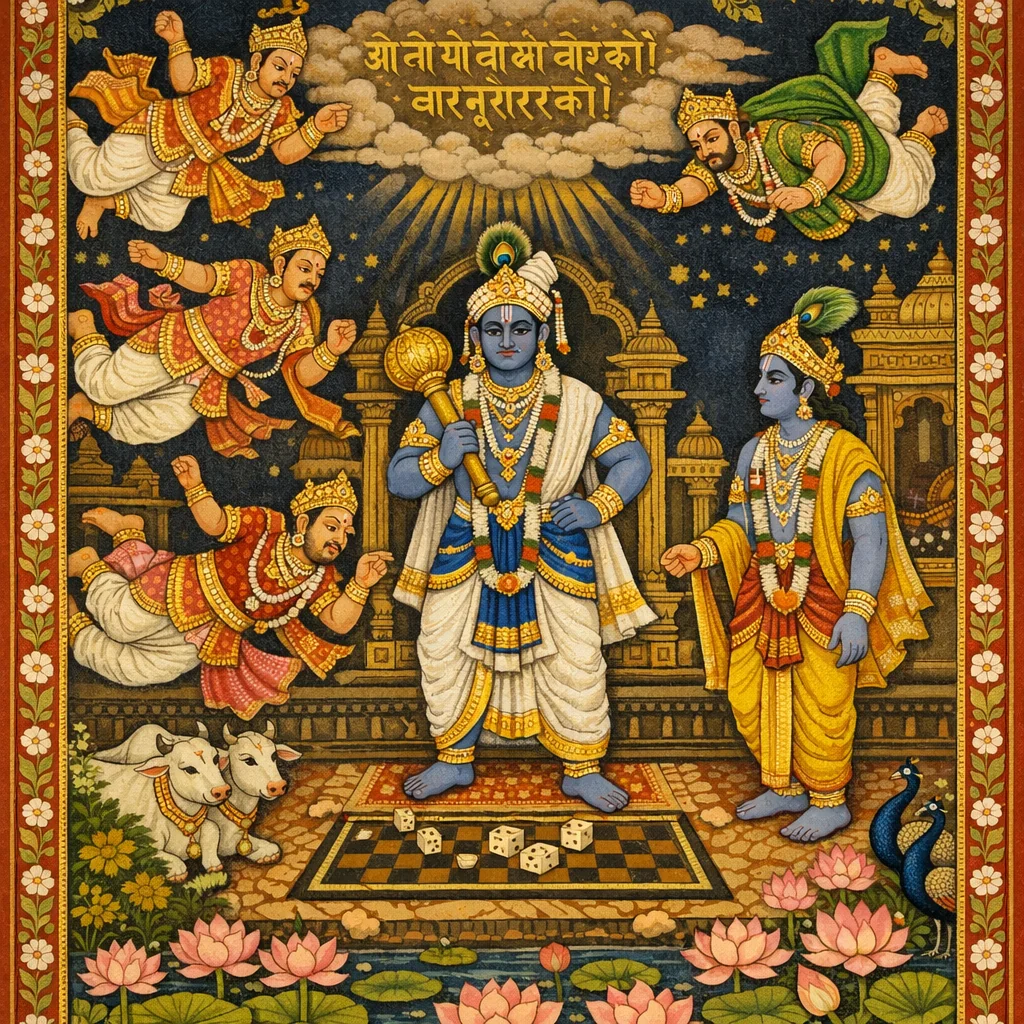
Adhyaya 61
Kṛṣṇa’s Queens, Their Sons, and Balarāma’s Victory over Rukmī at Dice (Aniruddha–Rocanā Marriage Context)
Continuing the Dvārakā-cycle of royal and familial līlās, this chapter first widens the lens from individual marriages to dynastic expansion: each of Kṛṣṇa’s queens bears ten sons, all endowed with opulence befitting their divine father. The queens, enchanted by Kṛṣṇa’s beauty and affectionate dealings, each feels uniquely favored—highlighting His inconceivable potency (acintya-śakti) in reciprocating with many simultaneously. Śukadeva then enumerates the sons of the principal queens (notably Pradyumna and Sāmba) and briefly notes the dynasty’s vast proliferation. Parīkṣit’s inquiry bridges genealogy to political psychology: how could the hostile Rukmī marry his daughter to Pradyumna? Śukadeva explains that Rukmavatī chose Pradyumna at svayaṁvara, and Rukmī—though inimical—consented out of affection for Rukmiṇī. The narrative then advances to Aniruddha’s marriage to Rocanā in Bhojakaṭa, where arrogant kings provoke Rukmī to challenge Balarāma at dice. Rukmī cheats, is condemned by a divine voice, insults Balarāma, and is slain by Balarāma’s club; the Kaliṅga king is punished and the assembly disperses. Kṛṣṇa remains neutral to preserve relational harmony, and the party returns to Dvārakā, setting up subsequent Yādava court developments and the moral consequences of pride and deceit.
Shlokas
Verse 1
श्रीशुक उवाच एकैकशस्ता: कृष्णस्य पुत्रान् दश दशाबला: । अजीजनन्ननवमान्पितु: सर्वात्मसम्पदा ॥ १ ॥
Śukadeva Gosvāmī said: Each of Lord Kṛṣṇa’s wives gave birth to ten sons, who were not less than their father, having all His personal opulence.
Verse 2
गृहादनपगं वीक्ष्य राजपुत्र्योऽच्युतं स्थितम् । प्रेष्ठं न्यमंसत स्वं स्वं न तत्तत्त्वविद: स्त्रिय: ॥ २ ॥
Because each of these princesses saw that Lord Acyuta never left her palace, each thought herself the Lord’s favorite. These women did not understand the full truth about Him.
Verse 3
चार्वब्जकोशवदनायतबाहुनेत्र- सप्रेमहासरसवीक्षितवल्गुजल्पै: । सम्मोहिता भगवतो न मनो विजेतुं स्वैर्विभ्रमै: समशकन् वनिता विभूम्न: ॥ ३ ॥
The Supreme Lord’s wives were fully enchanted by His lovely, lotuslike face, His long arms and large eyes, His loving glances imbued with laughter, and His charming talks with them. But with all their charms these ladies could not conquer the mind of the all-powerful Lord.
Verse 4
स्मायावलोकलवदर्शितभावहारि- भ्रूमण्डलप्रहितसौरतमन्त्रशौण्डै: । पत्न्यस्तु षोडशसहस्रमनङ्गबाणै- र्यस्येन्द्रियं विमथितुं करणैर्न शेकु: ॥ ४ ॥
The arched eyebrows of these sixteen thousand queens enchantingly expressed those ladies’ secret intentions through coyly smiling sidelong glances. Thus their eyebrows boldly sent forth conjugal messages. Yet even with these arrows of Cupid, and with other means as well, they could not agitate Lord Kṛṣṇa’s senses.
Verse 5
इत्थं रमापतिमवाप्य पतिं स्त्रियस्ता ब्रह्मादयोऽपि न विदु: पदवीं यदीयाम् । भेजुर्मुदाविरतमेधितयानुराग- हासावलोकनवसङ्गमलालसाद्यम् ॥ ५ ॥
Thus these women obtained as their husband the master of the goddess of fortune, although even great demigods like Brahmā do not know how to approach Him. With ever-increasing pleasure, they felt loving attraction for Him, exchanged smiling glances with Him, eagerly anticipated associating with Him in ever-fresh intimacy and enjoyed in many other ways.
Verse 6
प्रत्युद्गमासनवरार्हणपादशौच- ताम्बूलविश्रमणवीजनगन्धमाल्यै: । केशप्रसारशयनस्नपनोपहार्यै- र्दासीशता अपि विभोर्विदधु: स्म दास्यम् ॥ ६ ॥
Although the Supreme Lord’s queens each had hundreds of maidservants, they chose to personally serve the Lord by approaching Him humbly, offering Him a seat, worshiping Him with excellent paraphernalia, bathing and massaging His feet, giving Him pān to chew, fanning Him, anointing Him with fragrant sandalwood paste, adorning Him with flower garlands, dressing His hair, arranging His bed, bathing Him and presenting Him with various gifts.
Verse 7
तासां या दशपुत्राणां कृष्णस्त्रीणां पुरोदिता: । अष्टौ महिष्यस्तत्पुत्रान् प्रद्युम्नादीन् गृणामि ते ॥ ७ ॥
Among Lord Kṛṣṇa’s wives, each of whom had ten sons, I previously mentioned eight principal queens. I shall now recite for you the names of those eight queens’ sons, headed by Pradyumna.
Verse 8
चारुदेष्ण: सुदेष्णश्च चारुदेहश्च वीर्यवान् । सुचारुश्चारुगुप्तश्च भद्रचारुस्तथापर: ॥ ८ ॥ चारुचन्द्रो विचारुश्च चारुश्च दशमो हरे: । प्रद्युम्नप्रमुखा जाता रुक्मिण्यां नावमा: पितु: ॥ ९ ॥
The first son of Queen Rukmiṇī was Pradyumna, and also born of her were Cārudeṣṇa, Sudeṣṇa and the powerful Cārudeha, along with Sucāru, Cārugupta, Bhadracāru, Cārucandra, Vicāru and Cāru, the tenth. None of these sons of Lord Hari was less than his father.
Verse 9
चारुदेष्ण: सुदेष्णश्च चारुदेहश्च वीर्यवान् । सुचारुश्चारुगुप्तश्च भद्रचारुस्तथापर: ॥ ८ ॥ चारुचन्द्रो विचारुश्च चारुश्च दशमो हरे: । प्रद्युम्नप्रमुखा जाता रुक्मिण्यां नावमा: पितु: ॥ ९ ॥
The first son of Queen Rukmiṇī was Pradyumna, and also born of her were Cārudeṣṇa, Sudeṣṇa and the powerful Cārudeha, along with Sucāru, Cārugupta, Bhadracāru, Cārucandra, Vicāru and Cāru, the tenth. None of these sons of Lord Hari was less than his father.
Verse 10
भानु: सुभानु: स्वर्भानु: प्रभानुर्भानुमांस्तथा । चन्द्रभानुर्बृहद्भानुरतिभानुस्तथाष्टम: ॥ १० ॥ श्रीभानु: प्रतिभानुश्च सत्यभामात्मजा दश । साम्ब: सुमित्र: पुरुजिच्छतजिच्च सहस्रजित् ॥ ११ ॥ विजयश्चित्रकेतुश्च वसुमान् द्रविड: क्रतु: । जाम्बवत्या: सुता ह्येते साम्बाद्या: पितृसम्मता: ॥ १२ ॥
The ten sons of Satyabhāmā were Bhānu, Subhānu, Svarbhānu, Prabhānu, Bhānumān, Candrabhānu, Bṛhadbhānu, Atibhānu (the eighth), Śrībhānu and Pratibhānu. Sāmba, Sumitra, Purujit, Śatajit, Sahasrajit, Vijaya, Citraketu, Vasumān, Draviḍa and Kratu were the sons of Jāmbavatī. These ten, headed by Sāmba, were their father’s favorites.
Verse 11
भानु: सुभानु: स्वर्भानु: प्रभानुर्भानुमांस्तथा । चन्द्रभानुर्बृहद्भानुरतिभानुस्तथाष्टम: ॥ १० ॥ श्रीभानु: प्रतिभानुश्च सत्यभामात्मजा दश । साम्ब: सुमित्र: पुरुजिच्छतजिच्च सहस्रजित् ॥ ११ ॥ विजयश्चित्रकेतुश्च वसुमान् द्रविड: क्रतु: । जाम्बवत्या: सुता ह्येते साम्बाद्या: पितृसम्मता: ॥ १२ ॥
The ten sons of Satyabhāmā were Bhānu, Subhānu, Svarbhānu, Prabhānu, Bhānumān, Candrabhānu, Bṛhadbhānu, Atibhānu (the eighth), Śrībhānu and Pratibhānu. Sāmba, Sumitra, Purujit, Śatajit, Sahasrajit, Vijaya, Citraketu, Vasumān, Draviḍa and Kratu were the sons of Jāmbavatī. These ten, headed by Sāmba, were their father’s favorites.
Verse 12
भानु: सुभानु: स्वर्भानु: प्रभानुर्भानुमांस्तथा । चन्द्रभानुर्बृहद्भानुरतिभानुस्तथाष्टम: ॥ १० ॥ श्रीभानु: प्रतिभानुश्च सत्यभामात्मजा दश । साम्ब: सुमित्र: पुरुजिच्छतजिच्च सहस्रजित् ॥ ११ ॥ विजयश्चित्रकेतुश्च वसुमान् द्रविड: क्रतु: । जाम्बवत्या: सुता ह्येते साम्बाद्या: पितृसम्मता: ॥ १२ ॥
The ten sons of Satyabhāmā were Bhānu, Subhānu, Svarbhānu, Prabhānu, Bhānumān, Candrabhānu, Bṛhadbhānu, Atibhānu (the eighth), Śrībhānu and Pratibhānu. Sāmba, Sumitra, Purujit, Śatajit, Sahasrajit, Vijaya, Citraketu, Vasumān, Draviḍa and Kratu were the sons of Jāmbavatī. These ten, headed by Sāmba, were their father’s favorites.
Verse 13
वीरश्चन्द्रोऽश्वसेनश्च चित्रगुर्वेगवान् वृष: । आम: शङ्कुर्वसु: श्रीमान् कुन्तिर्नाग्नजिते: सुता: ॥ १३ ॥
The sons of Nāgnajitī were Vīra, Candra, Aśvasena, Citragu, Vegavān, Vṛṣa, Āma, Śaṅku, Vasu and the opulent Kunti.
Verse 14
श्रुत: कविर्वृषो वीर: सुबाहुर्भद्र एकल: । शान्तिर्दर्श: पूर्णमास: कालिन्द्या: सोमकोऽवर: ॥ १४ ॥
Śruta, Kavi, Vṛṣa, Vīra, Subāhu, Bhadra, Śānti, Darśa and Pūrṇamāsa were sons of Kālindī. Her youngest son was Somaka.
Verse 15
प्रघोषो गात्रवान्सिंहो बल: प्रबल ऊर्धग: । माद्रया: पुत्रा महाशक्ति: सह ओजोऽपराजित: ॥ १५ ॥
Mādrā’s sons were Praghoṣa, Gātravān, Siṁha, Bala, Prabala, Ūrdhaga, Mahāśakti, Saha, Oja and Aparājita.
Verse 16
वृको हर्षोऽनिलो गृध्रो वर्धनोन्नाद एव च । महांस: पावनो वह्निर्मित्रविन्दात्मजा: क्षुधि: ॥ १६ ॥
Mitravindā’s sons were Vṛka, Harṣa, Anila, Gṛdhra, Vardhana, Unnāda, Mahāṁsa, Pāvana, Vahni and Kṣudhi.
Verse 17
सङ्ग्रामजिद् बृहत्सेन: शूर: प्रहरणोऽरिजित् । जय: सुभद्रो भद्राया वाम आयुश्च सत्यक: ॥ १७ ॥
Saṅgrāmajit, Bṛhatsena, Śūra, Praharaṇa, Arijit, Jaya and Subhadra were the sons of Bhadrā, together with Vāma, Āyur and Satyaka.
Verse 18
दीप्तिमांस्ताम्रतप्ताद्या रोहिण्यास्तनया हरे: । प्रद्यम्नाच्चानिरुद्धोऽभूद्रुक्मवत्यां महाबल: । पुत्र्यां तु रुक्मिणो राजन् नाम्ना भोजकटे पुरे ॥ १८ ॥
Dīptimān, Tāmratapta and others were the sons of Lord Kṛṣṇa and Rohiṇī. Lord Kṛṣṇa’s son Pradyumna fathered the greatly powerful Aniruddha in the womb of Rukmavatī, the daughter of Rukmī. O King, this took place while they were living in the city of Bhojakaṭa.
Verse 19
एतेषां पुत्रपौत्राश्च बभूवु: कोटिशो नृप । मातर: कृष्णजातीनां सहस्राणि च षोडश ॥ १९ ॥
My dear King, the sons and grandsons of Lord Kṛṣṇa’s children numbered in the tens of millions. Sixteen thousand mothers gave rise to this dynasty.
Verse 20
श्रीराजोवाच कथं रुक्म्यरीपुत्राय प्रादाद् दुहितरं युधि । कृष्णेन परिभूतस्तं हन्तुं रन्ध्रं प्रतीक्षते । एतदाख्याहि मे विद्वन् द्विषोर्वैवाहिकं मिथ: ॥ २० ॥
King Parīkṣit said: How could Rukmī give his daughter to his enemy’s son? After all, Rukmī had been defeated by Lord Kṛṣṇa in battle and was waiting for an opportunity to kill Him. Please explain this to me, O learned one — how these two inimical parties became united through marriage.
Verse 21
अनागतमतीतं च वर्तमानमतीन्द्रियम् । विप्रकृष्टं व्यवहितं सम्यक् पश्यन्ति योगिन: ॥ २१ ॥
Mystic yogīs can perfectly see that which has not yet happened, as well as things in the past or present, beyond the senses, remote or blocked by physical obstacles.
Verse 22
श्रीशुक उवाच वृत: स्वयंवरे साक्षादनङ्गोऽङ्गयुतस्तया । राज्ञ: समेतान् निर्जित्य जहारैकरथो युधि ॥ २२ ॥
Śrī Śukadeva Gosvāmī said: At her svayaṁvara ceremony, Rukmavatī herself chose Pradyumna, who was the re-embodiment of Cupid. Then, although He fought alone on a single chariot, Pradyumna defeated the assembled kings in battle and took her away.
Verse 23
यद्यप्यनुस्मरन् वैरं रुक्मी कृष्णावमानित: । व्यतरद् भागिनेयाय सुतां कुर्वन् स्वसु: प्रियम् ॥ २३ ॥
Though Rukmī always remembered his enmity toward Lord Kṛṣṇa, who had insulted him, in order to please his sister he sanctioned his daughter’s marriage to his nephew.
Verse 24
रुक्मिण्यास्तनयां राजन् कृतवर्मसुतो बली । उपयेमे विशालाक्षीं कन्यां चारुमतीं किल ॥ २४ ॥
O King, Balī, the son of Kṛtavarmā, married Rukmiṇī’s young daughter, large-eyed Cārumatī.
Verse 25
दौहित्रायानिरुद्धाय पौत्रीं रुक्म्याददाद्धरे: । रोचनां बद्धवैरोऽपि स्वसु: प्रियचिकीर्षया । जानन्नधर्मं तद् यौनं स्नेहपाशानुबन्धन: ॥ २५ ॥
Rukmī gave his granddaughter Rocanā to his daughter’s son, Aniruddha, despite Rukmī’s relentless feud with Lord Hari. Although Rukmī considered this marriage irreligious, he wanted to please his sister, bound as he was by the ropes of affection.
Verse 26
तस्मिन्नभ्युदये राजन् रुक्मिणी रामकेशवौ । पुरं भोजकटं जग्मु: साम्बप्रद्युम्नकादय: ॥ २६ ॥
On the joyous occasion of that marriage, O King, Queen Rukmiṇī, Lord Balarāma, Lord Kṛṣṇa and several of the Lord’s sons, headed by Sāmba and Pradyumna, went to the city of Bhojakaṭa.
Verse 27
तस्मिन् निवृत्त उद्वाहे कालिङ्गप्रमुखा नृपा: । दृप्तास्ते रुक्मिणं प्रोचुर्बलमक्षैर्विनिर्जय ॥ २७ ॥ अनक्षज्ञो ह्ययं राजन्नपि तद्व्यसनं महत् । इत्युक्तो बलमाहूय तेनाक्षैर्रुक्म्यदीव्यत ॥ २८ ॥
After the wedding, a group of arrogant kings headed by the King of Kaliṅga told Rukmī, “You should defeat Balarāma at dice. He’s not expert at dice, O King, but still He’s quite addicted to it.” Thus advised, Rukmī challenged Balarāma and began a gambling match with Him.
Verse 28
तस्मिन् निवृत्त उद्वाहे कालिङ्गप्रमुखा नृपा: । दृप्तास्ते रुक्मिणं प्रोचुर्बलमक्षैर्विनिर्जय ॥ २७ ॥ अनक्षज्ञो ह्ययं राजन्नपि तद्व्यसनं महत् । इत्युक्तो बलमाहूय तेनाक्षैर्रुक्म्यदीव्यत ॥ २८ ॥
After the wedding, a group of arrogant kings headed by the King of Kaliṅga told Rukmī, “You should defeat Balarāma at dice. He’s not expert at dice, O King, but still He’s quite addicted to it.” Thus advised, Rukmī challenged Balarāma and began a gambling match with Him.
Verse 29
शतं सहस्रमयुतं रामस्तत्राददे पणम् । तं तु रुक्म्यजयत्तत्र कालिङ्ग: प्राहसद् बलम् । दन्तान् सन्दर्शयन्नुच्चैर्नामृष्यत्तद्धलायुध: ॥ २९ ॥
In that match Lord Balarāma first accepted a wager of one hundred coins, then one thousand, then ten thousand. Rukmī won this first round, and the King of Kaliṅga laughed loudly at Lord Balarāma, showing all his teeth. Lord Balarāma could not tolerate this.
Verse 30
ततो लक्षं रुक्म्यगृह्णाद्ग्लहं तत्राजयद् बल: । जितवानहमित्याह रुक्मी कैतवमाश्रित: ॥ ३० ॥
Next Rukmī accepted a bet of one hundred thousand coins, which Lord Balarāma won. But Rukmī tried to cheat, declaring “I’m the winner!”
Verse 31
मन्युना क्षुभित: श्रीमान् समुद्र इव पर्वणि । जात्यारुणाक्षोऽतिरुषा न्यर्बुदं ग्लहमाददे ॥ ३१ ॥
Shaking with anger like the ocean on the full-moon day, handsome Lord Balarāma, His naturally reddish eyes even redder in His fury, accepted a wager of one hundred million gold coins.
Verse 32
तं चापि जितवान् रामो धर्मेण छलमाश्रित: । रुक्मी जितं मयात्रेमे वदन्तु प्राश्निका इति ॥ ३२ ॥
Lord Balarāma fairly won this wager also, but Rukmī again resorted to cheating and declared, “I have won! Let these witnesses here say what they saw.”
Verse 33
तदाब्रवीन्नभोवाणी बलेनैव जितो ग्लह: । धर्मतो वचनेनैव रुक्मी वदति वै मृषा ॥ ३३ ॥
Just then a voice from the sky declared, “Balarāma has fairly won this wager. Rukmī is surely lying.”
Verse 34
तामनादृत्य वैदर्भो दुष्टराजन्यचोदित: । सङ्कर्षणं परिहसन् बभाषे कालचोदित: ॥ ३४ ॥
Urged on by the wicked kings, Rukmī ignored the divine voice. In fact destiny itself was urging Rukmī on, and thus he ridiculed Lord Balarāma as follows.
Verse 35
नैवाक्षकोविदा यूयं गोपाला वनगोचरा: । अक्षैर्दीव्यन्ति राजानो बाणैश्च न भवादृशा: ॥ ३५ ॥
[Rukmī said:] You cowherds who wander about the forests know nothing about dice. Playing with dice and sporting with arrows are only for kings, not for the likes of You.
Verse 36
रुक्मिणैवमधिक्षिप्तो राजभिश्चोपहासित: । क्रुद्ध: परिघमुद्यम्य जघ्ने तं नृम्णसंसदि ॥ ३६ ॥
Thus insulted by Rukmī and ridiculed by the kings, Lord Balarāma was provoked to anger. In the midst of the auspicious wedding assembly, He raised His club and struck Rukmī dead.
Verse 37
कलिङ्गराजं तरसा गृहीत्वा दशमे पदे । दन्तानपातयत् क्रुद्धो योऽहसद् विवृतैर्द्विजै: ॥ ३७ ॥
The King of Kaliṅga, who had laughed at Lord Balarāma and shown his teeth, tried to run away, but the furious Lord quickly seized him on his tenth step and knocked out all his teeth.
Verse 38
अन्ये निर्भिन्नबाहूरुशिरसो रुधिरोक्षिता: । राजानो दुद्रवर्भीता बलेन परिघार्दिता: ॥ ३८ ॥
Tormented by Lord Balarāma’s club, the other kings fled in fear, their arms, thighs and heads broken and their bodies drenched in blood.
Verse 39
निहते रुक्मिणि श्याले नाब्रवीत् साध्वसाधु वा । रक्मिणीबलयो राजन् स्नेहभङ्गभयाद्धरि: ॥ ३९ ॥
When His brother-in-law Rukmī was slain, Lord Kṛṣṇa neither applauded nor protested, O King, for He feared jeopardizing His affectionate ties with either Rukmiṇī or Balarāma.
Verse 40
ततोऽनिरुद्धं सह सूर्यया वरं रथं समारोप्य ययु: कुशस्थलीम् । रामादयो भोजकटाद् दशार्हा: सिद्धाखिलार्था मधुसूदनाश्रया: ॥ ४० ॥
Then the descendants of Daśārha, headed by Lord Balarāma, seated Aniruddha and His bride on a fine chariot and set off from Bhojakaṭa for Dvārakā. Having taken shelter of Lord Madhusūdana, they had fulfilled all their purposes.
Frequently Asked Questions
Śukadeva explains that at the svayaṁvara Rukmavatī herself chose Pradyumna (Kāma’s re-embodiment), who then defeated rival kings and took her. Although Rukmī maintained enmity toward Kṛṣṇa, he sanctioned the marriage to please his sister Rukmiṇī—showing how familial affection can override political hatred, even when the heart remains hostile.
Rukmī repeatedly cheated after losing fair wagers, appealed to biased witnesses, ignored the ākāśa-vāṇī affirming Balarāma’s victory, and publicly insulted Him as an unqualified cowherd. In kṣatriya etiquette, cheating and humiliating a noble opponent—especially in a sacred wedding assembly—constitutes grave adharma and aparādha, provoking Balarāma’s decisive punishment.
It illustrates the Lord’s acintya-śakti: He can be fully present and reciprocally intimate with each devotee without division. The queens’ perception underscores His personalism—bhakti is relational—and simultaneously warns that finite minds cannot measure the Infinite by ordinary assumptions of exclusivity.
The text states Kṛṣṇa remained neutral to avoid rupturing affectionate ties with either Rukmiṇī (Rukmī’s sister) or Balarāma (His elder brother). The episode highlights dharma’s complexity in family systems: even when justice is enacted, speech and social response must consider relational duties and the prevention of further discord.
Principal names include Pradyumna (Rukmiṇī’s first son) and Sāmba (noted among Jāmbavatī’s sons), alongside many others from the chief queens. Such lists serve vaṁśānucarita: they anchor later narratives, establish the Yādava dynasty’s scale, and reinforce the theme that Kṛṣṇa’s household opulence is not mundane fertility but an expansion of divine sovereignty within human social forms.