Adhyaya 59
The Slaying of Narakāsura (Bhaumāsura), Rescue of the Princesses, and the Pārijāta Episode Begins
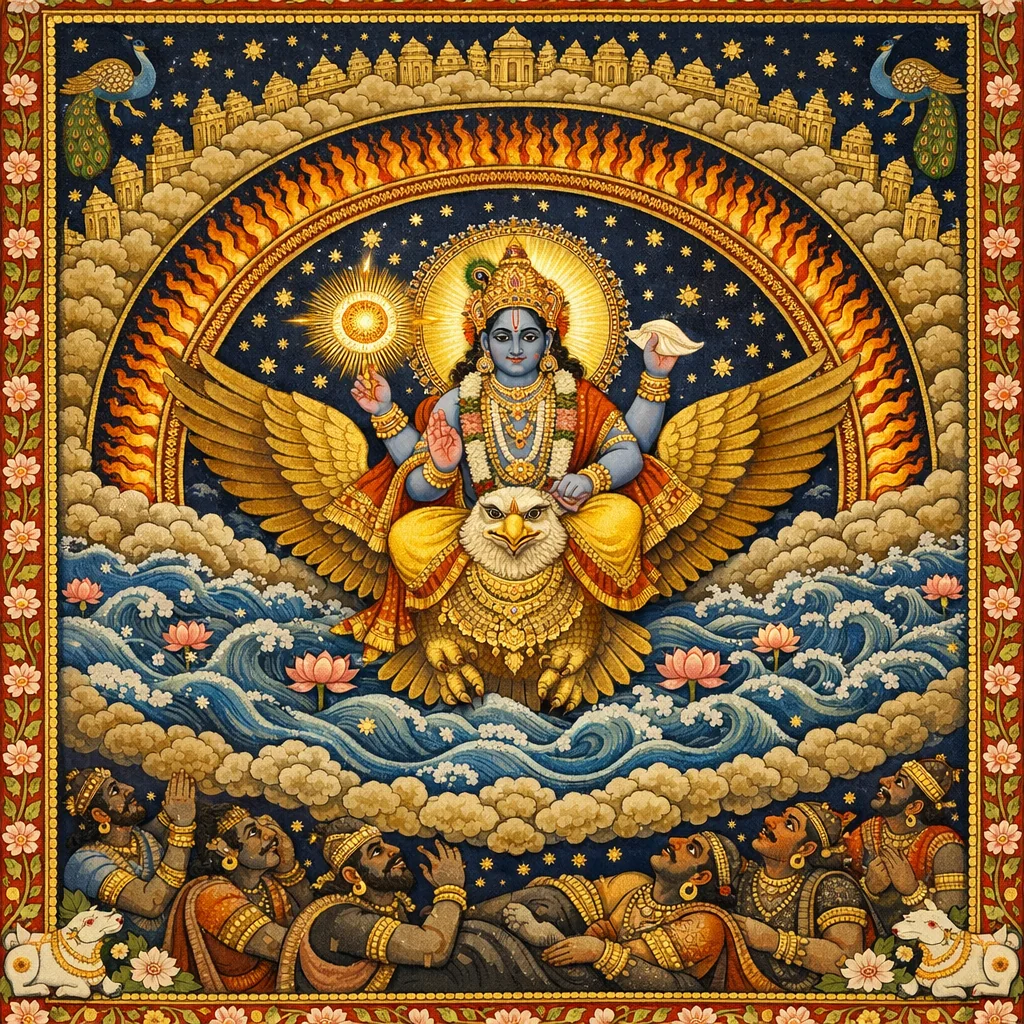
Prompted by Parīkṣit’s inquiry, Śukadeva narrates how Indra reports Bhaumāsura’s theft of Aditi’s earrings, Varuṇa’s umbrella, and the Mandara playground. Kṛṣṇa, accompanied by Satyabhāmā, rides Garuḍa to Prāgyotiṣa-pura, penetrating layered fortifications (rock, weapons, fire-water-wind, and mura-pāśa cables) through precise use of divine weapons. The demon Mura rises from the moat and attacks Garuḍa; Kṛṣṇa neutralizes his missiles and beheads him with the cakra. Bhauma’s commanders and Mura’s sons are destroyed; then Narakāsura himself is isolated, his forces routed by Kṛṣṇa’s arrows and Garuḍa’s assault. Kṛṣṇa decapitates Bhauma with the cakra, after which Bhūmi-devī offers the stolen regalia and praises Kṛṣṇa’s transcendence beyond the guṇas, requesting protection for Bhauma’s son—granted as fearlessness. Entering the palace, Kṛṣṇa finds sixteen thousand abducted princesses, sends them honorably to Dvārakā with wealth, returns Aditi’s earrings, and—at Satyabhāmā’s request—takes the heavenly pārijāta, leading into the subsequent Indra conflict and Dvārakā domestic līlās where Kṛṣṇa marries the rescued princesses by expanding into many forms.
Shlokas
Verse 1
श्रीराजोवाच यथा हतो भगवता भौमो येने च ता: स्त्रिय: । निरुद्धा एतदाचक्ष्व विक्रमं शार्ङ्गधन्वन: ॥ १ ॥
[King Parīkṣit said:] How was Bhaumāsura, who kidnapped so many women, killed by the Supreme Lord? Please narrate this adventure of Lord Śārṅgadhanvā’s.
Verse 2
श्रीशुक उवाच इन्द्रेण हृतछत्रेण हृतकुण्डलबन्धुना । हृतामराद्रिस्थानेन ज्ञापितो भौमचेष्टितम् । सभार्यो गरुडारूढ: प्राग्ज्योतिषपुरं ययौ ॥ २ ॥ गिरिदुर्गै: शस्त्रदुर्गैर्जलाग्न्यनिलदुर्गमम् । मुरपाशायुतैर्घोरैर्दृढै: सर्वत आवृतम् ॥ ३ ॥
Śukadeva Gosvāmī said: After Bhauma had stolen the earrings belonging to Indra’s mother, along with Varuṇa’s umbrella and the demigods’ playground at the peak of Mandara mountain, Indra went to Lord Kṛṣṇa and informed Him of these misdeeds. The Lord, taking His wife Satyabhāmā with Him, then rode on Garuḍa to Prāgyotiṣa-pura, which was surrounded on all sides by fortifications consisting of hills, unmanned weapons, water, fire and wind, and by obstructions of mura-pāśa wire.
Verse 3
श्रीशुक उवाच इन्द्रेण हृतछत्रेण हृतकुण्डलबन्धुना । हृतामराद्रिस्थानेन ज्ञापितो भौमचेष्टितम् । सभार्यो गरुडारूढ: प्राग्ज्योतिषपुरं ययौ ॥ २ ॥ गिरिदुर्गै: शस्त्रदुर्गैर्जलाग्न्यनिलदुर्गमम् । मुरपाशायुतैर्घोरैर्दृढै: सर्वत आवृतम् ॥ ३ ॥
Śukadeva Gosvāmī said: After Bhauma had stolen the earrings belonging to Indra’s mother, along with Varuṇa’s umbrella and the demigods’ playground at the peak of Mandara mountain, Indra went to Lord Kṛṣṇa and informed Him of these misdeeds. The Lord, taking His wife Satyabhāmā with Him, then rode on Garuḍa to Prāgyotiṣa-pura, which was surrounded on all sides by fortifications consisting of hills, unmanned weapons, water, fire and wind, and by obstructions of mura-pāśa wire.
Verse 4
गदया निर्बिभेदाद्रीन् शस्त्रदुर्गाणि सायकै: । चक्रेणाग्निं जलं वायुं मुरपाशांस्तथासिना ॥ ४ ॥
With His club the Lord broke through the rock fortifications; with His arrows, the weapon fortifications; with His disc, the fire, water and wind fortifications; and with His sword, the mura-pāśa cables.
Verse 5
शङ्खनादेन यन्त्राणि हृदयानि मनस्विनाम् । प्राकारं गदया गुर्व्या निर्बिभेद गदाधर: ॥ ५ ॥
With the sound of His conchshell Lord Gadādhara then shattered the magic seals of the fortress, along with the hearts of its brave defenders, and with His heavy club He demolished the surrounding earthen ramparts.
Verse 6
पाञ्चजन्यध्वनिं श्रुत्वा युगान्तशनिभीषणम् । मुर: शयान उत्तस्थौ दैत्य: पञ्चशिरा जलात् ॥ ६ ॥
The five-headed demon Mura, who slept at the bottom of the city’s moat, awoke and rose up out of the water when he heard the vibration of Lord Kṛṣṇa’s Pāñcajanya conchshell, a sound as terrifying as the thunder at the end of the cosmic age.
Verse 7
त्रिशूलमुद्यम्य सुदुर्निरीक्षणो युगान्तसूर्यानलरोचिरुल्बण: । ग्रसंस्त्रिलोकीमिव पञ्चभिर्मुखै- रभ्यद्रवत्तार्क्ष्यसुतं यथोरग: ॥ ७ ॥
Shining with the blinding, terrible effulgence of the sun’s fire at the end of a millennium, Mura seemed to be swallowing up the three worlds with his five mouths. He lifted up his trident and fell upon Garuḍa, the son of Tārkṣya, like an attacking snake.
Verse 8
आविध्य शूलं तरसा गरुत्मते निरस्य वक्त्रैर्व्यनदत्स पञ्चभि: । स रोदसी सर्वदिशोऽम्बरं महा- नापूरयन्नण्डकटाहमावृणोत् ॥ ८ ॥
Mura whirled his trident and then hurled it fiercely at Garuḍa, roaring from all five mouths. The sound filled the earth and sky, all directions and the limits of outer space, until it reverberated against the very shell of the universe.
Verse 9
तदापतद् वै त्रिशिखं गरुत्मते हरि: शराभ्यामभिनत्त्रिधोजसा । मुखेषु तं चापि शरैरताडयत् तस्मै गदां सोऽपि रुषा व्यमुञ्चत ॥ ९ ॥
Then with two arrows Lord Hari struck the trident flying toward Garuḍa and broke it into three pieces. Next the Lord hit Mura’s faces with several arrows, and the demon angrily hurled his club at the Lord.
Verse 10
तामापतन्तीं गदया गदां मृधे गदाग्रजो निर्बिभिदे सहस्रधा । उद्यम्य बाहूनभिधावतोऽजित: शिरांसि चक्रेण जहार लीलया ॥ १० ॥
As Mura’s club sped toward Him on the battlefield, Lord Gadāgraja intercepted it with His own and broke it into thousands of pieces. Mura then raised his arms high and rushed at the unconquerable Lord, who easily sliced off his heads with His disc weapon.
Verse 11
व्यसु: पपाताम्भसि कृत्तशीर्षो निकृत्तशृङ्गोऽद्रिरिवेन्द्रतेजसा । तस्यात्मजा: सप्त पितुर्वधातुरा: प्रतिक्रियामर्षजुष: समुद्यता: ॥ ११ ॥
Lifeless, Mura’s decapitated body fell into the water like a mountain whose peak has been severed by the power of Lord Indra’s thunderbolt. The demon’s seven sons, enraged by their father’s death, prepared to retaliate.
Verse 12
ताम्रोऽन्तरिक्ष: श्रवणो विभावसु- र्वसुर्नभस्वानरुणश्च सप्तम: । पीठं पुरस्कृत्य चमूपतिं मृधे भौमप्रयुक्ता निरगन् धृतायुधा: ॥ १२ ॥
Ordered by Bhaumāsura, Mura’s seven sons — Tāmra, Antarikṣa, Śravaṇa, Vibhāvasu, Vasu, Nabhasvān and Aruṇa — followed their general, Pīṭha, onto the battlefield bearing their weapons.
Verse 13
प्रायुञ्जतासाद्य शरानसीन् गदा: शक्त्यृष्टिशूलान्यजिते रुषोल्बणा: । तच्छस्त्रकूटं भगवान् स्वमार्गणै- रमोघवीर्यस्तिलशश्चकर्त ह ॥ १३ ॥
These fierce warriors furiously attacked invincible Lord Kṛṣṇa with arrows, swords, clubs, spears, lances and tridents, but the Supreme Lord, with unfailing prowess, cut this mountain of weapons into tiny pieces with His arrows.
Verse 14
तान् पीठमुख्याननयद् यमक्षयं निकृत्तशीर्षोरुभुजाङ्घ्रिवर्मण: । स्वानीकपानच्युतचक्रसायकै- स्तथा निरस्तान् नरको धरासुत: । निरीक्ष्य दुर्मर्षण आस्रवन्मदै- र्गजै: पयोधिप्रभवैर्निराक्रमात् ॥ १४ ॥
The Lord severed the heads, thighs, arms, legs and armor of these opponents led by Pīṭha and sent them all to the abode of Yamarāja. Narakāsura, the son of the earth, could not contain his fury when he saw the fate of his military leaders. Thus he went out of the citadel with elephants born from the Milk Ocean who were exuding mada from their foreheads out of excitement.
Verse 15
दृष्ट्वा सभार्यं गरुडोपरि स्थितं सूर्योपरिष्टात् सतडिद् घनं यथा । कृष्णं स तस्मै व्यसृजच्छतघ्नीं योधाश्च सर्वे युगपच्च विव्यधु: ॥ १५ ॥
Lord Kṛṣṇa and His wife, mounted upon Garuḍa, looked like a cloud with lightning sitting above the sun. Seeing the Lord, Bhauma released his Śataghnī weapon at Him, whereupon all of Bhauma’s soldiers simultaneously attacked with their weapons.
Verse 16
तद् भौमसैन्यं भगवान् गदाग्रजो विचित्रवाजैर्निशितै: शिलीमुखै: । निकृत्तबाहूरुशिरोध्रविग्रहं चकार तर्ह्येव हताश्वकुञ्जरम् ॥ १६ ॥
At that moment Lord Gadāgraja shot His sharp arrows at Bhaumāsura’s army. These arrows, displaying variegated feathers, soon reduced that army to a mass of bodies with severed arms, thighs and necks. The Lord similarly killed the opposing horses and elephants.
Verse 17
यानि योधै: प्रयुक्तानि शस्त्रास्त्राणि कुरूद्वह । हरिस्तान्यच्छिनत्तीक्ष्णै: शरैरेकैकशस्त्रिभि: ॥ १७ ॥ उह्यमान: सुपर्णेन पक्षाभ्यां निघ्नता गजान् । गुरुत्मता हन्यमानास्तुण्डपक्षनखेर्गजा: ॥ १८ ॥ पुरमेवाविशन्नार्ता नरको युध्ययुध्यत ॥ १९ ॥
Lord Hari then struck down all the missiles and weapons the enemy soldiers threw at Him, O hero of the Kurus, destroying each and every one with three sharp arrows. Meanwhile Garuḍa, as he carried the Lord, struck the enemy’s elephants with his wings. Beaten by Garuḍa’s wings, beak and talons, the elephants fled back into the city, leaving Narakāsura alone on the battlefield to oppose Kṛṣṇa.
Verse 18
यानि योधै: प्रयुक्तानि शस्त्रास्त्राणि कुरूद्वह । हरिस्तान्यच्छिनत्तीक्ष्णै: शरैरेकैकशस्त्रिभि: ॥ १७ ॥ उह्यमान: सुपर्णेन पक्षाभ्यां निघ्नता गजान् । गुरुत्मता हन्यमानास्तुण्डपक्षनखेर्गजा: ॥ १८ ॥ पुरमेवाविशन्नार्ता नरको युध्ययुध्यत ॥ १९ ॥
Lord Hari then struck down all the missiles and weapons the enemy soldiers threw at Him, O hero of the Kurus, destroying each and every one with three sharp arrows. Meanwhile Garuḍa, as he carried the Lord, struck the enemy’s elephants with his wings. Beaten by Garuḍa’s wings, beak and talons, the elephants fled back into the city, leaving Narakāsura alone on the battlefield to oppose Kṛṣṇa.
Verse 19
यानि योधै: प्रयुक्तानि शस्त्रास्त्राणि कुरूद्वह । हरिस्तान्यच्छिनत्तीक्ष्णै: शरैरेकैकशस्त्रिभि: ॥ १७ ॥ उह्यमान: सुपर्णेन पक्षाभ्यां निघ्नता गजान् । गुरुत्मता हन्यमानास्तुण्डपक्षनखेर्गजा: ॥ १८ ॥ पुरमेवाविशन्नार्ता नरको युध्ययुध्यत ॥ १९ ॥
Lord Hari then struck down all the missiles and weapons the enemy soldiers threw at Him, O hero of the Kurus, destroying each and every one with three sharp arrows. Meanwhile Garuḍa, as he carried the Lord, struck the enemy’s elephants with his wings. Beaten by Garuḍa’s wings, beak and talons, the elephants fled back into the city, leaving Narakāsura alone on the battlefield to oppose Kṛṣṇa.
Verse 20
दृष्ट्वा विद्रावितं सैन्यं गरुडेनार्दितं स्वकं । तं भौम: प्राहरच्छक्त्या वज्र: प्रतिहतो यत: । नाकम्पत तया विद्धो मालाहत इव द्विप: ॥ २० ॥
Seeing his army driven back and tormented by Garuḍa, Bhauma attacked him with his spear, which had once defeated Lord Indra’s thunderbolt. But though struck by that mighty weapon, Garuḍa was not shaken. Indeed, he was like an elephant hit with a flower garland.
Verse 21
शूलं भौमोऽच्युतं हन्तुमाददे वितथोद्यम: । तद्विसर्गात् पूर्वमेव नरकस्य शिरो हरि: । अपाहरद् गजस्थस्य चक्रेण क्षुरनेमिना ॥ २१ ॥
Bhauma, frustrated in all his attempts, took up his trident to kill Lord Kṛṣṇa. But even before he could release it, the Lord cut off his head with His razor-sharp cakra as the demon sat atop his elephant.
Verse 22
सकुण्डलं चारुकिरीटभूषणं बभौ पृथिव्यां पतितं समुज्ज्वलम् । हा हेति साध्वित्यृषय: सुरेश्वरा माल्यैर्मुकुन्दं विकिरन्त ईडिरे ॥ २२ ॥
Fallen on the ground, Bhaumāsura’s head shone brilliantly, decorated as it was with earrings and an attractive helmet. As cries of “Alas, alas!” and “Well done!” arose, the sages and principal demigods worshiped Lord Mukunda by showering Him with flower garlands.
Verse 23
ततश्च भू: कृष्णमुपेत्य कुण्डले प्रतप्तजाम्बूनदरत्नभास्वरे । सवैजयन्त्या वनमालयार्पयत् प्राचेतसं छत्रमथो महामणिम् ॥ २३ ॥
The goddess of the earth then approached Lord Kṛṣṇa and presented Him with Aditi’s earrings, which were made of glowing gold inlaid with shining jewels. She also gave Him a Vaijayantī flower garland, Varuṇa’s umbrella and the peak of Mandara Mountain.
Verse 24
अस्तौषीदथ विश्वेशं देवी देववरार्चितम् । प्राञ्जलि: प्रणता राजन् भक्तिप्रवणया धिया ॥ २४ ॥
O King, after bowing down to Him and then standing with joined palms, the goddess, her mind filled with devotion, began to praise the Lord of the universe, whom the best of demigods worship.
Verse 25
भूमिरुवाच नमस्ते देवदेवेश शङ्खचक्रगदाधर । भक्तेच्छोपात्तरूपाय परमात्मन् नमोऽस्तु ते ॥ २५ ॥
Goddess Bhūmi said: Obeisances unto You, O Lord of the chief demigods, O holder of the conchshell, disc and club. O Supreme Soul within the heart, You assume Your various forms to fulfill Your devotees’ desires. Obeisances unto You.
Verse 26
नम: पङ्कजनाभाय नम: पङ्कजमालिने । नम: पङ्कजनेत्राय नमस्ते पङ्कजाङ्घ्रये ॥ २६ ॥
My respectful obeisances are unto You, O Lord, whose abdomen is marked with a depression like a lotus flower, who are always decorated with garlands of lotus flowers, whose glance is as cool as the lotus and whose feet are engraved with lotuses.
Verse 27
नमो भगवते तुभ्यं वासुदेवाय विष्णवे । पुरुषायादिबीजाय पूर्णबोधाय ते नम: ॥ २७ ॥
Obeisances unto You, the Supreme Lord Vāsudeva, Viṣṇu, the primeval person, the original seed. Obeisances unto You, the omniscient one.
Verse 28
अजाय जनयित्रेऽस्य ब्रह्मणेऽनन्तशक्तये । परावरात्मन् भूतात्मन् परमात्मन् नमोऽस्तु ते ॥ २८ ॥
Obeisances unto You of unlimited energies, the unborn progenitor of this universe, the Absolute. O Soul of the high and the low, O Soul of the created elements, O all-pervading Supreme Soul, obeisances unto You.
Verse 29
त्वं वै सिसृक्षुरज उत्कटं प्रभो तमो निरोधाय बिभर्ष्यसंवृत: । स्थानाय सत्त्वं जगतो जगत्पते काल: प्रधानं पुरुषो भवान् पर: ॥ २९ ॥
Desiring to create, O unborn master, You increase and then assume the mode of passion. You do likewise with the mode of ignorance when You wish to annihilate the universe and with goodness when You wish to maintain it. Nonetheless, You remain uncovered by these modes. You are time, the pradhāna, and the puruṣa, O Lord of the universe, yet still You are separate and distinct.
Verse 30
अहं पयो ज्योतिरथानिलो नभो मात्राणि देवा मन इन्द्रियाणि । कर्ता महानित्यखिलं चराचरं त्वय्यद्वितीये भगवन्नयं भ्रम: ॥ ३० ॥
This is illusion: that earth, water, fire, air, ether, sense objects, demigods, mind, the senses, false ego and the total material energy exist independent of You. In fact, they are all within You, my Lord, who are one without a second.
Verse 31
तस्यात्मजोऽयं तव पादपङ्कजं भीत: प्रपन्नार्तिहरोपसादित: । तत् पालयैनं कुरु हस्तपङ्कजं शिरस्यमुष्याखिलकल्मषापहम् ॥ ३१ ॥
Here is the son of Bhaumāsura. Frightened, he is approaching Your lotus feet, since You remove the distress of all who seek refuge in You. Please protect him. Place Your lotus hand, which dispels all sins, upon his head.
Verse 32
श्रीशुक उवाच इति भूम्यर्थितो वाग्भिर्भगवान् भक्तिनम्रया । दत्त्वाभयं भौमगृहं प्राविशत् सकलर्द्धिमत् ॥ ३२ ॥
Śukadeva Gosvāmī said: Thus entreated by Goddess Bhūmi in words of humble devotion, the Supreme Lord bestowed fearlessness upon her grandson and then entered Bhaumāsura’s palace, which was filled with all manner of riches.
Verse 33
तत्र राजन्यकन्यानां षट्सहस्राधिकायुतम् । भौमाहृतानां विक्रम्य राजभ्यो ददृशे हरि: ॥ ३३ ॥
There Lord Kṛṣṇa saw sixteen thousand royal maidens, whom Bhauma had taken by force from various kings.
Verse 34
तं प्रविष्टं स्त्रियो वीक्ष्य नरवर्यं विमोहिता: । मनसा वव्रिरेऽभीष्टं पतिं दैवोपसादितम् ॥ ३४ ॥
The women became enchanted when they saw that most excellent of males enter. In their minds they each accepted Him, who had been brought there by destiny, as their chosen husband.
Verse 35
भूयात् पतिरयं मह्यं धाता तदनुमोदताम् । इति सर्वा: पृथक् कृष्णे भावेन हृदयं दधु: ॥ ३५ ॥
With the thought “May providence grant that this man become my husband,” each and every princess absorbed her heart in contemplation of Kṛṣṇa.
Verse 36
ता: प्राहिणोद्द्वारवतीं सुमृष्टविरजोऽम्बरा: । नरयानैर्महाकोशान् रथाश्वान् द्रविणं महत् ॥ ३६ ॥
The Lord had the princesses arrayed in clean, spotless garments and then sent them in palanquins to Dvārakā, together with great treasures of chariots, horses and other valuables.
Verse 37
ऐरावतकुलेभांश्च चतुर्दन्तांस्तरस्विन: । पाण्डुरांश्च चतु:षष्टिं प्रेरयामास केशव: ॥ ३७ ॥
Lord Kṛṣṇa also dispatched sixty-four swift white elephants, descendants of Airāvata, who each sported four tusks.
Verse 38
गत्वा सुरेन्द्रभवनं दत्त्वादित्यै च कुण्डले । पूजितस्त्रिदशेन्द्रेण महेन्द्रयाण्या च सप्रिय: ॥ ३८ ॥ चोदितो भार्ययोत्पाट्य पारिजातं गरुत्मति । आरोप्य सेन्द्रान् विबुधान् निर्जित्योपानयत्पुरम् ॥ ३९ ॥
The Lord then went to the abode of Indra, the demigods’ king, and gave mother Aditi her earrings; there Indra and his wife worshiped Kṛṣṇa and His beloved consort Satyabhāmā. Then, at Satyabhāmā’s behest the Lord uprooted the heavenly pārijāta tree and put it on the back of Garuḍa. After defeating Indra and all the other demigods, Kṛṣṇa brought the pārijāta to His capital.
Verse 39
गत्वा सुरेन्द्रभवनं दत्त्वादित्यै च कुण्डले । पूजितस्त्रिदशेन्द्रेण महेन्द्रयाण्या च सप्रिय: ॥ ३८ ॥ चोदितो भार्ययोत्पाट्य पारिजातं गरुत्मति । आरोप्य सेन्द्रान् विबुधान् निर्जित्योपानयत्पुरम् ॥ ३९ ॥
The Lord then went to the abode of Indra, the demigods’ king, and gave mother Aditi her earrings; there Indra and his wife worshiped Kṛṣṇa and His beloved consort Satyabhāmā. Then, at Satyabhāmā’s behest the Lord uprooted the heavenly pārijāta tree and put it on the back of Garuḍa. After defeating Indra and all the other demigods, Kṛṣṇa brought the pārijāta to His capital.
Verse 40
स्थापित: सत्यभामाया गृहोद्यानोपशोभन: । अन्वगुर्भ्रमरा: स्वर्गात् तद्गन्धासवलम्पटा: ॥ ४० ॥
Once planted, the pārijāta tree beautified the garden of Queen Satyabhāmā’s palace. Bees followed the tree all the way from heaven, greedy for its fragrance and sweet sap.
Verse 41
ययाच आनम्य किरीटकोटिभि: पादौ स्पृशन्नच्युतमर्थसाधनम् । सिद्धार्थ एतेन विगृह्यते महा- नहो सुराणां च तमो धिगाढ्यताम् ॥ ४१ ॥
Even after Indra had bowed down to Lord Acyuta, touched His feet with the tips of his crown and begged the Lord to fulfill his desire, that exalted demigod, having achieved his purpose, chose to fight with the Supreme Lord. What ignorance there is among the gods! To hell with their opulence!
Verse 42
अथो मुहूर्त एकस्मिन् नानागारेषु ता: स्त्रिय: । यथोपयेमे भगवान् तावद् रूपधरोऽव्यय: ॥ ४२ ॥
Then the imperishable Supreme Personality, assuming a separate form for each bride, duly married all the princesses simultaneously, each in her own palace.
Verse 43
गृहेषु तासामनपाय्यतर्ककृ- न्निरस्तसाम्यातिशयेष्ववस्थित: । रेमे रमाभिर्निजकामसम्प्लुतो यथेतरो गार्हकमेधिकांश्चरन् ॥ ४३ ॥
The Lord, performer of the inconceivable, constantly remained in each of His queens’ palaces, which were unequaled and unexcelled by any other residence. There, although fully satisfied within Himself, He enjoyed with His pleasing wives, and like an ordinary husband He carried out His household duties.
Verse 44
इत्थं रमापतिमवाप्य पतिं स्त्रियस्ता ब्रह्मादयोऽपि न विदु: पदवीं यदीयाम् । भेजुर्मुदाविरतमेधितयानुराग- हासावलोकनवसङ्गमजल्पलज्जा: ॥ ४४ ॥
Thus those women obtained as their husband the husband of the goddess of fortune, although even great demigods like Brahmā do not know how to approach Him. With ever-increasing pleasure they experienced loving attraction for Him, exchanged smiling glances with Him and reciprocated with Him in ever-fresh intimacy, replete with joking and feminine shyness.
Verse 45
प्रत्युद्गमासनवरार्हणपादशौच- ताम्बूलविश्रमणवीजनगन्धमाल्यै: । केशप्रसारशयनस्नपनोपहार्यै- र्दासीशता अपि विभोर्विदधु: स्म दास्यम् ॥ ४५ ॥
Although the Supreme Lord’s queens each had hundreds of maidservants, they chose to personally serve the Lord by approaching Him humbly, offering Him a seat, worshiping Him with excellent paraphernalia, bathing and massaging His feet, giving Him pān to chew, fanning Him, anointing Him with fragrant sandalwood paste, adorning Him with flower garlands, dressing His hair, arranging His bed, bathing Him, and presenting Him with various gifts.
Frequently Asked Questions
Kṛṣṇa penetrates Naraka’s heavily protected capital Prāgyotiṣa-pura by countering each defensive layer with an appropriate divine weapon (gadā, arrows, cakra, and sword). After defeating Mura and Naraka’s commanders, He isolates Narakāsura on the battlefield and severs his head with the Sudarśana cakra while Naraka sits upon his elephant—demonstrating the Lord’s precise, effortless sovereignty over asuric power.
Mura is the five-headed guardian demon who rises from the moat to defend Prāgyotiṣa-pura. His death marks the collapse of the city’s protective threshold: once the ‘gatekeeper’ of adharma is removed, Naraka’s military structure rapidly fails. The episode also showcases poṣaṇa—Kṛṣṇa’s protection of Garuḍa and His devotees—by neutralizing Mura’s trident and assault.
Her stuti functions as siddhānta embedded in itihāsa: even while acting as a warrior-king, Kṛṣṇa remains the guṇa-atīta Absolute who orchestrates creation, maintenance, and destruction without being conditioned by rajas, sattva, or tamas. This frames the slaying of Naraka not as ordinary violence but as īśānukathā—divine governance restoring cosmic and social order.
Bhūmi-devī presents Naraka’s frightened son (her grandson) to Kṛṣṇa and requests protection. Kṛṣṇa grants him fearlessness, indicating the Bhāgavata principle that surrender (even through a guardian’s plea) invokes the Lord’s shelter; the narrative emphasizes mercy and continuity of rightful order after the removal of a tyrant.
The princesses had been abducted and socially displaced by Naraka’s coercion; Kṛṣṇa’s marriage restores their honor and provides lawful protection within dharma. The Bhāgavata further teaches His inconceivable potency (acintya-śakti): He expands into separate forms to marry them simultaneously, showing that divine intimacy and divine infinity are not contradictory.
Returning Aditi’s earrings completes the dharmic restitution that motivated the campaign—Kṛṣṇa protects the devas by correcting theft rooted in asuric dominance. Taking the pārijāta at Satyabhāmā’s request transitions the narrative into the deva–Bhagavān tension: even after being benefited, Indra contests Kṛṣṇa, illustrating how pride can persist despite worship, and setting up the next chapter’s conflict and resolution.