Adhyaya 52
Mucukunda’s Departure; Jarāsandha’s Pursuit; Prelude to Rukmiṇī’s Abduction (Rukmiṇī’s Message Begins)
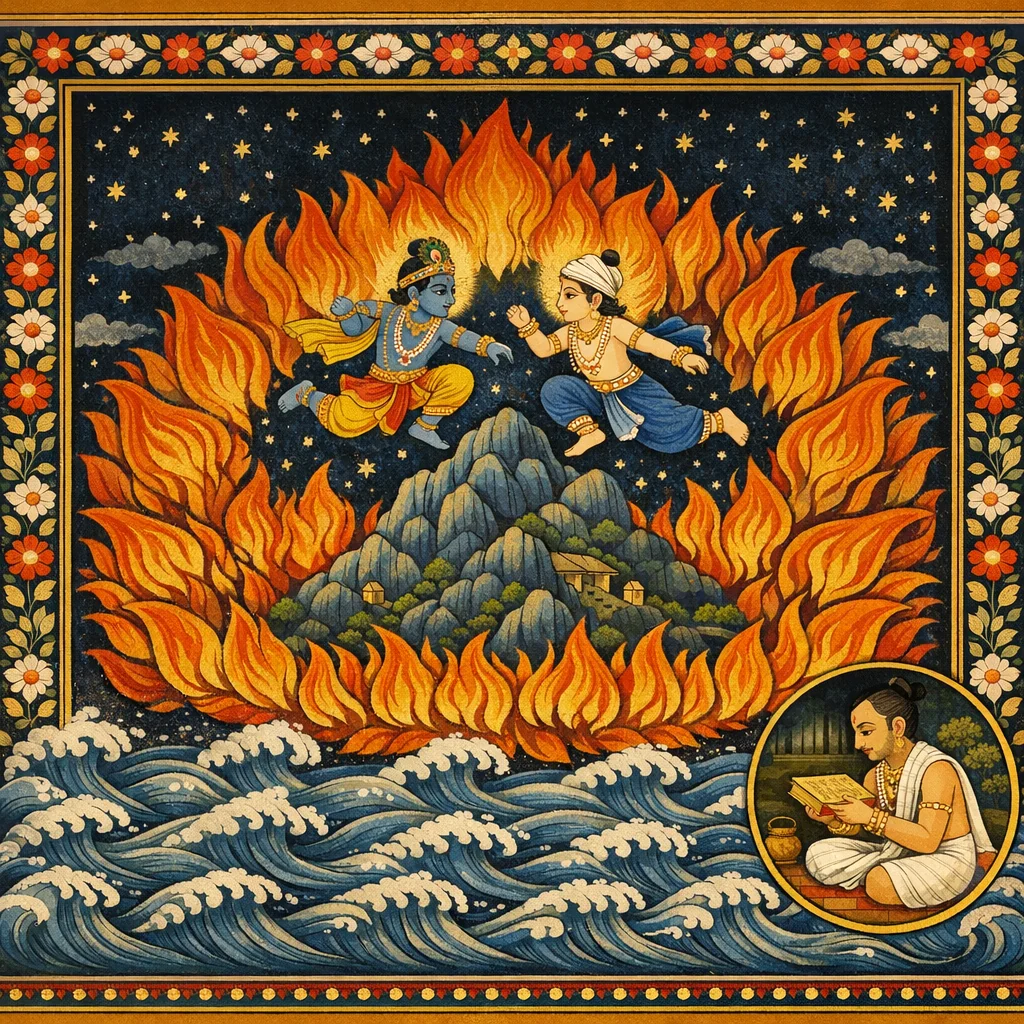
This chapter bridges two narrative streams: the aftermath of Kṛṣṇa’s grace to King Mucukunda and the political escalation that sets the stage for Kṛṣṇa’s marriage to Rukmiṇī. Having received the Lord’s benediction, Mucukunda circumambulates Kṛṣṇa, exits the cave, perceives the diminished stature of beings as a sign of Kali-yuga’s onset, and departs north to Gandhamādana and Badarikāśrama to worship Nara-Nārāyaṇa through austerity—showing the Bhāgavata’s theme of renunciation anchored in devotion. Meanwhile, Kṛṣṇa returns to Mathurā, defeats the surrounding Yavanas, and transports their wealth toward Dvārakā, when Jarāsandha arrives with twenty-three armies. Kṛṣṇa and Balarāma, ‘imitating human behavior’ (nara-līlā), flee, abandon the riches, and ascend Pravarṣaṇa Mountain; Jarāsandha burns it, but the Lords leap unseen and return safely to ocean-protected Dvārakā, while Jarāsandha mistakenly withdraws. The chapter then pivots to dynastic and marital developments: Balarāma’s marriage to Raivatī is recalled, and Kṛṣṇa’s forthcoming marriage to Bhīṣmaka’s daughter Rukmiṇī is introduced. Parīkṣit’s curiosity prompts Śukadeva to begin the Vidarbha narrative: Bhīṣmaka’s family, Rukmiṇī’s choice of Kṛṣṇa, Rukmī’s opposition and plan to marry her to Śiśupāla, and Rukmiṇī’s confidential letter sent via a brāhmaṇa messenger—ending as the message is delivered and Kṛṣṇa is asked to act immediately, leading directly into the next chapter’s detailed unfolding of the elopement plan.
Shlokas
Verse 1
श्रीशुक उवाच इत्थं सोऽनग्रहीतोऽङ्ग कृष्णेनेक्ष्वाकुनन्दन: । तं परिक्रम्य सन्नम्य निश्चक्राम गुहामुखात् ॥ १ ॥
Śukadeva Gosvāmī said: My dear King, thus graced by Lord Kṛṣṇa, Mucukunda circumambulated Him and bowed down to Him. Then Mucukunda, the beloved descendant of Ikṣvāku, exited through the mouth of the cave.
Verse 2
संवीक्ष्य क्षुल्लकान् मर्त्यान् पशून्वीरुद्वनस्पतीन् । मत्वा कलियुगं प्राप्तं जगाम दिशमुत्तराम् ॥ २ ॥
Seeing that the size of all the human beings, animals, trees and plants was severely reduced, and thus realizing that the Age of Kali was at hand, Mucukunda left for the north.
Verse 3
तप:श्रद्धायुतो धीरो नि:सङ्गो मुक्तसंशय: । समाधाय मन: कृष्णे प्राविशद् गन्धमादनम् ॥ ३ ॥
The sober King, beyond material association and free of doubt, was convinced of the value of austerity. Absorbing his mind in Lord Kṛṣṇa, he came to Gandhamādana Mountain.
Verse 4
बदर्याश्रममासाद्य नरनारायणालयम् । सर्वद्वन्द्वसह: शान्तस्तपसाराधयद्धरिम् ॥ ४ ॥
There he arrived at Badarikāśrama, the abode of Lord Nara-Nārāyaṇa, where, remaining tolerant of all dualities, he peacefully worshiped the Supreme Lord Hari by performing severe austerities.
Verse 5
भगवान् पुनराव्रज्य पुरीं यवनवेष्टिताम् । हत्वा म्लेच्छबलं निन्ये तदीयं द्वारकां धनम् ॥ ५ ॥
The Lord returned to Mathurā, which was still surrounded by Yavanas. Then He destroyed the army of barbarians and began taking their valuables to Dvārakā.
Verse 6
नीयमाने धने गोभिर्नृभिश्चाच्युतचोदितै: । आजगाम जरासन्धस्त्रयोविंशत्यनीकप: ॥ ६ ॥
As the wealth was being carried by oxen and men under Lord Kṛṣṇa’s direction, Jarāsandha appeared at the head of twenty-three armies.
Verse 7
विलोक्य वेगरभसं रिपुसैन्यस्य माधवौ । मनुष्यचेष्टामापन्नौ राजन् दुद्रुवतुर्द्रुतम् ॥ ७ ॥
O King, seeing the fierce waves of the enemy’s army, the two Mādhavas, imitating human behavior, ran swiftly away.
Verse 8
विहाय वित्तं प्रचुरमभीतौ भीरुभीतवत् । पद्भ्यां पद्मपलाशाभ्यां चेलतुर्बहुयोजनम् ॥ ८ ॥
Abandoning the abundant riches, fearless but feigning fear, They went many yojanas on Their lotuslike feet.
Verse 9
पलायमानौ तौ दृष्ट्वा मागध: प्रहसन्बली । अन्वधावद् रथानीकैरीशयोरप्रमाणवित् ॥ ९ ॥
When he saw Them fleeing, powerful Jarāsandha laughed loudly and then pursued Them with charioteers and foot soldiers. He could not understand the exalted position of the two Lords.
Verse 10
प्रद्रुत्य दूरं संश्रान्तौ तुङ्गमारुहतां गिरिम् । प्रवर्षणाख्यं भगवान् नित्यदा यत्र वर्षति ॥ १० ॥
Apparently exhausted after fleeing a long distance, the two Lords climbed a high mountain named Pravarṣaṇa, upon which Lord Indra showers incessant rain.
Verse 11
गिरौ निलीनावाज्ञाय नाधिगम्य पदं नृप । ददाह गिरिमेधोभि: समन्तादग्निमुत्सृजन् ॥ ११ ॥
Although he knew They were hiding on the mountain, Jarāsandha could find no trace of Them. Therefore, O King, he placed firewood on all sides and set the mountain ablaze.
Verse 12
तत उत्पत्य तरसा दह्यमानतटादुभौ । दशैकयोजनात्तुङ्गान्निपेततुरधो भुवि ॥ १२ ॥
The two of Them then suddenly jumped from the burning mountain, which was eleven yojanas high, and fell to the ground.
Verse 13
अलक्ष्यमाणौ रिपुणा सानुगेन यदूत्तमौ । स्वपुरं पुनरायातौ समुद्रपरिखां नृप ॥ १३ ॥
Unseen by Their opponent or his followers, O King, those two most exalted Yadus returned to Their city of Dvārakā, which had the ocean as a protective moat.
Verse 14
सोऽपि दग्धाविति मृषा मन्वानो बलकेशवौ । बलमाकृष्य सुमहन्मगधान् मागधो ययौ ॥ १४ ॥
Jarāsandha, moreover, mistakenly thought that Balarāma and Keśava had burned to death in the fire. Thus he withdrew his vast military force and returned to the Magadha kingdom.
Verse 15
आनर्ताधिपति: श्रीमान् रैवतो रैवतीं सुताम् । ब्रह्मणा चोदित: प्रादाद् बलायेति पुरोदितम् ॥ १५ ॥
As ordered by Lord Brahmā, Raivata, the opulent ruler of Ānarta, gave Lord Balarāma his daughter Raivatī in marriage. This has already been discussed.
Verse 16
भगवानपि गोविन्द उपयेमे कुरूद्वह । वैदर्भीं भीष्मकसुतां श्रियो मात्रां स्वयंवरे ॥ १६ ॥ प्रमथ्य तरसा राज्ञ: शाल्वादींश्चैद्यपक्षगान् । पश्यतां सर्वलोकानां तार्क्ष्यपुत्र: सुधामिव ॥ १७ ॥
O hero among the Kurus, the Supreme Lord Himself, Govinda, married Bhīṣmaka’s daughter, Vaidarbhī, who was a direct expansion of the goddess of fortune. The Lord did this by her desire, and in the process He beat down Śālva and other kings who took Śiśupāla’s side. Indeed, as everyone watched, Śrī Kṛṣṇa took Rukmiṇī just as Garuḍa boldly stole nectar from the demigods.
Verse 17
भगवानपि गोविन्द उपयेमे कुरूद्वह । वैदर्भीं भीष्मकसुतां श्रियो मात्रां स्वयंवरे ॥ १६ ॥ प्रमथ्य तरसा राज्ञ: शाल्वादींश्चैद्यपक्षगान् । पश्यतां सर्वलोकानां तार्क्ष्यपुत्र: सुधामिव ॥ १७ ॥
O hero among the Kurus, the Supreme Lord Himself, Govinda, married Bhīṣmaka’s daughter, Vaidarbhī, who was a direct expansion of the goddess of fortune. The Lord did this by her desire, and in the process He beat down Śālva and other kings who took Śiśupāla’s side. Indeed, as everyone watched, Śrī Kṛṣṇa took Rukmiṇī just as Garuḍa boldly stole nectar from the demigods.
Verse 18
श्रीराजोवाच भगवान् भीष्मकसुतां रुक्मिणीं रुचिराननाम् । राक्षसेन विधानेन उपयेम इति श्रुतम् ॥ १८ ॥
King Parīkṣit said: The Supreme Lord married Rukmiṇī, the beautiful-faced daughter of Bhīṣmaka, in the Rākṣasa style — or so I have heard.
Verse 19
भगवन् श्रोतुमिच्छामि कृष्णस्यामिततेजस: । यथा मागधशाल्वादीन् जित्वा कन्यामुपाहरत् ॥ १९ ॥
My lord, I wish to hear how the immeasurably powerful Lord Kṛṣṇa took away His bride while defeating such kings as Māgadha and Sālva.
Verse 20
ब्रह्मन् कृष्णकथा: पुण्या माध्वीर्लोकमलापहा: । को नु तृप्येत शृण्वान: श्रुतज्ञो नित्यनूतना: ॥ २० ॥
What experienced listener, O brāhmaṇa, could ever grow satiated while listening to the pious, charming and ever-fresh topics of Lord Kṛṣṇa, which cleanse away the world’s contamination?
Verse 21
श्रीबादरायणिरुवाच राजासीद् भीष्मको नाम विदर्भाधिपतिर्महान् । तस्य पञ्चाभवन् पुत्रा: कन्यैका च वरानना ॥ २१ ॥
Śrī Bādarāyaṇi said: There was a king named Bhīṣmaka, the powerful ruler of Vidarbha. He had five sons and one daughter of lovely countenance.
Verse 22
रुक्म्यग्रजो रुक्मरथो रुक्मबाहुरनन्तर: । रुक्मकेशो रुक्ममाली रुक्मिण्येषा स्वसा सती ॥ २२ ॥
Rukmī was the first-born son, followed by Rukmaratha, Rukmabāhu, Rukmakeśa and Rukmamālī. Their sister was the exalted Rukmiṇī.
Verse 23
सोपश्रुत्य मुकुन्दस्य रूपवीर्यगुणश्रिय: । गृहागतैर्गीयमानास्तं मेने सदृशं पतिम् ॥ २३ ॥
Hearing of the beauty, prowess, transcendental character and opulence of Mukunda from visitors to the palace who sang His praises, Rukmiṇī decided that He would be the perfect husband for her.
Verse 24
तां बुद्धिलक्षणौदार्यरूपशीलगुणाश्रयाम् । कृष्णश्च सदृशीं भार्यां समुद्वोढुं मनो दधे ॥ २४ ॥
Lord Kṛṣṇa knew that Rukmiṇī possessed intelligence, auspicious bodily markings, magnanimity, beauty, proper behavior and all other good qualities. Concluding that she would be an ideal wife for Him, He made up His mind to marry her.
Verse 25
बन्धूनामिच्छतां दातुं कृष्णाय भगिनीं नृप । ततो निवार्य कृष्णद्विड् रुक्मी चैद्यममन्यत ॥ २५ ॥
O King, because Rukmī envied the Lord, he forbade his family members to give his sister to Kṛṣṇa, although they wanted to. Instead, Rukmī decided to give Rukmiṇī to Śiśupāla.
Verse 26
तदवेत्यासितापाङ्गी वैदर्भी दुर्मना भृशम् । विचिन्त्याप्तं द्विजं कञ्चित् कृष्णाय प्राहिणोद्द्रुतम् ॥ २६ ॥
Dark-eyed Vaidarbhī was aware of this plan, and it deeply upset her. Analyzing the situation, she quickly sent a trustworthy brāhmaṇa to Kṛṣṇa.
Verse 27
द्वारकां स समभ्येत्य प्रतीहारै: प्रवेशित: । अपश्यदाद्यं पुरुषमासीनं काञ्चनासने ॥ २७ ॥
Upon reaching Dvārakā, the brāhmaṇa was brought inside by the gatekeepers and saw the primeval Personality of Godhead sitting on a golden throne.
Verse 28
दृष्ट्वा ब्रह्मण्यदेवस्तमवरुह्य निजासनात् । उपवेश्यार्हयां चक्रे यथात्मानं दिवौकस: ॥ २८ ॥
Seeing the brāhmaṇa, Śrī Kṛṣṇa, Lord of the brāhmaṇas, came down from His throne and seated him. Then the Lord worshiped him just as He Himself is worshiped by the demigods.
Verse 29
तं भुक्तवन्तं विश्रान्तमुपगम्य सतां गति: । पाणिनाभिमृशन् पादावव्यग्रस्तमपृच्छत ॥ २९ ॥
After the brāhmaṇa had eaten and rested, Śrī Kṛṣṇa, the goal of saintly devotees, came forward, and while massaging the brāhmaṇa’s feet with His own hands, He patiently questioned him as follows.
Verse 30
कच्चिद् द्विजवरश्रेष्ठ धर्मस्ते वृद्धसम्मत: । वर्तते नातिकृच्छ्रेण सन्तुष्टमनस: सदा ॥ ३० ॥
[The Supreme Lord said:] O best of exalted brāhmaṇas, are your religious practices, sanctioned by senior authorities, proceeding without great difficulty? Is your mind always fully satisfied?
Verse 31
सन्तुष्टो यर्हि वर्तेत ब्राह्मणो येन केनचित् । अहीयमान: स्वद्धर्मात् स ह्यस्याखिलकामधुक् ॥ ३१ ॥
When a brāhmaṇa is satisfied with whatever comes his way and does not fall away from his religious duties, those very religious principles become his desire cow, fulfilling all his wishes.
Verse 32
असन्तुष्टोऽसकृल्लोकानाप्नोत्यपि सुरेश्वर: । अकिञ्चनोऽपि सन्तुष्ट: शेते सर्वाङ्गविज्वर: ॥ ३२ ॥
An unsatisfied brāhmaṇa wanders restlessly from one planet to another, even if he becomes King of heaven. But a satisfied brāhmaṇa, though he may possess nothing, rests peacefully, all his limbs free of distress.
Verse 33
विप्रान् स्वलाभसन्तुष्टान् साधून् भूतसुहृत्तमान् । निरहङ्कारिण: शान्तान् नमस्ये शिरसासकृत् ॥ ३३ ॥
I repeatedly bow My head in respect to those brāhmaṇas who are satisfied with their lot. Saintly, prideless and peaceful, they are the best well-wishers of all living beings.
Verse 34
कच्चिद् व: कुशलं ब्रह्मन् राजतो यस्य हि प्रजा: । सुखं वसन्ति विषये पाल्यमाना: स मे प्रिय: ॥ ३४ ॥
O brāhmaṇa, is your King attending to your welfare? Indeed, that king in whose country the citizens are happy and protected is very dear to Me.
Verse 35
यतस्त्वमागतो दुर्गं निस्तीर्येह यदिच्छया । सर्वं नो ब्रूह्यगुह्यं चेत् किं कार्यं करवाम ते ॥ ३५ ॥
Whence have you come, crossing the impassable sea, and for what purpose? Explain all this to Us if it is not a secret, and tell Us what We may do for you.
Verse 36
एवं सम्पृष्टसम्प्रश्नो ब्राह्मण: परमेष्ठिना । लीलागृहीतदेहेन तस्मै सर्वमवर्णयत् ॥ ३६ ॥
Thus questioned by the Supreme Personality of Godhead, who incarnates to perform His pastimes, the brāhmaṇa told Him everything.
Verse 37
श्रीरुक्मिण्युवाच श्रुत्वा गुणान् भुवनसुन्दर शृण्वतां ते निर्विश्य कर्णविवरैर्हरतोऽङ्गतापम् । रूपं दृशां दृशिमतामखिलार्थलाभं त्वय्यच्युताविशति चित्तमपत्रपं मे ॥ ३७ ॥
Śrī Rukmiṇī said [in her letter, as read by the brāhmaṇa]: O beauty of the worlds, having heard of Your qualities, which enter the ears of those who hear and remove their bodily distress, and having also heard of Your beauty, which fulfills all the visual desires of those who see, I have fixed my shameless mind upon You, O Kṛṣṇa.
Verse 38
का त्वा मुकुन्द महती कुलशीलरूप- विद्यावयोद्रविणधामभिरात्मतुल्यम् । धीरा पतिं कुलवती न वृणीत कन्या काले नृसिंह नरलोकमनोऽभिरामम् ॥ ३८ ॥
O Mukunda, You are equal only to Yourself in lineage, character, beauty, knowledge, youthfulness, wealth and influence. O lion among men, You delight the minds of all mankind. What aristocratic, sober-minded and marriageable girl of a good family would not choose You as her husband when the proper time has come?
Verse 39
तन्मे भवान् खलु वृत: पतिरङ्ग जाया- मात्मार्पितश्च भवतोऽत्र विभो विधेहि । मा वीरभागमभिमर्शतु चैद्य आराद् गोमायुवन्मृगपतेर्बलिमम्बुजाक्ष ॥ ३९ ॥
Therefore, my dear Lord, I have chosen You as my husband, and I surrender myself to You. Please come swiftly, O almighty one, and make me Your wife. My dear lotus-eyed Lord, let Śiśupāla never touch the hero’s portion like a jackal stealing the property of a lion.
Verse 40
पूर्तेष्टदत्तनियमव्रतदेवविप्र- गुर्वर्चनादिभिरलं भगवान् परेश: । आराधितो यदि गदाग्रज एत्य पाणिं गृह्णातु मे न दमघोषसुतादयोऽन्ये ॥ ४० ॥
If I have sufficiently worshiped the Supreme Personality of Godhead by pious works, sacrifices, charity, rituals and vows, and also by worshiping the demigods, brāhmaṇas and gurus, then may Gadāgraja come and take my hand, and not Damaghoṣa’s son or anyone else.
Verse 41
श्वोभाविनि त्वमजितोद्वहने विदर्भान् गुप्त: समेत्य पृतनापतिभि: परीत: । निर्मथ्य चैद्यमगधेन्द्रबलं प्रसह्य मां राक्षसेन विधिनोद्वह वीर्यशुल्काम् ॥ ४१ ॥
O unconquerable one, tomorrow when my marriage ceremony is about to begin, You should arrive unseen in Vidarbha and surround Yourself with the leaders of Your army. Then crush the forces of Caidya and Magadhendra and marry me in the Rākṣasa style, winning me with Your valor.
Verse 42
अन्त:पुरान्तरचरीमनिहत्य बन्धून्- त्वामुद्वहे कथमिति प्रवदाम्युपायम् । पूर्वेद्युरस्ति महती कुलदेवयात्रा यस्यां बहिर्नववधूर्गिरिजामुपेयात् ॥ ४२ ॥
Since I will be staying within the inner chambers of the palace, You may wonder, “How can I carry you away without killing some of your relatives?” But I shall tell You a way: On the day before the marriage there is a grand procession to honor the royal family’s deity, and in this procession the new bride goes outside the city to visit Goddess Girijā.
Verse 43
यस्याङ्घ्रिपङ्कजरज:स्नपनं महान्तो वाञ्छन्त्युमापतिरिवात्मतमोऽपहत्यै । यर्ह्यम्बुजाक्ष न लभेय भवत्प्रसादं जह्यामसून्व्रतकृशान् शतजन्मभि: स्यात् ॥ ४३ ॥
O lotus-eyed one, great souls like Lord Śiva hanker to bathe in the dust of Your lotus feet and thereby destroy their ignorance. If I cannot obtain Your mercy, I shall simply give up my vital force, which will have become weak from the severe penances I will perform. Then, after hundreds of lifetimes of endeavor, I may obtain Your mercy.
Verse 44
ब्राह्मण उवाच इत्येते गुह्यसन्देशा यदुदेव मयाहृता: । विमृश्य कर्तुं यच्चात्र क्रियतां तदनन्तरम् ॥ ४४ ॥
The brāhmaṇa said: This is the confidential message I have brought with me, O Lord of the Yadus. Please consider what must be done in these circumstances, and do it at once.
Frequently Asked Questions
The phrase signals nara-līlā: the Lords are never overpowered, yet they enact humanlike strategies to accomplish broader purposes—relieving pressure on Mathurā, repositioning events toward Dvārakā, and drawing Jarāsandha into actions that reveal his ignorance (thinking the Lords burned). This preserves the līlā’s dramatic texture while affirming the Lord’s transcendence and sovereign control.
Traditional Purāṇic descriptions of Kali include diminishing longevity, strength, and bodily stature. Mucukunda’s observation functions as a narrative marker of yuga-transition awareness and as a moral-theological cue: recognizing decline, he turns from royal identity to bhakti-infused tapas at Badarikāśrama, illustrating the Bhāgavata’s preferred response to Kali—devotional orientation and inner renunciation.
Rukmiṇī (Vaidarbhī), daughter of King Bhīṣmaka of Vidarbha, is presented as the Lord’s eternal consort in the līlā context, hence described as a direct expansion of the goddess of fortune (Śrī/Lakṣmī). The text uses this to frame the marriage not as ordinary alliance-building but as divine union, with political conflict (Śiśupāla’s party) serving as the backdrop for revealing Bhagavān’s supremacy and the devotee’s surrender.
Kṛṣṇa’s praise establishes a bhakti-ethical standard: true spiritual authority is marked by santoṣa, humility, and welfare for all beings. It also elevates the messenger’s dignity and models proper dharma for rulers and householders—suggesting that ritual status without inner contentment yields restlessness, whereas contentment grounded in dharma supports clarity, peace, and devotion.
It introduces the Vidarbha royal family, Rukmiṇī’s deliberate choice of Kṛṣṇa, the obstacle (Rukmī arranging her marriage to Śiśupāla), and the tactical solution (the Girijā temple procession). The chapter ends with the brāhmaṇa delivering Rukmiṇī’s confidential appeal and urging immediate action—creating a direct narrative handoff to the next chapter’s execution of the plan and the ensuing confrontation with rival kings.