Adhyaya 85
Vasudeva and Devakī Glorify Kṛṣṇa and Balarāma; The Recovery of Devakī’s Six Sons from Sutala
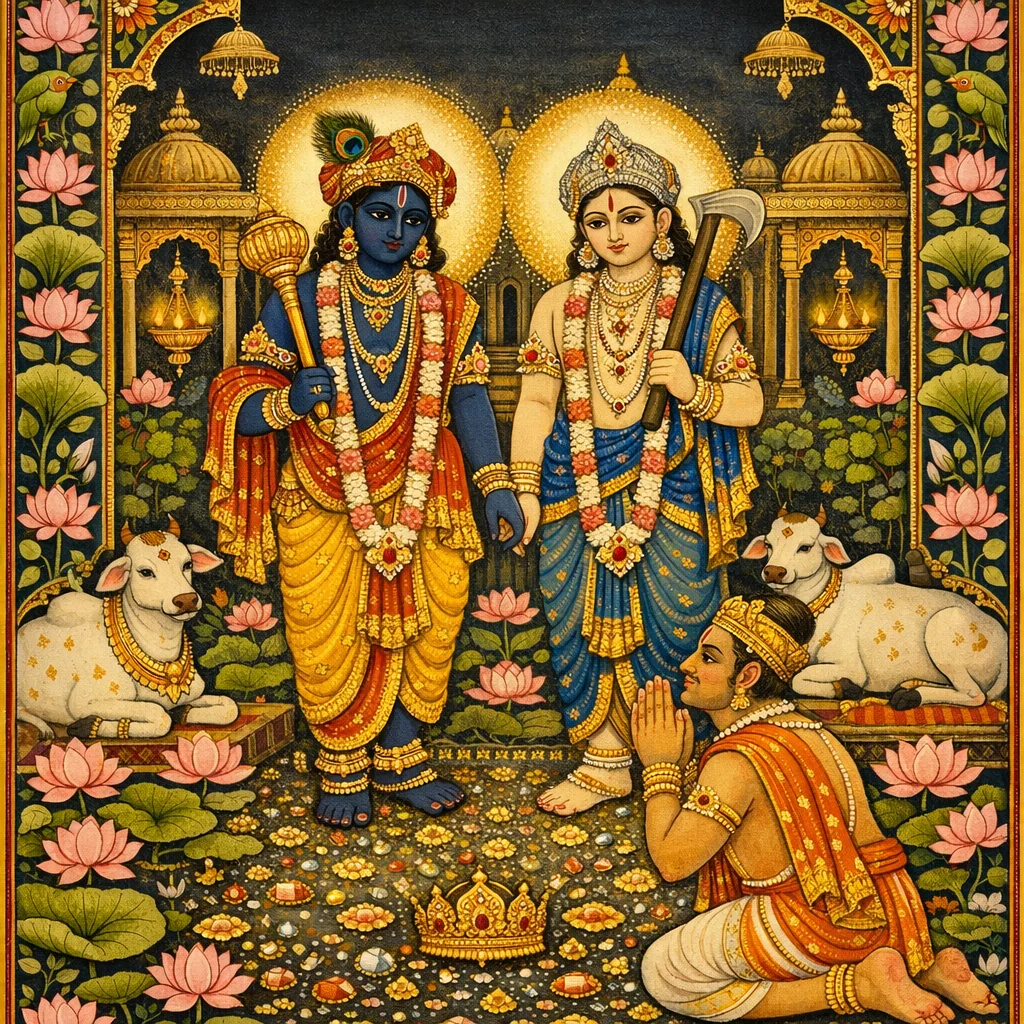
In Dvārakā, Vasudeva approaches his two sons—Saṅkarṣaṇa (Balarāma) and Acyuta (Kṛṣṇa)—with reverence shaped by the sages’ testimony and the Lords’ heroic deeds. He offers an extensive Vedāntic-styled stuti identifying Them as the source and substance of creation, the indwelling Supersoul, and the activating power behind the elements, senses, guṇas, and ahaṅkāra. Kṛṣṇa responds by affirming Vasudeva’s analysis yet expands it into a nondual Paramātmā teaching: the one self-luminous Supreme appears as many through the modes He Himself manifests. Freed from duality, Vasudeva becomes silent. Devakī then petitions Kṛṣṇa and Balarāma to restore her six sons killed by Kaṁsa, recalling Their earlier act of retrieving the guru’s son. The Lords enter Sutala, are worshiped by Bali Mahārāja, and reveal the hidden history of Devakī’s sons as Marīci’s cursed sons. They bring the six back to Dvārakā; Devakī’s maternal affection arises through Yoga-māyā, yet the sons awaken to their original identity through contact with the Lord and depart for the demigods’ abode. The chapter closes with the fruit of hearing: purification and steady meditation on the Supreme, preparing the narrative to continue highlighting Kṛṣṇa’s astonishing līlās and their salvific power.
Shlokas
Verse 1
श्रीबादरायणिरुवाच अथैकदात्मजौ प्राप्तौ कृतपादाभिवन्दनौ । वसुदेवोऽभिनन्द्याह प्रीत्या सङ्कर्षणाच्युतौ ॥ १ ॥
Śrī Bādarāyaṇi said: One day the two sons of Vasudeva — Saṅkarṣaṇa and Acyuta — came to pay him respects, bowing down at his feet. Vasudeva greeted Them with great affection and spoke to Them.
Verse 2
मुनीनां स वच: श्रुत्वा पुत्रयोर्धामसूचकम् । तद्वीर्यैर्जातविश्रम्भ: परिभाष्याभ्यभाषत ॥ २ ॥
Having heard the great sages’ words concerning the power of his two sons, and having seen Their valorous deeds, Vasudeva became convinced of Their divinity. Thus, addressing Them by name, he spoke to Them as follows.
Verse 3
कृष्ण कृष्ण महायोगिन् सङ्कर्षण सनातन । जाने वामस्य यत् साक्षात् प्रधानपुरुषौ परौ ॥ ३ ॥
[Vasudeva said:] O Kṛṣṇa, Kṛṣṇa, best of yogīs, O eternal Saṅkarṣaṇa! I know that You two are personally the source of universal creation and the ingredients of creation as well.
Verse 4
यत्र येन यतो यस्य यस्मै यद् यद् यथा यदा । स्यादिदं भगवान् साक्षात् प्रधानपुरुषेश्वर: ॥ ४ ॥
You are the Supreme Personality of Godhead, who manifest as the Lord of both nature and the creator of nature [Mahā-Viṣṇu]. Everything that comes into existence, however and whenever it does so, is created within You, by You, from You, for You and in relation to You.
Verse 5
एतन्नानाविधं विश्वमात्मसृष्टमधोक्षज । आत्मनानुप्रविश्यात्मन् प्राणो जीवो बिभर्ष्यज ॥ ५ ॥
O transcendental Lord, from Yourself You created this entire variegated universe, and then You entered within it in Your personal form as the Supersoul. In this way, O unborn Supreme Soul, as the life force and consciousness of everyone, You maintain the creation.
Verse 6
प्राणादीनां विश्वसृजां शक्तयो या: परस्य ता: । पारतन्त्र्याद् वैसादृश्याद् द्वयोश्चेष्टैव चेष्टताम् ॥ ६ ॥
Whatever potencies the life air and other elements of universal creation exhibit are actually all personal energies of the Supreme Lord, for both life and matter are subordinate to Him and dependent on Him, and also different from one another. Thus everything active in the material world is set into motion by the Supreme Lord.
Verse 7
कान्तिस्तेज: प्रभा सत्ता चन्द्राग्न्यर्कर्क्षविद्युताम् । यत् स्थैर्यं भूभृतां भूमेर्वृत्तिर्गन्धोऽर्थतो भवान् ॥ ७ ॥
The glow of the moon, the brilliance of fire, the radiance of the sun, the twinkling of the stars, the flash of lightning, the permanence of mountains and the aroma and sustaining power of the earth — all these are actually You.
Verse 8
तर्पणं प्राणनमपां देवत्वं ताश्च तद्रस: । ओज: सहो बलं चेष्टा गतिर्वायोस्तवेश्वर ॥ ८ ॥
My Lord, You are water, and also its taste and and its capacities to quench thirst and sustain life. You exhibit Your potencies through the manifestations of the air as bodily warmth, vitality, mental power, physical strength, endeavor and movement.
Verse 9
दिशां त्वमवकाशोऽसि दिश: खं स्फोट आश्रय: । नादो वर्णस्त्वम् ॐकार आकृतीनां पृथक्कृति: ॥ ९ ॥
You are the directions and their accommodating capacity, the all-pervading ether and the elemental sound residing within it. You are the primeval, unmanifested form of sound; the first syllable, om; and audible speech, by which sound, as words, acquires particular references.
Verse 10
इन्द्रियं त्विन्द्रियाणां त्वं देवाश्च तदनुग्रह: । अवबोधो भवान् बुद्धेर्जीवस्यानुस्मृति: सती ॥ १० ॥
You are the power of the senses to reveal their objects, the senses’ presiding demigods, and the sanction these demigods give for sensory activity. You are the capacity of the intelligence for decision-making, and the living being’s ability to remember things accurately.
Verse 11
भूतानामसि भूतादिरिन्द्रियाणां च तैजस: । वैकारिको विकल्पानां प्रधानमनुशायिनम् ॥ ११ ॥
You are false ego in the mode of ignorance, which is the source of the physical elements; false ego in the mode of passion, which is the source of the bodily senses; false ego in the mode of goodness, which is the source of the demigods; and the unmanifest, total material energy, which underlies everything.
Verse 12
नश्वरेष्विह भावेषु तदसि त्वमनश्वरम् । यथा द्रव्यविकारेषु द्रव्यमात्रं निरूपितम् ॥ १२ ॥
You are the one indestructible entity among all the destructible things of this world, like the underlying substance that is seen to remain unchanged while the things made from it undergo transformations.
Verse 13
सत्त्वं रजस्तम इति गुणास्तद्वृत्तयश्च या: । त्वय्यद्धा ब्रह्मणि परे कल्पिता योगमायया ॥ १३ ॥
The modes of material nature — namely goodness, passion and ignorance — together with all their functions, become directly manifest within You, the Supreme Absolute Truth, by the arrangement of Your Yoga-māyā.
Verse 14
तस्मान्न सन्त्यमी भावा यर्हि त्वयि विकल्पिता: । त्वं चामीषु विकारेषु ह्यन्यदाव्यावहारिक: ॥ १४ ॥
Thus these created entities, transformations of material nature, do not exist except when material nature manifests them within You, at which time You also manifest within them. But aside from such periods of creation, You stand alone as the transcendental reality.
Verse 15
गुणप्रवाह एतस्मिन्नबुधास्त्वखिलात्मन: । गतिं सूक्ष्मामबोधेन संसरन्तीह कर्मभि: ॥ १५ ॥
They are truly ignorant who, while imprisoned within the ceaseless flow of this world’s material qualities, fail to know You, the Supreme Soul of all that be, as their ultimate, sublime destination. Because of their ignorance, the entanglement of material work forces such souls to wander in the cycle of birth and death.
Verse 16
यदृच्छया नृतां प्राप्य सुकल्पामिह दुर्लभाम् । स्वार्थे प्रमत्तस्य वयो गतं त्वन्माययेश्वर ॥ १६ ॥
By good fortune a soul may obtain a healthy human life — an opportunity rarely achieved. But if he is nonetheless deluded about what is best for him, O Lord, Your illusory Māyā will cause him to waste his entire life.
Verse 17
असावहं ममैवैते देहे चास्यान्वयादिषु । स्नेहपाशैर्निबध्नाति भवान् सर्वमिदं जगत् ॥ १७ ॥
You keep this whole world bound up by the ropes of affection, and thus when people consider their material bodies, they think, “This is me,” and when they consider their progeny and other relations, they think, “These are mine.”
Verse 18
युवां न न: सुतौ साक्षात् प्रधानपुरुषेश्वरौ । भूभारक्षत्रक्षपण अवतीर्णौ तथात्थ ह ॥ १८ ॥
You are not our sons but the very Lords of both material nature and its creator [Mahā-Viṣṇu]. As You Yourself have told us, You have descended to rid the earth of the rulers who are a heavy burden upon her.
Verse 19
तत्ते गतोऽस्म्यरणमद्य पदारविन्द- मापन्नसंसृतिभयापहमार्तबन्धो । एतावतालमलमिन्द्रियलालसेन मर्त्यात्मदृक् त्वयि परे यदपत्यबुद्धि: ॥ १९ ॥
Therefore, O friend of the distressed, I now approach Your lotus feet for shelter — the same lotus feet that dispel all fear of worldly existence for those who have surrendered to them. Enough! Enough with hankering for sense enjoyment, which makes me identify with this mortal body and think of You, the Supreme, as my child.
Verse 20
सूतीगृहे ननु जगाद भवानजो नौ सञ्जज्ञ इत्यनुयुगं निजधर्मगुप्त्यै । नानातनूर्गगनवद् विदधज्जहासि को वेद भूम्न उरुगाय विभूतिमायाम् ॥ २० ॥
Indeed, while still in the maternity room You told us that You, the unborn Lord, had already been born several times as our son in previous ages. After manifesting each of these transcendental bodies to protect Your own principles of religion, You then made them unmanifest, thus appearing and disappearing like a cloud. O supremely glorified, all-pervading Lord, who can understand the mystic, deluding potency of Your opulent expansions?
Verse 21
श्रीशुक उवाच आकर्ण्येत्थं पितुर्वाक्यं भगवान् सात्वतर्षभ: । प्रत्याह प्रश्रयानम्र: प्रहसन् श्लक्ष्णया गिरा ॥ २१ ॥
Śukadeva Gosvāmī said: Having heard His father’s words, the Supreme Lord, leader of the Sātvatas, replied in a gentle voice as He bowed His head in humility and smiled.
Verse 22
श्रीभगवानुवाच वचो व: समवेतार्थं तातैतदुपमन्महे । यन्न: पुत्रान् समुद्दिश्य तत्त्वग्राम उदाहृत: ॥ २२ ॥
The Supreme Lord said: My dear Father, I consider your statements appropriate, since you have explained the various categories of existence by referring to Us, your sons.
Verse 23
अहं यूयमसावार्य इमे च द्वारकौकस: । सर्वेऽप्येवं यदुश्रेष्ठ विमृग्या: सचराचरम् ॥ २३ ॥
Not only I, but also you, along with My respected brother and these residents of Dvārakā, should all be considered in this same philosophical light, O best of the Yadus. Indeed, we should include all that exists, both moving and nonmoving.
Verse 24
आत्मा ह्येक: स्वयंज्योतिर्नित्योऽन्यो निर्गुणो गुणै: । आत्मसृष्टैस्तत्कृतेषु भूतेषु बहुधेयते ॥ २४ ॥
The supreme spirit, Paramātmā, is indeed one. He is self-luminous and eternal, transcendental and devoid of material qualities. But through the agency of the very modes He has created, the one Supreme Truth manifests as many among the expansions of those modes.
Verse 25
खं वायुर्ज्योतिरापो भूस्तत्कृतेषु यथाशयम् । आविस्तिरोऽल्पभूर्येको नानात्वं यात्यसावपि ॥ २५ ॥
The elements of ether, air, fire, water and earth become visible, invisible, minute or extensive as they manifest in various objects. Similarly, the Paramātmā, though one, appears to become many.
Verse 26
श्रीशुक उवाच एवं भगवता राजन् वसुदेव उदाहृत: । श्रुत्वा विनष्टनानाधीस्तूष्णीं प्रीतमना अभूत् ॥ २६ ॥
Śukadeva Gosvāmī said: O King, hearing these instructions spoken to him by the Supreme Lord, Vasudeva became freed from all ideas of duality. Satisfied at heart, he remained silent.
Verse 27
अथ तत्र कुरुश्रेष्ठ देवकी सर्वदेवता । श्रुत्वानीतं गुरो: पुत्रमात्मजाभ्यां सुविस्मिता ॥ २७ ॥ कृष्णरामौ समाश्राव्य पुत्रान् कंसविहिंसितान् । स्मरन्ती कृपणं प्राह वैक्लव्यादश्रुलोचना ॥ २८ ॥
At that time, O best of the Kurus, the universally worshiped Devakī took the opportunity to address her two sons, Kṛṣṇa and Balarāma. Previously she had heard with astonishment that They had brought Their spiritual master’s son back from death. Now, thinking of her own sons who had been murdered by Kaṁsa, she felt great sorrow, and thus with tear-filled eyes she beseeched Kṛṣṇa and Balarāma.
Verse 28
अथ तत्र कुरुश्रेष्ठ देवकी सर्वदेवता । श्रुत्वानीतं गुरो: पुत्रमात्मजाभ्यां सुविस्मिता ॥ २७ ॥ कृष्णरामौ समाश्राव्य पुत्रान् कंसविहिंसितान् । स्मरन्ती कृपणं प्राह वैक्लव्यादश्रुलोचना ॥ २८ ॥
At that time, O best of the Kurus, the universally worshiped Devakī took the opportunity to address her two sons, Kṛṣṇa and Balarāma. Previously she had heard with astonishment that They had brought Their spiritual master’s son back from death. Now, thinking of her own sons who had been murdered by Kaṁsa, she felt great sorrow, and thus with tear-filled eyes she beseeched Kṛṣṇa and Balarāma.
Verse 29
श्रीदेवक्युवाच राम रामाप्रमेयात्मन् कृष्ण योगेश्वरेश्वर । वेदाहं वां विश्वसृजामीश्वरावादिपूरुषौ ॥ २९ ॥
Śrī Devakī said: O Rāma, Rāma, immeasurable Supreme Soul! O Kṛṣṇa, Lord of all masters of yoga! I know that You are the ultimate rulers of all universal creators, the primeval Personalities of Godhead.
Verse 30
कालविध्वस्तसत्त्वानां राज्ञामुच्छास्त्रवर्तिनाम् । भूमेर्भारायमाणानामवतीर्णौ किलाद्य मे ॥ ३० ॥
Taking birth from me, You have now descended to this world in order to kill those kings whose good qualities have been destroyed by the present age, and who thus defy the authority of revealed scriptures and burden the earth.
Verse 31
यस्यांशांशांशभागेन विश्वोत्पत्तिलयोदया: । भवन्ति किल विश्वात्मंस्तं त्वाद्याहं गतिं गता ॥ ३१ ॥
O Soul of all that be, the creation, maintenance and destruction of the universe are all carried out by a fraction of an expansion of an expansion of Your expansion. Today I have come to take shelter of You, the Supreme Lord.
Verse 32
चिरान्मृतसुतादाने गुरुणा किल चोदितौ । आनिन्यथु: पितृस्थानाद् गुरवे गुरुदक्षिणाम् ॥ ३२ ॥ तथा मे कुरुतं कामं युवां योगेश्वरेश्वरौ । भोजराजहतान् पुत्रान् कामये द्रष्टुमाहृतान् ॥ ३३ ॥
It is said that when Your spiritual master ordered You to retrieve his long-dead son, You brought him back from the forefathers’ abode as a token of remuneration for Your guru’s mercy. Please fulfill my desire in the same way, O supreme masters of all yoga masters. Please bring back my sons who were killed by the King of Bhoja, so that I may see them once again.
Verse 33
चिरान्मृतसुतादाने गुरुणा किल चोदितौ । आनिन्यथु: पितृस्थानाद् गुरवे गुरुदक्षिणाम् ॥ ३२ ॥ तथा मे कुरुतं कामं युवां योगेश्वरेश्वरौ । भोजराजहतान् पुत्रान् कामये द्रष्टुमाहृतान् ॥ ३३ ॥
It is said that when Your spiritual master ordered You to retrieve his long-dead son, You brought him back from the forefathers’ abode as a token of remuneration for Your guru’s mercy. Please fulfill my desire in the same way, O supreme masters of all yoga masters. Please bring back my sons who were killed by the King of Bhoja, so that I may see them once again.
Verse 34
ऋषिरुवाच एवं सञ्चोदितौ मात्रा राम: कृष्णश्च भारत । सुतलं संविविशतुर्योगमायामुपाश्रितौ ॥ ३४ ॥
The sage Śukadeva said: Thus entreated by Their mother, O Bhārata, Balarāma and Kṛṣṇa employed Their mystic Yoga-māyā potency and entered the region of Sutala.
Verse 35
तस्मिन् प्रविष्टावुपलभ्य दैत्यराड् विश्वात्मदैवं सुतरां तथात्मन: । तद्दर्शनाह्लादपरिप्लुताशय: सद्य: समुत्थाय ननाम सान्वय: ॥ ३५ ॥
When the King of the Daityas, Bali Mahārāja, noticed the arrival of the two Lords, his heart overflowed with joy, since he knew Them to be the Supreme Soul and worshipable Deity of the entire universe, and especially of himself. He immediately stood up and then bowed down to offer respects, along with his entire entourage.
Verse 36
तयो: समानीय वरासनं मुदा निविष्टयोस्तत्र महात्मनोस्तयो: । दधार पादाववनिज्य तज्जलं सवृन्द आब्रह्म पुनद् यदम्बु ह ॥ ३६ ॥
Bali took pleasure in offering Them elevated seats. After They sat down, he washed the feet of the two Supreme Personalities. Then he took that water, which purifies the whole world even up to Lord Brahmā, and poured it upon himself and his followers.
Verse 37
समर्हयामास स तौ विभूतिभि- र्महार्हवस्त्राभरणानुलेपनै: । ताम्बूलदीपामृतभक्षणादिभि: स्वगोत्रवित्तात्मसमर्पणेन च ॥ ३७ ॥
He worshiped Them with all the riches at his disposal — priceless clothing, ornaments, fragrant sandalwood paste, betel nut, lamps, sumptuous food and so on. Thus he offered Them all his family’s wealth, and also his own self.
Verse 38
स इन्द्रसेनो भगवत्पदाम्बुजं बिभ्रन्मुहु: प्रेमविभिन्नया धिया । उवाच हानन्दजलाकुलेक्षण: प्रहृष्टरोमा नृप गद्गदाक्षरम् ॥ ३८ ॥
Taking hold of the Lords’ lotus feet again and again, Bali, the conqueror of Indra’s army, spoke from his heart, which was melting out of his intense love. O King, as tears of ecstasy filled his eyes and the hair on his limbs stood on end, he began to speak with faltering words.
Verse 39
बलिरुवाच नमोऽनन्ताय बृहते नम: कृष्णाय वेधसे । साङ्ख्ययोगवितानाय ब्रह्मणे परमात्मने ॥ ३९ ॥
King Bali said: Obeisances to the unlimited Lord, Ananta, the greatest of all beings. And obeisances to Lord Kṛṣṇa, the creator of the universe, who appears as the impersonal Absolute and the Supersoul in order to disseminate the principles of sāṅkhya and yoga.
Verse 40
दर्शनं वां हि भूतानां दुष्प्रापं चाप्यदुर्लभम् । रजस्तम:स्वभावानां यन्न: प्राप्तौ यदृच्छया ॥ ४० ॥
Seeing You Lords is a rare achievement for most living beings. But even persons like us, situated in the modes of passion and ignorance, can easily see You when You reveal Yourself by Your own sweet will.
Verse 41
दैत्यदानवगन्धर्वा: सिद्धविद्याध्रचारणा: । यक्षरक्ष:पिशाचाश्च भूतप्रमथनायका: ॥ ४१ ॥ विशुद्धसत्त्वधाम्न्यद्धा त्वयि शास्त्रशरीरिणि । नित्यं निबद्धवैरास्ते वयं चान्ये च तादृशा: ॥ ४२ ॥ केचनोद्बद्धवैरेण भक्त्या केचन कामत: । न तथा सत्त्वसंरब्धा: सन्निकृष्टा: सुरादय: ॥ ४३ ॥
Many who had been constantly absorbed in enmity toward You ultimately became attracted to You, who are the direct embodiment of transcendental goodness and whose divine form comprises the revealed scriptures. These reformed enemies include Daityas, Dānavas, Gandharvas, Siddhas, Vidyādharas, Cāraṇas, Yakṣas, Rākṣasas, Piśācas, Bhūtas, Pramathas and Nāyakas, and also ourselves and many others like us. Some of us have become attracted to You because of exceptional hatred, while others have become attracted because of their mood of devotion based on lust. But the demigods and others infatuated by material goodness feel no such attraction for You.
Verse 42
दैत्यदानवगन्धर्वा: सिद्धविद्याध्रचारणा: । यक्षरक्ष:पिशाचाश्च भूतप्रमथनायका: ॥ ४१ ॥ विशुद्धसत्त्वधाम्न्यद्धा त्वयि शास्त्रशरीरिणि । नित्यं निबद्धवैरास्ते वयं चान्ये च तादृशा: ॥ ४२ ॥ केचनोद्बद्धवैरेण भक्त्या केचन कामत: । न तथा सत्त्वसंरब्धा: सन्निकृष्टा: सुरादय: ॥ ४३ ॥
Many who had been constantly absorbed in enmity toward You ultimately became attracted to You, who are the direct embodiment of transcendental goodness and whose divine form comprises the revealed scriptures. These reformed enemies include Daityas, Dānavas, Gandharvas, Siddhas, Vidyādharas, Cāraṇas, Yakṣas, Rākṣasas, Piśācas, Bhūtas, Pramathas and Nāyakas, and also ourselves and many others like us. Some of us have become attracted to You because of exceptional hatred, while others have become attracted because of their mood of devotion based on lust. But the demigods and others infatuated by material goodness feel no such attraction for You.
Verse 43
दैत्यदानवगन्धर्वा: सिद्धविद्याध्रचारणा: । यक्षरक्ष:पिशाचाश्च भूतप्रमथनायका: ॥ ४१ ॥ विशुद्धसत्त्वधाम्न्यद्धा त्वयि शास्त्रशरीरिणि । नित्यं निबद्धवैरास्ते वयं चान्ये च तादृशा: ॥ ४२ ॥ केचनोद्बद्धवैरेण भक्त्या केचन कामत: । न तथा सत्त्वसंरब्धा: सन्निकृष्टा: सुरादय: ॥ ४३ ॥
Many who had been constantly absorbed in enmity toward You ultimately became attracted to You, who are the direct embodiment of transcendental goodness and whose divine form comprises the revealed scriptures. These reformed enemies include Daityas, Dānavas, Gandharvas, Siddhas, Vidyādharas, Cāraṇas, Yakṣas, Rākṣasas, Piśācas, Bhūtas, Pramathas and Nāyakas, and also ourselves and many others like us. Some of us have become attracted to You because of exceptional hatred, while others have become attracted because of their mood of devotion based on lust. But the demigods and others infatuated by material goodness feel no such attraction for You.
Verse 44
इदमित्थमिति प्रायस्तव योगेश्वरेश्वर । न विदन्त्यपि योगेशा योगमायां कुतो वयम् ॥ ४४ ॥
What to speak of ourselves, O Lord of all perfect yogīs, even the greatest mystics do not know what Your spiritual power of delusion is or how it acts.
Verse 45
तन्न: प्रसीद निरपेक्षविमृग्ययुष्मत्- पादारविन्दधिषणान्यगृहान्धकूपात् । निष्क्रम्य विश्वशरणाङ्घ्रयुपलब्धवृत्ति: शान्तो यथैक उत सर्वसखैश्चरामि ॥ ४५ ॥
Please be merciful to me so I may get out of the blind well of family life — my false home — and find the true shelter of Your lotus feet, which selfless sages always seek. Then, either alone or in the company of great saints, who are the friends of everyone, I may wander freely, finding life’s necessities at the feet of the universally charitable trees.
Verse 46
शाध्यस्मानीशितव्येश निष्पापान् कुरु न: प्रभो । पुमान् यच्छ्रद्धयातिष्ठंश्चोदनाया विमुच्यते ॥ ४६ ॥
O Lord of all subordinate creatures, please tell us what to do and thus free us of all sin. One who faithfully executes Your command, O master, is no longer obliged to follow the ordinary Vedic rites.
Verse 47
श्रीभगवानुवाच आसन्मरीचे: षट् पुत्रा ऊर्णायां प्रथमेऽन्तरे । देवा: कं जहसुर्वीक्ष्य सुतं यभितुमुद्यतम् ॥ ४७ ॥
The Supreme Lord said: During the age of the first Manu, the sage Marīci had six sons by his wife Ūrnā. They were all exalted demigods, but once they laughed at Lord Brahmā when they saw him preparing to have sex with his own daughter.
Verse 48
तेनासुरीमगन् योनिमधुनावद्यकर्मणा । हिरण्यकशिपोर्जाता नीतास्ते योगमायया ॥ ४८ ॥ देवक्या उदरे जाता राजन् कंसविहिंसिता: । सा तान् शोचत्यात्मजान् स्वांस्त इमेऽध्यासतेऽन्तिके ॥ ४९ ॥
Because of that improper act, they immediately entered a demoniac form of life, and thus they took birth as sons of Hiraṇyakaśipu. The goddess Yoga-māyā then took them away from Hiraṇyakaśipu, and they were born again from Devakī’s womb. After this, O King, Kaṁsa murdered them. Devakī still laments for them, thinking of them as her sons. These same sons of Marīci are now living here with you.
Verse 49
तेनासुरीमगन् योनिमधुनावद्यकर्मणा । हिरण्यकशिपोर्जाता नीतास्ते योगमायया ॥ ४८ ॥ देवक्या उदरे जाता राजन् कंसविहिंसिता: । सा तान् शोचत्यात्मजान् स्वांस्त इमेऽध्यासतेऽन्तिके ॥ ४९ ॥
Because of that improper act, they immediately entered a demoniac form of life, and thus they took birth as sons of Hiraṇyakaśipu. The goddess Yoga-māyā then took them away from Hiraṇyakaśipu, and they were born again from Devakī’s womb. After this, O King, Kaṁsa murdered them. Devakī still laments for them, thinking of them as her sons. These same sons of Marīci are now living here with you.
Verse 50
इत एतान् प्रणेष्यामो मातृशोकापनुत्तये । तत: शापाद् विनिर्मुक्ता लोकं यास्यन्ति विज्वरा: ॥ ५० ॥
We wish to take them from this place to dispel their mother’s sorrow. Then, released from their curse and free from all suffering, they will return to their home in heaven.
Verse 51
स्मरोद्गीथ: परिष्वङ्ग: पतङ्ग: क्षुद्रभृद् घृणी । षडिमे मत्प्रसादेन पुनर्यास्यन्ति सद्गतिम् ॥ ५१ ॥
By My grace these six — Smara, Udgītha, Pariṣvaṅga, Pataṅga, Kṣudrabhṛt and Ghṛṇī — will return to the abode of pure saints.
Verse 52
इत्युक्त्वा तान् समादाय इन्द्रसेनेन पूजितौ । पुनर्द्वारवतीमेत्य मातु: पुत्रानयच्छताम् ॥ ५२ ॥
[Śukadeva Gosvāmī continued:] After saying this, Lord Kṛṣṇa and Lord Balarāma, having been duly worshiped by Bali Mahārāja, took the six sons and returned to Dvārakā, where They presented them to Their mother.
Verse 53
तान् दृष्ट्वा बालकान् देवी पुत्रस्नेहस्नुतस्तनी । परिष्वज्याङ्कमारोप्य मूर्ध्न्यजिघ्रदभीक्ष्णश: ॥ ५३ ॥
When she saw her lost children, Goddess Devakī felt such affection for them that milk flowed from her breasts. She embraced them and took them onto her lap, smelling their heads again and again.
Verse 54
अपाययत् स्तनं प्रीता सुतस्पर्शपरिस्नुतम् । मोहिता मायया विष्णोर्यया सृष्टि: प्रवर्तते ॥ ५४ ॥
Lovingly she let her sons drink from her breast, which became wet with milk just by their touch. She was entranced by the same illusory energy of Lord Viṣṇu that initiates the creation of the universe.
Verse 55
पीत्वामृतं पयस्तस्या: पीतशेषं गदाभृत: । नारायणाङ्गसंस्पर्शप्रतिलब्धात्मदर्शना: ॥ ५५ ॥ ते नमस्कृत्य गोविन्दं देवकीं पितरं बलम् । मिषतां सर्वभूतानां ययुर्धाम दिवौकसाम् ॥ ५६ ॥
By drinking her nectarean milk, the remnants of what Kṛṣṇa Himself had previously drunk, the six sons touched the transcendental body of the Lord, Nārāyaṇa, and this contact awakened them to their original identities. They bowed down to Govinda, Devakī, their father and Balarāma, and then, as everyone looked on, they left for the abode of the demigods.
Verse 56
पीत्वामृतं पयस्तस्या: पीतशेषं गदाभृत: । नारायणाङ्गसंस्पर्शप्रतिलब्धात्मदर्शना: ॥ ५५ ॥ ते नमस्कृत्य गोविन्दं देवकीं पितरं बलम् । मिषतां सर्वभूतानां ययुर्धाम दिवौकसाम् ॥ ५६ ॥
By drinking her nectarean milk, the remnants of what Kṛṣṇa Himself had previously drunk, the six sons touched the transcendental body of the Lord, Nārāyaṇa, and this contact awakened them to their original identities. They bowed down to Govinda, Devakī, their father and Balarāma, and then, as everyone looked on, they left for the abode of the demigods.
Verse 57
तं दृष्ट्वा देवकी देवी मृतागमननिर्गमम् । मेने सुविस्मिता मायां कृष्णस्य रचितां नृप ॥ ५७ ॥
Seeing her sons return from death and then depart again, saintly Devakī was struck with wonder, O King. She concluded that this was all simply an illusion created by Kṛṣṇa.
Verse 58
एवंविधान्यद्भुतानि कृष्णस्य परमात्मन: । वीर्याण्यनन्तवीर्यस्य सन्त्यनन्तानि भारत ॥ ५८ ॥
Śrī Kṛṣṇa, the Supreme Soul, the Lord of unlimited valor, performed countless pastimes just as amazing as this one, O descendant of Bharata.
Verse 59
श्रीसूत उवाच य इदमनुशृणोति श्रावयेद् वा मुरारे- श्चरितममृतकीर्तेर्वर्णितं व्यासपुत्रै: । जगदघभिदलं तद्भक्तसत्कर्णपूरं भगवति कृतचित्तो याति तत्क्षेमधाम ॥ ५९ ॥
Śrī Sūta Gosvāmī said: This pastime enacted by Lord Murāri, whose fame is eternal, totally destroys the sins of the universe and serves as the transcendental ornament for His devotees’ ears. Anyone who carefully hears or narrates this pastime, as recounted by the venerable son of Vyāsa, will be able to fix his mind in meditation on the Supreme Lord and attain to the all-auspicious kingdom of God.
Frequently Asked Questions
Vasudeva’s praise is a bhāgavata re-reading of sāṅkhya categories: the elements and their capacities (rasa, gandha, tejas, etc.) act only by the Lord’s śakti. By identifying the cosmos with Bhagavān’s energies and presence, he asserts both transcendence (the Lord stands apart during dissolution) and immanence (He enters as Paramātmā). This framing supports the Bhāgavata’s conclusion that all causality ultimately rests in the Supreme Person, not in independent material principles.
Kṛṣṇa explains that the Supreme Self is eka (one), self-luminous, and nirguṇa in essence, but He appears as many through the upādhi-like differentiations of the guṇas He manifests. Just as the same elements appear in diverse objects as visible/invisible, subtle/gross, the one Paramātmā is reflected in varied bodies and minds. The multiplicity is an appearance conditioned by modes and forms, while the underlying reality remains one.
Kṛṣṇa reveals they were originally six sons of Marīci who laughed at Brahmā’s impropriety and were cursed into demoniac births, later becoming sons of Hiraṇyakaśipu and then transferred by Yoga-māyā into Devakī’s womb. Kaṁsa killed them due to the prophecy that Devakī’s child would be his death. Their repeated births illustrate karma, curse, and divine orchestration under Yoga-māyā.
The chapter indicates they were “living here with you,” i.e., under Bali’s domain in Sutala, by divine arrangement. Sutala—protected and sanctified by Vāmana’s presence—functions as a theologically significant realm where the Lord’s devotees (like Bali) receive intimate darśana, and where karmic knots can be resolved under the Lord’s direct supervision.
Their awakening is attributed to contact with the transcendental body of the Lord (Nārāyaṇa) through remnants associated with Kṛṣṇa—Devakī’s milk described as having been previously drunk by Him. In bhakti theology, such contact (saṅga) with Bhagavān and His prasāda catalyzes smṛti (true remembrance) and removes coverings created by curse and karma, enabling their return to higher abodes.
Devakī’s wonder underscores Yoga-māyā’s twofold function: it can generate intense worldly identification (maternal attachment) even in exalted devotees, and it can also arrange liberation by bringing souls into purifying proximity to Bhagavān. The episode teaches that the Lord alone controls appearance and disappearance, and that surrender to Him transforms grief into realization.