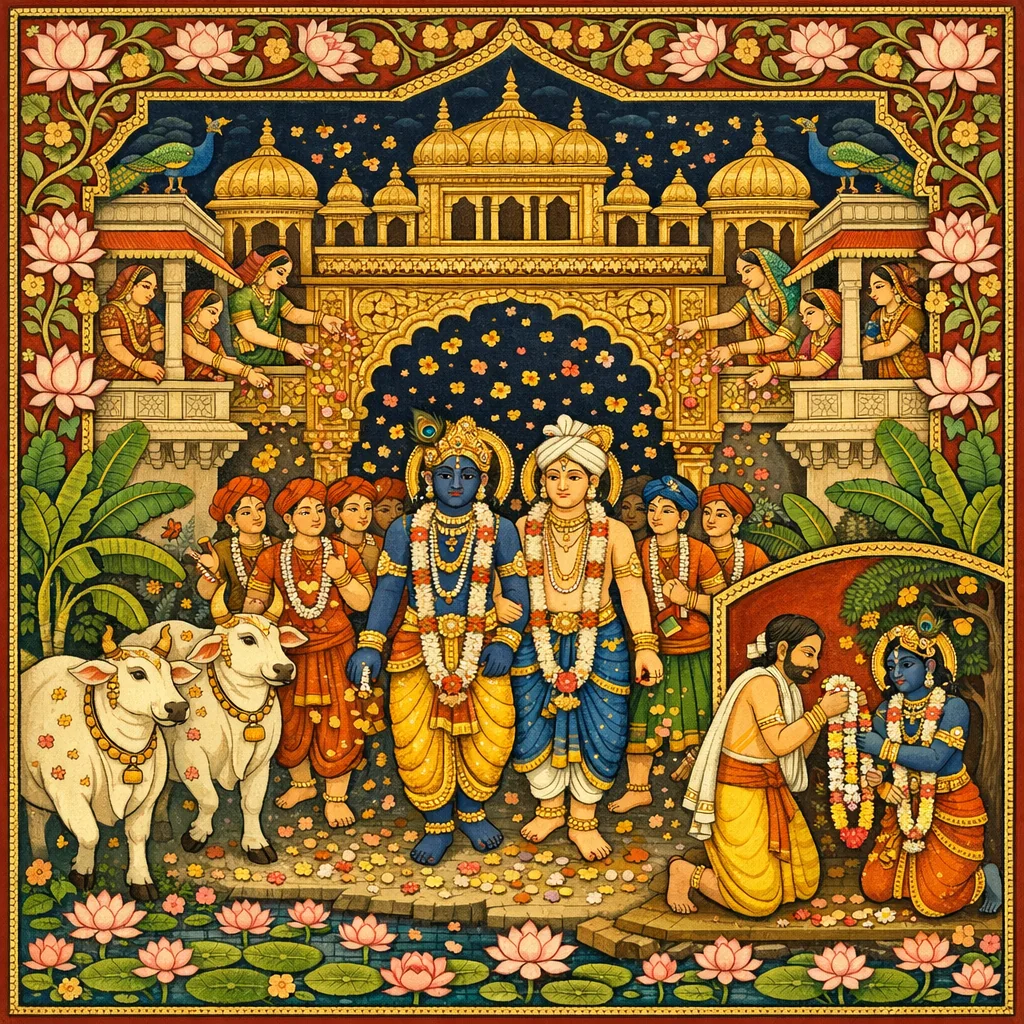
Adhyaya 41
Kṛṣṇa Enters Mathurā: City Splendor, Devotees’ Reception, and the Washerman’s Fate
Continuing from Akrūra’s revelation of Kṛṣṇa’s divinity (in the river vision), the Lord withdraws that cosmic form and returns to ordinary travel, teaching that the Absolute can veil and unveil Himself at will. Akrūra resumes the journey and reaches Mathurā with Kṛṣṇa and Balarāma, while Vraja elders wait outside the city. Kṛṣṇa sends Akrūra ahead; Akrūra, torn between duty and devotion, reports to Kaṁsa—setting the political stage for the impending confrontation. Kṛṣṇa then enters Mathurā with friends, and the text lingers on the city’s opulence, framing Mathurā as a public theater where bhakti will appear amid royal power. The women of Mathurā, long hearing of Kṛṣṇa, become overwhelmed by darśana, revealing śravaṇa → darśana → bhāva as a devotional progression. On the road, Kṛṣṇa requests garments: the arrogant royal washerman insults Him and is slain, while a humble weaver and the garland-maker Sudāmā receive grace and boons. The chapter thus contrasts aparādha and sevā, and bridges from arrival in Mathurā to the next episodes culminating in Kaṁsa’s destruction.
Shlokas
Verse 1
श्रीशुक उवाच स्तुवतस्तस्य भगवान् दर्शयित्वा जले वपु: । भूय: समाहरत् कृष्णो नटो नाट्यमिवात्मन: ॥ १ ॥
Śukadeva Gosvāmī said: While Akrūra was still offering prayers, the Supreme Lord Kṛṣṇa withdrew His form that He had revealed in the water, just as an actor winds up his performance.
Verse 2
सोऽपि चान्तर्हितं वीक्ष्य जलादुन्मज्य सत्वर: । कृत्वा चावश्यकं सर्वं विस्मितो रथमागमत् ॥ २ ॥
When Akrūra saw the vision disappear, he came out of the water and quickly finished his various ritual duties. He then returned to the chariot, astonished.
Verse 3
तमपृच्छद्धृषीकेश: किं ते दृष्टमिवाद्भुतम् । भूमौ वियति तोये वा तथा त्वां लक्षयामहे ॥ ३ ॥
Lord Kṛṣṇa asked Akrūra: Have you seen something wonderful on the earth, in the sky or in the water? From your appearance, We think you have.
Verse 4
श्रीअक्रूर उवाच अद्भुतानीह यावन्ति भूमौ वियति वा जले । त्वयि विश्वात्मके तानि किं मेऽदृष्टं विपश्यत: ॥ ४ ॥
Śrī Akrūra said: Whatever wonderful things the earth, sky or water contain, all exist in You. Since You encompass everything, when I am seeing You, what have I not seen?
Verse 5
यत्राद्भुतानि सर्वाणि भूमौ वियति वा जले । तं त्वानुपश्यतो ब्रह्मन् किं मे दृष्टमिहाद्भुतम् ॥ ५ ॥
And now that I am seeing You, O Supreme Absolute Truth, in whom reside all amazing things on the earth, in the sky and in the water, what amazing things could I see in this world?
Verse 6
इत्युक्त्वा चोदयामास स्यन्दनं गान्दिनीसुत: । मथुरामनयद् रामं कृष्णं चैव दिनात्यये ॥ ६ ॥
With these words, Akrūra, the son of Gāndinī, began driving the chariot onward. At the end of the day he arrived in Mathurā with Lord Balarāma and Lord Kṛṣṇa.
Verse 7
मार्गे ग्रामजना राजंस्तत्र तत्रोपसङ्गता: । वसुदेवसुतौ वीक्ष्य प्रीता दृष्टिं न चाददु: ॥ ७ ॥
Wherever they passed along the road, O King, the village people came forward and looked upon the two sons of Vasudeva with great pleasure. In fact, the villagers could not withdraw their eyes from Them.
Verse 8
तावद् व्रजौकसस्तत्र नन्दगोपादयोऽग्रत: । पुरोपवनमासाद्य प्रतीक्षन्तोऽवतस्थिरे ॥ ८ ॥
Nanda Mahārāja and the other residents of Vṛndāvana, having reached Mathurā ahead of the chariot, had stopped at a garden on the outskirts of the city to wait for Kṛṣṇa and Balarāma.
Verse 9
तान् समेत्याह भगवानक्रूरं जगदीश्वर: । गृहीत्वा पाणिना पाणिं प्रश्रितं प्रहसन्निव ॥ ९ ॥
After joining Nanda and the others, the Supreme Lord Kṛṣṇa, the controller of the universe, took humble Akrūra’s hand in His own and, smiling, spoke as follows.
Verse 10
भवान् प्रविशतामग्रे सहयान: पुरीं गृहम् । वयं त्विहावमुच्याथ ततो द्रक्ष्यामहे पुरीम् ॥ १० ॥
[Lord Kṛṣṇa said:] Take the chariot and enter the city ahead of us. Then go home. After resting here a while, we will go to see the city.
Verse 11
श्रीअक्रूर उवाच नाहं भवद्भ्यां रहित: प्रवेक्ष्ये मथुरां प्रभो । त्यक्तुं नार्हसि मां नाथ भक्तं ते भक्तवत्सल ॥ ११ ॥
Śrī Akrūra said: O master, without the two of You I shall not enter Mathurā. I am Your devotee, O Lord, so it is not fair for You to abandon me, since You are always affectionate to Your devotees.
Verse 12
आगच्छ याम गेहान्न: सनाथान्कुर्वधोक्षज । सहाग्रज: सगोपालै: सुहृद्भिश्च सुहृत्तम ॥ १२ ॥
Come, let us go to my house with Your elder brother, the cowherd men and Your companions. O best of friends, O transcendental Lord, in this way please grace my house with its master.
Verse 13
पुनीहि पादरजसा गृहान् नो गृहमेधिनाम् । यच्छौचेनानुतृप्यन्ति पितर: साग्नय: सुरा: ॥ १३ ॥
I am simply an ordinary householder attached to ritual sacrifices, so please purify my home with the dust of Your lotus feet. By that act of purification, my forefathers, the sacrificial fires and the demigods will all become satisfied.
Verse 14
अवनिज्याङ्घ्रियुगलमासीत्श्लोक्यो बलिर्महान् । ऐश्वर्यमतुलं लेभे गतिं चैकान्तिनां तु या ॥ १४ ॥
By bathing Your feet, the exalted Bali Mahārāja attained not only glorious fame and unequaled power but also the final destination of pure devotees.
Verse 15
आपस्तेऽङ्घ्य्रवनेजन्यस्त्रींल्लोकान् शुचयोऽपुनन् । शिरसाधत्त या: शर्व: स्वर्याता: सगरात्मजा: ॥ १५ ॥
The water of the river Ganges has purified the three worlds, having become transcendental by bathing Your feet. Lord Śiva accepted that water on his head, and by that water’s grace the sons of King Sagara attained to heaven.
Verse 16
देवदेव जगन्नाथ पुण्यश्रवणकीर्तन । यदूत्तमोत्तम:श्लोक नारायण नमोऽस्तु ते ॥ १६ ॥
O Lord of lords, master of the universe, O You whose glories it is most pious to hear and chant! O best of the Yadus, O You whose fame is recounted in excellent poetry! O Supreme Lord Nārāyaṇa, I offer You my obeisances.
Verse 17
श्रीभगवानुवाच आयास्ये भवतो गेहमहमार्यसमन्वित: । यदुचक्रद्रुहं हत्वा वितरिष्ये सुहृत्प्रियम् ॥ १७ ॥
The Supreme Lord said: I will come to Your house with My elder brother, but first I must satisfy My friends and well-wishers by killing the enemy of the Yadu clan.
Verse 18
श्रीशुक उवाच एवमुक्तो भगवता सोऽक्रूरो विमना इव । पुरीं प्रविष्ट: कंसाय कर्मावेद्य गृहं ययौ ॥ १८ ॥
Śukadeva Gosvāmī said: Thus addressed by the Lord, Akrūra entered the city with a heavy heart. He informed King Kaṁsa of the success of his mission and then went home.
Verse 19
अथापराह्ने भगवान् कृष्ण: सङ्कर्षणान्वित: । मथुरां प्राविशद् गोपैर्दिदृक्षु: परिवारित: ॥ १९ ॥
Lord Kṛṣṇa desired to see Mathurā, so toward evening He took Lord Balarāma and the cowherd boys with Him and entered the city.
Verse 20
ददर्श तां स्फाटिकतुङ्गगोपुर- द्वारां बृहद्धेमकपाटतोरणाम् । ताम्रारकोष्ठां परिखादुरासदा- मुद्यानरम्योपवनोपशोभिताम् ॥ २० ॥ सौवर्णशृङ्गाटकहर्म्यनिष्कुटै: श्रेणीसभाभिर्भवनैरुपस्कृताम् । वैदूर्यवज्रामलनीलविद्रुमै- र्मुक्ताहरिद्भिर्वलभीषु वेदिषु ॥ २१ ॥ जुष्टेषु जालामुखरन्ध्रकुट्टिमे- ष्वाविष्टपारावतबर्हिनादिताम् । संसिक्तरथ्यापणमार्गचत्वरां प्रकीर्णमाल्याङ्कुरलाजतण्डुलाम् ॥ २२ ॥ आपूर्णकुम्भैर्दधिचन्दनोक्षितै: प्रसूनदीपावलिभि: सपल्लवै: । सवृन्दरम्भाक्रमुकै: सकेतुभि: स्वलङ्कृतद्वारगृहां सपट्टिकै: ॥ २३ ॥
The Lord saw Mathurā, with its tall gates and household entrances made of crystal, its immense archways and main doors of gold, its granaries and other storehouses of copper and brass, and its impregnable moats. Beautifying the city were pleasant gardens and parks. The main intersections were fashioned of gold, and there were mansions with private pleasure gardens, along with guildhalls and many other buildings. Mathurā resounded with the calls of peacocks and pet turtledoves, who sat in the small openings of the lattice windows and on the gem-studded floors, and also on the columned balconies and on the ornate rafters in front of the houses. These balconies and rafters were adorned with vaidūrya stones, diamonds, crystal quartz, sapphires, coral, pearls and emeralds. All the royal avenues and commercial streets were sprinkled with water, as were the side roads and courtyards, and flower garlands, newly grown sprouts, parched grains and rice had been scattered about everywhere. Gracing the houses’ doorways were elaborately decorated pots filled with water, which were bedecked with mango leaves, smeared with yogurt and sandalwood paste, and encircled by flower petals and ribbons. Near the pots were flags, rows of lamps, bunches of flowers and the trunks of banana and betel-nut trees.
Verse 21
ददर्श तां स्फाटिकतुङ्गगोपुर- द्वारां बृहद्धेमकपाटतोरणाम् । ताम्रारकोष्ठां परिखादुरासदा- मुद्यानरम्योपवनोपशोभिताम् ॥ २० ॥ सौवर्णशृङ्गाटकहर्म्यनिष्कुटै: श्रेणीसभाभिर्भवनैरुपस्कृताम् । वैदूर्यवज्रामलनीलविद्रुमै- र्मुक्ताहरिद्भिर्वलभीषु वेदिषु ॥ २१ ॥ जुष्टेषु जालामुखरन्ध्रकुट्टिमे- ष्वाविष्टपारावतबर्हिनादिताम् । संसिक्तरथ्यापणमार्गचत्वरां प्रकीर्णमाल्याङ्कुरलाजतण्डुलाम् ॥ २२ ॥ आपूर्णकुम्भैर्दधिचन्दनोक्षितै: प्रसूनदीपावलिभि: सपल्लवै: । सवृन्दरम्भाक्रमुकै: सकेतुभि: स्वलङ्कृतद्वारगृहां सपट्टिकै: ॥ २३ ॥
The Lord saw Mathurā, with its tall gates and household entrances made of crystal, its immense archways and main doors of gold, its granaries and other storehouses of copper and brass, and its impregnable moats. Beautifying the city were pleasant gardens and parks. The main intersections were fashioned of gold, and there were mansions with private pleasure gardens, along with guildhalls and many other buildings. Mathurā resounded with the calls of peacocks and pet turtledoves, who sat in the small openings of the lattice windows and on the gem-studded floors, and also on the columned balconies and on the ornate rafters in front of the houses. These balconies and rafters were adorned with vaidūrya stones, diamonds, crystal quartz, sapphires, coral, pearls and emeralds. All the royal avenues and commercial streets were sprinkled with water, as were the side roads and courtyards, and flower garlands, newly grown sprouts, parched grains and rice had been scattered about everywhere. Gracing the houses’ doorways were elaborately decorated pots filled with water, which were bedecked with mango leaves, smeared with yogurt and sandalwood paste, and encircled by flower petals and ribbons. Near the pots were flags, rows of lamps, bunches of flowers and the trunks of banana and betel-nut trees.
Verse 22
ददर्श तां स्फाटिकतुङ्गगोपुर- द्वारां बृहद्धेमकपाटतोरणाम् । ताम्रारकोष्ठां परिखादुरासदा- मुद्यानरम्योपवनोपशोभिताम् ॥ २० ॥ सौवर्णशृङ्गाटकहर्म्यनिष्कुटै: श्रेणीसभाभिर्भवनैरुपस्कृताम् । वैदूर्यवज्रामलनीलविद्रुमै- र्मुक्ताहरिद्भिर्वलभीषु वेदिषु ॥ २१ ॥ जुष्टेषु जालामुखरन्ध्रकुट्टिमे- ष्वाविष्टपारावतबर्हिनादिताम् । संसिक्तरथ्यापणमार्गचत्वरां प्रकीर्णमाल्याङ्कुरलाजतण्डुलाम् ॥ २२ ॥ आपूर्णकुम्भैर्दधिचन्दनोक्षितै: प्रसूनदीपावलिभि: सपल्लवै: । सवृन्दरम्भाक्रमुकै: सकेतुभि: स्वलङ्कृतद्वारगृहां सपट्टिकै: ॥ २३ ॥
The Lord saw Mathurā, with its tall gates and household entrances made of crystal, its immense archways and main doors of gold, its granaries and other storehouses of copper and brass, and its impregnable moats. Beautifying the city were pleasant gardens and parks. The main intersections were fashioned of gold, and there were mansions with private pleasure gardens, along with guildhalls and many other buildings. Mathurā resounded with the calls of peacocks and pet turtledoves, who sat in the small openings of the lattice windows and on the gem-studded floors, and also on the columned balconies and on the ornate rafters in front of the houses. These balconies and rafters were adorned with vaidūrya stones, diamonds, crystal quartz, sapphires, coral, pearls and emeralds. All the royal avenues and commercial streets were sprinkled with water, as were the side roads and courtyards, and flower garlands, newly grown sprouts, parched grains and rice had been scattered about everywhere. Gracing the houses’ doorways were elaborately decorated pots filled with water, which were bedecked with mango leaves, smeared with yogurt and sandalwood paste, and encircled by flower petals and ribbons. Near the pots were flags, rows of lamps, bunches of flowers and the trunks of banana and betel-nut trees.
Verse 23
ददर्श तां स्फाटिकतुङ्गगोपुर- द्वारां बृहद्धेमकपाटतोरणाम् । ताम्रारकोष्ठां परिखादुरासदा- मुद्यानरम्योपवनोपशोभिताम् ॥ २० ॥ सौवर्णशृङ्गाटकहर्म्यनिष्कुटै: श्रेणीसभाभिर्भवनैरुपस्कृताम् । वैदूर्यवज्रामलनीलविद्रुमै- र्मुक्ताहरिद्भिर्वलभीषु वेदिषु ॥ २१ ॥ जुष्टेषु जालामुखरन्ध्रकुट्टिमे- ष्वाविष्टपारावतबर्हिनादिताम् । संसिक्तरथ्यापणमार्गचत्वरां प्रकीर्णमाल्याङ्कुरलाजतण्डुलाम् ॥ २२ ॥ आपूर्णकुम्भैर्दधिचन्दनोक्षितै: प्रसूनदीपावलिभि: सपल्लवै: । सवृन्दरम्भाक्रमुकै: सकेतुभि: स्वलङ्कृतद्वारगृहां सपट्टिकै: ॥ २३ ॥
The Lord saw Mathurā, with its tall gates and household entrances made of crystal, its immense archways and main doors of gold, its granaries and other storehouses of copper and brass, and its impregnable moats. Beautifying the city were pleasant gardens and parks. The main intersections were fashioned of gold, and there were mansions with private pleasure gardens, along with guildhalls and many other buildings. Mathurā resounded with the calls of peacocks and pet turtledoves, who sat in the small openings of the lattice windows and on the gem-studded floors, and also on the columned balconies and on the ornate rafters in front of the houses. These balconies and rafters were adorned with vaidūrya stones, diamonds, crystal quartz, sapphires, coral, pearls and emeralds. All the royal avenues and commercial streets were sprinkled with water, as were the side roads and courtyards, and flower garlands, newly grown sprouts, parched grains and rice had been scattered about everywhere. Gracing the houses’ doorways were elaborately decorated pots filled with water, which were bedecked with mango leaves, smeared with yogurt and sandalwood paste, and encircled by flower petals and ribbons. Near the pots were flags, rows of lamps, bunches of flowers and the trunks of banana and betel-nut trees.
Verse 24
तां सम्प्रविष्टौ वसुदेवनन्दनौ वृतौ वयस्यैर्नरदेववर्त्मना । द्रष्टुं समीयुस्त्वरिता: पुरस्त्रियो हर्म्याणि चैवारुरुहुर्नृपोत्सुका: ॥ २४ ॥
The women of Mathurā hurriedly assembled and went forth to see the two sons of Vasudeva as They entered the city on the King’s road, surrounded by Their cowherd boyfriends. Some of the women, my dear King, eagerly climbed to the roofs of their houses to see Them.
Verse 25
काश्चिद् विपर्यग्धृतवस्त्रभूषणा विस्मृत्य चैकं युगलेष्वथापरा: । कृतैकपत्रश्रवनैकनूपुरा नाङ्क्त्वा द्वितीयं त्वपराश्च लोचनम् ॥ २५ ॥
Some of the ladies put their clothes and ornaments on backwards, others forgot one of their earrings or ankle bells, and others applied makeup to one eye but not the other.
Verse 26
अश्नन्त्य एकास्तदपास्य सोत्सवा अभ्यज्यमाना अकृतोपमज्जना: । स्वपन्त्य उत्थाय निशम्य नि:स्वनं प्रपाययन्त्योऽर्भमपोह्य मातर: ॥ २६ ॥
Those who were taking their meals abandoned them, others went out without finishing their baths or massages, women who were sleeping at once rose when they heard the commotion, and mothers breast-feeding their infants simply put them aside.
Verse 27
मनांसि तासामरविन्दलोचन: प्रगल्भलीलाहसितावलोकै: । जहार मत्तद्विरदेन्द्रविक्रमो दृशां ददच्छ्रीरमणात्मनोत्सवम् ॥ २७ ॥
The lotus-eyed Lord, smiling as He recalled His bold pastimes, captivated those ladies’ minds with His glances. He walked with the gait of a lordly elephant in rut, creating a festival for their eyes with His transcendental body, which is the source of pleasure for the divine goddess of fortune.
Verse 28
दृष्ट्वा मुहु: श्रुतमनुद्रुतचेतसस्तं तत्प्रेक्षणोत्स्मितसुधोक्षणलब्धमाना: । आनन्दमूर्तिमुपगुह्य दृशात्मलब्धं हृष्यत्त्वचो जहुरनन्तमरिन्दमाधिम् ॥ २८ ॥
The ladies of Mathurā had repeatedly heard about Kṛṣṇa, and thus as soon as they saw Him their hearts melted. They felt honored that He was sprinkling upon them the nectar of His glances and broad smiles. Taking Him into their hearts through their eyes, they embraced Him, the embodiment of all ecstasy, and as their bodily hairs stood on end, O subduer of enemies, they forgot the unlimited distress caused by His absence.
Verse 29
प्रासादशिखरारूढा: प्रीत्युत्फुल्लमुखाम्बुजा: । अभ्यवर्षन् सौमनस्यै: प्रमदा बलकेशवौ ॥ २९ ॥
Their lotus faces blooming with affection, the ladies who had climbed to the roofs of the mansions rained down showers of flowers upon Lord Balarāma and Lord Kṛṣṇa.
Verse 30
दध्यक्षतै: सोदपात्रै: स्रग्गन्धैरभ्युपायनै: । तावानर्चु: प्रमुदितास्तत्र तत्र द्विजातय: ॥ ३० ॥
Brāhmaṇas standing along the way honored the two Lords with presentations of yogurt, unbroken barleycorns, pots full of water, garlands, fragrant substances such as sandalwood paste, and other items of worship.
Verse 31
ऊचु: पौरा अहो गोप्यस्तप: किमचरन्महत् । या ह्येतावनुपश्यन्ति नरलोकमहोत्सवौ ॥ ३१ ॥
The women of Mathurā exclaimed: Oh, what severe austerities the gopīs must have performed to be able to regularly see Kṛṣṇa and Balarāma, who are the greatest source of pleasure for all mankind!
Verse 32
रजकं कञ्चिदायान्तं रङ्गकारं गदाग्रज: । दृष्ट्वायाचत वासांसि धौतान्यत्युत्तमानि च ॥ ३२ ॥
Seeing a washerman approaching who had been dyeing some clothes, Kṛṣṇa asked him for the finest laundered garments he had.
Verse 33
देह्यावयो: समुचितान्यङ्ग वासांसि चार्हतो: । भविष्यति परं श्रेयो दातुस्ते नात्र संशय: ॥ ३३ ॥
[Lord Kṛṣṇa said:] Please give suitable garments to the two of Us, who certainly deserve them. If you grant this charity, you will undoubtedly receive the greatest benefit.
Verse 34
स याचितो भगवता परिपूर्णेन सर्वत: । साक्षेपं रुषित: प्राह भृत्यो राज्ञ: सुदुर्मद: ॥ ३४ ॥
Thus requested by the Supreme Lord, who is perfectly complete in all respects, that arrogant servant of the King became angry and replied insultingly.
Verse 35
ईदृशान्येव वासांसि नित्यं गिरिवनेचर: । परिधत्त किमुद्वृत्ता राजद्रव्याण्यभीप्सथ ॥ ३५ ॥
[The washerman said:] You impudent boys! You’re accustomed to roaming the mountains and forests, and yet You would dare put on such clothes as these! These are the King’s possessions You’re asking for!
Verse 36
याताशु बालिशा मैवं प्रार्थ्यं यदि जिजीवीषा । बध्नन्ति घ्नन्ति लुम्पन्ति दृप्तं राजकुलानि वै ॥ ३६ ॥
Fools, get out of here quickly! Don’t beg like this if You want to stay alive. When someone is too bold, the King’s men arrest him and kill him and take all his property.
Verse 37
एवं विकत्थमानस्य कुपितो देवकीसुत: । रजकस्य कराग्रेण शिर: कायादपातयत् ॥ ३७ ॥
As the washerman thus spoke brazenly, the son of Devakī became angry, and then merely with His fingertips He separated the man’s head from his body.
Verse 38
तस्यानुजीविन: सर्वे वास:कोशान्विसृज्य वै । दुद्रुवु: सर्वतो मार्गं वासांसि जगृहेऽच्युत: ॥ ३८ ॥
The washerman’s assistants all dropped their bundles of clothes and fled down the road, scattering in all directions. Lord Kṛṣṇa then took the clothes.
Verse 39
वसित्वात्मप्रिये वस्त्रे कृष्ण: सङ्कर्षणस्तथा । शेषाण्यादत्त गोपेभ्यो विसृज्य भुवि कानिचित् ॥ ३९ ॥
Kṛṣṇa and Balarāma put on pairs of garments that especially pleased Them, and then Kṛṣṇa distributed the remaining clothes among the cowherd boys, leaving some scattered on the ground.
Verse 40
ततस्तु वायक: प्रीतस्तयोर्वेषमकल्पयत् । विचित्रवर्णैश्चैलेयैराकल्पैरनुरूपत: ॥ ४० ॥
Thereupon a weaver came forward and, feeling affection for the Lords, nicely adorned Their attire with cloth ornaments of various colors.
Verse 41
नानालक्षणवेषाभ्यां कृष्णरामौ विरेजतु: । स्वलङ्कृतौ बालगजौ पर्वणीव सितेतरौ ॥ ४१ ॥
Kṛṣṇa and Balarāma looked resplendent, each in His own unique, wonderfully ornamented outfit. They resembled a pair of young elephants, one white and the other black, decorated for a festive occasion.
Verse 42
तस्य प्रसन्नो भगवान् प्रादात्सारूप्यमात्मन: । श्रियं च परमां लोके बलैश्वर्यस्मृतीन्द्रियम् ॥ ४२ ॥
Pleased with the weaver, the Supreme Lord Kṛṣṇa blessed him that after death he would achieve the liberation of attaining a form like the Lord’s, and that while in this world he would enjoy supreme opulence, physical strength, influence, memory and sensory vigor.
Verse 43
तत: सुदाम्नो भवनं मालाकारस्य जग्मतु: । तौ दृष्ट्वा स समुत्थाय ननाम शिरसा भुवि ॥ ४३ ॥
The two Lords then went to the house of the garland-maker Sudāmā. When Sudāmā saw Them he at once stood up and then bowed down, placing his head on the ground.
Verse 44
तयोरासनमानीय पाद्यं चार्घ्यार्हणादिभि: । पूजां सानुगयोश्चक्रे स्रक्ताम्बूलानुलेपनै: ॥ ४४ ॥
After offering Them seats and bathing Their feet, Sudāmā worshiped Them and Their companions with arghya, garlands, pān, sandalwood paste and other presentations.
Verse 45
प्राह न: सार्थकं जन्म पावितं च कुलं प्रभो । पितृदेवर्षयो मह्यं तुष्टा ह्यागमनेन वाम् ॥ ४५ ॥
[Sudāmā said:] O Lord, my birth is now sanctified and my family free of contamination. Now that You both have come here, my forefathers, the demigods and the great sages are certainly all satisfied with me.
Verse 46
भवन्तौ किल विश्वस्य जगत: कारणं परम् । अवतीर्णाविहांशेन क्षेमाय च भवाय च ॥ ४६ ॥
You two Lords are the ultimate cause of this entire universe. To bestow sustenance and prosperity upon this realm, You have descended with Your plenary expansions.
Verse 47
न हि वां विषमा दृष्टि: सुहृदोर्जगदात्मनो: । समयो: सर्वभूतेषु भजन्तं भजतोरपि ॥ ४७ ॥
Because You are the well-wishing friends and Supreme Soul of the whole universe, You regard all with unbiased vision. Therefore, although You reciprocate Your devotees’ loving worship, You always remain equally disposed toward all living beings.
Verse 48
तावाज्ञापयतं भृत्यं किमहं करवाणि वाम् । पुंसोऽत्यनुग्रहो ह्येष भवद्भिर्यन्नियुज्यते ॥ ४८ ॥
Please order me, Your servant, to do whatever You wish. To be engaged by You in some service is certainly a great blessing for anyone.
Verse 49
इत्यभिप्रेत्य राजेन्द्र सुदामा प्रीतमानस: । शस्तै: सुगन्धै: कुसुमैर्माला विरचिता ददौ ॥ ४९ ॥
[Śukadeva Gosvāmī continued:] O best of kings, having spoken these words, Sudāmā could understand what Kṛṣṇa and Balarāma wanted. Thus with great pleasure he presented Them with garlands of fresh, fragrant flowers.
Verse 50
ताभि: स्वलङ्कृतौ प्रीतौ कृष्णरामौ सहानुगौ । प्रणताय प्रपन्नाय ददतुर्वरदौ वरान् ॥ ५० ॥
Beautifully adorned with these garlands, Kṛṣṇa and Balarāma were delighted, and so were Their companions. The two Lords then offered the surrendered Sudāmā, who was bowing down before Them, whatever benedictions he desired.
Verse 51
सोऽपि वव्रेऽचलां भक्तिं तस्मिन्नेवाखिलात्मनि । तद्भक्तेषु च सौहार्दं भूतेषु च दयां पराम् ॥ ५१ ॥
Sudāmā chose unshakable devotion for Kṛṣṇa, the Supreme Soul of all existence; friendship with His devotees; and transcendental compassion for all living beings.
Verse 52
इति तस्मै वरं दत्त्वा श्रियं चान्वयवर्धिनीम् । बलमायुर्यश: कान्तिं निर्जगाम सहाग्रज: ॥ ५२ ॥
Not only did Lord Kṛṣṇa grant Sudāmā these benedictions, but He also awarded him strength, long life, fame, beauty and ever-increasing prosperity for his family. Then Kṛṣṇa and His elder brother took Their leave.
Frequently Asked Questions
It highlights līlā-tattva: Bhagavān reveals His aiśvarya (majestic divinity) to confirm truth and strengthen devotion, then withdraws it to preserve intimate humanlike exchange. Like an actor concluding a performance, Kṛṣṇa demonstrates sovereign control over revelation (yogamāyā), ensuring devotees relate through love rather than being forced into awe alone.
Akrūra is a devotee bound by a difficult assignment: he must complete a political mission for Kaṁsa while inwardly serving Kṛṣṇa’s plan. His “heavy heart” reflects the tension between external duty and internal bhakti, and it foreshadows Kaṁsa’s imminent downfall—Akrūra knows the Lord has come to remove the Yadu enemy, yet he must still act as messenger to set events in motion.
They model the Bhagavata pathway where hearing (śravaṇa) matures into direct vision (darśana) and emotional transformation (bhāva). Having repeatedly heard of Kṛṣṇa, they become absorbed at first sight, forget ordinary duties, and internally ‘embrace’ Him by taking Him into the heart through the eyes—depicting devotional psychology where the Lord’s beauty awakens latent devotion.
The episode is not about poverty or a simple refusal; it is about arrogant hostility aligned with adharmic royal power. The washerman insults the Lords and threatens violence on the King’s behalf, embodying pride, disrespect, and complicity in Kaṁsa’s regime. Kṛṣṇa’s swift punishment functions as rakṣā (protecting devotees and dharma) and as a narrative signal that Mathurā’s oppressive order will be dismantled.
They form a moral-spiritual triad: (1) the washerman represents aparādha—pride and contempt toward Bhagavān; (2) the weaver represents affectionate service offered spontaneously, rewarded with wellbeing and spiritual attainment; (3) Sudāmā represents surrendered devotion, hospitality, and right understanding of the Lord’s impartiality and reciprocal love, choosing bhakti itself as the highest boon.
Sudāmā asks for unshakable devotion to Kṛṣṇa, friendship with devotees, and compassion for all beings. In Bhagavata theology, this surpasses material prosperity and even impersonal liberation because it establishes an eternal relationship with the Supreme Soul and aligns one’s life with the Lord’s own compassionate purpose.