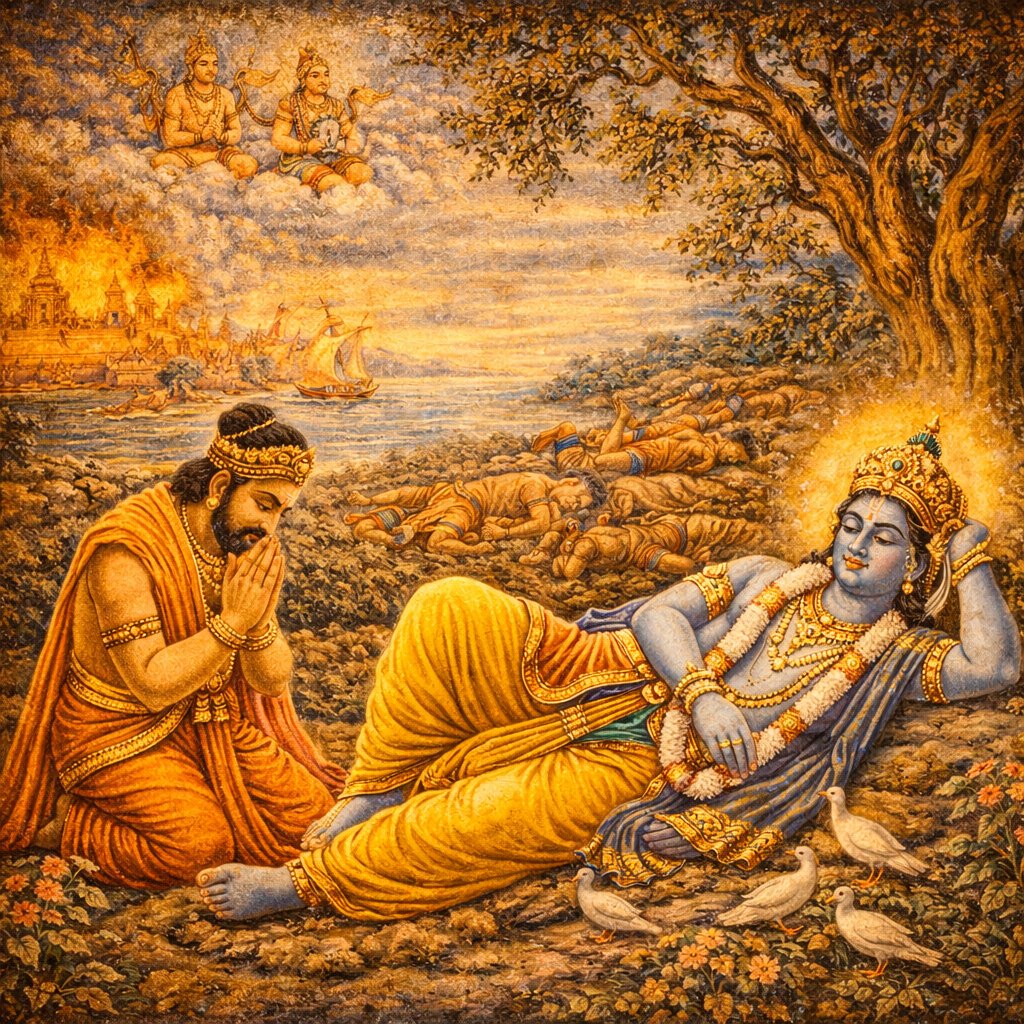
Canto 11 — Uddhava-gītā, the Lord’s final pastimes, and the Yadu dynasty’s withdrawal
एकादश स्कन्धः (Ekādaśa Skandhaḥ)
General History
Contains the Uddhava Gita -- Krishna's final teachings to Uddhava on devotion, knowledge, renunciation, and the nature of the self before departing.
Adhyayas in Ekadasha Skandha
Adhyaya 1
The Curse on the Yadus Begins: Kṛṣṇa’s Plan to Withdraw His Dynasty
Śukadeva explains to Parīkṣit how Kṛṣṇa first removed the earth’s burden by orchestrating the Kurukṣetra war through the Pāṇḍavas, then turned His attention to the remaining ‘burden’: the extraordinarily powerful Yādavas themselves. Knowing no external force could defeat them, the Lord resolves to inspire an internal quarrel, likened to bamboo igniting from friction, and uses a brāhmaṇa curse as the pretext for the dynasty’s withdrawal. Parīkṣit, surprised that brāhmaṇas could curse such respectful Vṛṣṇis, asks the cause and content of the curse. Śukadeva narrates the visit of great sages to Vasudeva’s sacrificial rites and their subsequent arrival at Piṇḍāraka, where Yadu youths mock them by disguising Sāmba as a pregnant woman. Angered, the sages curse that an iron club will be born to destroy the dynasty. The club appears, is reported to Ugrasena, ground and cast into the sea; reeds grow from the filings, and the remaining iron becomes an arrowhead for the hunter Jarā. Kṛṣṇa, fully aware and able to counteract it, sanctions the unfolding as Time—setting up the next chapter’s escalation toward the Yādava self-destruction and the Lord’s departure.
Adhyaya 2
Nārada’s Arrival, the Nine Yogendras, and the Foundations of Bhāgavata-dharma
Continuing the Eleventh Canto’s emphasis on the urgent, practical science of devotion, Śukadeva describes Nārada’s stay in Dvārakā and his visit to Vasudeva, who seeks the duties that most please Mukunda and remove fear. Nārada affirms that devotion is the eternal dharma of the jīva and introduces an ancient instructional precedent: King Videha (Nimi) questioning the nine sons of Ṛṣabhadeva (the Yogendras). After outlining Ṛṣabhadeva’s lineage—Bharata’s renunciation, the division of sons into rulers, brāhmaṇas, and renounced sages—Nārada narrates how the Yogendras arrive at Nimi’s sacrifice and are honored like the Lord Himself. Nimi asks for the supreme good and the method of bhakti. Kavi teaches that fear arises from turning away from the Lord under māyā, and that fearlessness comes through unalloyed devotion under guru guidance, offering all acts to Nārāyaṇa, controlling the mind, and chanting the holy name until ecstatic love awakens. Havir then begins defining Vaiṣṇava gradations—uttama, madhyama, and prākṛta—setting up the next chapter’s deeper analysis of devotees’ symptoms and conduct.
Adhyaya 3
Nimi Questions the Yogendras: Māyā, Cosmic Dissolution, Guru-Śaraṇāgati, Bhakti, and Deity Worship
Continuing King Nimi’s dialogue with the nine Yogendras, the chapter opens with his inquiry into Viṣṇu’s māyā—an energy so subtle that it bewilders even accomplished mystics. Antarīkṣa answers by mapping bondage: the Supersoul activates mind and senses, the jīva pursues guṇa-made objects, misidentifies with the body, and thus wanders through karma and repeated birth and death. The teaching then pivots to nirodha, detailing cosmic dissolution: drought, conflagration from Saṅkarṣaṇa, deluge, and the sequential merging of elements and faculties back into their subtle causes, culminating in the mahat-tattva—framing annihilation as the Lord’s time potency. Nimi then asks how a ‘foolish materialist’ can cross māyā; Prabuddha replies with a critique of household pleasure, wealth, and heaven, and prescribes taking shelter of a bona fide guru and cultivating disciplined devotion, saintly association, and compassion. Next, Nimi requests the Lord’s transcendental position; Pippalāyana establishes Nārāyaṇa as the causeless cause beyond waking/dream/sleep and beyond linguistic capture, while still knowable through bhakti. Finally, Nimi asks about karma-yoga; Āvirhotra explains Vedic authority, why karma is prescribed for the immature, and culminates in arcana (Deity worship) as regulated devotion—bridging this chapter into subsequent, more detailed expositions of sādhana and realization.
Adhyaya 4
Nara-Nārāyaṇa Ṛṣi and the Lord’s Unlimited Incarnations
Continuing King Nimi’s inquiry into the Lord’s descents, Śrī Drumila first establishes the epistemic boundary: the Lord’s guṇas and līlās are unlimited and cannot be exhaustively enumerated. He then situates avatāra-kathā within cosmic structure by describing the Puruṣa’s entry into the universal body and the functional triad of Brahmā (rajas/creation), Viṣṇu (sattva/maintenance), and Rudra (tamas/dissolution). From this cosmological frame, Drumila narrates the Nara-Nārāyaṇa Ṛṣi episode at Badarikāśrama, where Indra, fearing loss of status, sends Cupid and celestial associates; the Lord responds with humility and compassion, neutralizing temptation and revealing a superior opulence by manifesting incomparable attendants, from whom Urvaśī is chosen. The chapter then broadens into a catalogue of major avatāras (Haṁsa, Dattātreya, Kumāras, Ṛṣabhadeva; Matsya, Varāha, Kūrma, Nṛsiṁha, Vāmana, Paraśurāma, Rāma, Buddha, Kalki), linking past, present, and future divine interventions. It thus transitions from a specific exemplum of poṣaṇa (protection and grace) to a panoramic manvantara-oriented theology, preparing the reader for deeper instruction on devotion’s supremacy over demigod-dependent aspirations.
Adhyaya 5
Nimi Questions the Yogendras: Varṇāśrama’s Purpose, Ritualism’s Fall, and Yuga-Avatāras with Kali-yuga Saṅkīrtana
Continuing the royal inquiry setting, King Nimi asks the Yogendras about the destination of those who neglect worship of Hari. Camasa explains that varṇāśrama originates from the Lord and that disrespecting Him leads to spiritual and karmic downfall, especially when Vedic ritualism is pursued for passion, pride, violence, and household indulgence rather than purification. The sages clarify that scriptural concessions for sex, meat, and intoxication are meant to guide gradual renunciation, not to license exploitation; cruelty and false piety bind one to hellish reactions. Nimi then asks how the Lord is worshiped across the yugas. Karabhājana outlines the Lord’s yuga-forms, colors, names, and worship methods—meditation in Satya, sacrifice in Tretā, arcana with Vedic-tantric regulation in Dvāpara—and culminates in Kali-yuga’s prime process: congregational chanting (saṅkīrtana) of Kṛṣṇa’s names, identifying the Kali-yuga avatāra who spreads nāma. The chapter concludes by praising Kali’s unique accessibility, highlighting South India’s devotional proliferation, and affirming that full surrender to Mukunda frees one from other debts. This teaching transitions into the broader consolidation of bhakti principles and their exemplary application by devotees in the surrounding narrative.
Adhyaya 6
Devas in Dvārakā, Brahmā’s Petition, and Uddhava’s Appeal (Prabhāsa Departure Set-Up)
As the Yādava dynasty’s destined end draws near, Brahmā arrives in Dvārakā with Śiva, Indra, and the hosts of devas to behold and glorify Śrī Kṛṣṇa, whose fame purifies the universe. The devas offer layered stuti: Kṛṣṇa as the unaffected superintendent of māyā and the guṇas, the sole purifier beyond ordinary ritual merit, and the refuge whose lotus feet burn material desire. They recall Trivikrama’s cosmic stride and acknowledge kāla as His regulating power over creation, maintenance, and dissolution. Brahmā then confirms the earth’s burden has been removed and requests that the Lord now return to His own abode, while still protecting the cosmic administration. Kṛṣṇa replies that He has fulfilled the devas’ purpose and has already initiated the Yādavas’ withdrawal (through the brāhmaṇa curse) to prevent their excessive power from overwhelming the world. After the devas depart, disturbances and ominous signs intensify in Dvārakā; Kṛṣṇa instructs the elders to leave immediately for Prabhāsa-kṣetra for purification rites. As the Yādavas prepare to depart, Uddhava—alarmed by omens—approaches Kṛṣṇa privately and begins his heartfelt request to accompany the Lord, setting the stage for the confidential teachings that follow.
Adhyaya 7
Kṛṣṇa’s Impending Departure; Uddhava’s Surrender; King Yadu and the Avadhūta’s Twenty-Four Gurus (Beginnings)
Lord Kṛṣṇa confirms Uddhava’s understanding that the Yadu dynasty will be withdrawn and that the devas pray for His return to Vaikuṇṭha. He foretells the Yadus’ destruction by internecine conflict due to the brāhmaṇas’ curse and predicts Dvārakā’s inundation within seven days. Anticipating Kali-yuga’s dominance, Kṛṣṇa instructs Uddhava to leave, renounce attachment to kin and social identity, cultivate equal vision, and perceive the world as māyā—temporary objects misread through dualities of good and evil. Uddhava admits his bondage to bodily identification and begs for an easy method to execute renunciation; he surrenders to Kṛṣṇa as the only perfect teacher. The Lord then introduces a paradigmatic teaching: sometimes one’s own sharpened intelligence becomes an instructing guru, and He transitions into a historical narration—King Yadu’s encounter with an avadhūta brāhmaṇa. The avadhūta declares he learned from twenty-four gurus in nature and society, beginning with lessons from earth, wind, sky, water, fire, moon, and sun, and culminating here in the cautionary pigeon allegory against excessive family attachment. This chapter thus bridges Kṛṣṇa’s final counsel to Uddhava with the avadhūta’s extended instruction that continues into subsequent chapters.
Adhyaya 8
Avadhūta’s Teachers: Python, Ocean, Moth, Bee, Elephant, Deer, Fish—and Piṅgalā’s Song of Detachment
Continuing the Avadhūta-brāhmaṇa’s instruction to King Yadu, this chapter deepens the method of learning vairāgya through “gurus” found in nature and human society. The Avadhūta first teaches radical non-endeavor for material happiness, since sukha and duḥkha arrive by providence; like a python, the wise accept maintenance without anxious striving and remain patient even when fasting is required. He then describes the ocean-like steadiness of a devotee who neither swells with opulence nor dries in poverty. Next, he warns of sensory downfall through vivid analogies: the moth ruined by attraction to fire (lust), the honeybee’s proper lesson (take essence, don’t hoard), the elephant trapped by touch (sexual entanglement), the deer killed by enchanting sound (entertainment), and the fish destroyed by taste (the tongue as hardest to conquer). The narrative then pivots to Piṅgalā the prostitute, whose midnight disappointment matures into decisive detachment; her inner “song” redirects hope from temporary lovers to the indwelling Lord. This prepares the next movement of the Avadhūta’s broader instruction: stable renunciation grounded in devotion and clear discrimination.
Adhyaya 9
Avadhūta’s Further Teachers: Detachment, Solitude, One-Pointed Meditation, and the Lord as Āśraya
Continuing the avadhūta brāhmaṇa’s instruction to King Yadu, this chapter deepens the theme that attachment (āsakti) to “dear” material objects inevitably yields misery, whereas relinquishment produces fearlessness and happiness. The avadhūta illustrates renunciation through nature-based teachers: the hawk that drops meat and becomes relieved; the young girl whose clinking bracelets teach the advantage of solitude and minimal association; the arrow-maker whose absorption models ekāgratā (one-pointed focus) in yoga; and the snake that lives in houses built by others, teaching non-possessiveness. The discourse then shifts from ethics to metaphysics: Nārāyaṇa as the sole shelter at dissolution, time as His potency, pradhāna/mahat-tattva as the basis of manifestation, and the spider analogy for creation and withdrawal (sarga/nirodha). The wasp-and-insect principle explains how constant meditation shapes one’s next state. The avadhūta finally names the body as a teacher of detachment and warns of sense-harassment, urging quick use of rare human life for perfection. The chapter concludes as Yadu is transformed by the teaching and the avadhūta departs, leading into Kṛṣṇa’s continued instruction to Uddhava.
Adhyaya 10
Karma-vāda Critiqued, Varṇāśrama Reframed, and the Soul’s Distinction from the Body
Continuing Kṛṣṇa’s instruction to Uddhava on the progressive path of spiritual life, this chapter begins by establishing the proper stance toward varṇāśrama: one should take full shelter of Bhagavān, fix the mind in devotional service, and live without personal desire while observing regulated duties. Kṛṣṇa then exposes the futility of endeavors rooted in sense gratification, comparing worldly enjoyment to dream-objects—mind-made and ultimately useless—generated by māyā. He outlines a progression: regulated action that purifies, followed by renunciation of fruitive injunctions when one is fully engaged in searching the soul’s ultimate truth, culminating in approaching a bona fide guru. The disciple’s ethos is detailed—humility, non-proprietorship, diligence, freedom from envy and idle talk. Philosophically, Kṛṣṇa distinguishes the self from the gross and subtle bodies using the fire-and-fuel analogy and explains bondage as false identification with guṇa-produced bodies, removable by knowledge. He then refutes karma-vāda and heavenly reward narratives by showing time destroys all results; sin leads to hellish degradation; and even Brahmā fears time. The chapter ends with Uddhava’s inquiry into how the soul can be said both bound and free, setting up the next chapter’s clarification of conditioned versus liberated symptoms.
Adhyaya 11
Bondage and Liberation Under Māyā; Two Birds Analogy; Marks of the Saintly Devotee
Continuing Kṛṣṇa’s concluding guidance to Uddhava within the Uddhava-gītā setting, this chapter clarifies that ‘bondage’ and ‘liberation’ arise from the guṇas of prakṛti under the Lord’s māyā, while the ātmā remains essentially untouched. Kṛṣṇa employs dream and space/sun/wind analogies to show the unreality of material lamentation and the witness-position of the self-realized soul. He contrasts the enlightened person—who sees senses acting upon sense objects—with the ignorant doer-ego bound by karma. The famous two birds in one tree image distinguishes the jīva (enjoyer of fruits) from Paramātmā (non-enjoying witness and knower). The chapter then pivots from jñāna and vairāgya to bhakti: scholarship devoid of the Lord’s līlā is sterile, whereas dedicating action and mind to Him purifies existence. Uddhava’s inquiry about the true devotee leads into Kṛṣṇa’s definition of saintly qualities, preparing the next flow of teachings on approved devotion and the excellence of unalloyed love.
Adhyaya 12
Sādhu-saṅga, the Gopīs’ Prema, and the Veda’s Culmination in Exclusive Surrender
Continuing Kṛṣṇa’s instruction to Uddhava in the Uddhava-gītā flow, this chapter intensifies the argument that the decisive cause of liberation and attainment of Bhagavān is sādhu-saṅga and unalloyed bhakti, not the aggregate of pious or ascetic techniques. Kṛṣṇa lists esteemed disciplines—aṣṭāṅga-yoga, sāṅkhya analysis, ahiṁsā, Vedic recitation, tapas, sannyāsa, yajña, dāna, tīrtha, vrata, deva-worship—yet declares they do not ‘bind’ Him the way pure devotion does. He then surveys cross-yuga examples of seemingly ineligible beings and social groups elevated by devotee association, culminating in Vṛndāvana’s residents, whose separation (viraha) from Kṛṣṇa reveals the apex of prema. Uddhava’s doubt prompts Kṛṣṇa to explain the Lord’s manifestation through Vedic sound and the cosmos as His form, culminating in the allegory of the tree of material existence and the instruction to cut it with knowledge—then relinquish even that instrument upon realizing the Lord. The chapter bridges forward by setting a hermeneutic: Veda and analysis are supports whose final telos is exclusive shelter (śaraṇāgati) in Kṛṣṇa.
Adhyaya 13
Guṇa-viveka, Haṁsa-gītā, and the Yoga that Cuts False Ego
Continuing Kṛṣṇa’s progressive instruction to Uddhava on liberation, this chapter first distinguishes the guṇas as properties of material intelligence rather than the ātman, and teaches a practical ladder: cultivate sattva to subdue rajas and tamas, then transcend even sattva through transcendental goodness (bhakti/śuddha-sattva). Kṛṣṇa lists determinants that intensify guṇas—scripture, water, association, place, time, activities, birth, meditation, mantra-japa, and saṁskāras—urging the seeker to choose sattvic supports until direct self-knowledge awakens. Uddhava then asks why humans chase pleasure despite knowing future misery; Kṛṣṇa explains bondage through misidentification, passion-driven planning, and unrestrained senses, and prescribes renewed mind-control and tri-sandhyā absorption in Him. The narrative shifts to the origin of this yoga: the Sanaka sages question Brahmā, who cannot answer due to creative involvement; Kṛṣṇa appears as Haṁsa and delivers decisive nondual analysis—everything perceived is within Him—culminating in the teaching of the witness beyond waking/dream/sleep (turīya) and the sword of knowledge that severs ahaṅkāra. The sages’ doubts dissolve; they worship, and Haṁsa returns to His abode, setting up subsequent Uddhava-gītā emphases on unwavering remembrance and renunciation grounded in realization.
Adhyaya 14
Bhakti as the Supreme Process; Detachment and the Rudiments of Meditation
Continuing the Uddhava–Kṛṣṇa instruction stream, Uddhava asks Kṛṣṇa to adjudicate the many Vedic processes praised by sages: are they equal, or is one supreme? Kṛṣṇa explains that Vedic sound was re-taught after dissolution (to Brahmā, Manu, and the ṛṣis), and that the multiplicity of rituals and philosophies arises because embodied beings possess diverse natures and desires generated by the three guṇas. Human intelligence, bewildered by māyā, proposes countless ‘goods’—piety, fame, pleasure, austerity, charity, vows, politics—yet these yield temporary, lamentation-filled results. In contrast, those who give up material desire and fix consciousness on Kṛṣṇa share a unique happiness; pure devotees desire neither heavenly posts, yogic siddhis, nor even liberation—only Kṛṣṇa. Bhakti purifies like fire and gold-smelting, and even elevates the socially fallen; without loving service, other virtues cannot fully cleanse the heart. The chapter then pivots toward practice: rejecting dreamlike material elevation, avoiding binding association, and introducing meditative discipline (āsana, prāṇāyāma, oṁkāra focus) that prepares the ground for deeper dhyāna teachings in the subsequent section.
Adhyaya 15
Yoga-siddhi — The Mystic Perfections and Their Origin in Meditation on the Lord
Continuing the Uddhava-gītā’s practical instruction on sādhana, this chapter addresses Uddhava’s inquiry into yoga-siddhi: what mystic perfections are, how many exist, and how they are attained. Kṛṣṇa outlines eighteen perfections—eight primary (aṣṭa-siddhi) rooted in Him and ten secondary arising through sattva-guṇa—then adds further yogic attainments connected with meditation and control. He maps specific siddhis to specific meditations on His presence within subtle elements, mahat-tattva, false ego, the sun and vision, prāṇa pathways, and His various forms (Viṣṇu/Nārāyaṇa and Brahman). The narrative arc then pivots: although Kṛṣṇa confirms that a disciplined yogī can attain these powers, He warns that devotees aiming for the supreme yoga (bhakti) regard siddhis as distractions. The chapter thus advances the canto’s progression from technique to telos—yoga’s powers are real, but devotion is the higher perfection—leading into subsequent teachings that further prioritize pure bhakti over subordinate attainments.
Adhyaya 16
Vibhūti-yoga in the Bhāgavata: The Lord’s Manifest Opulences and the Discipline of Control
Continuing Uddhava’s earnest inquiry into the Lord’s hidden presence as Paramātmā, this chapter opens with Uddhava praising Kṛṣṇa as beginningless, endless, and the life of all beings, then requesting knowledge of the siddhis attained by devotion and the various divine forms worshiped by sages. The Lord responds by linking Uddhava’s question to Arjuna’s earlier inquiry at Kurukṣetra, establishing continuity with the Gītā tradition of vibhūti (divine excellences). Kṛṣṇa then enumerates representative manifestations—among Vedas, meters, deities, sages, kings, celestial beings, natural forces, time divisions, virtues, and cosmic principles—showing that whatever is supreme, beautiful, powerful, or purifying is an expansion of His opulence. The discourse culminates in a practical injunction: mastery of speech, mind, prāṇa, and senses through purified intelligence, for without such control one’s vows and austerities leak away like water from an unbaked pot. This chapter thus transitions from metaphysical recognition (“everything is His vibhūti”) to the next-step sādhana imperative (“therefore, control and surrender”).
Adhyaya 17
Varṇāśrama-dharma as a Path to Bhakti (Yuga-dharma Origins, Universal Virtues, Brahmacarya and Gṛhastha Duties)
Uddhava asks Kṛṣṇa to explain how all people—both regulated followers of varṇāśrama and ordinary human beings—can attain loving service (bhakti) through prescribed duties, especially as ancient dharma is fading with time. He recalls the Lord’s prior instruction as Haṁsa to Brahmā and laments that when Kṛṣṇa departs, who will restore this lost spiritual knowledge. Śukadeva introduces Kṛṣṇa’s pleased response: the Lord will now speak eternal religious principles for the welfare of conditioned souls. Kṛṣṇa outlines the yuga-wise unfolding of dharma: in Satya-yuga a single ‘haṁsa’ order exists, the Veda is expressed as oṁ, and worship is directed to the Lord as Haṁsa; in Tretā the Veda expands into three divisions and sacrifice becomes prominent. He then explains the emergence of the four varṇas and four āśramas from the universal form, their natural qualities, and universal duties like ahiṁsā and satya. The chapter gives detailed brahmacārī discipline centered on guru-sevā and purity, warns renunciants and students against association with women, and prescribes general daily regulations for all. It then turns to gṛhastha dharma—pañca-mahā-yajñas, honest maintenance, non-attachment, and the peril of possessiveness—setting up the next movement toward deeper detachment and the progressive āśrama path as bhakti matures.
Adhyaya 18
Vānaprastha-vidhi and Sannyāsa-dharma: Austerity, Detachment, and the Paramahaṁsa Ideal
Continuing Kṛṣṇa’s systematic guidance to Uddhava on the architecture of spiritual life, this chapter moves from regulated renunciation (vānaprastha) to the mature renunciation of sannyāsa, and finally to the transcendent stance of the paramahaṁsa. Kṛṣṇa outlines how one enters the forest stage, lives on forest produce, accepts bodily austerities, performs limited Vedic rites without violence, and avoids hoarding. He then explains when vānaprastha should culminate either in meditative self-immolation (placing the fire within the heart) or in adopting sannyāsa through inner withdrawal of ritual fire. Kṛṣṇa warns that devas may test the renunciant with alluring forms, and He defines true sannyāsa through inner disciplines (speech, action, prāṇa-control) rather than external symbols. The chapter then broadens into the ethics of nonviolence, equanimity, humility, and equal vision, grounding them in the doctrine that the one Lord resides in all beings. It concludes by harmonizing varṇāśrama duties with bhakti: when prescribed duties are offered to Kṛṣṇa without ulterior worship, they purify existence and swiftly award devotion and attainment of the Supreme—setting up the next instructions on deeper realization and steadfast devotion.
Adhyaya 19
Chapter 19
Perfection of Spiritual Knowledge
Adhyaya 20
Karma, Jñāna, and Bhakti: Vedic Dharma, Piety and Sin, and the Boat of Human Life
Continuing Kṛṣṇa’s Uddhava-upadeśa, this chapter begins with Uddhava’s epistemic concern: since the Vedas establish piety and sin through injunctions and prohibitions—structuring varṇāśrama and even the doctrines of heaven and hell—how can the same Vedic authority later transcend or nullify such dualities without causing confusion? In response, Kṛṣṇa presents a graded architecture of spiritual advancement: karma-yoga for those still driven by desires, jñāna-yoga for the disgusted and detached, and bhakti for the fortunate who develop faith in hearing and chanting His glories. He explains that dutiful action without fruitive desire neither elevates to heaven nor degrades to hell, and that human birth is uniquely coveted—even by heavenly and hellish beings—because it enables knowledge and love of God. The chapter then turns practical: time cuts down life; therefore one must detach, control mind and senses, and use the guru and Kṛṣṇa’s instructions as the “captain and favorable winds” of the human boat. Finally, Kṛṣṇa establishes bhakti’s supremacy: devotion destroys desires, severs karmic bondage, and places the devotee beyond material piety and sin. This teaching prepares the reader for subsequent refinements of exclusive devotion and steady realization.
Adhyaya 21
Dharma, Purity, and the Inner Purpose of the Vedas (Karma-kāṇḍa Reoriented to Bhakti)
Continuing Kṛṣṇa’s systematic instruction to Uddhava on how conditioned life is regulated and transcended, this chapter shifts from general spiritual discipline to a precise taxonomy of dharma/adharma and śuddhi/aśuddhi. The Lord explains that abandoning the authorized paths—bhakti, sāṅkhya-style analysis, and prescribed duty—leads to saṁsāra, whereas steadiness in one’s proper position constitutes piety. He then lays out how purity is contextually assessed across place, time, substance, and circumstance, including rules for contaminated lands, auspicious timing, and methods of purification by earth, water, fire, wind, time, and mantra. The chapter culminates in a critique of ‘flowery’ Vedic promises: fruitive statements entice the materially attached but do not define the ultimate good. Kṛṣṇa reveals the deeper hermeneutic: the Veda’s sound (oṁkāra and meters) originates from Him and returns to Him; karma-kāṇḍa, upāsanā-kāṇḍa, and jñāna-kāṇḍa all secretly indicate Him alone. This prepares the reader for the next movement of Uddhava-gītā, where external regulation is further internalized into direct God-centered realization and surrender.
Adhyaya 22
Sāṅkhya Enumeration of Tattvas, Distinction of Puruṣa–Prakṛti, and the Mechanics of Birth and Death
Continuing Kṛṣṇa’s intimate instruction to Uddhava in the Uddhava-gītā, this chapter opens with Uddhava’s inquiry into why sages enumerate creation’s elements (tattvas) in different totals (28, 26, 25, 17, etc.). Kṛṣṇa explains that because subtle and gross elements interpenetrate and because His māyā enables diverse analytic standpoints, multiple enumerations can be logically valid without contradicting truth. He then clarifies key Sāṅkhya structures: the guṇas, time as their agitation, mahat-tattva, and false ego’s threefold transformation, along with the triadic lens (adhyātmika, adhidaivika, adhibhautika). Uddhava next asks how puruṣa (jīva) and prakṛti can appear mutually resident; Kṛṣṇa distinguishes the enjoyer from nature while showing their functional entanglement in conditioned perception. The dialogue culminates in a practical explanation of transmigration: the karmic mind and senses carry impressions from body to body; “birth” and “death” are re-identifications amid constant transformation. The chapter closes by warning against sense enjoyment and highlighting the sādhaka’s need for tolerance under insult—setting up the next inquiry into how to internalize and properly understand such spiritual resilience.
Adhyaya 23
The Song of the Avantī Brāhmaṇa (Avanti-brāhmaṇa-gītā): Mind as the Root of Suffering and Equanimity Amid Insult
After Uddhava respectfully prompts Kṛṣṇa for higher instruction, the Lord introduces a practical problem: harsh words and public insult can destabilize even saintly persons. To illustrate the yogic solution, Kṛṣṇa narrates the history of a wealthy Avantī brāhmaṇa-merchant whose miserliness, anger, and neglect of dharma alienate family and deities, leading to the loss of all wealth and social support. Shocked into renunciation, he takes sannyāsa and wanders silently, only to face repeated humiliation—theft of his mendicant items, mockery, physical abuse, and false accusations. Rather than retaliate, he interprets his suffering as providential and begins his ‘song,’ a philosophical diagnosis: neither people, gods, body, planets, karma, nor time are the true cause of happiness and distress; the mind alone manufactures duality through guṇa-driven perception and false ego. He concludes that conquering the mind is the essence of yoga and that shelter at Kṛṣṇa’s lotus feet enables one to cross nescience. Kṛṣṇa then applies the lesson directly to Uddhava: fix intelligence on Him, control the mind, and transcend dualities—preparing the narrative momentum for subsequent, more systematic yogic instruction.
Adhyaya 24
Sāṅkhya of Creation and Annihilation (Sarga–Nirodha-viveka)
Continuing Kṛṣṇa’s systematic instruction to Uddhava, this chapter turns to a rigorous Sāṅkhya exposition meant to end bheda-bhrama (illusion of duality). Kṛṣṇa begins by grounding ontology: prior to manifestation, the seer and the seen are non-different in the one Absolute. For the sake of līlā and the conditioned souls’ enjoyment-impulse, the Absolute differentiates as prakṛti (material nature) and jīva (the conscious enjoyer). Agitated by the Lord’s glance, the guṇas unfold, generating sūtra/mahat, ahaṅkāra, the tanmātras, the gross elements, senses, and their presiding deities, culminating in the cosmic egg and Brahmā’s secondary creation of planetary systems and destinations. The chapter then pivots from sarga/visarga to nirodha: a stepwise dissolution sequence merges body and cosmos back through elements, qualities, deities, mind, ego, guṇas, unmanifest nature, time, Mahā-puruṣa, and finally the Supreme Self alone. This knowledge, Kṛṣṇa concludes, functions like sunrise—erasing darkness and preventing duality from re-entering. The next movement of the discourse naturally proceeds toward applying such discrimination as steady devotion and freedom from doubt.
Adhyaya 25
Guṇa-vibhāga: The Three Modes and the Path Beyond Them
Continuing Kṛṣṇa’s Uddhava-gītā instructions on disentangling the self from material conditioning, this chapter maps the lived signatures of sattva, rajas, and tamas and explains how association (saṅga) shapes one’s nature. Kṛṣṇa first catalogs behavioral and psychological traits of each guṇa, then shows how the mixed sense of “I” and “mine” and ordinary worldly transactions arise from their combination. He correlates the modes with worship-motives, states of consciousness (wakefulness, dreaming, deep sleep), social and cosmic outcomes (demigods/demons, higher/lower births), and practical domains such as work, knowledge, residence, faith, food, and happiness. The chapter culminates in a soteriological progression: rise by sattva, conquer rajas and tamas through sattvic engagement, and finally transcend even sattva by indifference to the modes—taking exclusive shelter of Kṛṣṇa in devotional service. This prepares the reader for subsequent teachings on steadiness in bhakti and the complete freedom of the jīva who no longer seeks enjoyment in external energy.
Adhyaya 26
Purūravā’s Song of Renunciation and the Glory of Sādhu-saṅga
Continuing Kṛṣṇa’s instructions to Uddhava on disentanglement from material desire, this chapter warns against association with sense-gratifiers and illustrates the psychology of bondage through the history of Emperor Purūravā (Aila) and Urvaśī. Kṛṣṇa introduces Purūravā’s lamentation-song: the king recalls how lust eclipsed time-awareness, dignity, learning, and sovereignty, and how repeated sense enjoyment never satisfied desire—like ghee fueling fire. He then turns to discrimination: the body’s ownership is indeterminate and its beauty is a deceptive covering over impurity, making bodily attraction irrational. The chapter concludes by shifting from negation to the positive remedy: rejecting bad association and embracing saintly devotees, whose speech severs attachment. Kṛṣṇa praises devotees as the rescuing ‘boat’ in saṁsāra and as one’s true family and worshipable refuge, culminating in Purūravā’s peace through realizing the Lord within. This sets the forward momentum toward deeper emphasis on bhakti sustained by sādhu-sevā and nāma-kīrtana.
Adhyaya 27
Arcana-vidhi: The Method of Deity Worship (Vedic, Tantric, and Mixed)
Continuing the Lord’s systematic instruction to Uddhava on reliable practices that convert daily life into bhakti, this chapter turns from general spiritual cultivation to the concrete liturgy of arcana (Deity worship). Uddhava asks about eligibility, scriptural basis, and procedure, affirming that sages like Nārada and Vyāsa praise Deity worship as supremely beneficial and broadly accessible. Kṛṣṇa replies that regulations are vast, so He will outline a stepwise method: choosing Vedic, tantric, or mixed worship; purifying the body; recognizing multiple loci of worship (Deity, fire, sun, water, heart); and understanding Deity materials and installation (temporary vs permanent). He details preparation, nyāsa, sanctifying vessels, invoking the Lord, offering pādya/ācamanīya/arghya, worshiping the Lord’s weapons and associates, and daily bathing, decoration, food offerings, festivals, and song-dance-kathā. A homa sequence is described, followed by prayers, honoring remnants, and (when applicable) dismissal. The chapter then links personal worship to institutional support—temples, gardens, endowments—promising results, while warning against theft of sacred property, setting ethical boundaries for sustaining worship as the narrative advances toward Kṛṣṇa’s concluding instructions.
Adhyaya 28
Nondual Vision Beyond Praise and Blame (Dvandva-nivṛtti and Ātma-viveka)
Continuing the Lord’s progressive education of Uddhava in steady knowledge and devotion, this chapter sharpens the practical application of nondual understanding: one should avoid praising or criticizing others, because such engagement binds the mind in dvandva (material dualities). Kṛṣṇa explains that what is grasped by material speech and mind cannot be ultimate; good and bad within name-and-form are therefore relative and immeasurable. Using analogies of dream, deep sleep, shadows, echoes, and mirages, He shows how false identification with body-mind-ego generates fear up to death, even though the self is untouched. Uddhava then raises a key philosophical doubt—if the soul is the seer and the body is inert, who experiences saṁsāra? The Lord answers: bondage persists as long as attraction to body and senses continues; emotions like fear and grief belong to false ego, not the pure ātmā. He outlines true knowledge (jñāna) as discrimination supported by śāstra, guru, tapas, and reasoning, culminating in the recognition that the Absolute alone exists before, during, and after creation. The chapter then addresses sādhaka risks: until passion is fully removed by bhakti, one must avoid guṇa-association; imperfect yogīs may relapse or face obstacles, yet progress carries forward. Finally, it critiques obsession with bodily siddhis, recommending constant remembrance, hearing/chanting, and following mahā-yogīs—ending with assurance that one who takes shelter of Kṛṣṇa remains undefeated by obstacles and free from hankering.
Adhyaya 29
Bhakti as the Easy and Supreme Yoga: Seeing Kṛṣṇa in All and Uddhava’s Departure to Badarikāśrama
Continuing the Uddhava-gītā’s culminating instructions, Uddhava confesses that mind-control in classical yoga is difficult for those with restless minds and requests a simpler, practicable method (1–3). He glorifies exclusive śaraṇāgati, citing Rāma’s affection for Hanumān over even exalted devas, and praises the Lord’s mercy as both external ācārya and inner Paramātmā (4–6). Kṛṣṇa responds by defining bhakti-sādhana that conquers death: constant remembrance, offering duties to Him, living near holy places and devotees, and celebrating festivals with kīrtana and public worship (8–11). The core discipline is sama-darśana—seeing the Supreme Soul within all beings—leading to humility, respectful conduct, and the rapid destruction of envy and false ego; until perfected, one continues worship with mind, speech, and body (12–19). Kṛṣṇa extols this as His own established, lossless path and praises dissemination and faithful hearing while restricting teaching to qualified, humble devotees (20–32). He concludes that all goals sought through karma, yoga, politics, or commerce are found easily in Him for the devotee, and that full surrender yields liberation and shared opulence (33–34). Overwhelmed, Uddhava expresses gratitude and seeks unwavering attachment; Kṛṣṇa orders him to Badarikāśrama for purification, austerity, and steady meditation, after which Uddhava departs in tearful separation—linking this chapter to the canto’s final transition: the Lord’s withdrawal (nirodha) and the safeguarding of liberating knowledge through Uddhava’s mission (35–49).
Adhyaya 30
The Disappearance of the Yadu Dynasty and Lord Kṛṣṇa’s Departure
Continuing after Uddhava’s departure, Parīkṣit asks how Kṛṣṇa could conclude His manifest presence despite His incomparable beauty and liberating darśana. Śukadeva describes ominous portents over Dvārakā, prompting Kṛṣṇa to convene the Yadus in Sudharmā and order an immediate move to Prabhāsa for expiation, worship of devas, brāhmaṇas, and cows, and ritual purification. Yet, by providence (daiva) and yogamāyā, the Yādavas become intoxicated, quarrel, and slaughter one another—fulfilling the brāhmaṇas’ curse like a bamboo-forest fire consuming itself. Balarāma withdraws through meditation, and Kṛṣṇa sits beneath a pippala tree revealing His four-armed effulgent form. The hunter Jarā, mistaking the Lord’s foot for a deer, wounds Him with an arrow made from the remaining iron fragment of Sāmba’s club; Jarā repents, and Kṛṣṇa absolves and elevates him. Dāruka finds the Lord, witnesses the divine chariot and weapons ascend, and is instructed to inform the family, leave Dvārakā before the ocean inundation, and take all to Indraprastha under Arjuna—thus setting up the transition to the aftermath and the next narrative phase.
Adhyaya 31
The Disappearance of Lord Śrī Kṛṣṇa and the Aftermath in Dvārakā
Following the Prabhāsa events and the annihilation of the Vṛṣṇis, celestial beings—Brahmā, Śiva, Indra, sages, Pitṛs, Siddhas, Gandharvas and others—assemble to witness the Lord’s return to His own abode. They glorify Śauri’s birth and deeds and shower flowers from their vimānas. Kṛṣṇa, seeing the devas (His empowered expansions), closes His lotus eyes and, without employing the yogic ‘āgneyī’ burning of the body, withdraws His manifest form and enters His own dhāma. With His departure, personified Truth, Dharma, Faithfulness, Glory, and Beauty follow; drums resound and flowers fall. Most devas cannot track His movement, underscoring His acintya-śakti; Brahmā and Śiva partially discern it and praise His mystic potency. Śukadeva clarifies to Parīkṣit that the Lord’s appearance/disappearance is a māyā-like theatrical display, not conditioned mortality. Dāruka reaches Dvārakā and reports the Vṛṣṇi destruction, plunging the city into grief; Devakī, Rohiṇī, and Vasudeva collapse and then depart, while the Yadu wives enter funeral fires, including Kṛṣṇa’s queens. Arjuna performs rites, later escorts survivors to Indraprastha, installs Vajra, and the ocean submerges Dvārakā (saving the Lord’s palace). The chapter closes by prescribing morning remembrance and chanting of these līlās as a direct means to the supreme destination and prema-bhakti—transitioning the narrative toward dynastic succession and the world’s Kali-yuga trajectory.
Frequently Asked Questions
Because it combines the Lord’s concluding līlā with sustained instruction (Uddhava-gītā), explaining how bhakti integrates renunciation, knowledge, and right conduct for Kali-yuga. It frames Kṛṣṇa as Kāla (Time) who completes His cosmic responsibility while giving a transferable path (śravaṇa-kīrtana, detachment, devotion) for future generations—thus directly serving Mukti and Rakṣā within the Bhagavata’s daśa-lakṣaṇam.