Adhyaya 27
Indra’s Prayers and the Coronation of Śrī Kṛṣṇa as Govinda (Govindābhiṣeka)
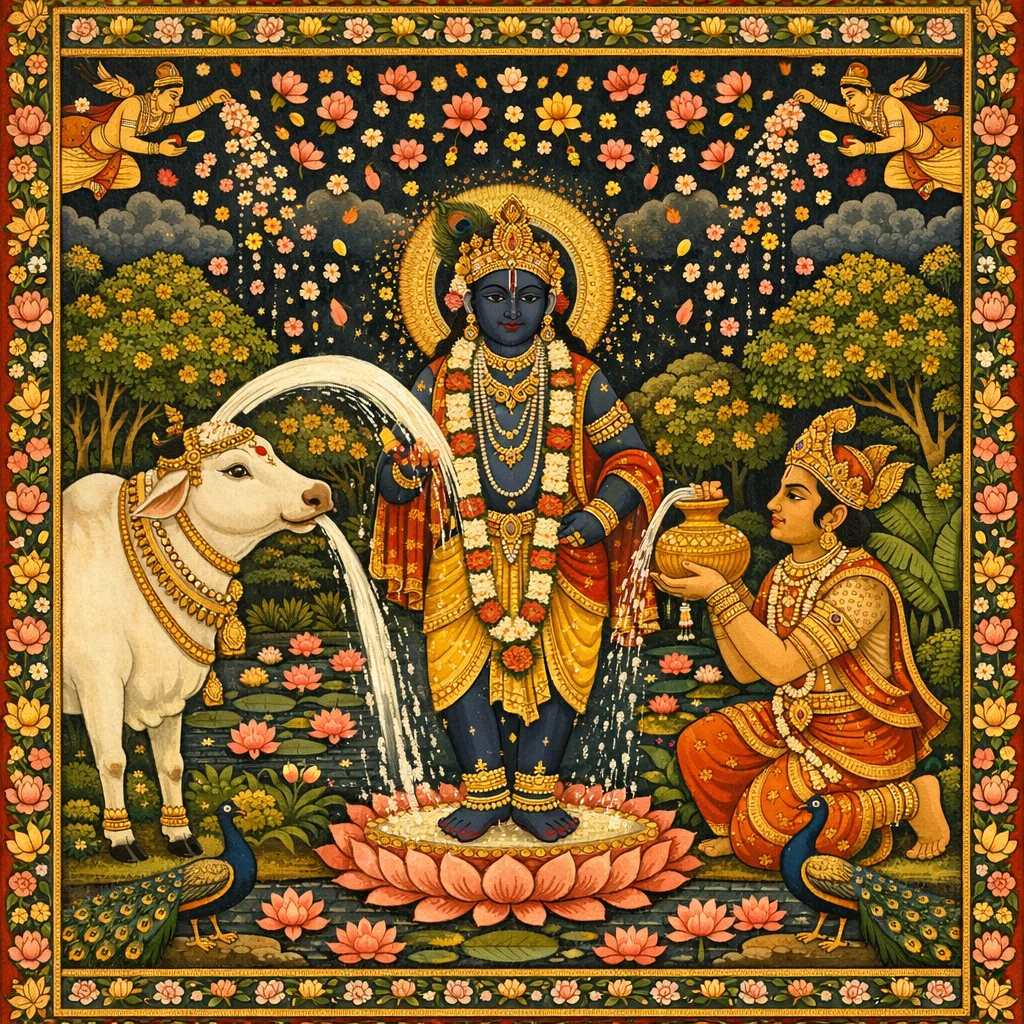
Following the previous Govardhana episode—where Kṛṣṇa protected Vraja by lifting the hill and Indra’s storm failed—Surabhi arrives with Indra to meet the Lord. In seclusion, Indra bows, confesses his aparādha born of aiśvarya-mada (pride of power), and offers a philosophical stotra describing Kṛṣṇa as transcendental to the guṇas, yet the compassionate chastiser who curbs the wicked for their upliftment. Kṛṣṇa replies that He disrupted Indra’s sacrifice out of mercy, since opulence intoxicates and blinds one to the Lord’s corrective “rod of punishment”; He instructs Indra to return to his office sober and humble. Surabhi then petitions that Kṛṣṇa become the true “Indra” for the cows and brāhmaṇas, and, by Brahmā’s order, performs the abhiṣeka: Surabhi bathes Him with milk, and Indra anoints Him with celestial Gaṅgā water from Airāvata. The devas and sages celebrate; nature becomes auspicious; universal enmity subsides. With permission, Indra departs—linking this chapter forward to the continued flourishing of Vraja under Govinda’s protection.
Shlokas
Verse 1
श्रीशुक उवाच गोवर्धने धृते शैले आसाराद् रक्षिते व्रजे । गोलोकादाव्रजत्कृष्णं सुरभि: शक्र एव च ॥ १ ॥
Śukadeva Gosvāmī said: After Kṛṣṇa had lifted Govardhana Hill and thus protected the inhabitants of Vraja from the terrible rainfall, Surabhi, the mother of the cows, came from her planet to see Kṛṣṇa. She was accompanied by Indra.
Verse 2
विविक्त उपसङ्गम्य व्रीडीत: कृतहेलन: । पस्पर्श पादयोरेनं किरीटेनार्कवर्चसा ॥ २ ॥
Indra was very ashamed of having offended the Lord. Approaching Him in a solitary place, Indra fell down and lay his helmet, whose effulgence was as brilliant as the sun, upon the Lord’s lotus feet.
Verse 3
दृष्टश्रुतानुभावोऽस्य कृष्णस्यामिततेजस: । नष्टत्रिलोकेशमद इदमाह कृताञ्जलि: ॥ ३ ॥
Indra had now heard of and seen the transcendental power of omnipotent Kṛṣṇa, and his false pride in being the lord of the three worlds was thus defeated. Holding his hands together in supplication, he addressed the Lord as follows.
Verse 4
इन्द्र उवाच विशुद्धसत्त्वं तव धाम शान्तंतपोमयं ध्वस्तरजस्तमस्कम् । मायामयोऽयं गुणसम्प्रवाहोन विद्यते तेऽग्रहणानुबन्ध: ॥ ४ ॥
King Indra said: Your transcendental form, a manifestation of pure goodness, is undisturbed by change, shining with knowledge and devoid of passion and ignorance. In You does not exist the mighty flow of the modes of material nature, which is based on illusion and ignorance.
Verse 5
कुतो नु तद्धेतव ईश तत्कृतालोभादयो येऽबुधलिङ्गभावा: । तथापि दण्डं भगवान् बिभर्तिधर्मस्य गुप्त्यै लनिग्रहाय ॥ ५ ॥
How, then, could there exist in You the symptoms of an ignorant person — such as greed, lust, anger and envy — which are produced by one’s previous involvement in material existence and which cause one to become further entangled in material existence? And yet as the Supreme Lord You impose punishment to protect religious principles and curb down the wicked.
Verse 6
पिता गुरुस्त्वं जगतामधीशोदुरत्यय: काल उपात्तदण्ड: । हिताय चेच्छातनुभि: समीहसेमानं विधुन्वन् जगदीशमानिनाम् ॥ ६ ॥
You are the father and spiritual master of this entire universe, and also its supreme controller. You are insurmountable time, imposing punishment upon the sinful for their own benefit. Indeed, in Your various incarnations, selected by Your own free will, You act decisively to remove the false pride of those who presume themselves masters of this world.
Verse 7
ये मद्विधाज्ञा जगदीशमानिन-स्त्वां वीक्ष्य कालेऽभयमाशु तन्मदम् । हित्वार्यमार्गं प्रभजन्त्यपस्मयाईहा खलानामपि तेऽनुशासनम् ॥ ७ ॥
Even fools like me, who proudly think themselves universal lords, quickly give up their conceit and directly take to the path of the spiritually progressive when they see You are fearless even in the face of time. Thus You punish the mischievous only to instruct them.
Verse 8
स त्वं ममैश्वर्यमदप्लुतस्यकृतागसस्तेऽविदुष: प्रभावम् । क्षन्तुं प्रभोऽथार्हसि मूढचेतसोमैवं पुनर्भून्मतिरीश मेऽसती ॥ ८ ॥
Engrossed in pride over my ruling power, ignorant of Your majesty, I offended You. O Lord, may You forgive me. My intelligence was bewildered, but let my consciousness never again be so impure.
Verse 9
तवावतारोऽयमधोक्षजेहभुवो भराणामुरुभारजन्मनाम् । चमूपतीनामभवाय देवभवाय युष्मच्चरणानुवर्तिनाम् ॥ ९ ॥
You descend into this world, O transcendent Lord, to destroy the warlords who burden the earth and create many terrible disturbances. O Lord, you simultaneously act for the welfare of those who faithfully serve Your lotus feet.
Verse 10
नमस्तुभ्यं भगवते पुरुषाय महात्मने । वासुदेवाय कृष्णाय सात्वतां पतये नम: ॥ १० ॥
Obeisances unto You, the Supreme Personality of Godhead, the great Soul, who are all-pervading and who reside in the hearts of all. My obeisances unto You, Kṛṣṇa, the chief of the Yadu dynasty.
Verse 11
स्वच्छन्दोपात्तदेहाय विशुद्धज्ञानमूर्तये । सर्वस्मै सर्वबीजाय सर्वभूतात्मने नम: ॥ ११ ॥
Unto Him who assumes transcendental bodies according to the desires of His devotees, unto Him whose form is itself pure consciousness, unto Him who is everything, who is the seed of everything and who is the Soul of all creatures, I offer my obeisances.
Verse 12
मयेदं भगवन् गोष्ठनाशायासारवायुभि: । चेष्टितं विहते यज्ञे मानिना तीव्रमन्युना ॥ १२ ॥
My dear Lord, when my sacrifice was disrupted I became fiercely angry because of false pride. Thus I tried to destroy Your cowherd community with severe rain and wind.
Verse 13
त्वयेशानुगृहीतोऽस्मि ध्वस्तस्तम्भो वृथोद्यम: । ईश्वरं गुरुमात्मानं त्वामहं शरणं गत: ॥ १३ ॥
O Lord, You have shown mercy to me by shattering my false pride and defeating my attempt [to punish Vṛndāvana]. To You, the Supreme Lord, spiritual master and Supreme Soul, I have now come for shelter.
Verse 14
श्रीशुक उवाच एवं सङ्कीर्तित: कृष्णो मघोना भगवानमुम् । मेघगम्भीरया वाचा प्रहसन्निदमब्रवीत् ॥ १४ ॥
Śukadeva Gosvāmī said: Thus glorified by Indra, Lord Kṛṣṇa, the Supreme Personality of Godhead, smiled and then spoke to him as follows in a voice resonant like the clouds.
Verse 15
श्रीभगवानुवाच मया तेऽकारि मघवन् मखभङ्गोऽनुगृह्णता । मदनुस्मृतये नित्यं मत्तस्येन्द्र श्रिया भृशम् ॥ १५ ॥
The Supreme Personality of Godhead said: My dear Indra, it was out of mercy that I stopped the sacrifice meant for you. You were greatly intoxicated by your opulence as King of heaven, and I wanted you to always remember Me.
Verse 16
मामैश्वर्यश्रीमदान्धो दण्डपाणिं न पश्यति । तं भ्रंशयामि सम्पद्भ्यो यस्य चेच्छाम्यनुग्रहम् ॥ १६ ॥
A man blinded by intoxication with his power and opulence cannot see Me nearby with the rod of punishment in My hand. If I desire his real welfare, I drag him down from his materially fortunate position.
Verse 17
गम्यतां शक्र भद्रं व: क्रियतां मेऽनुशासनम् । स्थीयतां स्वाधिकारेषु युक्तैर्व: स्तम्भवर्जितै: ॥ १७ ॥
Indra, you may now go. Execute My order and remain in your appointed position as King of heaven. But be sober, without false pride.
Verse 18
अथाह सुरभि: कृष्णमभिवन्द्यमनस्विनी । स्वसन्तानैरुपामन्त्र्य गोपरूपिणमीश्वरम् ॥ १८ ॥
Mother Surabhi, along with her progeny, the cows, then offered her obeisances to Lord Kṛṣṇa. Respectfully requesting His attention, the gentle lady addressed the Supreme Personality of Godhead, who was present before her as a cowherd boy.
Verse 19
सुरभिरुवाच कृष्ण कृष्ण महायोगिन् विश्वात्मन् विश्वसम्भव । भवता लोकनाथेन सनाथा वयमच्युत ॥ १९ ॥
Mother Surabhi said: O Kṛṣṇa, Kṛṣṇa, greatest of mystics! O Soul and origin of the universe! You are the master of the world, and by Your grace, O infallible Lord, we have You as our master.
Verse 20
त्वं न: परमकं दैवं त्वं न इन्द्रो जगत्पते । भवाय भव गोविप्रदेवानां ये च साधव: ॥ २० ॥
You are our worshipable Deity. Therefore, O Lord of the universe, for the benefit of the cows, the brāhmaṇas, the demigods and all other saintly persons, please become our Indra.
Verse 21
इन्द्रं नस्त्वाभिषेक्ष्यामो ब्रह्मणा चोदिता वयम् । अवतीर्णोऽसि विश्वात्मन् भूमेर्भारापनुत्तये ॥ २१ ॥
As ordered by Lord Brahmā, we shall perform Your bathing ceremony to coronate You as Indra. O Soul of the universe, You descend to this world to relieve the burden of the earth.
Verse 22
श्रीशुक उवाच एवं कृष्णमुपामन्त्र्य सुरभि: पयसात्मन: । जलैराकाशगङ्गाया ऐरावतकरोद्धृतै: ॥ २२ ॥ इन्द्र: सुरर्षिभि: साकं चोदितो देवमातृभि: । अभ्यसिञ्चत दाशार्हं गोविन्द इति चाभ्यधात् ॥ २३ ॥
Śukadeva Gosvāmī said: Having thus appealed to Lord Kṛṣṇa, mother Surabhi performed His bathing ceremony with her own milk, and Indra, ordered by Aditi and other mothers of the demigods, anointed the Lord with heavenly Gaṅgā water from the trunk of Indra’s elephant carrier, Airāvata. Thus, in the company of the demigods and great sages, Indra coronated Lord Kṛṣṇa, the descendant of Daśārha, and gave Him the name Govinda.
Verse 23
श्रीशुक उवाच एवं कृष्णमुपामन्त्र्य सुरभि: पयसात्मन: । जलैराकाशगङ्गाया ऐरावतकरोद्धृतै: ॥ २२ ॥ इन्द्र: सुरर्षिभि: साकं चोदितो देवमातृभि: । अभ्यसिञ्चत दाशार्हं गोविन्द इति चाभ्यधात् ॥ २३ ॥
Śukadeva Gosvāmī said: Having thus appealed to Lord Kṛṣṇa, mother Surabhi performed His bathing ceremony with her own milk, and Indra, ordered by Aditi and other mothers of the demigods, anointed the Lord with heavenly Gaṅgā water from the trunk of Indra’s elephant carrier, Airāvata. Thus, in the company of the demigods and great sages, Indra coronated Lord Kṛṣṇa, the descendant of Daśārha, and gave Him the name Govinda.
Verse 24
तत्रागतास्तुम्बुरुनारदादयोगन्धर्वविद्याधरसिद्धचारणा: । जगुर्यशो लोकमलापहं हरे:सुराङ्गना: सन्ननृतुर्मुदान्विता: ॥ २४ ॥
Tumburu, Nārada and other Gandharvas, along with the Vidyādharas, Siddhas and Cāraṇas, came there to sing the glories of Lord Hari, which purify the entire world. And the wives of the demigods, filled with joy, danced together in the Lord’s honor.
Verse 25
तं तुष्टुवुर्देवनिकायकेतवोह्यवाकिरंश्चाद्भुतपुष्पवृष्टिभि: । लोका: परां निर्वृतिमाप्नुवंस्त्रयोगावस्तदा गामनयन् पयोद्रुताम् ॥ २५ ॥
The most eminent demigods chanted the praises of the Lord and scattered wonderful showers of flowers all around Him. All three worlds felt supreme satisfaction, and the cows drenched the surface of the earth with their milk.
Verse 26
नानारसौघा: सरितो वृक्षा आसन् मधुस्रवा: । अकृष्टपच्यौषधयो गिरयोऽबिभ्रनुन्मणीन् ॥ २६ ॥
Rivers flowed with various kinds of tasty liquids, trees exuded honey, edible plants came to maturity without cultivation, and hills gave forth jewels formerly hidden in their interiors.
Verse 27
कृष्णेऽभिषिक्त एतानि सर्वाणि कुरुनन्दन । निर्वैराण्यभवंस्तात क्रूराण्यपि निसर्गत: ॥ २७ ॥
O Parīkṣit, beloved of the Kuru dynasty, upon the ceremonial bathing of Lord Kṛṣṇa, all living creatures, even those cruel by nature, became entirely free of enmity.
Verse 28
इति गोगोकुलपतिं गोविन्दमभिषिच्य स: । अनुज्ञातो ययौ शक्रो वृतो देवादिभिर्दिवम् ॥ २८ ॥
After he had ceremonially bathed Lord Govinda, who is the master of the cows and the cowherd community, King Indra took the Lord’s permission and, surrounded by the demigods and other higher beings, returned to his heavenly abode.
Frequently Asked Questions
Indra realizes his offense arose from false pride in his delegated cosmic post. Having witnessed Kṛṣṇa’s supremacy and fearlessness before time, Indra confesses that his anger and attempt to punish Vraja were products of delusion. His apology models how a jīva—even a powerful deva—must abandon entitlement and take shelter of Bhagavān to be purified.
Kṛṣṇa states it was an act of mercy: opulence can intoxicate and make one blind to the Lord’s presence and corrective authority. For a person’s true welfare, the Lord may reduce their material elevation to remove pride and restore remembrance—showing punishment can be compassionate instruction rather than revenge.
Surabhi is the celestial mother of cows. She asks Kṛṣṇa to be the true protector and lord for cows and brāhmaṇas, implying that the real source of rain, prosperity, and order is not an independent deva but Bhagavān Himself. Her request reframes ‘Indra’ as a functional title under the Supreme, not the ultimate shelter.
The abhiṣeka publicly affirms Kṛṣṇa’s supremacy over the cosmic hierarchy and His intimate role as protector of Vraja. Being named “Govinda” emphasizes His guardianship of cows and cowherds and also His mastery of the senses (go-indra), teaching that true prosperity and self-control arise from devotion to Him.
The chapter depicts cosmic harmony as responsive to divine satisfaction. When the Lord is honored, the guṇas settle into auspiciousness: hostility subsides, abundance manifests, and even cruel beings become free from enmity—illustrating the Bhāgavata theme that the world’s order is ultimately rooted in alignment with Bhagavān.