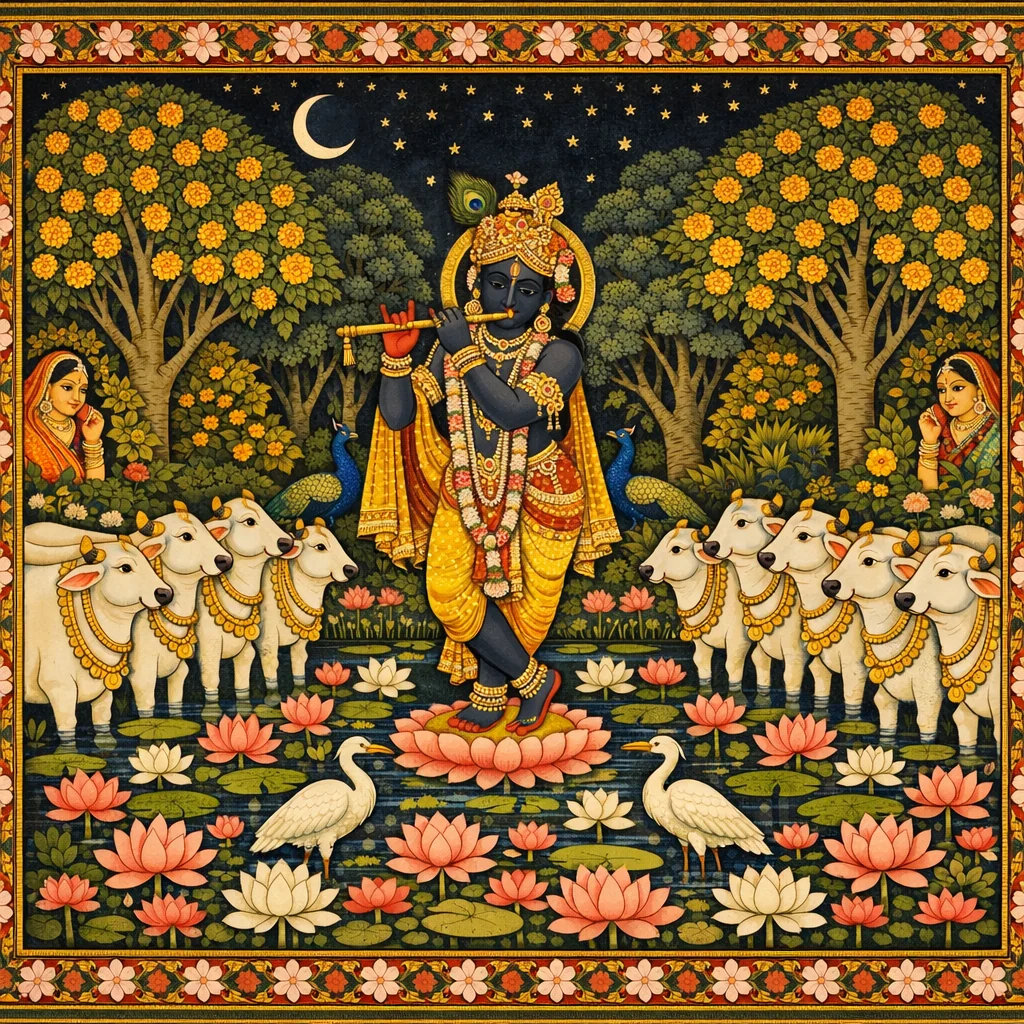
Adhyaya 21
The Gopīs Glorify the Song of Kṛṣṇa’s Flute (Veṇu-gīta)
As the rainy season yields to clear autumn in Vṛndāvana, Śukadeva describes the forest’s purified waters and fragrant breezes as Kṛṣṇa enters with Balarāma, the cowherd boys, and the cows. While herding, Kṛṣṇa begins to play His flute, and the sound becomes the narrative pivot: it moves from the forest into the hearts of the Vraja-gopīs, who privately gather and speak in ecstatic, interrupted speech as kāma (Cupid) is transmuted into bhakti-rasa. They praise Kṛṣṇa’s beauty, dress, footprints, and flute, then extend their vision outward—declaring the flute, deer, birds, rivers, clouds, aborigine women, and Govardhana Hill supremely fortunate because each receives some contact with Him. The chapter closes with the gopīs fully absorbed in smaraṇa, setting the emotional and theological bridge toward the intensification of Vraja’s madhurya mood that will unfold in subsequent flute-and-forest centered pastimes leading toward the rāsa-līlā arc.
Shlokas
Verse 1
श्रीशुक उवाच इत्थं शरत्स्वच्छजलं पद्माकरसुगन्धिना । न्यविशद् वायुना वातं सगोगोपालकोऽच्युत: ॥ १ ॥
Śukadeva Gosvāmī said: Thus the Vṛndāvana forest was filled with transparent autumnal waters and cooled by breezes perfumed with the fragrance of lotus flowers growing in the clear lakes. The infallible Lord, accompanied by His cows and cowherd boyfriends, entered that Vṛndāvana forest.
Verse 2
कुसुमितवनराजिशुष्मिभृङ्ग- द्विजकुलघुष्टसर:सरिन्महीध्रम् । मधुपतिरवगाह्य चारयन् गा: सहपशुपालबलश्चुकूज वेणुम् ॥ २ ॥
The lakes, rivers and hills of Vṛndāvana resounded with the sounds of maddened bees and flocks of birds moving about the flowering trees. In the company of the cowherd boys and Balarāma, Madhupati [Śrī Kṛṣṇa] entered that forest, and while herding the cows He began to vibrate His flute.
Verse 3
तद् व्रजस्त्रिय आश्रुत्य वेणुगीतं स्मरोदयम् । काश्चित्परोक्षं कृष्णस्य स्वसखीभ्योऽन्ववर्णयन् ॥ ३ ॥
When the young ladies in the cowherd village of Vraja heard the song of Kṛṣṇa’s flute, which arouses the influence of Cupid, some of them privately began describing Kṛṣṇa’s qualities to their intimate friends.
Verse 4
तद्वर्णयितुमारब्धा: स्मरन्त्य: कृष्णचेष्टितम् । नाशकन् स्मरवेगेन विक्षिप्तमनसो नृप ॥ ४ ॥
The cowherd girls began to speak about Kṛṣṇa, but when they remembered His activities, O King, the power of Cupid disturbed their minds, and thus they could not speak.
Verse 5
बर्हापीडं नटवरवपु: कर्णयो: कर्णिकारं बिभ्रद् वास: कनककपिशं वैजयन्तीं च मालाम् । रन्ध्रान् वेणोरधरसुधया पूरयन्गोपवृन्दै- र्वृन्दारण्यं स्वपदरमणं प्राविशद् गीतकीर्ति: ॥ ५ ॥
Wearing a peacock-feather ornament upon His head, blue karṇikāra flowers on His ears, a yellow garment as brilliant as gold, and the Vaijayantī garland, Lord Kṛṣṇa exhibited His transcendental form as the greatest of dancers as He entered the forest of Vṛndāvana, beautifying it with the marks of His footprints. He filled the holes of His flute with the nectar of His lips, and the cowherd boys sang His glories.
Verse 6
इति वेणुरवं राजन् सर्वभूतमनोहरम् । श्रुत्वा व्रजस्त्रिय: सर्वा वर्णयन्त्योऽभिरेभिरे ॥ ६ ॥
O King, when the young ladies in Vraja heard the sound of Kṛṣṇa’s flute, which captivates the minds of all living beings, they all embraced one another and began describing it.
Verse 7
श्रीगोप्य ऊचु: अक्षण्वतां फलमिदं न परं विदाम: सख्य: पशूननु विवेशयतोर्वयस्यै: । वक्त्रं व्रजेशसुतयोरनवेणु जुष्टं यैर्वा निपीतमनुरक्तकटाक्षमोक्षम् ॥ ७ ॥
The cowherd girls said: O friends, those eyes that see the beautiful faces of the sons of Mahārāja Nanda are certainly fortunate. As these two sons enter the forest, surrounded by Their friends, driving the cows before Them, They hold Their flutes to Their mouths and glance lovingly upon the residents of Vṛndāvana. For those who have eyes, we think there is no greater object of vision.
Verse 8
चूतप्रवालबर्हस्तबकोत्पलाब्ज- मालानुपृक्तपरिधानविचित्रवेशौ । मध्ये विरेजतुरलं पशुपालगोष्ठ्यां रङ्गे यथा नटवरौ क्व च गायमानौ ॥ ८ ॥
Dressed in a charming variety of garments, upon which Their garlands rest, and decorating Themselves with peacock feathers, lotuses, lilies, newly grown mango sprouts and clusters of flower buds, Kṛṣṇa and Balarāma shine forth magnificently among the assembly of cowherd boys. They look just like the best of dancers appearing on a dramatic stage, and sometimes They sing.
Verse 9
गोप्य: किमाचरदयं कुशलं स्म वेणु- र्दामोदराधरसुधामपि गोपिकानाम् । भुङ्क्ते स्वयं यदवशिष्टरसं ह्रदिन्यो हृष्यत्त्वचोऽश्रु मुमुचुस्तरवो यथार्या: ॥ ९ ॥
My dear gopīs, what auspicious activities must the flute have performed to enjoy the nectar of Kṛṣṇa’s lips independently and leave only a taste for us gopīs, for whom that nectar is actually meant! The forefathers of the flute, the bamboo trees, shed tears of pleasure. His mother, the river on whose bank the bamboo was born, feels jubilation, and therefore her blooming lotus flowers are standing like hair on her body.
Verse 10
वृन्दावनं सखि भुवो वितनोति कीर्तिं यद् देवकीसुतपदाम्बुजलब्धलक्ष्मि । गोविन्दवेणुमनु मत्तमयूरनृत्यं प्रेक्ष्याद्रिसान्ववरतान्यसमस्तसत्त्वम् ॥ १० ॥
O friend, Vṛndāvana is spreading the glory of the earth, having obtained the treasure of the lotus feet of Kṛṣṇa, the son of Devakī. The peacocks dance madly when they hear Govinda’s flute, and when other creatures see them from the hilltops, they all become stunned.
Verse 11
धन्या: स्म मूढगतयोऽपि हरिण्य एता या नन्दनन्दनमुपात्तविचित्रवेशम् । आकर्ण्य वेणुरणितं सहकृष्णसारा: पूजां दधुर्विरचितां प्रणयावलोकै: ॥ ११ ॥
Blessed are all these foolish deer because they have approached Mahārāja Nanda’s son, who is gorgeously dressed and is playing on His flute. Indeed, both the doe and the bucks worship the Lord with looks of love and affection.
Verse 12
कृष्णं निरीक्ष्य वनितोत्सवरूपशीलं श्रुत्वा च तत्क्वणितवेणुविविक्तगीतम् । देव्यो विमानगतय: स्मरनुन्नसारा भ्रश्यत्प्रसूनकबरा मुमुहुर्विनीव्य: ॥ १२ ॥
Kṛṣṇa’s beauty and character create a festival for all women. Indeed, when the demigods’ wives flying in airplanes with their husbands catch sight of Him and hear His resonant flute-song, their hearts are shaken by Cupid, and they become so bewildered that the flowers fall out of their hair and their belts loosen.
Verse 13
गावश्च कृष्णमुखनिर्गतवेणुगीत- पीयूषमुत्तभितकर्णपुटै: पिबन्त्य: । शावा: स्नुतस्तनपय:कवला: स्म तस्थु- र्गोविन्दमात्मनि दृशाश्रुकला: स्पृशन्त्य: ॥ १३ ॥
Using their upraised ears as vessels, the cows are drinking the nectar of the flute-song flowing out of Kṛṣṇa’s mouth. The calves, their mouths full of milk from their mothers’ moist nipples, stand still as they take Govinda within themselves through their tear-filled eyes and embrace Him within their hearts.
Verse 14
प्रायो बताम्ब विहगा मुनयो वनेऽस्मिन् कृष्णेक्षितं तदुदितं कलवेणुगीतम् । आरुह्य ये द्रुमभुजान् रुचिरप्रवालान् शृण्वन्ति मीलितदृशो विगतान्यवाच: ॥ १४ ॥
O mother, in this forest all the birds have risen onto the beautiful branches of the trees to see Kṛṣṇa. With closed eyes they are simply listening in silence to the sweet vibrations of His flute, and they are not attracted by any other sound. Surely these birds are on the same level as great sages.
Verse 15
नद्यस्तदा तदुपधार्य मुकुन्दगीत- मावर्तलक्षितमनोभवभग्नवेगा: । आलिङ्गनस्थगितमूर्मिभुजैर्मुरारे- र्गृह्णन्ति पादयुगलं कमलोपहारा: ॥ १५ ॥
When the rivers hear the flute-song of Kṛṣṇa, their minds begin to desire Him, and thus the flow of their currents is broken and their waters are agitated, moving around in whirlpools. Then with the arms of their waves the rivers embrace Murāri’s lotus feet and, holding on to them, present offerings of lotus flowers.
Verse 16
दृष्ट्वातपे व्रजपशून् सह रामगोपै: सञ्चारयन्तमनु वेणुमुदीरयन्तम् । प्रेमप्रवृद्ध उदित: कुसुमावलीभि: सख्युर्व्यधात् स्ववपुषाम्बुद आतपत्रम् ॥ १६ ॥
In the company of Balarāma and the cowherd boys, Lord Kṛṣṇa is continually vibrating His flute as He herds all the animals of Vraja, even under the full heat of the summer sun. Seeing this, the cloud in the sky has expanded himself out of love. He is rising high and constructing out of his own body, with its multitude of flower-like droplets of water, an umbrella for the sake of his friend.
Verse 17
पूर्णा: पुलिन्द्य उरुगायपदाब्जराग- श्रीकुङ्कुमेन दयितास्तनमण्डितेन । तद्दर्शनस्मररुजस्तृणरूषितेन लिम्पन्त्य आननकुचेषु जहुस्तदाधिम् ॥ १७ ॥
The aborigine women of the Vṛndāvana area become disturbed by lust when they see the grass marked with reddish kuṅkuma powder. Endowed with the color of Kṛṣṇa’s lotus feet, this powder originally decorated the breasts of His beloveds, and when the aborigine women smear it on their faces and breasts, they feel fully satisfied and give up all their anxiety.
Verse 18
हन्तायमद्रिरबला हरिदासवर्यो यद् रामकृष्णचरणस्परशप्रमोद: । मानं तनोति सहगोगणयोस्तयोर्यत् पानीयसूयवसकन्दरकन्दमूलै: ॥ १८ ॥
Of all the devotees, this Govardhana Hill is the best! O my friends, this hill supplies Kṛṣṇa and Balarāma, along with Their calves, cows and cowherd friends, with all kinds of necessities — water for drinking, very soft grass, caves, fruits, flowers and vegetables. In this way the hill offers respects to the Lord. Being touched by the lotus feet of Kṛṣṇa and Balarāma, Govardhana Hill appears very jubilant.
Verse 19
गा गोपकैरनुवनं नयतोरुदार- वेणुस्वनै: कलपदैस्तनुभृत्सु सख्य: । अस्पन्दनं गतिमतां पुलकस्तरुणां निर्योगपाशकृतलक्षणयोर्विचित्रम् ॥ १९ ॥
My dear friends, as Kṛṣṇa and Balarāma pass through the forest with Their cowherd friends, leading Their cows, They carry ropes to bind the cows’ rear legs at the time of milking. When Lord Kṛṣṇa plays on His flute, the sweet music causes the moving living entities to become stunned and the nonmoving trees to tremble with ecstasy. These things are certainly very wonderful.
Verse 20
एवंविधा भगवतो या वृन्दावनचारिण: । वर्णयन्त्यो मिथो गोप्य: क्रीडास्तन्मयतां ययु: ॥ २० ॥
Thus narrating to one another the playful pastimes of the Supreme Personality of Godhead as He wandered about in the Vṛndāvana forest, the gopīs became fully absorbed in thoughts of Him.
Frequently Asked Questions
The flute functions as nāda-brahma in līlā form: divine sound that bypasses mere intellect and directly awakens the heart’s dormant devotion. In this chapter, the flute-song draws all beings—gopīs, animals, birds, rivers, clouds—into a shared field of remembrance, showing that bhakti is elicited by Bhagavān’s self-manifesting beauty and mercy. The gopīs’ praise also highlights intimacy: the flute touches Kṛṣṇa’s lips, symbolizing proximity to the Lord that devotees yearn for.
Bhāgavata theology presents Vraja-prema as transcendental, yet it is expressed through human-like emotions to make the Absolute relatable and relishable (rasa). ‘Cupid’ here indicates the overwhelming force of attraction that, in conditioned life, binds one to sense pleasure, but in Vraja it is purified into prema—where desire is centered only on Kṛṣṇa’s pleasure. The gopīs’ speech breaking and their absorption in remembrance are signs of mahā-bhāva, not material lust.
The gopīs call many recipients fortunate: the flute (for tasting Kṛṣṇa’s lip-nectar), deer (for worshiping with loving glances), birds (for silent absorption like sages), rivers (for offering lotuses and embracing His feet), clouds (for shading Him as a friend), the Vraja-aborigine women (for contact with kuṅkuma from His feet), and especially Govardhana Hill (for serving Kṛṣṇa with grass, water, caves, and fruits). The unifying criterion is proximity and service to Kṛṣṇa—direct or indirect—revealing bhāgya (fortune) as devotional contact.
Govardhana is praised as the best devotee because it performs continuous, practical sevā—providing resources for Kṛṣṇa, Balarāma, cows, and cowherds—while being ‘touched’ by Their lotus feet. This frames devotion not only as emotion but as embodied service (poshana in a localized, intimate mode), and it foreshadows Govardhana’s later centrality in Vraja-līlā.