Adhyaya 31
Gopī-gīta: The Song of the Gopīs in Separation (Viraha-bhakti)
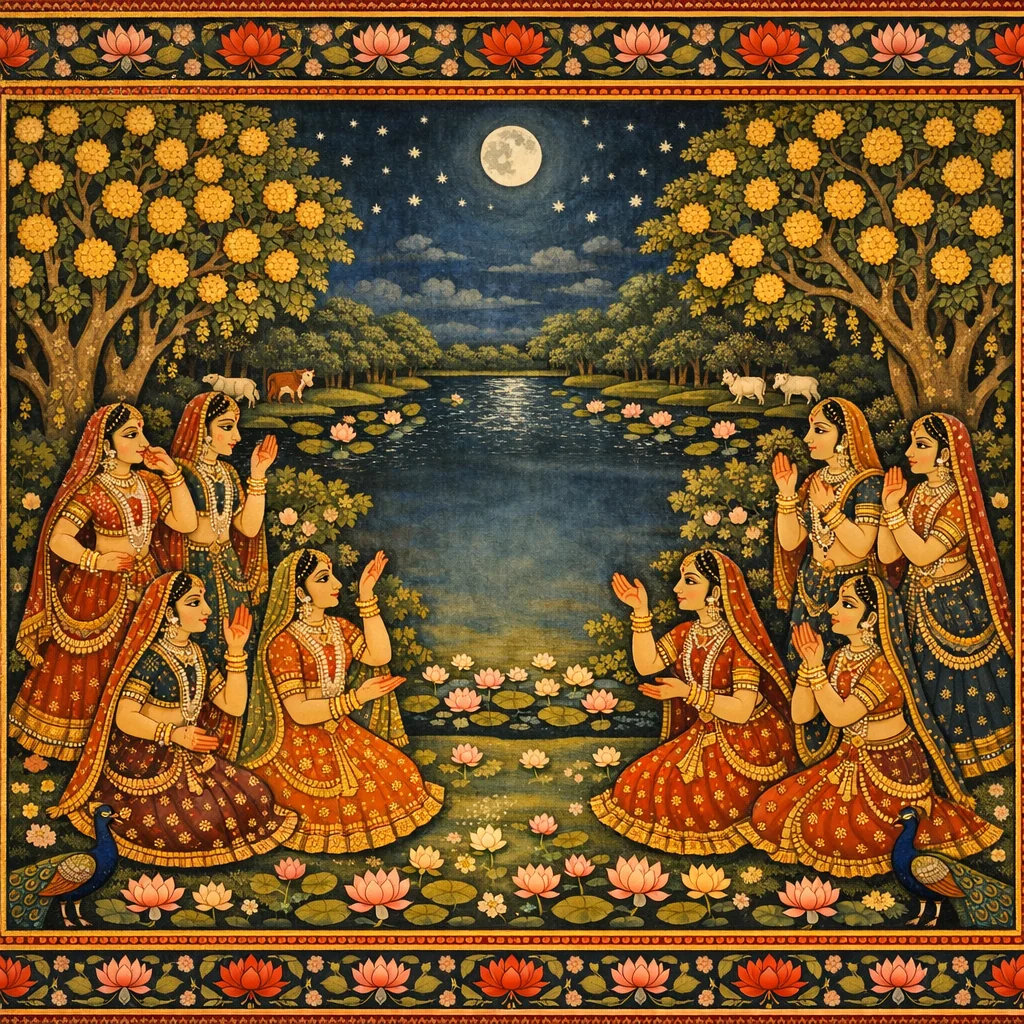
Following the rāsa-līlā sequence in which Śrī Kṛṣṇa disappears from the circle of dance, the gopīs—overwhelmed by viraha—gather and sing a unified lament-prayer (gopī-gīta). Their verses combine accusation and adoration: they plead for Kṛṣṇa’s darśana, praise His beauty (lotus eyes, smile, voice), and recall His repeated acts of poṣaṇa (saving them from Kāliya, Agha, Indra’s storm, and other dangers). They simultaneously assert profound theology—Kṛṣṇa as the indwelling witness and true protector—while expressing the embodied intensity of madhura-rasa, asking for His lotus hand and lotus feet as medicine for their hearts. The chapter crystallizes the Bhāgavata’s teaching that the highest devotion is self-forgetful dependence on Bhagavān, where even pain becomes a vehicle of remembrance. This lament sets the emotional and narrative bridge toward Kṛṣṇa’s eventual reappearance and the resolution of separation, clarifying that His ‘disappearance’ deepens the devotees’ prema and concentrates their consciousness exclusively upon Him.
Shlokas
Verse 1
गोप्य ऊचु: जयति तेऽधिकं जन्मना व्रज: श्रयत इन्दिरा शश्वदत्र हि । दयित दृश्यतां दिक्षु तावका- स्त्वयि धृतासवस्त्वां विचिन्वते ॥ १ ॥
The gopīs said: O beloved, Your birth in the land of Vraja has made it exceedingly glorious, and thus Indirā, the goddess of fortune, always resides here. It is only for Your sake that we, Your devoted servants, maintain our lives. We have been searching everywhere for You, so please show Yourself to us.
Verse 2
शरदुदाशये साधुजातसत्- सरसिजोदरश्रीमुषा दृशा । सुरतनाथ तेऽशुल्कदासिका वरद निघ्नतो नेह किं वध: ॥ २ ॥
O Lord of love, in beauty Your glance excels the whorl of the finest, most perfectly formed lotus within the autumn pond. O bestower of benedictions, You are killing the maidservants who have given themselves to You freely, without any price. Isn’t this murder?
Verse 3
विषजलाप्ययाद् व्यालराक्षसाद् वर्षमारुताद् वैद्युतानलात् । वृषमयात्मजाद् विश्वतो भया- दृषभ ते वयं रक्षिता मुहु: ॥ ३ ॥
O greatest of personalities, You have repeatedly saved us from all kinds of danger — from poisoned water, from the terrible man-eater Agha, from the great rains, from the wind demon, from the fiery thunderbolt of Indra, from the bull demon and from the son of Maya Dānava.
Verse 4
न खलु गोपीकानन्दनो भवान् अखिलदेहिनामन्तरात्मदृक् । विखनसार्थितो विश्वगुप्तये सख उदेयिवान् सात्वतां कुले ॥ ४ ॥
You are not actually the son of the gopī Yaśodā, O friend, but rather the indwelling witness in the hearts of all embodied souls. Because Lord Brahmā prayed for You to come and protect the universe, You have now appeared in the Sātvata dynasty.
Verse 5
विरचिताभयं वृष्णिधूर्य ते चरणमीयुषां संसृतेर्भयात् । करसरोरुहं कान्त कामदं शिरसि धेहि न: श्रीकरग्रहम् ॥ ५ ॥
O best of the Vṛṣṇis, Your lotuslike hand, which holds the hand of the goddess of fortune, grants fearlessness to those who approach Your feet out of fear of material existence. O lover, please place that wish-fulfilling lotus hand on our heads.
Verse 6
व्रजजनार्तिहन् वीर योषितां निजजनस्मयध्वंसनस्मित । भज सखे भवत्किङ्करी: स्म नो जलरुहाननं चारु दर्शय ॥ ६ ॥
O You who destroy the suffering of Vraja’s people, O hero of all women, Your smile shatters the false pride of Your devotees. Please, dear friend, accept us as Your maidservants and show us Your beautiful lotus face.
Verse 7
प्रणतदेहिनां पापकर्षणं तृणचरानुगं श्रीनिकेतनम् । फणिफणार्पितं ते पदाम्बुजं कृणु कुचेषु न: कृन्धि हृच्छयम् ॥ ७ ॥
Your lotus feet destroy the past sins of all embodied souls who surrender to them. Those feet follow after the cows in the pastures and are the eternal abode of the goddess of fortune. Since You once put those feet on the hoods of the great serpent Kāliya, please place them upon our breasts and tear away the lust in our hearts.
Verse 8
मधुरया गिरा वल्गुवाक्यया बुधमनोज्ञया पुष्करेक्षण । विधिकरीरिमा वीर मुह्यतीर् अधरसीधुनाप्याययस्व न: ॥ ८ ॥
O lotus-eyed one, Your sweet voice and charming words, which attract the minds of the intelligent, are bewildering us more and more. Our dear hero, please revive Your maidservants with the nectar of Your lips.
Verse 9
तव कथामृतं तप्तजीवनं कविभिरीडितं कल्मषापहम् । श्रवणमङ्गलं श्रीमदाततं भुवि गृणन्ति ये भूरिदा जना: ॥ ९ ॥
The nectar of Your words and the descriptions of Your activities are the life and soul of those suffering in this material world. These narrations, transmitted by learned sages, eradicate one’s sinful reactions and bestow good fortune upon whoever hears them. These narrations are broadcast all over the world and are filled with spiritual power. Certainly those who spread the message of Godhead are most munificent.
Verse 10
प्रहसितं प्रिय प्रेमवीक्षणं विहरणं च ते ध्यानमङ्गलम् । रहसि संविदो या हृदिस्पृश: कुहक नो मन: क्षोभयन्ति हि ॥ १० ॥
Your smiles, Your sweet, loving glances, the intimate pastimes and confidential talks we enjoyed with You — all these are auspicious to meditate upon, and they touch our hearts. But at the same time, O deceiver, they very much agitate our minds.
Verse 11
चलसि यद् व्रजाच्चारयन् पशून् नलिनसुन्दरं नाथ ते पदम् । शिलतृणाङ्कुरै: सीदतीति न: कलिलतां मन: कान्त गच्छति ॥ ११ ॥
Dear master, dear lover, when You leave the cowherd village to herd the cows, our minds are disturbed with the thought that Your feet, more beautiful than a lotus, will be pricked by the spiked husks of grain and the rough grass and plants.
Verse 12
दिनपरिक्षये नीलकुन्तलै- र्वनरुहाननं बिभ्रदावृतम् । घनरजस्वलं दर्शयन् मुहु- र्मनसि न: स्मरं वीर यच्छसि ॥ १२ ॥
At the end of the day You repeatedly show us Your lotus face, covered with dark blue locks of hair and thickly powdered with dust. Thus, O hero, You arouse lusty desires in our minds.
Verse 13
प्रणतकामदं पद्मजार्चितं धरणिमण्डनं ध्येयमापदि । चरणपङ्कजं शन्तमं च ते रमण न: स्तनेष्वर्पयाधिहन् ॥ १३ ॥
Your lotus feet, which are worshiped by Lord Brahmā, fulfill the desires of all who bow down to them. They are the ornament of the earth, they give the highest satisfaction, and in times of danger they are the appropriate object of meditation. O lover, O destroyer of anxiety, please put those lotus feet upon our breasts.
Verse 14
सुरतवर्धनं शोकनाशनं स्वरितवेणुना सुष्ठु चुम्बितम् । इतररागविस्मारणं नृणां वितर वीर नस्तेऽधरामृतम् ॥ १४ ॥
O hero, kindly distribute to us the nectar of Your lips, which enhances conjugal pleasure and vanquishes grief. That nectar is thoroughly relished by Your vibrating flute and makes people forget any other attachment.
Verse 15
अटति यद् भवानह्नि काननं त्रुटि युगायते त्वामपश्यताम् । कुटिलकुन्तलं श्रीमुखं च ते जड उदीक्षतां पक्ष्मकृद् दृशाम् ॥ १५ ॥
When You go off to the forest during the day, a tiny fraction of a second becomes like a millennium for us because we cannot see You. And even when we can eagerly look upon Your beautiful face, so lovely with its adornment of curly locks, our pleasure is hindered by our eyelids, which were fashioned by the foolish creator.
Verse 16
पतिसुतान्वयभ्रातृबान्धवा- नतिविलङ्घ्य तेऽन्त्यच्युतागता: । गतिविदस्तवोद्गीतमोहिता: कितव योषित: कस्त्यजेन्निशि ॥ १६ ॥
Dear Acyuta, You know very well why we have come here. Who but a cheater like You would abandon young women who come to see Him in the middle of the night, enchanted by the loud song of His flute? Just to see You, we have completely rejected our husbands, children, ancestors, brothers and other relatives.
Verse 17
रहसि संविदं हृच्छयोदयं प्रहसिताननं प्रेमवीक्षणम् । बृहदुर: श्रियो वीक्ष्य धाम ते मुहुरतिस्पृहा मुह्यते मन: ॥ १७ ॥
Our minds are repeatedly bewildered as we think of the intimate conversations we had with You in secret, feel the rise of lust in our hearts and remember Your smiling face, Your loving glances and Your broad chest, the resting place of the goddess of fortune. Thus we experience the most severe hankering for You.
Verse 18
व्रजवनौकसां व्यक्तिरङ्ग ते वृजिनहन्त्र्यलं विश्वमङ्गलम् । त्यज मनाक् च नस्त्वत्स्पृहात्मनां स्वजनहृद्रुजां यन्निषूदनम् ॥ १८ ॥
O beloved, Your all-auspicious appearance vanquishes the distress of those living in Vraja’s forests. Our minds long for Your association. Please give to us just a bit of that medicine, which counteracts the disease in Your devotees’ hearts.
Verse 19
यत्ते सुजातचरणाम्बुरुहं स्तनेषु भीता: शनै: प्रिय दधीमहि कर्कशेषु । तेनाटवीमटसि तद् व्यथते न किंस्वित् कूर्पादिभिर्भ्रमति धीर्भवदायुषां न: ॥ १९ ॥
O dearly beloved! Your lotus feet are so soft that we place them gently on our breasts, fearing that Your feet will be hurt. Our life rests only in You. Our minds, therefore, are filled with anxiety that Your tender feet might be wounded by pebbles as You roam about on the forest path.
Frequently Asked Questions
In Bhāgavata aesthetics, such speech is a feature of madhura-rasa: intimacy allows loving reproach. The gopīs’ ‘accusation’ intensifies remembrance and expresses exclusive dependence—Kṛṣṇa alone is their life—so the language of complaint functions as heightened devotion, not ordinary disrespect.
Viraha in the Bhāgavata is not mundane loss; it is single-pointed absorption (ekāgratā) where every faculty—memory, speech, and imagination—becomes kṛṣṇa-maya. The gopīs’ song shows that separation can produce continuous nāma-kīrtana, līlā-smaraṇa, and surrender, thereby becoming a potent form of bhakti.
Indirā is Śrī (Lakṣmī), the goddess of fortune. The gopīs declare Vraja supremely blessed because Bhagavān’s appearance sanctifies the land; where Kṛṣṇa is present, Śrī naturally resides. The statement also implies that Vraja’s ‘fortune’ is not material opulence but the presence of prema and divine intimacy.
The lotus feet symbolize refuge (śaraṇāgati) and purification—destroying sins and fear—while the lotus hand signifies grace (anugraha) and protection. In gopī-gīta, these images become ‘medicine’ for the heart’s disease (desire and burning separation), expressing that only divine touch—i.e., renewed relationship with Bhagavān—can restore life.
It teaches that Kṛṣṇa-kathā is the ‘life’ of the afflicted world: heard from realized sages, it removes sinful reactions, grants auspiciousness, and spreads spiritual potency broadly. The verse also elevates the preacher of God’s message as most munificent, aligning with the Bhāgavata’s emphasis on śravaṇa and kīrtana as primary sādhana.