Adhyaya 55
Pradyumna’s Abduction, Mahā-māyā, and the Slaying of Śambara
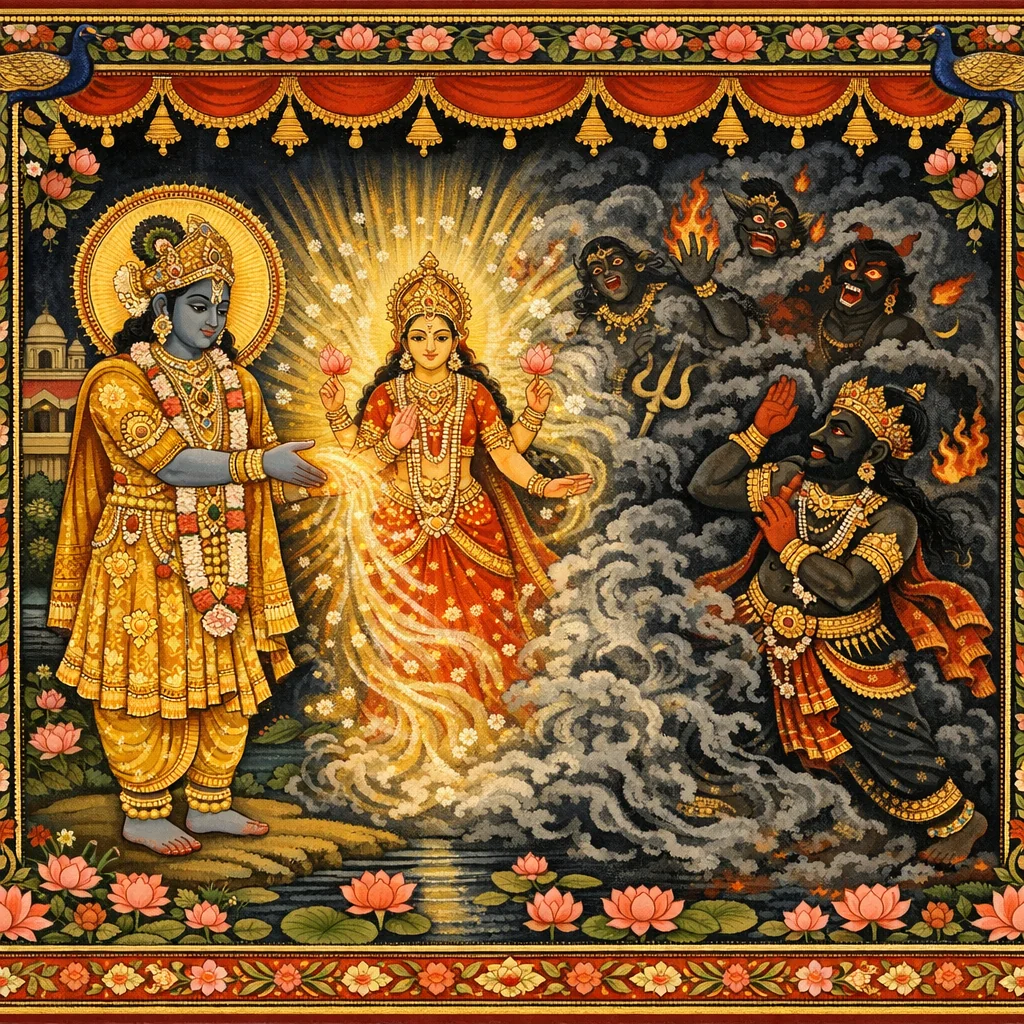
Continuing the Dvārakā cycle of Kṛṣṇa’s dynastic expansion and divine protection (poṣaṇa), this chapter recounts the restoration of Kāmadeva through Kṛṣṇa’s son Pradyumna. Kāmadeva—previously incinerated by Rudra—re-enters Vāsudeva and is born from Kṛṣṇa in the womb of Rukmiṇī (Vaidarbhī) as Pradyumna, equal to his father in beauty and prowess. The asura Śambara, fearing his destined enemy, abducts the infant and casts him into the sea; a fish swallows the child, and fate brings the fish to Śambara’s own kitchen. The cook’s discovery leads to Māyāvatī, who is revealed (via Nārada) as Rati, Kāmadeva’s consort. As Pradyumna matures, a tension arises between apparent maternal relation and conjugal destiny, resolved when Rati explains his identity and trains him in the sattva-born Mahā-māyā that subdues hostile sorcery. Pradyumna challenges and defeats Śambara despite volleys of daitya magic, then returns with Rati to Dvārakā, where the palace women mistake him for Kṛṣṇa and Rukmiṇī’s maternal intuition culminates in recognition through Nārada’s narration—setting the stage for further Yadu-line developments and Dvārakā court dynamics.
Shlokas
Verse 1
श्रीशुक उवाच कामस्तु वासुदेवांशो दग्ध: प्राग् रुद्रमन्युना । देहोपपत्तये भूयस्तमेव प्रत्यपद्यत ॥ १ ॥
Śukadeva Gosvāmī said: Kāmadeva [Cupid], an expansion of Vāsudeva, had previously been burned to ashes by Rudra’s anger. Now, to obtain a new body, he merged back into the body of Lord Vāsudeva.
Verse 2
स एव जातो वैदर्भ्यां कृष्णवीर्यसमुद्भव: । प्रद्युम्न इति विख्यात: सर्वतोऽनवम: पितु: ॥ २ ॥
He took birth in the womb of Vaidarbhī from the seed of Lord Kṛṣṇa and received the name Pradyumna. In no respect was He inferior to His father.
Verse 3
तं शम्बर: कामरूपी हृत्वा तोकमनिर्दशम् । स विदित्वात्मन: शत्रुं प्रास्योदन्वत्यगाद् गृहम् ॥ ३ ॥
The demon Śambara, who could assume any form he desired, kidnapped the infant before He was even ten days old. Understanding Pradyumna to be his enemy, Śambara threw Him into the sea and then returned home.
Verse 4
तं निर्जगार बलवान् मीन: सोऽप्यपरै: सह । वृतो जालेन महता गृहीतो मत्स्यजीविभि: ॥ ४ ॥
A powerful fish swallowed Pradyumna, and this fish, along with others, was caught in a huge net and seized by fishermen.
Verse 5
तं शम्बराय कैवर्ता उपाजह्रुरुपायनम् । सूदा महानसं नीत्वावद्यन् सुधितिनाद्भुतम् ॥ ५ ॥
The fishermen presented that extraordinary fish to Śambara, who had his cooks bring it to the kitchen, where they began cutting it up with a butcher knife.
Verse 6
दृष्ट्वा तदुदरे बालं मायावत्यै न्यवेदयन् । नारदोऽकथयत् सर्वं तस्या: शङ्कितचेतस: । बालस्य तत्त्वमुत्पत्तिं मत्स्योदरनिवेशनम् ॥ ६ ॥
Seeing a male child in the belly of the fish, the cooks gave the infant to Māyāvatī, who was astonished. Nārada Muni then appeared and explained to her everything about the child’s birth and His entering the fish’s abdomen.
Verse 7
सा च कामस्य वै पत्नी रतिर्नाम यशस्विनी । पत्युर्निर्दग्धदेहस्य देहोत्पत्तिं प्रतीक्षती ॥ ७ ॥ निरूपिता शम्बरेण सा सूदौदनसाधने । कामदेवं शिशुं बुद्ध्वा चक्रे स्नेहं तदार्भके ॥ ८ ॥
Māyāvatī was in fact Cupid’s renowned wife, Rati. While waiting for her husband to obtain a new body — his previous one having been burnt up — she had been assigned by Śambara to prepare vegetables and rice. Māyāvatī understood that this infant was actually Kāmadeva, and thus she began to feel love for Him.
Verse 8
सा च कामस्य वै पत्नी रतिर्नाम यशस्विनी । पत्युर्निर्दग्धदेहस्य देहोत्पत्तिं प्रतीक्षती ॥ ७ ॥ निरूपिता शम्बरेण सा सूदौदनसाधने । कामदेवं शिशुं बुद्ध्वा चक्रे स्नेहं तदार्भके ॥ ८ ॥
Māyāvatī was in fact Cupid’s renowned wife, Rati. While waiting for her husband to obtain a new body — his previous one having been burnt up — she had been assigned by Śambara to prepare vegetables and rice. Māyāvatī understood that this infant was actually Kāmadeva, and thus she began to feel love for Him.
Verse 9
नातिदीर्घेण कालेन स कार्ष्णि रूढयौवन: । जनयामास नारीणां वीक्षन्तीनां च विभ्रमम् ॥ ९ ॥
After a short time, this son of Kṛṣṇa — Pradyumna — attained His full youth. He enchanted all women who gazed upon Him.
Verse 10
सा तं पतिं पद्मदलायतेक्षणं प्रलम्बबाहुं नरलोकसुन्दरम् । सव्रीडहासोत्तभितभ्रुवेक्षती प्रीत्योपतस्थे रतिरङ्ग सौरतै: ॥ १० ॥
My dear King, with a bashful smile and raised eyebrows, Māyāvatī exhibited various gestures of conjugal attraction as she lovingly approached her husband, whose eyes were broad like the petals of a lotus, whose arms were very long and who was the most beautiful of men.
Verse 11
तामह भगवान् कार्ष्णिर्मातस्ते मतिरन्यथा । मातृभावमतिक्रम्य वर्तसे कामिनी यथा ॥ ११ ॥
Lord Pradyumna told her, “O mother, your attitude has changed. You are overstepping the proper feelings of a mother and behaving like a lover.”
Verse 12
रतिरुवाच भवान् नारायणसुत: शम्बरेणहृतो गृहात् । अहं तेऽधिकृता पत्नी रति: कामो भवान् प्रभो ॥ १२ ॥
Rati said: You are the son of Lord Nārāyaṇa and were kidnapped from Your parents’ home by Śambara. I, Rati, am Your legitimate wife, O master, because You are Cupid.
Verse 13
एष त्वानिर्दशं सिन्धावक्षिपच्छम्बरोऽसुर: । मत्स्योऽग्रसीत्तदुदरादित: प्राप्तो भवान् प्रभो ॥ १३ ॥
That demon, Śambara, threw You into the sea when You were not even ten days old, and a fish swallowed You. Then in this very place we recovered You from the fish’s abdomen, O master.
Verse 14
तमिमं जहि दुर्धर्षं दुर्जयं शत्रुमात्मन: । मायाशतविदं तं च मायाभिर्मोहनादिभि: ॥ १४ ॥
Now kill this dreadful Śambara, Your formidable enemy. Although he knows hundreds of magic spells, You can defeat him with bewildering magic and other techniques.
Verse 15
परीशोचति ते माता कुररीव गतप्रजा । पुत्रस्नेहाकुला दीना विवत्सा गौरिवातुरा ॥ १५ ॥
Your poor mother, having lost her son, cries for You like a kurarī bird. She is overwhelmed with love for her child, just like a cow that has lost its calf.
Verse 16
प्रभाष्यैवं ददौ विद्यां प्रद्युम्नाय महात्मने । मायावती महामायां सर्वमायाविनाशिनीम् ॥ १६ ॥
[Śukadeva Gosvāmī continued:] Speaking thus, Māyāvatī gave to the great soul Pradyumna the mystic knowledge called Mahā-māyā, which vanquishes all other deluding spells.
Verse 17
स च शम्बरमभ्येत्य संयुगाय समाह्वयत् । अविषह्यैस्तमाक्षेपै: क्षिपन् सञ्जनयन् कलिम् ॥ १७ ॥
Pradyumna approached Śambara and called him to battle, hurling intolerable insults at him to foment a conflict.
Verse 18
सोऽधिक्षिप्तो दुर्वाचोभि: पदाहत इवोरग: । निश्चक्राम गदापाणिरमर्षात्ताम्रलोचन: ॥ १८ ॥
Offended by these harsh words, Śambara became as agitated as a kicked snake. He came out, club in hand, his eyes red with rage.
Verse 19
गदामाविध्य तरसा प्रद्युम्नाय महात्मने । प्रक्षिप्य व्यनदन्नादं वज्रनिष्पेषनिष्ठुरम् ॥ १९ ॥
Śambara whirled his club swiftly about and then hurled it at the wise Pradyumna, producing a sound as sharp as a thunder crack.
Verse 20
तामापतन्तीं भगवान् प्रद्युम्नो गदया गदाम् । अपास्य शत्रवे क्रुद्ध: प्राहिणोत् स्वगदां नृप ॥ २० ॥
As Śambara’s club came flying toward Him, Lord Pradyumna knocked it away with His own. Then, O King, Pradyumna angrily threw His club at the enemy.
Verse 21
स च मायां समाश्रित्य दैतेयीं मयदर्शितम् । मुमुचेऽस्त्रमयं वर्षं कार्ष्णौ वैहायसोऽसुर: ॥ २१ ॥
Resorting to the black magic of the Daityas taught to him by Maya Dānava, Śambara suddenly appeared in the sky and released a downpour of weapons upon Kṛṣṇa’s son.
Verse 22
बाध्यमानोऽस्त्रवर्षेण रौक्मिणेयो महारथ: । सत्त्वात्मिकां महाविद्यां सर्वमायोपमर्दिनीम् ॥ २२ ॥
Harassed by this rain of weapons, Lord Raukmiṇeya, the greatly powerful warrior, made use of the mystic science called Mahā-māyā, which was created from the mode of goodness and which could defeat all other mystic power.
Verse 23
ततो गौह्यकगान्धर्वपैशाचोरगराक्षसी: । प्रायुङ्क्त शतशो दैत्य: कार्ष्णिर्व्यधमयत्स ता: ॥ २३ ॥
The demon then unleashed hundreds of mystic weapons belonging to the Guhyakas, Gandharvas, Piśācas, Uragas and Rākṣasas, but Lord Kārṣṇi, Pradyumna, struck them all down.
Verse 24
निशातमसिमुद्यम्य सकिरीटं सकुण्डलम् । शम्बरस्य शिर: कायात् ताम्रश्मश्र्वोजसाहरत् ॥ २४ ॥
Drawing His sharp-edged sword, Pradyumna forcefully cut off Śambara’s head, complete with red mustache, helmet and earrings.
Verse 25
आकीर्यमाणो दिविजै: स्तुवद्भि: कुसुमोत्करै: । भार्ययाम्बरचारिण्या पुरं नीतो विहायसा ॥ २५ ॥
As the residents of the higher planets showered Pradyumna with flowers and chanted His praises, His wife appeared in the sky and transported Him through the heavens, back to the city of Dvārakā.
Verse 26
अन्त:पुरवरं राजन् ललनाशतसङ्कुलम् । विवेश पत्न्या गगनाद् विद्युतेव बलाहक: ॥ २६ ॥
O King, Lord Pradyumna and His wife resembled a cloud accompanied by lightning as they descended from the sky into the inner quarters of Kṛṣṇa’s most excellent palace, which were crowded with lovely women.
Verse 27
तं दृष्ट्वा जलदश्यामं पीतकौशेयवाससम् । प्रलम्बबाहुं ताम्राक्षं सुस्मितं रुचिराननम् ॥ २७ ॥ स्वलङ्कृतमुखाम्भोजं नीलवक्रालकालिभि: । कृष्णं मत्वा स्त्रियो ह्रीता निलिल्युस्तत्र तत्र ह ॥ २८ ॥
The women of the palace thought He was Lord Kṛṣṇa when they saw His dark-blue complexion the color of a rain cloud, His yellow silk garments, His long arms and red-tinged eyes, His charming lotus face adorned with a pleasing smile, His fine ornaments and His thick, curly blue hair. Thus the women became bashful and hid themselves here and there.
Verse 28
तं दृष्ट्वा जलदश्यामं पीतकौशेयवाससम् । प्रलम्बबाहुं ताम्राक्षं सुस्मितं रुचिराननम् ॥ २७ ॥ स्वलङ्कृतमुखाम्भोजं नीलवक्रालकालिभि: । कृष्णं मत्वा स्त्रियो ह्रीता निलिल्युस्तत्र तत्र ह ॥ २८ ॥
The women of the palace thought He was Lord Kṛṣṇa when they saw His dark-blue complexion the color of a rain cloud, His yellow silk garments, His long arms and red-tinged eyes, His charming lotus face adorned with a pleasing smile, His fine ornaments and His thick, curly blue hair. Thus the women became bashful and hid themselves here and there.
Verse 29
अवधार्य शनैरीषद्वैलक्षण्येन योषित: । उपजग्मु: प्रमुदिता: सस्त्रीरत्नं सुविस्मिता: ॥ २९ ॥
Gradually, from the slight differences between His appearance and Kṛṣṇa’s, the ladies realized He was not the Lord. Delighted and astonished, they approached Pradyumna and His consort, who was a jewel among women.
Verse 30
अथ तत्रासितापाङ्गी वैदर्भी वल्गुभाषिणी । अस्मरत् स्वसुतं नष्टं स्नेहस्नुतपयोधरा ॥ ३० ॥
Seeing Pradyumna, sweet-voiced, dark-eyed Rukmiṇī remembered her lost son, and her breasts became moist out of affection.
Verse 31
को न्वयं नरवैदूर्य: कस्य वा कमलेक्षण: । धृत: कया वा जठरे केयं लब्धा त्वनेन वा ॥ ३१ ॥
[Śrīmatī Rukmiṇī-devī said:] Who is this lotus-eyed jewel among men? What man’s son is He, and what woman carried Him in her womb? And who is this woman He has taken as His wife?
Verse 32
मम चाप्यात्मजो नष्टो नीतो य: सूतिकागृहात् । एतत्तुल्यवयोरूपो यदि जीवति कुत्रचित् ॥ ३२ ॥
If my lost son, who was kidnapped from the maternity room, were still alive somewhere, He would be of the same age and appearance as this young man.
Verse 33
कथं त्वनेन सम्प्राप्तं सारूप्यं शार्ङ्गधन्वन: । आकृत्यावयवैर्गत्या स्वरहासावलोकनै: ॥ ३३ ॥
But how is it that this young man so much resembles my own Lord, Kṛṣṇa, the wielder of Śārṅga, in His bodily form and His limbs, in His gait and the tone of His voice, and in His smiling glance?
Verse 34
स एव वा भवेन्नूनं यो मे गर्भे धृतोऽर्भक: । अमुष्मिन् प्रीतिरधिका वाम: स्फुरति मे भुज: ॥ ३४ ॥
Yes, He must be the same child I bore in my womb, since I feel great affection for Him and my left arm is quivering.
Verse 35
एवं मीमांसमानायां वैदर्भ्यां देवकीसुत: । देवक्यानकदुन्दुभ्यामुत्तम:श्लोक आगमत् ॥ ३५ ॥
As Queen Rukmiṇī conjectured in this way, Lord Kṛṣṇa, the son of Devakī, arrived on the scene with Vasudeva and Devakī.
Verse 36
विज्ञातार्थोऽपि भगवांस्तूष्णीमास जनार्दन: । नारदोऽकथयत् सर्वं शम्बराहरणादिकम् ॥ ३६ ॥
Although Lord Janārdana knew perfectly well what had transpired, He remained silent. The sage Nārada, however, explained everything, beginning with Śambara’s kidnapping of the child.
Verse 37
तच्छ्रुत्वा महदाश्चर्यं कृष्णान्त:पुरयोषित: । अभ्यनन्दन् बहूनब्दान् नष्टं मृतमिवागतम् ॥ ३७ ॥
When the women of Lord Kṛṣṇa’s palace heard this most amazing account, they joyfully greeted Pradyumna, who had been lost for many years but who had now returned as if from the dead.
Verse 38
देवकी वसुदेवश्च कृष्णरामौ तथा स्त्रिय: । दम्पती तौ परिष्वज्य रुक्मिणी च ययुर्मुदम् ॥ ३८ ॥
Devakī, Vasudeva, Kṛṣṇa, Balarāma and all the women of the palace, especially Queen Rukmiṇī, embraced the young couple and rejoiced.
Verse 39
नष्टं प्रद्युम्नमायातमाकर्ण्य द्वारकौकस: । अहो मृत इवायातो बालो दिष्ट्येति हाब्रुवन् ॥ ३९ ॥
Hearing that lost Pradyumna had come home, the residents of Dvārakā declared, “Ah, providence has allowed this child to return as if from death!”
Verse 40
यं वै मुहु: पितृसरूपनिजेशभावा- स्तन्मातरो यदभजन् रहरूढभावा: । चित्रं न तत् खलु रमास्पदबिम्बबिम्बे कामे स्मरेऽक्षविषये किमुतान्यनार्य: ॥ ४० ॥
It is not astonishing that the palace women, who should have felt maternal affection for Pradyumna, privately felt ecstatic attraction for Him as if He were their own Lord. After all, the son exactly resembled His father. Indeed, Pradyumna was a perfect reflection of the beauty of Lord Kṛṣṇa, the shelter of the goddess of fortune, and appeared before their eyes as Cupid Himself. Since even those on the level of His mother felt conjugal attraction for Him, then what to speak of how other women felt when they saw Him?
Frequently Asked Questions
Śambara recognizes Pradyumna as his destined enemy and acts preemptively, a common Purāṇic motif where adharma attempts to thwart providence (daiva). The kidnapping intensifies the theme of poṣaṇa: despite asuric strategy and māyā, the Lord’s lineage is preserved and ultimately triumphs.
The chapter states Kāmadeva—burned by Rudra—merged back into Vāsudeva to obtain a new body, then took birth from Kṛṣṇa as Pradyumna. The point is theological: even forces like desire (kāma) are purified and re-situated when sourced in and serving Vāsudeva, and Pradyumna embodies divine beauty that enchants yet remains under dharma and devotion.
Māyāvatī is Rati, Kāmadeva’s wife, placed in Śambara’s house. Because Pradyumna is Kāmadeva reborn, her conjugal bhāva awakens naturally. The narrative also clarifies dharmic boundaries: Pradyumna initially objects on the assumption of a maternal relationship, and the situation is resolved only after authoritative revelation (Nārada) establishes their true identities.
Mahā-māyā here is a higher mystic science associated with sattva (clarity and divine order) that nullifies lower, tamasic/daityic spells. Śambara’s sorcery—learned from Maya Dānava—relies on bewilderment and aggression, whereas Mahā-māyā functions as superior knowledge/power aligned with the Lord’s will, enabling Pradyumna to counter weapon-showers and illusionary assaults.
Pradyumna is described as a near-perfect reflection of Kṛṣṇa’s form—dark rain-cloud complexion, long arms, lotus face, ornaments—so the women’s initial misrecognition underscores the theological claim that he is ‘in no respect inferior’ in beauty. The episode also illustrates how divine beauty evokes powerful rasa, even requiring contextual knowledge to place emotions within proper relationships.