Adhyaya 69
Nārada Sees Lord Kṛṣṇa’s Yoga-māyā in the Palaces of the Queens (Dvāra-kā-līlā)
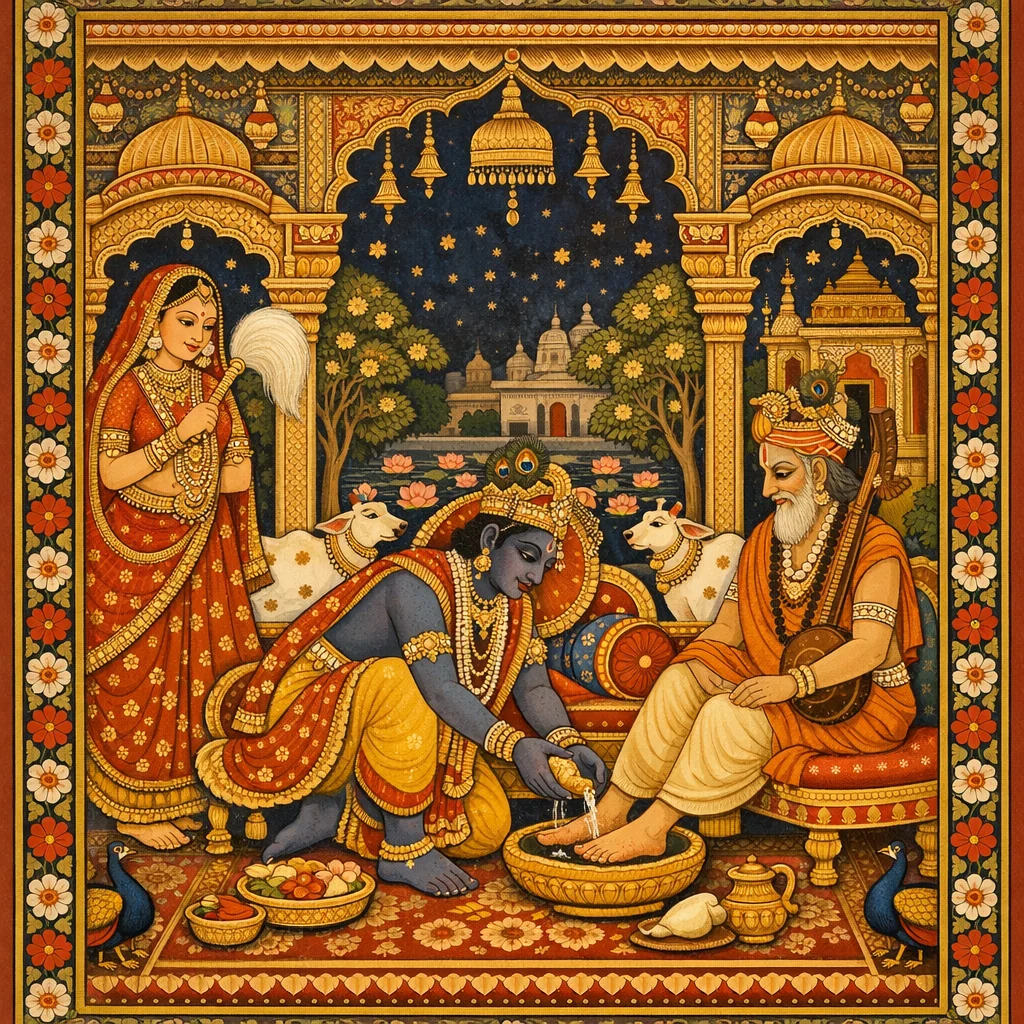
After hearing that Śrī Kṛṣṇa killed Narakāsura and married the rescued princesses, Devarṣi Nārada comes to Dvārakā to directly witness the paradox of one Lord living with sixteen thousand queens in separate palaces. Entering the exquisitely crafted royal quarter (a showcase of divine architecture and prosperity), Nārada sees Kṛṣṇa in one palace being served intimately by a queen; the Lord honors Nārada with exemplary brāhmaṇa-sat-kāra—rising, offering His seat, and washing the sage’s feet—thereby modeling dharma despite being the source of all sanctity. Moving from palace to palace, Nārada repeatedly finds Kṛṣṇa simultaneously engaged in diverse household and royal duties: dice with Uddhava, caring for children, bathing, yajña and pañca-mahā-yajñas, feeding brāhmaṇas, Gāyatrī at sandhyā, martial training, statecraft, recreation, charity, śāstra-kathā, family rituals, meditation, elder-service, diplomacy, marriages, public welfare, hunting for sacrificial purpose, and even disguised inspection of citizens. Nārada recognizes this as Yoga-māyā—Bhagavān’s inconceivable potency—then departs to broadcast the Lord’s purifying fame. The chapter bridges earlier Dvārakā episodes (Narakāsura’s defeat and marriages) to the broader theme of Kṛṣṇa’s ideal gṛhastha-dharma and divine omnipresence, preparing the reader for continued Dvārakā-centered teachings on kingship, devotion, and the Lord’s human-like conduct.
Shlokas
Verse 1
श्रीशुक उवाच नरकं निहतं श्रुत्वा तथोद्वाहं च योषिताम् । कृष्णेनैकेन बह्वीनां तद् दिदृक्षु: स्म नारद: ॥ १ ॥ चित्रं बतैतदेकेन वपुषा युगपत्पृथक् । गृहेषु द्वयष्टसाहस्रं स्त्रिय एक उदावहत् ॥ २ ॥ इत्युत्सुको द्वारवतीं देवर्षिर्द्रष्टुमागमत् । पुष्पितोपवनारामद्विजालिकुलनादिताम् ॥ ३ ॥ उत्फुल्लेन्दीवराम्भोजकह्लारकुमुदोत्पलै: । छुरितेषु सर:सूच्चै: कूजितां हंससारसै: ॥ ४ ॥ प्रासादलक्षैर्नवभिर्जुष्टां स्फाटिकराजतै: । महामरकतप्रख्यै: स्वर्णरत्नपरिच्छदै: ॥ ५ ॥ विभक्तरथ्यापथचत्वरापणै: शालासभाभी रुचिरां सुरालयै: । संसिक्तमार्गाङ्गनवीथिदेहलीं पतत्पताकध्वजवारितातपाम् ॥ ६ ॥
Śukadeva Gosvāmī said: Hearing that Lord Kṛṣṇa had killed Narakāsura and had alone married many brides, Nārada Muni desired to see the Lord in this situation. He thought, “It is quite amazing that in a single body Lord Kṛṣṇa simultaneously married sixteen thousand women, each in a separate palace.” Thus the sage of the demigods eagerly went to Dvārakā.
Verse 2
श्रीशुक उवाच नरकं निहतं श्रुत्वा तथोद्वाहं च योषिताम् । कृष्णेनैकेन बह्वीनां तद् दिदृक्षु: स्म नारद: ॥ १ ॥ चित्रं बतैतदेकेन वपुषा युगपत्पृथक् । गृहेषु द्वयष्टसाहस्रं स्त्रिय एक उदावहत् ॥ २ ॥ इत्युत्सुको द्वारवतीं देवर्षिर्द्रष्टुमागमत् । पुष्पितोपवनारामद्विजालिकुलनादिताम् ॥ ३ ॥ उत्फुल्लेन्दीवराम्भोजकह्लारकुमुदोत्पलै: । छुरितेषु सर:सूच्चै: कूजितां हंससारसै: ॥ ४ ॥ प्रासादलक्षैर्नवभिर्जुष्टां स्फाटिकराजतै: । महामरकतप्रख्यै: स्वर्णरत्नपरिच्छदै: ॥ ५ ॥ विभक्तरथ्यापथचत्वरापणै: शालासभाभी रुचिरां सुरालयै: । संसिक्तमार्गाङ्गनवीथिदेहलीं पतत्पताकध्वजवारितातपाम् ॥ ६ ॥
Śukadeva Gosvāmī said: Hearing that Lord Kṛṣṇa had killed Narakāsura and had alone married many brides, Nārada Muni desired to see the Lord in this situation. He thought, “It is quite amazing that in a single body Lord Kṛṣṇa simultaneously married sixteen thousand women, each in a separate palace.” Thus the sage of the demigods eagerly went to Dvārakā.
Verse 3
श्रीशुक उवाच नरकं निहतं श्रुत्वा तथोद्वाहं च योषिताम् । कृष्णेनैकेन बह्वीनां तद् दिदृक्षु: स्म नारद: ॥ १ ॥ चित्रं बतैतदेकेन वपुषा युगपत्पृथक् । गृहेषु द्वयष्टसाहस्रं स्त्रिय एक उदावहत् ॥ २ ॥ इत्युत्सुको द्वारवतीं देवर्षिर्द्रष्टुमागमत् । पुष्पितोपवनारामद्विजालिकुलनादिताम् ॥ ३ ॥ उत्फुल्लेन्दीवराम्भोजकह्लारकुमुदोत्पलै: । छुरितेषु सर:सूच्चै: कूजितां हंससारसै: ॥ ४ ॥ प्रासादलक्षैर्नवभिर्जुष्टां स्फाटिकराजतै: । महामरकतप्रख्यै: स्वर्णरत्नपरिच्छदै: ॥ ५ ॥ विभक्तरथ्यापथचत्वरापणै: शालासभाभी रुचिरां सुरालयै: । संसिक्तमार्गाङ्गनवीथिदेहलीं पतत्पताकध्वजवारितातपाम् ॥ ६ ॥
Śukadeva Gosvāmī said: Hearing that Lord Kṛṣṇa had killed Narakāsura and had alone married many brides, Nārada Muni desired to see the Lord in this situation. He thought, “It is quite amazing that in a single body Lord Kṛṣṇa simultaneously married sixteen thousand women, each in a separate palace.” Thus the sage of the demigods eagerly went to Dvārakā.
Verse 4
श्रीशुक उवाच नरकं निहतं श्रुत्वा तथोद्वाहं च योषिताम् । कृष्णेनैकेन बह्वीनां तद् दिदृक्षु: स्म नारद: ॥ १ ॥ चित्रं बतैतदेकेन वपुषा युगपत्पृथक् । गृहेषु द्वयष्टसाहस्रं स्त्रिय एक उदावहत् ॥ २ ॥ इत्युत्सुको द्वारवतीं देवर्षिर्द्रष्टुमागमत् । पुष्पितोपवनारामद्विजालिकुलनादिताम् ॥ ३ ॥ उत्फुल्लेन्दीवराम्भोजकह्लारकुमुदोत्पलै: । छुरितेषु सर:सूच्चै: कूजितां हंससारसै: ॥ ४ ॥ प्रासादलक्षैर्नवभिर्जुष्टां स्फाटिकराजतै: । महामरकतप्रख्यै: स्वर्णरत्नपरिच्छदै: ॥ ५ ॥ विभक्तरथ्यापथचत्वरापणै: शालासभाभी रुचिरां सुरालयै: । संसिक्तमार्गाङ्गनवीथिदेहलीं पतत्पताकध्वजवारितातपाम् ॥ ६ ॥
Śukadeva Gosvāmī said: Hearing that Lord Kṛṣṇa had killed Narakāsura and had alone married many brides, Nārada Muni desired to see the Lord in this situation. He thought, “It is quite amazing that in a single body Lord Kṛṣṇa simultaneously married sixteen thousand women, each in a separate palace.” Thus the sage of the demigods eagerly went to Dvārakā.
Verse 5
श्रीशुक उवाच नरकं निहतं श्रुत्वा तथोद्वाहं च योषिताम् । कृष्णेनैकेन बह्वीनां तद् दिदृक्षु: स्म नारद: ॥ १ ॥ चित्रं बतैतदेकेन वपुषा युगपत्पृथक् । गृहेषु द्वयष्टसाहस्रं स्त्रिय एक उदावहत् ॥ २ ॥ इत्युत्सुको द्वारवतीं देवर्षिर्द्रष्टुमागमत् । पुष्पितोपवनारामद्विजालिकुलनादिताम् ॥ ३ ॥ उत्फुल्लेन्दीवराम्भोजकह्लारकुमुदोत्पलै: । छुरितेषु सर:सूच्चै: कूजितां हंससारसै: ॥ ४ ॥ प्रासादलक्षैर्नवभिर्जुष्टां स्फाटिकराजतै: । महामरकतप्रख्यै: स्वर्णरत्नपरिच्छदै: ॥ ५ ॥ विभक्तरथ्यापथचत्वरापणै: शालासभाभी रुचिरां सुरालयै: । संसिक्तमार्गाङ्गनवीथिदेहलीं पतत्पताकध्वजवारितातपाम् ॥ ६ ॥
Śukadeva Gosvāmī said: Hearing that Lord Kṛṣṇa had killed Narakāsura and had alone married many brides, Nārada Muni desired to see the Lord in this situation. He thought, “It is quite amazing that in a single body Lord Kṛṣṇa simultaneously married sixteen thousand women, each in a separate palace.” Thus the sage of the demigods eagerly went to Dvārakā.
Verse 6
श्रीशुक उवाच नरकं निहतं श्रुत्वा तथोद्वाहं च योषिताम् । कृष्णेनैकेन बह्वीनां तद् दिदृक्षु: स्म नारद: ॥ १ ॥ चित्रं बतैतदेकेन वपुषा युगपत्पृथक् । गृहेषु द्वयष्टसाहस्रं स्त्रिय एक उदावहत् ॥ २ ॥ इत्युत्सुको द्वारवतीं देवर्षिर्द्रष्टुमागमत् । पुष्पितोपवनारामद्विजालिकुलनादिताम् ॥ ३ ॥ उत्फुल्लेन्दीवराम्भोजकह्लारकुमुदोत्पलै: । छुरितेषु सर:सूच्चै: कूजितां हंससारसै: ॥ ४ ॥ प्रासादलक्षैर्नवभिर्जुष्टां स्फाटिकराजतै: । महामरकतप्रख्यै: स्वर्णरत्नपरिच्छदै: ॥ ५ ॥ विभक्तरथ्यापथचत्वरापणै: शालासभाभी रुचिरां सुरालयै: । संसिक्तमार्गाङ्गनवीथिदेहलीं पतत्पताकध्वजवारितातपाम् ॥ ६ ॥
Śukadeva Gosvāmī said: Hearing that Lord Kṛṣṇa had killed Narakāsura and had alone married many brides, Nārada Muni desired to see the Lord in this situation. He thought, “It is quite amazing that in a single body Lord Kṛṣṇa simultaneously married sixteen thousand women, each in a separate palace.” Thus the sage of the demigods eagerly went to Dvārakā.
Verse 7
तस्यामन्त:पुरं श्रीमदर्चितं सर्वधिष्ण्यपै: । हरे: स्वकौशलं यत्र त्वष्ट्रा कार्त्स्न्येन दर्शितम् ॥ ७ ॥ तत्र षोडशभि: सद्मसहस्रै: समलङ्कृतम् । विवेशैकतोमं शौरे: पत्नीनां भवनं महत् ॥ ८ ॥
In the city of Dvārakā was a beautiful private quarter worshiped by the planetary rulers. This district, where the demigod Viśvakarmā had shown all his divine skill, was the residential area of Lord Hari, and thus it was gorgeously decorated by the sixteen thousand palaces of Lord Kṛṣṇa’s queens. Nārada Muni entered one of these immense palaces.
Verse 8
तस्यामन्त:पुरं श्रीमदर्चितं सर्वधिष्ण्यपै: । हरे: स्वकौशलं यत्र त्वष्ट्रा कार्त्स्न्येन दर्शितम् ॥ ७ ॥ तत्र षोडशभि: सद्मसहस्रै: समलङ्कृतम् । विवेशैकतोमं शौरे: पत्नीनां भवनं महत् ॥ ८ ॥
In the city of Dvārakā was a beautiful private quarter worshiped by the planetary rulers. This district, where the demigod Viśvakarmā had shown all his divine skill, was the residential area of Lord Hari, and thus it was gorgeously decorated by the sixteen thousand palaces of Lord Kṛṣṇa’s queens. Nārada Muni entered one of these immense palaces.
Verse 9
विष्टब्धं विद्रुमस्तम्भैर्वैदूर्यफलकोत्तमै: । इन्द्रनीलमयै: कुड्यैर्जगत्या चाहतत्विषा ॥ ९ ॥ वितानैर्निर्मितैस्त्वष्ट्रा मुक्तादामविलम्बिभि: । दान्तैरासनपर्यङ्कैर्मण्युत्तमपरिष्कृतै: ॥ १० ॥ दासीभिर्निष्ककण्ठीभि: सुवासोभिरलङ्कृतम् । पुम्भि: सकञ्चुकोष्णीषसुवस्त्रमणिकुण्डलै: ॥ ११ ॥ रत्नप्रदीपनिकरद्युतिभिर्निरस्त- ध्वान्तं विचित्रवलभीषु शिखण्डिनोऽङ्ग । नृत्यन्ति यत्र विहितागुरुधूपमक्षै- र्निर्यान्तमीक्ष्य घनबुद्धय उन्नदन्त: ॥ १२ ॥
Supporting the palace were coral pillars decoratively inlaid with vaidūrya gems. Sapphires bedecked the walls, and the floors glowed with perpetual brilliance. In that palace Tvaṣṭā had arranged canopies with hanging strands of pearls; there were also seats and beds fashioned of ivory and precious jewels. In attendance were many well-dressed maidservants bearing lockets on their necks, and also armor-clad guards with turbans, fine uniforms and jeweled earrings. The glow of numerous jewel-studded lamps dispelled all darkness in the palace. My dear King, on the ornate ridges of the roof danced loudly crying peacocks, who saw the fragrant aguru incense escaping through the holes of the latticed windows and mistook it for a cloud.
Verse 10
विष्टब्धं विद्रुमस्तम्भैर्वैदूर्यफलकोत्तमै: । इन्द्रनीलमयै: कुड्यैर्जगत्या चाहतत्विषा ॥ ९ ॥ वितानैर्निर्मितैस्त्वष्ट्रा मुक्तादामविलम्बिभि: । दान्तैरासनपर्यङ्कैर्मण्युत्तमपरिष्कृतै: ॥ १० ॥ दासीभिर्निष्ककण्ठीभि: सुवासोभिरलङ्कृतम् । पुम्भि: सकञ्चुकोष्णीषसुवस्त्रमणिकुण्डलै: ॥ ११ ॥ रत्नप्रदीपनिकरद्युतिभिर्निरस्त- ध्वान्तं विचित्रवलभीषु शिखण्डिनोऽङ्ग । नृत्यन्ति यत्र विहितागुरुधूपमक्षै- र्निर्यान्तमीक्ष्य घनबुद्धय उन्नदन्त: ॥ १२ ॥
Supporting the palace were coral pillars decoratively inlaid with vaidūrya gems. Sapphires bedecked the walls, and the floors glowed with perpetual brilliance. In that palace Tvaṣṭā had arranged canopies with hanging strands of pearls; there were also seats and beds fashioned of ivory and precious jewels. In attendance were many well-dressed maidservants bearing lockets on their necks, and also armor-clad guards with turbans, fine uniforms and jeweled earrings. The glow of numerous jewel-studded lamps dispelled all darkness in the palace. My dear King, on the ornate ridges of the roof danced loudly crying peacocks, who saw the fragrant aguru incense escaping through the holes of the latticed windows and mistook it for a cloud.
Verse 11
विष्टब्धं विद्रुमस्तम्भैर्वैदूर्यफलकोत्तमै: । इन्द्रनीलमयै: कुड्यैर्जगत्या चाहतत्विषा ॥ ९ ॥ वितानैर्निर्मितैस्त्वष्ट्रा मुक्तादामविलम्बिभि: । दान्तैरासनपर्यङ्कैर्मण्युत्तमपरिष्कृतै: ॥ १० ॥ दासीभिर्निष्ककण्ठीभि: सुवासोभिरलङ्कृतम् । पुम्भि: सकञ्चुकोष्णीषसुवस्त्रमणिकुण्डलै: ॥ ११ ॥ रत्नप्रदीपनिकरद्युतिभिर्निरस्त- ध्वान्तं विचित्रवलभीषु शिखण्डिनोऽङ्ग । नृत्यन्ति यत्र विहितागुरुधूपमक्षै- र्निर्यान्तमीक्ष्य घनबुद्धय उन्नदन्त: ॥ १२ ॥
Supporting the palace were coral pillars decoratively inlaid with vaidūrya gems. Sapphires bedecked the walls, and the floors glowed with perpetual brilliance. In that palace Tvaṣṭā had arranged canopies with hanging strands of pearls; there were also seats and beds fashioned of ivory and precious jewels. In attendance were many well-dressed maidservants bearing lockets on their necks, and also armor-clad guards with turbans, fine uniforms and jeweled earrings. The glow of numerous jewel-studded lamps dispelled all darkness in the palace. My dear King, on the ornate ridges of the roof danced loudly crying peacocks, who saw the fragrant aguru incense escaping through the holes of the latticed windows and mistook it for a cloud.
Verse 12
विष्टब्धं विद्रुमस्तम्भैर्वैदूर्यफलकोत्तमै: । इन्द्रनीलमयै: कुड्यैर्जगत्या चाहतत्विषा ॥ ९ ॥ वितानैर्निर्मितैस्त्वष्ट्रा मुक्तादामविलम्बिभि: । दान्तैरासनपर्यङ्कैर्मण्युत्तमपरिष्कृतै: ॥ १० ॥ दासीभिर्निष्ककण्ठीभि: सुवासोभिरलङ्कृतम् । पुम्भि: सकञ्चुकोष्णीषसुवस्त्रमणिकुण्डलै: ॥ ११ ॥ रत्नप्रदीपनिकरद्युतिभिर्निरस्त- ध्वान्तं विचित्रवलभीषु शिखण्डिनोऽङ्ग । नृत्यन्ति यत्र विहितागुरुधूपमक्षै- र्निर्यान्तमीक्ष्य घनबुद्धय उन्नदन्त: ॥ १२ ॥
Supporting the palace were coral pillars decoratively inlaid with vaidūrya gems. Sapphires bedecked the walls, and the floors glowed with perpetual brilliance. In that palace Tvaṣṭā had arranged canopies with hanging strands of pearls; there were also seats and beds fashioned of ivory and precious jewels. In attendance were many well-dressed maidservants bearing lockets on their necks, and also armor-clad guards with turbans, fine uniforms and jeweled earrings. The glow of numerous jewel-studded lamps dispelled all darkness in the palace. My dear King, on the ornate ridges of the roof danced loudly crying peacocks, who saw the fragrant aguru incense escaping through the holes of the latticed windows and mistook it for a cloud.
Verse 13
तस्मिन् समानगुणरूपवय:सुवेष- दासीसहस्रयुतयानुसवं गृहिण्या । विप्रो ददर्श चमरव्यजनेन रुक्म- दण्डेन सात्वतपतिं परिवीजयन्त्या ॥ १३ ॥
In that palace the learned brāhmaṇa saw the Lord of the Sātvatas, Śrī Kṛṣṇa, together with His wife, who fanned Him with a gold-handled yak-tail fan. She personally served Him in this way, even though she was constantly attended by a thousand maidservants equal to her in personal character, beauty, youth and fine dress.
Verse 14
तं सन्निरीक्ष्य भगवान् सहसोत्थितश्री- पर्यङ्कत: सकलधर्मभृतां वरिष्ठ: । आनम्य पादयुगलं शिरसा किरीट- जुष्टेन साञ्जलिरवीविशदासने स्वे ॥ १४ ॥
The Supreme Lord is the greatest upholder of religious principles. Thus when He noticed Nārada, He rose at once from Goddess Śrī’s bed, bowed His crowned head at Nārada’s feet and, joining His palms, had the sage sit in His own seat.
Verse 15
तस्यावनिज्य चरणौ तदप: स्वमूर्ध्ना बिभ्रज्जगद्गुरुतमोऽपि सतां पतिर्हि । ब्रह्मण्यदेव इति यद्गुणनाम युक्तं तस्यैव यच्चरणशौचमशेषतीर्थम् ॥ १५ ॥
The Lord bathed Nārada’s feet and then put the water on His own head. Although Lord Kṛṣṇa is the supreme spiritual authority of the universe and the master of His devotees, it was proper for Him to behave in this way, for His name is Brahmaṇya-deva, “the Lord who favors the bṛāhmaṇas.” Thus Śrī Kṛṣṇa honored the sage Nārada by bathing his feet, even though the water that bathes the Lord’s own feet becomes the Ganges, the ultimate holy shrine.
Verse 16
सम्पूज्य देवऋषिवर्यमृषि: पुराणो नारायणो नरसखो विधिनोदितेन । वाण्याभिभाष्य मितयामृतमिष्टया तं प्राह प्रभो भगवते करवाम हे किम् ॥ १६ ॥
After fully worshiping the great sage of the demigods according to Vedic injunctions, Lord Kṛṣṇa, who is Himself the original sage — Nārāyaṇa, the friend of Nara — conversed with Nārada, and the Lord’s measured speech was as sweet as nectar. Finally the Lord asked Nārada, “What may We do for you, Our lord and master?”
Verse 17
श्रीनारद उवाच नैवाद्भुतं त्वयि विभोऽखिललोकनाथे मैत्री जनेषु सकलेषु दम: खलानाम् । नि:श्रेयसाय हि जगत्स्थितिरक्षणाभ्यां स्वैरावतार उरुगाय विदाम सुष्ठु ॥ १७ ॥
Śrī Nārada said: O almighty Lord, it is no surprise that You, the ruler of all worlds, show friendship for all people and yet subdue the envious. As we well know, You descend by Your sweet will in order to bestow the highest good on this universe by maintaining and protecting it. Thus Your glories are widely sung.
Verse 18
दृष्टं तवाङ्घ्रियुगलं जनतापवर्गं ब्रह्मादिभिर्हृदि विचिन्त्यमगाधबोधै: । संसारकूपपतितोत्तरणावलम्बं ध्यायंश्चराम्यनुगृहाण यथा स्मृति: स्यात् ॥ १८ ॥
Now I have seen Your feet, which grant liberation to Your devotees, which even Lord Brahmā and other great personalities of unfathomable intelligence can only meditate upon within their hearts, and which those who have fallen into the well of material existence resort to for deliverance. Please favor me so that I may constantly think of You as I travel about. Please grant Me the power to remember You.
Verse 19
ततोऽन्यदाविशद् गेहं कृष्णपत्न्या: स नारद: । योगेश्वरेश्वरस्याङ्ग योगमायाविवित्सया ॥ १९ ॥
Nārada then entered the palace of another of Lord Kṛṣṇa’s wives, my dear King. He was eager to witness the spiritual potency possessed by the master of all masters of mystic power.
Verse 20
दीव्यन्तमक्षैस्तत्रापि प्रियया चोद्धवेन च । पूजित: परया भक्त्या प्रत्युत्थानासनादिभि: ॥ २० ॥ पृष्टश्चाविदुषेवासौ कदायातो भवानिति । क्रियते किं नु पूर्णानामपूर्णैरस्मदादिभि: ॥ २१ ॥ अथापि ब्रूहि नो ब्रह्मन् जन्मैतच्छोभनं कुरु । स तु विस्मित उत्थाय तूष्णीमन्यदगाद् गृहम् ॥ २२ ॥
There he saw the Lord playing at dice with His beloved consort and His friend Uddhava. Lord Kṛṣṇa worshiped Nārada by standing up, offering him a seat, and so on, and then, as if He did not know, asked him, “When did you arrive? What can needy persons like Us do for those who are full in themselves? In any case, My dear brāhmaṇa, please make My life auspicious.” Thus addressed, Nārada was astonished. He simply stood up silently and went to another palace.
Verse 21
दीव्यन्तमक्षैस्तत्रापि प्रियया चोद्धवेन च । पूजित: परया भक्त्या प्रत्युत्थानासनादिभि: ॥ २० ॥ पृष्टश्चाविदुषेवासौ कदायातो भवानिति । क्रियते किं नु पूर्णानामपूर्णैरस्मदादिभि: ॥ २१ ॥ अथापि ब्रूहि नो ब्रह्मन् जन्मैतच्छोभनं कुरु । स तु विस्मित उत्थाय तूष्णीमन्यदगाद् गृहम् ॥ २२ ॥
There he saw the Lord playing at dice with His beloved consort and His friend Uddhava. Lord Kṛṣṇa worshiped Nārada by standing up, offering him a seat, and so on, and then, as if He did not know, asked him, “When did you arrive? What can needy persons like Us do for those who are full in themselves? In any case, My dear brāhmaṇa, please make My life auspicious.” Thus addressed, Nārada was astonished. He simply stood up silently and went to another palace.
Verse 22
दीव्यन्तमक्षैस्तत्रापि प्रियया चोद्धवेन च । पूजित: परया भक्त्या प्रत्युत्थानासनादिभि: ॥ २० ॥ पृष्टश्चाविदुषेवासौ कदायातो भवानिति । क्रियते किं नु पूर्णानामपूर्णैरस्मदादिभि: ॥ २१ ॥ अथापि ब्रूहि नो ब्रह्मन् जन्मैतच्छोभनं कुरु । स तु विस्मित उत्थाय तूष्णीमन्यदगाद् गृहम् ॥ २२ ॥
There he saw the Lord playing at dice with His beloved consort and His friend Uddhava. Lord Kṛṣṇa worshiped Nārada by standing up, offering him a seat, and so on, and then, as if He did not know, asked him, “When did you arrive? What can needy persons like Us do for those who are full in themselves? In any case, My dear brāhmaṇa, please make My life auspicious.” Thus addressed, Nārada was astonished. He simply stood up silently and went to another palace.
Verse 23
तत्राप्यचष्ट गोविन्दं लालयन्तं सुतान् शिशून् । ततोऽन्यस्मिन् गृहेऽपश्यन्मज्जनाय कृतोद्यमम् ॥ २३ ॥
This time Nāradajī saw that Lord Kṛṣṇa was engaged as an affectionate father petting His small children. From there he entered another palace and saw Lord Kṛṣṇa preparing to take His bath.
Verse 24
जुह्वन्तं च वितानाग्नीन् यजन्तं पञ्चभिर्मखै: । भोजयन्तं द्विजान् क्वापि भुञ्जानमवशेषितम् ॥ २४ ॥
In one place the Lord was offering oblations into the sacrificial fires; in another, worshiping through the five mahā-yajñas; in another, feeding brāhmaṇas; and in yet another, eating the remnants of food left by brāhmaṇas.
Verse 25
क्वापि सन्ध्यामुपासीनं जपन्तं ब्रह्म वाग्यतम् । एकत्र चासिचर्माभ्यां चरन्तमसिवर्त्मसु ॥ २५ ॥
Somewhere Lord Kṛṣṇa was observing the rituals for worship at sunset by refraining from speech and quietly chanting the Gāyatrī mantra, and elsewhere He was moving about with sword and shield in the areas set aside for sword practice.
Verse 26
अश्वैर्गजै रथै: क्वापि विचरन्तं गदाग्रजम् । क्वचिच्छयानं पर्यङ्के स्तूयमानं च वन्दिभि: ॥ २६ ॥
In one place Lord Gadāgraja was riding on horses, elephants and chariots, and in another place He was resting on His bed while bards recited His glories.
Verse 27
मन्त्रयन्तं च कस्मिंश्चिन्मन्त्रिभिश्चोद्धवादिभि: । जलक्रीडारतं क्वापि वारमुख्याबलावृतम् ॥ २७ ॥
Somewhere He was consulting with royal ministers like Uddhava, and somewhere else He was enjoying in the water, surrounded by many society girls and other young women.
Verse 28
कुत्रचिद्द्विजमुख्येभ्यो ददतं गा: स्वलङ्कृता: । इतिहासपुराणानि शृण्वन्तं मङ्गलानि च ॥ २८ ॥
Somewhere He was giving well-decorated cows to exalted brāhmaṇas, and elsewhere he was listening to the auspicious narration of epic histories and Purāṇas.
Verse 29
हसन्तं हासकथया कदाचित् प्रियया गृहे । क्वापि धर्मं सेवमानमर्थकामौ च कुत्रचित् ॥ २९ ॥
Somewhere Lord Kṛṣṇa was found enjoying the company of a particular wife by exchanging joking words with her. Somewhere else He was found engaged, along with His wife, in religious ritualistic functions. Somewhere Kṛṣṇa was found engaged in matters of economic development, and somewhere else He was found enjoying family life according to the regulative principles of the śāstras.
Verse 30
ध्यायन्तमेकमासीनं पुरुषं प्रकृते: परम् । शुश्रूषन्तं गुरून् क्वापि कामैर्भोगै: सपर्यया ॥ ३० ॥
Somewhere He was sitting alone, meditating on the Supreme Personality of Godhead, who is transcendental to material nature, and somewhere He was rendering menial service to His elders, offering them desirable things and reverential worship.
Verse 31
कुर्वन्तं विग्रहं कैश्चित् सन्धिं चान्यत्र केशवम् । कुत्रापि सह रामेण चिन्तयन्तं सतां शिवम् ॥ ३१ ॥
In one place He was planning battles in consultation with some of His advisers, and in another place He was making peace. Somewhere Lord Keśava and Lord Balarāma were together pondering the welfare of the pious.
Verse 32
पुत्राणां दुहितृणां च काले विध्युपयापनम् । दारैर्वरैस्तत्सदृशै: कल्पयन्तं विभूतिभि: ॥ ३२ ॥
Nārada saw Lord Kṛṣṇa engaged in getting His sons and daughters married to suitable brides and bridegrooms at the appropriate time, and the marriage ceremonies were being performed with great pomp.
Verse 33
प्रस्थापनोपनयनैरपत्यानां महोत्सवान् । वीक्ष्य योगेश्वरेशस्य येषां लोका विसिस्मिरे ॥ ३३ ॥
Nārada observed how Śrī Kṛṣṇa, the master of all yoga masters, arranged to send away His daughters and sons-in-law, and also to receive them home again, at the time of great holiday celebrations. All the citizens were astonished to see these celebrations.
Verse 34
यजन्तं सकलान् देवान् क्वापि क्रतुभिरूर्जितै: । पूर्तयन्तं क्वचिद् धर्मं कूर्पाराममठादिभि: ॥ ३४ ॥
Somewhere He was worshiping all the demigods with elaborate sacrifices, and elsewhere He was fulfilling His religious obligations by doing public welfare work, such as the construction of wells, public parks and monasteries.
Verse 35
चरन्तं मृगयां क्वापि हयमारुह्य सैन्धवम् । घ्नन्तं तत्र पशून् मेध्यान् परीतं यदुपुङ्गवै: ॥ ३५ ॥
In another place He was on a hunting expedition. Mounted on His Sindhī horse and accompanied by the most heroic of the Yadus, He was killing animals meant for offering in sacrifice.
Verse 36
अव्यक्तलिङ्गं प्रकृतिष्वन्त:पुरगृहादिषु । क्वचिच्चरन्तं योगेशं तत्तद्भावबुभुत्सया ॥ ३६ ॥
Somewhere Kṛṣṇa, the Lord of mystic power, was moving about in disguise among the homes of ministers and other citizens in order to understand what each of them was thinking.
Verse 37
अथोवाच हृषीकेशं नारद: प्रहसन्निव । योगमायोदयं वीक्ष्य मानुषीमीयुषो गतिम् ॥ ३७ ॥
Having thus seen this display of the Lord’s Yoga-māyā, Nārada mildly laughed and then addressed Lord Hṛṣīkeśa, who was adopting the behavior of a human being.
Verse 38
विदाम योगमायास्ते दुर्दर्शा अपि मायिनाम् । योगेश्वरात्मन् निर्भाता भवत्पादनिषेवया ॥ ३८ ॥
[Nārada said:] Now we understand Your mystic potencies, which are difficult to comprehend, even for great mystics, O Supreme Soul, master of all mystic power. Only by serving Your feet have I been able to perceive Your powers.
Verse 39
अनुजानीहि मां देव लोकांस्ते यशसाप्लुतान् । पर्यटामि तवोद्गायन् लीला भुवनपावनी: ॥ ३९ ॥
O Lord, please give me Your leave. I will wander about the worlds, which are flooded with Your fame, loudly singing about Your pastimes, which purify the universe.
Verse 40
श्रीभगवानुवाच ब्रह्मन् धर्मस्य वक्ताहं कर्ता तदनुमोदिता । तच्छिक्षयन् लोकमिममास्थित: पुत्र मा खिद: ॥ ४० ॥
The Supreme Personality of Godhead said: O brāhmaṇa, I am the speaker of religion, its performer and sanctioner. I observe religious principles to teach them to the world, My child, so do not be disturbed.
Verse 41
श्रीशुक उवाच इत्याचरन्तं सद्धर्मान् पावनान् गृहमेधिनाम् । तमेव सर्वगेहेषु सन्तमेकं ददर्श ह ॥ ४१ ॥
Śukadeva Gosvāmī said: Thus in every palace Nārada saw the Lord in His same personal form, executing the transcendental principles of religion that purify those engaged in household affairs.
Verse 42
कृष्णस्यानन्तवीर्यस्य योगमायामहोदयम् । मुहुर्दृष्ट्वा ऋषिरभूद् विस्मितो जातकौतुक: ॥ ४२ ॥
Having repeatedly seen the vast mystic display of Lord Kṛṣṇa, whose power is unlimited, the sage was amazed and filled with wonder.
Verse 43
इत्यर्थकामधर्मेषु कृष्णेन श्रद्धितात्मना । सम्यक् सभाजित: प्रीतस्तमेवानुस्मरन् ययौ ॥ ४३ ॥
Lord Kṛṣṇa greatly honored Nārada, faithfully presenting him with gifts related to economic prosperity, sense gratification and religious duties. Thus fully satisfied, the sage departed, constantly remembering the Lord.
Verse 44
एवं मनुष्यपदवीमनुवर्तमानो नारायणोऽखिलभवाय गृहीतशक्ति: । रेमेऽङ्ग षोडशसहस्रवराङ्गनानां सव्रीडसौहृदनिरीक्षणहासजुष्ट: ॥ ४४ ॥
In this way Lord Nārāyaṇa imitated the ways of ordinary humans, manifesting His divine potencies for the benefit of all beings. Thus He enjoyed, dear King, in the company of His sixteen thousand exalted consorts, who served the Lord with their shy, affectionate glances and laughter.
Verse 45
यानीह विश्वविलयोद्भववृत्तिहेतु: कर्माण्यनन्यविषयाणि हरिश्चकार । यस्त्वङ्ग गायति शृणोत्यनुमोदते वा भक्तिर्भवेद् भगवति ह्यपवर्गमार्गे ॥ ४५ ॥ यस्यात्मबुद्धि: कुणपे त्रिधातुके स्वधी: कलत्रादिषु भौम इज्यधी: । यत्तीर्थबुद्धि: सलिले न कर्हिचिज् जनेष्वभिज्ञेषु स एव गोखर: ॥
Lord Hari is the ultimate cause of universal creation, maintenance and destruction. My dear King, anyone who chants about, hears about or simply appreciates the extraordinary activities He performed in this world, which are impossible to imitate, will surely develop devotion for the Supreme Lord, the bestower of liberation.
Frequently Asked Questions
Nārada heard that Kṛṣṇa had married many queens after killing Narakāsura and wanted to witness how the Lord could simultaneously live with each queen in a separate palace. His purpose is theological: to observe and then affirm the Lord’s Yoga-māyā—Bhagavān’s capacity to manifest many concurrent personal engagements while remaining one nondual Supreme Person.
The chapter presents this as Yoga-māyā, not a material duplication. Kṛṣṇa remains the single Supreme Person (āśraya-tattva) and, by His own potency, manifests concurrent personal presence and activities in multiple locations. The narrative emphasizes that this is “difficult to comprehend even for great mystics” and is perceived through devotion (service to His feet), not merely through logic.
It demonstrates Brahmaṇya-deva—Kṛṣṇa’s special favor toward brāhmaṇas and His role as the teacher of dharma through personal example. Although the water bathing Kṛṣṇa’s feet becomes Gaṅgā, He still honors His devotee and a brāhmaṇa sage, showing that divine supremacy does not negate humility and proper social-religious conduct.
Nārada witnesses Kṛṣṇa performing a complete spectrum of ideal royal and household duties—yajña, charity, sandhyā worship, scriptural listening, family affection, governance, diplomacy, welfare works, and recreation. The import is that household life becomes purifying when centered on Bhagavān, and that the Lord models integrated dharma (religion, prosperity, regulated enjoyment) while remaining transcendent.
Uddhava appears as Kṛṣṇa’s intimate friend and ministerial confidant (seen with Kṛṣṇa during leisure like dice and in counsel elsewhere). His presence signals that Kṛṣṇa’s līlā includes both affectionate intimacy and serious statecraft, and that the Lord’s associates participate in revealing His qualities to observers like Nārada.
That Bhagavān’s personal form and daily human-like conduct can simultaneously reveal unlimited divine potency. Hearing, chanting, or even appreciating these “impossible to imitate” activities fosters devotion and leads toward liberation because it anchors the mind in the āśraya—Śrī Hari—as the ultimate cause and refuge.