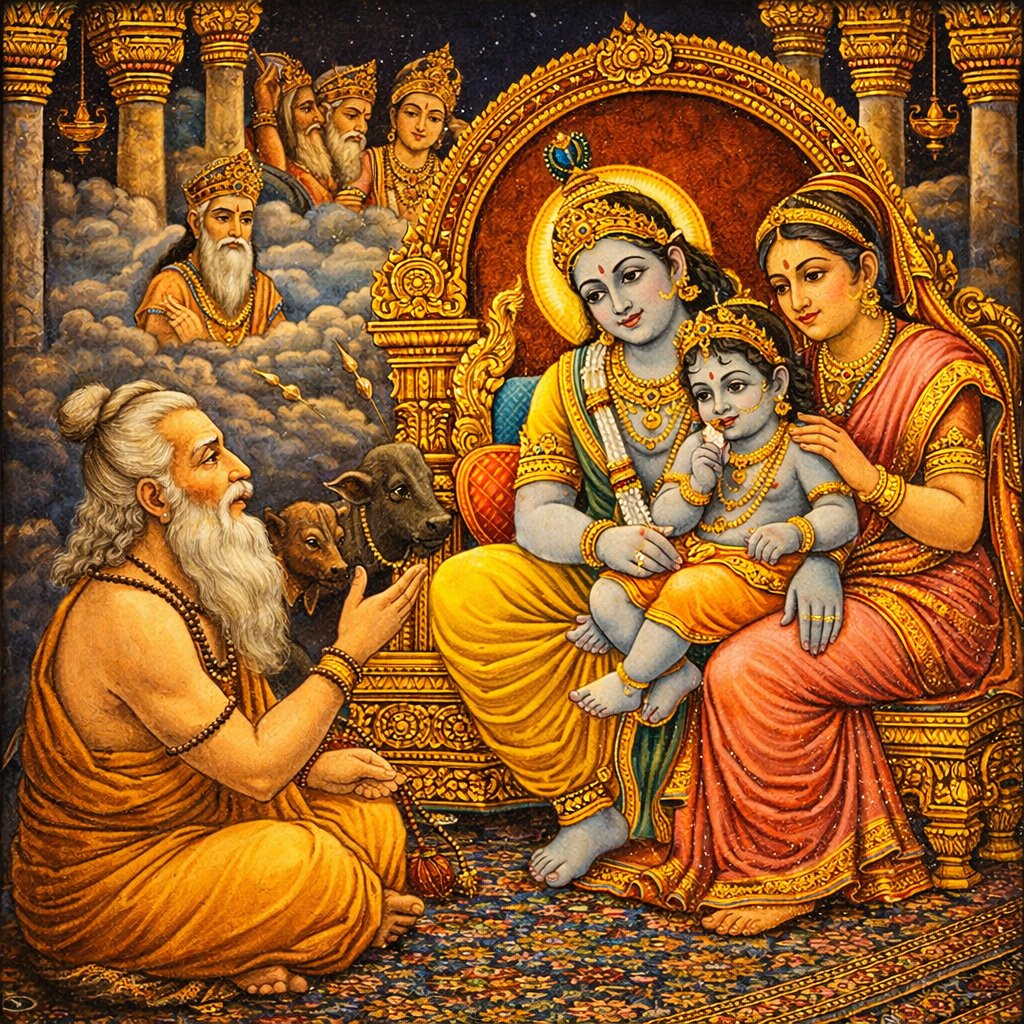
Canto 1: Creation Impetus, Sūta’s Narration, and the Foundation of Bhāgavata Dharma
प्रथमस्कन्धः (Prathama Skandha)
Creation Impetus, Suta's Narration
This Skandha opens the Bhagavatam with Suta Gosvami narrating to the sages at Naimisharanya. It introduces the purpose of the text, the glory of devotion, and the context of Parikshit's curse.
Adhyayas in Prathama Skandha
Adhyaya 1
Questions by the Sages of Naimiṣāraṇya (Śaunaka’s Inquiries and the Bhāgavata Thesis)
The Bhāgavatam begins with a theological invocation identifying Śrī Kṛṣṇa as the Absolute Truth and the conscious, independent source of sarga–sthiti–pralaya, who instructs Brahmā from within and whose māyā bewilders even devas and ṛṣis. The text then declares its purpose: rejecting kaitava-dharma and presenting the highest truth for pure-hearted devotees, effective through attentive, submissive hearing that installs the Lord in the heart. The scene shifts to Naimiṣāraṇya, where Śaunaka and other sages commence a thousand-year sacrifice for the Lord’s pleasure and honor Sūta Gosvāmī. Recognizing his learning, humility, and disciplic blessings, they request an essence suitable for Kali-yuga’s short-lived, disturbed people. Their questions prioritize Kṛṣṇa’s avatāras and līlās, the sanctifying power of saints and the holy name, and culminate in a pressing concern: after Kṛṣṇa’s departure, where has dharma taken shelter? This chapter sets the inquiry that the next chapters progressively answer through Sūta’s structured narration and the Bhāgavata’s lineage of speakers.
Adhyaya 2
Divinity and Divine Service (Bhagavān and Bhakti as the Supreme Dharma)
Responding to the sages’ exemplary inquiries (continuing the Naimiṣāraṇya dialogue introduced in the prior chapter), Sūta Gosvāmī begins with maṅgalācaraṇa—honoring Śukadeva, Nārāyaṇa, Nara-Nārāyaṇa Ṛṣi, Sarasvatī, and Vyāsa—thereby situating the forthcoming teaching in paramparā and sacred intent. He then crystallizes the Bhāgavata thesis: the supreme dharma is unmotivated, uninterrupted bhakti to the transcendent Lord, which immediately yields jñāna and vairāgya. Duties and rituals are evaluated by a single metric—whether they awaken attraction to Hari-kathā—while human desire is redirected from sense gratification to inquiry into the Absolute Truth. Sūta defines the nondual Absolute as realized in three phases—Brahman, Paramātmā, and Bhagavān—and prescribes realization through śravaṇa-based devotion grounded in Vedānta. The chapter traces the bhakti-purification sequence: service to pure devotees → taste for hearing → cleansing of the heart → establishment in sattva → direct, “scientific” knowledge of the Lord. It concludes by contrasting guṇa-based worship with exclusive Viṣṇu-bhakti and introduces cosmological theology (the Lord’s entry into creation as Supersoul), preparing the next narrative developments on the Lord’s energies, avatāras, and the unfolding Bhāgavata history.
Adhyaya 3
Avatāra-kathā — The Puruṣa, the Many Incarnations, and Kṛṣṇa as Svayam Bhagavān
Continuing Sūta’s response to the Naimiṣāraṇya sages’ desire to hear the essence of dharma and the Lord’s līlā, this chapter begins with sarga/visarga framing: the Lord’s puruṣa expansion initiates material manifestation, Brahmā appears from the lotus, and yet the Lord remains untouched and fully spiritual. Sūta then enumerates prominent avatāras—Kumāras, Varāha, Nārada, Nara-Nārāyaṇa, Kapila, Dattātreya (Atri-putra), Yajña, Ṛṣabha, Pṛthu, Matsya, Kūrma, Dhanvantari, Mohinī, Nṛsiṁha, Vāmana, Paraśurāma, Vyāsa, Rāma, Balarāma-Kṛṣṇa, Buddha, and Kalki—while affirming that incarnations are innumerable. The theological apex declares: all listed forms are aṁśa/kalā, but Śrī Kṛṣṇa is the original Personality of Godhead (svayam bhagavān), who descends to protect the faithful when atheistic disturbance arises. The chapter then clarifies virāṭ-rūpa as a conceptual aid for neophytes, distinguishes self from gross/subtle bodies, and concludes that only unbroken favorable service reveals the Lord. It bridges toward deeper Bhāgavata focus: the text itself as the Lord’s literary avatāra and the necessity of sincere inquiry for liberation.
Adhyaya 4
The Appearance of Śrī Nārada and Vyāsa’s Dissatisfaction (Veda-vibhāga and the Need for Bhakti)
Following the sages’ request to hear the Bhāgavata’s sacred message, Śaunaka intensifies the inquiry: who was Śukadeva, how was he recognized, and what circumstance led Parīkṣit to receive the Bhāgavata on the Gaṅgā’s bank. Sūta begins answering by shifting to the prior cause: Vyāsadeva’s birth and his assessment of yuga-dharma decline. Seeing Kali’s effects—reduced lifespan, weakened goodness, impatience, and spiritual incapacity—Vyāsa systematizes revelation: he divides the one Veda into four, assigns custodians (Paila, Jaimini, Vaiśampāyana, Sumantu), and entrusts Purāṇas/itihāsa to Romaharṣaṇa. Out of compassion he composes Mahābhārata for those excluded from Vedic study. Yet despite these monumental works, Vyāsa feels inner incompleteness, diagnosing the root: he did not explicitly and centrally proclaim bhagavad-bhakti. At that moment of repentance, Nārada arrives at Vyāsa’s Sarasvatī āśrama—bridging this chapter into the next, where Nārada will instruct Vyāsa on the Bhāgavata’s essential devotional purpose.
Adhyaya 5
Nārada’s Instruction to Vyāsa: The Defect of Bhakti-less Literature and the Mandate of Kṛṣṇa-kathā
Continuing from Vyāsa’s inner dissatisfaction after compiling vast Vedic literature, this chapter depicts Nārada’s visit and diagnostic counsel. Nārada first acknowledges Vyāsa’s achievements—Veda arrangement, Vedānta delineation, and the Mahābhārata’s dharma exposition—yet asks why despondency persists. Vyāsa admits the lack of inner peace and requests the root cause. Nārada identifies the deficiency: Vyāsa has not sufficiently broadcast the spotless glories of Bhagavān; literature not centered on Vāsudeva is compared to a crow’s pilgrimage, whereas even imperfectly composed Bhagavān-kathā transforms the world. He critiques encouragement of sense-enjoyment under the label of religion and insists that those attached to matter must be led by narrations of the Lord’s transcendental activities. Nārada then establishes bhakti’s supremacy: even an immature devotee is not a loser, while nondevotional duty yields no ultimate gain; intelligent persons seek the unattainable-by-travel goal (prema/bhagavat-prāpti), letting worldly happiness come automatically. He briefly states the Lord’s relation to the cosmos (emanation, maintenance, dissolution) and urges Vyāsa to vividly describe Śrī Kṛṣṇa’s līlā. The chapter transitions into Nārada’s own formative history (expanded next), grounding authority in lived transformation through association with bhakti-vedāntins and hearing Kṛṣṇa-kathā.
Adhyaya 6
Nārada’s Past Life, the Lord’s Brief Vision, and the Power of Kīrtana
After hearing of Nārada’s birth and activities, Vyāsadeva asks what occurred after the great sages departed and how Nārada could remember events from a prior day of Brahmā. Nārada recounts his childhood as the son of a maidservant, bound by affection yet ultimately directed by daiva (supreme time). When his mother dies from a snakebite, he accepts it as the Lord’s mercy and journeys north, passing through varied landscapes until exhaustion leads him to bathe and then meditate beneath a banyan tree. Through learned bhakti-meditation, the Lord appears within his heart; overwhelmed, Nārada then loses that vision and grieves. The Lord speaks: Nārada will not see Him again in that life, because residual material taints obstruct constant vision; the single glimpse is meant to intensify longing, purify desire, and fix intelligence in devotion. Nārada then adopts constant nāma-kīrtana and līlā-kathā, becomes unattached, dies free of karma, receives a transcendental body, survives cosmic dissolution, and reappears with the ṛṣis in the next creation. Now he roams unrestricted, singing with his vīṇā, teaching that kīrtana is the boat across saṁsāra—superior to mere sense-restraint—thus preparing Vyāsa to compose the Bhāgavata as a kīrtana-centered scripture.
Adhyaya 7
Vyāsa’s Vision, the Power of Bhāgavatam, and the Arrest of Aśvatthāmā
Responding to Śaunaka’s inquiry, Sūta describes Vyāsadeva’s post-Nārada resolution: he retires to Śamyāprāsa on the Sarasvatī, purifies himself, and in bhakti-yoga directly beholds the Supreme Person along with māyā under His control. Seeing how the jīva—though distinct from the guṇas—suffers by misidentification, Vyāsa compiles the Bhāgavatam as the direct medicine; mere hearing kindles devotion that burns away grief and fear. Vyāsa then teaches this refined work to Śukadeva, prompting the question of why an ātmārāma would study it—answered by the Lord’s irresistible qualities that attract even the liberated. The narration then bridges into the post-Kurukṣetra crisis: Aśvatthāmā murders Draupadī’s sleeping sons, flees Arjuna, and releases a brahmāstra without knowing withdrawal. Guided by Kṛṣṇa, Arjuna counters and retracts the weapons to save the worlds, captures Aśvatthāmā, and faces a dharmic tension—justice versus mercy—setting up the next chapter’s resolution through Draupadī’s compassion and Kṛṣṇa’s nuanced counsel.
Adhyaya 8
Kuntī’s Prayers and the Neutralization of the Brahmāstra (Uttarā Protected; Yudhiṣṭhira’s Grief Begins)
After the Kurukṣetra war, the Pāṇḍavas perform funerary rites at the Gaṅgā, overwhelmed by grief. Kṛṣṇa and the sages console them by invoking divine law (kāla, karma, īśvara-niyama). As Kṛṣṇa prepares to depart for Dvārakā following Yudhiṣṭhira’s aśvamedha sacrifices, Uttarā rushes to Him in terror: Aśvatthāmā has released a brahmāstra to terminate the last heir of the Kuru line. The Pāṇḍavas arm themselves, but Kṛṣṇa intervenes decisively—Sudarśana and His yogamāyā shield the embryo, and Viṣṇu’s potency nullifies the otherwise irresistible weapon, preserving the dynasty through Parīkṣit. In gratitude and urgency at Kṛṣṇa’s impending departure, Kuntī offers profound prayers on His transcendence, His intimate līlā, calamity as a doorway to remembrance, and the necessity of ananya-bhakti. The chapter then transitions toward the next movement: Yudhiṣṭhira, still inconsolable, stops Kṛṣṇa and begins a moral crisis of conscience over wartime slaughter, setting up extended instruction on dharma and atonement.
Adhyaya 9
Bhīṣmadeva’s Passing Away in the Presence of Lord Kṛṣṇa
After the Kurukṣetra war, Yudhiṣṭhira—burdened by grief and fear of sin—travels with his brothers, sages (Vyāsa, Dhaumya, Nārada, Paraśurāma, and many others), and Śrī Kṛṣṇa to see Bhīṣma lying on his bed of arrows. The cosmic assembly underscores Bhīṣma’s stature and frames his death as a dhārmic and devotional event rather than tragedy. Bhīṣma consoles the Pāṇḍavas, attributes reversals to kāla and the Lord’s inconceivable plan, and urges Yudhiṣṭhira to accept kingship and protect the helpless. He reveals Kṛṣṇa’s supreme identity (ādi-Nārāyaṇa) despite His intimate human-like dealings. At Yudhiṣṭhira’s request, Bhīṣma outlines varṇāśrama-dharma, royal duties, charity, detachment/attachment frameworks, and duties of women and devotees. As uttarāyaṇa begins—favored for self-willed departure—Bhīṣma withdraws his senses, fixes his gaze on four-armed Kṛṣṇa, and offers a sequence of concentrated prayers remembering Kṛṣṇa’s līlā (as Arjuna’s charioteer, the Gītā teacher, the beloved of Vraja, and the honored Lord at the Rājasūya). He then merges his consciousness in the Lord; the universe honors him with silence, drums, and flowers. After the rites, Yudhiṣṭhira returns to Hastināpura with Kṛṣṇa, consoles Dhṛtarāṣṭra and Gāndhārī, and begins righteous rule—setting up the next movement of governance and Kali-yuga’s pressures.
Adhyaya 10
The Departure of Lord Kṛṣṇa from Hastināpura
Responding to Śaunaka’s inquiry, Sūta describes how Yudhiṣṭhira—freed from misgivings by Bhīṣma’s instructions and Kṛṣṇa’s counsel—rules as a dharmic emperor whose reign yields abundance, health, and seasonal harmony (a sign of righteous rājadharma and divine favor). After residing some months in Hastināpura to console the Kurus and delight Subhadrā, Śrī Kṛṣṇa requests leave to return to Dvārakā. The farewell scene intensifies: elders and queens nearly faint under viraha (separation), while the city honors Him with music, flowers, and royal service (umbrella, fans). The women of Hastināpura articulate a compact theology of Bhagavān—pre-creation existence, empowerment of prakṛti, purification through bhakti, and His avatāra-mission to curb adharmic rulers—then praise Mathurā and Dvārakā and His queens. Yudhiṣṭhira, though ‘enemyless,’ still arranges a fourfold escort out of affection and prudence. The Pāṇḍavas accompany Kṛṣṇa far, return at His request, and Kṛṣṇa journeys through named provinces toward Dvārakā, observing evening rites—bridging the restored Kuru order to the next narrative movement centered on the Lord’s return westward.
Adhyaya 11
Kṛṣṇa’s Arrival at Dvārakā (Dvārakā-praveśa and Bhakta-vātsalya)
Continuing the Dvārakā narrative arc following Kṛṣṇa’s public and political movements, this chapter depicts His return to His prosperous capital, Ānarta (Dvārakā). The Lord announces His arrival by sounding His conchshell, which electrifies the city and draws citizens rushing for darśana. The residents—though offering gifts to the self-sufficient Supreme—express ecstatic dependence, praising Him as mother, father, guru, and worshipable Lord, untouched by kāla. Dvārakā is described as fortified by the Vṛṣṇis and ornamented with auspicious festival arrangements, while elders, royalty, artists, and even courtesans come forward, each according to their disposition, to honor Him. Kṛṣṇa reciprocates universally—greeting, embracing, blessing—then enters the city amidst women watching from rooftops, never satiated by His beauty. At home He honors Devakī and the mothers; in His palaces the queens’ inner devotion culminates in overwhelming emotion. The chapter closes with theological clarification: although Kṛṣṇa appears to partake in worldly domesticity, He remains untouched by guṇas, and devotees sheltered in Him similarly transcend material influence—preparing the reader for deeper discussions of the Lord’s transcendence amid worldly settings in subsequent chapters.
Adhyaya 12
The Birth of Mahārāja Parīkṣit and Prophecies of His Greatness
Responding to Śaunaka’s inquiry, Sūta connects the post-war reign of Yudhiṣṭhira—marked by generosity and Kṛṣṇa-centered detachment—to the miraculous survival and birth of Parīkṣit. While still in Uttarā’s womb, the child is scorched by Aśvatthāmā’s brahmāstra, yet directly beholds the Supreme Lord in a minute, four-armed form neutralizing the weapon’s radiance. After the Lord vanishes, auspicious signs arise and Parīkṣit is born; Yudhiṣṭhira performs jāta-karma and lavish charity, and the brāhmaṇas proclaim the child “protected by Viṣṇu.” They forecast Parīkṣit’s kingly virtues by comparing him to archetypal rulers (Rāma, Ikṣvāku, Śibi, Bharata, etc.), and they also foretell his death by the snakebird (Takṣaka) due to a brāhmaṇa’s son—prompting his renunciation and surrender, culminating in inquiry from Vyāsa’s son Śukadeva. The chapter then bridges forward: Yudhiṣṭhira plans aśvamedha to atone for war, wealth is gathered, sacrifices are performed with Kṛṣṇa present, and finally the Lord departs for Dvārakā—setting up the next phase of separation and Kali’s approach.
Adhyaya 13
Vidura’s Return; Dhṛtarāṣṭra’s Departure; Nārada’s Instruction on Kāla and Detachment
Returning from tīrtha-yātrā, Vidura arrives in Hastināpura after receiving transcendental knowledge from Maitreya and is warmly welcomed by Yudhiṣṭhira, the Pāṇḍavas, and the palace elders. Yudhiṣṭhira inquires about Vidura’s travels and, pointedly, about Dvārakā—foreshadowing the looming Yadu destruction, which Vidura compassionately withholds to spare them premature distress. Recognizing the silent danger of attachment and the approach of kāla, Vidura confronts Dhṛtarāṣṭra with stark truths: bodily decline, dependence, and the dishonor of clinging to life in another’s home. He urges immediate withdrawal to the North for spiritual practice. Dhṛtarāṣṭra accepts, leaves secretly with Gāndhārī, and begins austerity and aṣṭāṅga-yoga at Saptasrota. When Yudhiṣṭhira discovers their absence, anxiety rises until Devarṣi Nārada arrives, reframing separation as illusory under the Supreme’s control. Nārada reveals their location and foretells Dhṛtarāṣṭra’s imminent yogic death and Gāndhārī’s self-immolation, dissolving Yudhiṣṭhira’s lamentation and advancing the canto’s momentum toward the Lord’s impending withdrawal and the world’s transition into a new moral phase.
Adhyaya 14
Inauspicious Omens and Arjuna’s Return from Dvārakā
Continuing the post-war tension of Hastināpura’s reliance on Śrī Kṛṣṇa, Arjuna departs for Dvārakā to meet the Lord and learn His forthcoming plans. Months pass without his return, and Mahārāja Yudhiṣṭhira perceives a systemic disturbance in kāla: seasonal disorder, moral decay in society, and a cascade of ominous portents in animals, weather, celestial phenomena, rivers, and temple Deities. Reading these as more than private anxiety, he interprets them as signs of a world-level misfortune—possibly the withdrawal of the Lord’s lotus-foot presence from the earth, as Nārada had indicated. Arjuna finally returns, visibly devastated and drained of luster, confirming Yudhiṣṭhira’s fears. The chapter ends with Yudhiṣṭhira’s compassionate but probing inquiry: he asks about the welfare of the Yadus and Kṛṣṇa’s associates, and then explores whether Arjuna’s dejection could be due to social failures—or only the unbearable possibility of separation from Kṛṣṇa—thus setting up the next chapter’s disclosures about Dvārakā and the Lord’s departure.
Adhyaya 15
Arjuna’s Lament, the End of the Yadus, and the Pāṇḍavas’ Departure
Following Yudhiṣṭhira’s anxious inquiries about Dvārakā and Kṛṣṇa’s welfare, Arjuna returns devastated by separation (viraha) and initially cannot speak. He then recounts how all his heroic efficacy—Gāṇḍīva, chariot, weapons, and fame—was empowered solely by Kṛṣṇa’s presence. He remembers pivotal interventions: Draupadī’s svayaṁvara, Khāṇḍava’s burning and Maya’s rescue, Jarāsandha’s fall, Draupadī’s vindication, Durvāsā’s thwarted curse, and divine weapons gained—culminating in the confession that without Kṛṣṇa he was defeated while guarding Kṛṣṇa’s queens. Arjuna reports the brāhmaṇa curse and fratricidal destruction of the Yadu dynasty as the Lord’s will to lighten the earth’s burden. Absorbed in Govinda’s instructions, Arjuna regains inner steadiness. Hearing Kṛṣṇa’s return to His abode, Yudhiṣṭhira recognizes Kali’s full manifestation and renounces kingship, enthroning Parīkṣit and appointing Vajra in Mathurā. The Pāṇḍavas, then Draupadī and Subhadrā, depart by constant remembrance and attain the Lord’s realm; Vidura also departs at Prabhāsa. The chapter closes by declaring this narration supremely purifying for hearers—bridging the epic’s closure into the Bhāgavata’s salvific program for Kali-yuga.
Adhyaya 16
Parīkṣit Confronts Kali; Dharma and Bhūmi Lament Kṛṣṇa’s Departure
Following the immediate post-war consolidation of the Kuru realm, Parīkṣit is portrayed as a rājarṣi: guided by brāhmaṇas, confirmed by auspicious omens, married into the Uttara line, and performing aśvamedha sacrifices under Kṛpācārya. As Kali-yuga’s symptoms begin entering his jurisdiction, the King sets out on a digvijaya (world-conquest tour) and hears widespread glorification of Kṛṣṇa and the Pāṇḍavas, which deepens his bhakti. The narrative then pivots to the moral crisis of Kali: Parīkṣit encounters Kali disguised as a ruler abusing a cow and bull—an emblematic attack on Bhūmi (Earth) and Dharma (Religion). Parallel to this, Dharma (bull) meets Bhūmi (cow) in grief; Dharma questions the causes of her suffering—loss of sacrificial order, social degeneration, and the collapse of regulated life under Kali. Bhūmi identifies the root: Kṛṣṇa’s manifest līlā has concluded, and in His absence Kali spreads. Their dialogue prepares the next movement: Parīkṣit’s decisive intervention on the Sarasvatī’s bank, where kingship and dharma must respond to Kali’s encroachment.
Adhyaya 17
Parīkṣit Confronts Kali: Dharma (Bull) and Bhūmi (Cow) at the Dawn of Kali-yuga
Continuing Parīkṣit Mahārāja’s tour of his kingdom after assuming imperial responsibility, the narrative pivots from general observation of Kali-yuga symptoms to a direct confrontation with adharma personified. Parīkṣit discovers a śūdra-like figure dressed as a king beating a cow and a bull—Bhūmi and Dharma—signaling the inversion of varṇāśrama order and the abuse of the helpless. The King vows protection, questions the bull about the loss of three legs, and hears Dharma’s cautious reflection on competing causal theories (self, fate, karma, nature), highlighting the limits of mere tarka (argument). Parīkṣit identifies Dharma, diagnoses Kali-yuga’s moral collapse—truth remaining as the last leg—and raises his sword to kill Kali. Kali surrenders; Parīkṣit, embodying kṣatriya mercy and the ethics of śaraṇāgati, spares him but banishes him to domains that institutionalize vice: gambling, intoxication, prostitution, animal slaughter, and ultimately gold (wealth that amplifies deceit and envy). The chapter closes by showing Parīkṣit restoring dharma’s strength and stabilizing the earth, preparing the next progression: Kali’s permitted footholds become the social ecology for Parīkṣit’s later curse and the Bhāgavatam’s seven-day discourse.
Adhyaya 18
Mahārāja Parīkṣit Cursed by a Brāhmaṇa Boy (Śṛṅgi) and the Moral Crisis of Kali-yuga
Sūta Gosvāmī concludes the prior thread about Parīkṣit’s greatness—protected by Kṛṣṇa in the womb and fearless even before the foretold serpent-bird—then the Naimiṣāraṇya sages intensify their request to hear the bhakti-saturated narrations spoken by Śukadeva. Sūta affirms the purifying power of saintly association and the Lord’s unlimitedness (Ananta), then begins the causal backstory that leads to the seven-day Bhāgavata recital. While hunting, Parīkṣit becomes exhausted, hungry, and thirsty, enters Śamīka Ṛṣi’s āśrama, and—misreading the silent sage’s trance as neglect—commits an offense by placing a dead snake on the sage’s shoulder. Returning to his palace, he doubts the sage’s sincerity. Śamīka’s powerful son Śṛṅgi, inflamed by pride and anger, condemns kings and issues a curse: in seven days Takṣaka (the snake-bird) will bite Parīkṣit. When Śamīka awakens, he laments the disproportionate punishment, praises righteous monarchy as society’s protection, foresees chaos without dharmic rule, prays to the Lord for his son’s pardon, and exemplifies the forbearance of devotees. This chapter directly sets up the next movement: Parīkṣit’s response to the curse and his turning fully toward hearing Śrīmad Bhāgavatam.
Adhyaya 19
Parīkṣit’s Vow on the Gaṅgā and the Advent of Śukadeva Gosvāmī
Returning from the incident with the brāhmaṇa, Parīkṣit Mahārāja is seized by remorse, recognizing his offense as a rupture of brahminical culture, God consciousness, and cow protection. When he learns of the curse—death by the bite of Takṣaka, the “snake-bird”—he accepts it as providential, a merciful shock meant to sever attachment. He renounces alternative self-realization paths and sits on the Gaṅgā’s bank to fast until death, taking sage-like vows and entrusting the kingdom to his son. The sanctity of Gaṅgā is extolled as the final shelter for the dying, bearing dust of the Lord’s lotus feet and tulasī. Great ṛṣis, demigods, and rājarṣis assemble, praising Parīkṣit’s renunciation. The king petitions them for the universal duty—especially for one at death’s door—then the pivotal transition occurs: Śukadeva Gosvāmī arrives, is honored by all, and Parīkṣit formally inquires what one should hear, chant, remember, and worship. The chapter thus bridges the king’s repentance to the forthcoming seven-day Bhāgavata discourse, with Śuka poised to answer in the next chapter.
Frequently Asked Questions
Because duties pursued for artha, kāma, prestige, or even impersonal liberation lack the Bhāgavata’s central aim: unalloyed devotion (ahaitukī bhakti) to the Supreme Person. Such mixed motives keep the jīva within saṁsāra’s threefold miseries. The Bhāgavata presents dharma as that which directly awakens loving service to Kṛṣṇa, making spiritual realization immediate through śravaṇa and kīrtana rather than prolonged ritualism for worldly gain.
Kṛṣṇa is presented as the prime cause of creation, maintenance, and dissolution, fully conscious of all manifestations directly and indirectly, and independent (svatantra) with no cause beyond Him. He enlightens Brahmā internally with Vedic knowledge and remains eternally situated in a transcendental realm free from māyā’s distortions—thereby grounding the Bhāgavata’s theology and epistemology.
Sūta is portrayed as free from vice, trained under proper guidance, learned in Purāṇas, histories, and Vedānta, and blessed by his gurus due to humility and service. The sages see him as the providential “captain” capable of delivering the essence of śāstra suitable for Kali-yuga’s limitations, especially through narrations of Kṛṣṇa-kathā.