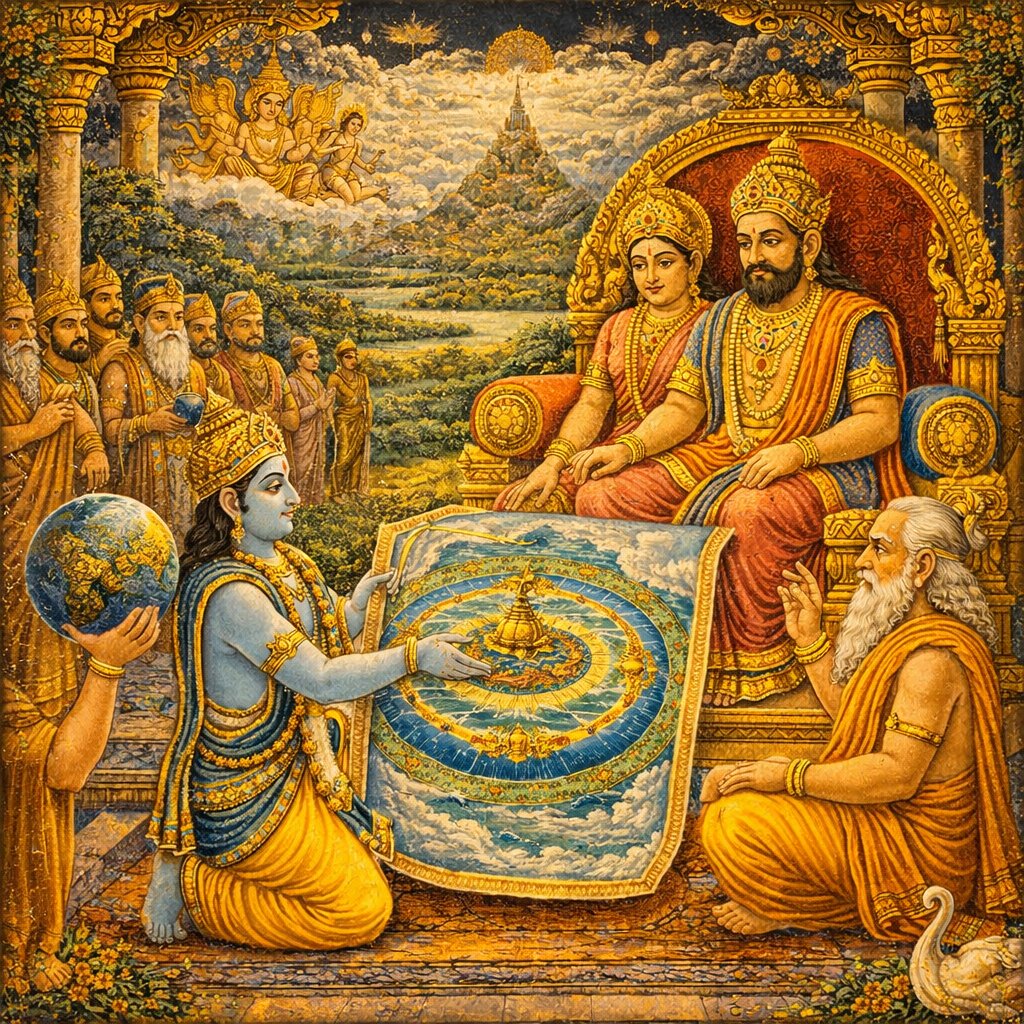
The Cosmic Order of Bhū-maṇḍala and Exemplars of Devotional Governance
पञ्चमः स्कन्धः (Pañcamaḥ Skandhaḥ)
Creative Impetus
Describes the cosmography of the universe, the story of Rishabhadeva and Bharata, and the structure of the planetary systems and hells.
Adhyayas in Panchama Skandha
Adhyaya 1
Priyavrata Accepts Kingship by Brahmā’s Instruction; Sapta-dvīpa Formation and Renunciation
Continuing the Purāṇic focus on dynastic transmission and dharmic governance, Parīkṣit questions how the self-realized devotee Priyavrata could remain entangled in household life, seemingly contrary to liberation. Śukadeva affirms the premise—devotees are beyond bondage—yet explains that impediments may appear without destroying devotion. Priyavrata, trained by Nārada in bhakti and jñāna, hesitates to accept rulership when Svāyambhuva Manu requests it. Brahmā descends with the personified Vedas and instructs Priyavrata that no being can defy the Supreme Lord’s order; varṇāśrama duties must be executed without envy, with inner shelter at the Lord’s lotus feet. Priyavrata accepts, rules powerfully, marries Barhiṣmatī, begets heirs, and performs a cosmic feat: following the sun, his chariot marks seven oceans, dividing Bhū-maṇḍala into seven dvīpas and oceans, which he assigns to his sons. Despite apparent domestic absorption, he remains internally liberated. Later, he awakens to renunciation, divides his kingdom, abandons attachment, and returns to pure Kṛṣṇa consciousness—setting the stage for subsequent geographical and genealogical expansions of Canto 5.
Adhyaya 2
Āgnīdhra Meets Pūrvacitti and Begets the Nine Sons of Jambūdvīpa
Following Priyavrata’s withdrawal into austerity, Āgnīdhra assumes kingship of Jambūdvīpa, ruling with strict adherence to religious principles and paternal protection of his subjects. Seeking a qualified son and the attainment of Pitṛloka, he performs worship of Lord Brahmā in a secluded valley of Mandara Hill. Brahmā, understanding the king’s intent, dispatches the apsarā Pūrvacitti. Her beauty disrupts Āgnīdhra’s yogic restraint, and the chapter unfolds through his ornate praise—misidentifying her as a brāhmaṇa/saintly figure—revealing how desire can redirect the mind even amid disciplined practice. Pūrvacitti accepts his courtship; they enjoy prolonged prosperity and union, resulting in nine sons who become eponymous rulers of the nine varṣas/regions of Jambūdvīpa. After bearing the sons, Pūrvacitti returns to Brahmā, and Āgnīdhra’s lingering attachment leads, by Vedic consequence, to promotion to Pitṛloka. The narrative transitions toward the next phase: the sons’ marriages (to Meru’s daughters) and the further unfolding of Jambūdvīpa’s dynastic and geographic partitioning.
Adhyaya 3
Nābhi’s Sacrifice and Lord Viṣṇu’s Promise to Appear as a Son (Ṛṣabhadeva’s Advent Prelude)
Continuing from the dynasty narrative of Priyavrata and Āgnīdhra, the focus turns to Mahārāja Nābhi, who longs for progeny and performs yajña to please Lord Viṣṇu. Though Vedic sacrifice has multiple sanctioned means (deśa, kāla, mantra, ṛtvij mediation, dakṣiṇā, niyama, and offerings), the chapter stresses that the Lord is ultimately attained by devotion rather than paraphernalia. Pleased by Nābhi’s faith, Viṣṇu manifests in a captivating four-armed form, richly ornamented, overwhelming the assembly with awe. The priests offer profound prayers: confessing their limited capacity to know the transcendent, praising nāma-kīrtana as sin-destroying, and begging for remembrance at death. They also admit their material motive—asking for a son “like the Lord”—and seek forgiveness for approaching Bhagavān for worldly ends. Viṣṇu responds that an equal to Him cannot exist; therefore, to preserve the truth of brāhmaṇas’ words, He will expand as a plenary portion and enter Merudevī’s womb. The Lord disappears, setting the narrative trajectory toward Ṛṣabhadeva’s birth and His forthcoming instruction on dharma leading to apavarga.
Adhyaya 4
Ṛṣabhadeva’s Enthronement, Exemplary Household Life, and the Birth of Bharata and the Nine Yogendras
Building on Nābhi’s successful worship that drew the Supreme Lord into his dynasty, this chapter opens with Ṛṣabhadeva’s divine marks and qualities becoming publicly evident, prompting citizens and brāhmaṇas to request His coronation. Indra’s envy manifests as drought, but Ṛṣabhadeva, smiling, restores rainfall through yoga-māyā, affirming divine sovereignty over devas. Nābhi, overwhelmed by parental affection under yoga-māyā, enthrones Ṛṣabhadeva and retires with Merudevī to Badarikāśrama to worship Nara-Nārāyaṇa, attaining Vaikuṇṭha. Ṛṣabhadeva then models the full arc of gṛhastha-dharma: brahmacarya in gurukula, guru-dakṣiṇā, marriage to Jayantī (given by Indra), and the begetting of one hundred sons. The chapter identifies Bharata—whose name sanctifies Bhārata-varṣa—along with nine elder sons, the nine Yogendras (future Bhāgavata preachers), and eighty-one sons trained as brāhmaṇas. It concludes by transitioning to Ṛṣabhadeva’s public instruction at Brahmāvarta, setting up the next chapter’s teachings to His sons.
Adhyaya 5
Ṛṣabhadeva Instructs His Sons: Tapasya, Mahātmā-Sevā, and Cutting the Heart-Knot
Continuing the Ṛṣabhadeva–Bharata narrative arc, this chapter shifts from royal setting to definitive spiritual instruction meant to prepare the Lord’s sons for both governance and liberation. Ṛṣabhadeva begins by contrasting rare human life with animalistic sense-gratification and establishes tapasya as the doorway to purified devotion and eternal bliss. He then identifies the decisive lever of deliverance—service to mahātmās—and warns that association with sex-centered materialists opens the road to hellish bondage. The discourse analyzes how karma colors the mind, how ignorance perpetuates rebirth, and how the male–female attraction forms the ‘knot’ producing ‘I and mine.’ Ṛṣabhadeva prescribes a full bhakti-yoga regimen—guru shelter, hearing and chanting, equanimity, self-control, scriptural study, celibacy, and detachment even from the means of liberation. He further defines true responsibility: no leader should accept roles (guru/parent/king) without power to deliver dependents from saṁsāra. The chapter culminates with affirmations of His sac-cid-ānanda form, reverence for brāhmaṇas and the Vedas, universal non-envy, and sense engagement in service. It transitions into Śukadeva’s narration of Ṛṣabhadeva’s exemplary avadhūta conduct, setting up the next chapter’s expanded account of His wandering and public persecution.
Adhyaya 6
Ṛṣabhadeva’s Indifference to Siddhis, Vigilance Toward the Mind, and the Kali-yuga Rise of Anti-Vedic धर्म
Continuing the Ṛṣabhadeva-carita from the prior adhyāyas, Parīkṣit asks why a perfectly pure bhakta—who naturally gains mystic siddhis—would neglect such powers. Śukadeva answers with a cautionary psychology: the mind is as untrustworthy as captured animals to a hunter; even great beings (e.g., Śiva, Saubhari) were disturbed, so the sādhaka must remain vigilant. The chapter then depicts Ṛṣabhadeva’s avadhūta-like conduct—appearing dull, wandering naked, placing stones in His mouth—meant to teach yogīs detachment from the subtle body and the finality of renunciation when performed in true God-consciousness. His apparent bodily end occurs through a forest fire, underscoring the instructional nature of His līlā rather than material defeat. The narrative pivots to a Kali-yuga prophecy: King Arhat imitates externals and founds a Veda-opposed system (identified here as the beginning of Jain dharma), leading to broader pāṣaṇḍa trends marked by rejection of cleanliness, worship, and Vedic authority. The chapter closes by glorifying Ṛṣabhadeva’s auspiciousness: hearing and speaking His pastimes grants pure bhakti, where even mukti is considered insignificant compared to loving service to Mukunda—setting the reader toward the canto’s ongoing emphasis on bhakti as the supreme nirodha.
Adhyaya 7
Bharata Mahārāja’s Ideal Kingship and His Transition from Yajña to Exclusive Bhakti at Pulahāśrama
Śukadeva continues the dynasty narrative by presenting Bharata Mahārāja as a consummate devotee-king who assumes sovereignty under his father’s order and sustains citizens by keeping them aligned with varṇāśrama duties. He marries Pañcajanī and begets five sons, and the land formerly called Ajanābha-varṣa becomes renowned as Bhārata-varṣa due to his rule. Bharata performs major Vedic sacrifices (agni-hotra, darśa-pūrṇamāsa, cāturmāsya, paśu-yajña, soma-yajña) but with a mature theological vision: all devatā oblations are offerings to the limbs of Vāsudeva, freeing him from lust, greed, and attachment. As his heart becomes purified, his devotion intensifies, recognizing Kṛṣṇa as Bhagavān—realized by yogīs as Paramātmā, by jñānīs as Brahman, and by devotees as the personal Vāsudeva described in śāstra. When his destined term of opulence ends, he renounces, distributes wealth to his sons, and retires to Pulahāśrama near the Gaṇḍakī River, worshiping with śālagrāma-śilā and simple forest offerings. His devotion flowers into ecstasy, sometimes eclipsing regulative ritual, and he offers a sunrise hymn to Nārāyaṇa, setting the stage for the next developments in his inner life and the narrative consequences of intense absorption.
Adhyaya 8
Bharata Mahārāja’s Attachment to a Deer and His Fall from Yoga
Continuing from Bharata’s forest renunciation and regulated worship, this chapter introduces the decisive turn: after morning ablutions at the Gaṇḍakī, Bharata chants his mantra when a pregnant doe, startled by a nearby lion’s roar, miscarries mid-leap and dies, leaving a fawn drifting in the river. Bharata’s compassion prompts rescue, but care matures into possessive affection—he feeds, protects, pets, carries, and constantly checks on the deer, gradually neglecting niyama and Bhagavān’s worship. When the deer goes missing, Bharata’s mind becomes agitated and irrational; he laments, idealizes the deer’s footprints, and projects meanings onto the moon, revealing how attachment distorts buddhi. Śukadeva diagnoses the fall as karma-driven: despite prior renunciation, latent impressions reawaken through misplaced saṅga. At death, Bharata’s consciousness fixes on the deer; he attains a deer body yet retains memory due to prior bhakti. Repentant, he avoids bad association, returns to Śālagrāma environs, and waits for death—setting up the next chapter’s continuation of his purification and eventual re-entry into human spiritual pursuit.
Adhyaya 9
Jaḍa Bharata’s Birth, Feigned Madness, and Protection by Goddess Kālī
Continuing from Bharata Mahārāja’s previous-life fall and deer body, this chapter begins his rebirth in a pure brāhmaṇa lineage (Āṅgirasa). By the Lord’s special mercy he retains memory of his past, becomes fearful of degrading association, and adopts the public persona of a dull, deaf, and mad man—thus earning the name Jaḍa Bharata. After his affectionate father’s unsuccessful attempts to educate him and the father’s death, Jaḍa Bharata is neglected and exploited by stepbrothers devoted to karma-kāṇḍa, who mistake his transcendence for stupidity. He tolerates insults, accepts whatever food comes, and remains equipoised in bodily dualities. The plot turns when śūdra dacoits seek a ‘man-animal’ for sacrifice to Bhadra Kālī; they seize Jaḍa Bharata, ritually prepare him, and raise a sword to kill him. Offended by the attempt to murder a great Vaiṣṇava, the deity manifests as Kālī, slays the dacoits, and thereby demonstrates the Bhāgavatam’s doctrine: the Lord (and His śakti) protects nonviolent devotees. The chapter sets up the next narrative movement by establishing Jaḍa Bharata’s hidden spiritual stature, which will later be revealed through his teachings.
Adhyaya 10
Rahūgaṇa Meets Jaḍa Bharata: The Shaking Palanquin and the Teaching Beyond Body-Identity
Continuing the Jaḍa Bharata narrative from the preceding section of Skandha 5, Śukadeva describes how King Rahūgaṇa, traveling to Kapilāśrama, is carried in a palanquin. When a carrier is needed near the Ikṣumatī River, the attendants forcibly recruit Jaḍa Bharata, misjudging his strong body while ignoring his saintly status. Because of ahiṁsā, Jaḍa Bharata steps carefully to avoid harming ants, causing the palanquin to shake. Rahūgaṇa, driven by rajas and the bodily conception of kingship, rebukes him harshly. Jaḍa Bharata replies with penetrating ātma-jñāna: the ‘carrier’ is the body, not the self; fatness, fatigue, and social roles like master/servant are temporary designations under material nature. His calm tolerance and logic loosen the king’s heart-knot, leading Rahūgaṇa to descend, prostrate, confess vaiṣṇava-aparādha, and beg instruction. The chapter ends with the king’s earnest philosophical questions, setting up the next chapter’s fuller exposition on self-realization, devotion, and the danger of offending saints.
Adhyaya 11
Jaḍa Bharata Instructs King Rahūgaṇa: The Mind as Bondage and the Two Kṣetrajñas
Continuing the encounter where King Rahūgaṇa, humbled after offending the seemingly dull carrier Jaḍa Bharata, requests spiritual instruction, this chapter shifts from royal arrogance to śāstric inquiry. Jaḍa Bharata dismantles Rahūgaṇa’s material logic about “master and servant” and about bodily pain and pleasure, labeling them external to the Absolute Truth (verses 1–3). He then gives a systematic analysis of the mind under the three guṇas: like an uncontrolled elephant, it expands pious/impious action, generating karma and repeated embodiment across species (verses 4–8). He outlines the mind’s functional field—senses, their objects, bodily and social identifications, and false ego—showing how countless mental modifications arise, yet remain directed by the Supreme Lord (verses 9–11). The chapter culminates in the doctrine of two kṣetrajñas (jīva and Paramātmā/Nārāyaṇa/Vāsudeva) and a practical injunction: conquer the mind through careful service to guru and Bhagavān’s lotus feet (verses 13–17). This prepares the narrative for deeper consolidation of Rahūgaṇa’s surrender and the canto’s onward emphasis on liberation through realized devotion.
Adhyaya 12
Rahūgaṇa Instructed by Jaḍa Bharata — Dehātma-buddhi, Nondual Truth, and the Mercy of Devotees
Following the prior tension where King Rahūgaṇa, riding in a palanquin, chastises the seemingly slow carrier Jaḍa Bharata, this chapter turns as the King recognizes Jaḍa Bharata’s spiritual stature and seeks clarification. Rahūgaṇa confesses pride and requests a simpler restatement of the earlier, subtle teaching—especially the claim that perceived fatigue and bodily movement do not touch the self. Jaḍa Bharata replies by dismantling the King’s identification with the palanquin-body complex: carriers, palanquin, and kingly body are all transformations of earth, while the conscious self is distinct. He exposes the King’s injustice toward the unpaid carriers as a symptom of false prestige, then expands into a philosophical critique of material varieties and atomistic causation, establishing that worldly distinctions are imposed names and forms under material nature. He culminates in the Bhāgavata’s graduated realization of the Absolute—Brahman, Paramātmā, and finally Bhagavān Vāsudeva—and insists that realization depends not on austerities alone but on the dust/mercy of great devotees. Jaḍa Bharata reveals his identity as Bharata Mahārāja, recounts his deer-birth due to attachment, and closes by praising sādhu-saṅga as the swift means to revive bhakti through śravaṇa and kīrtana. The narrative naturally prepares the next chapter’s continued refinement of Rahūgaṇa’s understanding and the broader canto’s movement from embodied pride to liberated vision.
Adhyaya 13
The Forest of Material Existence: Jaḍa Bharata Instructs King Rahūgaṇa
Continuing Jaḍa Bharata’s instruction to King Rahūgaṇa, this chapter unfolds a sustained allegory: the conditioned soul is a merchant entering a perilous forest seeking profit, only to be robbed by the senses and misled by the mirage of pleasure. Jaḍa Bharata enumerates recurring saṁsāric hazards—family attachment, lust, social enmity, taxation and loss, hunger and disease, false gurus, and the oscillations of climate and fortune—showing how the jīva cycles through auspicious, inauspicious, and mixed karmic results under the guṇas. The teaching culminates in direct counsel: abandon exploitative power and sense-attraction, take up the ‘sword of knowledge’ sharpened by devotional service, and cut the knot of māyā to cross the ocean of nescience. Rahūgaṇa responds with repentance and glorification of sādhu-saṅga; Śukadeva concludes that Jaḍa Bharata forgives the insult and resumes wandering, while Rahūgaṇa becomes awakened to the soul’s constitutional position. The chapter closes by setting up Parīkṣit’s request for a clearer, non-allegorical explanation in the next section.
Adhyaya 14
The Forest of Material Existence (Saṁsāra-vana) and the Delivering Path of Bharata’s Teachings
Responding to Parīkṣit’s inquiry into the ‘direct meaning’ of the material forest, Śukadeva Gosvāmī unfolds Jaḍa Bharata’s instruction as an extended allegory of saṁsāra. The jīva, like a profit-seeking merchant, enters the forest of the world for gain and becomes lost under daivī māyā, cycling through bodies by guṇa and mental speculation. The chapter maps specific dangers: senses as plunderers, family attachment as predators and wildfire, ritual burdens as thorny hills, sleep as a python, enemies as serpents, and illicit pleasures as traps leading to punishment. It critiques atheistic counsel and unauthorized ‘gods’ as carrion birds unable to save one from the hari-cakra (time). The narrative then pivots to glorify Bharata Mahārāja’s renunciation and unwavering remembrance—even as a deer—presenting bhakti and sādhu-saṅga as the only exit from the forest. This chapter consolidates the canto’s ethical thrust and prepares the listener to value devotional shelter over karmic ascent and decline.
Adhyaya 15
The Priyavrata Dynasty Continues: Sumati’s Line and the Glorification of Mahārāja Gaya
Śukadeva Gosvāmī continues the Priyavrata-vaṁśa by tracing the descendants of Mahārāja Bharata through Sumati, while warning Parīkṣit that in Kali-yuga unscrupulous, atheistic interpreters will misidentify Sumati as Lord Buddha and distort Vedic principles to justify irreligion. The genealogy proceeds through Devatājit, Devadyumna, Parameṣṭhī, and Pratīha, who personally propagates self-realization and attains direct devotion to Viṣṇu. From Pratīha’s ritual-expert sons the line extends to King Gaya, praised as a Mahāpuruṣa situated in viśuddha-sattva—an expansion aligned with the Lord’s protecting potency. Gaya exemplifies ideal kingship via poṣaṇa (provision/security), prīṇana (charity), upalālana (gentle encouragement), and anuśāsana (moral instruction), while remaining a strict householder-devotee free from pride and bodily identification. Scholars of Purāṇic history eulogize his yajñas, where Indra drinks soma and Viṣṇu personally accepts the offerings, declaring His satisfaction—implying universal satisfaction when the Supreme is pleased. The chapter then extends Gaya’s progeny through Citraratha and further generations to Viraja, whose fame adorns the dynasty, setting the narrative momentum for continued dynastic unfolding in the subsequent chapter(s).
Adhyaya 16
Bhū-maṇḍala as a Lotus: Jambūdvīpa, Ilāvṛta, and the Meru System (Mountains, Rivers, Lakes, and Brahmapurī)
Continuing the Bhū-maṇḍala discussion introduced earlier (Priyavrata’s seven trenches forming seven oceans and islands), Parīkṣit presses Śukadeva for a detailed, measurable description of the dvīpas and varṣas. He also asks how the Lord’s gross universal form (virāṭ) is perceived, since such contemplation elevates the mind toward pure goodness and ultimately toward Vāsudeva beyond the guṇas. Śukadeva answers with epistemic humility—no finite being can exhaustively describe the Lord’s material energy—yet he outlines the principal regions of Bhūloka. He presents Bhū-maṇḍala as lotus-like, with Jambūdvīpa at the center and Ilāvṛta-varṣa as the middle division containing golden Mount Sumeru (Meru) with precise dimensions. He maps the boundary mountains separating the nine varṣas, the four “belt” mountains around Meru, the celestial trees, lakes with distinctive tastes, and gardens enjoyed by Siddhas, Cāraṇas, and Gandharvas. The chapter then explains the origin of fragrant rivers (Aruṇodā, Jambū-nadī), honey streams, and prosperity-giving flows, culminating in Meru’s summit township of Brahmā (Śātakaumbhī) and surrounding abodes of the lokapālas—setting the stage for further elaboration of cosmic regions in subsequent chapters.
Adhyaya 17
Viṣṇupadī Gaṅgā: Descent, Cosmic Pathways, and Śiva’s Praise of Saṅkarṣaṇa
Continuing Skandha 5’s Bhū-maṇḍala mapping, this chapter pivots from spatial description to the sanctifying movement of Gaṅgā, linking cosmic geography with devotional causality. Śukadeva explains that when Vāmanadeva expanded His foot, the universe’s covering was pierced and the causal waters entered as Gaṅgā, becoming pink from the Lord’s foot-dust and eternally purifying as Viṣṇupadī. The river’s descent is traced through Dhruvaloka—where Dhruva Mahārāja receives it on his head in ecstasy—and past the Saptarṣis, who regard it as the culmination of austerity and the wealth of spiritual life. Gaṅgā then reaches Candraloka and Brahmā’s abode atop Meru, dividing into four principal branches (Sītā, Alakanandā, Cakṣu, Bhadrā) that irrigate varṣas and oceans. The narrative then transitions to Ilāvṛta-varṣa, where Śiva alone resides, guarded by Durgā, and culminates in Śiva’s stotra to Saṅkarṣaṇa, affirming the Lord’s transcendence over creation and māyā. This sets up the next movement: further detailing of varṣas, their rulers, and the Lord’s expansions worshiped therein.
Adhyaya 18
Varṣa-devatā Worship in Jambūdvīpa: Hayagrīva/Hayaśīrṣa, Nṛsiṁha, Kāmadeva (Pradyumna), Matsya, Kūrma, and Varāha
Continuing the Fifth Canto’s systematic presentation of Jambūdvīpa and its varṣas, Śukadeva shifts from descriptive cosmography to liturgical theology by detailing how distinct regions worship the Supreme Lord in particular forms. In Bhadrāśva-varṣa, Bhadraśravā leads worship of Vāsudeva’s plenary expansion Hayaśīrṣa (Hayagrīva), praising the Lord as the director of dharma and the restorer of the stolen Vedas. The narration then moves to Hari-varṣa, where Prahlāda and the inhabitants worship Nṛsiṁhadeva, emphasizing inner purification, fearlessness, and renunciation of household entanglement in favor of sādhu-saṅga and bhakti-yoga. Next, in Ketumāla-varṣa, Lakṣmīdevī worships Viṣṇu as Kāmadeva/Pradyumna, reframing ‘husband/protector’ as the Lord alone and warning against material motive in worship. In Ramyaka-varṣa, Vaivasvata Manu worships Matsya, acknowledging divine governance over all social orders and cosmic maintenance during inundation. In Hiraṇmaya-varṣa, Aryamā worships Kūrma, distinguishing the virāṭ-rūpa from the Lord’s true transcendental form and affirming the world as a temporary display of inconceivable energy. Finally, in Uttarakuru-varṣa, Bhū-devī and residents worship Varāha as yajña-svarūpa, recalling the slaying of Hiraṇyākṣa and the lifting of the earth—preparing the reader to continue through remaining varṣa accounts and the canto’s broader cosmological-moral arc.
Adhyaya 19
Devotion in Kimpuruṣa-varṣa and the Glory of Bhārata-varṣa (Rāmacandra & Nara-Nārāyaṇa; Rivers, Varṇāśrama, and Liberation)
Continuing the canto’s tour of Jambūdvīpa’s varṣas and their distinctive devotional cultures, Śukadeva describes Kimpuruṣa-varṣa where Hanumān leads constant worship of Lord Rāmacandra amid Gandharva kīrtana. Hanumān’s prayers establish Rāma as the transcendental Supreme Person who adopts human-like conduct to teach dharma, exposing the misery of material attachment while remaining untouched by it. The narration then shifts to Bhārata-varṣa, where the Lord appears as Nara-Nārāyaṇa at Badarikāśrama, teaching religion, knowledge, renunciation, and yogic perfection; Nārada’s Pañcarātra is referenced as a systematic guide to devotion through jñāna and yoga. The chapter catalogs Bhārata-varṣa’s mountains and purifying rivers, then explains birth by guṇas and karma, and the purpose of varṇāśrama as Viṣṇu-sevā under a bona fide guru. It climaxes with the devas’ praise of human birth in Bhārata-varṣa as superior even to heaven, because bhakti and surrender here can swiftly grant Vaikuṇṭha. The chapter concludes by noting traditions about eight islands around Jambūdvīpa, bridging toward the canto’s continued geographic-cosmological exposition.
Adhyaya 20
The Six Dvīpas Beyond Jambūdvīpa and the Cosmic Boundary of Lokāloka
Continuing the Bhū-maṇḍala account after Jambūdvīpa, Śukadeva Gosvāmī begins describing the six outer islands (dvīpas) starting with Plakṣadvīpa. He details the concentric expansion pattern—each dvīpa and its surrounding ocean—along with rulers descended from Priyavrata, the seven varṣas within each dvīpa, their mountains and rivers, and the purification gained by bathing in those waters. Each region’s inhabitants follow varṇāśrama-like divisions and worship the Supreme Lord through a presiding cosmic form (sun in Plakṣa, Soma in Śālmalī, Agni in Kuśa, Varuṇa/water in Krauñca, Vāyu in Śāka, and Brahmā as karma-maya in Puṣkara). The chapter then shifts from regional sacred geography to universal limits: Puṣkaradvīpa’s Mānasottara Mountain and the sun’s circuit, followed by Lokāloka Mountain as the boundary of illumination. The narrative prepares the next cosmological discussions by locating the sun in antarikṣa, explaining its names and functions, and establishing how cosmic perception and planetary distinction depend upon the sun’s presence.
Adhyaya 21
The Orbit of the Sun, the Measure of Day and Night, and the Sun-God’s Chariot
Continuing the Fifth Canto’s cosmographic survey, Śukadeva Gosvāmī transitions from the universe’s general dimensions to the functional mechanics of time in antarikṣa (mid-space). He explains how the sun’s movement—northward, southward, and across the equator—produces unequal or equal days and nights through its contact with rāśis (zodiacal signs). The chapter then situates the sun’s circular path around Mānasottara Mountain and correlates sunrise, noon, sunset, and midnight with four directional abodes linked to Indra, Yama, Varuṇa, and the moon-god. A key cosmological explanation follows: Sumeru’s inhabitants experience perpetual midday due to the sun’s relative position, while the dakṣiṇāvarta wind creates apparent directional motion. Śukadeva details the sun’s speed, the trayīmaya nature of the sun’s worship (om bhūr bhuvaḥ svaḥ), and the symbolic engineering of the chariot—Saṁvatsara as the wheel, months as spokes, seasons as rim-sections—leading naturally into subsequent descriptions of other luminaries and their regulated courses within Bhū-maṇḍala.
Adhyaya 22
Kāla-cakra and the Motions of the Sun, Moon, Stars, and Grahas (Bhāgavata Jyotiṣa Framework)
Continuing Skandha 5’s sacred-geographical survey—after situating cosmic regions around Sumeru and Dhruvaloka—Parīkṣit raises a logical problem about the sun’s orientation: how can Sumeru and Dhruvaloka be described as on both the sun’s right and left? Śukadeva resolves this through a potter’s-wheel analogy, distinguishing the rotation of the zodiacal framework and the wheel of time from the apparent motions of the “antlike” luminaries within it. The chapter then identifies the sun as Nārāyaṇa’s empowered manifestation, divided into twelve seasonal forms and twelve zodiacal names, establishing the year (saṁvatsara), months, fortnights, and ayanas. It proceeds upward through the cosmic strata—moon, nakṣatras, Venus, Mercury, Mars, Jupiter, Saturn—and describes their relative distances, characteristic motions, and auspicious/inauspicious effects (especially regarding rainfall and social well-being). The sequence culminates with the Seven Sages (Saptarṣi-maṇḍala) circumambulating Dhruvaloka, preparing the reader for further elaborations on higher planetary arrangements and divine governance of time.
Adhyaya 23
Dhruva-loka as the Cosmic Pivot and the Śiśumāra-cakra (Viṣṇu’s Astral Form)
Continuing the Fifth Canto’s systematic ascent through higher planetary arrangements, Śukadeva identifies Dhruva-loka far above the Saptarṣi-maṇḍala, honoring Mahārāja Dhruva as an enduring devotee revered by Agni, Indra, Prajāpati, Kaśyapa, and Dharma. Dhruva’s pole-star position is then presented as the fixed pivot around which all luminaries revolve, driven by the invisible, unsleeping force of kāla under the Supreme Lord’s will. A vivid analogy of bulls circling a central post explains orbital hierarchy and karmically fixed paths. The chapter culminates in the Śiśumāra-cakra: the star-and-planet system visualized as a coiled dolphin-like form, treated as a visible manifestation for yogic meditation on Vāsudeva. Specific nakṣatras, planets, and deities are mapped onto limbs and organs, with Nārāyaṇa in the heart. The narrative moves from cosmic description to sādhana by prescribing thrice-daily mantra worship and remembrance, previewing subsequent discussions where cosmography consistently serves purification and God-centered contemplation.
Adhyaya 24
Rāhu, Eclipses, Antarikṣa, and the Seven Subterranean Heavens (Bila-svarga)
Continuing the Fifth Canto’s vertical mapping of the universe (sthāna), Śukadeva explains to Parīkṣit the region below the sun: Rāhu’s planet and his recurring obstruction of sun and moon, which manifests as eclipses. The narrative emphasizes that Viṣṇu’s Sudarśana cakra protects the luminaries, and Rāhu’s terror reveals the Lord’s supremacy over cosmic anomalies. The discourse then descends through Siddhaloka, Cāraṇaloka, and Vidyādharaloka into antarikṣa—the mid-sky inhabited by Yakṣas, Rākṣasas, Piśācas, and ghosts—before arriving at Earth and then the seven lower planetary systems: Atala through Pātāla. These realms are portrayed as ‘imitation heavens’ (bila-svarga), dazzling with architecture, gardens, jewels, longevity, and sensual ease—yet still shadowed by time’s ultimate weapon: the Sudarśana effulgence that enforces death’s appointed moment. The chapter closes by profiling each nether realm’s rulers and inhabitants (Bala, Śiva in Vitala, Bali in Sutala, Maya in Talātala, Nāgas in Mahātala and Pātāla), setting up further elaboration of lower worlds and the theological lesson that devotion—not opulence—marks true auspiciousness.
Adhyaya 25
The Glories of Lord Ananta (Śeṣa/Saṅkarṣaṇa) and the Cosmic Foundation Beneath Pātāla
Continuing the Fifth Canto’s descent through cosmic geography and the karmic placement of beings, Śukadeva identifies the ultimate ontological support beneath the lower planetary systems: Lord Ananta (Śeṣa), also known as Saṅkarṣaṇa, situated far below Pātāla. He is portrayed as a Viṣṇu-expansion who presides over tamo-guṇa and the conditioned soul’s false ego—specifically the enjoyer-conception that makes one think oneself supreme. The universe, resting like a mustard seed on one of His countless hoods, is shown to be infinitesimal before His magnitude. At dissolution, Rudra manifests from between His eyebrows to enact devastation, linking Ananta to nirodha. The chapter then shifts to devotional aesthetics: His lotus feet, jeweled toenails, spiritual arms, ornaments, and tulasī garland; celestial beings and serpent dynasties worship Him. Hearing His glories through paramparā and meditating on Him purifies the heart-knot of domination. The chapter closes by summarizing the broader cosmological teaching: beings migrate through higher and lower worlds according to desire and karma, preparing the listener for the next movement in Śukadeva’s exposition beyond this cosmographic segment.
Adhyaya 26
Naraka-varṇana: The Hellish Planets and the Karmic Logic of Punishment
Continuing Canto 5’s cosmographic tour (sthāna), Parīkṣit’s inquiry turns from planetary layout to moral causality: why jīvas enter varied material conditions. Śukadeva answers through the guṇa-based taxonomy of action—sattva, rajas, tamas—and explains that destinations (heavenly or hellish) follow the quality and intentionality of karma. Parīkṣit then asks where Naraka is situated, and Śukadeva locates the hellish regions beneath Bhū-maṇḍala, above the Garbhodaka Ocean, near Pitṛloka, where Yamarāja administers justice via Yamadūtas. The chapter lists the principal hells (with variant totals in tradition) and then, hell by hell, pairs specific sins—theft, adultery, violence, cruelty, false witness, misuse of power, disrespect, and perverse acts—with corresponding punishments, emphasizing proportional retribution and remembrance of wrongdoing. The conclusion pivots from fear to remedy: hearing and teaching the virāṭ-rūpa description strengthens bhakti, supports samādhi, and leads from cosmic awareness toward realization of Kṛṣṇa’s spiritual form. This closes the cosmology section and transitions the listener from external mapping to internal transformation.
Frequently Asked Questions
Because the Bhāgavata presents reality as the Lord’s ordered domain: inner liberation (bhakti, mukti) and outer structure (lokas, dvīpas, oceans) are coordinated under divine supervision. The cosmography frames how karma, governance, and manvantara administration operate, while simultaneously teaching that remembrance of the Lord’s lotus feet is the true axis of freedom within any position.
Skandha 5 prominently expresses manvantara (administration under Manus and their lineages), īśānukathā (the Lord’s supremacy expressed through His order and devotees’ obedience), and nirodha/mukti (detachment and return to pure devotion). It also supports poṣaṇa (the Lord’s protection of devotees) by showing how a devotee remains untouched even while executing heavy worldly responsibilities.
Both. Renunciants receive clarity on sense-conquest and the dangers of subtle attachment, while householders receive a canonical model showing that gṛhastha life can be spiritually safe when regulated, duty-bound, and centered on bhakti under guru and śāstra.