Adhyaya 28
Nanda’s Captivity by Varuṇa and the Revelation of the Spiritual World (Brahma-hrada)
Following the unfolding of Kṛṣṇa’s Vraja līlā that increasingly discloses His divinity, this chapter pivots from communal wonder to direct revelation. Nanda Mahārāja, after Ekādaśī worship and fasting, enters the Yamunā (Kālindī) at an inauspicious hour on Dvādaśī and is seized by a servant of Varuṇa. The cowherds cry out to Kṛṣṇa and Balarāma; Kṛṣṇa immediately goes to Varuṇa’s court, where Varuṇa worships Him as the Supreme Absolute and apologizes for his servant’s ignorance, returning Nanda. Back in Vraja, Nanda recounts Varuṇa’s opulence and humility before Kṛṣṇa, intensifying the cowherds’ question: will the Supreme Lord grant them His own abode? Knowing their hearts, Kṛṣṇa compassionately reveals the realm beyond material darkness by taking them to Brahma-hrada; after immersion and rising, they behold the planet of the Absolute Truth—like Akrūra’s earlier vision—and see Kṛṣṇa there, worshiped by the personified Vedas. The episode bridges to subsequent revelations by establishing that Vraja-bhakti is oriented not to worldly elevation but to the Lord’s eternal domain.
Shlokas
Verse 1
श्रीबादरायणिरुवाच एकादश्यां निराहार: समभ्यर्च्य जनार्दनम् । स्नातुं नन्दस्तु कालिन्द्यां द्वादश्यां जलमाविशत् ॥ १ ॥
Śrī Bādarāyaṇi said: Having worshiped Lord Janārdana and fasted on the Ekādaśī day, Nanda Mahārāja entered the water of the Kālindī on the Dvādaśī to take his bath.
Verse 2
तं गृहीत्वानयद् भृत्यो वरुणस्यासुरोऽन्तिकम् । अवज्ञायासुरीं वेलां प्रविष्टमुदकं निशि ॥ २ ॥
Because Nanda Mahārāja entered the water in the dark of night, disregarding that the time was inauspicious, a demoniac servant of Varuṇa seized him and brought him to his master.
Verse 3
चुक्रुशुस्तमपश्यन्त: कृष्ण रामेति गोपका: । भगवांस्तदुपश्रुत्य पितरं वरुणाहृतम् । तदन्तिकं गतो राजन्स्वानामभयदो विभु: ॥ ३ ॥
O King, not seeing Nanda Mahārāja, the cowherd men loudly cried out, “O Kṛṣṇa! O Rāma!” Lord Kṛṣṇa heard their cries and understood that His father had been captured by Varuṇa. Therefore the almighty Lord, who makes His devotees fearless, went to the court of Varuṇadeva.
Verse 4
प्राप्तं वीक्ष्य हृषीकेशं लोकपाल: सपर्यया । महत्या पूजयित्वाह तद्दर्शनमहोत्सव: ॥ ४ ॥
Seeing that the Lord, Hṛṣīkeśa, had arrived, the demigod Varuṇa worshiped Him with elaborate offerings. Varuṇa was in a state of great jubilation upon seeing the Lord, and he spoke as follows.
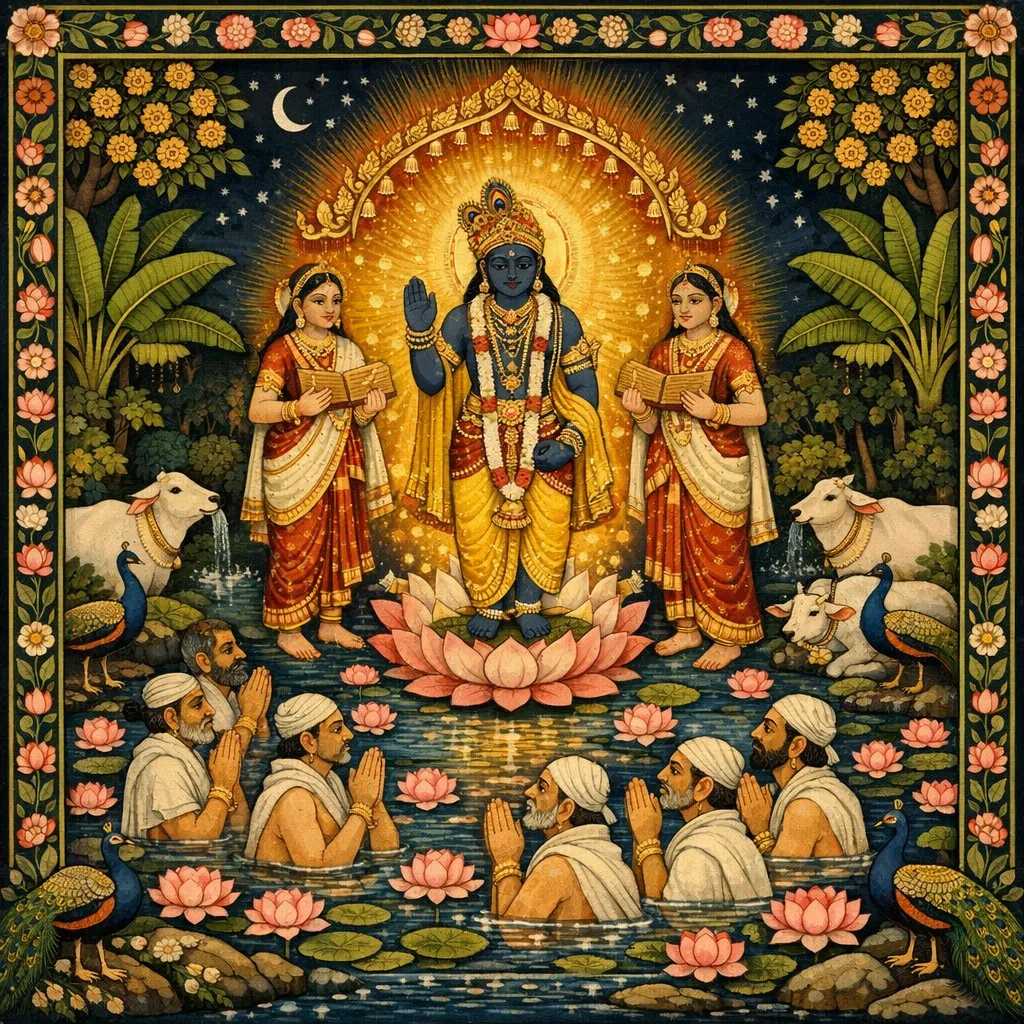
Verse 5
श्रीवरुण उवाच अद्य मे निभृतो देहोऽद्यैवार्थोऽधिगत: प्रभो । त्वत्पादभाजो भगवन्नवापु: पारमध्वन: ॥ ५ ॥
Śrī Varuṇa said: Now my body has fulfilled its function. Indeed, now the goal of my life is achieved, O Lord. Those who accept Your lotus feet, O Personality of Godhead, can transcend the path of material existence.
Verse 6
नमस्तुभ्यं भगवते ब्रह्मणे परमात्मने । न यत्र श्रूयते माया लोकसृष्टिविकल्पना ॥ ६ ॥
My obeisances unto You, the Supreme Personality of Godhead, the Absolute Truth, the Supreme Soul, within whom there is no trace of the illusory energy, which orchestrates the creation of this world.
Verse 7
अजानता मामकेन मूढेनाकार्यवेदिना । आनीतोऽयं तव पिता तद्भवान् क्षन्तुमर्हति ॥ ७ ॥
Your father, who is sitting here, was brought to me by a foolish, ignorant servant of mine who did not understand his proper duty. Therefore, please forgive us.
Verse 8
ममाप्यनुग्रहं कृष्ण कर्तुमर्हस्यशेषदृक् । गोविन्द नीयतामेष पिता ते पितृवत्सल ॥ ८ ॥
O Kṛṣṇa, O seer of everything, please give Your mercy even to me. O Govinda, You are most affectionate to Your father. Please take him home.
Verse 9
श्रीशुक उवाच एवं प्रसादित: कृष्णो भगवानीश्वरेश्वर: । आदायागत्स्वपितरं बन्धूनां चावहन्मुदम् ॥ ९ ॥
Śukadeva Gosvāmī said: Thus satisfied by Lord Varuṇa, Śrī Kṛṣṇa, the Supreme Personality of Godhead, Lord of lords, took His father and returned home, where their relatives were overjoyed to see them.
Verse 10
नन्दस्त्वतीन्द्रियं दृष्ट्वा लोकपालमहोदयम् । कृष्णे च सन्नतिं तेषां ज्ञातिभ्यो विस्मितोऽब्रवीत् ॥ १० ॥
Nanda Mahārāja had been astonished to see for the first time the great opulence of Varuṇa, the ruler of the ocean planet, and also to see how Varuṇa and his servants had offered such humble respect to Kṛṣṇa. Nanda described all this to his fellow cowherd men.
Verse 11
ते चौत्सुक्यधियो राजन् मत्वा गोपास्तमीश्वरम् । अपि न: स्वगतिं सूक्ष्मामुपाधास्यदधीश्वर: ॥ ११ ॥
[Hearing about Kṛṣṇa’s pastimes with Varuṇa,] the cowherd men considered that Kṛṣṇa must be the Supreme Lord, and their minds, O King, were filled with eagerness. They thought, “Will the Supreme Lord bestow upon us His transcendental abode?”
Verse 12
इति स्वानां स भगवान् विज्ञायाखिलदृक्स्वयम् । सङ्कल्पसिद्धये तेषां कृपयैतदचिन्तयत् ॥ १२ ॥
Because He sees everything, Lord Kṛṣṇa, the Supreme Personality of Godhead, automatically understood what the cowherd men were conjecturing. Wanting to show His compassion to them by fulfilling their desires, the Lord thought as follows.
Verse 13
जनो वै लोक एतस्मिन्नविद्याकामकर्मभि: । उच्चावचासु गतिषु न वेद स्वां गतिं भ्रमन् ॥ १३ ॥
[Lord Kṛṣṇa thought:] Certainly people in this world are wandering among higher and lower destinations, which they achieve through activities performed according to their desires and without full knowledge. Thus people do not know their real destination.
Verse 14
इति सञ्चिन्त्य भगवान् महाकारुणिको हरि: । दर्शयामास लोकं स्वं गोपानां तमस: परम् ॥ १४ ॥
Thus deeply considering the situation, the all-merciful Supreme Personality of Godhead Hari revealed to the cowherd men His abode, which is beyond material darkness.
Verse 15
सत्यं ज्ञानमनन्तं यद् ब्रह्मज्योति: सनातनम् । यद्धि पश्यन्ति मुनयो गुणापाये समाहिता: ॥ १५ ॥
Lord Kṛṣṇa revealed the indestructible spiritual effulgence, which is unlimited, conscious and eternal. Sages see that spiritual existence in trance, when their consciousness is free of the modes of material nature.
Verse 16
ते तु ब्रह्मह्रदं नीता मग्ना: कृष्णेन चोद्धृता: । ददृशुर्ब्रह्मणो लोकं यत्राक्रूरोऽध्यगात् पुरा ॥ १६ ॥
The cowherd men were brought by Lord Kṛṣṇa to the Brahma-hrada, made to submerge in the water, and then lifted up. From the same vantage point that Akrūra saw the spiritual world, the cowherd men saw the planet of the Absolute Truth.
Verse 17
नन्दादयस्तु तं दृष्ट्वा परमानन्दनिवृता: । कृष्णं च तत्रच्छन्दोभि: स्तूयमानं सुविस्मिता: ॥ १७ ॥
Nanda Mahārāja and the other cowherd men felt the greatest happiness when they saw that transcendental abode. They were especially amazed to see Kṛṣṇa Himself there, surrounded by the personified Vedas, who were offering Him prayers.
Frequently Asked Questions
Nanda entered the Yamunā at night at an inauspicious time on Dvādaśī, and Varuṇa’s servant—described as ignorant of proper duty—mistook this as an offense warranting seizure. The narrative highlights that cosmic servants may act mechanically, but Bhagavān’s presence protects devotees and corrects administrative error.
Varuṇa receives Kṛṣṇa as Hṛṣīkeśa (Lord of the senses), worships Him with offerings, and explicitly glorifies Him as the Absolute Truth and Supreme Soul untouched by māyā. This establishes that even deva-rulers, though powerful within the universe, are subordinate devotees of Bhagavān.
They are shown a transcendental realm ‘beyond material darkness’ and the indestructible spiritual effulgence, and they also see Kṛṣṇa there being praised by the personified Vedas. The passage presents transcendence in a personal frame (Kṛṣṇa present and worshiped) while also acknowledging the unlimited spiritual effulgence perceived by sages—integrating Brahman realization within Bhagavān-centered revelation.
They are the Śrutayaḥ—Vedic revelations personified—depicted as conscious devotees offering prayers. The image conveys that śāstra is not merely text but living testimony whose purpose culminates in glorifying and serving Bhagavān.
Śukadeva notes the cowherds see the spiritual world from the same vantage point that Akrūra did, creating narrative continuity: earlier, a Yādava devotee receives divine disclosure; here, Vraja’s simple-hearted devotees are granted an even more intimate confirmation that their beloved Kṛṣṇa is the supreme destination.