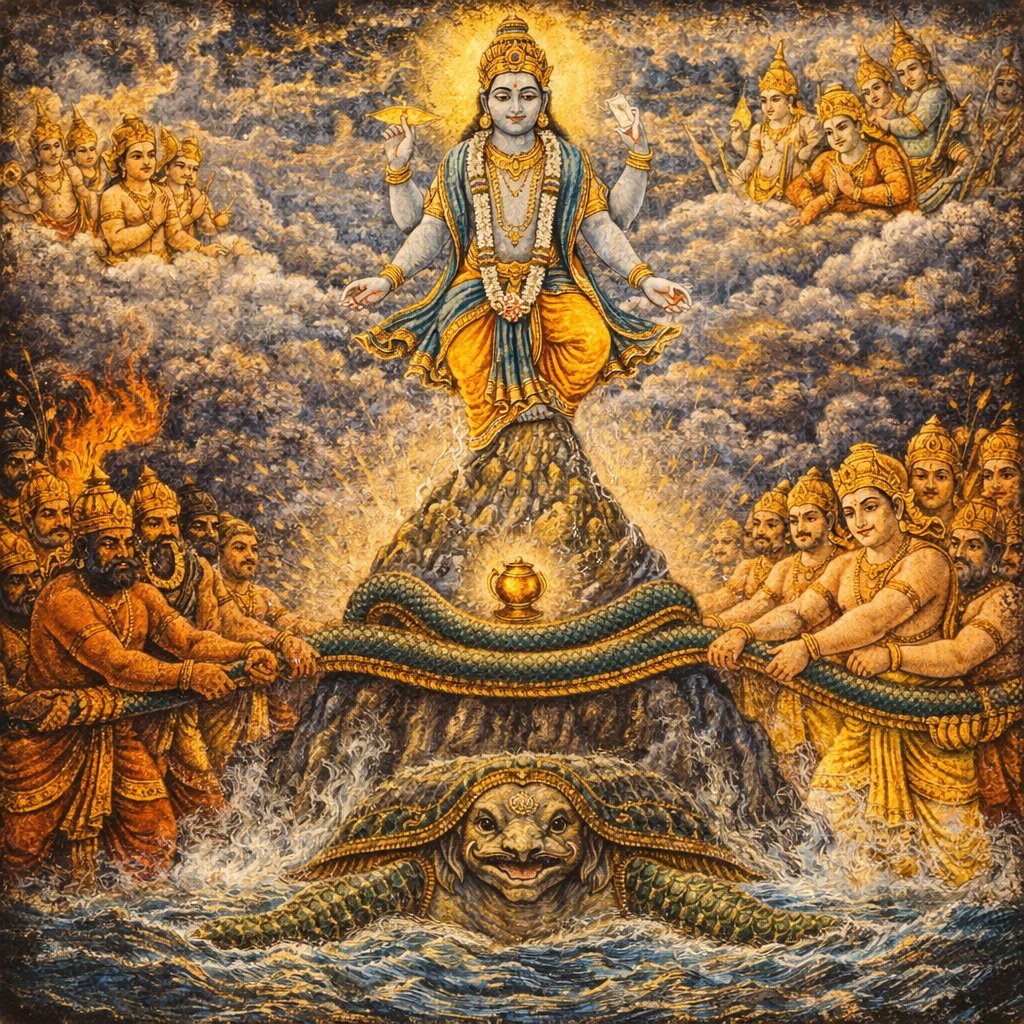
Canto 8 — Manvantara Narratives and the Lord’s Protection of Devotees
अष्टमस्कन्धः (Aṣṭama-skandhaḥ)
Withdrawal of Cosmic Creations
Narrates the churning of the ocean (Samudra Manthana), the Gajendra-moksha, the Vamana avatara, and the Matsya avatara during the cosmic deluge.
Adhyayas in Ashtama Skandha
Adhyaya 1
Manvantara Enumerations Begin: Svāyambhuva’s Austerity, Yajñapati’s Protection, and the Avatāras up to Hari (Gajendra Prelude)
Parīkṣit, having heard the Svāyambhuva Manu dynasty, requests a broader account of the other Manus and the Lord’s manvantara-avatāras. Śukadeva frames the present kalpa as already having six Manus and recalls Svāyambhuva as the first. He notes the Lord’s appearances through Manu’s daughters: Kapila (already narrated) and Yajñapati/Yajñamūrti, whose activities are now introduced. Svāyambhuva renounces royal enjoyment, performs severe austerities, and offers Upaniṣadic praise of the Supreme as the all-pervading witness (Paramātmā), beyond dualities, the cosmic body, and the model of action without karmic bondage—urging humans to follow the Lord’s dharma. Demons attempt to devour the meditating Manu; the Lord as Yajñapati arrives with the Yāmas and devatās, destroys the aggressors, and assumes Indra’s post. Śukadeva then catalogs subsequent manvantaras—Svārociṣa (Vibhu avatāra), Uttama (Satyasena avatāra), and Tāmasa—culminating in the mention of Hari, who rescues Gajendra. Parīkṣit’s eagerness to hear that deliverance transitions directly into the next chapter’s detailed Gajendra-mokṣa narration.
Adhyaya 2
Trikūṭa Mountain, Ṛtumat Garden, and the Beginning of Gajendra’s Crisis
Śukadeva Gosvāmī describes to Mahārāja Parīkṣit the majestic Trikūṭa Mountain rising within the Kṣīra-samudra (Ocean of Milk), detailing its three principal peaks and the celestial ecology of jeweled valleys, waterfalls, birds, and heavenly residents. The narration narrows to Ṛtumat, Varuṇa’s all-season garden, and its lotus-filled lake—an aesthetic prelude that frames the stage for a decisive spiritual event. Into this setting comes Gajapati (Gajendra), leader of the elephants, moving with his herd to the lake, bathing and drinking, and affectionately serving his family—an image used to illustrate embodied attachment under māyā. By daiva (providence), a powerful crocodile attacks Gajendra’s leg, initiating a prolonged struggle that lasts a thousand years. As Gajendra’s strength wanes and the crocodile’s increases (being in its element), Gajendra recognizes the futility of worldly assistance and resolves to seek the Supreme Lord as the only universal shelter. This chapter thus transitions from cosmic beauty to existential danger, setting up the forthcoming prayer of surrender and divine intervention in the next section.
Adhyaya 3
Gajendra’s Prayers and the Appearance of Lord Hari (Gajendra-stuti and Hari-darśana)
Continuing from the crisis of Gajendra’s capture, Śukadeva describes how the elephant-king, in extreme distress, gathers his mind with resolute intelligence and remembers a mantra learned in a previous birth (as Indradyumna). He offers a sustained stuti to Vāsudeva/Nārāyaṇa that begins with the Lord as the root cause and indwelling witness, then expands into apophatic and Vedāntic negation (neti neti), affirming the Lord as simultaneously the source, support, and transcendence of creation. Gajendra acknowledges the inadequacy of demigod worship for ultimate refuge and implicitly bypasses deva-invocation by addressing the Supreme without sectarian limitation. The devas therefore do not respond, but Hari—Paramātmā and Puruṣottama—manifests swiftly on Garuḍa with divine weapons. Seeing the Lord approach, Gajendra offers a lotus and direct obeisance. The Lord descends by causeless mercy, pulls both elephant and crocodile from the water, and with the Sudarśana-cakra severs the crocodile’s mouth, rescuing Gajendra. The chapter thus bridges philosophical theology (Brahman–Paramātmā–Bhagavān realization) to narrative resolution, setting up the aftermath and deeper liberation implications in the subsequent section of the episode.
Adhyaya 4
Aftermath of Gajendra’s Deliverance: Hūhū’s Release, Indradyumna’s Curse, and Sārūpya-mukti
Following the Lord’s dramatic rescue of Gajendra (the elephant king) from the crocodile, the cosmos responds in celebration: devas, sages, Gandharvas, Cāraṇas, and Siddhas praise Puruṣottama with drums, song, and showers of flowers (vv.1–2). The crocodile is revealed as King Hūhū, a Gandharva cursed by Devala; upon being delivered by the Lord, he regains his celestial form, offers fitting prayers, circumambulates the Lord, and returns purified to Gandharvaloka (vv.3–5). Gajendra, having been directly touched by Bhagavān, is freed from avidyā and bondage and receives sārūpya-mukti—attaining a four-armed form with yellow garments like the Lord (v.6). Śukadeva then discloses Gajendra’s prior identity as the Vaiṣṇava king Indradyumna of Pāṇḍya in Draviḍa, whose absorbed worship and vow of silence led to Agastya’s anger and curse to become an elephant; the devotee accepts the curse as the Lord’s will and retains devotional memory (vv.7–12). The Lord returns to His abode on Garuḍa, taking Gajendra with Him (v.13). Śukadeva concludes with the śravaṇa-phala: hearing this account grants auspiciousness, protection from Kali’s taint, and relief from bad dreams; it is recommended for morning recitation. The chapter then transitions as the pleased Lord prepares to speak blessings to Gajendra before all present (vv.14–16), setting up the next dialogue.
Adhyaya 5
Raivata and Cākṣuṣa Manvantaras; Brahmā’s Prayers at Śvetadvīpa (Prelude to Samudra-manthana)
Śukadeva connects the prior deliverance narrative (Gajendra-mokṣaṇa) to a wider manvantara chronology, first describing the fifth Manu, Raivata: his sons, the Indra (Vibhu), the deva-gaṇa (Bhūtarayas), and the saptarṣis. In that manvantara the Lord appears as Vaikuṇṭha from Śubhra and Vikuṇṭhā, and—at Lakṣmī’s request—manifests an additional Vaikuṇṭha planet, underscoring the Lord’s immeasurable qualities. The narration then advances to the sixth Manu, Cākṣuṣa, naming his sons, the Indra (Mantradruma), the devas (Āpyas), and sages (including Haviṣmān and Vīraka). The Lord appears as Ajita, who will later enable the churning of the Ocean of Milk and support Mandara as Kūrma. Parīkṣit’s eager inquiry bridges into the next narrative unit: why the devas became powerless (Durvāsā’s curse, loss of prosperity and yajña), their appeal to Brahmā on Sumeru, and Brahmā’s guidance to seek Viṣṇu at Śvetadvīpa. The chapter culminates in Brahmā’s Vedic prayers describing the Lord as transcendent, all-pervading Supersoul, source of cosmic functions, and the ultimate shelter—setting the theological and plot foundation for Samudra-manthana in the following chapters.
Adhyaya 6
The Lord Appears to the Devas and Instructs the Truce; Mandara Is Brought for Churning
Continuing from the devas’ distress and their appeal for divine shelter, Hari manifests before Brahmā, Śiva, and the assembled demigods in an overwhelming effulgence that eclipses their vision. Brahmā and Śiva perceive the Lord’s marakata-hued form adorned with Kaustubha, Lakṣmī, and divine weapons; the devas fall in reverence. Brahmā offers philosophical prayers affirming the Lord’s guṇa-transcendence, His role as the source-resting-place-end of the cosmos, and bhakti-yoga as the means to approach Him. The devas then request guidance, and the Lord replies: make a strategic truce with the asuras (favored by time), churn the Ocean of Milk using Mandara as the rod and Vāsuki as the rope, remain patient, and do not fear the arising kālakūṭa poison or become greedy for interim products. After the Lord disappears, the devas approach Bali, who accepts Indra’s Viṣṇu-derived proposal; both sides uproot Mandara. Exhausted, they drop it, crushing many; Viṣṇu arrives on Garuḍa, revives the fallen, and effortlessly transports Mandara to the ocean—setting up the next chapter’s churning operations and ensuing manifestations.
Adhyaya 7
Kūrma Supports Mandara; Hālahala Appears; Śiva Becomes Nīlakaṇṭha
Continuing the devas–asuras alliance for amṛta, both parties invite Vāsuki and coil him around Mandara as the churning rope. A dispute arises over auspiciousness—demons demand the ‘front’ of the serpent—yet Ajita (Viṣṇu) silently accepts the tail, reversing their calculation. When Mandara sinks for lack of support, the Lord assumes the Kūrma-avatāra, lifting the mountain upon His back and transforming failure into renewed momentum. Viṣṇu further empowers the participants by entering devas, asuras, and Vāsuki through the guṇas (sattva, rajas, tamas), and He steadies Mandara from above with thousand hands as the churning intensifies. The first product is not nectar but the catastrophic hālahala poison, spreading across the worlds. Terrified, devas seek Sadāśiva on Kailāsa; the prajāpatis offer hymns describing Śiva’s cosmic identity and transcendence. Moved by compassion and dharma of protection, Śiva resolves to drink the poison for the welfare of all, with Satī’s consent. The poison marks his throat blue—Nīlakaṇṭha—turning peril into an emblem of benevolent sacrifice, setting the stage for subsequent auspicious emergences from the ocean.
Adhyaya 8
Lakṣmī’s Emergence, Dhanvantari, and the Advent of Mohinī-mūrti
After Lord Śiva neutralizes the Hālāhala poison (linking from the prior churning crisis), devas and asuras resume Samudra-manthana with renewed force. A sequence of auspicious manifestations arises: Surabhi for sacrificial ghee, Uccaiḥśravā and Airāvata, directional elephants, celestial gems (Kaustubha, Padmarāga), the pārijāta flower, and apsarās. Then Lakṣmī (Ramā) appears and is installed through a cosmic abhiṣeka: rivers, earth, cows, seasons, sages, Gandharvas, and directional elephants contribute to her consecration. Lakṣmī surveys devas, asuras, and other beings, concluding that none are faultless or fully independent; therefore she accepts Mukunda, the self-sufficient Lord, and garlands Him—enriching the devas by her glance while the asuras become despondent. Next Vāruṇī appears and is taken by the demons. Dhanvantari emerges with the amṛta-kumbha, which the asuras seize, causing the devas to surrender to Hari. Viṣṇu promises to bewilder the demons, who begin quarreling over nectar—setting the transition into the next chapter where Mohinī-mūrti’s līlā orchestrates the distribution of amṛta and the unfolding of further divine strategy.
Adhyaya 9
Mohinī-mūrti Distributes Amṛta; Rāhu is Severed; Results Differ by Shelter
Following the churning, the asuras seize the amṛta-kalaśa and immediately fall into internal rivalry, revealing the instability of alliance built on enjoyment and power. At that moment the Lord appears as Mohinī-mūrti—an extraordinarily beautiful woman—whose charm agitates the asuras’ minds. They request Her to arbitrate and divide the nectar equally, appealing to shared lineage from Kaśyapa. Mohinī openly warns them that trusting an independent woman is unwise, yet they—overconfident and bewitched—hand over the vessel and agree to accept whatever She does, fair or unfair. After ritual preparations and formal seating, Mohinī arranges separate lines and, by sweet speech, cheats the asuras while serving amṛta to the devas, granting freedom from old age and death. The asuras remain silent to preserve their pledged “equilibrium” and their infatuated rapport. Rāhu infiltrates the deva line, but Sūrya and Candra expose him; Hari beheads him with the Sudarśana-cakra, leaving his immortal head as a ग्रह that causes eclipses. When the devas finish, the Lord reveals His true form. The chapter concludes with a decisive principle: same endeavor, different result—devas succeed because they are sheltered at the Lord’s feet; asuras fail due to being separate from bhakti, and all worldly acts become fruitful only when offered for the Lord’s satisfaction.
Adhyaya 10
Deva–Asura Battle after the Nectar; Bali’s Illusions and Hari’s Intervention
After the Ocean of Milk is churned and the devas receive amṛta, the asuras—excluded from the nectar despite their labor—erupt in envy and advance with weapons. Empowered by nectar and anchored in Nārāyaṇa’s shelter, the devas counterattack, and a vast, symmetrical battle unfolds with matched divisions, exotic mounts, and resounding war instruments. The chapter catalogs leading asura commanders under Mahārāja Bali, who appears in Maya’s wondrous, intermittently visible aircraft, while Indra stands on Airāvata amid the devas. Pairwise duels are assigned across cosmic offices (sun, moon, Vāyu, Varuṇa, Śiva, Bṛhaspati, Śukra, Durgā/Bhadrakālī, etc.), showing the universe’s administrative powers locked in conflict. Bali directly engages Indra, then vanishes into māyā, producing terrifying battlefield illusions—fire, floods, falling beasts, and demonic apparitions—until the devas, unable to counteract, meditate on the Supreme. Hari arrives on Garuḍa; His presence dissolves illusion like waking ends a dream. The Lord then begins decisive slaying of key asuras, reasserting divine protection and setting the stage for continued rout of demoniac forces.
Adhyaya 11
Indra Slays Namuci—The Limits of Power and the Triumph of Divine Strategy
Following the devas’ revival by Śrī Hari’s grace after the amṛta episode, the battlefield reverses: the previously defeated demigods now press the asuras. Indra, enraged, moves to kill Bali, but Bali answers with sober philosophy—victory and defeat unfold under kāla, not personal ego, and the wise neither exult nor lament. The combat escalates: Bali strikes Indra; Jambhāsura intervenes and is slain by the thunderbolt; Namuci, Bala, and Pāka attack with extraordinary archery, temporarily obscuring Indra. Indra reemerges and kills Bala and Pāka, but Namuci proves invulnerable—Indra’s vajra cannot pierce him. A celestial voice reveals Namuci’s boon: he cannot be killed by anything “dry or moist.” Indra meditates and discovers foam, neither dry nor wet, and uses it to sever Namuci’s head. The devas celebrate, then Brahmā sends Nārada to halt further slaughter; the devas desist and return to heaven, while surviving asuras rescue Bali to Aṣṭagiri, where Śukrācārya revives the fallen with the Saṁjīvanī mantra, and Bali remains steady, without lamentation—setting the stage for Bali’s later destiny under the Lord’s plan.
Adhyaya 12
Lord Śiva Bewildered by Mohinī (Viṣṇu’s Yoga-māyā and the Limits of Ascetic Power)
Following the devas’ successful receipt of amṛta through Viṣṇu’s Mohinī form in the aftermath of Ocean-churning events, Śukadeva continues the narrative by introducing Lord Śiva’s desire to witness that extraordinary form. Śiva, accompanied by Umā and his gaṇas, approaches Madhusūdana and offers profound theological praise: Viṣṇu as the non-material Supreme Cause, the unity of cause and effect, and the inadequacy of partial philosophical readings (Vedānta, Mīmāṁsā, Sāṅkhya, Pātañjala, Pañcarātra) without full recognition of Bhagavān. Viṣṇu agrees and manifests Mohinī in a forest, whose beauty agitates Śiva; he pursues her, becomes overcome, and discharges semen—later said to become mines of gold and silver. When the illusion ends, Śiva regains composure, recognizes Viṣṇu’s incomparable śakti, and is praised for his steadiness. Viṣṇu resumes His form; Śiva returns to Kailāsa and instructs Bhavānī on the astonishing reach of the Lord’s māyā. The chapter closes by reaffirming that hearing these līlās destroys suffering and culminates in worshipful remembrance—bridging the churning narrative to its devotional takeaway.
Adhyaya 13
The Future Manus and the Avatāras in Their Manvantaras
Śukadeva, continuing his manvantara framework, first anchors the present administration by naming Śrāddhadeva (Vaivasvata) Manu as the seventh Manu and listing his sons, along with the principal deva-groups, Indra (Purandara), the seven ṛṣis, and the avatāra Vāmana born of Kaśyapa and Aditi. He then transitions from the present to the future by recalling Vivasvān’s wives (Saṁjñā, Chāyā, and Vaḍavā) and their progeny, establishing the genealogy for the eighth Manu, Sāvarṇi. The chapter proceeds as a structured forecast: for each forthcoming Manu (8th through 14th), Śukadeva identifies key sons, the ruling Indra, the deva communities, the seven sages, and the Lord’s partial or plenary incarnation who will stabilize that era. Bali Mahārāja’s future elevation is highlighted: though bound by the Lord, he is installed in Sutala and later becomes Indra in the eighth manvantara when Sārvabhauma reallocates sovereignty. The chapter culminates by defining the full cycle of fourteen Manus as one kalpa—one day of Brahmā—creating a bridge from earlier Vāmana–Bali history to the Purāṇic macro-chronology that frames subsequent narration.
Adhyaya 14
Manvantara Administration: Appointment of Manus, Indras, and the Restoration of Dharma
Following earlier descriptions of avatāras and manvantara arrangements, Parīkṣit asks how Manu and other cosmic administrators perform their duties and by whose command they act. Śukadeva explains that the Supreme Personality of Godhead, through specific incarnations (e.g., Yajña), appoints the Manus, their sons, the great ṛṣis, Indra, and the devas to manage universal affairs. When dharma becomes distorted at yuga junctions, saintly authorities reestablish religious principles; thereafter the Manus, acting directly under the Lord’s instruction, restore varṇāśrama duties in their complete fourfold structure. Kings descended from Manu conduct yajñas, share their results with the devas, and maintain order through the Lord’s mandate; Indra, empowered by divine benediction, sustains the three worlds by timely rains. The chapter broadens into a theology of divine functions—knowledge-teaching siddhas, karma instructors, yoga teachers, prajāpatis, kingship, and time itself—as manifestations of Hari. It concludes by noting that speculative seekers, bewildered by māyā, fail to see the Lord, and it anchors the discussion in cosmic time: fourteen Manus occur in one day of Brahmā, setting up further manvantara-specific narrations.
Adhyaya 15
Bali Mahārāja’s Empowerment and Conquest of Indra’s City (Prelude to Vāmana’s Petition)
Parīkṣit raises the central theological tension of the Vāmana–Bali episode: how the all-proprietor Lord begs for three steps of land and then arrests Bali. Śukadeva begins the backstory that makes the “contradiction” intelligible. Revived by Śukrācārya after a prior defeat, Bali becomes the Bhṛgu brāhmaṇas’ disciple and is purified for the Viśvajit yajña, from which divine military paraphernalia manifests—chariot, weapons, armor, unfading garland, and conch. Empowered by brahma-tejas, Bali gathers formidable asura forces and advances on Indra’s exquisitely described capital, Indrapurī. Unable to counter Bali’s consecrated strength, Indra consults Bṛhaspati, who advises strategic withdrawal: only the Supreme Lord can subdue Bali, and Bali’s eventual downfall will come when he offends brāhmaṇas. The devas vanish, Bali occupies heaven, and the Bhṛgus engage him in a hundred aśvamedhas, swelling his fame and prosperity—setting the stage for Vāmana’s arrival in the next movement of the narrative.
Adhyaya 16
Aditi’s Lament and Kaśyapa’s Instruction of the Payo-vrata (Milk Vow) to Please Keśava
After the devas (Aditi’s sons) lose their heavenly position and the asuras occupy Svarga, Aditi grieves as though unprotected. Kaśyapa returns from meditation, observes the āśrama’s loss of festivity, and first diagnoses possible lapses in gṛhastha-dharma—hospitality to atithis, maintenance of sacrificial fire, and reverence to brāhmaṇas—underscoring the householder’s responsibility as a religious node of society. Aditi replies that all duties are intact; her sorrow is specifically the devas’ dispossession. She appeals to Kaśyapa for protection, noting the Lord’s impartiality yet special favor to devotees. Kaśyapa gently redirects her from bodily and familial attachment toward the ultimate remedy: exclusive devotional service to Vāsudeva, the heart-dwelling master who alone grants auspiciousness. At Aditi’s request for a practical method, Kaśyapa transmits Brahmā’s procedure: the payo-vrata observed for twelve days in Phālguna’s bright fortnight, featuring purification, mantra-prayers, Deity worship, offerings, feeding brāhmaṇas, celibacy, simplicity, and universal distribution of viṣṇu-prasāda. This chapter bridges the devas’ crisis to the forthcoming divine response—Aditi’s disciplined bhakti that prepares the narrative ground for the Lord’s avatāra intervention.
Adhyaya 17
Aditi’s Payo-vrata and Viṣṇu’s Promise to Appear as Her Son (Prelude to Vāmana)
Continuing from Kaśyapa’s prior instruction, Aditi rigorously performs the payo-vrata with single-pointed meditation on Vāsudeva, bringing mind and senses under control. Pleased, the four-armed Lord appears before her; overwhelmed with sāttvika-bhāvas, she offers prayers praising Him as yajña-bhoktā, universal form, infallible controller, and the giver of all perfections. Viṣṇu reveals He already knows her intent: to restore the devas’ lost kingdom and honor, and to see the asuras defeated. Yet He cautions that the daitya leaders are presently “unconquerable” due to brāhmaṇa protection—thus direct force will not yield happiness. Because her vow has satisfied Him, He grants a strategic boon: He will become her son, entered through Kaśyapa, to protect the devas. Aditi is instructed to worship Kaśyapa while keeping the plan confidential. After the Lord disappears, Kaśyapa, in trance, perceives Viṣṇu’s plenary portion entering him; he places his potency into Aditi’s womb. Brahmā, recognizing the Lord’s descent, offers Vedic prayers—linking this chapter forward into the avatāra narrative that will unfold as Vāmana’s appearance and the reconfiguration of sovereignty in the next chapters.
Adhyaya 18
The Appearance of Vāmanadeva and His Arrival at Bali’s Sacrifice
Following Brahmā’s glorification and the devas’ appeal for divine protection, the Supreme Lord appears from Aditi’s womb as Viṣṇu—radiant, four-armed, and adorned with śaṅkha-cakra-gadā-padma—signaling Poṣaṇa in action. Cosmic auspiciousness accompanies the advent: sacred calendrical markers (Śravaṇa-dvādaśī, Abhijit-muhūrta, Vijayā-dvādaśī) and universal celebration by devas, sages, and celestial beings establish the avatāra within sacred time. The Lord then adopts the dramatic guise of a brahmacārī dwarf, Vāmana, and undergoes saṁskāras: upanayana, gifts from deities (daṇḍa, kamaṇḍalu, ajina, mekhalā, rudrākṣa), and the setting of sacrificial fire—showing that the transcendent Lord honors dharma’s forms. Hearing of Bali Mahārāja’s aśvamedha at Bhṛgukaccha on the Narmadā, Vāmana proceeds there, overwhelming the assembly with effulgence. The Bhṛgu priests and Bali rise to receive Him; Bali worships by washing the Lord’s feet and welcomes Him to ask a boon—setting the immediate bridge to the next chapter where the “three steps of land” request initiates Bali’s decisive test of charity, truthfulness, and surrender.
Adhyaya 19
Vāmanadeva Praises Bali; the Measure of Three Steps; Śukrācārya Warns Against the Gift
Continuing the Vāmana–Bali encounter, Vāmanadeva responds to Bali’s courteous, dharma-grounded speech by praising the Daitya dynasty’s traditional generosity and its crowning jewel—Prahlāda. The Lord recalls the line’s heroic and antagonistic figures (Hiraṇyākṣa and Hiraṇyakaśipu), using their histories to contrast uncontrolled anger and ambition with Bali’s cultivated religious etiquette. He then asks for only three paces of land, teaching that restraint and contentment (santoṣa) are the brāhmaṇa’s safeguard from karmic entanglement, while sense-driven acquisition never satisfies. Bali, seeing the request as childish, urges Him to ask for more and prepares to seal the donation with water. At this pivotal moment—bridging Bali’s vow and the imminent cosmic expansion of Trivikrama—Śukrācārya intervenes, identifying the dwarf as Viṣṇu and warning that the gift will strip Bali of kingdom, prestige, and livelihood. He argues for strategic refusal, even permitting untruth in exceptional social emergencies, thereby setting up the next chapter’s ethical clash: satya-vrata (truthful vow) versus pragmatic self-preservation under a guru’s command.
Adhyaya 20
Bali Mahārāja Upholds Truth; Vāmana Reveals the Universal Form and Takes the Two Steps
Following Śukrācārya’s strategic counsel to retract the promised gift, Bali Mahārāja pauses, deliberates, and chooses satya over expediency. He argues that untruthfulness is the greatest sin, that wealth is inevitably lost at death, and that true legacy is kīrti (reputation) grounded in virtue—citing exemplars like Dadhīci and Śibi. Though recognizing Vāmana as Viṣṇu and even an “enemy” of the asuras, Bali resolves to honor a brāhmaṇa’s request without retaliation. Śukrācārya, impelled by the Lord’s arrangement, curses Bali to lose his opulence; Bali remains steady and completes the dāna by offering water and formally gifting the land, assisted by Vindhyāvali’s worship. The devas and celestial beings celebrate Bali’s nonduplicitous charity. Then Vāmana expands into the viśvarūpa, containing all worlds and principles within His body, and with His first step covers the earth; with the second, He covers the heavenly realms, leaving no space for the third—setting the narrative tension for the next chapter’s resolution of where the final step will be placed and how Bali’s surrender will culminate.
Adhyaya 21
Brahmā Worships Vāmana; the Demons Attack; Bali is Bound and Questioned About the Third Step
As Vāmanadeva’s transcendental effulgence pervades the cosmos, Brahmā—accompanied by Marīci and other ṛṣis and perfected yogīs—approaches the Lord, whose brilliance renders even Brahmaloka’s splendor secondary. Brahmā performs pāda-pūjā; the water from his kamaṇḍalu washes the Lord’s feet and becomes Gaṅgā, descending to purify the three worlds. The devas and divine administrators assemble elaborate worship with offerings and celebratory acclamation; Jāmbavān proclaims a festival of victory. In contrast, Bali’s asura followers interpret the Lord’s brāhmaṇa form as strategic deception favoring the devas and resolve to kill Vāmana. Viṣṇu’s associates (Nanda, Sunanda, Jaya, Vijaya, Garuḍa, and others) repel them, and Bali—recalling Śukrācārya’s warning—orders a retreat, teaching that kāla (time/providence), the Lord’s representation, cannot be overcome by force, diplomacy, mantras, or medicine. After the soma-pāna day concludes, Garuḍa binds Bali with Varuṇa’s ropes. Vāmana then confronts Bali: two steps have covered the universe; where will the promised third step be placed—setting up Bali’s decisive response in the next chapter.
Adhyaya 22
Bali Mahārāja’s Surrender, Prahlāda’s Praise, and the Lord’s Mercy (Sutala and Future Indrahood)
Continuing from the Vāmana-yajña episode where Bali is bound by Varuṇa’s ropes after offering the three steps, this chapter shifts from external conflict to inner resolution. Bali, though seemingly ‘cheated,’ insists his dāna-vrata must be completed and asks the Lord to place the third step on his head, declaring that he fears infamy more than loss, hell, or punishment. He interprets the Lord’s chastisement as hidden well-wishing for asuras, recalling Prahlāda’s exemplary refuge in the Lord amid persecution. As Bali laments the futility of bodily and familial attachments when they obstruct bhagavat-sevā, Prahlāda arrives, worships the Lord, and explains that both giving opulence and removing it are equally beautiful when they awaken knowledge. Vindhyāvalī critiques false proprietorship, and Brahmā petitions for Bali’s release. The Lord then articulates a core bhakti principle: He especially favors the proud by taking away possessions, praises Bali’s truthfulness despite defeat and curse, grants him Sutala—crafted by Viśvakarmā and protected by the Lord—and promises future elevation as Indra in Sāvarṇi Manvantara, with the Lord’s perpetual presence as Bali’s guardian. The narrative thus transitions toward Bali’s settled kingship in Sutala and the restoration of cosmic order beyond the immediate sacrifice scene.
Adhyaya 23
Bali Liberated, Prahlāda Blessed, and Vāmana Accepted as Universal Protector
Following the Lord’s concluding words to Bali, Bali Mahārāja—overwhelmed with bhakti—offers prayers and obeisances. He is released from Varuṇa’s nāga-pāśa and enters Sutala, while the Lord restores the heavenly proprietorship to Indra, fulfilling Aditi’s desire and stabilizing universal administration. Prahlāda Mahārāja, hearing of Bali’s deliverance and benediction, offers profound devotional reflections: the Lord is equal as Supersoul yet especially favors devotees, like a desire tree reciprocating to one’s approach—thus His ‘partiality’ is actually divine consistency. The Lord then instructs Prahlāda to go to Sutala, promising personal darśana there in His four-armed Nārāyaṇa form, freeing Prahlāda from further fruitive bondage through constant vision. Next, Hari addresses Śukrācārya to identify and nullify any sacrificial discrepancies; Śukra affirms that chanting the Lord’s name perfects all ritual faults and complies with the Lord’s order to rectify details. The chapter culminates in the devas and sages accepting Upendra (Vāmana) as the supreme protector of Veda and dharma; Indra regains sovereignty under Vāmana’s protection. Śukadeva closes by praising the liberating merit of hearing Vāmana–Trivikrama kathā, linking this conclusion to the next narrative arc by reaffirming avatāra-kathā as the Bhāgavata’s pathway from governance (manvantara) to liberation (mokṣa).
Adhyaya 24
Matsya-avatāra: The Lord as Fish Saves the Vedas and Guides Satyavrata
Prompted by Parīkṣit’s inquiry into why Hari would accept an apparently “abominable” fish form, Śukadeva clarifies the avatāra principle: the Lord descends to protect cows, brāhmaṇas, devas, devotees, Vedic literature, and dharma, remaining transcendental like air moving through varied atmospheres. The chapter situates the event at the end of Brahmā’s day, when pralaya waters rise and Hayagrīva steals the Vedas; Hari becomes Matsya to recover the Vedas and later slay the demon. In the Cākṣuṣa-manvantara, the devotee-king Satyavrata encounters a small fish that rapidly expands through pot, well, lake, and ocean, revealing divine identity and eliciting the king’s surrender. Matsya foretells a seven-day countdown to inundation, instructs Satyavrata to board a divinely sent boat with seeds, herbs, living beings, and the seven ṛṣis, and to tether it to Matsya’s horn using Vāsuki. As the deluge arrives, the king prays to the Lord as the original guru; Matsya then teaches sāṅkhya-yoga (as discernment culminating in bhakti) and Purāṇic-saṁhitā wisdom. The narrative prepares continuity into subsequent teachings about divine instruction, the restoration of Vedic knowledge, and the establishment of Vaivasvata Manu’s role in the ongoing manvantara lineage.
Frequently Asked Questions
Because manvantara-kathā demonstrates providential order in cosmic time: each epoch is structured by a Manu, Indra, saptarṣis and devatās, while the Supreme Lord appears as avatāra to restore dharma. This fulfills the Purāṇic aim of īśānukathā—showing that history is a theater for divine guidance and devotee-protection, not merely a chronology.
Viṣṇu/Nārāyaṇa as the Supreme Personality of Godhead, especially as Paramātmā (the indwelling witness) and as avatāra who actively protects devotees and reestablishes Vedic authority across changing manvantaras.
By presenting cosmic offices (Manu, Indra, sages) as dharma-bearing roles under the Lord’s supervision, while simultaneously teaching inner devotion: the Lord is the unseen witness of all actions, and worship of the Supersoul and bhakti lead to freedom from karmic entanglement.