Canto 7 — The Science of Devotion Through Prahlāda and the Lord’s Apparent Partiality
सप्तमः स्कन्धः (Prahlāda-carita-skandha)
The Science of God
Centers on the story of Prahlada and Narasimha -- the supreme demonstration of divine protection of the devotee and the destruction of demoniac pride.
Adhyayas in Saptama Skandha
Adhyaya 1
Nārāyaṇa’s Impartiality, Absorption in Kṛṣṇa, and the Jaya–Vijaya Descent (Prelude to Prahlāda’s History)
This chapter opens with Parīkṣit’s doubt: if Viṣṇu is the well-wisher of all and equal to everyone, why does He appear to side with Indra and kill the asuras? Śukadeva replies by establishing the Lord’s nirguṇa nature—unborn, without material attachment or hatred—while explaining that creation operates through the guṇas under the Lord’s supervision as Paramātmā. As sattva becomes prominent, devas prosper; as rajas and tamas rise, asuric and rākṣasic forces expand. The Lord “favors” devas only insofar as time (kāla) strengthens sattva, yet He remains impartial, acting for universal welfare. To illustrate, Śukadeva recounts Nārada’s response to Yudhiṣṭhira’s amazement at Śiśupāla’s liberation: praise and blame belong to embodied ignorance, but the Lord is unaffected and turns even chastisement into benefit. Nārada teaches that intense remembrance of Kṛṣṇa—whether through devotion, fear, lust, affection, or enmity—can grant liberation, citing the bhramara-kīṭa analogy. The narrative then introduces the theological backstory: Śiśupāla and Dantavakra are Jaya and Vijaya, cursed by the Kumāras to take three births (as Hiraṇyākṣa/Hiraṇyakaśipu, then Rāvaṇa/Kumbhakarṇa, then Śiśupāla/Dantavakra) and return after being slain by the Lord. The chapter closes by transitioning into the next inquiry: why Hiraṇyakaśipu became inimical to his devotee-son Prahlāda and how Prahlāda’s bhakti arose—setting the stage for the Prahlāda narrative that follows.
Adhyaya 2
Hiraṇyakaśipu’s Wrath, the Assault on Vedic Culture, and the Boy-Yamarāja’s Teaching on the Soul
Nārada continues to brief Mahārāja Yudhiṣṭhira on the Daitya crisis that precedes Prahlāda’s emergence. After Varāha kills Hiraṇyākṣa, Hiraṇyakaśipu erupts in rage, denouncing Viṣṇu as “diplomatic” and vowing to kill Him. Strategically, he orders his demonic forces to attack Earth’s dhārmic infrastructure—brāhmaṇas, yajña, Vedic study, cow protection, and varṇāśrama-based settlements—so that the demigods, deprived of sacrificial nourishment, will weaken. The demons burn cities, hermitages, forests, food-bearing trees, and civic defenses, forcing society to abandon Vedic rites; the disturbed devas descend invisibly to assess the calamity. After Hiraṇyākṣa’s funeral rites, Hiraṇyakaśipu, though furious, adopts a statesmanlike tone to pacify Diti, Ruṣābhānu, and his nephews, delivering a striking ātma-tattva discourse: the soul is eternal, bodily relations are temporary, and lamentation arises from misidentification with mind and body. To reinforce this, he cites an itihāsa where Yamarāja appears as a boy to instruct mourners around King Suyajña’s corpse, using analogies and a parable of the kuliṅga birds to expose the futility of grief. The chapter ends with Diti’s sorrow easing as she turns toward true philosophical understanding, setting the psychological and moral stage for the coming confrontation between demonic power and pure devotion.
Adhyaya 3
Hiraṇyakaśipu’s Austerities and Brahmā’s Boons (The Architecture of ‘Conditional Immortality’)
Nārada continues instructing Mahārāja Yudhiṣṭhira by detailing how Hiraṇyakaśipu, burning with the desire to become unconquerable, undertakes terrifying tapas at Mandara Hill—standing on his toes with arms raised for a hundred celestial years. The heat and radiance from his penance destabilize the cosmos: planets scorch, oceans churn, and the demigods flee to Brahmā for relief. Brahmā, with sages, locates the asura encased in an anthill, revives him with water from the kamaṇḍalu, and offers a boon in admiration of his endurance. Hiraṇyakaśipu then praises Brahmā as cosmic creator and time-controller, before strategically requesting layered protections against death—negating place, time, agent, weapon, and category of being—along with unrivaled sovereignty and yogic perfections. This chapter sets the narrative tension for the next movement: the asura’s near-impregnable boon will become the stage on which Bhagavān’s superior design manifests, culminating later in the Lord’s extraordinary intervention to protect Prahlāda while honoring Brahmā’s words.
Adhyaya 4
Brahmā’s Boons, Hiraṇyakaśipu’s Cosmic Tyranny, and Prahlāda’s Transcendental Qualities
Continuing Nārada’s narration to Mahārāja Yudhiṣṭhira, this chapter opens with Brahmā granting Hiraṇyakaśipu rare benedictions in response to severe tapas, after which the asura gains a radiant body yet intensifies his envy toward Viṣṇu, remembering Hiraṇyākṣa’s death (vv.1–4). Empowered by boons, he subjugates the three worlds and their rulers, occupying Indra’s opulent residence in Svarga and humiliating the devas (vv.5–15). Nature itself appears to serve him—earth yields without ploughing, oceans supply gems, and cosmic departmental functions are commandeered—yet his inner dissatisfaction persists because he remains a servant of uncontrolled senses (vv.16–19). His pride and śāstra-transgression lead to further karmic consequence, and the distressed devas finally take refuge in Viṣṇu through austere meditation; an unseen divine voice reassures them, instructing bhakti through hearing, chanting, and prayer, and foretells Hiraṇyakaśipu’s imminent end when he torments Prahlāda (vv.20–29). The chapter then pivots to Prahlāda’s extraordinary saintly qualities and ecstatic absorption in Kṛṣṇa, culminating in Yudhiṣṭhira’s inquiry about the father’s cruel persecution—setting up the next chapter’s detailed account of Prahlāda’s trials (vv.30–46).
Adhyaya 5
Prahlāda Rejects Demonic Diplomacy and Proclaims Navadhā Bhakti
Nārada recounts how Hiraṇyakaśipu installs Śukrācārya’s sons, Ṣaṇḍa and Amarka, as educators for asura princes, sending the already-devotional Prahlāda to their gurukula. Though he hears lessons in politics and economics, Prahlāda rejects their foundation in duality—friend versus enemy. When his father affectionately asks for the ‘best’ learning, Prahlāda shocks him by urging renunciation of anxious household entanglement and taking shelter of Bhagavān (explicitly, Vṛndāvana as the emblem of pure Kṛṣṇa consciousness). Suspecting Vaiṣṇava ‘contamination,’ Hiraṇyakaśipu orders strict surveillance. Questioned by the teachers, Prahlāda explains that the Lord’s external energy manufactures enmity and friendship, while devotion yields equal vision. He then declares his helpless attraction to Viṣṇu like iron to a magnet. Enraged, the teachers intensify instruction in dharma-artha-kāma and later present him again to his father, where Prahlāda defines the nine processes of bhakti (navadhā-bhakti). Hiraṇyakaśipu attempts repeated executions, but all fail as Prahlāda remains absorbed in the Lord. The chapter closes with the teachers advising restraint (Varuṇa-pāśa) and renewed indoctrination, setting up Prahlāda’s forthcoming preaching to his classmates and escalating the conflict that will culminate in divine intervention.
Adhyaya 6
Prahlāda Instructs the Sons of Demons: Begin Bhakti from Childhood; Household Attachment as Bondage; Nārāyaṇa as the All-Pervading Supersoul
Continuing Prahlāda’s classroom setting among the sons of asuras, this chapter advances from earlier depictions of his unwavering devotion into a structured sermon on human urgency and spiritual economics. Prahlāda urges bhakti from childhood (kaumāra ācaret), arguing that sense-pleasure is pre-allotted by karma and thus not worth life’s prime energy. He analyzes the human lifespan—sleep, childhood, play, and infirm old age—showing how uncontrolled senses make the remaining years vanish in family-absorption and money-chasing, likened to a silkworm’s self-made cocoon. He then pivots from critique to ontology: Nārāyaṇa is the original Supersoul, worshipable in any condition, present from plants to Brahmā, within the guṇas and beyond them, perceived as sac-cid-ānanda yet hidden from atheistic vision by māyā. Prahlāda concludes by calling for non-envious compassion and devotional enlightenment of others, declaring dharma-artha-kāma-mokṣa secondary for devotees. The chapter ends with the boys’ inquiry into how Prahlāda accessed Nārada’s teachings, setting up the next chapter’s backstory of Prahlāda’s initiation and the transmission of bhāgavata-dharma.
Adhyaya 7
Nārada’s Protection of Kayādhu and Prahlāda’s Womb-Instructions: Ātma-tattva and the Path of Bhakti
Continuing Prahlāda’s instruction to his school friends, the chapter backtracks to the origin of his devotion. While Hiraṇyakaśipu performs austerities at Mandarācala, Indra and the devas raid the asura capital, scatter the demons, and seize Prahlāda’s mother, Kayādhu. Nārada intervenes, declaring her sinless and revealing that the unborn child is a mahā-bhāgavata whom the devas cannot kill; Indra releases her and the devas honor her due to the devotee in her womb. Nārada shelters Kayādhu in his āśrama until Hiraṇyakaśipu’s return and transmits dharma and transcendental knowledge to both mother and unborn Prahlāda. Prahlāda then summarizes that teaching for his classmates: the body undergoes six transformations but the ātman does not; one must discriminate spirit from matter (neti-neti), understand the soul as observer amid the Lord’s material energies, and take up Kṛṣṇa consciousness to burn karmic seeds. He outlines guru-śaraṇāgati, hearing and worship, Paramātmā remembrance, conquest of inner enemies, and the ecstatic symptoms of pure devotion. The chapter concludes by rejecting temporary opulence and even heavenly elevation, urging immediate worship of the Supersoul and affirming bhakti as the sole goal—setting up the later confrontation where Prahlāda’s inner realization collides with Hiraṇyakaśipu’s external power.
Adhyaya 8
Nṛsiṁhadeva Appears from the Pillar and Slays Hiraṇyakaśipu
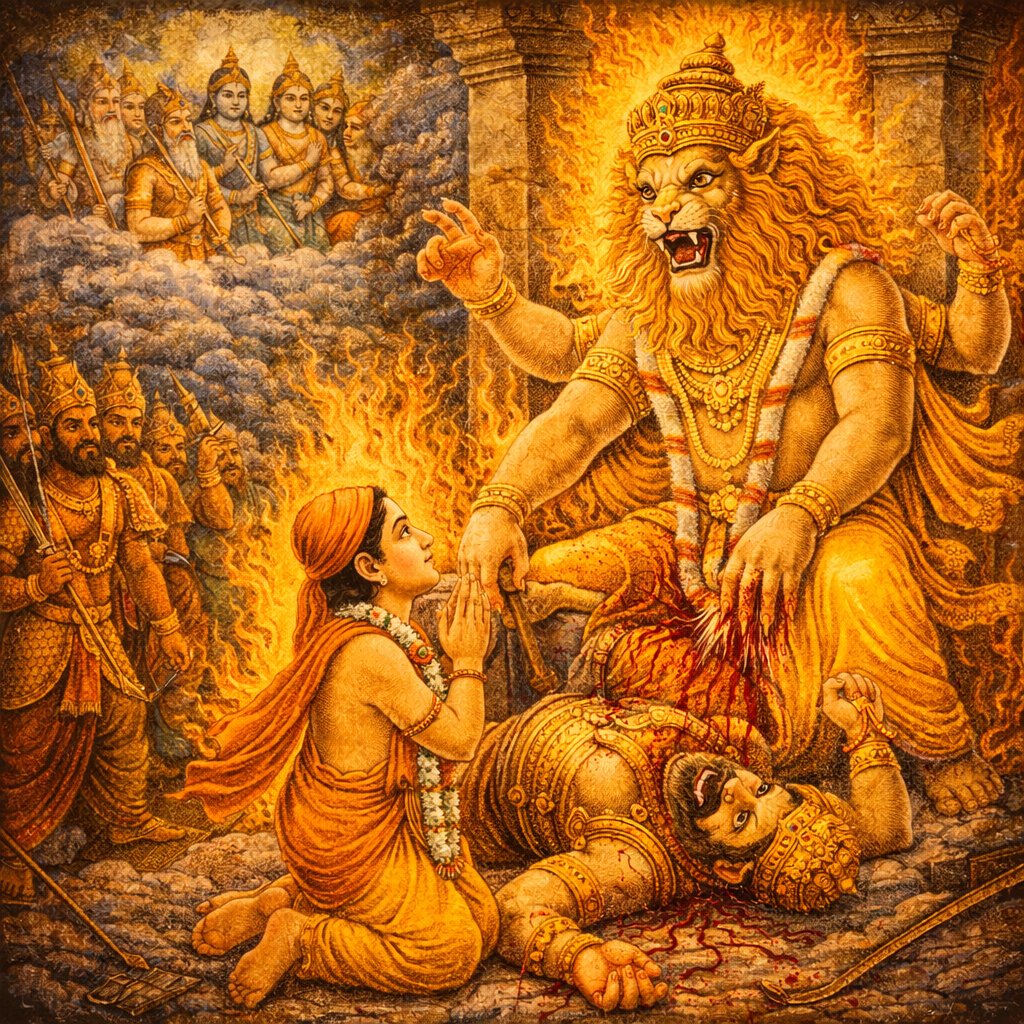
Following Prahlāda’s transformative influence on the sons of the demons—who reject the materialistic pedagogy of Ṣaṇḍa and Amarka—the teachers report to Hiraṇyakaśipu, escalating the father–son conflict into a crisis of sovereignty and theology. The enraged king challenges Prahlāda’s claim that a single Supreme source empowers all beings and that the true enemy is the uncontrolled mind, not external rivals. Mocking omnipresence, Hiraṇyakaśipu demands that Viṣṇu appear from a pillar and strikes it in fury. A universe-shaking sound erupts, and the Lord manifests in an unprecedented liminal form—neither man nor lion—vindicating the devotee’s word and the doctrine of all-pervasiveness. Nṛsiṁhadeva engages the demon in battle, then kills him in the doorway upon His lap with His nails, fulfilling the constraints of the demon’s boons while restoring cosmic order. The Lord’s wrath shakes the worlds; demigods and beings from many lokas assemble, offer prayers, and recognize divine protection as the canto moves toward pacification of the Lord and Prahlāda’s forthcoming glorification and benediction.
Adhyaya 9
Prahlāda’s Prayers Pacify Lord Nṛsiṁhadeva (Prahlāda-stuti and the Lord’s Benediction Offer)
Immediately after Hiraṇyakaśipu’s death, the cosmos remains tense: Brahmā, Śiva, and the devas cannot approach the ferocious Nṛsiṁha, and even Lakṣmī hesitates before the unprecedented form. Brahmā therefore sends Prahlāda forward. The child-devotee prostrates; the Lord’s touch grants fearlessness and instant purification, placing Prahlāda in ecstatic trance. Prahlāda’s prayers unfold in a deliberate arc: humility about his asura birth; the supremacy of bhakti over wealth, learning, or yogic power; the Lord’s self-sufficiency (service benefits the devotee); surrender under the crushing wheel of time; and a theological vision of the Lord as both transcendent and immanent cause of creation. He rejects material boons, critiques sense-driven life and merely professional “liberation practices,” and culminates in compassion—seeking deliverance not only for himself but for the suffering world. Pacified by these transcendental prayers, Nṛsiṁhadeva relinquishes His anger and offers Prahlāda any benediction, setting up the next narrative movement: Prahlāda’s refusal of sense-enjoyment and his model of desireless devotion.
Adhyaya 10
Prahlāda Rejects Material Boons; Forgives His Father; Tripura and the Power of Remembrance
Following the slaying of Hiraṇyakaśipu and the Lord’s offering of benedictions, Prahlāda—though still a child—politely refuses any material reward, identifying boons as obstacles to bhakti and praying only for freedom from desire (niṣkāmatā). Nṛsiṁhadeva affirms Prahlāda’s purity yet instructs him to rule the daityas as king, remain absorbed in hearing and remembrance, and thereby exhaust karmic reactions while living in the world. Prahlāda then asks a single boon: forgiveness for his father’s offenses; the Lord declares Hiraṇyakaśipu and twenty-one forefathers purified, highlighting how a devotee sanctifies a lineage and locality. Prahlāda performs śrāddha and is enthroned; Brahmā offers prayers, and the Lord warns against granting dangerous boons to demons. Nārada then links this episode to the broader theology of liberation: the Lord’s associates’ repeated births as enemies (Hiraṇyākṣa/Hiraṇyakaśipu → Rāvaṇa/Kumbhakarṇa → Śiśupāla/Dantavakra) and their attainment of sārūpya through intense absorption. The chapter closes by transitioning to Yudhiṣṭhira’s inquiry about Maya Dānava’s Tripura episode and Kṛṣṇa’s role in restoring Śiva’s glory, setting up the next narrative arc.
Adhyaya 11
Varṇāśrama-Dharma and the Thirty Qualities of a Human Being
After the account of Prahlāda’s exalted character—celebrated even by Brahmā and Śiva—Mahārāja Yudhiṣṭhira, delighted and eager for applicable guidance, questions Nārada Muni about the principles of religion that lead to the ultimate goal: devotional service. Nārada begins by offering obeisances to Kṛṣṇa, the protector of dharma, and grounds his teaching in revelation received from Nārāyaṇa (Nara-Nārāyaṇa at Badarikāśrama). He then outlines universal sādhāraṇa-dharma: a comprehensive set of thirty virtues culminating in the ninefold/complete bhakti attitudes (hearing, chanting, remembering, serving, worship, obeisances, servitorship, friendship, surrender). The chapter proceeds to applied varṇāśrama: who is dvija by saṁskāra, the duties of brāhmaṇa/kṣatriya/vaiśya/śūdra, emergency livelihoods and prohibitions, defining symptoms (lakṣaṇa) of each varṇa, and conduct for chaste women. It concludes by stressing guṇa-and-symptom-based classification over birth alone, preparing the reader for further refinements of righteous living as a support for devotion in subsequent teachings.
Adhyaya 12
Brahmacarya and Vānaprastha Duties; Gradual Dissolution of Bodily Identity
Continuing Nārada Muni’s varṇāśrama exposition to King Yudhiṣṭhira (following the canto’s climax of divine protection and the ethical lessons drawn from Prahlāda), this chapter details the formative discipline of brahmacarya: sense-control, submissive service in the gurukula, daily sandhyā worship (Gāyatrī), Vedic study, regulated dress and conduct, alms-gathering for the guru, and strict boundaries regarding association with women and sense-agitating luxuries. Nārada then transitions to vānaprastha, prescribing forest-based austerities, non-agricultural sustenance, endurance of climatic hardship, and a sober, non-excessive approach to tapas. The latter portion presents a contemplative exit strategy from bodily identification: merging the body’s constituents into the pañca-bhūtas and returning the senses and their powers to presiding deities, culminating in the cessation of material designations and the remaining spiritual identity (Brahman) aligned in quality with Parabrahman. The narrative progression moves from social-spiritual formation (student life) to mature withdrawal (forest life), preparing the ground for fuller renunciation and liberation teachings that follow.
Adhyaya 13
Paramahaṁsa-Dharma: The Avadhūta-like Sannyāsī and Prahlāda’s Dialogue with the ‘Python’ Saint
Continuing the canto’s shift from Prahlāda’s personal ordeal to his instructional role for society, Nārada Muni outlines the conduct of a true renunciant: minimal dependence, non-accumulation, freedom from sectarian quarrel, and vision of the Supreme pervading all. External symbols (daṇḍa, kamaṇḍalu, dress) are treated as secondary to inner realization, and the saint may conceal his stature—appearing childish or mute—to avoid worldly entanglement. Nārada then introduces an illustrative itihāsa: Prahlāda, touring to study saintly character, meets an advanced brāhmaṇa living “like a python,” inactive yet well-nourished. Prahlāda’s respectful inquiry elicits a penetrating diagnosis of material life: sense-driven action yields only the threefold miseries and anxiety, especially in wealth and prestige. The saint teaches contentment through the models of the bee (non-hoarding) and python (patient non-endeavor), accepting whatever comes by destiny. The chapter closes with Prahlāda grasping the duties of the paramahaṁsa, preparing the narrative to proceed toward further institutional and ethical teachings grounded in detachment and bhakti.
Adhyaya 14
Gṛhastha-Dharma: How a Householder Attains Liberation by Offering All to Vāsudeva
Following the canto’s demonstrations of the Lord’s supremacy and the primacy of bhakti, Mahārāja Yudhiṣṭhira asks Nārada Muni how householders—often absorbed in home life and unaware of life’s ultimate goal—may attain liberation in accordance with Vedic instruction. Nārada answers that livelihood and social duties need not be rejected; rather, their fruits must be offered to Kṛṣṇa (Vāsudeva), best learned through repeated association with great devotees and hearing Bhāgavata-kathā. The chapter outlines a disciplined simplicity: minimal endeavor for maintenance, avoidance of ugra-karma, inner detachment even while externally fulfilling family roles, and a strict ethic of non-proprietorship—claiming only what is necessary, else becoming a ‘thief’ under nature’s law. Nārada expands worship into social theology: guests, brāhmaṇas, demigods, forefathers (śrāddha), animals, and the marginalized must be maintained, culminating in the principle that worship of Kṛṣṇa—the root of the cosmic tree—worships all. The chapter transitions toward temple worship, sacred times/places, and the proper honoring of qualified brāhmaṇas and Vaiṣṇavas as the Lord’s dear servants.
Adhyaya 15
Nārada’s Instructions: Śrāddha, True Dharma, Contentment, Yoga, and Devotion-Centered Renunciation
Continuing Nārada Muni’s discourse to Mahārāja Yudhiṣṭhira on applied dharma within devotional life, this chapter begins by distinguishing practitioners attached to karma, tapas, Vedic study, jñāna, and especially bhakti. Nārada then regulates śrāddha and charity: few qualified brāhmaṇas should be invited, offerings must be sattvic (no animal killing), and prasāda should be distributed while seeing recipients in relation to Bhagavān. He defines five counterfeit forms of religion (vidharma, para-dharma, ābhāsa, upadharma, chala-dharma) and urges non-enviousness as the highest dharma. Turning to inner discipline, he praises contentment and warns against greed, outlining methods to conquer lust, anger, fear, illusion, and sleep by knowledge, service to devotees, silence, and sattva. He establishes guru-tattva and insists that ritual, austerity, and yoga are futile without meditation on the Supreme Lord. Practical yoga instructions follow (solitude, prāṇāyāma, mind-restraint), alongside critiques of hypocritical āśrama behavior and sannyāsa relapse. Using the chariot allegory, he explains bondage and liberation, contrasts pravṛtti with nivṛtti, critiques animal-linked sacrifices, and describes deva-yāna/pitṛ-yāna and progressive self-offering into Brahman. The chapter concludes with Nārada’s personal lesson (Upabarhaṇa’s fall and redemption via Vaiṣṇava service), affirming nāma-saṅkīrtana as accessible even for householders, and transitions back to Śukadeva’s narration as Yudhiṣṭhira worships Kṛṣṇa and Nārada departs—setting up the next thematic shift toward broader genealogical descriptions.
Frequently Asked Questions
Because the Lord is nirguṇa and not driven by personal likes or dislikes; He administers cosmic order through kāla (time) and the guṇas. When sattva rises, devas flourish; when tamas dominates, asuric forces expand. The Lord’s interventions (killing, protecting) are corrective and ultimately beneficial—even for the slain—since contact with Him can grant purification and liberation.
The chapter teaches that intense, continuous absorption in the Lord (ekāgratā) produces purification regardless of the initial emotion—fear, envy, lust, affection, or devotion. Śiśupāla’s constant fixation on Kṛṣṇa culminated in liberation, illustrating the Bhāgavata principle that remembrance of the Supreme is transformative, while atheistic rejection that cannot fix on His form yields no such result.
Jaya and Vijaya are gatekeepers of Vaikuṇṭha who, by obstructing the Kumāras, receive a brāhmaṇa curse to take three births in the material world. Their descent is not ordinary bondage; it is a divinely arranged līlā in which their enmity intensifies remembrance of the Lord, and they return to Vaikuṇṭha after being slain by Him in successive incarnations.