Adhyaya 87
The Prayers of the Personified Vedas (Śruti-stuti) and the Indescribable Absolute
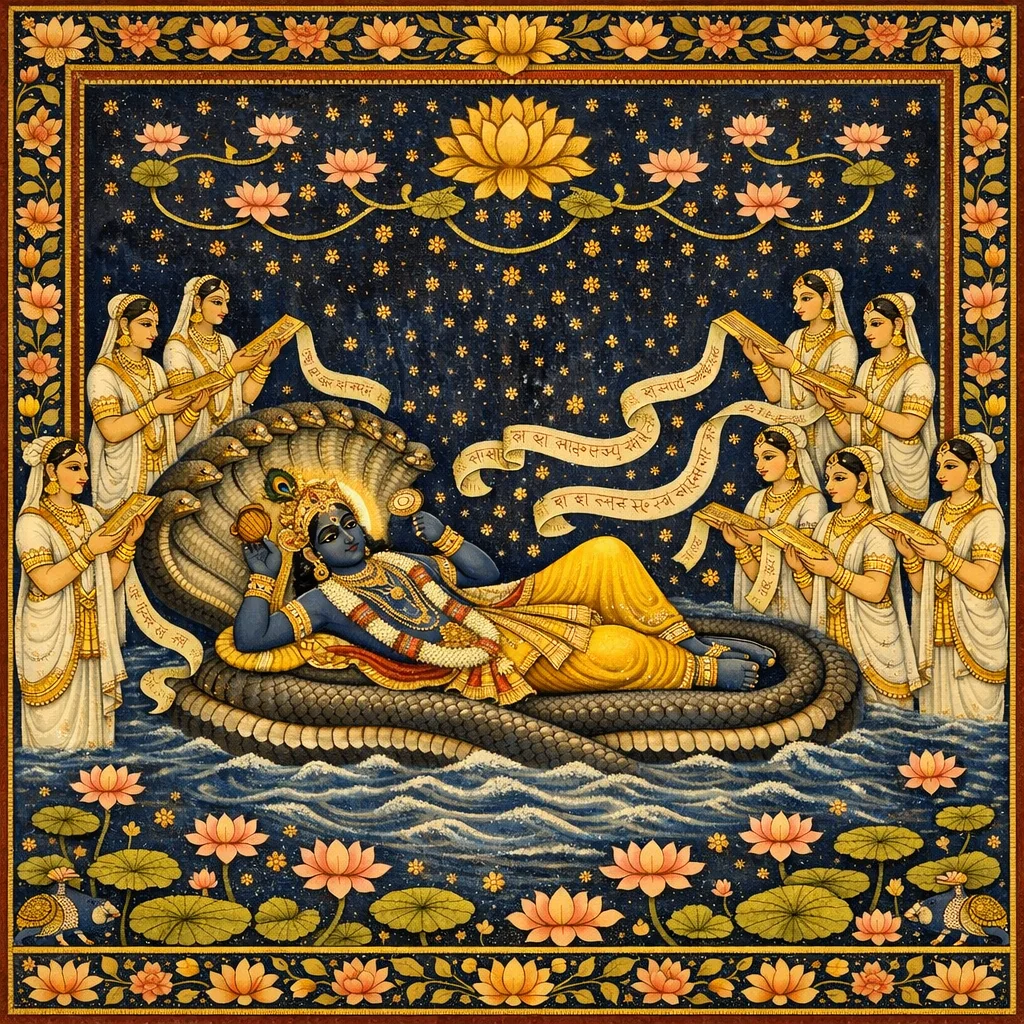
Responding to Parīkṣit’s doubt—how the Vedas can speak of the transcendent, nirguṇa Absolute—Śukadeva explains that the Lord manifests the subtle and gross faculties so conditioned beings can exhaust desire, rise through karma, and ultimately attain mukti by His grace. To ground the answer, he narrates a disciplic chain: Parīkṣit’s question echoes Nārada’s inquiry to Nārāyaṇa Ṛṣi at Badarikāśrama, who then recounts an ancient Janaloka assembly where Brahmā’s mind-born sages appointed Sanandana to speak. Sanandana describes cosmic nirodha and re-creation: after dissolution, the Lord ‘rests,’ and the personified Vedas awaken Him by glorification—revealing that śabda (Vedic sound) reaches the Absolute not by material description but by apophatic discernment (neti-neti), devotion, and surrender. The śrutis praise the Lord as the substratum of all, beyond māyā, yet immanent as antaryāmī. They critique materialist and dualist claims, warn against yoga without guru-shelter, and extol bhakti as fearlessness over Death. Nārāyaṇa Ṛṣi instructs Nārada to meditate on this confidential essence; Nārada transmits it to Vyāsa, and Śukadeva concludes: Hari pervades creation as regulator, and constant meditation and surrender alone free one from illusion—setting the stage for deeper bhakti-centered revelations in subsequent teachings of the canto.
Shlokas
Verse 1
श्रीपरीक्षिदुवाच ब्रह्मन् ब्रह्मण्यनिर्देश्ये निर्गुणे गुणवृत्तय: । कथं चरन्ति श्रुतय: साक्षात् सदसत: परे ॥ १ ॥
Śrī Parīkṣit said: O brāhmaṇa, how can the Vedas directly describe the Supreme Absolute Truth, who cannot be described in words? The Vedas are limited to describing the qualities of material nature, but the Supreme is devoid of these qualities, being transcendental to all material manifestations and their causes.
Verse 2
श्रीशुक उवाच बुद्धीन्द्रियमन:प्राणान् जनानामसृजत् प्रभु: । मात्रार्थं च भवार्थं च आत्मनेऽकल्पनाय च ॥ २ ॥
Śukadeva Gosvamī said: The Supreme Lord manifested the material intelligence, senses, mind and vital air of the living entities so that they could indulge their desires for sense gratification, take repeated births to engage in fruitive activities, become elevated in future lives and ultimately attain liberation.
Verse 3
सैषा ह्युपनिषद् ब्राह्मी पूर्वेशां पूर्वजैर्धृता । श्रद्धया धारयेद् यस्तां क्षेमं गच्छेदकिञ्चन: ॥ ३ ॥
Those who came before even our ancient predecessors meditated upon this same confidential knowledge of the Absolute Truth. Indeed, anyone who faithfully concentrates on this knowledge will become free from material attachments and attain the final goal of life.
Verse 4
अत्र ते वर्णयिष्यामि गाथां नारायणान्विताम् । नारदस्य च संवादमृषेर्नारायणस्य च ॥ ४ ॥
In this connection I will relate to you a narration concerning the Supreme Lord Nārāyaṇa. It is about a conversation that once occurred between Śrī Nārāyaṇa Ṛṣi and Nārada Muni.
Verse 5
एकदा नारदो लोकान् पर्यटन् भगवत्प्रिय: । सनातनमृषिं द्रष्टुं ययौ नारायणाश्रमम् ॥ ५ ॥
Once, while traveling among the various planets of the universe, the Lord’s beloved devotee Nārada went to visit the primeval sage Nārāyaṇa at His āśrama.
Verse 6
यो वै भारतवर्षेऽस्मिन् क्षेमाय स्वस्तये नृणाम् । धर्मज्ञानशमोपेतमाकल्पादास्थितस्तप: ॥ ६ ॥
From the very beginning of Brahmā’s day Lord Nārāyaṇa Ṛṣi has been undergoing austere penances in this land of Bhārata while perfectly performing religious duties and exemplifying spiritual knowledge and self-control — all for the benefit of human beings in both this world and the next.
Verse 7
तत्रोपविष्टमृषिभि: कलापग्रामवासिभि: । परीतं प्रणतोऽपृच्छदिदमेव कुरूद्वह ॥ ७ ॥
There Nārada approached Lord Nārāyaṇa Ṛṣi, who was sitting amidst sages of the village of Kalāpa. After bowing down to the Lord, O hero of the Kurus, Nārada asked Him the very same question you have asked me.
Verse 8
तस्मै ह्यवोचद् भगवानृषीणां शृण्वतामिदम् । यो ब्रह्मवाद: पूर्वेषां जनलोकनिवासिनाम् ॥ ८ ॥
As the sages listened, Lord Nārāyaṇa Ṛṣi related to Nārada an ancient discussion about the Absolute Truth that took place among the residents of Janaloka.
Verse 9
श्रीभगवानुवाच स्वायम्भुव ब्रह्मसत्रं जनलोकेऽभवत् पुरा । तत्रस्थानां मानसानां मुनीनामूर्ध्वरेतसाम् ॥ ९ ॥
The Personality of Godhead said: O son of self-born Brahmā, once long ago on Janaloka, wise sages who resided there performed a great sacrifice to the Absolute Truth by vibrating transcendental sounds. These sages, mental sons of Brahmā, were all perfect celibates.
Verse 10
श्वेतद्वीपं गतवति त्वयि द्रष्टुं तदीश्वरम् । ब्रह्मवाद: सुसंवृत्त: श्रुतयो यत्र शेरते । तत्र हायमभूत् प्रश्नस्त्वं मां यमनुपृच्छसि ॥ १० ॥
At that time you happened to be visiting the Lord on Śvetadvīpa — that Supreme Lord in whom the Vedas lie down to rest during the period of universal annihilation. A lively discussion arose among the sages on Janaloka as to the nature of the Supreme Absolute Truth. Indeed, the same question arose then that you are asking Me now.
Verse 11
तुल्यश्रुततप:शीलास्तुल्यस्वीयारिमध्यमा: । अपि चक्रु: प्रवचनमेकं शुश्रूषवोऽपरे ॥ ११ ॥
Although these sages were all equally qualified in terms of Vedic study and austerity, and although they all saw friends, enemies and neutral parties equally, they chose one of their number to be the speaker, and the rest became eager listeners.
Verse 12
श्रीसनन्दन उवाच स्वसृष्टमिदमापीय शयानं सह शक्तिभि: । तदन्ते बोधयां चक्रुस्तल्लिङ्गै: श्रुतय: परम् ॥ १२ ॥ यथा शयानं संराजं वन्दिनस्तत्पराक्रमै: । प्रत्यूषेऽभेत्य सुश्लोकैर्बोधयन्त्यनुजीविन: ॥ १३ ॥
Śrī Sanandana replied: After the Supreme Lord withdrew the universe He had previously created, He lay for some time as if asleep, and all His energies rested dormant within Him. When the time came for the next creation, the personified Vedas awakened Him by chanting His glories, just as the poets serving a king approach him at dawn and awaken him by reciting his heroic deeds.
Verse 13
श्रीसनन्दन उवाच स्वसृष्टमिदमापीय शयानं सह शक्तिभि: । तदन्ते बोधयां चक्रुस्तल्लिङ्गै: श्रुतय: परम् ॥ १२ ॥ यथा शयानं संराजं वन्दिनस्तत्पराक्रमै: । प्रत्यूषेऽभेत्य सुश्लोकैर्बोधयन्त्यनुजीविन: ॥ १३ ॥
Śrī Sanandana replied: After the Supreme Lord withdrew the universe He had previously created, He lay for some time as if asleep, and all His energies rested dormant within Him. When the time came for the next creation, the personified Vedas awakened Him by chanting His glories, just as the poets serving a king approach him at dawn and awaken him by reciting his heroic deeds.
Verse 14
श्रीश्रुतय ऊचु: जय जय जह्यजामजित दोषगृभीतगुणां त्वमसि यदात्मना समवरुद्धसमस्तभग: । अगजगदोकसामखिलशक्त्यवबोधक ते क्वचिदजयात्मना च चरतोऽनुचरेन्निगम: ॥ १४ ॥
The śrutis said: Victory, victory to You, O unconquerable one! By Your very nature You are perfectly full in all opulences; therefore please defeat the eternal power of illusion, who assumes control over the modes of nature to create difficulties for conditioned souls. O You who awaken all the energies of the moving and nonmoving embodied beings, sometimes the Vedas can recognize You as You sport with Your material and spiritual potencies.
Verse 15
बृहदुपलब्धमेतदवयन्त्यवशेषतया यत उदयास्तमयौ विकृतेर्मृदि वाविकृतात् । अत ऋषयो दधुस्त्वयि मनोवचनाचरितं कथमयथा भवन्ति भुवि दत्तपदानि नृणाम् ॥ १५ ॥
This perceivable world is identified with the Supreme because the Supreme Brahman is the ultimate foundation of all existence, remaining unchanged as all created things are generated from it and at last dissolved into it, just as clay remains unchanged by the products made from it and again merged with it. Thus it is toward You alone that the Vedic sages direct all their thoughts, words and acts. After all, how can the footsteps of men fail to touch the earth on which they live?
Verse 16
इति तव सूरयस्त्र्यधिपतेऽखिललोकमल-क्षपणकथामृताब्धिमवगाह्य तपांसि जहु: । किमुत पुन: स्वधामविधुताशयकालगुणा:परम भजन्ति ये पदमजस्रसुखानुभवम् ॥ १६ ॥
Therefore, O master of the three worlds, the wise get rid of all misery by diving deep into the nectarean ocean of topics about You, which washes away all the contamination of the universe. Then what to speak of those who, having by spiritual strength rid their minds of bad habits and freed themselves from time, are able to worship Your true nature, O supreme one, finding within it uninterrupted bliss?
Verse 17
दृतय इव श्वसन्त्यसुभृतो यदि तेऽनुविधा महदहमादयोऽण्डमसृजन् यदनुग्रहत: । पुरुषविधोऽन्वयोऽत्र चरमोऽन्नमयादिषु य: सदसत: परं त्वमथ यदेष्ववशेषमृतम् ॥ १७ ॥
Only if they become Your faithful followers are those who breathe actually alive, otherwise their breathing is like that of a bellows. It is by Your mercy alone that the elements, beginning with the mahat-tattva and false ego, created the egg of this universe. Among the manifestations known as anna-maya and so forth, You are the ultimate one, entering within the material coverings along with the living entity and assuming the same forms as those he takes. Distinct from the gross and subtle material manifestations, You are the reality underlying them all.
Verse 18
उदरमुपासते य ऋषिवर्त्मसु कूर्पदृश: परिसरपद्धतिं हृदयमारुणयो दहरम् । तत उदगादनन्त तव धाम शिर: परमं पुनरिह यत् समेत्य न पतन्ति कृतान्तमुखे ॥ १८ ॥
Among the followers of the methods set forth by great sages, those with less refined vision worship the Supreme as present in the region of the abdomen, while the Āruṇis worship Him as present in the heart, in the subtle center from which all the prāṇic channels emanate. From there, O unlimited Lord, these worshipers raise their consciousness upward to the top of the head, where they can perceive You directly. Then, passing through the top of the head toward the supreme destination, they reach that place from which they will never again fall to this world, into the mouth of death.
Verse 19
स्वकृतविचित्रयोनिषु विशन्निव हेतुतया तरतमतश्चकास्स्यनलवत् स्वकृतानुकृति: । अथ वितथास्वमूष्ववितथं तव धाम समं विरजधियोऽनुयन्त्यभिविपण्यव एकरसम् ॥ १९ ॥
Apparently entering among the variegated species of living beings You have created, You inspire them to act, manifesting Yourself according to their higher and lower positions, just as fire manifests differently according to the shape of what it burns. Therefore those of spotless intelligence, who are altogether free from material attachments, realize Your undifferentiated, unchanging Self to be the permanent reality among all these impermanent life forms.
Verse 20
स्वकृतपुरेष्वमीष्वबहिरन्तरसंवरणं तव पुरुषं वदन्त्यखिलशक्तिधृतोंऽशकृतम् । इति नृगतिं विविच्य कवयो निगमावपनं भवत उपासतेऽङ्घ्रिमभवं भुवि विश्वसिता: ॥ २० ॥
The individual living entity, while inhabiting the material bodies he has created for himself by his karma, actually remains uncovered by either gross or subtle matter. This is so because, as the Vedas describe, he is part and parcel of You, the possessor of all potencies. Having determined this to be the status of the living entity, learned sages become imbued with faith and worship Your lotus feet, to which all Vedic sacrifices in this world are offered, and which are the source of liberation.
Verse 21
दुरवगमात्मतत्त्वनिगमाय तवात्ततनो- श्चरितमहामृताब्धिपरिवर्तपरिश्रमणा: । न परिलषन्ति केचिदपवर्गमपीश्वर ते चरणसरोजहंसकुलसङ्गविसृष्टगृहा: ॥ २१ ॥
My Lord, some fortunate souls have gotten relief from the fatigue of material life by diving into the vast nectar ocean of Your pastimes, which You enact when You manifest Your personal forms to propagate the unfathomable science of the self. These rare souls, indifferent even to liberation, renounce the happiness of home and family because of their association with devotees who are like flocks of swans enjoying at the lotus of Your feet.
Verse 22
त्वदनुपथं कुलायमिदमात्मसुहृत्प्रियव- च्चरति तथोन्मुखे त्वयि हिते प्रिय आत्मनि च । न बत रमन्त्यहो असदुपासनयात्महनो यदनुशया भ्रमन्त्युरुभये कुशरीरभृत: ॥ २२ ॥
When this human body is used for Your devotional service, it acts as one’s self, friend and beloved. But unfortunately, although You always show mercy to the conditioned souls and affectionately help them in every way, and although You are their true Self, people in general fail to delight in You. Instead they commit spiritual suicide by worshiping illusion. Alas, because they persistently hope for success in their devotion to the unreal, they continue to wander about this greatly fearful world, assuming various degraded bodies.
Verse 23
निभृतमरुन्मनोऽक्षदृढयोगयुजो हृदि य- न्मुनय उपासते तदरयोऽपि ययु: स्मरणात् । स्त्रिय उरगेन्द्रभोगभुजदण्डविषक्तधियो वयमपि ते समा: समदृशोऽङ्घ्रिसरोजसुधा: ॥ २३ ॥
Simply by constantly thinking of Him, the enemies of the Lord attained the same Supreme Truth whom sages fixed in yoga worship by controlling their breath, mind and senses. Similarly, we śrutis, who generally see You as all-pervading, will achieve the same nectar from Your lotus feet that Your consorts are able to relish because of their loving attraction to Your mighty, serpentine arms, for You look upon us and Your consorts in the same way.
Verse 24
क इह नु वेद बतावरजन्मलयोऽग्रसरं यत उदगादृषिर्यमनु देवगणा उभये । तर्हि न सन्न चासदुभयं न च कालजव: किमपि न तत्र शास्त्रमवकृष्य शयीत यदा ॥ २४ ॥
Everyone in this world has recently been born and will soon die. So how can anyone here know Him who existed prior to everything else and who gave rise to the first learned sage, Brahmā, and all subsequent demigods, both lesser and greater? When He lies down and withdraws everything within Himself, nothing else remains — no gross or subtle matter or bodies composed of these, no force of time or revealed scripture.
Verse 25
जनिमसत: सतो मृतिमुतात्मनि ये च भिदां विपणमृतं स्मरन्त्युपदिशन्ति त आरुपितै: । त्रिगुणमय: पुमानिति भिदा यदबोधकृता त्वयि न तत: परत्र स भवेदवबोधरसे ॥ २५ ॥
Supposed authorities who declare that matter is the origin of existence, that the permanent qualities of the soul can be destroyed, that the self is compounded of separate aspects of spirit and matter, or that material transactions constitute reality — all such authorities base their teachings on mistaken ideas that hide the truth. The dualistic conception that the living entity is produced from the three modes of nature is simply a product of ignorance. Such a conception has no real basis in You, for You are transcendental to all illusion and always enjoy perfect, total awareness.
Verse 26
सदिव मनस्त्रिवृत्त्वयि विभात्यसदामनुजात् सदभिमृशन्त्यशेषमिदमात्मतयात्मविद: । न हि विकृतिं त्यजन्ति कनकस्य तदात्मतया स्वकृतमनुप्रविष्टमिदमात्मतयावसितम् ॥ २६ ॥
The three modes of material nature comprise everything in this world — from the simplest phenomena to the complex human body. Although these phenomena appear real, they are only a false reflection of the spiritual reality, being a superimposition of the mind upon You. Still, those who know the Supreme Self consider the entire material creation to be real inasmuch as it is nondifferent from the Self. Just as things made of gold are indeed not to be rejected, since their substance is actual gold, so this world is undoubtedly nondifferent from the Lord who created it and then entered within it.
Verse 27
तव परि ये चरन्त्यखिलसत्त्वनिकेततया त उत पदाक्रमन्त्यविगणय्य शिरो निर्ऋतेः । परिवयसे पशूनिव गिरा विबुधानपि तां- स्त्वयि कृतसौहृदा: खलु पुनन्ति न ये विमुखा: ॥ २७ ॥
The devotees who worship You as the shelter of all beings disregard Death and place their feet on his head. But with the words of the Vedas You bind the nondevotees like animals, though they be vastly learned scholars. It is Your affectionate devotees who can purify themselves and others, not those who are inimical to You.
Verse 28
त्वमकरण: स्वराडखिलकारकशक्तिधर- स्तव बलिमुद्वहन्ति समदन्त्यजयानिमिषा: । वर्षभुजोऽखिलक्षितिपतेरिव विश्वसृजो विदधति यत्र ये त्वधिकृता भवतश्चकिता: ॥ २८ ॥
Though You have no material senses, You are the self-effulgent sustainer of everyone’s sensory powers. The demigods and material nature herself offer You tribute, while also enjoying the tribute offered them by their worshipers, just as subordinate rulers of various districts in a kingdom offer tribute to their lord, the ultimate proprietor of the land, while also enjoying the tribute paid them by their own subjects. In this way the universal creators faithfully execute their assigned services out of fear of You.
Verse 29
स्थिरचरजातय: स्युरजयोत्थनिमित्तयुजो विहर उदीक्षया यदि परस्य विमुक्त तत: । न हि परमस्य कश्चिदपरो न परश्च भवेद् वियत इवापदस्य तव शून्यतुलां दधत: ॥ २९ ॥
O eternally liberated, transcendental Lord, Your material energy causes the various moving and nonmoving species of life to appear by activating their material desires, but only when and if You sport with her by briefly glancing at her. You, the Supreme Personality of Godhead, see no one as an intimate friend and no one as a stranger, just as the ethereal sky has no connection with perceptible qualities. In this sense You resemble a void.
Verse 30
अपरिमिता ध्रुवास्तनुभृतो यदि सर्वगता- स्तर्हि न शास्यतेति नियमो ध्रुव नेतरथा । अजनि च यन्मयं तदविमुच्य नियन्तृ भवेत् सममनुजानतां यदमतं मतदुष्टतया ॥ ३० ॥
If the countless living entities were all-pervading and possessed forms that never changed, You could not possibly be their absolute ruler, O immutable one. But since they are Your localized expansions and their forms are subject to change, You do control them. Indeed, that which supplies the ingredients for the generation of something is necessarily its controller because a product never exists apart from its ingredient cause. It is simply illusion for someone to think that he knows the Supreme Lord, who is equally present in each of His expansions, since whatever knowledge one gains by material means must be imperfect.
Verse 31
न घटत उद्भव: प्रकृतिपूरुषयोरजयो- रुभययुजा भवन्त्यसुभृतो जलबुद्बुदवत् । त्वयि त इमे ततो विविधनामगुणै: परमे सरित इवार्णवे मधुनि लिल्युरशेषरसा: ॥ ३१ ॥
Neither material nature nor the soul who tries to enjoy her are ever born, yet living bodies come into being when these two combine, just as bubbles form where water meets the air. And just as rivers merge into the ocean or the nectar from many different flowers blends into honey, so all these conditioned beings eventually merge back into You, the Supreme, along with their various names and qualities.
Verse 32
नृषु तव मयया भ्रमममीष्ववगत्य भृशं त्वयि सुधियोऽभवे दधति भावमनुप्रभवम् । कथमनुवर्ततां भवभयं तव यद् भ्रुकुटि: सृजति मुहुस्त्रिनेमिरभवच्छरणेषु भयम् ॥ ३२ ॥
The wise souls who understand how Your Māyā deludes all human beings render potent loving service to You, who are the source of liberation from birth and death. How, indeed, can fear of material life affect Your faithful servants? On the other hand, Your furrowing eyebrows — the triple-rimmed wheel of time — repeatedly terrify those who refuse to take shelter of You.
Verse 33
विजितहृषीकवायुभिरदान्तमनस्तुरगं य इह यतन्ति यन्तुमतिलोलमुपायखिद: । व्यसनशतान्विता: समवहाय गुरोश्चरणं वणिज इवाज सन्त्यकृतकर्णधरा जलधौ ॥ ३३ ॥
The mind is like an impetuous horse that even persons who have regulated their senses and breath cannot control. Those in this world who try to tame the uncontrolled mind, but who abandon the feet of their spiritual master, encounter hundreds of obstacles in their cultivation of various distressful practices. O unborn Lord, they are like merchants on a boat in the ocean who have failed to employ a helmsman.
Verse 34
स्वजनसुतात्मदारधनधामधरासुरथै- स्त्वयि सति किं नृणां श्रयत आत्मनि सर्वरसे । इति सदजानतां मिथुनतो रतये चरतां सुखयति को न्विह स्वविहते स्वनिरस्तभगे ॥ ३४ ॥
To those persons who take shelter of You, You reveal Yourself as the Supersoul, the embodiment of all transcendental pleasure. What further use have such devotees for their servants, children or bodies, their wives, money or houses, their land, good health or conveyances? And for those who fail to appreciate the truth about You and go on pursuing the pleasures of sex, what could there be in this entire world — a place inherently doomed to destruction and devoid of significance — that could give them real happiness?
Verse 35
भुवि पुरुपुण्यतीर्थसदनान्यृषयो विमदा- स्त उत भवत्पदाम्बुजहृदोऽघभिदङ्घ्रिजला: । दधति सकृन्मनस्त्वयि य आत्मनि नित्यसुखे न पुनरुपासते पुरुषसारहरावसथान् ॥ ३५ ॥
Sages free from false pride live on this earth by frequenting the sacred pilgrimage sites and those places where the Supreme Lord displayed His pastimes. Because such devotees keep Your lotus feet within their hearts, the water that washes their feet destroys all sins. Anyone who even once turns his mind toward You, the ever-blissful Soul of all existence, no longer dedicates himself to serving family life at home, which simply robs a man of his good qualities.
Verse 36
सत इदमुत्थितं सदिति चेन्ननु तर्कहतं व्यभिचरति क्व च क्व च मृषा न तथोभययुक् । व्यवहृतये विकल्प इषितोऽन्धपरम्परया भ्रमयति भारती त उरुवृत्तिभिरुक्थजडान् ॥ ३६ ॥
It may be proposed that this world is permanently real because it is generated from the permanent reality, but such an argument is subject to logical refutation. Sometimes, indeed, the apparent nondifference of a cause and its effect fails to prove true, and at other times the product of something real is illusory. Furthermore, this world cannot be permanently real, for it partakes of the natures of not only the absolute reality but also the illusion disguising that reality. Actually, the visible forms of this world are just an imaginary arrangement resorted to by a succession of ignorant persons in order to facilitate their material affairs. With their various meanings and implications, the learned words of Your Vedas bewilder all persons whose minds have been dulled by hearing the incantations of sacrificial rituals.
Verse 37
न यदिदमग्र आस न भविष्यदतो निधना- दनुमितमन्तरा त्वयि विभाति मृषैकरसे । अत उपमीयते द्रविणजातिविकल्पपथै- र्वितथमनोविलासमृतमित्यवयन्त्यबुधा: ॥ ३७ ॥
Since this universe did not exist prior to its creation and will no longer exist after its annihilation, we conclude that in the interim it is nothing more than a manifestation imagined to be visible within You, whose spiritual enjoyment never changes. We liken this universe to the transformation of various material substances into diverse forms. Certainly those who believe that this figment of the imagination is substantially real are less intelligent.
Verse 38
स यदजया त्वजामनुशयीत गुणांश्च जुषन् भजति सरूपतां तदनु मृत्युमपेतभग: । त्वमुत जहासि तामहिरिव त्वचमात्तभगो महसि महीयसेऽष्टगुणितेऽपरिमेयभग: ॥ ३८ ॥
The illusory material nature attracts the minute living entity to embrace her, and as a result he assumes forms composed of her qualities. Subsequently, he loses all his spiritual qualities and must undergo repeated deaths. You, however, avoid the material energy in the same way that a snake abandons its old skin. Glorious in Your possession of eight mystic perfections, You enjoy unlimited opulences.
Verse 39
यदि न समुद्धरन्ति यतयो हृदि कामजटा दुरधिगमोऽसतां हृदि गतोऽस्मृतकण्ठमणि: । असुतृपयोगिनामुभयतोऽप्यसुखं भगव- न्ननपगतान्तकादनधिरूढपदाद् भवत: ॥ ३९ ॥
Members of the renounced order who fail to uproot the last traces of material desire in their hearts remain impure, and thus You do not allow them to understand You. Although You are present within their hearts, for them You are like a jewel worn around the neck of a man who has totally forgotten it is there. O Lord, those who practice yoga only for sense gratification must suffer punishment both in this life and the next: from death, who will not release them, and from You, whose kingdom they cannot reach.
Verse 40
त्वदवगमी न वेत्ति भवदुत्थशुभाशुभयो- र्गुणविगुणान्वयांस्तर्हि देहभृतां च गिर: । अनुयुगमन्वहं सगुण गीतपरम्परया श्रवणभृतो यतस्त्वमपवर्गगतिर्मनुजै: ॥ ४० ॥
When a person realizes You, he no longer cares about his good and bad fortune arising from past pious and sinful acts, since it is You alone who control this good and bad fortune. Such a realized devotee also disregards what ordinary living beings say about him. Every day he fills his ears with Your glories, which are recited in each age by the unbroken succession of Manu’s descendants, and thus You become his ultimate salvation.
Verse 41
द्युपतय एव ते न ययुरन्तमनन्ततयात्वमपि यदन्तराण्डनिचया ननु सावरणा: । ख इव रजांसि वान्ति वयसा सह यच्छ्रुतय-स्त्वयि हि फलन्त्यतन्निरसनेन भवन्निधना: ॥ ४१ ॥
Because You are unlimited, neither the lords of heaven nor even You Yourself can ever reach the end of Your glories. The countless universes, each enveloped in its shell, are compelled by the wheel of time to wander within You, like particles of dust blowing about in the sky. The śrutis, following their method of eliminating everything separate from the Supreme, become successful by revealing You as their final conclusion.
Verse 42
श्रीभगवानुवाच इत्येतद् ब्रह्मण: पुत्रा आश्रुत्यात्मानुशासनम् । सनन्दनमथानर्चु: सिद्धा ज्ञात्वात्मनो गतिम् ॥ ४२ ॥
The Supreme Lord, Śrī Nārāyaṇa Ṛṣi, said: Having heard these instructions about the Supreme Self, the Personality of Godhead, the sons of Brahmā now understood their final destination. They felt perfectly satisfied and honored Sanandana with their worship.
Verse 43
इत्यशेषसमाम्नायपुराणोपनिषद्रस: । समुद्धृत: पूर्वजातैर्व्योमयानैर्महात्मभि: ॥ ४३ ॥
Thus the ancient saints who travel in the upper heavens distilled this nectarean and confidential essence of all the Vedas and Purāṇas.
Verse 44
त्वं चैतद् ब्रह्मदायाद श्रद्धयात्मानुशासनम् । धारयंश्चर गां कामं कामानां भर्जनं नृणाम् ॥ ४४ ॥
And as you wander the earth at will, My dear son of Brahmā, you should faithfully meditate on these instructions concerning the science of the Self, which burn up the material desires of all men.
Verse 45
श्रीशुक उवाच एवं स ऋषिणादिष्टं गृहीत्वा श्रद्धयात्मवान् । पूर्ण: श्रुतधरो राजन्नाह वीरव्रतो मुनि: ॥ ४५ ॥
Śukadeva Gosvāmī said: When Śrī Nārāyaṇa Ṛṣi ordered him in this way, the self-possessed sage Nārada, whose vow is as heroic as a warrior’s, accepted the command with firm faith. Now successful in all his purposes, he thought about what he had heard, O King, and replied to the Lord as follows.
Verse 46
श्रीनारद उवाच नमस्तस्मै भगवते कृष्णायामलकीर्तये । यो धत्ते सर्वभूतानामभवायोशती: कला: ॥ ४६ ॥
Śrī Nārada said: I offer my obeisances to Him of spotless fame, the Supreme Lord Kṛṣṇa, who manifests His all-attractive personal expansions so that all living beings can achieve liberation.
Verse 47
इत्याद्यमृषिमानम्य तच्छिष्यांश्च महात्मन: । ततोऽगादाश्रमं साक्षात् पितुर्द्वैपायनस्य मे ॥ ४७ ॥
[Śukadeva Gosvāmī continued:] After saying this, Nārada bowed down to Śrī Nārāyaṇa Ṛṣi, the foremost of sages, and also to His saintly disciples. He then returned to the hermitage of my father, Dvaipāyana Vyāsa.
Verse 48
सभाजितो भगवता कृतासनपरिग्रह: । तस्मै तद् वर्णयामास नारायणमुखाच्छ्रुतम् ॥ ४८ ॥
Vyāsadeva, the incarnation of the Personality of Godhead, respectfully greeted Nārada Muni and offered him a seat, which he accepted. Nārada then described to Vyāsa what he had heard from the mouth of Śrī Nārāyaṇa Ṛṣi.
Verse 49
इत्येतद् वर्णितं राजन् यन्न: प्रश्न: कृतस्त्वया । यथा ब्रह्मण्यनिर्देश्ये निर्गुणेऽपि मनश्चरेत् ॥ ४९ ॥
Thus I have replied to the question you asked me, O King, concerning how the mind can have access to the Absolute Truth, which is indescribable by material words and devoid of material qualities.
Verse 50
योऽस्योत्प्रेक्षक आदिमध्यनिधने योऽव्यक्तजीवेश्वरो य: सृष्ट्वेदमनुप्रविश्य ऋषिणा चक्रे पुर: शास्ति ता: । यं सम्पद्य जहात्यजामनुशयी सुप्त: कुलायं यथा तं कैवल्यनिरस्तयोनिमभयं ध्यायेदजस्रं हरिम् ॥ ५० ॥
He is the Lord who eternally watches over this universe, who exists before, during and after its manifestation. He is the master of both the unmanifest material energy and the spirit soul. After sending forth the creation He enters within it, accompanying each living entity. There He creates the material bodies and then remains as their regulator. By surrendering to Him one can escape the embrace of illusion, just as a dreaming person forgets his own body. One who wants liberation from fear should constantly meditate upon Him, Lord Hari, who is always on the platform of perfection and thus never subject to material birth.
Frequently Asked Questions
Bhāgavatam 10.87 explains that the Vedas do not ‘capture’ the Absolute as an object within material categories; rather, they indicate Him through negation of limiting concepts (neti-neti), through revealing His role as the unchanging substratum of all causes and effects, and—most decisively—through devotional glorification that invokes His self-revelation. Thus śabda works not by material definition but by purifying the hearer and directing surrender to the Lord, who is known by His own mercy.
The personified Vedas (śrutis) represent revealed sound as conscious praise and conclusion (siddhānta). In the Janaloka narration, after cosmic nirodha the Lord remains with all potencies dormant; when creation is to begin again, the śrutis ‘awaken’ Him by stuti, illustrating that Vedic sound ultimately functions as glorification and invocation of the Supreme will—showing the Lord is independent, and creation proceeds when He glances upon māyā.
The śrutis state that the mind is extremely difficult to control; without guru-śaraṇāgati, practitioners face obstacles and drift into ego-driven austerity or siddhi-seeking. The chapter’s analogy of merchants without a helmsman teaches that even advanced techniques (prāṇāyāma, sense restraint) become perilous without guidance, humility, and devotion—whereas surrendered bhakti grants the Lord’s direct revelation as Paramātmā and ānanda.