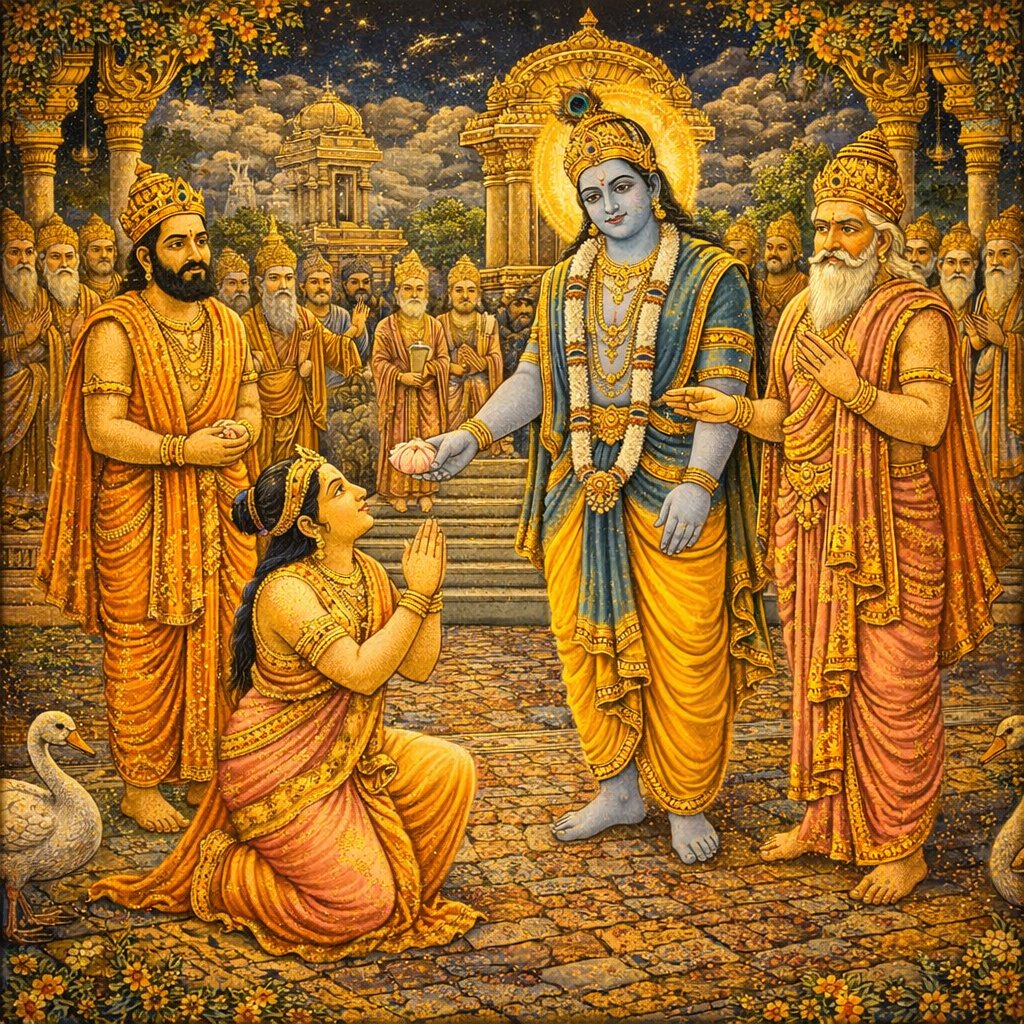
The Canto of Dynasties, Dharma, and the Rise of Sacred Lineages
चतुर्थ स्कन्धः (Caturtha Skandhaḥ)
Creation of the Fourth Order
Narrates the story of Daksha, Dhruva's penance, and the tale of King Prithu -- illustrating the principles of devotion, determination, and righteous rule.
Adhyayas in Chaturtha Skandha
Adhyaya 1
Genealogies of Svāyambhuva Manu, the Appearance of Yajña, and Atri’s Sons (Brahmā–Viṣṇu–Śiva Expansions)
Maitreya continues instructing Vidura by moving from earlier accounts of Svāyambhuva Manu to the concrete spread of lineages (vaṁśa). Manu’s daughters—Ākūti, Devahūti, and Prasūti—are married into prajāpati lines, establishing the social and cosmic network of progenitors. Ākūti and Ruci beget Yajña (Viṣṇu’s incarnation as the Lord of sacrifice) and Dakṣiṇā; Yajña later becomes Indra during this Manvantara, while his sons become the Tuṣitas. The narration then resumes Kardama’s daughters’ descendants, highlighting how sacred rivers and cosmic features (Devakulyā as the heavenly Gaṅgā source) are tied to divine contact. Vidura’s theological question about Atri’s three sons leads to Atri’s austerities and the simultaneous appearance of Brahmā, Viṣṇu, and Śiva, who explain their unity and grant partial expansions as Soma, Dattātreya, and Durvāsā. The chapter broadens into additional ṛṣi genealogies (Aṅgirā, Pulastya, Pulaha, Kratu, Vasiṣṭha, Bhṛgu) and culminates by returning to Dakṣa and Prasūti, setting up the coming Dakṣa–Śiva tension through Satī’s marriage and Dakṣa’s disrespect of Śiva—an immediate narrative bridge into the next developments.
Adhyaya 2
Dakṣa Offends Lord Śiva: Cursing and Countercursing in the Sacrificial Assembly
Vidura asks Maitreya to explain how Dakṣa—despite affection for Satī—became envious of Lord Śiva, and how the quarrel escalated to Satī’s eventual self-sacrifice (setting the trajectory for the later Dakṣa-yajña catastrophe). Maitreya recounts an ancient grand sacrifice where Dakṣa enters radiant and is honored by nearly all, except Brahmā and Śiva. Dakṣa interprets Śiva’s seated composure as disrespect and launches a public denunciation, attacking Śiva’s ascetic lifestyle and declaring him unfit for sacrificial shares. Dakṣa exits in anger. Nandīśvara, outraged, curses Dakṣa and the brāhmaṇas who tolerated the insult, condemning ritualism and materialistic Vedic interpretation that eclipses transcendental knowledge. Bhṛgu retaliates by cursing Śiva’s followers, branding their vows as atheistic deviations. Amid escalating sectarian hostility, Śiva remains silent, becomes morose, and leaves the arena with his attendants. The sacrifice continues for ages and concludes with avabhṛtha-snāna, but the unresolved offense foreshadows imminent devastation and Satī’s decisive response in the subsequent narrative arc.
Adhyaya 3
Satī Desires to Attend Dakṣa’s Sacrifice; Śiva Warns Against the Pain of Relatives’ Insults
Continuing the long-standing tension between Dakṣa and his son-in-law Śiva, the chapter opens with Dakṣa being empowered as chief of the Prajāpatis, which inflames his pride. He conducts grand sacrifices (vājapeya and bṛhaspati-sava), drawing ṛṣis, pitṛs, devas, and their ornamented wives from across the universe. Satī hears celestial talk and sees the procession of divine ladies traveling to her father’s yajña; stirred by familial affection and social expectation, she requests that Śiva accompany her to Dakṣa’s assembly, arguing that one may visit a father’s house even without invitation. Śiva replies with a sober ethic of association: visiting the envious invites harm, and wounds from relatives’ harsh words cut deeper than enemies’ arrows. He diagnoses Dakṣa’s blindness—pride in education, austerity, wealth, beauty, youth, and lineage—and contrasts bodily etiquette with transcendental respect offered to the Supersoul within all. Declaring his constant obeisance to Vāsudeva in pure consciousness, Śiva warns Satī that Dakṣa’s envy will translate into her humiliation, and that such insult from kin can become “equal to death,” setting the stage for the coming catastrophe at the sacrifice.
Adhyaya 4
Satī at Dakṣa’s Sacrifice: Condemnation of Blasphemy and Voluntary Departure by Yoga-Fire
After Lord Śiva warns Satī about Dakṣa’s hostile mentality, she wavers between filial affection and obedience to her husband. Overcome by longing and sorrow, she leaves for her father’s sacrifice despite Śiva’s counsel, escorted by Śiva’s gaṇas and royal-like paraphernalia. Entering the yajña arena, she finds the assembly intimidated by Dakṣa; only her mother and sisters welcome her, while Dakṣa pointedly neglects her and offers no share to Śiva. Satī’s grief turns to righteous fury: she denounces prideful fruitive ritualism, defends Śiva’s stainless character, and states the dharmic response to blasphemy of the Lord and the master of religion. Ashamed to bear a body received from an offender, she sits facing north, performs yogic concentration, meditates on Śiva’s lotus feet, and burns her body through inner fire. The universe resounds; observers lament Dakṣa’s hard-heartedness. Śiva’s attendants attempt retaliation, but Bhṛgu invokes Yajur-mantras; the Ṛbhus manifest and rout the gaṇas—setting up the next chapter’s escalation toward the destruction of Dakṣa’s sacrifice and the wider cosmic repercussions of Satī’s death.
Adhyaya 5
Vīrabhadra Destroys Dakṣa’s Sacrifice (Dakṣa-yajña-vināśa)
Hearing from Nārada of Satī’s death and the humiliation inflicted by Dakṣa, Lord Śiva erupts in controlled cosmic fury. From a blazing lock of his hair he manifests Vīrabhadra—an embodiment of wrath—commissioned to punish Dakṣa and disrupt the sacrificial assembly. As Vīrabhadra and Śiva’s gaṇas approach, ominous darkness and dust overwhelm the arena; the participants interpret the portents as dissolution-like catastrophe and Prasūti recognizes the crisis as the karmic consequence of Dakṣa’s offense against Satī and Śiva. The gaṇas storm the venue, dismantling the ritual infrastructure, terrorizing the assembly, and subduing key officiants and devas. Vīrabhadra humiliates Bhṛgu, blinds Bhaga, breaks the teeth of Dakṣa and Pūṣā, and finally beheads Dakṣa using the sacrificial apparatus itself—turning yajña’s instruments into the means of retribution. Dakṣa’s head is offered into the southern fire, the arena is burned, and Śiva’s party returns to Kailāsa—setting the stage for later reconciliation, restoration, and the theological resolution of offense, forgiveness, and the proper purpose of sacrifice.
Adhyaya 6
Brahmā Counsels the Demigods; Journey to Kailāsa; Śiva’s Tranquility and Brahmā’s Praise
In the wake of Dakṣa’s ruined sacrifice (carried over from the prior adhyāya), the wounded priests, assembly members, and devas—defeated by Śiva’s gaṇas—approach Brahmā in fear and report the events. Brahmā, who along with Viṣṇu had foreknown the outcome and therefore did not attend, diagnoses the root cause: blasphemy of a great personality makes yajña joyless and fruitless. He urges them to abandon reservation, surrender at Śiva’s feet, and beg pardon, stressing Śiva’s immeasurable power and his personal grief after Satī’s loss and Dakṣa’s harsh words. Brahmā leads them to Kailāsa, whose opulence and sanctity are described through its forests, rivers, birds, and celestial pleasures, culminating in the sight of Śiva seated in yogic composure beneath a vast banyan tree, surrounded by liberated sages. Śiva rises to honor Brahmā, and Brahmā begins a theological praise of Śiva as cosmic controller and the one who institutes sacrifice—setting the stage for reconciliation, restoration of limbs and life, and the completion of the interrupted yajña in the next movement of the narrative.
Adhyaya 7
Dakṣa’s Sacrifice Restored: Śiva’s Mercy and Nārāyaṇa’s Appearance
Following the devastation of Dakṣa’s yajña by Vīrabhadra (from the prior episode), Brahmā pacifies Śiva and requests restoration. Śiva, embodying kṣamā (forgiveness), declares remedial outcomes for the injured devas and priests and grants Dakṣa a goat’s head—turning punishment into correction. The assembly returns to the sacrificial arena; Dakṣa is revived, his envy cleansed, and he offers repentant prayers to Śiva, acknowledging Śiva’s role as protector of brāhmaṇical discipline and dharma. With Brahmā’s sanction, the rite resumes: the arena is purified and oblations offered. At the moment of proper sanctified offering, Viṣṇu appears as Nārāyaṇa on Garuḍa, eclipsing all other splendor. A cascade of prayers arises from multiple cosmic constituencies (devas, sages, Vedas, Agni, etc.), establishing Viṣṇu as yajña-personified and the ultimate shelter. Viṣṇu then teaches nonsectarian metaphysics: Brahmā, Śiva, and Viṣṇu are one in the impersonal sense, yet He remains the original Personality acting through guṇa-based functions. Dakṣa completes worship of all, order is restored, and the narrative closes by foreshadowing Satī’s rebirth as Pārvatī—linking this chapter to the next cycle of divine līlā and lineage history.
Adhyaya 8
Dhruva’s Humiliation, Sunīti’s Counsel, and Nārada’s Bhakti-Yoga Instruction
Maitreya first frames the moral genealogy of adharma—personified Irreligion and Falsity producing Bluffing, Cheating, Greed, Anger, Envy, Kali, Harsh Speech, Death, Fear, Pain, and Hell—establishing how inner vices propagate societal devastation. He then transitions to Svāyambhuva Manu’s descendants, focusing on King Uttānapāda, his queens Sunīti and Suruci, and their sons Dhruva and Uttama. Dhruva’s attempt to sit on his father’s lap is rejected; Suruci’s cutting words inflame the child’s kṣatriya pride, and the king’s silence deepens the wound. Sunīti redirects Dhruva from retaliation to refuge in Nārāyaṇa, explaining that even Brahmā and Manu achieved success by worshiping the Lord’s lotus feet. Nārada tests Dhruva with counsel on tolerance and karma, but Dhruva admits his ambition and requests a higher-than-anyone position. Nārada then gives precise sādhana: go to Madhuvana on the Yamunā, practice regulated yoga and meditation on Viṣṇu’s four-armed form, and chant the dvādaśākṣarī mantra “oṁ namo bhagavate vāsudevāya.” Dhruva departs for austerity; the remorseful king is consoled by Nārada. Dhruva’s escalating tapas shakes the cosmos, prompting the devas to appeal to the Lord, who promises to intervene—setting up the next chapter’s divine response.
Adhyaya 9
Dhruva’s Darśana, Transformative Prayers, and the Boon of the Dhruva-loka (Pole Star)
Following the Lord’s reassurance to the demigods, Viṣṇu rides Garuḍa to Madhuvana to meet Dhruva, whose meditation culminates when the internal vision suddenly ceases and the Lord appears directly. Dhruva’s ecstatic response moves from speechless awe to empowered articulation when the Lord touches his forehead with the conchshell, awakening conclusive Vedic understanding. Dhruva’s prayers progress from glorifying the Lord’s energies, Supersoul entry, and cosmic functions to self-critique of material desire, elevating the ideal of bhakti above brahmānanda and svarga. He begs chiefly for sādhu-saṅga, recognizing that devotion alone ferries one across saṁsāra. The Lord grants Dhruva the imperishable Dhruva-loka (polestar) and foretells future events—rule, sacrifices, family tragedies, and final ascent to the Lord’s abode. After the Lord departs, Dhruva returns home ashamed of his earlier ambitions. Vidura asks why he is not pleased; Maitreya explains Dhruva’s remorse, illustrating the bhakta’s purification. The chapter then transitions into Dhruva’s royal reception and Uttānapāda’s enthronement of Dhruva, setting the next narrative phase: righteous governance flowing from realized devotion and eventual renunciation by the elder king.
Adhyaya 10
Dhruva’s War with the Yakṣas and the Protection of the Holy Name
Following Dhruva’s earlier establishment as an exalted devotee-king, this chapter opens by situating him in gṛhastha life through marriage and progeny, extending the vaṁśa narrative. The plot turns when his younger brother Uttama is killed by a Yakṣa during a Himalayan hunt, and Suruci dies thereafter, intensifying Dhruva’s grief and wrath. Dhruva marches to Alakāpurī, the Yakṣa city associated with Śiva’s followers, and initiates battle with his conchshell. He devastates the Yakṣa forces despite their massive numbers and weapon-shower, reasserting kṣatriya prowess. When the surviving Yakṣas resort to māyā—illusory storms, bloody rains, falling bodies, serpents, beasts, and a cosmic-dissolution-like ocean—Dhruva is portrayed as challenged not merely militarily but psychologically and spiritually. Sages then intervene with auspicious instruction: invoke Śārṅgadhanvā (Viṣṇu) and rely on the holy name, which protects devotees from fearful death. The chapter thus bridges toward the next stage: Dhruva’s restraint and reorientation under saintly counsel, transforming vengeance into devotion-guided action.
Adhyaya 11
Dhruva Uses the Nārāyaṇāstra; Manu Checks His Wrath and Teaches Dharma
Following Dhruva’s campaign against the Yakṣas after Uttama’s death, this chapter opens with Dhruva, encouraged by sages, performing ācamana and deploying the nārāyaṇāstra, which instantly dispels Yakṣa illusion. Empowered, he releases devastating arrows and slaughters many Yakṣas—extending punishment beyond the actual offenders. Svāyambhuva Manu arrives with sages, intervening compassionately to halt Dhruva’s excessive anger. Manu instructs that uncontrolled wrath leads to hellish consequences, violates righteous family conduct, and contradicts the devotional path that forbids bodily identification and needless killing. He then gives a sustained metaphysical teaching: creation and destruction occur through the Lord’s māyā and the guṇas; the Lord is transcendent yet operates as time, neutrally awarding karmic results. The Yakṣas are not the true cause of Uttama’s fate; ultimate causality rests in the Supreme. Manu urges surrender, restoration of Dhruva’s original spiritual vision, and the practical step of pacifying Kuvera to prevent further offense. The chapter closes with Dhruva offering respects as Manu and the sages depart, setting up Dhruva’s reconciliation and the cooling of conflict in the next narrative movement.
Adhyaya 12
Dhruva’s Benediction from Kuvera and His Ascension to Viṣṇuloka (Dhruvaloka)
Following the prior episode of Dhruva’s fierce retaliation against the Yakṣas, this chapter turns the narrative from kṣatriya anger to Vaiṣṇava restraint: Dhruva’s wrath subsides under counsel, and Kuvera appears to bless him. Kuvera reframes the conflict through the doctrine of kāla—time as the Lord’s instrument—exposing bodily “I/you” misidentification as the root of saṁsāra. Dhruva then chooses a distinctly devotional benediction: unwavering faith and remembrance of Bhagavān, the means to cross the ocean of nescience. The text moves from Dhruva’s righteous reign and sacrifice-oriented household life to his growing realization of the world as māyā-like dream, prompting renunciation and yogic absorption at Badarikāśrama. In trance, liberation symptoms arise, and Viṣṇu’s associates Nanda and Sunanda arrive with a divine airplane to take him to Viṣṇuloka—an attainment portrayed as unprecedented. Dhruva’s triumph over death, concern for his mother Sunīti (who is also granted passage), and his passage beyond the saptarṣi-lokas culminate in the establishment of Dhruvaloka and the chapter’s śravaṇa-phala: hearing Dhruva-kathā grants purification, prosperity, and bhakti, especially when recited selflessly on auspicious days—setting the stage for subsequent dynastic continuations centered on the Pracetās and further vaṁśānucarita.
Adhyaya 13
Dhruva-vaṁśa Continuation: Utkala’s Renunciation, Aṅga’s Sacrifice, and the Birth of Vena (Prelude to Pṛthu)
Following Dhruva Mahārāja’s departure to Viṣṇu’s abode, Vidura—moved by devotion—asks Maitreya about the Pracetās and Nārada’s glorification of Dhruva, creating a bridge from Dhruva’s personal bhakti to the broader royal lineage narrative. Maitreya first traces Dhruva’s succession: Utkala refuses the throne, absorbed in Brahman-realization and bhakti-yoga, appearing mad to the worldly; thus Vatsara becomes king and the dynasty proceeds through descendants up to Cākṣuṣa Manu and his line, culminating in Aṅga and the birth of Vena. The chapter then pivots from genealogy to crisis: Aṅga’s aśvamedha fails because the demigods do not accept offerings, revealing karmic impediments—specifically, Aṅga’s lack of a son. By directing the sacrifice to Hari (Viṣṇu), the priests obtain divine prasāda that produces a son, yet Vena grows cruel and irreligious, driving Aṅga to renounce kingdom and home. The citizens’ grief and the sages’ assembly set the immediate narrative runway for Vena’s reign, his confrontation with brāhmaṇas, and ultimately the emergence of Pṛthu in the next sequence.
Adhyaya 14
King Vena’s Tyranny, the Sages’ Counsel, and the Birth of Niṣāda
With King Aṅga absent and social order weakening, Bhṛgu and other sages install Vena under Queen Sunīthā’s consent, despite ministerial misgivings. Vena’s harsh rule initially terrifies criminals, but his newfound opulence inflames pride and he suppresses sacrifice and charity, halting yajña across the realm. Seeing citizens trapped between royal irresponsibility and resurgent thieves, the sages deliberate: they enthroned Vena for protection, yet he has become the threat. They approach him diplomatically, teaching that a king gains legitimacy by protecting subjects and enabling varṇāśrama and Viṣṇu-worship through sacrifice. Vena rejects their counsel, claims the king is the supreme worshipable, and insults devotion to Viṣṇu and the devas. The sages, concluding he will burn the world through adharma, kill him by potent mantric words. After his death, disorder erupts; thieves plunder. The sages decide governance must continue through Aṅga’s line and churn Vena’s body, producing the dark dwarf Bāhuka, named Niṣāda, who absorbs Vena’s sins—setting the narrative bridge toward the emergence of a righteous successor (Pr̥thu) and restoration of dharma.
Adhyaya 15
The Appearance and Coronation of King Pṛthu (Pṛthu-avatāra) and His Humble Refusal of Premature Praise
Following the downfall and death of the irreligious King Vena (previous arc), the brāhmaṇas and sages churn Vena’s body to extract a divinely ordained resolution for the kingdom’s crisis. From his arms manifest a male-female pair—Pṛthu and Arci—recognized as partial expansions: Pṛthu as an empowered manifestation of Viṣṇu’s ruling potency and Arci as a partial manifestation of Śrī (Lakṣmī), ensuring dharma and prosperity re-enter the world together. Cosmic celebration follows: Gandharvas sing, Siddhas shower flowers, and Brahmā arrives, verifying Pṛthu’s avatāric identity through auspicious bodily signs (Viṣṇu-lakṣaṇas) such as the cakra marking on the palm and lotus marks on the feet. The brāhmaṇas arrange the coronation, and all strata of creation—from rivers and mountains to demigods—offer royal gifts (weapons, insignia, knowledge-armor, opulences), establishing Pṛthu as universal sovereign. Yet when professional bards (sūta, māgadha, vandī) praise him, Pṛthu checks flattery: he rejects attributing unmanifest virtues to a human ruler and redirects praise toward the Supreme until his deeds truly warrant acclaim—setting the ethical tone for his forthcoming governance (next chapter arc: his active kingship and restoration of prosperity).
Adhyaya 16
The Sūtas Foretell the Glories and Future Deeds of King Pṛthu
Maitreya narrates how the reciters (sūtas/bandīs), delighted by Pṛthu’s humility, renew their praise with elevated prayers. They declare him a direct empowerment of Viṣṇu and admit that even Brahmā and the devas cannot fully describe his greatness, yet they speak as instructed by realized sages. Their eulogy outlines Pṛthu’s forthcoming reign: he will protect dharma, chastise irreligion, administer like the devas through departmental order, and balance taxation with benevolent redistribution—likened to the sun’s evaporation and rainfall cycle. He will be tolerant like earth, neutral like air, and impartial in justice even toward friend and foe. His influence will extend across the globe; rogues will hide at his approach. The prophecy also foreshadows key plot points that lead into subsequent chapters: Pṛthu’s world-conquest, his ‘milking’ of the Earth for prosperity, his performance of one hundred aśvamedhas (with Indra’s theft of the horse), and his meeting with Sanat-kumāra, from whom he will receive liberating instruction—transitioning the narrative from royal conquest to spiritual culmination.
Adhyaya 17
Pṛthu Pursues the Earth and the Earth Takes the Form of a Cow (Bhūmi as Gauḥ)
After bards and reciters glorify Pṛthu’s virtues, the king honors all social orders—brāhmaṇas, administrators, priests, citizens, and dependents—signaling a stable rājarṣi polity. Vidura then presses Maitreya for specific theological and narrative clarifications: why Bhūmi assumes the form of a cow, how the earth was leveled, why Indra stole the sacrificial horse, and how Pṛthu attained his ultimate destination after instruction from Sanat-kumāra. Maitreya resumes the history: at Pṛthu’s enthronement, famine afflicts the populace; citizens approach him as their divinely empowered protector, begging for food and livelihood. Investigating the cause, Pṛthu angrily confronts the earth for withholding grains. Terrified, Bhūmi flees through the cosmos, taking the form of a cow, yet cannot escape. When she surrenders, she argues from dharma (nonviolence to women), cosmic dependence (earth as the boat holding all beings), and theology—recognizing Pṛthu as the Supreme’s empowered presence, untouched by guṇas. This chapter sets up the next movement: rather than destruction, a dhārmic solution—milking the earth properly—so prosperity returns under righteous governance.
Adhyaya 18
Pṛthu Mahārāja Milks the Earth (Bhūmi-dugdha) and Organizes Human Settlement
Continuing from the prior confrontation where Pṛthu pursues the earth for withholding produce, this chapter opens with Bhūmi-devī’s appeal: she asks the king to restrain anger and to hear the śāstric rationale behind scarcity. She explains that irreligious rulers and consumers misuse grains for sense gratification and neglect yajña, so she concealed seeds meant for sacrifice; the remaining stock has deteriorated and must be restored by the standard process taught by ācāryas. She then gives the practical method—bring a suitable calf, vessel, and milker—so the earth, affectionate to her calf, will yield ‘milk’ as grains and nourishment. Pṛthu accepts, milks the earth using Svāyambhuva Manu as calf, and others follow, each extracting their desired essence (Vedic knowledge, soma, liquor, music, kavya, siddhis, poison, grasses, flesh, juices, minerals) through appropriate calves and pots, illustrating regulated reciprocity with nature. Satisfied, Pṛthu levels the globe, enabling water retention and agriculture, and then plans settlements—villages, towns, forts, pastures, mines—instituting orderly civilization. The narrative thus bridges from crisis and coercion to cooperative dharma-based prosperity, setting up the next developments in Pṛthu’s reign and its societal outcomes.
Adhyaya 19
Indra’s Envy at Pṛthu’s Aśvamedha and Brahmā’s Intervention (False Renunciation Exposed)
Continuing the Pṛthu-carita, Maitreya describes how King Pṛthu conducts aśvamedha-yajñas at Brahmāvarta on the Sarasvatī, drawing Lord Viṣṇu and the cosmic assembly of devas, sages, siddhas, gandharvas, and associates like Nanda and Sunanda. The yajña generates visible prosperity—rivers, trees, cows, oceans, and hills yield abundance—signaling dharmic alignment with Adhokṣaja. Indra, fearing Pṛthu’s surpassing fame and merit, repeatedly steals the sacrificial horse, disguising himself as various “renunciants,” thereby introducing deceptive pseudo-sannyāsa forms that later mislead society. Pṛthu’s son pursues Indra but hesitates to kill him due to the religious appearance; he is honored as Vijitāśva for his prowess. When Pṛthu himself prepares to punish Indra, the priests attempt to invoke mantras to destroy him, but Lord Brahmā arrives and forbids violence, warning that further conflict will multiply irreligious systems. Brahmā advises Pṛthu to stop at ninety-nine sacrifices, emphasizing liberation over rivalry. Pṛthu accepts, makes peace with Indra, concludes the yajña rites, bathes, rewards brāhmaṇas, and receives universal blessings—setting the stage for later reflections on dharma beyond ritual competition.
Adhyaya 20
Lord Viṣṇu Instructs Pṛthu: Forgiveness, Ātmā-Deha Viveka, and the Bhakti Ideal of Kingship
After the tension surrounding Indra’s disruption of Pṛthu’s hundredth aśvamedha, Bhagavān Viṣṇu personally appears with Indra to resolve the conflict and protect dharma. Viṣṇu asks Pṛthu to forgive Indra, reframing true greatness as nonmalice, equipoise, and clear discrimination between body and soul. He teaches that a ruler devoted to Him—acting without motive for gain—becomes internally satisfied, sees equally, and remains unagitated by happiness and distress. Viṣṇu then defines the king’s occupational duty: protection of citizens under brāhmaṇical guidance and paramparā-based dharma; taxation without protection is condemned. Pleased, Viṣṇu offers Pṛthu a boon, but Pṛthu’s prayers reject material benedictions and even sāyujya, begging instead for endless capacity to hear the Lord’s glories from pure devotees. Viṣṇu blesses him with steadfast devotional service and instructs careful obedience to divine order. The chapter closes with worship, reconciliation, and Viṣṇu’s departure—setting the stage for Pṛthu’s continued reign grounded in bhakti and humility.
Adhyaya 21
Pṛthu Mahārāja’s Homecoming, Sacrificial Assembly, and Instruction on Devotional Kingship
Maitreya narrates to Vidura how Pṛthu returns to his capital amid elaborate maṅgala decorations and public स्वागत (welcome), yet remains internally unaffected—signaling detachment amid opulence. Vidura, hearing Pṛthu’s fame and divine empowerment from Viṣṇu, requests further narration of his exemplary rule. Maitreya situates Pṛthu between Gaṅgā and Yamunā and describes his unrivaled sovereignty, then introduces a great sacrifice where sages, brāhmaṇas, demigods, and rājarṣis assemble. Pṛthu’s regal and auspicious form is detailed as he accepts initiation and follows ritual discipline. He then delivers a programmatic address: the king must guide citizens in varṇa–āśrama duties, for a ruler shares karmic outcomes with those he directs and those who support his governance. Pṛthu establishes theism as the rational and Vedic conclusion, teaches bhakti as the cleansing process, and elevates service to brāhmaṇas and Vaiṣṇavas above mere fire-sacrifice. The assembly blesses him, noting how a virtuous son can deliver even sinful fathers, setting the stage for subsequent developments in Pṛthu’s sacrificial narrative and the continuing demonstration of ideal rājarṣi leadership.
Adhyaya 22
Pṛthu Mahārāja Meets the Four Kumāras: Bhakti as the Boat Across Saṁsāra
As Pṛthu’s citizens praise him, the four Kumāras descend, recognized by their effulgence and siddhi. Pṛthu rises with urgency, receives them per śāstra, worships them, and honors caraṇāmṛta as the exemplary standard for welcoming advanced devotees. He glorifies the presence of brāhmaṇas and Vaiṣṇavas as the true sanctifier of household life, contrasting it with opulent homes devoid of devotees. Pṛthu then asks the Kumāras—friends of the conditioned—how those burned by material existence can swiftly reach life’s ultimate goal. Sanat-kumāra replies that steadfast attachment to Bhagavān’s lotus feet, cultivated through bhakti-yoga (inquiry, worship, śravaṇa-kīrtana) and avoidance of sense-driven association, uproots lust and karmic knots. He analyzes mind-agitation, loss of memory, and the futility of artha-kāma fixation, urging serious pursuit of mokṣa through surrender to Paramātmā. Pṛthu offers everything to the sages; they bless and praise him, and the chapter transitions into Pṛthu’s continued rule as a detached, prosperous, devotional monarch, setting the stage for his exemplary reign to be further described.
Adhyaya 23
Pṛthu Mahārāja’s Renunciation, Austerities, Departure, and the Glory of Hearing His History
As the Pṛthu narrative approaches its conclusion, the king—seeing old age—transfers responsibility and distributes accumulated opulence across all beings, establishing orderly support according to dharma and entrusting his heirs to the Earth (personified as his daughter). Leaving behind grieving citizens, he enters the forest with Queen Arci and rigorously adopts vānaprastha disciplines. His tapas escalates from austere diet to breath-control, not for mystic display but solely for Kṛṣṇa’s satisfaction, culminating in unwavering bhakti, Paramātmā-realization, and the abandonment of ancillary yoga/jñāna aims. At death, Pṛthu fixes his mind on Kṛṣṇa’s lotus feet and performs a yogic withdrawal, merging the elements and relinquishing designations—depicting a Bhāgavata-inflected ‘return’ grounded in devotion. Arci, embodying pativratā-dharma, performs the final rites and enters the funeral fire, praised by celestial women. The chapter closes with Maitreya’s phala-śruti: hearing, reciting, and teaching Pṛthu’s character grants spiritual elevation and strengthens devotion—setting a transition toward subsequent dynastic and instructive narrations after Pṛthu’s departure.
Adhyaya 24
Lord Śiva Instructs the Pracetās (Śiva-stuti and the Path of Bhakti)
This chapter advances the post-Pṛthu lineage: Vijitāśva (Antardhāna) assumes imperial rule, assigns the quarters to his brothers, and—despite royal power—shows restraint toward Indra and reluctance to punish, ultimately retiring into sacrifice and attaining the Lord’s abode through intelligent devotional service. His son Havirdhāna begets Barhiṣat, later famed as Prācīnabarhi for spreading kuśa grass in sacrifices. Ordered by Brahmā, Prācīnabarhi marries Śatadruti and fathers ten sons, the Pracetās, who are commissioned to generate progeny. On their westward journey they encounter a vast, lotus-filled lake resonant with celestial music; from its waters emerges Lord Śiva with associates. Pleased by their piety, Śiva reveals his devotion to Kṛṣṇa/Viṣṇu, teaches the supremacy of surrendered bhakti over demigod promotion, and recites a powerful stotra describing the Lord’s cosmic functions, expansions (Saṅkarṣaṇa, Pradyumna, Aniruddha), and exquisite personal form cherished by devotees. He instructs the Pracetās to chant and meditate on this prayer as their yogic method, promising swift perfection and freedom from karma, setting up their long austerities and the next phase of creation through devotion.
Adhyaya 25
Nārada Instructs Prācīnabarhiṣat: The Purañjana Narrative Begins (City of Nine Gates)
After Lord Śiva blesses the Pracetās and disappears, the princes remain in water for ten thousand years, continuously reciting Śiva’s prayers. Meanwhile, their father King Prācīnabarhiṣat intensifies fruitive sacrificial performances. Seeing the king’s karmic entanglement and the violence implicit in his yajñas, Nārada approaches out of compassion, challenging the very premise that ritual action can deliver freedom from misery and lasting happiness. He warns the king by revealing the sacrificed animals awaiting vengeance—an ethical and karmic critique meant to awaken vairāgya. To redirect the king toward ātma-tattva, Nārada introduces an ancient allegory: King Purañjana and his enigmatic friend Avijñāta. Purañjana wanders seeking fulfillment, finds a splendid city with nine gates, and meets a captivating woman guarded by a five-hooded serpent; she offers him a century of sense enjoyment. The chapter establishes the allegorical architecture (body, senses, mind, prāṇa, companions) and depicts the jīva’s increasing captivity through identification and imitation. This sets up the next chapters to decode the city’s gates, the king’s movements, and the consequences of absorption in household enjoyment.
Adhyaya 26
Purañjana Goes Hunting — The Chariot of the Body, Violence of Passion, and Return to Conjugal Bondage
Continuing Nārada’s allegorical instruction to King Prācīnabarhiṣat, this chapter opens with a dense symbolic description of King Purañjana’s chariot-journey to the forest Pañca-prastha—an encoded portrait of embodied life: body, senses, mind, prāṇas, and the guṇic apparatus that carries the jīva into experience. Overcome by rājasic-tāmasic impulse, Purañjana leaves his queen and hunts, killing animals mercilessly; Nārada inserts a dharma-clarification that śāstra regulates animal-killing within sacrificial limits to curb passion and ignorance, while whimsical violence binds one to karma and repeated birth. Exhausted, the king returns, refreshes himself, and becomes Cupid-struck, seeking his queen as the source of domestic satisfaction. Finding her lying like a mendicant, he is bewildered and begins elaborate appeasement—touching her feet, flattering, offering protection, and confessing offense for hunting without her consent. The chapter thus bridges the allegory from outward sense-expansion (forest enjoyment/violence) to inward dependence on “queen” (intelligence/attachment), setting up the next movement where the deeper meanings of queen, city, and bondage will be further unpacked.
Adhyaya 27
Purañjana Captivated by Lust; Time (Caṇḍavega) and Old Age (Kālakanyā) Begin the Siege
Continuing Nārada’s allegorical instruction to King Prācīnabarhiṣat, the chapter depicts King Purañjana’s deepening entanglement in conjugal attachment: captivated by his queen, he loses discrimination and fails to perceive that days and nights are silently reducing his lifespan. Absorbed in sense pleasure and fruitive religiosity, he begets an enormous progeny and becomes further bound by possessions, family expansion, and karma-kāṇḍa sacrifices tinged with violence. The narrative then pivots from domestic illusion to cosmic inevitability: Caṇḍavega, the Gandharva king (symbolizing the marching days), with 360 soldiers and their female counterparts (days and nights), repeatedly plunders the city of enjoyment. The city’s five-hooded serpent protector resists for ‘one hundred years’ but weakens—signaling the fading life-air and bodily defenses. As death approaches, Old Age—Kālakanyā, daughter of Time—enters the three worlds seeking a husband, is rejected by all, and finally joins the Yavana king Bhaya (Fear). Their alliance, with Prajvāra (fever) and soldiers, sets the stage for the next chapter’s intensified assault on Purañjana’s city-body and the inevitable collapse of material security.
Adhyaya 28
The Fall of Purañjana and the Supersoul as the Eternal Friend (Purañjana-Upākhyāna Culmination)
Continuing Nārada’s instruction to King Prācīnabarhiṣat, the allegory reaches its crisis: Yavana-rāja (fear/death) and Kālakanyā (Time/old age) invade Purañjana’s city (the body), exhausting its pleasures and turning the ‘citizens’ (faculties/relations) against him. The serpent-guardian (prāṇa/life-air) is weakened and forced out as the city is burned by Prajvāra (fever) and dismantled—signifying bodily collapse. Bound and dragged away, Purañjana fails to remember his true well-wisher, the Paramātmā, and suffers karmic reactions (the sacrificed animals torment him). Dying absorbed in his wife (material attachment), he takes rebirth as a woman (Vaidarbhī) and later becomes the devoted wife of Malayadhvaja, who renounces and attains steady bhakti through austerity and discrimination between jīva and Supersoul. After his departure, the grieving queen is instructed by an old brāhmaṇa—revealed as the Supersoul, the swan-companion in the heart—who explains the “city of nine gates” and concludes the indirect teaching. The chapter thus transitions from bondage under Time to liberation through remembrance and right identity, preparing Prācīnabarhiṣat for renunciation and bhakti-oriented action.
Adhyaya 29
Nārada Explains the Allegory of King Purañjana (Deha–Indriya–Manaḥ Mapping and the Remedy of Bhakti)
Responding to King Prācīnabarhi’s inability to grasp the Purañjana allegory, Nārada systematically decodes the narrative into a map of embodied existence: the jīva as Purañjana, the “unknown friend” as Bhagavān, and the human/deva body as the nine-gated city where the senses, mind, prāṇas, and intelligence cooperate in enjoyment and suffering. He identifies each ‘gate’ and ‘city’ with sensory functions and objects, then expands the allegory into a chariot model of the body driven by intelligence and bound by mind-rope, with time (Caṇḍavega) eroding lifespan through day and night and old age (Kālakanyā/Jarā) allied with death. Nārada critiques karma-kāṇḍa pride and shows that merely reshuffling activities cannot undo karma; only awakening through Kṛṣṇa consciousness—especially hearing and associating with devotees—ends the dream of saṁsāra. Prācīnabarhi accepts the correction, inquires into karmic continuity across bodies, and Nārada explains subtle-body transmigration via mind, impressions, and desire. The chapter closes with the king’s renunciation and liberation, and a phala-śruti promising freedom from bodily identification for attentive hearers—transitioning from allegory to lived transformation.
Adhyaya 30
The Pracetās Meet Lord Viṣṇu—Benedictions, Pure Prayer, and the Birth of Dakṣa
Vidura asks Maitreya what the Pracetās gained by chanting Śiva’s prayer and satisfying Viṣṇu. Maitreya recounts their ten-thousand-year austerity in the ocean and the Lord’s appearance on Garuḍa in an eight-armed, effulgent form. Pleased especially by their mutual friendship and single-minded bhakti, Viṣṇu offers benedictions: fame, the future birth of an extraordinary son, and long enjoyment of worldly and heavenly facilities—followed by inevitable purification into unalloyed devotion and return to Godhead. The Pracetās respond with a theology-rich stuti (praise), asking not for wealth but for the Lord’s satisfaction and continued association with devotees life after life, extolling saṅkīrtana and the incomparable value of sādhu-saṅga. After the Lord departs, the brothers emerge to find the earth overrun by trees; in anger they burn them with fire and air from their mouths. Brahmā pacifies them; the remaining trees offer Māriṣā, whom the Pracetās marry. From her is born Dakṣa (a rebirth due to offense to Śiva), who resumes population work—setting up the next narrative arc concerning progeny, ritual power, and its purification.
Adhyaya 31
Nārada Instructs the Pracetās: Bhakti as the Goal of All Paths
After completing their long household tenure and cultivating realized knowledge, the Pracetās remember the Lord’s blessings and renounce, entrusting their wife to the care of a qualified son (v.1). They proceed to the western seashore near the liberated sage Jājali and perfect an equal vision toward all beings, deepening Kṛṣṇa consciousness (v.2). Engaged in yogic discipline—āsana, prāṇāyāma, and restraint of mind, speech, and senses—they become free from attachment, at which point Nārada arrives (v.3–4). The Pracetās honor him and confess that family absorption made them nearly forget prior instructions from Śiva and Viṣṇu, requesting torchlight knowledge to cross ignorance (v.5–7). Nārada replies that a life becomes perfect only when dedicated to devotional service; even ‘three births’ (biological, initiation, and Viṣṇu-worship eligibility) and exalted spiritual disciplines are useless without Hari-bhakti (v.9–13). He illustrates the Lord as the root that satisfies all devas (v.14) and explains emanation and re-entry of the cosmos into the Lord, stressing simultaneous difference and non-difference and the Lord’s transcendence over guṇas (v.15–18). He then prescribes mercy, contentment, and sense-restraint as quick means to please Janārdana, describing the Lord’s intimate reciprocity with pure devotees and His indifference to proud materialists (v.19–22). Nārada departs; the Pracetās attain firm attachment and advance to the supreme destination (v.23–24). The frame narrative closes: Maitreya finishes for Vidura; Śukadeva transitions to Priyavrata’s descendants, and Vidura departs for Hastināpura, with a śravaṇa-phala promising worldly and ultimate benefits to hearers (v.25–31).
Frequently Asked Questions
Because Vaṁśa and Vaṁśānucarita are core Bhāgavatam subjects: they show how cosmic creation becomes historical society under dharma. The genealogies also locate avatāras, ṛṣis, and rulers within time, demonstrating that devotion and right conduct (dharma) are transmitted through exemplary lives, not merely abstract doctrine.
Skandha 4 repeatedly identifies the Lord as the inner controller and beneficiary of sacrifice. The appearance of Yajña (a name of Viṣṇu) teaches that ritual order is meant to culminate in remembrance and service of the Supreme, and that cosmic administration (including Indra-ship) is ultimately empowered by the Lord.
Prajāpatis are progenitors appointed to generate and regulate populations. In Skandha 4, figures like Ruci and Dakṣa anchor the spread of living beings across the three worlds, and their narratives illustrate how creation is guided by brahminical austerity, vows, and divine sanction rather than mere material causality.