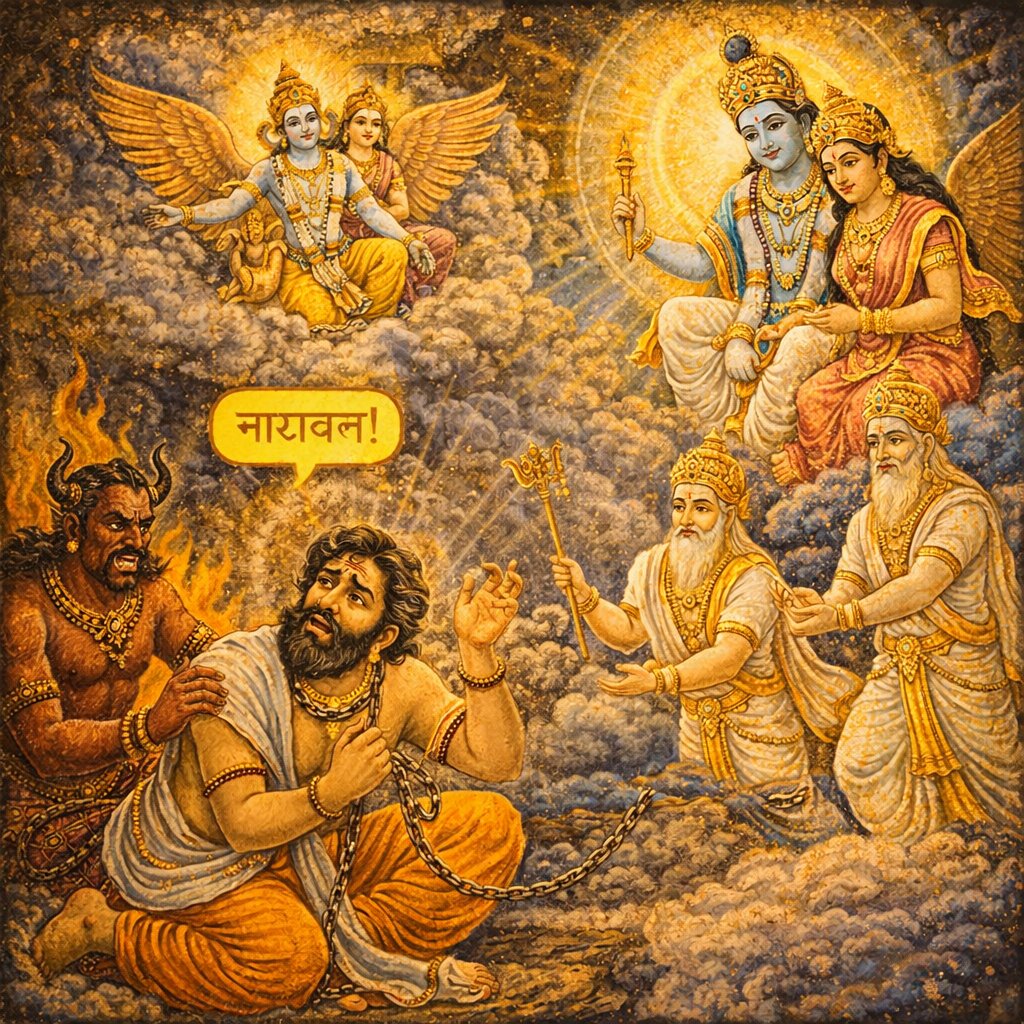
Canto 6 — Atonement, the Holy Name, and the Supremacy of Bhakti over Karma
Ṣaṣṭha-skandha
Prescribed Duties
Contains the stories of Ajamila's deliverance, Daksha's prayers, Vritra's devotion, and the Maruts -- emphasizing the power of the holy name and devotional surrender.
Adhyayas in Shashtha Skandha
Adhyaya 1
Prāyaścitta, the ‘Elephant Bath’ Problem, and the Opening of Ajāmila-Upākhyāna
Parīkṣit Mahārāja recapitulates Śukadeva’s prior teachings on nivṛtti-mārga, pravṛtti-mārga, manvantara accounts, and hellish destinations, then presses a practical question: how can humans be saved from naraka? Śukadeva initially answers in the idiom of dharma-śāstra—impious acts must be counteracted by prescribed atonement before death, proportionate to the sin, like medical treatment. Parīkṣit then raises a decisive objection: people knowingly sin again even after atonement; such prāyaścitta resembles the ‘elephant bath’ (washing then re-soiling). Śukadeva agrees, critiquing fruitive atonement as unable to uproot the tendency (vāsanā) and identifies real atonement as enlightenment culminating in devotion. He distinguishes temporary purification through disciplines (brahmacarya, self-control, charity, truthfulness, cleanliness, nonviolence, and nāma-kīrtana) from the complete eradication achieved by unalloyed bhakti. The chapter then transitions into the Ajāmila history: a learned brāhmaṇa falls through lust and association, lives sinfully, and at death cries “Nārāyaṇa,” triggering the arrival of Viṣṇudūtas who stop the Yamadūtas—setting up the ensuing theological debate on dharma, sin, and the holy name in the next chapter.
Adhyaya 2
Ajāmila Delivered: Viṣṇudūtas Establish the Supremacy of the Holy Name
Following the prior crisis of Ajāmila’s arrest at death, this chapter opens with Śukadeva presenting the Viṣṇudūtas as expert in śāstric logic. They challenge the Yamadūtas for attempting to punish one who has become “unpunishable” through contact with Hari-nāma, warning that corrupted justice destabilizes society because citizens imitate leaders. The Viṣṇudūtas then articulate a graduated theology of purification: ritual prāyaścitta may counter reactions but fails to uproot desire, whereas chanting Viṣṇu’s name—even indirectly, jokingly, or unknowingly—burns sins like fire and awakens bhakti by remembrance of the Lord’s fame, qualities, and pastimes. They cite Ajāmila’s repeated utterance of “Nārāyaṇa” (calling his son) and his final helpless cry at death as sufficient atonement across countless lives. Convinced, the Yamadūtas withdraw and report to Yamarāja. Ajāmila, freed, repents, renounces lust and bodily identification, goes to Haridwar, practices bhakti-yoga, attains a spiritual body, and is escorted to Vaikuṇṭha—setting up the next movement: the broader doctrinal implications of nāma and dharma under Yamarāja’s governance.
Adhyaya 3
Yamarāja Instructs the Yamadūtas: Supreme Authority, Mahājanas, and the Glory of the Holy Name
Following the Viṣṇudūtas’ intervention in Ajāmila’s arrest attempt, Parīkṣit asks Śukadeva to resolve the unprecedented puzzle: how can Yamarāja’s order be thwarted. The Yamadūtas, astonished and unsettled, question their master about the true structure of cosmic governance and the identity of the four radiant protectors. Yamarāja responds by re-centering authority in the Supreme Personality of Godhead, above all devas and administrators, and explains that the Lord’s Vedic injunctions bind beings like ropes. He identifies the Viṣṇudūtas as rare, Viṣṇu-like guardians who protect devotees even from his jurisdiction. He then defines real dharma as Bhagavān’s enactment, known through the twelve mahājanas, and declares bhāgavata-dharma—devotion beginning with chanting—as the ultimate principle. Ajāmila’s accidental utterance of “Nārāyaṇa” becomes the paradigm: nāma can uproot sin and grant liberation when free from offense. Yamarāja orders his servants to avoid surrendered Vaiṣṇavas and to bring only those averse to Kṛṣṇa’s name and service. The chapter closes with the Yamadūtas’ transformed fear of devotees and a pointer to further confidential transmission (Agastya’s instruction), carrying the narrative toward deeper implications of nāma, aparādha, and devotional eligibility.
Adhyaya 4
Soma Pacifies the Pracetās; Dakṣa’s Haṁsa-guhya Prayers; Hari Grants Creative Power
Responding to Parīkṣit’s desire to hear visarga (secondary creation) in detail, Śukadeva links earlier creation accounts to the Pracetās’ return from long austerities. Seeing the earth overrun by trees, the Pracetās erupt in anger and unleash fire and wind to burn the forests. Soma, as lord of vegetation and moon-deity, intervenes: he reframes kingship as protection of all prajā—including trees—and teaches a dharmic ecology grounded in Paramātmā’s presence in moving and nonmoving beings. He offers Māriṣā, raised by the trees, and from her the Pracetās beget Dakṣa, who will populate the worlds. Dakṣa first creates mentally but, finding it insufficient, performs severe tapas at Aghamarṣaṇa and offers the Haṁsa-guhya prayers, stressing the Lord’s transcendence beyond guṇas and material pramāṇas, yet immanence as Supersoul. Pleased, Hari appears in majestic eight-armed form, instructs Dakṣa on creation’s purpose, gives him Asiknī as wife, and empowers procreation—setting up the next phase of genealogies and population expansion.
Adhyaya 5
Nārada Instructs Dakṣa’s Sons; Allegory of the World; Dakṣa Curses Nārada
Continuing the Prajāpati line within visarga (secondary creation), Dakṣa fathers the Haryaśvas and orders them to increase progeny. They travel west to the tīrtha Nārāyaṇa-saras (Sindhu’s meeting with the sea) and, through austerity and purification, become inclined to paramahaṁsa-life. Nārada arrives and speaks a deliberate allegory—‘the one man,’ ‘the unchaste woman,’ ‘the two-way river,’ ‘the house of twenty-five,’ ‘the haṁsa,’ and ‘time like razors’—to redirect their intelligence from fruitive expansion to liberation. The Haryaśvas decode each symbol as metaphysics: the Supreme Enjoyer, māyā-buddhi, prakṛti’s cycles, the tattvas, śāstra-discrimination, and kāla. Accepting Nārada as guru, they depart on the path of no return. Dakṣa produces a second set (Savalāśvas) who repeat the tapas at the same tīrtha; Nārada’s brief instruction—follow your elder brothers—leads them also to renunciation and bhakti. The chapter closes with Dakṣa’s grief and anger: he accuses Nārada of prematurely inducing vairāgya, invokes the ‘three debts’ (to devas, ṛṣis, and pitṛs), and curses Nārada to have no fixed residence—accepted by the tolerant sage. This sets up the next narrative tension: Dakṣa’s continued role in creation and the consequences of offenses toward a mahā-bhāgavata.
Adhyaya 6
Dakṣa’s Daughters, Cosmic Lineages, and the Population of the Three Worlds
Continuing the canto’s movement from moral governance (Yama’s domain) into cosmic administration (visarga), Śukadeva narrates how, at Brahmā’s request, Prajāpati Dakṣa (Prācetasa) begets sixty daughters in Asiknī and distributes them in marriages that become channels of secondary creation. Ten daughters marry Dharmarāja (Yamarāja), generating lineages such as the Mauhūrtikas and the eight Vasus; the chapter details their spouses and progeny, including notable figures like Upendra (Jayanta) and Viśvakarmā, and identifies expansions of the Supreme (e.g., Śiśumāra). The account then turns to other prajāpatis—Aṅgirā and Kṛśāśva—and to Kaśyapa’s wives (Vinatā, Kadrū, etc.), mapping births of Garuḍa, Aruṇa, serpents, birds, and locusts. The narrative explains the moon-god’s curse and recovery, then enumerates Kaśyapa’s principal wives (Aditi, Diti, Danu, etc.) and the species emerging from them, culminating in the opening of Aditi’s lineage and the birth-context for Viśvarūpa. This sets up the next chapter’s deeper focus on Aditi’s descendants and the unfolding deva–asura tensions tied to priesthood and power.
Adhyaya 7
Bṛhaspati Rejects the Demigods: The Root of Deva Weakness and the Need for Humility
Following the prior developments in the deva–asura conflict and the broader Skandha 6 emphasis on inner qualification over external status, Mahārāja Parīkṣit presses Śukadeva Gosvāmī on a key turning point: why Bṛhaspati, guru of the devas, withdrew from his own disciples. This chapter opens by identifying the devas’ offense as a breach of proper honor and attentiveness toward their spiritual master—an instance of guru-aparādha arising from pride in position and preoccupation with political power. As Bṛhaspati departs, the devas’ spiritual backing weakens, setting the conditions for strategic and moral confusion in their struggle with the asuras. The narrative thus bridges the ethical teachings of atonement and purification with governance in the heavenly administration: when dharma is neglected at its root—reverence for guru and dependence on Bhagavān—cosmic order falters. The chapter’s trajectory points forward to the devas seeking alternative counsel and ultimately being compelled back toward genuine humility and Viṣṇu-centered reliance in the unfolding Vṛtrāsura arc.
Adhyaya 8
Nārāyaṇa-kavaca — The Armor of Lord Nārāyaṇa
In continuity with the Indra–asura conflict cycle of Skandha 6, Mahārāja Parīkṣit asks Śukadeva Gosvāmī to explain the protective Viṣṇu-mantra armor that enabled Indra to conquer enemies and regain sovereignty. Śukadeva recounts how Indra approached Viśvarūpa, appointed as priest of the devatās, and received the Nārāyaṇa-kavaca. Viśvarūpa outlines a disciplined ritual sequence: purification (ācamana), proper posture and direction, and nyāsa procedures using the aṣṭākṣarī (oṁ namo nārāyaṇāya), dvādaśākṣarī (oṁ namo bhagavate vāsudevāya), and ṣaḍakṣarī (oṁ viṣṇave namaḥ), culminating in directional binding (dig-bandhana) and weapon-mantras. The kavaca then expands into a litany of divine protections—invoking avatāras (Matsya, Vāmana, Nṛsiṁha, Varāha, Rāma, etc.), the Lord’s names across divisions of time, and His weapons (Sudarśana, club, conch, sword, shield). The chapter closes with efficacy claims and an illustrative history (Kauśika and Citraratha), before Śukadeva affirms that faithful hearing or application removes dangers and grants honor—preparing the narrative for Indra’s renewed success against the demons in subsequent developments.
Adhyaya 9
Viśvarūpa’s Death, Vṛtrāsura’s Manifestation, and the Devas’ Surrender to Nārāyaṇa
Continuing the Deva–Asura tension intensified by sacrificial intrigue, Śukadeva describes Viśvarūpa serving as the devas’ priest while secretly offering oblations to asuras due to maternal kinship. Indra, fearing defeat, kills Viśvarūpa—incurring brahma-hatyā—and later distributes the sin among earth, trees, women, and water, each receiving a compensatory boon and manifesting a lasting ‘mark’ (deserts, sap, menstruation, foam). In retaliation, Tvaṣṭā performs a rite to produce an Indra-killer; from the Anvāhārya fire arises the terrifying Vṛtra, whose austerity enables him to ‘cover’ the worlds and swallow the devas’ weapons. Overwhelmed, the devas abandon self-reliance and worship the Supersoul, Nārāyaṇa, praising His avatāras and reconciling apparent theological contradictions through His inconceivable śakti. Hari appears with attendants, receives their prayers, and instructs Indra to approach Dadhīci for his body so Viśvakarmā can fashion a bone-vajra empowered by the Lord to slay Vṛtrāsura—while revealing that Vṛtra is also a devotee, reshaping the coming battle as a providential unfolding of bhakti and cosmic order.
Adhyaya 10
Dadhīci’s Supreme Charity and the Opening of Indra’s War with Vṛtrāsura
After Hari instructs Indra and vanishes, the devas follow the divine plan by approaching Dadhīci Ṛṣi to request his body for the creation of the vajra (thunderbolt). Dadhīci first humorously highlights bodily attachment and the pain of death, drawing out a dharma-śikṣā exchange on compassion, charity, and the impermanence of the body. Concluding that an ephemeral body should be sacrificed for higher religious purpose and eternal glory, he offers himself, enters samādhi, and relinquishes the pañca-bhautika body. Viśvakarmā fashions the thunderbolt from his bones; empowered by Dadhīci’s tapas and the Lord’s sanction, Indra mounts Airāvata with the assembled devas and sages’ praises to confront Vṛtrāsura. The battlefield on the Narmadā erupts with overwhelming demonic volleys, yet the devas—protected by Kṛṣṇa—remain unharmed, causing the asuras to panic and flee. Vṛtrāsura restrains them, teaching that death is inevitable and that “glorious death” is achieved either through yogic absorption (especially bhakti-yoga) or fearless leadership in battle—setting the stage for the deeper devotional discourse that follows in subsequent chapters.
Adhyaya 11
Vṛtrāsura Rebukes Indra; Heroic Combat and the Asura’s Pure Devotional Prayers
Following the prior escalation of the Indra–Vṛtrāsura conflict (and the background of the thunderbolt empowered by Viṣṇu and Dadhīci), the battle turns when the demigods exploit a tactical moment and strike the demons from behind, scattering their ranks. Vṛtrāsura, distressed at his army’s cowardice, condemns dishonorable warfare and challenges the devas to stand and fight face to face. His roar stuns the battlefield; he advances with trident, tramples the devas, and catches Indra’s hurled club, using it to strike Airāvata and unseat Indra—an act praised by both armies. Yet Vṛtrāsura restrains himself from killing Indra when Indra is vulnerable, modeling a kṣatriya-like adherence to dharma even amid rage. Remembering Indra’s killing of his brāhmaṇa-brother (Viśvarūpa), Vṛtrāsura castigates Indra’s sins, then pivots into theological certainty: Indra will kill him by Viṣṇu’s will. The chapter culminates in Vṛtrāsura’s celebrated bhakti-prayers—rejecting svarga, sovereignty, siddhis, and even impersonal liberation—seeking only eternal servitude to the Lord’s devotees. This devotional climax prepares the next movement of the narrative: Indra’s decisive act with the thunderbolt and the unfolding consequences of divine providence versus personal culpability.
Adhyaya 12
Vṛtrāsura Instructs Indra on Providence and Devotion; The Slaying of Vṛtrāsura
Continuing the Indra–Vṛtrāsura conflict from the preceding battle sequence, this chapter intensifies combat while unexpectedly foregrounding theology. Vṛtrāsura, preferring death to embodied victory, attacks Indra with a blazing trident; Indra counters with the vajra, severing Vṛtrāsura’s arm. Vṛtrāsura strikes Indra and causes him to drop the thunderbolt, after which Indra hesitates in shame. At this turning point, Vṛtrāsura—still the enemy—delivers a lucid discourse: all beings and capacities function under the supreme controller; victory and defeat arise by providence; one should remain equipoised, understanding the guṇas as properties of prakṛti, with the ātmā as witness. Indra recognizes Vṛtrāsura’s devotional stature, and both resume duty-bound fighting. Indra cuts off Vṛtrāsura’s remaining hand; Vṛtrāsura assumes a colossal form and swallows Indra, who survives by Nārāyaṇa-kavaca. Indra bursts out, and after a year-long severing process with the vajra, Vṛtrāsura is slain. His jīva is seen departing to the transcendental realm as an associate of Saṅkarṣaṇa, setting up the aftermath: the devas’ celebration and the deeper moral tension around killing a realized devotee.
Adhyaya 13
Indra’s Brahma-hatyā, Flight from Sin, and Purification by Aśvamedha
After Vṛtrāsura’s death, the universe feels relief, yet Indra alone remains distressed. Parīkṣit asks why, and Śukadeva explains Indra’s fear of brahma-hatyā—Vṛtrāsura is regarded as brāhmaṇa-like, so killing him carries grave reaction. Indra recalls how earlier sin (from killing Viśvarūpa) was distributed among women, earth, trees, and water, but doubts such relief is possible again. The sages reassure him: by pleasing the Supersoul Nārāyaṇa through aśvamedha-yajña—and by the purifying potency of the holy name—sin can be neutralized. Indra proceeds to kill Vṛtrāsura; personified sin appears as a terrifying caṇḍāla woman and pursues him. Indra flees and hides for a thousand years within a lotus stem in Mānasa-sarovara, during which Nahuṣa temporarily rules and falls through pride, becoming cursed. Protected by Lakṣmī’s presence and by strict Viṣṇu worship, Indra’s sin diminishes. The brāhmaṇas summon him back and initiate the horse sacrifice, which clears the reactions like sunrise dispersing fog, restoring Indra’s status. The chapter concludes with phala-śruti: hearing this narration grants auspiciousness, victory, longevity, and release from sin—linking this episode to the canto’s broader movement from conflict to purification through devotion.
Adhyaya 14
Parīkṣit’s Inquiry into Vṛtrāsura’s Bhakti and the Beginning of Citraketu’s Trial
Linking from the Vṛtrāsura discourse, Parīkṣit presses a theological paradox: if asuras are dominated by rajas and tamas, how could Vṛtrāsura manifest such exalted prema-bhakti, rarer even among devas and liberated sages? Śukadeva answers by opening a received history (Vyāsa–Nārada–Devala paramparā), shifting the narrative lens to King Citraketu of Śūrasena. Despite vast opulence and millions of queens, Citraketu’s childlessness produces deep duḥkha, revealing that material completeness cannot satisfy when the heart clings to a specific desire (putra-kāma). Sage Aṅgirā arrives, performs hospitable dialogue on royal order and governance, diagnoses the King’s anxiety, and grants a son through yajña remnants given to Queen Kṛtadyuti—forewarning that the child will bring both joy and lamentation. The son’s birth triggers partiality, envy among co-wives, and ultimately poisoning of the child, plunging the palace into collective grief. As the lamentation peaks, Aṅgirā returns with Nārada, setting up the next chapter’s decisive instruction that reframes death, karma, and attachment and becomes the bridge to understanding how devotion can arise in unexpected persons like Vṛtrāsura.
Adhyaya 15
Nārada and Aṅgirā Instruct Citraketu: Impermanence, Ātma-Tattva, and Mantra-Upadeśa
Following Citraketu’s rise to kingship and subsequent plunge into grief at the death of his son, this chapter opens with the king collapsed beside the child’s body. Nārada and Aṅgirā confront the logic of lamentation by questioning the reality and continuity of “father–son” identity across time, likening embodied relationships to temporary meetings of sand-particles moved by waves and to conditional fertility of seeds. They affirm the world’s temporariness as real but non-eternal, and describe Bhagavān’s controlled orchestration of creation, maintenance, and destruction through secondary agents—exposing the false ego’s claim to doership. Citraketu, awakened, recognizes the sages (avadhūta-like Vaiṣṇavas) and begs for knowledge; Aṅgirā reveals his identity and reframes the earlier gift of a son as a concession to Citraketu’s former material absorption. The sages further analyze household and royal opulence as dreamlike (gandharva-nagara) sources of fear and distress, urging inquiry into the self beyond body-mind and the threefold miseries. The chapter turns toward the next phase of the narrative: Nārada promises a powerful mantra by which Citraketu will attain direct darśana of the Lord within seven nights, setting up Citraketu’s devotional ascent and the canto’s further unfolding of poṣaṇa through bhakti.
Adhyaya 16
Citraketu’s Detachment, Nārada’s Mantra, and the Darśana of Anantadeva
Following the prior episode of Citraketu’s grief over his dead son, this chapter intensifies the Bhāgavata’s teaching that bodily relations are temporary and the jīva is eternal. Nārada, by mystic power, brings the departed child into brief visibility; the child speaks Vedāntic truth—transmigration by karma, impermanence of social bonds, and the error of identifying ‘mother’ and ‘father’ as eternal relations—cutting the family’s lamentation at the root. The co-wives who poisoned the child repent and atone at the Yamunā. Citraketu, enlightened by Aṅgirā and Nārada, emerges from the ‘dark well’ of household attachment and receives a Vaiṣṇava mantra glorifying the catur-vyūha (Vāsudeva, Saṅkarṣaṇa, Pradyumna, Aniruddha). After a week of focused japa, he attains Vidyādhara sovereignty as an interim fruit, then quickly attains shelter and direct vision of Anantadeva (Śeṣa). Overwhelmed with prema, he offers profound prayers exalting bhāgavata-dharma above envy-based religiosity. Anantadeva confirms his realization, teaches the Lord’s transcendence and the jīva’s bondage through misidentification, and assures Citraketu of final perfection—setting the stage for Citraketu’s further spiritual trajectory in subsequent chapters.
Adhyaya 17
Citraketu Offends Śiva, Is Cursed by Pārvatī, and Is Glorified as a Vaiṣṇava
After receiving the Lord’s mercy and attaining extraordinary mystic opulence, Citraketu roams as the leader of the Vidyādharas, singing Hari’s glories while moving through Siddha and Cāraṇa realms and the valleys of Sumeru. The narrative turns when he beholds Lord Śiva in a saintly assembly, seated with Pārvatī on his lap. Mistaking the scene through a lens of external propriety, Citraketu laughs and criticizes Śiva’s conduct. Śiva, embodying depth and restraint, remains silent; Pārvatī, however, responds with indignation and curses Citraketu to take birth among demons. Citraketu immediately descends, offers reverence, and accepts the curse without retaliation, articulating a Bhāgavata philosophy of karma, the relativity of curse/boon, and the Lord’s impartiality amid dualities. Astonished, Śiva instructs Pārvatī on the greatness of Vaiṣṇavas—fearless, detached, and equal-minded—then the text bridges forward: Citraketu’s demonic birth becomes the prelude to his manifestation as Vṛtrāsura, setting the stage for the ensuing Indra–Vṛtra narrative and its theology of devotion beyond externals.
Adhyaya 18
Diti’s Puṁsavana Vow, Indra’s Intervention, and the Birth of the Maruts
This chapter continues the vaṁśa-thread by completing key branches of Aditi’s sons (Ādityas) and then turning to Diti’s Daityas, linking cosmic genealogy to moral and devotional causality. After listing progeny connected to yajña-structures and ṛṣi-origins (including Vāmana/Urukrama’s future līlā signposted for Skandha 8), the narrative shifts to Diti’s grief over Hiraṇyākṣa and Hiraṇyakaśipu and her resolve to conceive a son who will kill Indra. Diti’s strategic service captivates Kaśyapa, who grants a conditional boon through a year-long Vaiṣṇava-aligned puṁsavana vow. Indra, fearing for self-preservation, serves Diti outwardly while seeking a fault; when Diti inadvertently breaks etiquette at twilight, Indra enters the womb and splits the embryo—first into seven, then into forty-nine—yet by Viṣṇu’s mercy they live as Maruts and become Indra’s allies. The chapter closes with Indra’s confession, Diti’s purification and satisfaction, and Śukadeva’s invitation for Parīkṣit to inquire further, carrying the story forward into subsequent discussions of devas-asuras dynamics and dharmic causality.
Adhyaya 19
Puṁsavana / Viṣṇu-vrata: Worship of Lakṣmī-Nārāyaṇa for Auspicious Progeny and Fortune
Parīkṣit, having heard of the puṁsavana vow, requests a detailed procedure for pleasing Viṣṇu (v.1). Śukadeva outlines a yearlong devotional vrata beginning on the bright fortnight’s first day of Agrahāyaṇa: the wife, under husband and brāhmaṇa guidance, performs morning purification, dresses in white, hears the Marut-birth narration (context from Diti’s observance), and worships Viṣṇu with Lakṣmī before eating (vv.2–3). The chapter provides core prayers glorifying Viṣṇu as Lakṣmī’s Lord and master of all opulences, and Lakṣmī as His internal potency (vv.4–6), followed by a daily worship-mantra and full upacāra offerings (v.7). A fire component includes twelve ghee oblations with a specified mantra (v.8), stressing Lakṣmī-Nārāyaṇa as the joint source of auspiciousness (v.9). Daṇḍavat repetitions and a theological prayer explain energy, yajña, and the Lord-Potency relationship (vv.10–14). The vrata’s domestic rhythm includes prasāda, honoring brāhmaṇas and chaste women, and mutual spousal participation (vv.15–20). After one year, Kārttika pūrṇimā fasting and a concluding festival offering yield blessings—sons, fortune, health, marital stability—culminating in the reaffirmation that Diti’s successful observance produced the Maruts and a happy life, bridging the narrative to subsequent discussions of devotional efficacy and karmic outcomes (vv.21–28).
Frequently Asked Questions
Because prāyaścitta is typically karmic and corrective at the behavioral level, it may neutralize specific reactions but often leaves intact the bīja (seed) of desire and the propensity to sin. Bhakti, especially surrender and nāma-bhajana, addresses the root (avidyā and anarthas) by reorienting the self toward the Supreme Lord (Nārāyaṇa/Kṛṣṇa). Thus the Bhāgavata presents bhakti as the true nirodha—cessation of bondage—rather than a temporary adjustment within pravṛtti.
Yamarāja administers justice for karmīs within the jurisdiction of karma and varṇāśrama duty, based on cosmic witnesses and the Vedic standard of dharma/adharma. However, the Bhāgavata asserts that surrendered devotees and those who genuinely take shelter of the Lord’s name come under Viṣṇu’s rakṣā (protection). In such cases, Yamarāja’s messengers are checked, indicating that bhagavad-dharma supersedes ordinary karmic adjudication.