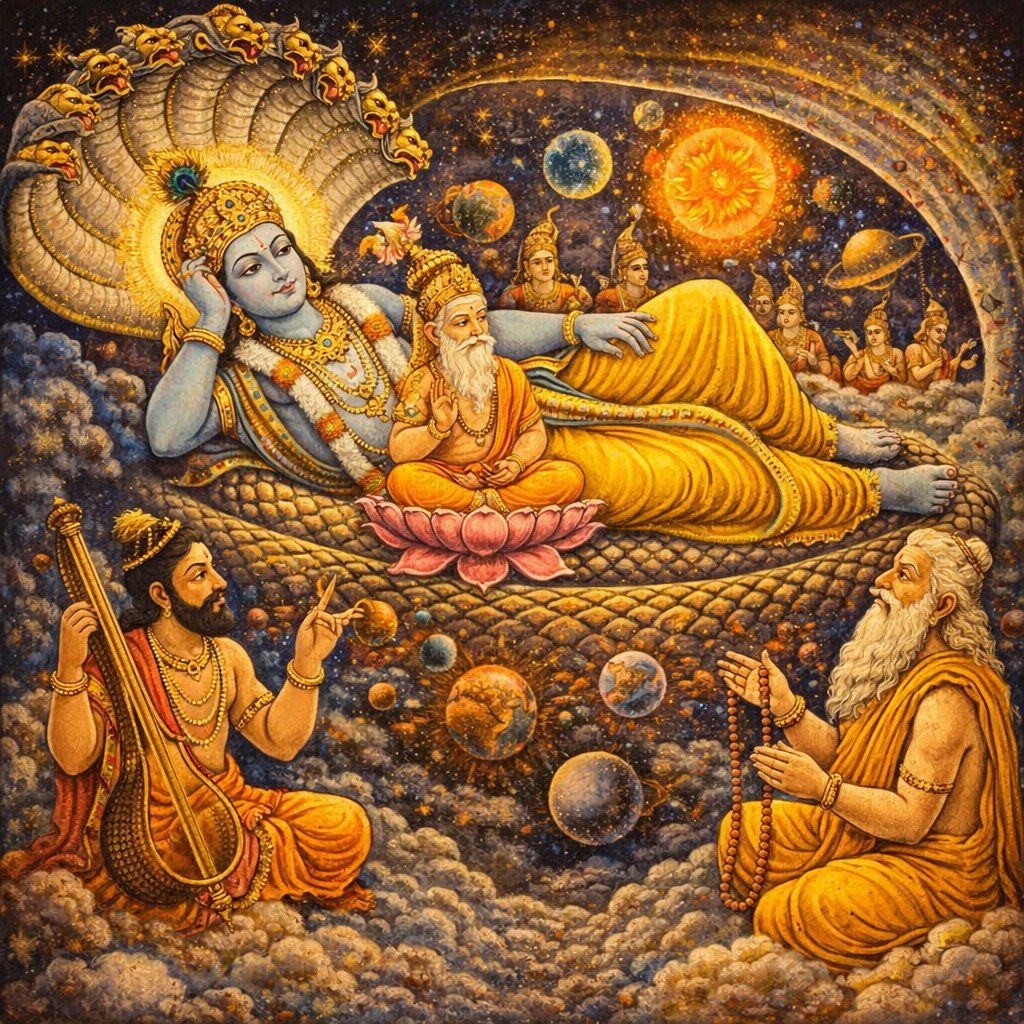
Canto 2: The Cosmic Manifestation and the Science of God (Bhagavata as the Supreme Hearing)
द्वितीय स्कन्धः (Brahmaṇḍa–Virāṭ-Varṇanam / Bhāgavata-tattva)
Cosmic Manifestation
Shukadeva begins instructing King Parikshit on the nature of the Supreme, the universal form (Virat-rupa), and the process of cosmic creation and dissolution.
Adhyayas in Dvitiya Skandha
Adhyaya 1
The First Step in God Realization: The Glory of Hearing and the Virāṭ-Rūpa Meditation
Śukadeva Gosvāmī praises Parīkṣit’s question as universally auspicious, contrasting it with the distracted life of materialistic householders who spend their days in wealth-making and maintenance and their nights in sleep or sex. He declares that freedom from misery begins with hearing, glorifying, and remembering the Supreme Lord (Paramātmā, controller and savior), and that the highest perfection is to remember Bhagavān at death—whether one follows jñāna, yoga, or karma. He affirms the Bhāgavatam’s supreme authority, recounting how even he, self-realized, was attracted to Kṛṣṇa’s līlā, and he recommends nāma-saṅkīrtana as the fearless path for all seekers. With Parīkṣit’s remaining seven days in view, Śukadeva outlines a disciplined end-of-life sādhana: renunciation, solitude, prāṇāyāma, oṁ-smaraṇa, sense-withdrawal, and focused meditation. Responding to Parīkṣit’s request for details, he introduces concentration on the Lord’s gross potency—the virāṭ-puruṣa—describing the cosmic body and planetary systems as His limbs. The chapter ends by insisting that the mind must ultimately fix on the all-blissful Supreme Person, or else it risks misdirection and degradation, setting up the next stages of deeper theological exposition.
Adhyaya 2
The Lord in the Heart and the Discipline of Yoga-Bhakti
Continuing from the canto’s opening emphasis on hearing and fixing the mind upon the Supreme, Śukadeva explains to Parīkṣit how Brahmā, before manifest creation, regained consciousness by meditating on the virāṭ-rūpa and pleasing the Lord—linking cosmogenesis to devotion rather than independent material causation. He critiques bewildering Vedic sound that diverts people toward heavenly ambitions, urging minimal necessities, renunciation, and reliance on the Lord’s protection instead of flattering the wealthy. The chapter then gives a concrete meditative theology: the Lord as Paramātmā in the heart, described with four arms and divine ornaments, and a step-by-step method of meditation from the lotus feet upward to the smiling face, purifying intelligence progressively. Next, it outlines yogic departure at death: regulation of prāṇa, merging mind and self toward the Superself, and contrasting desireless bhakti-yogīs with those seeking siddhis or higher planets. The narrative expands into cosmological pathways (Suṣumṇā, Vaiśvānara, Śiśumāra, Maharloka, Satyaloka) and culminates in the doctrinal conclusion: Brahmā’s Vedic scrutiny establishes attraction to Śrī Kṛṣṇa as the highest dharma, and constant hearing and remembrance leads back to Godhead—preparing the reader for deeper creation accounts and the Bhāgavatam’s explicit Kṛṣṇa-centered theology in subsequent chapters.
Adhyaya 3
Karmic Aspirations, Demigod Worship, and the Supreme Duty of Bhakti (Hari-kathā as Life’s True Gain)
Śukadeva confirms to Parīkṣit that the essential instruction for one at the threshold of death has been answered, then maps the Vedic landscape of desire-driven worship: various devatās are approached for specific fruits—power, progeny, wealth, fame, beauty, longevity, kingdom, and heavenly ascent. This catalog functions as a diagnostic of kāma (material motivation) and its many ritual outlets. The chapter then pivots: for spiritual advancement one should worship Viṣṇu (or His devotee), and the broad-minded—whether full of desires, desireless, or seeking liberation—should worship the Supreme Personality of Godhead alone. The highest perfection, fixed attraction to Bhagavān, is said to arise especially through association with the pure devotee, and true knowledge of Hari is defined as that which suspends the waves of the modes. The frame returns to the Naimiṣāraṇya dialogue: Śaunaka urges Sūta to continue, praising hari-kathā as the best use of time as life diminishes, and condemning a life devoid of hearing and chanting as spiritually dead. This chapter thus transitions from ritual taxonomy to devotional exclusivity, preparing the listener for subsequent, more focused inquiries into the Lord and His remembrance.
Adhyaya 4
Parīkṣit’s Full Surrender and Śukadeva’s Maṅgalācaraṇa to Kṛṣṇa (Inquiry into Creation, Maintenance, and Dissolution)
Continuing the deathbed dialogue, Sūta describes how Parīkṣit—having heard self-realization topics from Śukadeva—becomes intensely absorbed in Kṛṣṇa and relinquishes attachment to body, family, royal opulence, and even the standard triad of karma-driven pursuits (dharma, artha, kāma). From this purified platform, Parīkṣit frames precise, “People’s questions” about the Lord’s acintya śaktis: how Bhagavān creates innumerable universes, how He deploys modes (guṇas) and expansions (aṁśa/kalā) to maintain and dissolve the cosmos, and how the One appears to act singly, simultaneously, or sequentially. Śukadeva, requested to speak on the Lord’s creative energy, first remembers Hṛṣīkeśa (master of the senses) and offers a sustained series of obeisances that function as a theological preface: Kṛṣṇa purifies through bhakti-acts, grants liberation, empowers Brahmā with Vedic knowledge, enters the universe as the puruṣa, and even delivers the most fallen through association with devotees. The chapter closes by pointing forward to the paramparā source: Brahmā answering Nārada as received directly from the Lord—setting up the next stage of systematic cosmological exposition.
Adhyaya 5
Nārada’s Questions and Brahmā’s Reply: Vāsudeva as the Source; Sarga–Visarga; Virāṭ-rūpa Mapping
Continuing the pedagogical arc of Skandha 2, Nārada approaches Brahmā with reverence yet sharp theological inquiry: he asks for knowledge that differentiates the individual soul from the Supersoul and requests a factual account of the manifested world—its origin, creation, maintenance, and governing authority. Nārada probes Brahmā’s apparent independence, using the spider analogy to test whether Brahmā creates solely by his own śakti. Brahmā answers by redirecting all greatness to Vāsudeva: Brahmā’s creative capacity is secondary, illuminated by the Lord’s effulgence, and māyā bewilders those who mistake the secondary controller for the Supreme. Brahmā then outlines the mechanics of creation: puruṣa-avatāra, mahat-tattva, time, guṇas, false ego’s transformations, the emergence of the pañca-mahābhūtas and senses, and the necessity of the Lord’s entry to animate universes. The chapter culminates in virāṭ-rūpa cosmography, mapping varṇas and planetary systems onto the Lord’s universal body, preparing the reader for subsequent, more detailed cosmological and theological elaborations.
Adhyaya 6
Puruṣa-sūkta Logic of the Virāṭ: Cosmic Anatomy, Sacrifice, and the Lord’s Transcendence
Continuing Brahmā’s instruction to Nārada on how the Supreme is understood through both immanence and transcendence, this chapter maps the universe onto the virāṭ-puruṣa: mouth, nostrils, eyes, ears, skin, hair, limbs, and internal organs become generating centers for speech, Vedic meters, prāṇa, sound/ākāśa, touch/vāyu, vegetation, rivers, mountains, and cosmic governance by devatās. The text then pivots from anatomy to ontology: despite covering all beings across time, the Lord remains beyond measurement and beyond death and karma. Brahmā explains how he derived sacrificial paraphernalia from the Lord’s own limbs, establishing yajña as a cosmological principle whose ultimate beneficiary is Viṣṇu. The chapter culminates in Brahmā’s confession of the Lord’s incomprehensibility—even for Brahmā, Śiva, and the devas—followed by praise of Mahā-Viṣṇu as the first expansion for creation and a warning against mistaking powerful beings as the Supreme. It closes by announcing the forthcoming narration of līlā-avatāras, linking cosmic theory to devotional hearing.
Adhyaya 7
Bhagavān’s Avatāras, Their Protections (Poṣaṇa), and the Limits of Knowing Him
Continuing Brahmā’s instruction to Nārada on how the Supreme Lord is the root cause behind creation and governance, this chapter presents a sweeping avatāra-saṅgraha (catalog of incarnations) illustrating poṣaṇa—divine protection of the cosmos and devotees—across yugas and crises. Brahmā recounts major descents: Varāha’s rescue of Earth; Kapila’s teaching of sāṅkhya-bhakti to Devahūti; Dattātreya’s blessing of dynasties; the Kumāras restoring spiritual truth; Nara-Nārāyaṇa’s invincible tapas; Dhruva and Pṛthu as paradigms of devotion and righteous rule; Hayagrīva safeguarding Veda; Matsya and Kūrma in cosmic transitions; Nṛsiṁha’s protection of the devas; Gajendra’s rescue; Vāmana’s humbling of Bali; Haṁsa’s instruction to Nārada; Dhanvantari’s healing; Paraśurāma’s correction of fallen kṣatriyas; Rāma’s dharma-līlā; and Kṛṣṇa’s extraordinary childhood and royal pastimes. The chapter then turns reflective: Viṣṇu’s greatness is immeasurable; even Brahmā and Śeṣa cannot reach His limit. Yet surrendered devotees can cross māyā and know Him by grace. Brahmā concludes by urging Nārada to expand this Bhāgavata science so humans can develop firm devotional service, linking this avatāra overview to the next stage of systematic teaching and transmission.
Adhyaya 8
Parīkṣit’s Comprehensive Inquiries and the Bhāgavata as Śabda-avatāra
Continuing the momentum of Skandha 2’s cosmological and devotional setup, Mahārāja Parīkṣit intensifies his inquiry to Śukadeva Gosvāmī, asking how Nārada described the Lord’s transcendental qualities and to whom he spoke. Parīkṣit foregrounds the soteriological purpose of hearing: regular, serious śravaṇa of Śrīmad-Bhāgavatam manifests Kṛṣṇa in the heart and cleanses lust, anger, and hankering, like autumn rains clearing muddy pools. He then expands into a systematic catalogue of questions that effectively outlines forthcoming Bhāgavata topics: the jīva’s embodiment and causality; the Lord’s body versus conditioned bodies; Brahmā’s lotus-birth and vision of the Lord; Paramātmā in the heart untouched by māyā; the actual placement of planetary systems within the virāṭ-puruṣa; measures of time, lifespans, yugas, and manvantaras; karma and guṇa-driven transmigration; cosmic geography; varṇāśrama characteristics; elements (tattvas), devotional process, and yogic perfections; Vedic literature and subsidiary rites; creation, maintenance, dissolution, and the Lord’s witnessing role through internal and external potencies. Sūta notes Śukadeva’s pleasure and readiness to answer, introducing that this science was first spoken by the Lord to Brahmā—bridging into the next explanatory sequence.
Adhyaya 9
Brahmā’s Tapasya, the Vision of Vaikuṇṭha, and the Lord’s Seed Instructions (Catuḥ-śloki)
Continuing the Canto’s movement from inquiry to realized knowledge, Śukadeva clarifies that the soul’s identification with the body is māyā—like a dream—rooted in the dual misconceptions of “I” and “mine.” The narrative then turns to Brahmā at the dawn of creation: unable to locate the source of his lotus seat or the method of creation, he hears the divine injunction “tapa” and performs prolonged penance. Pleased, the Lord reveals Vaikuṇṭha—beyond time and the guṇas—describing its inhabitants, splendor, and Lakṣmī’s service, culminating in Brahmā’s ecstatic surrender. The Lord authorizes Brahmā for secondary creation (visarga) and teaches confidential knowledge to be realized through devotion, including the core ontological conclusions: Bhagavān alone exists before, during, and after creation; what lacks relation to Him is māyā; and He is simultaneously within and beyond all. After the Lord disappears, Brahmā begins creation and transmits Bhāgavatam in disciplic succession—Brahmā to Nārada to Vyāsa—preparing the next discussion where Śukadeva will answer Parīkṣit’s cosmological questions by expanding these foundational verses.
Adhyaya 10
Daśa-lakṣaṇam: The Ten Topics, Virāṭ-Puruṣa Sense-Manifestation, and the Supreme Shelter (Āśraya)
This chapter functions as an interpretive hinge within Skandha 2. Śukadeva Gosvāmī first enumerates the Bhāgavatam’s ten defining subjects (daśa-lakṣaṇam), clarifying that the other nine are described to spotlight the transcendence of the tenth—āśraya, the Supreme Being. He distinguishes sarga (primary creation of elemental categories and senses) from visarga (secondary creation through guṇa-interaction), and outlines governance themes such as manvantara and poṣaṇa. The narration then moves into a cosmological-theological account of Mahā-Viṣṇu entering each universe as Garbhodakaśāyī, establishing the etymology of Nārāyaṇa, and asserting the Lord’s absolute dependence-relationship: all ingredients, time, modes, and jīvas exist only by His mercy. A detailed ‘cosmic anatomy’ sequence follows, describing how the virāṭ-puruṣa’s desires manifest the senses, their objects, and their presiding deities. The chapter concludes by transcending the gross universal form, affirming that pure devotees accept the Lord’s personal transcendental form, and transitions the narrative frame toward Vidura–Maitreya discussions, setting up the next section’s inquiry-driven exposition.
Frequently Asked Questions
Skandha 2 establishes the Bhāgavata’s method (śravaṇa–kīrtana–smaraṇa) as the decisive means for liberation, and it frames cosmology (sarga/visarga, planetary systems, virāṭ-rūpa) as devotional knowledge meant to fix the mind on Bhagavān. It therefore connects existential urgency (Parīkṣit’s impending death) with a systematic theology where creation is read as the Lord’s energy and guidance (poṣaṇa) toward bhakti.
The virāṭ-rūpa is presented as a meditative support for conditioned minds: by mapping the cosmos onto the Lord’s body, the practitioner redirects perception from sense objects to the Lord’s presence everywhere. The chapter then emphasizes that Viṣṇu is the Ultimate Truth and that the goal is devotional service under His shelter—so the universal form is a step toward personal devotion, not a denial of the Lord’s personality.
The text explicitly states that nāma-kīrtana and Bhāgavata-śravaṇa are effective for all categories—akāma (free of desires), sarva-kāma (full of material desires), and mokṣa-kāma or jñānī (seeking liberation/self-satisfied by knowledge)—because the holy name and remembrance of Bhagavān purify and reorient consciousness toward the supreme interest (parama-puruṣārtha).