Adhyaya 33
Rāsa-līlā Begins; Divine Multiplication; Moral Doubt and Its Resolution
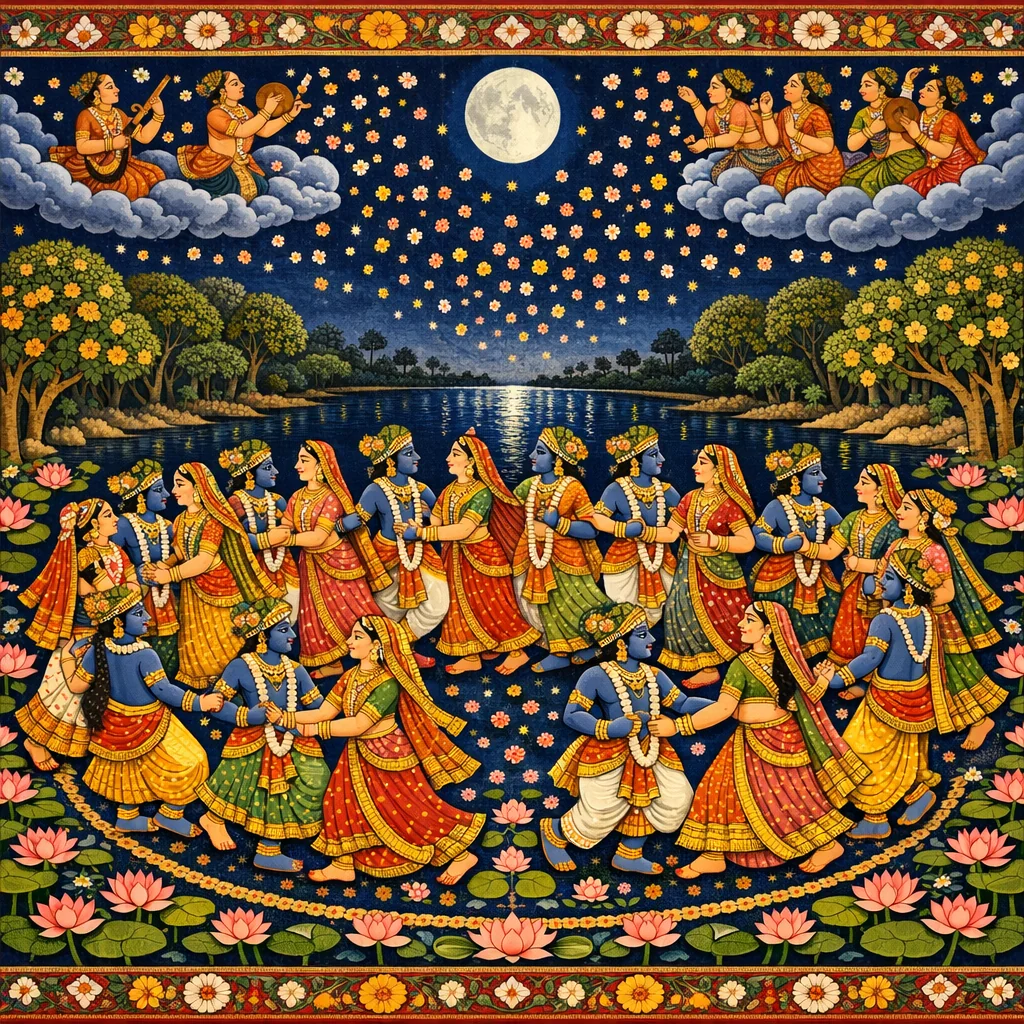
Following Kṛṣṇa’s reconciliation with the gopīs after the pain of separation, the rāsa dance unfolds on the Yamunā’s moonlit banks. Kṛṣṇa enters the circular dance by expanding Himself so each gopī experiences exclusive proximity, while devas, Gandharvas, and their consorts witness and celebrate from the sky. The chapter lingers on the aesthetic and devotional texture of the rāsa—song, ornaments, perspiration, affectionate gestures—then shifts to a crucial hermeneutic pivot: Parīkṣit questions how the dharma-protecting Lord could appear to transgress morality by associating with others’ wives. Śukadeva answers with a theology of īśvara-transcendence: the Supreme is untouched by karma, cannot be judged by ordinary standards, and must never be imitated by non-controllers; His līlā is enacted to attract hearts toward devotion. The cowherd men are deluded by yogamāyā and feel no jealousy. As dawn approaches, Kṛṣṇa instructs the gopīs to return home. The chapter concludes with a phala-śruti: faithful hearing of these pastimes grants pure bhakti and quickly conquers lust—setting up the next movement of post-rāsa instruction and deepening devotional implications.
Shlokas
Verse 1
श्रीशुक उवाच इत्थं भगवतो गोप्य: श्रुत्वा वाच: सुपेशला: । जहुर्विरहजं तापं तदङ्गोपचिताशिष: ॥ १ ॥
Śukadeva Gosvāmī said: When the cowherd girls heard the Supreme Personality of Godhead speak these most charming words, they forgot their distress caused by separation from Him. Touching His transcendental limbs, they felt all their desires fulfilled.
Verse 2
तत्रारभत गोविन्दो रासक्रीडामनुव्रतै: । स्त्रीरत्नैरन्वित: प्रीतैरन्योन्याबद्धबाहुभि: ॥ २ ॥
There on the Yamunā’s banks Lord Govinda then began the pastime of the rāsa dance in the company of those jewels among women, the faithful gopīs, who joyfully linked their arms together.
Verse 3
रासोत्सव: सम्प्रवृत्तो गोपीमण्डलमण्डित: । योगेश्वरेण कृष्णेन तासां मध्ये द्वयोर्द्वयो: । प्रविष्टेन गृहीतानां कण्ठे स्वनिकटं स्त्रिय: । यं मन्येरन् नभस्तावद् विमानशतसङ्कुलम् । दिवौकसां सदाराणामौत्सुक्यापहृतात्मनाम् ॥ ३ ॥
The festive rāsa dance commenced, with the gopīs arrayed in a circle. Lord Kṛṣṇa expanded Himself and entered between each pair of gopīs, and as that master of mystic power placed His arms around their necks, each girl thought He was standing next to her alone. The demigods and their wives were overwhelmed with eagerness to witness the rāsa dance, and they soon crowded the sky with their hundreds of celestial airplanes.
Verse 4
ततो दुन्दुभयो नेदुर्निपेतु: पुष्पवृष्टय: । जगुर्गन्धर्वपतय: सस्त्रीकास्तद्यशोऽमलम् ॥ ४ ॥
Kettledrums then resounded in the sky while flowers rained down and the chief Gandharvas and their wives sang Lord Kṛṣṇa’s spotless glories.
Verse 5
वलयानां नूपुराणां किङ्किणीनां च योषिताम् । सप्रियाणामभूच्छब्दस्तुमुलो रासमण्डले ॥ ५ ॥
A tumultuous sound arose from the armlets, ankle bells and waist bells of the gopīs as they sported with their beloved Kṛṣṇa in the circle of the rāsa dance.
Verse 6
तत्रातिशुशुभे ताभिर्भगवान् देवकीसुत: । मध्ये मणीनां हैमानां महामरकतो यथा ॥ ६ ॥
In the midst of the dancing gopīs, Lord Kṛṣṇa appeared most brilliant, like an exquisite sapphire in the midst of golden ornaments.
Verse 7
पादन्यासैर्भुजविधुतिभि: सस्मितैर्भ्रूविलासै- र्भज्यन्मध्यैश्चलकुचपटै: कुण्डलैर्गण्डलोलै: । स्विद्यन्मुख्य: कवररसनाग्रन्थय: कृष्णवध्वो गायन्त्यस्तं तडित इव ता मेघचक्रे विरेजु: ॥ ७ ॥
As the gopīs sang in praise of Kṛṣṇa, their feet danced, their hands gestured, and their eyebrows moved with playful smiles. With their braids and belts tied tight, their waists bending, their faces perspiring, the garments on their breasts moving this way and that, and their earrings swinging on their cheeks, Lord Kṛṣṇa’s young consorts shone like streaks of lightning in a mass of clouds.
Verse 8
उच्चैर्जगुर्नृत्यमाना रक्तकण्ठ्यो रतिप्रिया: । कृष्णाभिमर्शमुदिता यद्गीतेनेदमावृतम् ॥ ८ ॥
Eager to enjoy conjugal love, their throats colored with various pigments, the gopīs sang loudly and danced. They were overjoyed by Kṛṣṇa’s touch, and they sang songs that filled the entire universe.
Verse 9
काचित् समं मुकुन्देन स्वरजातीरमिश्रिता: । उन्निन्ये पूजिता तेन प्रीयता साधु साध्विति । तदेव ध्रुवमुन्निन्ये तस्यै मानं च बह्वदात् ॥ ९ ॥
One gopī, joining Lord Mukunda in His singing, sang pure melodious tones that rose harmoniously above His. Kṛṣṇa was pleased and showed great appreciation for her performance, saying “Excellent! Excellent!” Then another gopī repeated the same melody, but in a special metrical pattern, and Kṛṣṇa praised her also.
Verse 10
काचिद् रासपरिश्रान्ता पार्श्वस्थस्य गदाभृत: । जग्राह बाहुना स्कन्धं श्लथद्वलयमल्लिका ॥ १० ॥
When one gopī grew tired from the rāsa dance, She turned to Kṛṣṇa, standing at Her side holding a baton, and grasped His shoulder with Her arm. The dancing had loosened Her bracelets and the flowers in Her hair.
Verse 11
तत्रैकांसगतं बाहुं कृष्णस्योत्पलसौरभम् । चन्दनालिप्तमाघ्राय हृष्टरोमा चुचुम्ब ह ॥ ११ ॥
Upon the shoulder of one gopī Kṛṣṇa placed His arm, whose natural blue-lotus fragrance was mixed with that of the sandalwood pulp anointing it. As the gopī relished that fragrance, her bodily hair stood on end in jubilation, and she kissed His arm.
Verse 12
कस्याश्चिन्नाट्यविक्षिप्त कुण्डलत्विषमण्डितम् । गण्डं गण्डे सन्दधत्या: प्रादात्ताम्बूलचर्वितम् ॥ १२ ॥
Next to Kṛṣṇa’s cheek one gopī put her own, beautified by the effulgence of her earrings, which glittered as she danced. Kṛṣṇa then carefully gave her the betel nut He was chewing.
Verse 13
नृत्यती गायती काचित् कूजन्नूपुरमेखला । पार्श्वस्थाच्युतहस्ताब्जं श्रान्ताधात्स्तनयो: शिवम् ॥ १३ ॥
Another gopī became fatigued as she danced and sang, the bells on her ankles and waist tinkling. So she placed upon her breasts the comforting lotus hand of Lord Acyuta, who was standing by her side.
Verse 14
गोप्यो लब्ध्वाच्युतं कान्तं श्रिय एकान्तवल्लभम् । गृहीतकण्ठ्यस्तद्दोर्भ्यां गायन्त्यस्तं विजह्रिरे ॥ १४ ॥
Having attained as their intimate lover Lord Acyuta, the exclusive consort of the goddess of fortune, the gopīs enjoyed great pleasure. They sang His glories as He held their necks with His arms.
Verse 15
कर्णोत्पलालकविटङ्ककपोलघर्म- वक्त्रश्रियो वलयनूपुरघोषवाद्यै: । गोप्य: समं भगवता ननृतु: स्वकेश- स्रस्तस्रजो भ्रमरगायकरासगोष्ठ्याम् ॥ १५ ॥
Enhancing the beauty of the gopīs ’ faces were the lotus flowers behind their ears, the locks of hair decorating their cheeks, and drops of perspiration. The reverberation of their armlets and ankle bells made a loud musical sound, and their chaplets scattered. Thus the gopīs danced with the Supreme Lord in the arena of the rāsa dance as swarms of bees sang in accompaniment.
Verse 16
एवं परिष्वङ्गकराभिमर्श- स्निग्धेक्षणोद्दामविलासहासै: । रेमे रमेशो व्रजसुन्दरीभि- र्यथार्भक: स्वप्रतिबिम्बविभ्रम: ॥ १६ ॥
In this way Lord Kṛṣṇa, the original Lord Nārāyaṇa, master of the goddess of fortune, took pleasure in the company of the young women of Vraja by embracing them, caressing them and glancing lovingly at them as He smiled His broad, playful smiles. It was just as if a child were playing with his own reflection.
Verse 17
तदङ्गसङ्गप्रमुदाकुलेन्द्रिया: केशान् दुकूलं कुचपट्टिकां वा । नाञ्ज: प्रतिव्योढुमलं व्रजस्त्रियो विस्रस्तमालाभरणा: कुरूद्वह ॥ १७ ॥
Their senses overwhelmed by the joy of having His physical association, the gopīs could not prevent their hair, their dresses and the cloths covering their breasts from becoming disheveled. Their garlands and ornaments scattered, O hero of the Kuru dynasty.
Verse 18
कृष्णविक्रीडितं वीक्ष्य मुमुहु: खेचरस्त्रिय: । कामार्दिता: शशाङ्कश्च सगणो विस्मितोऽभवत् ॥ १८ ॥
The wives of the demigods, observing Kṛṣṇa’s playful activities from their airplanes, were entranced and became agitated with lust. Indeed, even the moon and his entourage, the stars, became astonished.
Verse 19
कृत्वा तावन्तमात्मानं यावतीर्गोपयोषित: । रेमे स भगवांस्ताभिरात्मारामोऽपि लीलया ॥ १९ ॥
Expanding Himself as many times as there were cowherd women to associate with, the Supreme Lord, though self-satisfied, playfully enjoyed their company.
Verse 20
तासां रतिविहारेण श्रान्तानां वदनानि स: । प्रामृजत् करुण: प्रेम्णा शन्तमेनाङ्ग पाणिना ॥ २० ॥
Seeing that the gopīs were fatigued from conjugal enjoyment, my dear King, merciful Kṛṣṇa lovingly wiped their faces with His comforting hand.
Verse 21
गोप्य: स्फुरत्पुरटकुण्डलकुन्तलत्विड्- गण्डश्रिया सुधितहासनिरीक्षणेन । मानं दधत्य ऋषभस्य जगु: कृतानि पुण्यानि तत्कररुहस्पर्शप्रमोदा: ॥ २१ ॥
The gopīs honored their hero with smiling glances sweetened by the beauty of their cheeks and the effulgence of their curly locks and glittering golden earrings. Overjoyed from the touch of His fingernails, they chanted the glories of His all-auspicious transcendental pastimes.
Verse 22
ताभिर्युत: श्रममपोहितुमङ्गसङ्ग- घृष्टस्रज: स कुचकुङ्कुमरञ्जिताया: । गन्धर्वपालिभिरनुद्रुत आविशद् वा: श्रान्तो गजीभिरिभराडिव भिन्नसेतु: ॥ २२ ॥
Lord Kṛṣṇa’s garland had been crushed during His conjugal dalliance with the gopīs and colored vermilion by the kuṅkuma powder on their breasts. To dispel the fatigue of the gopīs, Kṛṣṇa entered the water of the Yamunā, followed swiftly by bees who were singing like the best of the Gandharvas. He appeared like a lordly elephant entering the water to relax in the company of his consorts. Indeed, the Lord had transgressed all worldly and Vedic morality just as a powerful elephant might break the dikes in a paddy field.
Verse 23
सोऽम्भस्यलं युवतिभि: परिषिच्यमान: प्रेम्णेक्षित: प्रहसतीभिरितस्ततोऽङ्ग । वैमानिकै: कुसुमवर्षिभिरीड्यमानो रेमे स्वयं स्वरतिरत्र गजेन्द्रलील: ॥ २३ ॥
My dear King, in the water Kṛṣṇa found Himself being splashed on all sides by the laughing gopīs, who looked at Him with love. As the demigods worshiped Him by showering flowers from their airplanes, the self-satisfied Lord took pleasure in playing like the king of the elephants.
Verse 24
ततश्च कृष्णोपवने जलस्थल- प्रसूनगन्धानिलजुष्टदिक्तटे । चचार भृङ्गप्रमदागणावृतो यथा मदच्युद् द्विरद: करेणुभि: ॥ २४ ॥
Then the Lord strolled through a small forest on the bank of the Yamunā. This forest was filled to its limits with breezes carrying the fragrances of all the flowers growing on the land and in the water. Followed by His entourage of bees and beautiful women, Lord Kṛṣṇa appeared like an intoxicated elephant with his she-elephants.
Verse 25
एवं शशाङ्कांशुविराजिता निशा: स सत्यकामोऽनुरताबलागण: । सिषेव आत्मन्यवरुद्धसौरत: सर्वा: शरत्काव्यकथारसाश्रया: ॥ २५ ॥
Although the gopīs were firmly attached to Lord Kṛṣṇa, whose desires are always fulfilled, the Lord was not internally affected by any mundane sex desire. Still, to perform His pastimes the Lord took advantage of all those moonlit autumn nights, which inspire poetic descriptions of transcendental affairs.
Verse 26
श्रीपरीक्षिदुवाच संस्थापनाय धर्मस्य प्रशमायेतरस्य च । अवतीर्णो हि भगवानंशेन जगदीश्वर: ॥ २६ ॥ स कथं धर्मसेतूनां वक्ता कर्ताभिरक्षिता । प्रतीपमाचरद् ब्रह्मन् परदाराभिमर्शनम् ॥ २७ ॥
Parīkṣit Mahārāja said: O brāhmaṇa, the Supreme Personality of Godhead, the Lord of the universe, has descended to this earth along with His plenary portion to destroy irreligion and reestablish religious principles. Indeed, He is the original speaker, follower and guardian of moral laws. How, then, could He have violated them by touching other men’s wives?
Verse 27
श्रीपरीक्षिदुवाच संस्थापनाय धर्मस्य प्रशमायेतरस्य च । अवतीर्णो हि भगवानंशेन जगदीश्वर: ॥ २६ ॥ स कथं धर्मसेतूनां वक्ता कर्ताभिरक्षिता । प्रतीपमाचरद् ब्रह्मन् परदाराभिमर्शनम् ॥ २७ ॥
Parīkṣit Mahārāja said: O brāhmaṇa, the Supreme Personality of Godhead, the Lord of the universe, has descended to this earth along with His plenary portion to destroy irreligion and reestablish religious principles. Indeed, He is the original speaker, follower and guardian of moral laws. How, then, could He have violated them by touching other men’s wives?
Verse 28
आप्तकामो यदुपति: कृतवान्वै जुगुप्सितम् । किमभिप्राय एतन्न: शंशयं छिन्धि सुव्रत ॥ २८ ॥
O faithful upholder of vows, please destroy our doubt by explaining to us what purpose the self-satisfied Lord of the Yadus had in mind when He behaved so contemptibly.
Verse 29
श्रीशुक उवाच धर्मव्यतिक्रमो दृष्ट ईश्वराणां च साहसम् । तेजीयसां न दोषाय वह्ने: सर्वभुजो यथा ॥ २९ ॥
Śukadeva Gosvāmī said: The status of powerful controllers is not harmed by any apparently audacious transgression of morality we may see in them, for they are just like fire, which devours everything fed into it and remains unpolluted.
Verse 30
नैतत् समाचरेज्जातु मनसापि ह्यनीश्वर: । विनश्यत्याचरन् मौढ्याद्यथारुद्रोऽब्धिजं विषम् ॥ ३० ॥
One who is not a great controller should never imitate the behavior of ruling personalities, even mentally. If out of foolishness an ordinary person does imitate such behavior, he will simply destroy himself, just as a person who is not Rudra would destroy himself if he tried to drink an ocean of poison.
Verse 31
ईश्वराणां वच: सत्यं तथैवाचरितं क्वचित् । तेषां यत् स्ववचोयुक्तं बुद्धिमांस्तत् समाचरेत् ॥ ३१ ॥
The statements of the Lord’s empowered servants are always true, and the acts they perform are exemplary when consistent with those statements. Therefore one who is intelligent should carry out their instructions.
Verse 32
कुशलाचरितेनैषामिह स्वार्थो न विद्यते । विपर्ययेण वानर्थो निरहङ्कारिणां प्रभो ॥ ३२ ॥
My dear Prabhu, when these great persons who are free from false ego act piously in this world, they have no selfish motives to fulfill, and even when they act in apparent contradiction to the laws of piety, they are not subject to sinful reactions.
Verse 33
किमुताखिलसत्त्वानां तिर्यङ्मर्त्यदिवौकसाम् । ईशितुश्चेशितव्यानां कुशलाकुशलान्वय: ॥ ३३ ॥
How, then, could the Lord of all created beings — animals, men and demigods — have any connection with the piety and impiety that affect His subject creatures?
Verse 34
यत्पादपङ्कजपरागनिषेवतृप्ता योगप्रभावविधुताखिलकर्मबन्धा: । स्वैरं चरन्ति मुनयोऽपि न नह्यमाना- स्तस्येच्छयात्तवपुष: कुत एव बन्ध: ॥ ३४ ॥
Material activities never entangle the devotees of the Supreme Lord, who are fully satisfied by serving the dust of His lotus feet. Nor do material activities entangle those intelligent sages who have freed themselves from the bondage of all fruitive reactions by the power of yoga. So how could there be any question of bondage for the Lord Himself, who assumes His transcendental forms according to His own sweet will?
Verse 35
गोपीनां तत्पतीनां च सर्वेषामेव देहिनाम् । योऽन्तश्चरति सोऽध्यक्ष: क्रीडनेनेह देहभाक् ॥ ३५ ॥
He who lives as the overseeing witness within the gopīs and their husbands, and indeed within all embodied living beings, assumes forms in this world to enjoy transcendental pastimes.
Verse 36
अनुग्रहाय भक्तानां मानुषं देहमास्थित: । भजते तादृशी: क्रीडा या: श्रुत्वा तत्परो भवेत् ॥ ३६ ॥
When the Lord assumes a humanlike body to show mercy to His devotees, He engages in such pastimes as will attract those who hear about them to become dedicated to Him.
Verse 37
नासूयन् खलु कृष्णाय मोहितास्तस्य मायया । मन्यमाना: स्वपार्श्वस्थान्स्वान्स्वान्दारान् व्रजौकस: ॥ ३७ ॥
The cowherd men, bewildered by Kṛṣṇa’s illusory potency, thought their wives had remained home at their sides. Thus they did not harbor any jealous feelings against Him.
Verse 38
ब्रह्मरात्र उपावृत्ते वासुदेवानुमोदिता: । अनिच्छन्त्यो ययुर्गोप्य: स्वगृहान्भगवत्प्रिया: ॥ ३८ ॥
After an entire night of Brahmā had passed, Lord Kṛṣṇa advised the gopīs to return to their homes. Although they did not wish to do so, the Lord’s beloved consorts complied with His command.
Verse 39
विक्रीडितं व्रजवधूभिरिदं च विष्णो: श्रद्धान्वितोऽनुशृणुयादथ वर्णयेद् य: । भक्तिं परां भगवति प्रतिलभ्य कामं हृद्रोगमाश्वपहिनोत्यचिरेण धीर: ॥ ३९ ॥
Anyone who faithfully hears or describes the Lord’s playful affairs with the young gopīs of Vṛndāvana will attain the Lord’s pure devotional service. Thus he will quickly become sober and conquer lust, the disease of the heart.
Frequently Asked Questions
The text presents this as yogeśvara-lakṣaṇa—His supreme mystic sovereignty—revealing that the Lord can reciprocate fully with each devotee without division or limitation. Theologically, it illustrates personal reciprocity (bhakta-vātsalya) and the non-material nature of līlā: the Supreme remains complete while manifesting intimate presence for all.
Śukadeva argues that the Supreme Controller is not subject to karmic contamination and cannot be evaluated like conditioned beings. He uses analogies (fire remains pure while consuming; Rudra drinking poison cannot be imitated) to establish two principles: (1) īśvara is beyond piety/impiety that bind creatures, and (2) imitation by ordinary persons is spiritually destructive. The līlā is framed as mercy meant to attract souls to bhakti, not as a license for sensuality.
The cowherd men (gopas) are bewildered so they believe their wives remain at home, preventing jealousy and social rupture. This supports the narrative’s devotional purpose: the līlā proceeds under divine arrangement, protecting devotees and demonstrating that Kṛṣṇa’s actions occur within His sovereign, non-material potency rather than ordinary social causality.
The chapter states that faithful hearing or describing these pastimes grants pure devotional service (śuddha-bhakti) and quickly conquers lust, described as a disease of the heart. In Bhāgavata logic, properly received līlā-kathā does not inflame kāma; it reorients desire toward the Lord, transforming it into devotion.
The text depicts rāsa as cosmically captivating, revealing Kṛṣṇa as the supreme object of attraction (ākarṣaṇa-śakti). Their agitation functions as a narrative contrast: even celestial observers are moved, underscoring the extraordinary potency of the Lord’s beauty and play, while reminding readers that the līlā operates on a transcendental plane requiring proper understanding.