Adhyaya 9
Dāmodara-līlā: Mother Yaśodā Binds Kṛṣṇa; the Two-Fingers Mystery; Prelude to the Yamala-Arjuna Deliverance
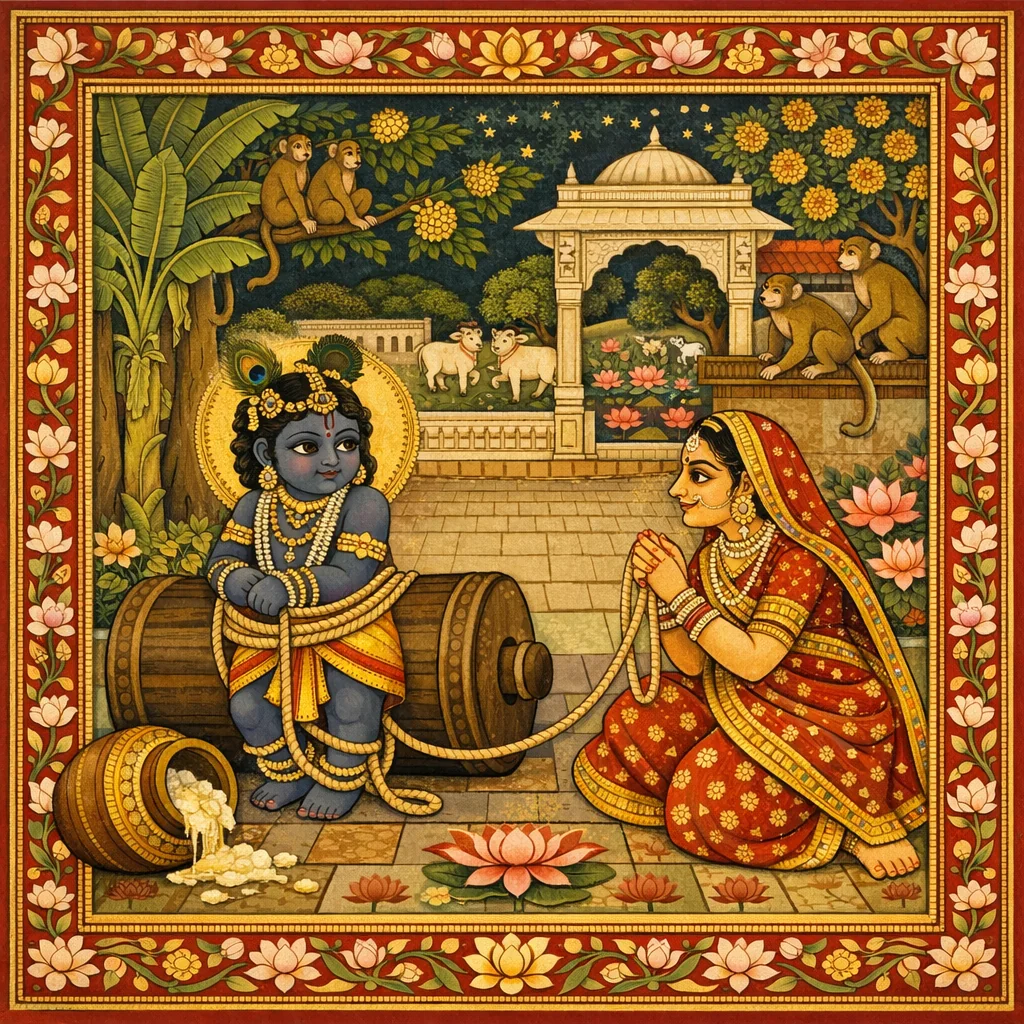
Continuing the Vraja childhood cycle of intimate household līlās, Yaśodā churns yogurt while singing of Kṛṣṇa’s antics. Kṛṣṇa interrupts, seeking her breast milk; when she briefly leaves Him to save boiling milk, He vents playful anger—breaking the yogurt pot and secretly distributing butter to monkeys. Yaśodā discovers the mischief, approaches quietly, and chases Him; the theological contrast is explicit: yogīs cannot capture Him by meditation, yet He flees before His mother’s stick. When she decides to bind Him to prevent further ‘offenses,’ every rope proves short by two fingers, even after joining many. Neighbors smile in wonder as Yaśodā strains; seeing her fatigue, Kṛṣṇa mercifully consents to be bound—revealing bhakti-vaśyatā (the Lord’s subjugation to devotion). The chapter then pivots toward the next episode: Kṛṣṇa, now near the twin yamala-arjuna trees, recalls their prior identity as Nalakūvara and Maṇigrīva, setting up their liberation that follows.
Shlokas
Verse 1
श्रीशुक उवाच एकदा गृहदासीषु यशोदा नन्दगेहिनी । कर्मान्तरनियुक्तासु निर्ममन्थ स्वयं दधि ॥ १ ॥ यानि यानीह गीतानि तद्बालचरितानि च । दधिनिर्मन्थने काले स्मरन्ती तान्यगायत ॥ २ ॥
Śrī Śukadeva Gosvāmī continued: One day when mother Yaśodā saw that all the maidservants were engaged in other household affairs, she personally began to churn the yogurt. While churning, she remembered the childish activities of Kṛṣṇa, and in her own way she composed songs and enjoyed singing to herself about all those activities.
Verse 2
श्रीशुक उवाच एकदा गृहदासीषु यशोदा नन्दगेहिनी । कर्मान्तरनियुक्तासु निर्ममन्थ स्वयं दधि ॥ १ ॥ यानि यानीह गीतानि तद्बालचरितानि च । दधिनिर्मन्थने काले स्मरन्ती तान्यगायत ॥ २ ॥
Śrī Śukadeva Gosvāmī continued: One day when mother Yaśodā saw that all the maidservants were engaged in other household affairs, she personally began to churn the yogurt. While churning, she remembered the childish activities of Kṛṣṇa, and in her own way she composed songs and enjoyed singing to herself about all those activities.
Verse 3
क्षौमं वास: पृथुकटितटे बिभ्रती सूत्रनद्धं पुत्रस्नेहस्नुतकुचयुगं जातकम्पं च सुभ्रू: । रज्ज्वाकर्षश्रमभुजचलत्कङ्कणौ कुण्डले च स्विन्नं वक्त्रं कबरविगलन्मालती निर्ममन्थ ॥ ३ ॥
Dressed in a saffron-yellow sari, with a belt tied about her full hips, mother Yaśodā pulled on the churning rope, laboring considerably, her bangles and earrings moving and vibrating and her whole body shaking. Because of her intense love for her child, her breasts were wet with milk. Her face, with its very beautiful eyebrows, was wet with perspiration, and mālatī flowers were falling from her hair.
Verse 4
तां स्तन्यकाम आसाद्य मथ्नन्तीं जननीं हरि: । गृहीत्वा दधिमन्थानं न्यषेधत् प्रीतिमावहन् ॥ ४ ॥
While mother Yaśodā was churning butter, Lord Kṛṣṇa, desiring to drink the milk of her breast, appeared before her, and in order to increase her transcendental pleasure, He caught hold of the churning rod and began to prevent her from churning.
Verse 5
तमङ्कमारूढमपाययत् स्तनं स्नेहस्नुतं सस्मितमीक्षती मुखम् । अतृप्तमुत्सृज्य जवेन सा यया- वुत्सिच्यमाने पयसि त्वधिश्रिते ॥ ५ ॥
Mother Yaśodā then embraced Kṛṣṇa, allowed Him to sit down on her lap, and began to look upon the face of the Lord with great love and affection. Because of her intense affection, milk was flowing from her breast. But when she saw that the milk pan on the oven was boiling over, she immediately left her son to take care of the overflowing milk, although the child was not yet fully satisfied with drinking the milk of His mother’s breast.
Verse 6
सञ्जातकोप: स्फुरितारुणाधरं सन्दश्य दद्भिर्दधिमन्थभाजनम् । भित्त्वा मृषाश्रुर्दृषदश्मना रहो जघास हैयङ्गवमन्तरं गत: ॥ ६ ॥
Being very angry and biting His reddish lips with His teeth, Kṛṣṇa, with false tears in His eyes, broke the container of yogurt with a piece of stone. Then He entered a room and began to eat the freshly churned butter in a solitary place.
Verse 7
उत्तार्य गोपी सुशृतं पय: पुन: प्रविश्य संदृश्य च दध्यमत्रकम् । भग्नं विलोक्य स्वसुतस्य कर्म त- ज्जहास तं चापि न तत्र पश्यती ॥ ७ ॥
Mother Yaśodā, after taking down the hot milk from the oven, returned to the churning spot, and when she saw that the container of yogurt was broken and that Kṛṣṇa was not present, she concluded that the breaking of the pot was the work of Kṛṣṇa.
Verse 8
उलूखलाङ्घ्रेरुपरि व्यवस्थितं मर्काय कामं ददतं शिचि स्थितम् । हैयङ्गवं चौर्यविशङ्कितेक्षणं निरीक्ष्य पश्चात् सुतमागमच्छनै: ॥ ८ ॥
Kṛṣṇa, at that time, was sitting on an upside-down wooden mortar for grinding spices and was distributing milk preparations such as yogurt and butter to the monkeys as He liked. Because of having stolen, He was looking all around with great anxiety, suspecting that He might be chastised by His mother. Mother Yaśodā, upon seeing Him, very cautiously approached Him from behind.
Verse 9
तामात्तयष्टिं प्रसमीक्ष्य सत्वर- स्ततोऽवरुह्यापससार भीतवत् । गोप्यन्वधावन्न यमाप योगिनां क्षमं प्रवेष्टुं तपसेरितं मन: ॥ ९ ॥
When Lord Śrī Kṛṣṇa saw His mother, stick in hand, He very quickly got down from the top of the mortar and began to flee as if very much afraid. Although yogīs try to capture Him as Paramātmā by meditation, desiring to enter into the effulgence of the Lord with great austerities and penances, they fail to reach Him. But mother Yaśodā, thinking that same Personality of Godhead, Kṛṣṇa, to be her son, began following Kṛṣṇa to catch Him.
Verse 10
अन्वञ्चमाना जननी बृहच्चल- च्छ्रोणीभराक्रान्तगति: सुमध्यमा । जवेन विस्रंसितकेशबन्धन- च्युतप्रसूनानुगति: परामृशत् ॥ १० ॥
While following Kṛṣṇa, mother Yaśodā, her thin waist overburdened by her heavy breasts, naturally had to reduce her speed. Because of following Kṛṣṇa very swiftly, her hair became loose, and the flowers in her hair were falling after her. Yet she did not fail to capture her son, Kṛṣṇa.
Verse 11
कृतागसं तं प्ररुदन्तमक्षिणी कषन्तमञ्जन्मषिणी स्वपाणिना । उद्वीक्षमाणं भयविह्वलेक्षणं हस्ते गृहीत्वा भिषयन्त्यवागुरत् ॥ ११ ॥
When caught by mother Yaśodā, Kṛṣṇa became more and more afraid and admitted to being an offender. As she looked upon Him, she saw that He was crying, His tears mixing with the black ointment around His eyes, and as He rubbed His eyes with His hands, He smeared the ointment all over His face. Mother Yaśodā, catching her beautiful son by the hand, mildly began to chastise Him.
Verse 12
त्यक्त्वा यष्टिं सुतं भीतं विज्ञायार्भकवत्सला । इयेष किल तं बद्धुं दाम्नातद्वीर्यकोविदा ॥ १२ ॥
Mother Yaśodā was always overwhelmed by intense love for Kṛṣṇa, not knowing who Kṛṣṇa was or how powerful He was. Because of maternal affection for Kṛṣṇa, she never even cared to know who He was. Therefore, when she saw that her son had become excessively afraid, she threw the stick away and desired to bind Him so that He would not commit any further naughty activities.
Verse 13
न चान्तर्न बहिर्यस्य न पूर्वं नापि चापरम् । पूर्वापरं बहिश्चान्तर्जगतो यो जगच्च य: ॥ १३ ॥ तं मत्वात्मजमव्यक्तं मर्त्यलिङ्गमधोक्षजम् । गोपिकोलूखले दाम्ना बबन्ध प्राकृतं यथा ॥ १४ ॥
The Supreme Personality of Godhead has no beginning and no end, no exterior and no interior, no front and no rear. In other words, He is all-pervading. Because He is not under the influence of the element of time, for Him there is no difference between past, present and future; He exists in His own transcendental form at all times. Being absolute, beyond relativity, He is free from distinctions between cause and effect, although He is the cause and effect of everything. That unmanifested person, who is beyond the perception of the senses, had now appeared as a human child, and mother Yaśodā, considering Him her own ordinary child, bound Him to the wooden mortar with a rope.
Verse 14
न चान्तर्न बहिर्यस्य न पूर्वं नापि चापरम् । पूर्वापरं बहिश्चान्तर्जगतो यो जगच्च य: ॥ १३ ॥ तं मत्वात्मजमव्यक्तं मर्त्यलिङ्गमधोक्षजम् । गोपिकोलूखले दाम्ना बबन्ध प्राकृतं यथा ॥ १४ ॥
The Supreme Personality of Godhead has no beginning and no end, no exterior and no interior, no front and no rear. In other words, He is all-pervading. Because He is not under the influence of the element of time, for Him there is no difference between past, present and future; He exists in His own transcendental form at all times. Being absolute, beyond relativity, He is free from distinctions between cause and effect, although He is the cause and effect of everything. That unmanifested person, who is beyond the perception of the senses, had now appeared as a human child, and mother Yaśodā, considering Him her own ordinary child, bound Him to the wooden mortar with a rope.
Verse 15
तद् दाम बध्यमानस्य स्वार्भकस्य कृतागस: । द्व्यङ्गुलोनमभूत्तेन सन्दधेऽन्यच्च गोपिका ॥ १५ ॥
When mother Yaśodā was trying to bind the offending child, she saw that the binding rope was short by a distance the width of two fingers. Thus she brought another rope to join to it.
Verse 16
यदासीत्तदपि न्यूनं तेनान्यदपि सन्दधे । तदपि द्व्यङ्गुलं न्यूनं यद् यदादत्त बन्धनम् ॥ १६ ॥
This new rope also was short by a measurement of two fingers, and when another rope was joined to it, it was still two fingers too short. As many ropes as she joined, all of them failed; their shortness could not be overcome.
Verse 17
एवं स्वगेहदामानि यशोदा सन्दधत्यपि । गोपीनां सुस्मयन्तीनां स्मयन्ती विस्मिताभवत् ॥ १७ ॥
Thus mother Yaśodā joined whatever ropes were available in the household, but still she failed in her attempt to bind Kṛṣṇa. Mother Yaśodā’s friends, the elderly gopīs in the neighborhood, were smiling and enjoying the fun. Similarly, mother Yaśodā, although laboring in that way, was also smiling. All of them were struck with wonder.
Verse 18
स्वमातु: स्विन्नगात्राया विस्रस्तकबरस्रज: । दृष्ट्वा परिश्रमं कृष्ण: कृपयासीत् स्वबन्धने ॥ १८ ॥
Because of mother Yaśodā’s hard labor, her whole body became covered with perspiration, and the flowers and comb were falling from her hair. When child Kṛṣṇa saw His mother thus fatigued, He became merciful to her and agreed to be bound.
Verse 19
एवं सन्दर्शिता ह्यङ्ग हरिणा भृत्यवश्यता । स्ववशेनापि कृष्णेन यस्येदं सेश्वरं वशे ॥ १९ ॥
O Mahārāja Parīkṣit, this entire universe, with its great, exalted demigods like Lord Śiva, Lord Brahmā and Lord Indra, is under the control of the Supreme Personality of Godhead. Yet the Supreme Lord has one transcendental attribute: He comes under the control of His devotees. This was now exhibited by Kṛṣṇa in this pastime.
Verse 20
नेमं विरिञ्चो न भवो न श्रीरप्यङ्गसंश्रया । प्रसादं लेभिरे गोपी यत्तत्प्राप विमुक्तिदात् ॥ २० ॥
Neither Lord Brahmā, nor Lord Śiva, nor even the goddess of fortune, who is always the better half of the Supreme Lord, can obtain from the Supreme Personality of Godhead, the deliverer from this material world, such mercy as received by mother Yaśodā.
Verse 21
नायं सुखापो भगवान्देहिनां गोपिकासुत: । ज्ञानिनां चात्मभूतानां यथा भक्तिमतामिह ॥ २१ ॥
The Supreme Personality of Godhead, Kṛṣṇa, the son of mother Yaśodā, is accessible to devotees engaged in spontaneous loving service, but He is not as easily accessible to mental speculators, to those striving for self-realization by severe austerities and penances, or to those who consider the body the same as the self.
Verse 22
कृष्णस्तु गृहकृत्येषु व्यग्रायां मातरि प्रभु: । अद्राक्षीदर्जुनौ पूर्वं गुह्यकौ धनदात्मजौ ॥ २२ ॥
While mother Yaśodā was very busy with household affairs, the Supreme Lord, Kṛṣṇa, observed twin trees known as yamala-arjuna, which in a former millennium had been the demigod sons of Kuvera.
Verse 23
पुरा नारदशापेन वृक्षतां प्रापितौ मदात् । नलकूवरमणिग्रीवाविति ख्यातौ श्रियान्वितौ ॥ २३ ॥
In their former birth, these two sons, known as Nalakūvara and Maṇigrīva, were extremely opulent and fortunate. But because of pride and false prestige, they did not care about anyone, and thus Nārada Muni cursed them to become trees.
Frequently Asked Questions
Traditional Vaiṣṇava explanation reads the “two fingers” as a deliberate theological sign: one ‘finger’ represents human endeavor (sādhaka-prayatna or the devotee’s sincere effort), and the second represents Bhagavān’s mercy (kṛpā). Binding the Infinite is impossible by material means alone; Kṛṣṇa allows Himself to be ‘captured’ only when devotion is complete—effort is offered fully and grace is bestowed freely.
The chapter juxtaposes tattva and līlā: ontologically Kṛṣṇa is the timeless, all-pervading Absolute, yet in Vraja He voluntarily accepts the rules of intimate relationship (vātsalya-rasa). His ‘fear’ is not ignorance or limitation imposed by māyā; it is a self-chosen līlā that magnifies His devotee’s love and demonstrates that prema is a higher ‘binding force’ than yogic or speculative approaches.
Commentarial tradition highlights dharma within bhakti: Yaśodā’s love is practical, attentive, and responsible—she serves Kṛṣṇa while also protecting offerings and household duties meant for Him. The scene also intensifies the līlā’s rasa: Kṛṣṇa’s playful jealousy and mischief amplify the sweetness (mādhurya) of their relationship.
They are the two sons of Kuvera, formerly cursed by Nārada Muni due to intoxication with wealth and pride, resulting in their birth as the twin yamala-arjuna trees. Their mention here functions as narrative foreshadowing: bound to the mortar, Kṛṣṇa will soon move between the trees and grant them liberation, demonstrating His compassion and the purifying power of contact with Him.