Adhyaya 1
Parīkṣit’s Questions and the Prelude to Kṛṣṇa’s Advent (Earth’s Burden, Viṣṇu’s Order, and Kaṁsa’s Fear)
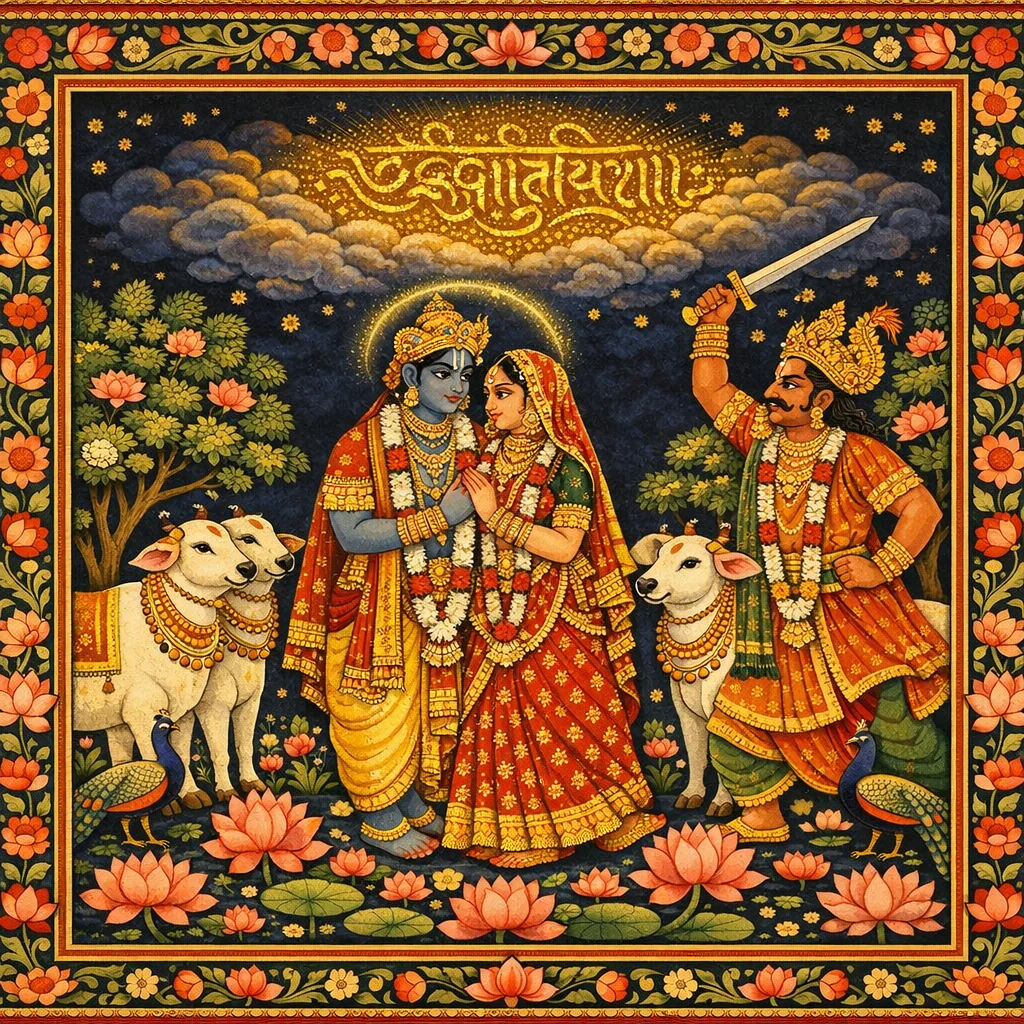
Continuing from the prior genealogical narrations of the Sūrya and Candra dynasties and the Yadu line, Mahārāja Parīkṣit pivots the discourse toward Kṛṣṇa-līlā, requesting a full account of Śrī Kṛṣṇa’s character and activities from birth to departure. He frames hari-kathā as paramparā-transmitted medicine for saṁsāra and recalls Kṛṣṇa’s saving grace—guiding the Pāṇḍavas through Kurukṣetra and protecting Parīkṣit in the womb from Aśvatthāmā’s weapon—thus setting a devotional and existential urgency. Parīkṣit also asks technical questions: Balarāma’s transfer from Devakī to Rohiṇī, Kṛṣṇa’s relocation to Vraja, His residence in Vṛndāvana/Mathurā, and the dharma-question of killing Kaṁsa. Śukadeva begins the avatāra context: Bhū-devī, overburdened by demonic rulers, approaches Brahmā; the devas worship Kṣīrodakaśāyī Viṣṇu at the Milk Ocean, receiving the command to take birth in the Yadu dynasty. The narrative then descends into Mathurā’s political crisis—Devakī’s marriage, the prophecy of Kaṁsa’s death by her eighth child, Vasudeva’s reasoning on death and transmigration, Kaṁsa’s duplicity, and the imprisonment and killing of Devakī’s children—ending with Kaṁsa’s tyrannical rule, setting the immediate stage for Kṛṣṇa’s appearance in the next chapter sequence.
Shlokas
Verse 1
श्रीराजोवाच कथितो वंशविस्तारो भवता सोमसूर्ययो: । राज्ञां चोभयवंश्यानां चरितं परमाद्भुतम् ॥ १ ॥
King Parīkṣit said: My dear lord, you have elaborately described the dynasties of both the moon-god and the sun-god, with the exalted and wonderful character of their kings.
Verse 2
यदोश्च धर्मशीलस्य नितरां मुनिसत्तम । तत्रांशेनावतीर्णस्य विष्णोर्वीर्याणि शंस न: ॥ २ ॥
O best of munis, you have also described the descendants of Yadu, who were very pious and strictly adherent to religious principles. Now, if you will, kindly describe the wonderful, glorious activities of Lord Viṣṇu, or Kṛṣṇa, who appeared in that Yadu dynasty with Baladeva, His plenary expansion.
Verse 3
अवतीर्य यदोर्वंशे भगवान् भूतभावन: । कृतवान् यानि विश्वात्मा तानि नो वद विस्तरात् ॥ ३ ॥
The Supersoul, the Supreme Personality of Godhead, Śrī Kṛṣṇa, the cause of the cosmic manifestation, appeared in the dynasty of Yadu. Please tell me elaborately about His glorious activities and character, from the beginning to the end of His life.
Verse 4
निवृत्ततर्षैरुपगीयमानाद्भवौषधाच्छ्रोत्रमनोऽभिरामात् । क उत्तमश्लोकगुणानुवादात्पुमान् विरज्येत विना पशुघ्नात् ॥ ४ ॥
Glorification of the Supreme Personality of Godhead is performed in the paramparā system, that is, it is conveyed from the spiritual master to disciple. Such glorification is relished by those no longer interested in the false, temporary glorification of this cosmic manifestation. Descriptions of the Lord are the right medicine for the conditioned soul undergoing repeated birth and death. Therefore, who will cease hearing such glorification of the Lord except a butcher or one who is killing his own self?
Verse 5
पितामहा मे समरेऽमरञ्जयै-र्देवव्रताद्यातिरथैस्तिमिङ्गिलै: । दूरत्ययं कौरवसैन्यसागरंकृत्वातरन् वत्सपदं स्म यत्प्लवा: ॥ ५ ॥ द्रौण्यस्त्रविप्लुष्टमिदं मदङ्गंसन्तानबीजं कुरुपाण्डवानाम् । जुगोप कुक्षिं गत आत्तचक्रोमातुश्च मे य: शरणं गताया: ॥ ६ ॥ वीर्याणि तस्याखिलदेहभाजा-मन्तर्बहि: पूरुषकालरूपै: । प्रयच्छतो मृत्युमुतामृतं चमायामनुष्यस्य वदस्व विद्वन् ॥ ७ ॥
Taking the boat of Kṛṣṇa’s lotus feet, my grandfather Arjuna and others crossed the ocean of the Battlefield of Kurukṣetra, in which such commanders as Bhīṣmadeva resembled great fish that could very easily have swallowed them. By the mercy of Lord Kṛṣṇa, my grandfathers crossed this ocean, which was very difficult to cross, as easily as one steps over the hoofprint of a calf. Because my mother surrendered unto Lord Kṛṣṇa’s lotus feet, the Lord, Sudarśana-cakra in hand, entered her womb and saved my body, the body of the last remaining descendant of the Kurus and the Pāṇḍavas, which was almost destroyed by the fiery weapon of Aśvatthāmā. Lord Śrī Kṛṣṇa, appearing within and outside of all materially embodied living beings by His own potency in the forms of eternal time — that is, as Paramātmā and as virāṭ-rūpa — gave liberation to everyone, either as cruel death or as life. Kindly enlighten me by describing His transcendental characteristics.
Verse 6
पितामहा मे समरेऽमरञ्जयै-र्देवव्रताद्यातिरथैस्तिमिङ्गिलै: । दूरत्ययं कौरवसैन्यसागरंकृत्वातरन् वत्सपदं स्म यत्प्लवा: ॥ ५ ॥ द्रौण्यस्त्रविप्लुष्टमिदं मदङ्गंसन्तानबीजं कुरुपाण्डवानाम् । जुगोप कुक्षिं गत आत्तचक्रोमातुश्च मे य: शरणं गताया: ॥ ६ ॥ वीर्याणि तस्याखिलदेहभाजा-मन्तर्बहि: पूरुषकालरूपै: । प्रयच्छतो मृत्युमुतामृतं चमायामनुष्यस्य वदस्व विद्वन् ॥ ७ ॥
Taking the boat of Kṛṣṇa’s lotus feet, my grandfather Arjuna and others crossed the ocean of the Battlefield of Kurukṣetra, in which such commanders as Bhīṣmadeva resembled great fish that could very easily have swallowed them. By the mercy of Lord Kṛṣṇa, my grandfathers crossed this ocean, which was very difficult to cross, as easily as one steps over the hoofprint of a calf. Because my mother surrendered unto Lord Kṛṣṇa’s lotus feet, the Lord, Sudarśana-cakra in hand, entered her womb and saved my body, the body of the last remaining descendant of the Kurus and the Pāṇḍavas, which was almost destroyed by the fiery weapon of Aśvatthāmā. Lord Śrī Kṛṣṇa, appearing within and outside of all materially embodied living beings by His own potency in the forms of eternal time — that is, as Paramātmā and as virāṭ-rūpa — gave liberation to everyone, either as cruel death or as life. Kindly enlighten me by describing His transcendental characteristics.
Verse 7
पितामहा मे समरेऽमरञ्जयै-र्देवव्रताद्यातिरथैस्तिमिङ्गिलै: । दूरत्ययं कौरवसैन्यसागरंकृत्वातरन् वत्सपदं स्म यत्प्लवा: ॥ ५ ॥ द्रौण्यस्त्रविप्लुष्टमिदं मदङ्गंसन्तानबीजं कुरुपाण्डवानाम् । जुगोप कुक्षिं गत आत्तचक्रोमातुश्च मे य: शरणं गताया: ॥ ६ ॥ वीर्याणि तस्याखिलदेहभाजा-मन्तर्बहि: पूरुषकालरूपै: । प्रयच्छतो मृत्युमुतामृतं चमायामनुष्यस्य वदस्व विद्वन् ॥ ७ ॥
Taking the boat of Kṛṣṇa’s lotus feet, my grandfather Arjuna and others crossed the ocean of the Battlefield of Kurukṣetra, in which such commanders as Bhīṣmadeva resembled great fish that could very easily have swallowed them. By the mercy of Lord Kṛṣṇa, my grandfathers crossed this ocean, which was very difficult to cross, as easily as one steps over the hoofprint of a calf. Because my mother surrendered unto Lord Kṛṣṇa’s lotus feet, the Lord, Sudarśana-cakra in hand, entered her womb and saved my body, the body of the last remaining descendant of the Kurus and the Pāṇḍavas, which was almost destroyed by the fiery weapon of Aśvatthāmā. Lord Śrī Kṛṣṇa, appearing within and outside of all materially embodied living beings by His own potency in the forms of eternal time — that is, as Paramātmā and as virāṭ-rūpa — gave liberation to everyone, either as cruel death or as life. Kindly enlighten me by describing His transcendental characteristics.
Verse 8
रोहिण्यास्तनय: प्रोक्तो राम: सङ्कर्षणस्त्वया । देवक्या गर्भसम्बन्ध: कुतो देहान्तरं विना ॥ ८ ॥
My dear Śukadeva Gosvāmī, you have already explained that Saṅkarṣaṇa, who belongs to the second quadruple, appeared as the son of Rohiṇī named Balarāma. If Balarāma was not transferred from one body to another, how is it possible that He was first in the womb of Devakī and then in the womb of Rohiṇī? Kindly explain this to me.
Verse 9
कस्मान्मुकुन्दो भगवान् पितुर्गेहाद् व्रजं गत: । क्व वासं ज्ञातिभि: सार्धं कृतवान् सात्वतांपति: ॥ ९ ॥
Why did Kṛṣṇa, the Supreme Personality of Godhead, leave the house of His father, Vasudeva, and transfer Himself to the house of Nanda in Vṛndāvana? Where did the Lord, the master of the Yadu dynasty, live with His relatives in Vṛndāvana?
Verse 10
व्रजे वसन् किमकरोन्मधुपुर्यां च केशव: । भ्रातरं चावधीत् कंसं मातुरद्धातदर्हणम् ॥ १० ॥
Lord Kṛṣṇa lived both in Vṛndāvana and in Mathurā. What did He do there? Why did He kill Kaṁsa, His mother’s brother? Such killing is not at all sanctioned in the śāstras.
Verse 11
देहं मानुषमाश्रित्य कति वर्षाणि वृष्णिभि: । यदुपुर्यां सहावात्सीत् पत्न्य: कत्यभवन् प्रभो: ॥ ११ ॥
Kṛṣṇa, the Supreme Personality of Godhead, has no material body, yet He appears as a human being. For how many years did He live with the descendants of Vṛṣṇi? How many wives did He marry, and for how many years did He live in Dvārakā?
Verse 12
एतदन्यच्च सर्वं मे मुने कृष्णविचेष्टितम् । वक्तुमर्हसि सर्वज्ञ श्रद्दधानाय विस्तृतम् ॥ १२ ॥
O great sage, who know everything about Kṛṣṇa, please describe in detail all the activities of which I have inquired and also those of which I have not, for I have full faith and am very eager to hear of them.
Verse 13
नैषातिदु:सहा क्षुन्मां त्यक्तोदमपि बाधते । पिबन्तं त्वन्मुखाम्भोजच्युतं हरिकथामृतम् ॥ १३ ॥
Because of my vow on the verge of death, I have given up even drinking water, yet because I am drinking the nectar of topics about Kṛṣṇa, which is flowing from the lotus mouth of your Lordship, my hunger and thirst, which are extremely difficult to bear, cannot hinder me.
Verse 14
सूत उवाच एवं निशम्य भृगुनन्दन साधुवादंवैयासकि: स भगवानथ विष्णुरातम् । प्रत्यर्च्य कृष्णचरितं कलिकल्मषघ्नंव्याहर्तुमारभत भागवतप्रधान: ॥ १४ ॥
Sūta Gosvāmī said: O son of Bhṛgu, after Śukadeva Gosvāmī, the most respectable devotee, the son of Vyāsadeva, heard the pious questions of Mahārāja Parīkṣit, he thanked the King with great respect. Then he began to discourse on topics concerning Kṛṣṇa, which are the remedy for all sufferings in this Age of Kali.
Verse 15
श्रीशुक उवाच सम्यग्व्यवसिता बुद्धिस्तव राजर्षिसत्तम । वासुदेवकथायां ते यज्जाता नैष्ठिकी रति: ॥ १५ ॥
Śrīla Śukadeva Gosvāmī said: O Your Majesty, best of all saintly kings, because you are greatly attracted to topics of Vāsudeva, it is certain that your intelligence is firmly fixed in spiritual understanding, which is the only true goal for humanity. Because that attraction is unceasing, it is certainly sublime.
Verse 16
वासुदेवकथाप्रश्न: पुरुषांस्त्रीन् पुनाति हि । वक्तारं प्रच्छकं श्रोतृंस्तत्पादसलिलं यथा ॥ १६ ॥
The Ganges, emanating from the toe of Lord Viṣṇu, purifies the three worlds, the upper, middle and lower planetary systems. Similarly, when one asks questions about the pastimes and characteristics of Lord Vāsudeva, Kṛṣṇa, three varieties of men are purified: the speaker or preacher, he who inquires, and the people in general who listen.
Verse 17
भूमिर्दृप्तनृपव्याजदैत्यानीकशतायुतै: । आक्रान्ता भूरिभारेण ब्रह्माणं शरणं ययौ ॥ १७ ॥
Once when mother earth was overburdened by hundreds of thousands of military phalanxes of various conceited demons dressed like kings, she approached Lord Brahmā for relief.
Verse 18
गौर्भूत्वाश्रुमुखी खिन्ना क्रन्दन्ती करुणं विभो: । उपस्थितान्तिके तस्मै व्यसनं समवोचत ॥ १८ ॥
Mother earth assumed the form of a cow. Very much distressed, with tears in her eyes, she appeared before Lord Brahmā and told him about her misfortune.
Verse 19
ब्रह्मा तदुपधार्याथ सह देवैस्तया सह । जगाम सत्रिनयनस्तीरं क्षीरपयोनिधे: ॥ १९ ॥
Thereafter, having heard of the distress of mother earth, Lord Brahmā, with mother earth, Lord Śiva and all the other demigods, approached the shore of the Ocean of Milk.
Verse 20
तत्र गत्वा जगन्नाथं देवदेवं वृषाकपिम् । पुरुषं पुरुषसूक्तेन उपतस्थे समाहित: ॥ २० ॥
After reaching the shore of the Ocean of Milk, the demigods worshiped the Supreme Personality of Godhead, Lord Viṣṇu, the master of the whole universe, the supreme God of all gods, who provides for everyone and diminishes everyone’s suffering. With great attention, they worshiped Lord Viṣṇu, who lies on the Ocean of Milk, by reciting the Vedic mantras known as the Puruṣa-sūkta.
Verse 21
गिरं समाधौ गगने समीरितांनिशम्य वेधास्त्रिदशानुवाच ह । गां पौरुषीं मे शृणुतामरा: पुन-र्विधीयतामाशु तथैव मा चिरम् ॥ २१ ॥
While in trance, Lord Brahmā heard the words of Lord Viṣṇu vibrating in the sky. Thus he told the demigods: O demigods, hear from me the order of Kṣīrodakaśāyī Viṣṇu, the Supreme Person, and execute it attentively without delay.
Verse 22
पुरैव पुंसावधृतो धराज्वरोभवद्भिरंशैर्यदुषूपजन्यताम् । स यावदुर्व्या भरमीश्वरेश्वर:स्वकालशक्त्या क्षपयंश्चरेद् भुवि ॥ २२ ॥
Lord Brahmā informed the demigods: Before we submitted our petition to the Lord, He was already aware of the distress on earth. Consequently, for as long as the Lord moves on earth to diminish its burden by His own potency in the form of time, all of you demigods should appear through plenary portions as sons and grandsons in the family of the Yadus.
Verse 23
वसुदेवगृहे साक्षाद् भगवान्पुरुष: पर: । जनिष्यते तत्प्रियार्थं सम्भवन्तु सुरस्त्रिय: ॥ २३ ॥
The Supreme Personality of Godhead, Śrī Kṛṣṇa, who has full potency, will personally appear as the son of Vasudeva. Therefore all the wives of the demigods should also appear in order to satisfy Him.
Verse 24
वासुदेवकलानन्त: सहस्रवदन: स्वराट् । अग्रतो भविता देवो हरे: प्रियचिकीर्षया ॥ २४ ॥
The foremost manifestation of Kṛṣṇa is Saṅkarṣaṇa, who is known as Ananta. He is the origin of all incarnations within this material world. Previous to the appearance of Lord Kṛṣṇa, this original Saṅkarṣaṇa will appear as Baladeva, just to please the Supreme Lord Kṛṣṇa in His transcendental pastimes.
Verse 25
विष्णोर्माया भगवती यया सम्मोहितं जगत् । आदिष्टा प्रभुणांशेन कार्यार्थे सम्भविष्यति ॥ २५ ॥
The potency of the Lord, known as viṣṇu-māyā, who is as good as the Supreme Personality of Godhead, will also appear with Lord Kṛṣṇa. This potency, acting in different capacities, captivates all the worlds, both material and spiritual. At the request of her master, she will appear with her different potencies in order to execute the work of the Lord.
Verse 26
श्रीशुक उवाच इत्यादिश्यामरगणान् प्रजापतिपतिर्विभु: । आश्वास्य च महीं गीर्भि: स्वधाम परमं ययौ ॥ २६ ॥
Śukadeva Gosvāmī continued: After thus advising the demigods and pacifying mother earth, the very powerful Lord Brahmā, who is the master of all other Prajāpatis and is therefore known as Prajāpati-pati, returned to his own abode, Brahmaloka.
Verse 27
शूरसेनो यदुपतिर्मथुरामावसन् पुरीम् । माथुराञ्छूरसेनांश्च विषयान् बुभुजे पुरा ॥ २७ ॥
Formerly, Śūrasena, the chief of the Yadu dynasty, had gone to live in the city of Mathurā. There he enjoyed the places known as Māthura and Śūrasena.
Verse 28
राजधानी तत: साभूत्सर्वयादवभूभुजाम् । मथुरा भगवान् यत्र नित्यं सन्निहितो हरि: ॥ २८ ॥
Since that time, the city of Mathurā had been the capital of all the kings of the Yadu dynasty. The city and district of Mathurā are very intimately connected with Kṛṣṇa, for Lord Kṛṣṇa lives there eternally.
Verse 29
तस्यां तु कर्हिचिच्छौरिर्वसुदेव: कृतोद्वह: । देवक्या सूर्यया सार्धं प्रयाणे रथमारुहत् ॥ २९ ॥
Some time ago, Vasudeva, who belonged to the demigod family [or to the Śūra dynasty], married Devakī. After the marriage, he mounted his chariot to return home with his newly married wife.
Verse 30
उग्रसेनसुत: कंस: स्वसु: प्रियचिकीर्षया । रश्मीन् हयानां जग्राह रौक्मै रथशतैर्वृत: ॥ ३० ॥
Kaṁsa, the son of King Ugrasena, in order to please his sister Devakī on the occasion of her marriage, took charge of the reins of the horses and became the chariot driver. He was surrounded by hundreds of golden chariots.
Verse 31
चतु:शतं पारिबर्हं गजानां हेममालिनाम् । अश्वानामयुतं सार्धं रथानां च त्रिषट्शतम् ॥ ३१ ॥ दासीनां सुकुमारीणां द्वे शते समलङ्कृते । दुहित्रे देवक: प्रादाद् याने दुहितृवत्सल: ॥ ३२ ॥
Devakī’s father, King Devaka, was very much affectionate to his daughter. Therefore, while she and her husband were leaving home, he gave her a dowry of four hundred elephants nicely decorated with golden garlands. He also gave ten thousand horses, eighteen hundred chariots, and two hundred very beautiful young maidservants, fully decorated with ornaments.
Verse 32
चतु:शतं पारिबर्हं गजानां हेममालिनाम् । अश्वानामयुतं सार्धं रथानां च त्रिषट्शतम् ॥ ३१ ॥ दासीनां सुकुमारीणां द्वे शते समलङ्कृते । दुहित्रे देवक: प्रादाद् याने दुहितृवत्सल: ॥ ३२ ॥
Devakī’s father, King Devaka, was very much affectionate to his daughter. Therefore, while she and her husband were leaving home, he gave her a dowry of four hundred elephants nicely decorated with golden garlands. He also gave ten thousand horses, eighteen hundred chariots, and two hundred very beautiful young maidservants, fully decorated with ornaments.
Verse 33
शङ्खतूर्यमृदङ्गाश्च नेदुर्दुन्दुभय: समम् । प्रयाणप्रक्रमे तात वरवध्वो: सुमङ्गलम् ॥ ३३ ॥
O beloved son, Mahārāja Parīkṣit, when the bride and bridegroom were ready to start, conchshells, bugles, drums and kettledrums all vibrated in concert for their auspicious departure.
Verse 34
पथि प्रग्रहिणं कंसमाभाष्याहाशरीरवाक् । अस्यास्त्वामष्टमो गर्भो हन्ता यां वहसेऽबुध ॥ ३४ ॥
While Kaṁsa, controlling the reins of the horses, was driving the chariot along the way, an unembodied voice addressed him, “You foolish rascal, the eighth child of the woman you are carrying will kill you!”
Verse 35
इत्युक्त: स खल: पापो भोजानां कुलपांसन: । भगिनीं हन्तुमारब्धं खड्गपाणि: कचेऽग्रहीत् ॥ ३५ ॥
Kaṁsa was a condemned personality in the Bhoja dynasty because he was envious and sinful. Therefore, upon hearing this omen from the sky, he caught hold of his sister’s hair with his left hand and took up his sword with his right hand to sever her head from her body.
Verse 36
तं जुगुप्सितकर्माणं नृशंसं निरपत्रपम् । वसुदेवो महाभाग उवाच परिसान्त्वयन् ॥ ३६ ॥
Wanting to pacify Kaṁsa, who was so cruel and envious that he was shamelessly ready to kill his sister, the great soul Vasudeva, who was to be the father of Kṛṣṇa, spoke to him in the following words.
Verse 37
श्रीवसुदेव उवाच श्लाघनीयगुण: शूरैर्भवान् भोजयशस्कर: । स कथं भगिनीं हन्यात् स्त्रियमुद्वाहपर्वणि ॥ ३७ ॥
Vasudeva said: My dear brother-in-law Kaṁsa, you are the pride of your family, the Bhoja dynasty, and great heroes praise your qualities. How could such a qualified person as you kill a woman, your own sister, especially on the occasion of her marriage?
Verse 38
मृत्युर्जन्मवतां वीर देहेन सह जायते । अद्य वाब्दशतान्ते वा मृत्युर्वै प्राणिनां ध्रुव: ॥ ३८ ॥
O great hero, one who takes birth is sure to die, for death is born with the body. One may die today or after hundreds of years, but death is sure for every living entity.
Verse 39
देहे पञ्चत्वमापन्ने देही कर्मानुगोऽवश: । देहान्तरमनुप्राप्य प्राक्तनं त्यजते वपु: ॥ ३९ ॥
When the present body turns to dust and is again reduced to five elements — earth, water, fire, air and ether — the proprietor of the body, the living being, automatically receives another body of material elements according to his fruitive activities. When the next body is obtained, he gives up the present body.
Verse 40
व्रजंस्तिष्ठन् पदैकेन यथैवैकेन गच्छति । यथा तृणजलौकैवं देही कर्मगतिं गत: ॥ ४० ॥
Just as a person traveling on the road rests one foot on the ground and then lifts the other, or as a worm on a vegetable transfers itself to one leaf and then gives up the previous one, the conditioned soul takes shelter of another body and then gives up the one he had before.
Verse 41
स्वप्ने यथा पश्यति देहमीदृशंमनोरथेनाभिनिविष्टचेतन: । दृष्टश्रुताभ्यां मनसानुचिन्तयन्प्रपद्यते तत् किमपि ह्यपस्मृति: ॥ ४१ ॥
Having experienced a situation by seeing or hearing about it, one contemplates and speculates about that situation, and thus one surrenders to it, not considering his present body. Similarly, by mental adjustments one dreams at night of living under different circumstances, in different bodies, and forgets his actual position. Under this same process, one gives up his present body and accepts another [tathā dehāntara-prāptiḥ].
Verse 42
यतो यतो धावति दैवचोदितंमनो विकारात्मकमाप पञ्चसु । गुणेषु मायारचितेषु देह्यसौप्रपद्यमान: सह तेन जायते ॥ ४२ ॥
At the time of death, according to the thinking, feeling and willing of the mind, which is involved in fruitive activities, one receives a particular body. In other words, the body develops according to the activities of the mind. Changes of body are due to the flickering of the mind, for otherwise the soul could remain in its original, spiritual body.
Verse 43
ज्योतिर्यथैवोदकपार्थिवेष्वद:समीरवेगानुगतं विभाव्यते । एवं स्वमायारचितेष्वसौ पुमान्गुणेषु रागानुगतो विमुह्यति ॥ ४३ ॥
When the luminaries in the sky, such as the moon, the sun and the stars, are reflected in liquids like oil or water, they appear to be of different shapes — sometimes round, sometimes long, and so on — because of the movements of the wind. Similarly, when the living entity, the soul, is absorbed in materialistic thoughts, he accepts various manifestations as his own identity because of ignorance. In other words, one is bewildered by mental concoctions because of agitation from the material modes of nature.
Verse 44
तस्मान् कस्यचिद्द्रोहमाचरेत् स तथाविध: । आत्मन: क्षेममन्विच्छन् द्रोग्धुर्वै परतो भयम् ॥ ४४ ॥
Therefore, since envious, impious activities cause a body in which one suffers in the next life, why should one act impiously? Considering one’s welfare, one should not envy anyone, for an envious person must always fear harm from his enemies, either in this life or in the next.
Verse 45
एषा तवानुजा बाला कृपणा पुत्रिकोपमा । हन्तुं नार्हसि कल्याणीमिमां त्वं दीनवत्सल: ॥ ४५ ॥
As your younger sister, this poor girl Devakī is like your own daughter and deserves to be affectionately maintained. You are merciful, and therefore you should not kill her. Indeed, she deserves your affection.
Verse 46
श्रीशुक उवाच एवं स सामभिर्भेदैर्बोध्यमानोऽपि दारुण: । न न्यवर्तत कौरव्य पुरुषादाननुव्रत: ॥ ४६ ॥
Śukadeva Gosvāmī continued: O best of the Kuru dynasty, Kaṁsa was fiercely cruel and was actually a follower of the Rākṣasas. Therefore he could be neither pacified nor terrified by the good instructions given by Vasudeva. He did not care about the results of sinful activities, either in this life or in the next.
Verse 47
निर्बन्धं तस्य तं ज्ञात्वा विचिन्त्यानकदुन्दुभि: । प्राप्तं कालं प्रतिव्योढुमिदं तत्रान्वपद्यत ॥ ४७ ॥
When Vasudeva saw that Kaṁsa was determined to kill his sister Devakī, he thought to himself very deeply. Considering the imminent danger of death, he thought of another plan to stop Kaṁsa.
Verse 48
मृत्युर्बुद्धिमतापोह्यो यावद्बुद्धिबलोदयम् । यद्यसौ न निवर्तेत नापराधोऽस्ति देहिन: ॥ ४८ ॥
As long as he has intelligence and bodily strength, an intelligent person must try to avoid death. This is the duty of every embodied person. But if death cannot be avoided in spite of one’s endeavors, a person facing death commits no offense.
Verse 49
प्रदाय मृत्यवे पुत्रान् मोचये कृपणामिमाम् । सुता मे यदि जायेरन् मृत्युर्वा न म्रियेत चेत् ॥ ४९ ॥ विपर्ययो वा किं न स्याद् गतिर्धातुर्दुरत्यया । उपस्थितो निवर्तेत निवृत्त: पुनरापतेत् ॥ ५० ॥
Vasudeva considered: By delivering all my sons to Kaṁsa, who is death personified, I shall save the life of Devakī. Perhaps Kaṁsa will die before my sons take birth, or, since he is already destined to die at the hands of my son, one of my sons may kill him. For the time being, let me promise to hand over my sons so that Kaṁsa will give up this immediate threat, and if in due course of time Kaṁsa dies, I shall have nothing to fear.
Verse 50
प्रदाय मृत्यवे पुत्रान् मोचये कृपणामिमाम् । सुता मे यदि जायेरन् मृत्युर्वा न म्रियेत चेत् ॥ ४९ ॥ विपर्ययो वा किं न स्याद् गतिर्धातुर्दुरत्यया । उपस्थितो निवर्तेत निवृत्त: पुनरापतेत् ॥ ५० ॥
Vasudeva considered: By delivering all my sons to Kaṁsa, who is death personified, I shall save the life of Devakī. Perhaps Kaṁsa will die before my sons take birth, or, since he is already destined to die at the hands of my son, one of my sons may kill him. For the time being, let me promise to hand over my sons so that Kaṁsa will give up this immediate threat, and if in due course of time Kaṁsa dies, I shall have nothing to fear.
Verse 51
अग्नेर्यथा दारुवियोगयोगयो-रदृष्टतोऽन्यन्न निमित्तमस्ति । एवं हि जन्तोरपि दुर्विभाव्य:शरीरसंयोगवियोगहेतु: ॥ ५१ ॥
When a fire, for some unseen reason, leaps over one piece of wood and sets fire to the next, the reason is destiny. Similarly, when a living being accepts one kind of body and leaves aside another, there is no other reason than unseen destiny.
Verse 52
एवं विमृश्य तं पापं यावदात्मनिदर्शनम् । पूजयामास वै शौरिर्बहुमानपुर:सरम् ॥ ५२ ॥
After thus considering the matter as far as his knowledge would allow, Vasudeva submitted his proposal to the sinful Kaṁsa with great respect.
Verse 53
प्रसन्नवदनाम्भोजो नृशंसं निरपत्रपम् । मनसा दूयमानेन विहसन्निदमब्रवीत् ॥ ५३ ॥
Vasudeva’s mind was full of anxiety because his wife was facing danger, but in order to please the cruel, shameless and sinful Kaṁsa, he externally smiled and spoke to him as follows.
Verse 54
श्रीवसुदेव उवाच न ह्यस्यास्ते भयं सौम्य यद् वैसाहाशरीरवाक् । पुत्रान् समर्पयिष्येऽस्या यतस्ते भयमुत्थितम् ॥ ५४ ॥
Vasudeva said: O best of the sober, you have nothing to fear from your sister Devakī because of what you have heard from the unseen omen. The cause of death will be her sons. Therefore I promise that when she gives birth to the sons from whom your fear has arisen, I shall deliver them all unto your hands.
Verse 55
श्रीशुक उवाच स्वसुर्वधान्निववृते कंसस्तद्वाक्यसारवित् । वसुदेवोऽपि तं प्रीत: प्रशस्य प्राविशद् गृहम् ॥ ५५ ॥
Śrīla Śukadeva Gosvāmī continued: Kaṁsa agreed to the logical arguments of Vasudeva, and, having full faith in Vasudeva’s words, he refrained from killing his sister. Vasudeva, being pleased with Kaṁsa, pacified him further and entered his own house.
Verse 56
अथ काल उपावृत्ते देवकी सर्वदेवता । पुत्रान् प्रसुषुवे चाष्टौ कन्यां चैवानुवत्सरम् ॥ ५६ ॥
Each year thereafter, in due course of time, Devakī, the mother of God and all the demigods, gave birth to a child. Thus she bore eight sons, one after another, and a daughter named Subhadrā.
Verse 57
कीर्तिमन्तं प्रथमजं कंसायानकदुन्दुभि: । अर्पयामास कृच्छ्रेण सोऽनृतादतिविह्वल: ॥ ५७ ॥
Vasudeva was very much disturbed by fear of becoming a liar by breaking his promise. Thus with great pain he delivered his first-born son, named Kīrtimān, into the hands of Kaṁsa.
Verse 58
किं दु:सहं नु साधूनां विदुषां किमपेक्षितम् । किमकार्यं कदर्याणां दुस्त्यजं किं धृतात्मनाम् ॥ ५८ ॥
What is painful for saintly persons who strictly adhere to the truth? How could there not be independence for pure devotees who know the Supreme Lord as the substance? What deeds are forbidden for persons of the lowest character? And what cannot be given up for the sake of Lord Kṛṣṇa by those who have fully surrendered at His lotus feet?
Verse 59
दृष्ट्वा समत्वं तच्छौरे: सत्ये चैव व्यवस्थितिम् । कंसस्तुष्टमना राजन् प्रहसन्निदमब्रवीत् ॥ ५९ ॥
My dear King Parīkṣit, when Kaṁsa saw that Vasudeva, being situated in truthfulness, was completely equipoised in giving him the child, he was very happy. Therefore, with a smiling face, he spoke as follows.
Verse 60
प्रतियातु कुमारोऽयं न ह्यस्मादस्ति मे भयम् । अष्टमाद् युवयोर्गर्भान्मृत्युर्मे विहित: किल ॥ ६० ॥
O Vasudeva, you may take back your child and go home. I have no fear of your first child. It is the eighth child of you and Devakī I am concerned with because that is the child by whom I am destined to be killed.
Verse 61
तथेति सुतमादाय ययावानकदुन्दुभि: । नाभ्यनन्दत तद्वाक्यमसतोऽविजितात्मन: ॥ ६१ ॥
Vasudeva agreed and took his child back home, but because Kaṁsa had no character and no self-control, Vasudeva knew that he could not rely on Kaṁsa’s word.
Verse 62
नन्दाद्या ये व्रजे गोपा याश्चामीषां च योषित: । वृष्णयो वसुदेवाद्या देवक्याद्या यदुस्त्रिय: ॥ ६२ ॥ सर्वे वै देवताप्राया उभयोरपि भारत । ज्ञातयो बन्धुसुहृदो ये च कंसमनुव्रता: ॥ ६३ ॥
The inhabitants of Vṛndāvana, headed by Nanda Mahārāja and including his associate cowherd men and their wives, were none but denizens of the heavenly planets, O Mahārāja Parīkṣit, best of the descendants of Bharata, and so too were the descendants of the Vṛṣṇi dynasty, headed by Vasudeva and Devakī and the other women of the dynasty of Yadu. The friends, relatives and well-wishers of both Nanda Mahārāja and Vasudeva and even those who externally appeared to be followers of Kaṁsa were all demigods.
Verse 63
नन्दाद्या ये व्रजे गोपा याश्चामीषां च योषित: । वृष्णयो वसुदेवाद्या देवक्याद्या यदुस्त्रिय: ॥ ६२ ॥ सर्वे वै देवताप्राया उभयोरपि भारत । ज्ञातयो बन्धुसुहृदो ये च कंसमनुव्रता: ॥ ६३ ॥
The inhabitants of Vṛndāvana, headed by Nanda Mahārāja and including his associate cowherd men and their wives, were none but denizens of the heavenly planets, O Mahārāja Parīkṣit, best of the descendants of Bharata, and so too were the descendants of the Vṛṣṇi dynasty, headed by Vasudeva and Devakī and the other women of the dynasty of Yadu. The friends, relatives and well-wishers of both Nanda Mahārāja and Vasudeva and even those who externally appeared to be followers of Kaṁsa were all demigods.
Verse 64
एतत् कंसाय भगवाञ्छशंसाभ्येत्य नारद: । भूमेर्भारायमाणानां दैत्यानां च वधोद्यमम् ॥ ६४ ॥
Once the great saint Nārada approached Kaṁsa and informed him of how the demoniac persons who were a great burden on the earth were going to be killed. Thus Kaṁsa was placed into great fear and doubt.
Verse 65
ऋषेर्विनिर्गमे कंसो यदून् मत्वा सुरानिति । देवक्या गर्भसम्भूतं विष्णुं च स्ववधं प्रति ॥ ६५ ॥ देवकीं वसुदेवं च निगृह्य निगडैर्गृहे । जातं जातमहन् पुत्रं तयोरजनशङ्कया ॥ ६६ ॥
After the departure of the great saint Nārada, Kaṁsa thought that all the members of the Yadu dynasty were demigods and that any of the children born from the womb of Devakī might be Viṣṇu. Fearing his death, Kaṁsa arrested Vasudeva and Devakī and chained them with iron shackles. Suspecting each of the children to be Viṣṇu, Kaṁsa killed them one after another because of the prophecy that Viṣṇu would kill him.
Verse 66
ऋषेर्विनिर्गमे कंसो यदून् मत्वा सुरानिति । देवक्या गर्भसम्भूतं विष्णुं च स्ववधं प्रति ॥ ६५ ॥ देवकीं वसुदेवं च निगृह्य निगडैर्गृहे । जातं जातमहन् पुत्रं तयोरजनशङ्कया ॥ ६६ ॥
After the departure of the great saint Nārada, Kaṁsa thought that all the members of the Yadu dynasty were demigods and that any of the children born from the womb of Devakī might be Viṣṇu. Fearing his death, Kaṁsa arrested Vasudeva and Devakī and chained them with iron shackles. Suspecting each of the children to be Viṣṇu, Kaṁsa killed them one after another because of the prophecy that Viṣṇu would kill him.
Verse 67
मातरं पितरं भ्रातृन् सर्वांश्च सुहृदस्तथा । घ्नन्ति ह्यसुतृपो लुब्धा राजान: प्रायशो भुवि ॥ ६७ ॥
Kings greedy for sense gratification on this earth almost always kill their enemies indiscriminately. To satisfy their own whims, they may kill anyone, even their mothers, fathers, brothers or friends.
Verse 68
आत्मानमिह सञ्जातं जानन्प्राग् विष्णुना हतम् । महासुरं कालनेमिं यदुभि: स व्यरुध्यत ॥ ६८ ॥
In his previous birth, Kaṁsa had been a great demon named Kālanemi and been killed by Viṣṇu. Upon learning this information from Nārada, Kaṁsa became envious of everyone connected with the Yadu dynasty.
Verse 69
उग्रसेनं च पितरं यदुभोजान्धकाधिपम् । स्वयं निगृह्य बुभुजे शूरसेनान् महाबल: ॥ ६९ ॥
Kaṁsa, the most powerful son of Ugrasena, even imprisoned his own father, the King of the Yadu, Bhoja and Andhaka dynasties, and personally ruled the states known as Śūrasena.
Frequently Asked Questions
Parīkṣit treats Kṛṣṇa-kathā as the direct remedy for saṁsāra (repeated birth and death) and as the consummation of paramparā knowledge. Facing imminent death, he demonstrates the Bhagavata’s ideal: exclusive absorption in Vāsudeva through hearing, which eclipses bodily hunger and thirst and fixes consciousness in the true goal (puruṣārtha) of liberation through bhakti.
Kaṁsa’s reaction to the prophecy shows adharma rooted in envy and fear: he is ready to murder his own sister, violating basic kṣatriya and human ethics. Vasudeva counters with dharmic reasoning—inevitability of death, transmigration, and the karmic consequences of envy—yet Kaṁsa’s rākṣasa-like disposition makes him indifferent to sin, illustrating how power divorced from dharma becomes destructive.
The chapter states that many associates in the Yadu-Vṛṣṇi line and Vraja community are devas taking birth by Viṣṇu’s order to assist the Lord’s mission of reducing the earth’s burden and participating in His līlā. This frames Kṛṣṇa’s advent as a coordinated cosmic event (poṣaṇa/rakṣā) while preserving the intimacy of humanlike relationships central to līlā.
In many transmitted editions and compiled datasets, repetitions can appear due to recension overlaps, formatting duplication, or editorial aggregation. Interpreting the chapter’s intent, the repeated passage reinforces Parīkṣit’s personal indebtedness to Kṛṣṇa’s protection and his urgency to hear the Lord’s transcendental qualities.