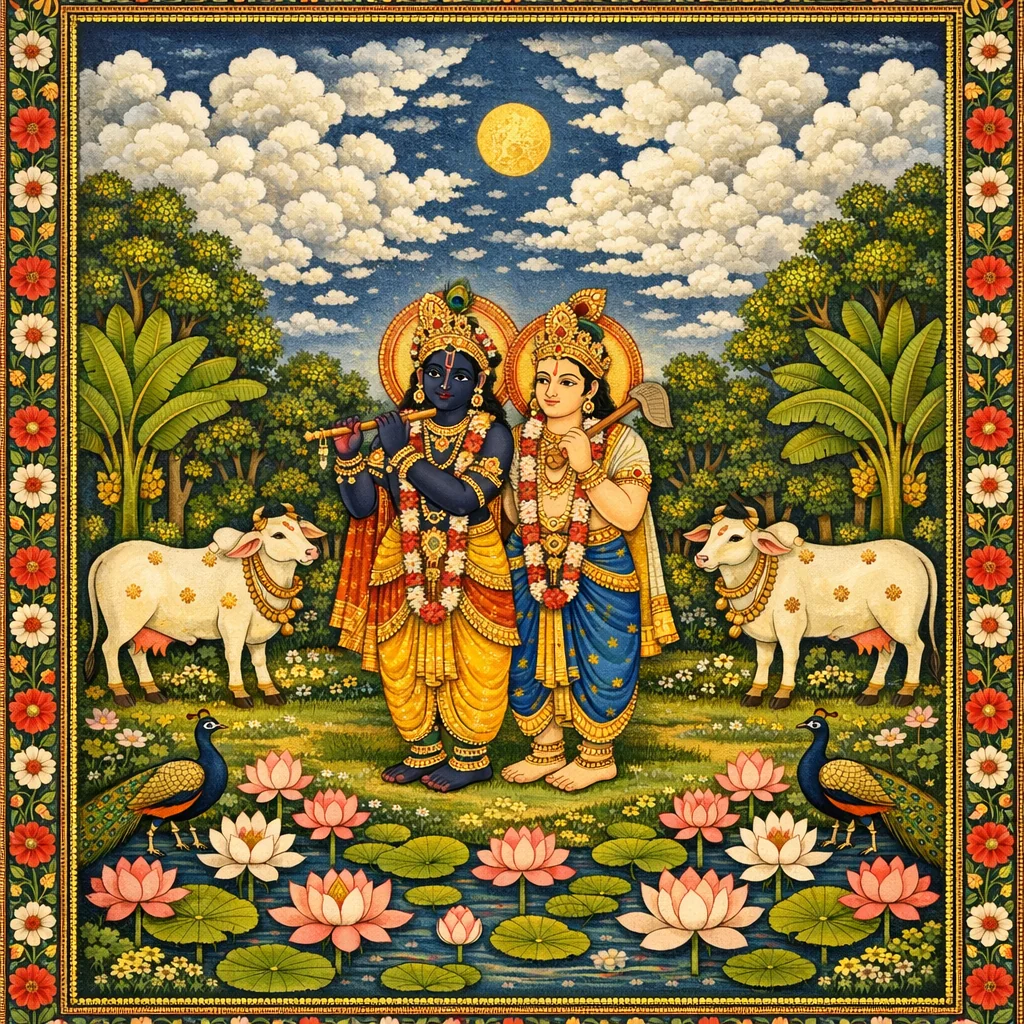
Adhyaya 20
Varṣā-Śarad Vṛndāvana-Śobha: The Beauty of the Rainy and Autumn Seasons in Vraja
After the cowherd boys recount to the Vraja elders Kṛṣṇa and Balarāma’s deliverance from the forest fire and the slaying of Pralamba, the community marvels and intuits Their divinity. The narration then shifts into an extended, didactic description of varṣā (rainy season) in Vṛndāvana, where each natural phenomenon becomes an upamā (spiritual analogy) for guṇas, false ego, Kali-yuga distortions, discipline, charity, and bhakti’s beautifying power. As Kṛṣṇa and Balarāma roam the refreshed forest with cows and friends—resting in caves, eating simple meals, and honoring the season as an expansion of internal potency—the text subtly frames nature as a theater of īśānukathā (God-centered narration). The chapter transitions into śarad (autumn): skies clear, waters purify, and lotus blooms mirror the cleansing effects of devotional service and wisdom. This seasonal movement prepares the narrative mood for forthcoming Vraja episodes by intensifying beauty, fertility, and festival life, while also foreshadowing how separation and union will be experienced against Vṛndāvana’s changing rhythms.
Shlokas
Verse 1
श्रीशुक उवाच तयोस्तदद्भुतं कर्म दावाग्नेर्मोक्षमात्मन: । गोपा: स्त्रीभ्य: समाचख्यु: प्रलम्बवधमेव च ॥ १ ॥
Śukadeva Gosvāmī said:To the ladies of Vṛndāvana, the cowherd boys then related in full detail Kṛṣṇa’s and Balarāma’s wonderful activities of delivering them from the forest fire and killing the demon Pralamba.
Verse 2
गोपवृद्धाश्च गोप्यश्च तदुपाकर्ण्य विस्मिता: । मेनिरे देवप्रवरौ कृष्णरामौ व्रजं गतौ ॥ २ ॥
The elder cowherd men and ladies were amazed to hear this account, and they concluded that Kṛṣṇa and Balarāma must be exalted demigods who had appeared in Vṛndāvana.
Verse 3
तत: प्रावर्तत प्रावृट् सर्वसत्त्वसमुद्भवा । विद्योतमानपरिधिर्विस्फूर्जितनभस्तला ॥ ३ ॥
Then the rainy season began, giving life and sustenance to all living beings. The sky began to rumble with thunder, and lightning flashed on the horizon.
Verse 4
सान्द्रनीलाम्बुदैर्व्योम सविद्युत्स्तनयित्नुभि: । अस्पष्टज्योतिराच्छन्नं ब्रह्मेव सगुणं बभौ ॥ ४ ॥
The sky was then covered by dense blue clouds accompanied by lightning and thunder. Thus the sky and its natural illumination were covered in the same way that the spirit soul is covered by the three modes of material nature.
Verse 5
अष्टौ मासान् निपीतं यद् भूम्याश्चोदमयं वसु । स्वगोभिर्मोक्तुमारेभे पर्जन्य: काल आगते ॥ ५ ॥
With its rays, the sun had for eight months drunk up the earth’s wealth in the form of water. Now that the proper time had arrived, the sun began releasing this accumulated wealth.
Verse 6
तडिद्वन्तो महामेघाश्चण्डश्वसनवेपिता: । प्रीणनं जीवनं ह्यस्य मुमुचु: करुणा इव ॥ ६ ॥
Flashing with lightning, great clouds were shaken and swept about by fierce winds. Just like merciful persons, the clouds gave their lives for the pleasure of this world.
Verse 7
तप:कृशा देवमीढा आसीद् वर्षीयसी मही । यथैव काम्यतपसस्तनु: सम्प्राप्य तत्फलम् ॥ ७ ॥
The earth had been emaciated by the summer heat, but she became fully nourished again when moistened by the god of rain. Thus the earth was like a person whose body has been emaciated by austerities undergone for a material purpose, but who again becomes fully nourished when he achieves the fruit of those austerities.
Verse 8
निशामुखेषु खद्योतास्तमसा भान्ति न ग्रहा: । यथा पापेन पाषण्डा न हि वेदा: कलौ युगे ॥ ८ ॥
In the evening twilight during the rainy season, the darkness allowed the glowworms but not the stars to shine forth, just as in the Age of Kali the predominance of sinful activities allows atheistic doctrines to overshadow the true knowledge of the Vedas.
Verse 9
श्रुत्वा पर्जन्यनिनदं मण्डुका: ससृजुर्गिर: । तूष्णीं शयाना: प्राग् यद्वद्ब्राह्मणा नियमात्यये ॥ ९ ॥
The frogs, who had all along been lying silent, suddenly began croaking when they heard the rumbling of the rain clouds, in the same way that brāhmaṇa students, who perform their morning duties in silence begin reciting their lessons when called by their teacher.
Verse 10
आसन्नुत्पथगामिन्य: क्षुद्रनद्योऽनुशुष्यती: । पुंसो यथास्वतन्त्रस्य देहद्रविणसम्पद: ॥ १० ॥
With the advent of the rainy season, the insignificant streams, which had become dry, began to swell and then strayed from their proper courses, like the body, property and money of a man controlled by the urges of his senses.
Verse 11
हरिता हरिभि: शष्पैरिन्द्रगोपैश्च लोहिता । उच्छिलीन्ध्रकृतच्छाया नृणां श्रीरिव भूरभूत् ॥ ११ ॥
The newly grown grass made the earth emerald green, the indragopa insects added a reddish hue, and white mushrooms added further color and circles of shade. Thus the earth appeared like a person who has suddenly become rich.
Verse 12
क्षेत्राणि शष्यसम्पद्भि: कर्षकाणां मुदं ददु: । मानिनामनुतापं वै दैवाधीनमजानताम् ॥ १२ ॥
With their wealth of grains, the fields gave joy to the farmers. But those fields created remorse in the hearts of those who were too proud to engage in farming and who failed to understand how everything is under the control of the Supreme.
Verse 13
जलस्थलौकस: सर्वे नववारिनिषेवया । अबिभ्रन् रुचिरं रूपं यथा हरिनिषेवया ॥ १३ ॥
As all creatures of the land and water took advantage of the newly fallen rainwater, their forms became attractive and pleasing, just as a devotee becomes beautiful by engaging in the service of the Supreme Lord.
Verse 14
सरिद्भि: सङ्गत: सिन्धुश्चुक्षोभ श्वसनोर्मिमान् । अपक्वयोगिनश्चित्तं कामाक्तं गुणयुग् यथा ॥ १४ ॥
Where the rivers joined the ocean it became agitated, its waves blown about by the wind, just as the mind of an immature yogī becomes agitated because he is still tainted by lust and attached to the objects of sense gratification.
Verse 15
गिरयो वर्षधाराभिर्हन्यमाना न विव्यथु: । अभिभूयमाना व्यसनैर्यथाधोक्षजचेतस: ॥ १५ ॥
Just as devotees whose minds are absorbed in the Personality of Godhead remain peaceful even when attacked by all sorts of dangers, the mountains in the rainy season were not at all disturbed by the repeated striking of the rain-bearing clouds.
Verse 16
मार्गा बभूवु: सन्दिग्धस्तृणैश्छन्ना ह्यसंस्कृता: । नाभ्यस्यमाना: श्रुतयो द्विजै: कालेन चाहता: ॥ १६ ॥
During the rainy season the roads, not being cleansed, became covered with grass and debris and were thus difficult to make out. These roads were like religious scriptures that brāhmaṇas no longer study and that thus become corrupted and covered over with the passage of time.
Verse 17
लोकबन्धुषु मेघेषु विद्युतश्चलसौहृदा: । स्थैर्यं न चक्रु: कामिन्य: पुरुषेषु गुणिष्विव ॥ १७ ॥
Though the clouds are the well-wishing friends of all living beings, the lightning, fickle in its affinities, moved from one group of clouds to another, like lusty women unfaithful even to virtuous men.
Verse 18
धनुर्वियति माहेन्द्रं निर्गुणं च गुणिन्यभात् । व्यक्ते गुणव्यतिकरेऽगुणवान् पुरुषो यथा ॥ १८ ॥
When the curved bow of Indra [the rainbow] appeared in the sky, which had the quality of thundering sound, it was unlike ordinary bows because it did not rest upon a string. Similarly, when the Supreme Lord appears in this world, which is the interaction of the material qualities, He is unlike ordinary persons because He remains free from all material qualities and independent of all material conditions.
Verse 19
न रराजोडुपश्छन्न: स्वज्योत्स्नाराजितैर्घनै: । अहंमत्या भासितया स्वभासा पुरुषो यथा ॥ १९ ॥
During the rainy season the moon was prevented from appearing directly by the covering of the clouds, which were themselves illumined by the moon’s rays. Similarly, the living being in material existence is prevented from appearing directly by the covering of the false ego, which is itself illumined by the consciousness of the pure soul.
Verse 20
मेघागमोत्सवा हृष्टा: प्रत्यनन्दञ्छिखण्डिन: । गृहेषु तप्तनिर्विण्णा यथाच्युतजनागमे ॥ २० ॥
The peacocks became festive and cried out a joyful greeting when they saw the clouds arrive, just as people distressed in household life feel pleasure when the pure devotees of the infallible Supreme Lord visit them.
Verse 21
पीत्वाप: पादपा: पद्भिरासन्नानात्ममूर्तय: । प्राक् क्षामास्तपसा श्रान्ता यथा कामानुसेवया ॥ २१ ॥
The trees had grown thin and dry, but after they drank the newly fallen rainwater through their feet, their various bodily features blossomed. Similarly, one whose body has grown thin and weak from austerity again exhibits his healthy bodily features upon enjoying the material objects gained through that austerity.
Verse 22
सर:स्वशान्तरोध:सु न्यूषुरङ्गापि सारसा: । गृहेष्वशान्तकृत्येषु ग्राम्या इव दुराशया: ॥ २२ ॥
The cranes continued dwelling on the shores of the lakes, although the shores were agitated during the rainy season, just as materialistic persons with contaminated minds always remain at home, despite the many disturbances there.
Verse 23
जलौघैर्निरभिद्यन्त सेतवो वर्षतीश्वरे । पाषण्डिनामसद्वादैर्वेदमार्गा: कलौ यथा ॥ २३ ॥
When Indra sent forth his rains, the floodwaters broke through the irrigation dikes in the agricultural fields, just as in the Kali-yuga the atheists’ false theories break down the boundaries of Vedic injunctions.
Verse 24
व्यमुञ्चन् वायुभिर्नुन्ना भूतेभ्यश्चामृतं घना: । यथाशिषो विश्पतय: काले काले द्विजेरिता: ॥ २४ ॥
The clouds, impelled by the winds, released their nectarean water for the benefit of all living beings, just as kings, instructed by their brāhmaṇa priests, dispense charity to the citizens.
Verse 25
एवं वनं तद् वर्षिष्ठं पक्वखर्जुरजम्बुमत् । गोगोपालैर्वृतो रन्तुं सबल: प्राविशद्धरि: ॥ २५ ॥
When the Vṛndāvana forest had thus become resplendent, filled with ripe dates and jambu fruits, Lord Kṛṣṇa, surrounded by His cows and cowherd boyfriends and accompanied by Śrī Balarāma, entered that forest to enjoy.
Verse 26
धेनवो मन्दगामिन्य ऊधोभारेण भूयसा । ययुर्भगवताहूता द्रुतं प्रीत्या स्नुतस्तना: ॥ २६ ॥
The cows had to move slowly because of their weighty milk bags, but they quickly ran to the Supreme Personality of Godhead as soon as He called them, their affection for Him causing their udders to become wet.
Verse 27
वनौकस: प्रमुदिता वनराजीर्मधुच्युत: । जलधारा गिरेर्नादादासन्ना ददृशे गुहा: ॥ २७ ॥
The Lord saw the joyful aborigine girls of the forest, the trees dripping sweet sap, and the mountain waterfalls, whose resounding indicated that there were caves nearby.
Verse 28
क्वचिद् वनस्पतिक्रोडे गुहायां चाभिवर्षति । निर्विश्य भगवान् रेमे कन्दमूलफलाशन: ॥ २८ ॥
When it rained, the Lord would sometimes enter a cave or the hollow of a tree to play and to eat roots and fruits.
Verse 29
दध्योदनं समानीतं शिलायां सलिलान्तिके । सम्भोजनीयैर्बुभुजे गोपै: सङ्कर्षणान्वित: ॥ २९ ॥
Lord Kṛṣṇa would take His meal of boiled rice and yogurt, sent from home, in the company of Lord Saṅkarṣaṇa and the cowherd boys who regularly ate with Him. They would all sit down to eat on a large stone near the water.
Verse 30
शाद्वलोपरि संविश्य चर्वतो मीलितेक्षणान् । तृप्तान् वृषान् वत्सतरान् गाश्च स्वोधोभरश्रमा: ॥ ३० ॥ प्रावृट्श्रियं च तां वीक्ष्य सर्वकालसुखावहाम् । भगवान् पूजयां चक्रे आत्मशक्त्युपबृंहिताम् ॥ ३१ ॥
Lord Kṛṣṇa watched the contented bulls, calves and cows sitting on the green grass and grazing with closed eyes, and He saw that the cows were tired from the burden of their heavy milk bags. Thus observing the beauty and opulence of Vṛndāvana’s rainy season, a perennial source of great happiness, the Lord offered all respect to that season, which was expanded from His own internal potency.
Verse 31
शाद्वलोपरि संविश्य चर्वतो मीलितेक्षणान् । तृप्तान् वृषान् वत्सतरान् गाश्च स्वोधोभरश्रमा: ॥ ३० ॥ प्रावृट्श्रियं च तां वीक्ष्य सर्वकालसुखावहाम् । भगवान् पूजयां चक्रे आत्मशक्त्युपबृंहिताम् ॥ ३१ ॥
Lord Kṛṣṇa watched the contented bulls, calves and cows sitting on the green grass and grazing with closed eyes, and He saw that the cows were tired from the burden of their heavy milk bags. Thus observing the beauty and opulence of Vṛndāvana’s rainy season, a perennial source of great happiness, the Lord offered all respect to that season, which was expanded from His own internal potency.
Verse 32
एवं निवसतोस्तस्मिन् रामकेशवयोर्व्रजे । शरत्समभवद् व्यभ्रा स्वच्छाम्ब्वपरुषानिला ॥ ३२ ॥
While Lord Rāma and Lord Keśava were thus dwelling in Vṛndāvana, the fall season arrived, when the sky is cloudless, the water clear and the wind gentle.
Verse 33
शरदा नीरजोत्पत्त्या नीराणि प्रकृतिं ययु: । भ्रष्टानामिव चेतांसि पुनर्योगनिषेवया ॥ ३३ ॥
The autumn season, which regenerated the lotus flowers, also restored the various bodies of water to their original purity, just as the process of devotional service purifies the minds of the fallen yogīs when they return to it.
Verse 34
व्योम्नोऽब्भ्रं भूतशाबल्यं भुव: पङ्कमपां मलम् । शरज्जहाराश्रमिणां कृष्णे भक्तिर्यथाशुभम् ॥ ३४ ॥
Autumn cleared the sky of clouds, let the animals get out of their crowded living conditions, cleaned the earth of its covering of mud, and purified the water of contamination, in the same way that loving service rendered to Lord Kṛṣṇa frees the members of the four spiritual orders from their respective troubles.
Verse 35
सर्वस्वं जलदा हित्वा विरेजु: शुभ्रवर्चस: । यथा त्यक्तैषणा: शान्ता मुनयो मुक्तकिल्बिषा: ॥ ३५ ॥
The clouds, having given up all they possessed, shone forth with purified effulgence, just like peaceful sages who have given up all material desires and are thus free of all sinful propensities.
Verse 36
गिरयो मुमुचुस्तोयं क्वचिन्न मुमुचु: शिवम् । यथा ज्ञानामृतं काले ज्ञानिनो ददते न वा ॥ ३६ ॥
During this season the mountains sometimes released their pure water and sometimes did not, just as experts in transcendental science sometimes give the nectar of transcendental knowledge and sometimes do not.
Verse 37
नैवाविदन् क्षीयमाणं जलं गाधजलेचरा: । यथायुरन्वहं क्षय्यं नरा मूढा: कुटुम्बिन: ॥ ३७ ॥
The fish swimming in the increasingly shallow water did not at all understand that the water was diminishing, just as foolish family men cannot see how the time they have left to live is diminishing with every passing day.
Verse 38
गाधवारिचरास्तापमविन्दञ्छरदर्कजम् । यथा दरिद्र: कृपण: कुटुम्ब्यविजितेन्द्रिय: ॥ ३८ ॥
Just as a miserly, poverty-stricken person overly absorbed in family life suffers because he cannot control his senses, the fish swimming in the shallow water had to suffer the heat of the autumn sun.
Verse 39
शनै: शनैर्जहु: पङ्कं स्थलान्यामं च वीरुध: । यथाहंममतां धीरा: शरीरादिष्वनात्मसु ॥ ३९ ॥
Gradually the different areas of land gave up their muddy condition and the plants grew past their unripe stage, in the same way that sober sages give up egotism and possessiveness. These are based on things different from the real self, namely, the material body and its by-products.
Verse 40
निश्चलाम्बुरभूत्तूष्णीं समुद्र: शरदागमे । आत्मन्युपरते सम्यङ्मुनिर्व्युपरतागम: ॥ ४० ॥
With the arrival of autumn, the ocean and the lakes became silent, their water still, just like a sage who has desisted from all material activities and given up his recitation of Vedic mantras.
Verse 41
केदारेभ्यस्त्वपोऽगृह्णन् कर्षका दृढसेतुभि: । यथा प्राणै: स्रवज्ज्ञानं तन्निरोधेन योगिन: ॥ ४१ ॥
In the same way that the practitioners of yoga bring their senses under strict control to check their consciousness from flowing out through the agitated senses, the farmers erected strong mud banks to keep the water within their rice fields from draining out.
Verse 42
शरदर्कांशुजांस्तापान् भूतानामुडुपोऽहरत् । देहाभिमानजं बोधो मुकुन्दो व्रजयोषिताम् ॥ ४२ ॥
The autumn moon relieved all creatures of the suffering caused by the sun’s rays, just as wisdom relieves a person of the misery caused by his identifying with his material body and as Lord Mukunda relieves Vṛndāvana’s ladies of the distress caused by their separation from Him.
Verse 43
खमशोभत निर्मेघं शरद्विमलतारकम् । सत्त्वयुक्तं यथा चित्तं शब्दब्रह्मार्थदर्शनम् ॥ ४३ ॥
Free of clouds and filled with clearly visible stars, the autumn sky shone brilliantly, just like the spiritual consciousness of one who has directly experienced the purport of the Vedic scriptures.
Verse 44
अखण्डमण्डलो व्योम्नि रराजोडुगणै: शशी । यथा यदुपति: कृष्णो वृष्णिचक्रावृतो भुवि ॥ ४४ ॥
The full moon shone in the sky, surrounded by stars, just as Śrī Kṛṣṇa, the Lord of the Yadu dynasty, shone brilliantly on the earth, surrounded by all the Vṛṣṇis.
Verse 45
आश्लिष्य समशीतोष्णं प्रसूनवनमारुतम् । जनास्तापं जहुर्गोप्यो न कृष्णहृतचेतस: ॥ ४५ ॥
Except for the gopīs, whose hearts had been stolen by Kṛṣṇa, the people could forget their suffering by embracing the wind coming from the flower-filled forest. This wind was neither hot nor cold.
Verse 46
गावो मृगा: खगा नार्य: पुष्पिण्य: शरदाभवन् । अन्वीयमाना: स्ववृषै: फलैरीशक्रिया इव ॥ ४६ ॥
By the influence of the autumn season, all the cows, doe, women and female birds became fertile and were followed by their respective mates in search of sexual enjoyment, just as activities performed for the service of the Supreme Lord are automatically followed by all beneficial results.
Verse 47
उदहृष्यन् वारिजानि सूर्योत्थाने कुमुद् विना । राज्ञा तु निर्भया लोका यथा दस्यून् विना नृप ॥ ४७ ॥
O King Parīkṣit, when the autumn sun rose, all the lotus flowers blossomed happily, except the night-blooming kumut, just as in the presence of a strong ruler everyone becomes fearless, except the thieves.
Verse 48
पुरग्रामेष्वाग्रयणैरिन्द्रियैश्च महोत्सवै: । बभौ भू: पक्वशष्याढ्या कलाभ्यां नितरां हरे: ॥ ४८ ॥
In all the towns and villages people held great festivals, performing the Vedic fire sacrifice for honoring and tasting the first grains of the new harvest, along with similar celebrations that followed local custom and tradition. Thus the earth, rich with newly grown grain and especially beautified by the presence of Kṛṣṇa and Balarāma, shone beautifully as an expansion of the Supreme Lord.
Verse 49
वणिङ्मुनिनृपस्नाता निर्गम्यार्थान् प्रपेदिरे । वर्षरुद्धा यथा सिद्धा: स्वपिण्डान् काल आगते ॥ ४९ ॥
The merchants, sages, kings and brahmacārī students, kept in by the rain, were at last free to go out and attain their desired objects, just as those who achieve perfection in this life can, when the proper time comes, leave the material body and attain their respective forms.
Frequently Asked Questions
The chapter uses seasonal observation as a teaching device: varṣā and śarad become a living commentary on Vedāntic and bhakti themes—how the jīva is covered by guṇas and ahaṅkāra, how Kali-yuga obscures Vedic knowledge, and how devotion restores clarity like autumn purifies sky and water. The beauty of Vṛndāvana also establishes the emotional and aesthetic setting (rasa) for upcoming Vraja līlās.
Dense clouds covering the sky’s natural illumination are compared to the three guṇas covering the self’s luminous consciousness. The moon hidden by clouds—though those clouds shine by the moon’s rays—parallels the pure soul illumining the false ego that nonetheless obscures the soul’s direct manifestation.
Śukadeva narrates to Parīkṣit. Kṛṣṇa and Balarāma dwell in Vṛndāvana with cowherd boys and cows, enjoying the forest’s renewal, taking simple meals, sheltering during rain, and honoring the season as arising from Kṛṣṇa’s internal potency.
Through analogy: glowworms shining while stars are obscured depicts how sinful predominance allows atheistic doctrines to overshadow Vedic knowledge; floodwaters breaking dikes depicts false theories breaching the boundaries of Vedic injunctions; neglected roads resemble scriptures not studied by brāhmaṇas becoming corrupted over time.
Indra’s bow appears amid thunderous clouds yet is unlike ordinary bows because it lacks a string; similarly, the Supreme appears within the world of material qualities yet remains independent and untouched by those qualities—affirming the Lord’s transcendence even while immanent in līlā.