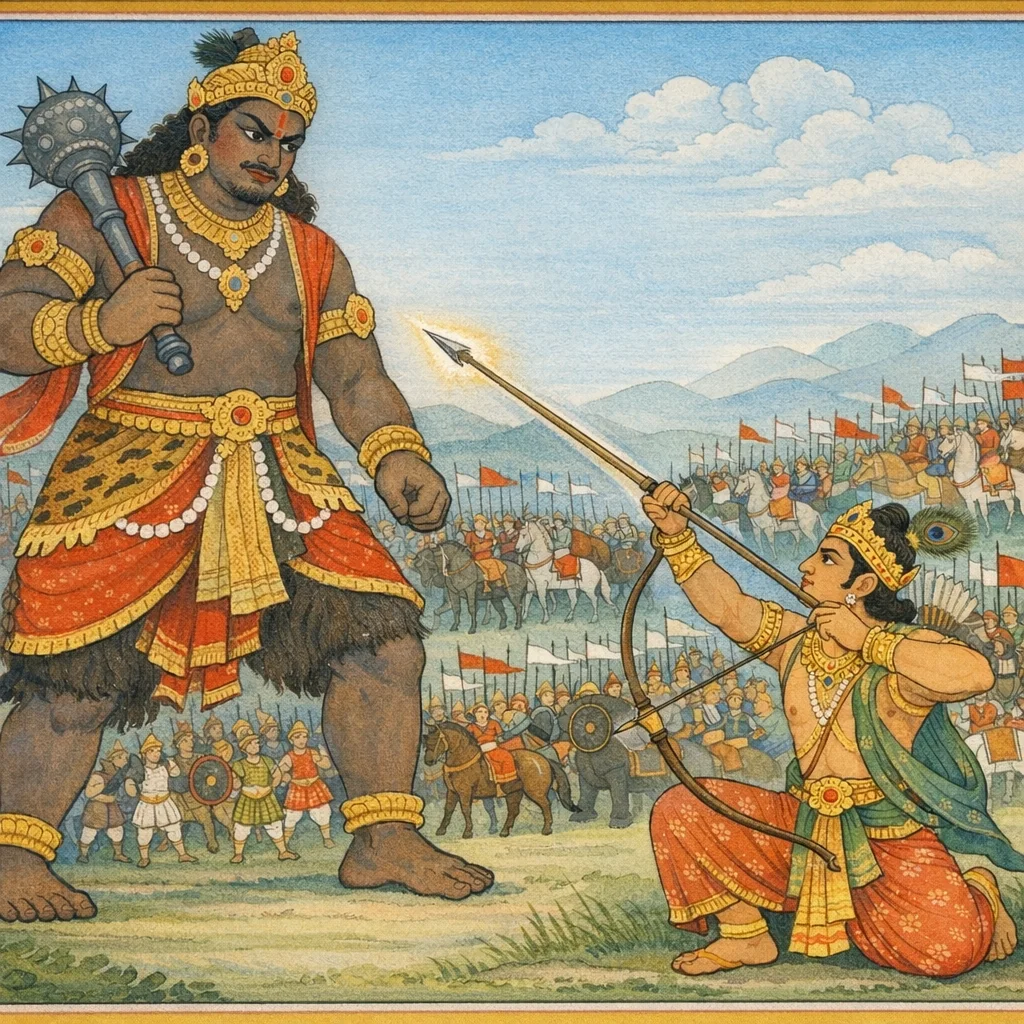
Adhyaya 158
वासवी-शक्तेः प्रयोगः, घटोत्कच-वधोत्तर-शोकः, व्यासोपदेशश्च (The Vāsavī Spear’s Use, Post-Ghaṭotkaca Grief, and Vyāsa’s Counsel)
Upa-parva: Ghaṭotkaca-vadha-anantara-vimarśa (Post–Ghaṭotkaca Death Deliberations)
Dhṛtarāṣṭra questions Sañjaya about the strategic non-use of Karṇa’s ekaghnī Vāsavī-śakti against Kṛṣṇa or Arjuna earlier, given its reputed irresistibility even to divine forces. Sañjaya reports that, after the day’s withdrawal, a nocturnal consensus urged Karṇa to release the weapon at dawn, yet at daybreak that intention dissolved—interpreted as daiva disrupting counsel—so Karṇa did not discharge it at the principal targets. Dhṛtarāṣṭra then draws a causal indictment: the weapon’s deployment against Ghaṭotkaca both saved immediate pressure and precipitated subsequent losses, and he requests continuation of the war account after the rākṣasa’s fall. Sañjaya narrates the battlefield mood: Kauravas exult, Pāṇḍava forces experience disarray, and Yudhiṣṭhira enters deep grief and shock, instructing Bhīma to check the opposing advance. Kṛṣṇa rebukes Yudhiṣṭhira’s collapse and urges him to bear the ‘heavy yoke’ of kingship in war. Yudhiṣṭhira responds with a moral-psychological account of indebtedness to Ghaṭotkaca’s prior services, lamenting the perceived humiliation of being unable to protect him, and argues that Droṇa and Karṇa constitute the operational root of their sufferings—implying priority targeting. He then moves swiftly, supported by allied contingents, to pursue Karṇa. Vyāsa intercepts and reframes: Arjuna survives precisely because Karṇa conserved the spear for him; had Arjuna met Karṇa in a direct duel under pressure, Karṇa would likely have released it. Therefore Ghaṭotkaca’s death functions as a protective contingency for Arjuna and the coalition’s long-term prospects. Vyāsa counsels restraint from anger and grief, reiterates dharma-practices (non-cruelty, austerity, giving, forbearance, truth), and offers a forward-looking assurance of strategic success tied to dharmic steadiness.
Chapter Arc: धूल-धूसरित रणभूमि में सात्यकि के सामने सोमदत्त खड़ा है—और क्षत्रधर्म की दुहाई देकर उसे ललकारता है कि जो शस्त्र त्यागकर दीन हुआ हो, उस पर प्रहार करना दस्युधर्म है। → सोमदत्त सात्यकि पर नैतिक दबाव डालता है, भूरिश्रवा-वध की स्मृति और ‘पीठ दिखाने वाले पर वार’ जैसे नियमों को सामने रखकर उसे अपराध-बोध में बाँधना चाहता है। उधर युद्ध का प्रवाह रुकता नहीं—राक्षस-सेना और घटोत्कच का उग्र प्रवेश, तथा अश्वत्थामा का प्रतिशोधी क्रोध, अध्याय को एक साथ नीति-विवाद और प्रलय-युद्ध में खींच ले जाता है। → अश्वत्थामा राक्षसों की सेना पर प्रलयाग्नि-सा टूट पड़ता है; अद्भुत पराक्रम दिखाकर घटोत्कच को लक्ष्य कर यमदण्डोपम, सीधा जाने वाला भयंकर बाण संधान करता है—और घटोत्कच के पतन का निर्णायक क्षण उपस्थित होता है। → घटोत्कच के मारे जाने का समाचार और दृश्य रण को स्तब्ध कर देता है; धृष्टद्युम्न घटोत्कच को गिरा हुआ जानकर अश्वत्थामा के निकट से अपना रथ हटा लेता है। सोमदत्त-सात्यकि प्रसंग में ‘धर्म’ की भाषा युद्ध की क्रूर वास्तविकता से टकराकर रह जाती है—और रण का पलड़ा क्षणिक रूप से कौरव-पक्ष की ओर झुकता है। → घटोत्कच-वध के बाद पाण्डव-सेना के मनोबल पर जो आघात पड़ेगा और भीम/युधिष्ठिर की प्रतिक्रिया से युद्ध की दिशा कैसे बदलेगी—यह अगले प्रसंग की दहलीज़ पर छोड़ दिया जाता है।
Shlokas
Verse 1
(दाक्षिणात्य अधिक पाठका १ श्लोक मिलाकर कुल ४७ “लोक हैं।) पम्प बछ। अर: अं षट्पज्चाशर्दाधिकशततमो< ध्याय: सोमदत्त और सात्यकिका युद्ध, सोमदत्तकी पराजय, घटोत्कच और कक अआहिणी और अभ्रृत्थामाद्वारा घटोत्कचके पुत्रका, एक अ राक्षससेनाका तथा ट्रुपदपुत्रोका वध एवं पाण्डव-सेनाकी पराजय सयजय उवाच प्रायोपविष्टे तु हते पुत्रे सात्यकिना तदा । सोमदत्तो भृशं क्रुद्ध: सात्यकिं वाक्यमब्रवीत्,संजय कहते हैं--राजन्! आमरण उपवासका व्रत लेकर बैठे हुए अपने पुत्र भूरिश्रवाके, सात्यकिद्वारा मारे जानेपर उस समय सोमदत्तको बड़ा क्रोध हुआ। उन्होंने सात्यकिसे इस प्रकार कहा--
Sanjaya said: O King, when his son—who had taken the vow of fasting unto death—was slain by Satyaki, Somadatta was seized by fierce wrath. In that moment he addressed Satyaki with these words.
Verse 2
क्षत्रधर्म: पुरा दृष्टो यस्तु देवैर्महात्मभि: । त॑ त्वं सात्वत संत्यज्य दस्युधर्मे कथं रत:,'सात्वत! पूर्वकालमें महात्माओं तथा देवताओंने जिस क्षत्रियधर्मका साक्षात्कार किया है, उसे छोड़कर तुम लुटेरोंके धर्ममें कैसे प्रवृत्त हो गये?
“O Sātvata, how can you abandon the ancient kṣatriya dharma—once beheld and upheld by the gods and great-souled sages—and take delight in the way of the dāsus, in predatory and lawless conduct?”
Verse 3
पराड्मुखाय दीनाय न्यस्तशस्त्राय सात्यके । क्षत्रधर्मरत: प्राज्ञ: कथं नु प्रहरेद् रणे,'सात्यके! जो युद्धसे विमुख एवं दीन होकर हथियार डाल चुका हो, उसपर रणभूमिमें क्षत्रियधर्मपरायण दिद्वान् पुरुष कैसे प्रहार कर सकता है?
“O Sātyaki, when a man has turned away from the fight, become helpless, and laid down his weapons, how could a wise warrior devoted to kṣatriya dharma strike him on the battlefield?”
Verse 4
द्वावेव किल वृष्णीनां तत्र ख्यातौ महारथौ । प्रद्युम्नश्च महाबाहुस्त्वं चैव युधि सात्वत,'सात्वत! वृष्णिवंशियोंमें दो ही महारथी युद्धके लिये विख्यात हैं। एक तो महाबाहु प्रद्यम्न और दूसरे तुम
“O Sātvata, among the Vṛṣṇis it is said that only two are famed as great chariot-warriors fit for battle: the mighty-armed Pradyumna, and you as well in the fight.”
Verse 5
कथं प्रायोपविष्टाय पार्थेन छिन्नबाहवे । नृशंसं पतनीयं च तादृशं॑ कृतवानसि,'अर्जुनने जिसकी बाँह काट डाली थी तथा जो आमरण अनशनका निश्चय लेकर बैठा था, उस मेरे पुत्रपर तुमने वैसा पतनकारक क्रूर प्रहार क्यों किया?
“Why did you strike such a cruel blow—an act that leads to moral downfall—against my son, when his arm had already been cut off by Pārtha (Arjuna) and he had sat down resolved to fast unto death?”
Verse 6
कर्मणस्तस्य दुर्वत्त फल प्राप्रुहि संयुगे । अद्य च्छेत्स्यामि ते मूढ शिरो विक्रम्य पत्रिणा,'ओ दुराचारी मूर्ख! उस पापकर्मका फल तुम इस युद्धस्थलमें ही प्राप्त करो। आज मैं पराक्रम करके एक बाणसे तुम्हारा सिर काट डालूँगा'
Sanjaya said: “You, vile and deluded one, shall reap in this very battlefield the fruit of your wicked deeds. Today, exerting my valor, I will cut off your head with a sharp arrow.”
Verse 7
शपे सात्वत पुत्राभ्यामिष्टेन सुकृतेन च । अनतीतामिमां रात्रि यदि त्वां वीरमानिनम्
Sañjaya said: “I swear by the two sons of the Sātvata (Kṛṣṇa), and by the merit of my sacrifices and good deeds: if you truly deem yourself a hero, then let this night not pass (without your proving it).”
Verse 8
अरक्ष्यमाणं पार्थेन जिष्णुना ससुतानुजम् । न हन्यां नरके घोरे पतेयं वृष्णिपांसन
Sañjaya said: “If I were to slay him—though he stands unprotected by Pārtha (Arjuna), the victorious Jiṣṇu—together with his sons and younger brothers, I would surely fall into a dreadful hell. O scion of the Vṛṣṇis, such a killing would be a grievous sin.”
Verse 9
*वृष्णिकुलकलंक सात्वत! मैं अपने दोनों पुत्रोंकी तथा यज्ञ और पुण्यकर्मोकी शपथ खाकर कहता हूँ कि यदि आज रात्रि बीतनेके पहले ही कुन्तीपुत्र अर्जुनसे अरक्षित रहनेपर अपनेको वीर माननेवाले तुम्हें पुत्रों और भाइयोंसहित न मार डालूँ तो घोर नरकमें पड़ूँ ।। एवमुक््त्वा सुसंक्रुद्ध: सोमदत्तो महाबल: । दध्मौ शड़्खं च तारेण सिंहनादं ननाद च,ऐसा कहकर महाबली सोमदत्तने अत्यन्त कुपित हो उच्चस्वरसे शंख बजाया और सिंहनाद किया
Sañjaya said: “O Sātvata, disgrace to the Vṛṣṇi line! I swear by my two sons, and by sacrifice and meritorious rites: if, before this very night has passed, I do not slay you—who call yourselves heroes—together with your sons and brothers, once I find Kuntī’s son Arjuna unprotected, then may I fall into dreadful hell.” Having spoken thus, the mighty Somadatta, inflamed with anger, blew his conch loudly and roared a lion-like battle cry.
Verse 10
ततः कमलपत्राक्ष: सिंहदंष्टो दुरासद: । सात्यकिर्भुशसंक्रुद्ध: सोमदत्तमथाब्रवीत्,तब कमलके समान नेत्र और सिंहके सदृश दाँतवाले दुर्धर्ष वीर सात्यकि भी अत्यन्त कुपित हो सोमदत्तसे इस प्रकार बोले--
Then Sātyaki—lotus-eyed, lion-fanged, and hard to assail—burning with intense anger, addressed Somadatta.
Verse 11
कौरवेय न मे त्रास: कथंचिदपि विद्यते । त्वया सार्थमथान्यैश्न युध्यतो हृदि कश्नन
Sañjaya said: “O son of the Kuru line, no fear arises in me at all. Whether I must contend with you or with others, there is no trembling in my heart.”
Verse 12
“कौरवेय! तुम्हारे या किसी दूसरेके साथ युद्ध करते समय मेरे हृदयमें किसी तरह भी कोई भय नहीं होगा ।। यदि सर्वेण सैन्येन गुप्तो मां योधयिष्यसि । तथापि न व्यथा काचित् त्वयि स्यान्मम कौरव,“कौरव! यदि सारी सेनासे सुरक्षित होकर तुम मेरे साथ युद्ध करोगे तो भी तुम्हारे कारण मुझे कोई व्यथा नहीं होगी
Sañjaya said: “O son of the Kuru line, whether I face you or any other in battle, no fear will arise in my heart. Even if you fight me while shielded by your entire army, still, because of you, no distress will touch me.”
Verse 13
युद्धसारेण वाक्येन असतां सम्मतेन च | नाहं भीषयितुं शक््य: क्षत्रवृत्ते स्थितस्त्वया,“मैं सदा क्षत्रियोचित आचारमें स्थित हूँ। युद्ध ही जिसका सार है तथा दुष्ट पुरुष ही जिसे आदर देते हैं; ऐसे कटुवाक्यसे तुम मुझे डरा नहीं सकते
Sañjaya said: “By harsh words whose very essence is war, and which are approved only by the wicked, you cannot frighten me. I stand firm in the conduct proper to a kṣatriya.”
Verse 14
यदि ते<स्ति युयुत्साद्य मया सह नराधिप । निर्दयो निशितैर्बाणै: प्रहर प्रहरामि ते,नरेश्वर! यदि मेरे साथ तुम्हारी युद्ध करनेकी इच्छा है तो निर्दयतापूर्वक पैने बाणोंद्वारा मुझपर प्रहार करो। मैं भी तुमपर प्रहार करूँगा
Sañjaya said: “O king, if you truly desire to fight with me, then strike me—mercilessly—with sharp arrows. I too will strike you, O lord of men.”
Verse 15
हतो भूरिश्रवा वीरस्तव पुत्रो महारथ: । शलश्चैव महाराज भ्रातृव्यसनकर्षित:,“महाराज! तुम्हारा वीर महारथी पुत्र भूरिश्रवा मारा गया। भाईके दुःखसे दुःखी होकर शल भी वीरगतिको प्राप्त हुआ है
Sañjaya said: “O King, your heroic son Bhūriśravā, a great chariot-warrior, has been slain. And Śala too, O Mahārāja—overwhelmed and dragged down by the calamity that befell his brother—has attained a warrior’s death.”
Verse 16
त्वां चाप्यद्य वधिष्यामि सहपुत्रं सबान्धवम् । तिष्ठेदानीं रणे यत्त: कौरवो5सि महारथ:,“अब पुत्रों और बान्धवोंसहित तुम्हें भी मार डालूँगा। तुम कुरुकुलके महारथी वीर हो। इस समय रणभूमिमें सावधान होकर खड़े रहो
Sañjaya said: “Today I shall slay you as well—together with your sons and your kinsmen. Stand now on the battlefield, fully alert; you are a Kaurava, a great chariot-warrior.” The utterance conveys the ruthless escalation typical of the war’s climax, where prowess is invoked to justify total annihilation of an opponent’s line, pressing the ethical tension between kṣatriya duty in battle and the moral horror of exterminating families.
Verse 17
यस्मिन् दानं दम: शौचमहिंसा ह्वीर्धति: क्षमा । अनपायानि सर्वाणि नित्यं राज्ञि युधिष्ठिरे,“जिन महाराज युधिष्ठिरमें दान, दम, शौच, अहिंसा, लज्जा, धृति और क्षमा आदि सारे सदगुण अविनश्वरभावसे सदा विद्यमान रहते हैं, अपनी ध्वजामें मृदंगका चिह्न धारण करनेवाले उन्हीं धर्मराजके तेजसे तुम पहले ही मर चुके हो। अत: कर्ण और शकुनिके साथ ही इस युद्धस्थलमें तुम विनाशको प्राप्त होओगे
Sañjaya said: “In King Yudhiṣṭhira abide, ever and unfailingly, all these virtues—generosity, self-restraint, purity, non-violence, modesty, steadfastness, and forgiveness. By the very splendor of that Dharmarāja, you are already as good as slain; therefore, together with Karṇa and Śakuni, you will meet destruction here on this battlefield.”
Verse 18
मृदड़केतोस्तस्य त्वं तेजसा निहत: पुरा । सकर्णसौबल: संख्ये विनाशमुपयास्यसि,“जिन महाराज युधिष्ठिरमें दान, दम, शौच, अहिंसा, लज्जा, धृति और क्षमा आदि सारे सदगुण अविनश्वरभावसे सदा विद्यमान रहते हैं, अपनी ध्वजामें मृदंगका चिह्न धारण करनेवाले उन्हीं धर्मराजके तेजसे तुम पहले ही मर चुके हो। अत: कर्ण और शकुनिके साथ ही इस युद्धस्थलमें तुम विनाशको प्राप्त होओगे
Sañjaya said: “You have already been struck down before by the splendor of that Dharmarāja Yudhiṣṭhira—he whose banner bears the emblem of a drum. Therefore, together with Karṇa and Śakuni, you will meet destruction on this battlefield.”
Verse 19
शपे<हं कृष्णचरणैरिष्टपूर्तेन चैव ह । यदि त्वां ससुतं पाप॑ं न हन्यां युधि रोषित:,“मैं श्रीकृष्णके चरणों तथा अपने इष्टापूर्तकर्मोकी शपथ खाकर कहता हूँ कि यदि मैं युद्धमें क्ुद्ध होकर तुम-जैसे पापीको पुत्रोंसहित न मार डालूँ तो मुझे उत्तम गति न मिले 'टद्रोणपुत्र!! खड़ा रह, खड़ा रह, तू मेरे हाथसे छूटकर जीवित नहीं जा सकेगा। आज इस रणांगणमें मैं तेरा युद्धका हौसला मिटा दूँगा”
Sañjaya said: “I swear by the feet of Kṛṣṇa, and by the merit of my sacrifices and acts of public beneficence: if, enraged in battle, I do not slay you—sinful as you are—together with your sons, then may I not attain the highest state.” The oath frames vengeance as a moral necessity in the speaker’s mind, invoking devotion to Kṛṣṇa and the ethical capital of religious and charitable deeds to sanction a violent resolve within the brutal logic of war.
Verse 20
अपयास्यसि चेत्युक्त्वा रणं॑ मुक्तो भविष्यसि । एवमाभाष्य चान्योन्यं क्रोधसंरक्तलोचनौ
Sañjaya said: “Saying, ‘If you withdraw, you will be released from this battle,’ they spoke to one another in this manner—both with eyes reddened by anger.”
Verse 21
ततो रथसहस्रेण नागानामयुतेन च
Then, with a thousand chariots and also with ten thousand war-elephants, the host advanced—an image of overwhelming martial power being marshalled in the Kurukṣetra war, where sheer force and strategic display press upon the moral weight of the conflict.
Verse 22
शकुनिश्च सुसंक्रुद्धः सर्वशस्त्रभूृतां वर:,समस्त शस्त्रधारियोंमें श्रेष्ठ और वज्रके समान सुदृढ़ शरीरवाला आपका नवयुवक साला महाबाहु शकुनि भी अत्यन्त कुपित हो इन्द्रके समान पराक्रमी भाइयों तथा पुत्र- पौत्रोंसे घिरकर वहाँ आ पहुँचा
Sañjaya said: Shakuni too, inflamed with fierce anger—foremost among those who bear weapons—your young brother-in-law, the mighty-armed Shakuni, whose body was hard as a thunderbolt, arrived there. He came surrounded by brothers and by sons and grandsons, all possessing valor like Indra’s, ready to join the battle’s violent course.
Verse 23
पुत्रपौत्रै: परिवृतो भ्रातृभिश्रेन्द्रविक्रमै: । स्यालस्तव महाबाहुर्वजसंहननो युवा,समस्त शस्त्रधारियोंमें श्रेष्ठ और वज्रके समान सुदृढ़ शरीरवाला आपका नवयुवक साला महाबाहु शकुनि भी अत्यन्त कुपित हो इन्द्रके समान पराक्रमी भाइयों तथा पुत्र- पौत्रोंसे घिरकर वहाँ आ पहुँचा
Sañjaya said: Your brother-in-law Śakuni—young, mighty-armed, with a body compact and hard as a thunderbolt, and foremost among weapon-bearers—arrived there in great fury, surrounded by his brothers of Indra-like prowess and by his sons and grandsons. The scene underscores how kinship bonds and pride in martial strength can intensify wrath and draw entire family-lines into the momentum of war.
Verse 24
साग्रं शतसहस्र॑ तु हयानां तस्य धीमत: । सोमदत्तं महेष्वासं समन्तात् पर्यरक्षत,बुद्धिमान शकुनिके एक लाखसे अधिक घुड़सवार महाधनुर्धर सोमदत्तकी सब ओरसे रक्षा करने लगे
Sañjaya said: More than a hundred thousand horsemen, acting under the direction of that wise commander, formed a protective ring on every side around Somadatta, the great archer. In the moral atmosphere of the war, this line underscores how strategy and loyalty—however aligned—are employed to preserve a key warrior amid the chaos of battle.
Verse 25
रक्ष्यमाणश्न बलिभिश्छादयामास सात्यकिम् । त॑ छाद्यमानं विशिखैर्दृष्टवा संनतपर्वभि:
Sañjaya said: Though protected by mighty warriors, he covered (overwhelmed) Sātyaki. Seeing Sātyaki being thus screened and struck by arrows with well-joined knots, the battle’s pressure intensified—showing how, in war, even a valiant fighter’s safety depends on the strength and vigilance of his protectors.
Verse 26
चण्डवाताभिसृष्टानामुदधीनामिव स्वन:
Sañjaya said: “The sound was like the roaring of oceans, churned into turmoil by fierce, stormy winds”—a simile for how the battlefield’s uproar had grown vast, uncontrollable, and terrifying.
Verse 27
विव्याध सोमदत्तस्तु सात्वतं नवभि: शरै:
Sañjaya said: Somadatta then pierced the Sātvata warrior with nine arrows, driving the battle onward with relentless force and martial resolve.
Verse 28
सो5तिविद्धो बलवता समरे दृढ्धन्विना
Sañjaya said: In the thick of battle, he was struck through with great force by a steadfast archer.
Verse 29
रथोपस्थं समासाद्य मुमोह गतचेतन: । सुदृढ़ धनुष धारण करनेवाले बलवान सात्यकिके द्वारा समरभूमिमें अत्यन्त घायल किये जानेपर सोमदत्त रथकी बैठकमें जा बैठे और सुध-बुध खोकर मूर्च्छित हो गये || २८ न] त॑ विमूढं समालक्ष्य सारथिस्त्वरया युत:
Sañjaya said: Struck with extreme severity on the battlefield by the mighty Sātyaki, famed for bearing a firm and powerful bow, Somadatta collapsed onto the seat of his chariot. His awareness failed; losing consciousness, he fell into a faint. Seeing him thus bewildered, the charioteer hastened to act.
Verse 30
तं विसंज्ञं समालक्ष्य युयुधानशरार्दितम्
Sañjaya said: Seeing him lying unconscious, grievously afflicted by the arrows shot by Yuyudhāna, the scene revealed the brutal immediacy of war—where even the foremost warriors can be reduced to helplessness in a moment.
Verse 31
तमायान्तमभिप्रेक्ष्य युधिष्ठिरपुरोगमा:
Sañjaya said: Seeing him approach, the party led by Yudhiṣṭhira watched—keenly alert to what his coming might signify amid the pressure of dharma and the urgency of war.
Verse 32
ततः प्रववृते युद्ध द्रोणस्प सह पाण्डवै:
Sañjaya said: Thereafter the battle began in earnest, as Droṇa’s forces engaged the Pāṇḍavas—an escalation that set the tragic tension between martial duty and the mounting cost of war.
Verse 33
बलेरिव सुरै: पूर्व त्रलोक्यजयकाड्क्षया । जैसे पूर्वकालमें त्रिलोकीपर विजय पानेकी इच्छासे राजा बलिका देवताओंके साथ युद्ध हुआ था, उसी प्रकार द्रोणाचार्यका पाण्डवोंके साथ घोर संग्राम आरम्भ हुआ ।। ३२ $ || तत: सायकजालेन पाण्डवानीकमावृणोत्
Sañjaya said: Just as in ancient times King Bali, yearning to conquer the three worlds, went to war with the gods, so too did a dreadful battle begin between Droṇācārya and the Pāṇḍavas—showing how the hunger for supremacy kindles conflict, and how war, once unleashed, swells beyond personal rivalry into a struggle with cosmic overtones.
Verse 34
सात्यकिं दशभिर्बाणैविशत्या पार्षतं शरै:
Sañjaya said: With ten arrows he struck Sātyaki, and with twenty shafts he struck Pārṣata (Dhṛṣṭadyumna), revealing the battlefield’s relentless precision, where prowess is measured by disciplined aim and endurance, not by anger alone.
Verse 35
भीमसेनं च नवभिनर्नकुलं पञ्चभिस्तथा । सहदेवं तथाष्टाभि: शतेन च शिखण्डिनम्
Sañjaya said: He struck Bhīmasena with nine arrows, Nakula with five, Sahadeva with eight, and Śikhaṇḍin with a hundred—an emphatic display of battlefield prowess meant to overwhelm the Pāṇḍavas’ champions through sheer force and intimidation.
Verse 36
द्रौपदेयान् महाबाहुः पञ्चभि: पठ्चभि: शरै: । विराट मत्स्यमष्टाभिर्दुपद॑ दशभि: शरै:
Sañjaya said: The mighty-armed warrior struck the sons of Draupadī with five arrows each; he struck Virāṭa and Matsya with eight arrows, and King Drupada with ten. The report lays bare the grim arithmetic of battle—prowess counted in wounds—and reminds us how war turns even noble houses and elders into targets in a contest of force.
Verse 37
युधामन्यु त्रिभि: षड़भिरुत्तमौजसमाहवे । अन्यांश्व सैनिकान् विद्ध्वा युधिष्ठटिरमुपाद्रवत्
Sañjaya said: In the thick of battle, Yudhāmanyu struck down Uttamaujas with three or six shafts; and after also piercing other soldiers, he pressed forward in pursuit of Yudhiṣṭhira. The verse underscores the war’s relentless momentum, where martial prowess and tactical aggression drive the action even against the foremost warriors, intensifying the moral strain of fratricidal conflict.
Verse 38
फिर महाबाहु द्रोणने सात्यकिको दस, धृष्टद्युम्मनको बीस, भीमसेनको नौ, नकुलको पाँच, सहदेवको आठ, शिखण्डीको सौ, द्रौपदी-पुत्रोंको पाँच-पाँच, मत्स्यराज विराटको आठ, ट्रुपदको दस, युधामन्युको तीन, उत्तमौजाको छः तथा अन्य सैनिकोंको अन्यान्य बाणोंसे घायल करके युद्धस्थलमें राजा युधिष्ठिरपर आक्रमण किया ।। ते वध्यमाना द्रोणेन पाण्डुपुत्रस्य सैनिका: । प्राद्रवन् वै भयाद् राजन् सार्तनादा दिशो दश,राजन! द्रोणाचार्यकी मार खाकर पाण्डुपुत्र युधिष्ठिरके सैनिक आर्तनाद करते हुए भयके मारे दसों दिशाओंमें भाग गये
Sañjaya said: Struck down by Droṇa, the soldiers of the son of Pāṇḍu (Yudhiṣṭhira) broke in fear. Crying out in anguish, O King, they fled in all ten directions. The scene underscores how even a righteous cause can be shaken when leadership and morale collapse under overwhelming force, and how fear can scatter an army faster than weapons can destroy it.
Verse 39
काल्यमान तु तत् सैन्यं दृष्टवा द्रोणेन फाल्गुन: । किंचिदागतसंरम्भो गुरु पार्थो3 भ्ययाद् द्रुतम्
Sañjaya said: Seeing that army being hard-pressed by Droṇa, Phālguna (Arjuna)—his ardor newly stirred—swiftly advanced against his revered teacher, Droṇa. The verse highlights the moral strain of war: duty to protect one’s side compels Arjuna to confront even the guru he honors.
Verse 40
द्रोणाचार्यके द्वारा पाण्डव-सेनाका संहार होता देख कुन्तीकुमार अर्जुनके हृदयमें कुछ क्रोध हो आया। वे तुरंत ही आचार्यका सामना करनेके लिये चल दिये ।। दृष्टवा द्रोणं तु बीभत्सुमभिधावन्तमाहवे । संन्यवर्तत तत् सैन्यं पुनर्योधिष्ठिरे बलम्,अर्जुनको युद्धमें द्रोणाचार्यपर धावा करते देख युधिष्ठिरकी सेना पुनः: वापस लौट आयी
Sañjaya said: Seeing the Pāṇḍava host being slaughtered by Droṇācārya, Arjuna (Bībhatsu), Kuntī’s son, felt anger rise within him and at once went forth to face the teacher. When the army saw Arjuna rushing in battle against Droṇācārya, it turned back and re-formed its strength under Yudhiṣṭhira. In the epic’s ethical frame, Arjuna’s righteous wrath at the ruin of his side becomes a rallying point: the warriors regain resolve when their foremost protector moves to check the teacher’s devastating onslaught.
Verse 41
ततो युद्धम भूद् भूयो भारद्वाजस्य पाण्डवै: । द्रोणस्तव सुतै राजन् सर्वतः परिवारित:
Sañjaya said: Then the battle flared up once again between the Pāṇḍavas and Bhāradvāja’s son (Droṇa). O King, Droṇa was surrounded on all sides by your sons—like a tightening net of war, where strategy and duty collide amid escalating violence.
Verse 42
तं॑ ज्वलन्तमिवादित्यं दीप्तानलसमद्युतिम्
Sañjaya said: “He appeared like the blazing sun—radiant with the splendor of a kindled fire, shining with an overwhelming brilliance.”
Verse 43
राजन्ननिशमत्यन्तं दृष्टवा द्रोणं शरार्चिषम् । मण्डलीकृतथन्वानं तपन्तमिव भास्करम्
Sañjaya said: O King, seeing Droṇa incessantly and with overwhelming intensity—blazing with the fiery radiance of arrows, his bow drawn into a full circle—he appeared like the scorching sun itself. The verse underscores the terrifying moral weight of martial prowess when it becomes an all-consuming force on the battlefield.
Verse 44
दहन्तमहितान् सैन्ये नैनं कश्चिदवारयत् । नरेश्वर! प्रजजलित अग्निके समान कान्तिमान् तथा निरन्तर बाणरूपी किरणोंसे युक्त सूर्यके समान अत्यन्त प्रकाशित होनेवाले द्रोणाचार्यको धनुषको मण्डलाकार करके तपते हुए प्रभाकरके समान शत्रुओंको दग्ध करते देख पाण्डव-सेनामें कोई वीर उन्हें रोक न सका || ४२-४३ $ || यो यो हि प्रमुखे तस्य तस्थौ द्रोणस्य पूरुष:
Sañjaya said: O king, as Droṇa blazed through the army, burning down his foes, no one could check him. Radiant like a flaming fire and shining like the sun whose rays were unbroken streams of arrows, Droṇācārya—wheeling his bow in a circle like a scorching luminary—seemed to scorch the enemies; and seeing him thus, no warrior in the Pāṇḍava host was able to restrain him. Indeed, whoever stood in his very front—any man facing Droṇa—was overpowered.
Verse 45
तस्य तस्य शिरकश्शकछित्त्वा ययुद्रोणशरा:क्षितिम् जो-जो योद्धा पुरुष द्रोणाचार्यके सामने खड़ा होता, उसी-उसीका सिर काटकर द्रोणाचार्यके बाण धरतीमें समा जाते थे || ४४ ई || एवं सा पाण्डवी सेना वध्यमाना महात्मना
Sañjaya said: Whoever—each and every warrior—stood facing Droṇācārya, his head was cut down, and Droṇa’s arrows, having accomplished their work, sank into the earth. Thus the Pāṇḍava host, being slain by that great-souled warrior, continued to be devastated. The passage underscores the terrifying efficiency of martial skill when yoked to duty in war, while also hinting at the moral weight of mass slaughter even when performed under the banner of kṣatriya obligation.
Verse 46
सम्प्रभग्नं बल॑ दृष्टवा द्रोणेन निशि भारत
Sañjaya said: O Bhārata, seeing the army shattered by Droṇa in the night, the warriors were thrown into disarray.
Verse 47
ततो रजततगोक्षीरकुन्देन्दुसदृशप्रभान्
Then (Sañjaya said), there appeared those whose radiance resembled silver—the whiteness of a lake, milk, jasmine, and the moon—dazzling, pure brilliance set against the grim backdrop of battle.
Verse 48
भीमसेनोडपि त॑ दृष्टवा यान्तं द्रोणाय फाल्गुनम्
Sañjaya said: Seeing Arjuna (Phālguna) moving toward Droṇa, Bhīmasena too took note, recognizing the urgency of confronting the teacher-commander amid the war.
Verse 49
सो<पि तस्य वच: श्रुत्वा विशोकोडवाहयद्धयान्
Sañjaya said: Hearing those words, he too—now free from grief—turned his mind to reflection, steadying his thoughts after what had been spoken.
Verse 50
तौ दृष्टवा भ्रातरौ यत्तौ द्रोणानीकमभिद्रुती,महाराज! उन दोनों भाइयोंको द्रोणाचार्यकी सेनाकी ओर युद्धके लिये उद्यत होकर जाते देख पांचाल, सूंजय, मत्स्य, चेदि, कारूष, कोसल तथा केकय महारथियोंने भी उन्हींका अनुसरण किया
Sañjaya said: O King, seeing those two brothers rushing, ready for battle, toward Droṇa’s battle-array, the great chariot-warriors of the Pāñcālas, Śūrajayas, Matsyas, Cedis, Kāruṣas, Kośalas, and Kaikeyas likewise followed after them.
Verse 51
पज्चाला: सृज्जया: मत्स्याश्वनेदिकारूषकोसला: । अन्वगच्छन् महाराज केकयाश्न महारथा:,महाराज! उन दोनों भाइयोंको द्रोणाचार्यकी सेनाकी ओर युद्धके लिये उद्यत होकर जाते देख पांचाल, सूंजय, मत्स्य, चेदि, कारूष, कोसल तथा केकय महारथियोंने भी उन्हींका अनुसरण किया
Sañjaya said: O King, seeing those two brothers advancing, ready for battle, toward Droṇācārya’s army, the Pāñcālas, the Sṛñjayas, the Matsyas, the Cedis, the Kāruṣas, the Kosalas, and the great chariot-warriors of Kekaya also followed after them.
Verse 52
ततो राजन्नभूद् घोर: संग्रामो लोमहर्षण: । बीभस्सुर्दक्षिणं पार्श्वमुत्तरं च वृकोदर:
Then, O King, a dreadful battle arose—one that made the hair stand on end. Bhībhatsu held the right flank, and Vṛkodara the northern flank.
Verse 53
तौ दृष्टवा पुरुषव्याप्रौ भीमसेनधनंजयौ,धृष्टद्युम्नो5 भ्ययाद् राजन् सात्यकिश्न महाबल: । राजन! पुरुषसिंह भीमसेन और अर्जुनको द्रोणाचार्यपर धावा करते देख धृष्टद्युम्न और महाबली सात्यकि भी वहीं जा पहुँचे
Sañjaya said: O King, seeing those two tiger-like heroes—Bhīmasena and Dhanañjaya (Arjuna)—charging at Droṇācārya, Dhṛṣṭadyumna and the mighty Sātyaki also rushed there.
Verse 54
।। चण्डवाताभिपन्नानामुदधीनामिव स्वन:
Sañjaya said: The sound rose like the roar of oceans lashed and driven by a fierce gale.
Verse 55
सौमदत्तिवधात् क्रुद्धों दृष्टया सात्यकिमाहवे
Enraged at the slaying of Saumadatti, and seeing Sātyaki on the battlefield, he was seized by wrath and turned his attention toward him.
Verse 56
तमापततन्तं सम्प्रेक्ष्य शैनेयस्य रथं प्रति
Seeing him rush headlong toward Śaineya’s chariot, Sañjaya marks the moment as the battle’s focus tightening into a direct, imminent assault—where intent, courage, and the ethics of singling out one warrior meet in the heat of war.
Verse 57
कार्ष्णायसं महाघोरमृक्षचर्मपरिच्छदम्,घटोत्कच जिस विशाल रथपर बैठकर आया था, वह काले लोहेका बना हुआ और अत्यन्त भयंकर था। उसके ऊपर रीछकी खाल मढ़ी हुई थी। उसके भीतरी भागकी लंबाई- चौड़ाई तीस नल्व- (बारह हजार हाथ) थी। उसमें यन्त्र और कवच रखे हुए थे। चलते समय उससे मेघोंकी भारी घटाके समान गम्भीर शब्द होता था। उसमें हाथी-जैसे विशालकाय वाहन जुते हुए थे, जो वास्तवमें न घोड़े थे और न हाथी। उस रथकी ध्वजाका डंडा बहुत ऊँचा था। वह ध्वज पंख और पंजे फैलाकर आँखें फाड़-फाड़कर देखने और कूजनेवाले एक गृध्रराजसे सुशोभित था। उसकी पताका खूनसे भीगी हुई थी और उस रथको आँतोंकी मालासे विभूषित किया गया था
Sañjaya said: Mounted on a vast chariot of black iron—terrifying in aspect and covered with bearskin—Ghaṭotkaca arrived. Its inner space was immense, said to measure thirty nalvas (twelve thousand cubits) in length and breadth. Within it were stored engines and armor. As it moved, it gave forth a deep, ominous roar like a dense mass of thunderclouds. It was yoked to huge elephant-like creatures—yet they were neither horses nor elephants in truth. Its flagstaff rose exceedingly high, and the banner bore a king of vultures, wings and talons spread, eyes wide and crying out. The pennant was drenched in blood, and the chariot was adorned with garlands of entrails—an image of deliberate terror and the moral darkness that follows slaughter.
Verse 58
महान्तं रथमास्थाय त्रिंशन्नल्वान्तरान्तरम् । विक्षिप्तयन्त्रसंनाहं महामेघौघनि:स्वनम्,घटोत्कच जिस विशाल रथपर बैठकर आया था, वह काले लोहेका बना हुआ और अत्यन्त भयंकर था। उसके ऊपर रीछकी खाल मढ़ी हुई थी। उसके भीतरी भागकी लंबाई- चौड़ाई तीस नल्व- (बारह हजार हाथ) थी। उसमें यन्त्र और कवच रखे हुए थे। चलते समय उससे मेघोंकी भारी घटाके समान गम्भीर शब्द होता था। उसमें हाथी-जैसे विशालकाय वाहन जुते हुए थे, जो वास्तवमें न घोड़े थे और न हाथी। उस रथकी ध्वजाका डंडा बहुत ऊँचा था। वह ध्वज पंख और पंजे फैलाकर आँखें फाड़-फाड़कर देखने और कूजनेवाले एक गृध्रराजसे सुशोभित था। उसकी पताका खूनसे भीगी हुई थी और उस रथको आँतोंकी मालासे विभूषित किया गया था
Sañjaya said: Mounting a colossal chariot—its inner span measured at thirty nalvas—Ghaṭotkaca advanced. The vehicle was packed with scattered engines and armor, and as it moved it roared with a deep, ominous sound like the rumbling surge of dense storm-clouds. The description underscores a terrifying, war-driven spectacle of power meant to shake the enemy’s resolve and deepen the moral darkness of the night-battle.
Verse 59
युक्त गजनिभेर्वाहैर्न हयैर्नापि वारणै: । विक्षिप्तपक्षचरणविवृताक्षेण कूजता,घटोत्कच जिस विशाल रथपर बैठकर आया था, वह काले लोहेका बना हुआ और अत्यन्त भयंकर था। उसके ऊपर रीछकी खाल मढ़ी हुई थी। उसके भीतरी भागकी लंबाई- चौड़ाई तीस नल्व- (बारह हजार हाथ) थी। उसमें यन्त्र और कवच रखे हुए थे। चलते समय उससे मेघोंकी भारी घटाके समान गम्भीर शब्द होता था। उसमें हाथी-जैसे विशालकाय वाहन जुते हुए थे, जो वास्तवमें न घोड़े थे और न हाथी। उस रथकी ध्वजाका डंडा बहुत ऊँचा था। वह ध्वज पंख और पंजे फैलाकर आँखें फाड़-फाड़कर देखने और कूजनेवाले एक गृध्रराजसे सुशोभित था। उसकी पताका खूनसे भीगी हुई थी और उस रथको आँतोंकी मालासे विभूषित किया गया था
Sañjaya said: That chariot came yoked with elephant-like beasts—yet they were neither horses nor elephants. Its banner-staff rose exceedingly high, and the standard was adorned with a king of vultures, wings and talons flung wide, eyes glaring open as it cried out. The image intensifies the moral atmosphere of the battle: a spectacle of terror and omen, where martial ingenuity and ferocity eclipse ordinary norms of life and restraint.
Verse 60
ध्वजेनोच्छितदण्डेन गृध्रराजेन राजितम् । लोहितार्द्रपताकं तु अन्त्रमालाविभूषितम्,घटोत्कच जिस विशाल रथपर बैठकर आया था, वह काले लोहेका बना हुआ और अत्यन्त भयंकर था। उसके ऊपर रीछकी खाल मढ़ी हुई थी। उसके भीतरी भागकी लंबाई- चौड़ाई तीस नल्व- (बारह हजार हाथ) थी। उसमें यन्त्र और कवच रखे हुए थे। चलते समय उससे मेघोंकी भारी घटाके समान गम्भीर शब्द होता था। उसमें हाथी-जैसे विशालकाय वाहन जुते हुए थे, जो वास्तवमें न घोड़े थे और न हाथी। उस रथकी ध्वजाका डंडा बहुत ऊँचा था। वह ध्वज पंख और पंजे फैलाकर आँखें फाड़-फाड़कर देखने और कूजनेवाले एक गृध्रराजसे सुशोभित था। उसकी पताका खूनसे भीगी हुई थी और उस रथको आँतोंकी मालासे विभूषित किया गया था
Sañjaya said: “That chariot was adorned with a banner whose staff rose exceedingly high, and it was made splendid by a king of vultures set upon it. Its pennon was drenched in blood, and it was decorated with a garland of entrails.” In the ethical atmosphere of the war, this imagery signals not heroism but terror—an intentional display meant to unnerve opponents and proclaim a ruthless, death-dealing intent on the battlefield.
Verse 61
अष्टचक्रसमायुक्तमास्थाय विपुलं रथम् | शूलमुद्गरधारिण्या शैलपादपहस्तया
Sañjaya said: Mounted upon a vast chariot fitted with eight wheels, she advanced—bearing a spear and a mace, with feet like rocky crags and hands that struck like stone. The description heightens the battlefield’s moral tension: war here is not merely human contest but a confrontation with a terrifying, almost elemental force, testing courage, restraint, and steadfastness in dharma amid chaos.
Verse 62
रक्षसां घोररूपाणामक्षौहिण्या समावृत: । ऐसे आठ पहियोंवाले विशाल रथपर बैठा हुआ घटोत्कच भयंकर रूपवाले राक्षसोंकी एक अक्षौहिणी सेनासे घिरा हुआ था। उस समस्त सेनाने अपने हाथोंमें शूल, मुद्गर, पर्वत- शिखर और वृक्ष ले रखे थे ।। ६१ है ।। तमुद्यतमहाचापं निशम्य व्यथिता नृपा:
Sañjaya said: Ghaṭotkaca, of terrifying appearance, sat upon a vast and splendid chariot with eight wheels, surrounded by a full akṣauhiṇī of dreadful rākṣasas. That entire host, raising in their hands spears and maces, and even mountain-peaks and uprooted trees, surged forward for battle. Hearing of him—his mighty bow already lifted—the kings were shaken with fear.
Verse 63
युगान्तकालसमये दण्डहस्तमिवान्तकम् | प्रलयकालमें दण्डधारी यमराजके समान विशाल धनुष उठाये घटोत्कचको देखकर समस्त राजा व्यथित हो उठे || ६२ ई ।। ततस्तं गिरिशुद्भाभं भीमरूपं भयावहम्,वह देखनेमें पर्वत-शिखरके समान जान पड़ता था। उसका रूप भयानक होनेके कारण वह सबको भयंकर प्रतीत होता था। उसका मुख यों ही बड़ा भीषण था; किंतु दाढ़ोंक कारण और भी विकराल हो उठा था। उसके कान कील या खूँटेके समान जान पड़ते थे। ठोढ़ी बहुत बड़ी थी। बाल ऊपरकी ओर उठे हुए थे। आँखें डरावनी थीं। मुख आगके समान प्रज्वलित था, पेट भीतरकी ओर धँसा हुआ था। उसके गलेका छेद बहुत बड़े गड़्ढेके समान जान पड़ता था। सिरके बाल किरीटसे ढके हुए थे। वह मुँह बाये हुए यमराजके समान समस्त प्राणियोंके मनमें त्रास उत्पन्न करनेवाला था। शत्रुओंको क्षुब्ध कर देनेवाले प्रजजलित अग्निके समान राक्षसराज घटोत्कचको विशाल धनुष उठाये आते देख आपके पुत्रकी सेना भयसे पीड़ित एवं क्षुब्ध हो उठी, मानो वायुसे विक्षुब्ध हुई गंगामें भयानक भँवरें और ऊँची-ऊँची लहरें उठ रही हों
Sañjaya said: At that moment, like Death himself at the end of an age—like Yama bearing his staff at the time of cosmic dissolution—Ghaṭotkaca appeared, lifting a mighty bow. Seeing him, the kings were shaken with distress. He looked like a mountain peak, and his terrifying form struck fear into all. His face was dreadful, made even more grotesque by his fangs; his ears seemed like spikes, his chin was huge, his hair stood upright, his eyes were frightening, and his mouth blazed like fire. His belly was drawn in, his throat-gorge looked like a vast pit, and his head was crowned. With his gaping mouth, like Yama himself, he filled living beings with dread. As the rākṣasa-king, blazing like a fire that agitates enemies, advanced with his great bow, your son’s army became panic-stricken and churned—like the Gaṅgā when whipped by wind, raising fearful whirlpools and towering waves.
Verse 64
दंष्टाकरालोग्रमुखं शड्कुकर्ण महाहनुम् । ऊर्ध्वकेशं विरूपाक्ष॑ दीप्तास्यं निम्नितोदरम्,वह देखनेमें पर्वत-शिखरके समान जान पड़ता था। उसका रूप भयानक होनेके कारण वह सबको भयंकर प्रतीत होता था। उसका मुख यों ही बड़ा भीषण था; किंतु दाढ़ोंक कारण और भी विकराल हो उठा था। उसके कान कील या खूँटेके समान जान पड़ते थे। ठोढ़ी बहुत बड़ी थी। बाल ऊपरकी ओर उठे हुए थे। आँखें डरावनी थीं। मुख आगके समान प्रज्वलित था, पेट भीतरकी ओर धँसा हुआ था। उसके गलेका छेद बहुत बड़े गड़्ढेके समान जान पड़ता था। सिरके बाल किरीटसे ढके हुए थे। वह मुँह बाये हुए यमराजके समान समस्त प्राणियोंके मनमें त्रास उत्पन्न करनेवाला था। शत्रुओंको क्षुब्ध कर देनेवाले प्रजजलित अग्निके समान राक्षसराज घटोत्कचको विशाल धनुष उठाये आते देख आपके पुत्रकी सेना भयसे पीड़ित एवं क्षुब्ध हो उठी, मानो वायुसे विक्षुब्ध हुई गंगामें भयानक भँवरें और ऊँची-ऊँची लहरें उठ रही हों
Sañjaya said: “He appeared with a mouth made terrifying by protruding fangs, ears like spikes, and massive jaws; his hair stood upright, his eyes were grotesque, his face blazed as if aflame, and his belly was drawn in. Seeing the rākṣasa-king Ghaṭotkaca advancing like a mountain-peak—radiant and dreadful like a blazing fire that shakes enemies—your son’s army was seized by fear and thrown into turmoil, like the Gaṅgā churned by wind into frightening whirlpools and towering waves.”
Verse 65
महाश्व॒ भ्रगलद्वारं किरीटच्छन्नमूर्थजम् । त्रासनं सर्वभूतानां व्यात्तानममिवान्तकम्,वह देखनेमें पर्वत-शिखरके समान जान पड़ता था। उसका रूप भयानक होनेके कारण वह सबको भयंकर प्रतीत होता था। उसका मुख यों ही बड़ा भीषण था; किंतु दाढ़ोंक कारण और भी विकराल हो उठा था। उसके कान कील या खूँटेके समान जान पड़ते थे। ठोढ़ी बहुत बड़ी थी। बाल ऊपरकी ओर उठे हुए थे। आँखें डरावनी थीं। मुख आगके समान प्रज्वलित था, पेट भीतरकी ओर धँसा हुआ था। उसके गलेका छेद बहुत बड़े गड़्ढेके समान जान पड़ता था। सिरके बाल किरीटसे ढके हुए थे। वह मुँह बाये हुए यमराजके समान समस्त प्राणियोंके मनमें त्रास उत्पन्न करनेवाला था। शत्रुओंको क्षुब्ध कर देनेवाले प्रजजलित अग्निके समान राक्षसराज घटोत्कचको विशाल धनुष उठाये आते देख आपके पुत्रकी सेना भयसे पीड़ित एवं क्षुब्ध हो उठी, मानो वायुसे विक्षुब्ध हुई गंगामें भयानक भँवरें और ऊँची-ऊँची लहरें उठ रही हों
Sañjaya said: “He appeared like a mountain-peak to behold—his head-hair hidden beneath a crown, his mouth gaping wide like Death itself. Terrifying in form, he struck dread into the hearts of all beings.”
Verse 66
वीक्ष्य दीप्तमिवायान्तं रिपुविक्षो भकारिणम् | तमुद्यतमहाचापं राक्षसेन्द्रं घटोत्कचम्,वह देखनेमें पर्वत-शिखरके समान जान पड़ता था। उसका रूप भयानक होनेके कारण वह सबको भयंकर प्रतीत होता था। उसका मुख यों ही बड़ा भीषण था; किंतु दाढ़ोंक कारण और भी विकराल हो उठा था। उसके कान कील या खूँटेके समान जान पड़ते थे। ठोढ़ी बहुत बड़ी थी। बाल ऊपरकी ओर उठे हुए थे। आँखें डरावनी थीं। मुख आगके समान प्रज्वलित था, पेट भीतरकी ओर धँसा हुआ था। उसके गलेका छेद बहुत बड़े गड़्ढेके समान जान पड़ता था। सिरके बाल किरीटसे ढके हुए थे। वह मुँह बाये हुए यमराजके समान समस्त प्राणियोंके मनमें त्रास उत्पन्न करनेवाला था। शत्रुओंको क्षुब्ध कर देनेवाले प्रजजलित अग्निके समान राक्षसराज घटोत्कचको विशाल धनुष उठाये आते देख आपके पुत्रकी सेना भयसे पीड़ित एवं क्षुब्ध हो उठी, मानो वायुसे विक्षुब्ध हुई गंगामें भयानक भँवरें और ऊँची-ऊँची लहरें उठ रही हों
Sañjaya said: Seeing Ghaṭotkaca—the lord of the Rākṣasas—advancing like a blazing fire, a disturber of the enemy host, with his mighty bow raised, the Kaurava army was shaken with fear and agitation. His terrifying form, like a mountain peak and like Death itself with gaping mouth, struck dread into all beings, as if the Gaṅgā were churned by wind into dreadful whirlpools and towering waves.
Verse 67
भयार्दिता प्रचुक्षोभ पुत्रस्य तव वाहिनी । वायुना क्षोभितावर्ता गड्जेवोर्ध्वतरक्षलिणी,वह देखनेमें पर्वत-शिखरके समान जान पड़ता था। उसका रूप भयानक होनेके कारण वह सबको भयंकर प्रतीत होता था। उसका मुख यों ही बड़ा भीषण था; किंतु दाढ़ोंक कारण और भी विकराल हो उठा था। उसके कान कील या खूँटेके समान जान पड़ते थे। ठोढ़ी बहुत बड़ी थी। बाल ऊपरकी ओर उठे हुए थे। आँखें डरावनी थीं। मुख आगके समान प्रज्वलित था, पेट भीतरकी ओर धँसा हुआ था। उसके गलेका छेद बहुत बड़े गड़्ढेके समान जान पड़ता था। सिरके बाल किरीटसे ढके हुए थे। वह मुँह बाये हुए यमराजके समान समस्त प्राणियोंके मनमें त्रास उत्पन्न करनेवाला था। शत्रुओंको क्षुब्ध कर देनेवाले प्रजजलित अग्निके समान राक्षसराज घटोत्कचको विशाल धनुष उठाये आते देख आपके पुत्रकी सेना भयसे पीड़ित एवं क्षुब्ध हो उठी, मानो वायुसे विक्षुब्ध हुई गंगामें भयानक भँवरें और ऊँची-ऊँची लहरें उठ रही हों
Sañjaya said: Struck by fear, your son’s army was thrown into turmoil. It heaved and churned like the Gaṅgā when the wind whips it into violent eddies and drives its waves to rise ever higher—an image of panic spreading through ranks at the sight of a terrifying foe.
Verse 68
घटोत्कचप्रयुक्तेन सिंहनादेन भीषिता: । प्रसुखरुवुर्गजा मूत्र विव्यथुश्न नरा भूशम्,घटोत्कचके द्वारा किये हुए सिंहनादसे भयभीत हो हाथियोंके पेशाब झड़ने लगे और मनुष्य भी अत्यन्त व्यथित हो उठे
Sañjaya said: Terrified by the lion-like roar raised by Ghaṭotkaca, the elephants began to dribble urine in fear, and the men too were shaken and distressed exceedingly—an ominous sign of panic spreading through the ranks amid the violence of war.
Verse 69
ततो<श्मवृष्टिरत्यर्थमासीत् तत्र समन्ततः । संध्याकालाधिकबलेै: प्रयुक्ता राक्षसै: क्षितो,तदनन्तर उस रणभूमिमें चारों ओर संध्याकालसे ही अधिक बलवान हुए राक्षसोंद्वारा की हुई पत्थरोंकी बड़ी भारी वर्षा होने लगी
Sañjaya said: Then, all around that battlefield, there arose an exceedingly fierce shower of stones, hurled upon the earth by the Rākṣasas—who, empowered beyond measure by the strength of twilight—unleashed it as a terrifying instrument of war.
Verse 70
आयसानि च चक्राणि भुशुण्ड्य: प्रासतोमरा: । पतन्त्यविरता: शूला: शतघ्न्य: पट्टिशास्तथा,लोहेके चक्र, भुशुण्डी, प्रास, तोमर, शूल, शतघ्नी और पट्टिश आदि अस्त्र अविराम गतिसे गिरने लगे
Sañjaya said: Iron wheels, heavy sling-stones, spears and javelins began to rain down without pause; so too fell tridents, mace-like missiles, and battle-axes. The scene conveys the relentless, indiscriminate momentum of war, where human resolve is overwhelmed by a ceaseless storm of weapons and the ethical cost of violence becomes starkly visible.
Verse 71
तदुग्रमतिरौद्रं च दृष्टवा युद्ध नराधिपा: । तनयास्तव कर्णश्न व्यथिता: प्राद्रवन् दिश:,उस अत्यन्त भयंकर और उग्र संग्रामको देखकर समस्त नरेश, आपके पुत्र और कर्ण --ये सभी पीड़ित हो सम्पूर्ण दिशाओंमें भाग गये
Sañjaya said: Seeing that battle—so fierce and exceedingly dreadful—the kings, your sons, and Karṇa, shaken with fear and distress, fled in all directions.
Verse 72
तत्रैको<स्त्रबलश्लाघी दौणिर्मानी न विव्यथे | व्यधमच्च शरैर्मायां घटोत्कचविनिर्मिताम्,उस समय वहाँ अपने अस्त्र-बलपर अभिमान करनेवाला एकमात्र द्रोणकुमार स्वाभिमानी अश्वत्थामा तनिक भी व्यथित नहीं हुआ। उसने घटोत्कचकी रची हुई माया अपने बाणोंद्वारा नष्ट कर दी
Then, there, only one—Drona’s son Aśvatthāmā, proud of his weapon-might and high-spirited—did not waver at all. With his arrows he shattered the illusion wrought by Ghaṭotkaca.
Verse 73
विहतायां तु मायायाममर्षी स घटोत्कच: । विससर्ज शरान् घोरांस्ते5श्वत्थामानमाविशन्,माया नष्ट हो जानेपर अमर्षमें भरे हुए घटोत्कचने बड़े भयंकर बाण छोड़े। वे सभी बाण अभश्वृत्थामाके शरीरमें घुस गये
Sañjaya said: When his illusion had been shattered, Ghaṭotkaca, burning with indignation, released a volley of dreadful arrows. Those shafts struck and pierced Aśvatthāmā’s body.
Verse 74
भुजज़ा इव वेगेन वल्मीकं क्रोधमूर्च्छिता: । ते शरा रुधिराक्ताज़ा भिनत्त्वा शारद्वतीसुतम्
Like serpents rushing with sudden speed toward an anthill, those arrows—overpowered by rage—blood-smeared, struck and pierced Śāradvatī’s son.
Verse 75
अश्वत्थामा तु संक़रुद्धो लघुहस्त: प्रतापवान्
Aśvatthāmā, however, enraged and swift-handed, stood forth in his might—his prowess rising with wrath amid the pressures of battle.
Verse 76
घटोत्कचो5तिविद्धस्तु द्रोणपुत्रेण मर्मसु,द्रोणपुत्रके द्वारा मर्मस्थानोंमें गहरी चोट लगनेके कारण घटोत्कच अत्यन्त व्यथित हो उठा और उसने एक ऐसा चक्र हाथमें लिया, जिसमें एक लाख अरे थे। उसके प्रान्तभागमें छुरे लगे हुए थे। मणियों तथा हीरोंसे विभूषित वह चक्र प्रातःकालके सूर्यके समान जान पड़ता था
Sañjaya said: Ghaṭotkaca, pierced deeply in his vital points by Droṇa’s son, was seized with intense pain. Then he took up a discus with a hundred thousand spokes, its rim set with blades. Adorned with gems and diamonds, it blazed like the morning sun—an ominous sign of the rising fury and the ruthless momentum of war.
Verse 77
चक्रं शतसहस्रारमगृह्नाद् व्यथितो भृशम् | क्षुरान्तं बालसूर्याभं मणिवजविभूषितम्,द्रोणपुत्रके द्वारा मर्मस्थानोंमें गहरी चोट लगनेके कारण घटोत्कच अत्यन्त व्यथित हो उठा और उसने एक ऐसा चक्र हाथमें लिया, जिसमें एक लाख अरे थे। उसके प्रान्तभागमें छुरे लगे हुए थे। मणियों तथा हीरोंसे विभूषित वह चक्र प्रातःकालके सूर्यके समान जान पड़ता था
Sañjaya said: Struck with intense pain, Ghaṭotkaca seized a discus with a hundred thousand spokes. Its rim was razor-edged, and adorned with gems and diamonds it blazed like the rising sun—taken up in fury after the deep wound dealt to his vital points by Droṇa’s son.
Verse 78
अश्रत्थाम्नि च चिक्षेप भैमसेनिर्जिघांसया । वेगेन महता55गच्छद् विक्षिप्तं द्रौणिना शरै:
Sañjaya said: Bhīmasena, intent on killing Aśvatthāmā, hurled his weapon at him. But it sped on with great force only to be deflected, for Drauṇi (Aśvatthāmā) struck it aside with his arrows—showing how, in the fury of war, lethal intent meets counter-violence and skill, and the battlefield becomes a contest where anger must confront disciplined defense.
Verse 79
अभाग्यस्येव संकल्पस्तन्मोघमपतद् भुवि । भीमसेनकुमारने अश्वत्थामाका वध करनेकी इच्छासे वह चक्र उसके ऊपर चला दिया, परंतु अश्वत्थामाने अपने बाणोंद्वारा बड़े वेगसे आते हुए उस चक्रको दूर फेंक दिया। वह भाग्यहीनके संकल्प (मनोरथ)-की भाँति व्यर्थ होकर पृथ्वीपर गिर पड़ा || ७८ $ || घटोत्कचस्ततस्तूर्ण दृष्टवा चक्रं निपातितम्
Sañjaya said: Like the resolve of an unfortunate man, the attempt came to nothing and fell upon the earth. Desiring to slay Aśvatthāmā, Bhīmasena’s son hurled a discus at him; but Aśvatthāmā, with his arrows, struck away that swiftly advancing weapon and cast it far aside. Thus the discus, rendered futile, dropped to the ground—an image of intention without fortune or right occasion.
Verse 80
दौ्णिं प्राच्छादयद् बाणै: स्वर्भानुरिव भास्करम् | तदनन्तर अपने चक्रको धरतीपर गिराया हुआ देख घटोत्कचने अपने बाणोंकी वर्षासे अश्व॒त्थामाको उसी प्रकार ढक दिया, जैसे राहु सूर्यको आच्छादित कर देता है ।। घटोत्कचसुत: श्रीमान् भिन्नाउजनचयोपम:
Sañjaya said: Drauṇi (Aśvatthāmā) was covered over by a dense shower of arrows, as the eclipsing demon Svarbhānu (Rāhu) veils the Sun. Then, seeing his discus fall to the ground, Ghaṭotkaca, with a renewed downpour of shafts, likewise enveloped Aśvatthāmā—just as Rāhu obscures the solar orb. The illustrious son of Ghaṭotkaca appeared like a heap of shattered collyrium, dark and formidable amid the storm of weapons.
Verse 81
पौत्रेण भीमसेनस्थ शरैरञ्जनपर्वणा
Sañjaya said: “O Bhīmasena, you were struck by the grandson with arrows whose joints were dark as collyrium.”
Verse 82
अभश्र॒त्थामा त्वसम्भ्रान्तो रुद्रोपेन्द्रेन्द्रविक्रम:
Sañjaya said: Then Aśvatthāmā, unshaken and fearless, advanced with a prowess likened to Rudra, Indra, and Upendra—moving forward in the fury of battle with unwavering resolve.
Verse 83
द्वाभ्यां तु रथयन्तारौ त्रिभिश्वास्य त्रिवेणुकम्
Sañjaya said: “Two men served as the charioteers, and three others attended to his triveṇuka—his triple-plumed standard/crest.”
Verse 84
विरथस्योद्यतं हस्ताद्धेमबिन्दुभिराचितम्
Sañjaya said: From Viratha’s upraised hand, there fell something adorned with golden droplets.
Verse 85
गदा हेमाड्दा राजंस्तूर्ण हैडिम्बिसूनुना
Sañjaya said: “O King, the golden mace was swiftly hurled by the son of Hiḍimbā.”
Verse 86
ततो&न््तरिक्षमुत्प्लुत्य कालमेघ इवोन्नदन्
Then, springing up into mid-air, he roared like a dark cloud heavy with thunder—an ominous sound that deepened the dread and moral gravity of the battlefield, where prowess and wrath surged amid the ruin of war.
Verse 87
ततो मायाधरं द्रौणिर्घटोत्कचसुतं दिवि
Sañjaya said: Then Droṇa’s son (Aśvatthāman) beheld in the sky the illusion-wielding son of Ghaṭotkaca—showing that the battle had shifted into a contest of supernatural force and counter-force, where prowess was measured not only by arms but by mastery of deceptive powers that could unsettle the moral order (dharma) of combat.
Verse 88
सो<वतीर्य पुरस्तस्थौ रथे हेमविभूषिते
Sañjaya said: Having descended, he stood in front, beside a chariot adorned with gold—an image of poised readiness amid the war’s splendor, where outward magnificence frames the grave moral weight of impending action.
Verse 89
तमयस्मयवर्माणं दौणिर्भीमात्मजात्मजम्
Sañjaya said: Droṇa’s son (Aśvatthāmā) struck down Bhīma’s grandson, who was clad in iron armor—an episode that underscores the ruthless escalation of night-raid warfare, where even the young and well-protected were not spared.
Verse 90
अथ दृष्ट्वा हत॑ पुत्रमश्चत्थाम्ना महाबलम्
Sañjaya said: Then, seeing his son slain by the mighty Aśvatthāmā, the scene turned toward the bitter consequences of vengeance in war—where grief swiftly hardens into further violence and the moral order (dharma) is strained by retaliatory acts.
Verse 91
द्रौणे: सकाशमभ्येत्य रोषात् प्रज्वलिताड्गभद: । प्राह वाक्यमसम्भ्रान्तो वीरं शारद्वतीसुतम्
Sañjaya said: Then, approaching Droṇa in person, his whole frame blazing with anger, he—steady and unshaken—addressed the heroic son of Śāradvatī with these words.
Verse 92
दहन्तं पाण्डवानीकं वनमग्निमिवोच्छितम् । अपने महाबली पुत्रको अश्व॒त्थामाद्वारा मारा गया देख चमकते हुए बाजूबंदसे विभूषित घटोत्कच बड़े रोषके साथ द्रोणकुमारके समीप आकर बढ़े हुए दावानलके समान पाण्डव- सेनारूपी वनको दग्ध करते हुए उस वीर कृपीकुमारसे बिना किसी घबराहटके इस प्रकार बोला || ९०-९१ $ || घटोत्कच उवाच तिष्ठ तिष्ठ न मे जीवन द्रोणपुत्र गमिष्यसि
Seeing the Pāṇḍava host being scorched like a forest ablaze, Ghaṭotkaca—his arms adorned with shining armlets—rushed in fury toward Droṇa’s son. Without the least fear, he challenged Aśvatthāmā: “Stand! Stand! You shall not leave here alive.”
Verse 93
त्वामद्य निहनिष्यामि क्रौड्चमग्निसुतो यथा । घटोत्कचने कहा--द्रोणपुत्र! खड़े रहो, खड़े रहो। आज तुम मेरे हाथसे जीवित बचकर नहीं जा सकोगे। जैसे अग्निपुत्र कार्तिकेयने क्रौंच पर्वतको विदीर्ण किया था, उसी प्रकार आज मैं तुम्हारा विनाश कर डालूँगा ।। अश्वत्थामोवाच गच्छ वत्स सहान्यैस्त्वं युध्यस्वामरविक्रम
Ghaṭotkaca declared, “Today I will slay you; you will not escape alive from my hands—just as the son of Agni (Kārttikeya) shattered the Krauñca mountain. So too, today I shall bring about your destruction.”
Verse 94
काम खलु न रोषो मे हैडिम्बे विद्यते त्वयि
“Truly, O Haiḍimbī, it is not anger that I bear toward you—no wrath exists in me against you.”
Verse 95
संजय उवाच श्रुत्वैतत् क्रोधताम्राक्ष: पुत्रशोकसमन्वित:
Sañjaya said: Hearing this, he—his eyes reddened with anger and overwhelmed by grief for his son—was inwardly consumed by sorrow and wrath.
Verse 96
किमहं कातरो द्रौणे पृूथगजन इवाहवे
Sañjaya said: “Why should I be fearful before Drauṇi in battle, like an ordinary, untrained man?”
Verse 97
भीमात् खलु समुत्पन्न: कुरूणां विपुले कुले,“देख, मैं कौरवोंके विशाल कुलमें भीमसेनसे उत्पन्न हुआ हूँ, समरांगणमें कभी पीठ न दिखानेवाले पाण्डवोंका पुत्र हूँ, राक्षम्ोंका राजा हूँ और दशग्रीव रावणके समान बलवान् हूँ
Sañjaya said: “Behold! I am born of Bhīmasena, within the mighty and renowned Kuru line. I am the son of the Pāṇḍavas—warriors who never turn their backs on the battlefield. I am a king among the Rākṣasas, and in strength I am like Daśagrīva Rāvaṇa.”
Verse 98
पाण्डवानामहं पुत्र: समरेष्वनिवर्तिनाम् | रक्षसामधिराजो<हं दशग्रीवसमो बले,“देख, मैं कौरवोंके विशाल कुलमें भीमसेनसे उत्पन्न हुआ हूँ, समरांगणमें कभी पीठ न दिखानेवाले पाण्डवोंका पुत्र हूँ, राक्षम्ोंका राजा हूँ और दशग्रीव रावणके समान बलवान् हूँ
Sañjaya said: “I am the son of the Pāṇḍavas, who never turn back in battle. I am the overlord of the Rākṣasas, equal in might to Daśagrīva (Rāvaṇa).”
Verse 99
तिष्ठ तिष्ठ न मे जीवन द्रोणपुत्र गमिष्यसि । युद्धश्रद्धामहं तेड्द्य विनेष्यामि रणाजिरे
Sañjaya said: “Stand—stand! You shall not depart alive, O son of Droṇa. Today, on the battlefield, I will shatter your confidence in war.”
Verse 100
इत्युक्त्वा क्रोधताम्राक्षो राक्षस: सुमहाबल: । द्रौणिमभ्यद्रवत् क्रुद्धो गजेन्द्रमिव केसरी,ऐसा कहकर क्रोधसे लाल आँखें किये महाबली राक्षस घटोत्कचने द्रोणपुत्रपर रोषपूर्वक धावा किया, मानो सिंहने गजराजपर आक्रमण किया हो
Sañjaya said: Having spoken thus, the mighty rākṣasa, his eyes reddened with anger, rushed in fury toward Drona’s son (Aśvatthāman), like a lion charging a lordly elephant.
Verse 101
रथाक्षमात्रैरिषुभिर भ्यवर्षद् घटोत्कच: । रथिनामृषभं द्रौणिं धाराभिरिव तोयद:,जैसे बादल पर्वतपर जलकी धारा बरसाता है, उसी प्रकार घटोत्कच रथियोंमें श्रेष्ठ अश्वत्थामापर रथकी धुरीके समान मोटे बाणोंकी वर्षा करने लगा
Sañjaya said: Ghaṭotkaca poured down upon Aśvatthāmā (Drauṇi), the foremost of chariot-warriors, a shower of arrows as thick as a chariot’s axle. It was like a rain-cloud sending down streaming torrents—an image of overwhelming force unleashed in the fury of battle, where prowess and wrath eclipse restraint.
Verse 102
शरवृष्टिं शरैद्रौणिरप्राप्तां तां व्यशातयत् । ततोडन््तरिक्षे बाणानां संग्रामो5न्य इवाभवत्
Sañjaya said: Aśvatthāman (Drauṇi) shattered that oncoming rain of arrows with his own shafts before it could reach him. Then, in the open sky, there arose as it were another battle—an intense clash of arrows meeting and breaking one another—showing how martial skill and resolve can intercept harm even before it strikes.
Verse 103
पंरतु द्रोणपुत्र अश्वत्थामा अपने पास आनेसे पहले ही उस बाण-वर्षाको बाणोंद्वारा नष्ट कर देता था। इससे आकाशकमें बाणोंका दूसरा संग्राम-सा मच गया था ।। अथास्त्रसम्मर्दकृतैर्विस्फुलिज्जैस्तदा बभौ | विभावरीमुखे व्योम खद्योतैरिव चित्रितम्,अस्त्रोंके परस्पर टकरानेसे जो आगकी चिनगारियाँ छूटती थीं, उससे रात्रिके प्रथम प्रहरमें आकाश जुगनुओंसे चित्रित-सा प्रतीत होता था
Sañjaya said: Droṇa’s son Aśvatthāmā destroyed that rain of arrows with his own shafts before it could come near. Thus, in the sky, it was as though a second battle of arrows had arisen. And as the weapons struck and ground against one another, sparks flew out; in the first watch of the night, the heavens seemed painted with fireflies.
Verse 104
निशाम्य निहतां मायां द्रौणिना रणमानिना । घटोत्कचस्ततो मायां ससर्जान्तर्हित: पुन:,युद्धाभिमानी अश्व॒त्थामाके द्वारा अपनी माया नष्ट हुई देख घटोत्कचने अदृश्य होकर पुनः दूसरी मायाकी सृष्टि की
Sañjaya said: Seeing that his illusion had been destroyed by Droṇa’s son—who fought with proud confidence in battle—Ghaṭotkaca vanished from sight and again projected another illusion.
Verse 105
सो5भवद् गिरिरत्युच्च: शिखरैस्तरुसंकटै: । शूलप्रासासिमुसलजलप्रस्रवणो महान्,वह वृक्षोंसे भरे हुए शिखरोंद्वारा सुशोभित एक बहुत ऊँचा पर्वत बन गया। वह महान् पर्वत शूल, प्रास, खड्ग और मूसलरूपी जलके झरने बहा रहा था
Sañjaya said: He became like a towering mountain, its peaks thickly crowded with trees. That mighty “mountain” seemed to pour down torrents in the form of weapons—spears, lances, swords, and clubs.
Verse 106
तमज्जनगिरिप्रख्य॑ द्रौणिर्दृष्टया महीधरम् । प्रपतद्धिश्व बहुभि: शस्त्रसंघैर्न विव्यथे,अंजनगिरिके समान उस काले पहाड़को देखकर और वहाँसे गिरनेवाले बहुतेरे अस्त्र- शस्त्रोंसे घायल होकर भी द्रोणकुमार अश्वत्थामा व्यथित नहीं हुआ
Sañjaya said: Seeing that mountain-like mass, dark as the Añjana hill, and though struck by showers of many weapons falling from all directions, Droṇa’s son Aśvatthāmā did not waver or feel distress—steadfast amid the violence of war.
Verse 107
ततो हसन्निव द्रौणिर्वज्ञमस्त्रमुदैरयत् । स तेनास्त्रेण शैलेन्द्र: क्षिप्त: क्षिप्रं व्यनश्यत,तदनन्तर द्रोणकुमारने हँसते हुए-से वज्ञास्त्रको प्रकट किया। उस अस्त्रका आघात होते ही वह पर्वतराज तत्काल अदृश्य हो गया
Sañjaya said: Then Droṇa’s son, as though laughing, brought forth the Vajra-weapon. Struck and hurled by that missile, the king of mountains vanished at once.
Verse 108
ततः स तोयदो भूत्वा नील: सेन्द्रायुधो दिवि । अश्मवृष्टिभिरत्युग्रो दौणिमाच्छादयद् रणे,तत्पश्चात् वह आकाशमें इन्द्रधनुषसहित अत्यन्त भयंकर नील मेघ बनकर पत्थरोंकी वर्षसे रणभूमिमें अश्वत्थामाको आच्छादित करने लगा
Sañjaya said: Then he became like a rain-laden cloud—dark blue in the sky and adorned with an Indra’s bow (rainbow). With a most fierce shower of stones, he covered Droṇa’s son Aśvatthāmā on the battlefield.
Verse 109
अथ संधाय वायब्यमस्त्रमस्त्रविदां वर: । व्यधमद् द्रोणतनयो नीलमेघं समुत्थितम्
Sañjaya said: Then the son of Droṇa—foremost among masters of weapons—fixed and released the Vāyavya missile. With it he blew away the dark-blue cloud that had risen.
Verse 110
तब अस्त्रवेत्ताओंमें श्रेष्ठ द्रोणकुमारने वायव्यास्त्रका संधान करके वहाँ प्रकट हुए नील मेघको नष्ट कर दिया ।। स मार्गणगणैद्रौणिर्दिश: प्रच्छाद्य सर्वश: । शतं रथसहस्राणां जघान द्विपदां वर:,मनुष्योंमें श्रेष्ठ अश्वत्थामाने अपने बाणसमूहोंसे सम्पूर्ण दिशाओंको आच्छादित करके शत्रुपक्षके एक लाख रथियोंका संहार कर डाला
Sañjaya said: Then Droṇa’s son, foremost among masters of weapons, invoked the Vāyavya missile and dispelled the dark cloud that had appeared there. After that, Aśvatthāman—best of men—covered all directions with volleys of arrows and slaughtered a hundred thousand chariot-warriors of the opposing host.
Verse 111
स दृष्टवा पुनरायान्तं रथेनायातकार्मुकम् । घटोत्कचमसम्भ्रान्तं राक्षसैर्बहुभिवृतम्,तत्पश्चात् अश्वत्थामाने देखा कि घटोत्कच बिना किसी घबराहटके बहुत-से राक्षसोंसे घिरा हुआ पुन: रथपर आरूढ़ होकर आ रहा है। उसने अपने धनुषको खींचकर फैला रखा है। उसके साथ सिंह, व्याप्र और मतवाले हाथियोंके समान पराक्रमी तथा विकराल मुख, मस्तक और कण्ठवाले बहुत-से अनुचर हैं, जो हाथी, घोड़ों तथा रथपर बैठे हुए हैं। उसके अनुचरोंमें राक्षस, यातुधान तथा तामस जातिके लोग हैं, जिनका पराक्रम इन्द्रके समान है। नाना प्रकारके अस्त्र-शस्त्र धारण करनेवाले, भाँति-भाँतिके कवच और आशभूषणोंसे विभूषित, महाबली, भयंकर सिंहनाद करनेवाले तथा क्रोधसे घूरते हुए नेत्रोंवाले बहुसंख्यक रणदुर्मद राक्षस घटोत्कचकी ओरसे युद्धके लिये उपस्थित हैं। यह सब देखकर दुर्योधन विषादग्रस्त हो रहा है। इन सब बातोंपर दृष्टिपात करके अश्व॒त्थामाने आपके पुत्रसे कहा --
Sañjaya said: Seeing Ghaṭotkaca returning once more—mounted on his chariot, bow drawn and ready—unshaken though surrounded by many rākṣasas, the warriors looked on. Then Aśvatthāmā, taking in the situation and marking Duryodhana’s deepening despondency, addressed your son about what was to be done next.
Verse 112
सिंहशार्दूलसदृशैर्मत्तद्विरदविक्रमै: । गजस्थैश्न रथस्थैश्न वाजिपृष्ठगतैरपि,तत्पश्चात् अश्वत्थामाने देखा कि घटोत्कच बिना किसी घबराहटके बहुत-से राक्षसोंसे घिरा हुआ पुन: रथपर आरूढ़ होकर आ रहा है। उसने अपने धनुषको खींचकर फैला रखा है। उसके साथ सिंह, व्याप्र और मतवाले हाथियोंके समान पराक्रमी तथा विकराल मुख, मस्तक और कण्ठवाले बहुत-से अनुचर हैं, जो हाथी, घोड़ों तथा रथपर बैठे हुए हैं। उसके अनुचरोंमें राक्षस, यातुधान तथा तामस जातिके लोग हैं, जिनका पराक्रम इन्द्रके समान है। नाना प्रकारके अस्त्र-शस्त्र धारण करनेवाले, भाँति-भाँतिके कवच और आशभूषणोंसे विभूषित, महाबली, भयंकर सिंहनाद करनेवाले तथा क्रोधसे घूरते हुए नेत्रोंवाले बहुसंख्यक रणदुर्मद राक्षस घटोत्कचकी ओरसे युद्धके लिये उपस्थित हैं। यह सब देखकर दुर्योधन विषादग्रस्त हो रहा है। इन सब बातोंपर दृष्टिपात करके अश्व॒त्थामाने आपके पुत्रसे कहा --
Sañjaya said: “Thereafter Aśvatthāmā was seen advancing again, mounting his chariot without the least alarm though surrounded by many fierce rākṣasas; his bow was drawn and held ready. With him were numerous attendants of dreadful visage—heads, faces, and throats grim and terrifying—whose prowess resembled lions, tigers, and rut-maddened elephants. Some were seated on elephants, some on chariots, and some upon the backs of horses. Among his followers were rākṣasas, yātudhānas, and men of dark (tāmasa) disposition, bearing many kinds of weapons, clad in varied armor and ornaments, roaring like lions and glaring with wrath as they came forth for battle on Ghaṭotkaca’s side. Seeing all this, Duryodhana sank into despondency; and observing the situation, Aśvatthāmā spoke to your son.”
Verse 113
विकृतास्यशिरांग्रीवैहिडिम्बानुचरैः सह । पौलत्त्यर्यातुधानैश्व तामसै क्षेन्द्रविक्रमै:,तत्पश्चात् अश्वत्थामाने देखा कि घटोत्कच बिना किसी घबराहटके बहुत-से राक्षसोंसे घिरा हुआ पुन: रथपर आरूढ़ होकर आ रहा है। उसने अपने धनुषको खींचकर फैला रखा है। उसके साथ सिंह, व्याप्र और मतवाले हाथियोंके समान पराक्रमी तथा विकराल मुख, मस्तक और कण्ठवाले बहुत-से अनुचर हैं, जो हाथी, घोड़ों तथा रथपर बैठे हुए हैं। उसके अनुचरोंमें राक्षस, यातुधान तथा तामस जातिके लोग हैं, जिनका पराक्रम इन्द्रके समान है। नाना प्रकारके अस्त्र-शस्त्र धारण करनेवाले, भाँति-भाँतिके कवच और आशभूषणोंसे विभूषित, महाबली, भयंकर सिंहनाद करनेवाले तथा क्रोधसे घूरते हुए नेत्रोंवाले बहुसंख्यक रणदुर्मद राक्षस घटोत्कचकी ओरसे युद्धके लिये उपस्थित हैं। यह सब देखकर दुर्योधन विषादग्रस्त हो रहा है। इन सब बातोंपर दृष्टिपात करके अश्व॒त्थामाने आपके पुत्रसे कहा --
Sañjaya said: “He came accompanied by the followers of Hiḍimba—grim beings with distorted faces, heads, and necks—together with Paulastya rākṣasas, yātudhānas, and dark-natured fighters whose prowess was like Indra’s. In the wake of these terrifying allies, the battlefield’s moral atmosphere thickened: power gathered in monstrous forms, and the sight of such forces pressed Duryodhana into despondency.”
Verse 114
नानाशस्त्रधरैवीरि्नानाकवच भूषणै: । महाबलैर्भीमरवै: संरम्भोद्वृत्तलोचनै:,तत्पश्चात् अश्वत्थामाने देखा कि घटोत्कच बिना किसी घबराहटके बहुत-से राक्षसोंसे घिरा हुआ पुन: रथपर आरूढ़ होकर आ रहा है। उसने अपने धनुषको खींचकर फैला रखा है। उसके साथ सिंह, व्याप्र और मतवाले हाथियोंके समान पराक्रमी तथा विकराल मुख, मस्तक और कण्ठवाले बहुत-से अनुचर हैं, जो हाथी, घोड़ों तथा रथपर बैठे हुए हैं। उसके अनुचरोंमें राक्षस, यातुधान तथा तामस जातिके लोग हैं, जिनका पराक्रम इन्द्रके समान है। नाना प्रकारके अस्त्र-शस्त्र धारण करनेवाले, भाँति-भाँतिके कवच और आशभूषणोंसे विभूषित, महाबली, भयंकर सिंहनाद करनेवाले तथा क्रोधसे घूरते हुए नेत्रोंवाले बहुसंख्यक रणदुर्मद राक्षस घटोत्कचकी ओरसे युद्धके लिये उपस्थित हैं। यह सब देखकर दुर्योधन विषादग्रस्त हो रहा है। इन सब बातोंपर दृष्टिपात करके अश्व॒त्थामाने आपके पुत्रसे कहा --
Sañjaya said: “Thereafter, many heroic warriors—bearing diverse weapons, adorned with varied armor and ornaments, mighty in strength, roaring terribly, and with eyes widened in wrath—came forth in a furious surge for battle.”
Verse 115
उपस्थितैस्ततो युद्धे राक्षसैर्युद्धदुर्मदै: । विषण्णमभिसप्प्रेक्ष्य पुत्रं ते द्रौणिरब्रवीत्,तत्पश्चात् अश्वत्थामाने देखा कि घटोत्कच बिना किसी घबराहटके बहुत-से राक्षसोंसे घिरा हुआ पुन: रथपर आरूढ़ होकर आ रहा है। उसने अपने धनुषको खींचकर फैला रखा है। उसके साथ सिंह, व्याप्र और मतवाले हाथियोंके समान पराक्रमी तथा विकराल मुख, मस्तक और कण्ठवाले बहुत-से अनुचर हैं, जो हाथी, घोड़ों तथा रथपर बैठे हुए हैं। उसके अनुचरोंमें राक्षस, यातुधान तथा तामस जातिके लोग हैं, जिनका पराक्रम इन्द्रके समान है। नाना प्रकारके अस्त्र-शस्त्र धारण करनेवाले, भाँति-भाँतिके कवच और आशभूषणोंसे विभूषित, महाबली, भयंकर सिंहनाद करनेवाले तथा क्रोधसे घूरते हुए नेत्रोंवाले बहुसंख्यक रणदुर्मद राक्षस घटोत्कचकी ओरसे युद्धके लिये उपस्थित हैं। यह सब देखकर दुर्योधन विषादग्रस्त हो रहा है। इन सब बातोंपर दृष्टिपात करके अश्व॒त्थामाने आपके पुत्रसे कहा --
Sañjaya said: Then, as those battle-maddened rākṣasas stood ready for combat, Droṇa’s son (Aśvatthāman), seeing your son overwhelmed with dejection, spoke to him.
Verse 116
तिष्ठ दुर्योधनाद्य त्वं न कार्य: सम्भ्रमस्त्वया । सहैभि भ्रत्रभिवीरि: पार्थिवैश्रेन्द्रविक्रमै:,“दुर्योधन! आज तुम चुपचाप खड़े रहो। तुम्हें इन्द्रके समान पराक्रमी इन राजाओं तथा अपने वीर भाइयोंके साथ तनिक भी घबराना नहीं चाहिये
Sañjaya said: “Duryodhana, stand firm today and remain steady. You must not give way to agitation. With these heroic brothers of yours and with these kings whose prowess is like Indra’s, there is no cause for panic.”
Verse 117
निहनिष्याम्यमित्रांस्ते न तवास्ति पराजय: । सत्यं ते प्रतिजानामि पर्याश्वासय वाहिनीम्
Sañjaya said: “I shall strike down your foes; for you there is no defeat. This I pledge to you as truth—go, reassure and steady the army.”
Verse 118
“राजन! मैं तुम्हारे शत्रुओंको मार डालूगा, तुम्हारी पराजय नहीं हो सकती; इसके लिये मैं तुमसे सच्ची प्रतिज्ञा करता हूँ। तुम अपनी सेनाको आश्वासन दो” ।। दुर्योधन उवाच न त्वेतदद्भुतं मन्ये यत् ते महदिदं मनः । अस्मासु च परा भक्तिस्तव गौतमिनन्दन,दुर्योधन बोला--गौतमीनन्दन! तुम्हारा यह हृदय इतना विशाल है कि तुम्हारे द्वारा इस कार्यका होना मैं अद्भुत नहीं मानता। हमलोगोंपर तुम्हारा अनुराग बहुत अधिक है
Sañjaya said: “O King, I shall strike down your foes; your defeat is impossible. For this I make you a true pledge—go and reassure your army.” Duryodhana said: “O delight of Gautamī (Ashvatthama), I do not find it wondrous that your heart is so great; therefore I do not deem it strange that this deed can be accomplished by you. Your devotion toward us is exceedingly strong.”
Verse 119
संजय उवाच अश्वत्थामानमुक्त्वैवं तत: सौबलमब्रवीत् | वृतं रथसहस्रेण हयानां रणशोभिनाम्,संजय कहते हैं--राजन्! अश्वत्थामासे ऐसा कहकर दुर्योधन संग्राममें शोभा पानेवाले घोड़ोंसे युक्त एक हजार रथोंद्वारा घिरे हुए शकुनिसे इस प्रकार बोला--
Sanjaya said: “O King, having spoken thus to Ashvatthama, he then addressed Saubala (Shakuni), who was surrounded by a thousand chariots drawn by horses splendid in battle.”
Verse 120
षष्ट्या रथसहसैश्व प्रयाहि त्वं धनंजयम् । कर्णश्न वृषसेनश्व॒ कृपो नीलस्तथैव च,“मामा! तुम साठ हजार रथियोंकी सेना साथ लेकर अर्जुनपर आक्रमण करो। कर्ण, वृषसेन, कृपाचार्य, नील, उत्तर दिशाके सैनिक, कृतवर्मा, पुरुमित्र, सुतापन, दुःशासन, निकुम्भ, कुण्डभेदी, पराक्रमी, पुरंजय, दृढ़रथ, पताकी, हेमकम्पन, शल्य, आरुणि, इन्द्रसेन, संजय, विजय, जय, कमलाक्ष, परक्राथी, जयवर्मा और सुदर्शन--ये सभी महारथी वीर तथा साठ हजार पैदल सैनिक तुम्हारे साथ जायँगे
Sañjaya said: “March forth against Dhanañjaya (Arjuna), taking with you sixty thousand chariots. Let Karṇa and Vṛṣasena go as well, and Kṛpa, and Nīla too.”
Verse 121
उदीच्या: कृतवर्मा च पुरुमित्र: सुतापन: । दुःशासनो निकुम्भश्न कुण्डभेदी पराक्रम:,“मामा! तुम साठ हजार रथियोंकी सेना साथ लेकर अर्जुनपर आक्रमण करो। कर्ण, वृषसेन, कृपाचार्य, नील, उत्तर दिशाके सैनिक, कृतवर्मा, पुरुमित्र, सुतापन, दुःशासन, निकुम्भ, कुण्डभेदी, पराक्रमी, पुरंजय, दृढ़रथ, पताकी, हेमकम्पन, शल्य, आरुणि, इन्द्रसेन, संजय, विजय, जय, कमलाक्ष, परक्राथी, जयवर्मा और सुदर्शन--ये सभी महारथी वीर तथा साठ हजार पैदल सैनिक तुम्हारे साथ जायँगे
Sañjaya said: “From the northern quarter came Kṛtavarmā, along with Purumitra and Sutāpana; and also Duḥśāsana, Nikumbha, and Kuṇḍabhedī—men renowned for their prowess.”
Verse 122
पुरंजयो दृढरथ: पताकी हेमकम्पन: । शल्यारुणीन्द्रसेना श्व॒संजयो विजयो जय:,“मामा! तुम साठ हजार रथियोंकी सेना साथ लेकर अर्जुनपर आक्रमण करो। कर्ण, वृषसेन, कृपाचार्य, नील, उत्तर दिशाके सैनिक, कृतवर्मा, पुरुमित्र, सुतापन, दुःशासन, निकुम्भ, कुण्डभेदी, पराक्रमी, पुरंजय, दृढ़रथ, पताकी, हेमकम्पन, शल्य, आरुणि, इन्द्रसेन, संजय, विजय, जय, कमलाक्ष, परक्राथी, जयवर्मा और सुदर्शन--ये सभी महारथी वीर तथा साठ हजार पैदल सैनिक तुम्हारे साथ जायँगे
Sañjaya said: “Purañjaya, Dṛḍharatha, Patākī, Hemakampana, Śalya, Āruṇi, Indrasena, Sañjaya, Vijaya, and Jaya—these warriors, named in the continuing roster, were among those appointed to go forth in the Kaurava war-effort.”
Verse 123
कमलाक्ष: परक्राथी जयवर्मा सुदर्शन: । एते त्वामनुयास्यन्ति पत्तीनामयुतानि षघट्,“मामा! तुम साठ हजार रथियोंकी सेना साथ लेकर अर्जुनपर आक्रमण करो। कर्ण, वृषसेन, कृपाचार्य, नील, उत्तर दिशाके सैनिक, कृतवर्मा, पुरुमित्र, सुतापन, दुःशासन, निकुम्भ, कुण्डभेदी, पराक्रमी, पुरंजय, दृढ़रथ, पताकी, हेमकम्पन, शल्य, आरुणि, इन्द्रसेन, संजय, विजय, जय, कमलाक्ष, परक्राथी, जयवर्मा और सुदर्शन--ये सभी महारथी वीर तथा साठ हजार पैदल सैनिक तुम्हारे साथ जायँगे
Sañjaya said: “Kamalākṣa, Parakrāthī, Jayavarmā, and Sudarśana—these warriors will follow you, along with six ayutas (sixty thousand) of infantry.”
Verse 124
जहि भीम॑ यमौ चोभौ धर्मराजं च मातुल | असुरानिव देवेन्द्रो जयाशा मे त्वयि स्थिता,“मामा! जैसे देवराज इन्द्र असुरोंका संहार करते हैं, उसी प्रकार तुम भीमसेन, नकुल, सहदेव तथा धर्मराज युधिष्ठिरका भी वध कर डालो। मेरी विजयकी आशा तुमपर ही अवलम्बित है
Sañjaya said: “Slay Bhīma, and both the twins, and also Dharmarāja (Yudhiṣṭhira), O maternal uncle. As Indra destroys the Asuras, so should you strike them down. My hope of victory rests upon you alone.”
Verse 125
दारितान् द्रौणिना बाणैर्भुशं विक्षतविग्रहान् । जहि मातुल कौन्तेयानसुरानिव पावकि:,“मातुल! द्रोणकुमार अश्व॒त्थामाने कुन्तीकुमारोंको अपने बाणोंद्वारा विदीर्ण कर डाला है; उनके शरीरोंको क्षत-विक्षत कर दिया है। इस अवस्थामें असुरोंका वध करनेवाले कुमार कार्तिकेयकी भाँति तुम कुन्तीपुत्रोंकी मार डालो"
Sañjaya said: “Torn apart by Droṇa’s son with his arrows, their bodies grievously mangled—slay the sons of Kuntī, O maternal uncle, as the Fire-born (Kārttikeya) slew the asuras.”
Verse 126
एवमुक्तो ययौ शीघ्र पुत्रेण तव सौबल: । पिप्रीषुस्ते सुतान् राजन् दिधक्षुश्रवैव पाण्डवान्,राजन! आपके पुत्रके ऐसा कहनेपर सुबलपुत्र शकुनि आपके पुत्रोंको प्रसन्न करने तथा पाण्डवोंको दग्ध कर डालनेकी इच्छासे शीघ्र ही युद्धँके लिये चल दिया
Sañjaya said: Thus addressed by your son, Śakuni—the son of Subala—set out swiftly for battle, intent on pleasing your sons, O King, and desiring to burn down the Pāṇḍavas.
Verse 127
अथ प्रववृते युद्ध द्रौणिराक्षसयोर्मुधे । विभावर्या सुतुमुलं शक्रप्रह्लादयोरिव,तदनन्तर रणभूमिमें रात्रिके समय द्रोणकुमार अश्वत्थामा तथा राक्षस घटोत्कचका इन्द्र और प्रह्नादके समान अत्यन्त भयंकर युद्ध आरम्भ हुआ
Sañjaya said: Then, in the thick of battle, a fierce fight began between Droṇa’s son Aśvatthāmā and the rākṣasa Ghaṭotkaca. In the night it swelled into a most tumultuous clash, like that of Indra and Prahlāda.
Verse 128
ततो घटोत्कचो बाणैर्दशभिगगॉतमीसुतम् । जघानोरसि संक्रुद्धों विषाग्निप्रतिमैर्दृढै:
Sañjaya said: Then Ghaṭotkaca, inflamed with wrath, struck the son of Gautamī on the chest with ten firm arrows, like poison and fire in their deadly force.
Verse 129
उस समय घटोत्कचने अत्यन्त कुपित होकर विष और अग्निके समान भयंकर दस सुदृढ़ बाणोंद्वारा कृपीकुमार अश्वत्थामाकी छातीमें गहरा आघात किया ।। स तैरभ्याहतो गाढं शरैर्भीमसुतेरितै: । चचाल रथमध्यस्थो वातोद्धत इव द्रुम:,भीमपुत्र घटोत्कचके चलाये हुए उन बाणोंद्वारा गहरी चोट खाकर रथमें बैठा हुआ अश्व॒ृत्थामा वायुके झकझोरे हुए वृक्षके समान काँपने लगा
Sañjaya said: Struck hard by those dreadful arrows loosed by Bhīma’s son, Aśvatthāmā—seated in the midst of his chariot—reeled and trembled like a tree shaken by a violent wind.
Verse 130
भूयश्वाञज्जलिकेनाथ मार्गणेन महाप्रभम् | दौणिहस्तस्थितं चापं चिच्छेदाशु घटोत्कच:,इतनेहीमें घटोत्कचने पुन: अंजलिक नामक बाणसे अअश्वत्थामाके हाथमें स्थित अत्यन्त कान्तिमान् धनुषको शीघ्रतापूर्वक काट डाला
Sañjaya said: Then again, with an Añjalika arrow, Ghaṭotkaca swiftly cut down the exceedingly splendid bow that was held in the hand of Droṇa’s son, Aśvatthāmā.
Verse 131
ततोअन्यद् द्रौणिरादाय धनुर्भारसहं महत् | ववर्ष विशिखांस्तीक्ष्णान् वारिधारा इवाम्बुद:
Then Droṇa’s son took up another mighty bow, able to bear a heavy strain, and showered keen arrows—like a cloud pouring down streams of rain.
Verse 132
तब द्रोणकुमार भार सहन करनेमें समर्थ दूसरा विशाल धनुष हाथमें लेकर, जैसे मेघ जलकी धारा बरसाता है, उसी प्रकार तीखे बाणोंकी वर्षा करने लगा ।। ततः शारद्वतीपुत्र: प्रेषयामास भारत । सुवर्णपुड्खाउछत्रुघ्नानू खचरान् खचरं प्रति
Sañjaya said: Then the son of Śāradvatī (Aśvatthāmā), O Bhārata, began to loose a shower of arrows—gold-feathered and deadly to warriors—hurling them against the foes in the air, as a rain-cloud pours down streams of water.
Verse 133
भारत! तदनन्तर गौतमीपुत्रने सुवर्णमय पंखवाले शत्रुनाशक आकाशचारी बाणोंको उस राक्षसपर चलाया ।। तद् बाणैररदितं यूथं रक्षसां पीनवक्षसाम् । सिंहैरिव बभौ मत्तं गजानामाकुलं कुलम्,उन बाणोंसे चौड़ी छातीवाले राक्षसरोंका वह समूह अत्यन्त पीड़ित हो सिंहोंद्वारा व्याकुल किये गये मतवाले हाथियोंके झुंडके समान प्रतीत होने लगा
O Bhārata! Then the son of Gautamī shot at those rākṣasas sky-ranging, foe-destroying arrows with golden feathers. Struck and harried by those shafts, that band of broad-chested rākṣasas looked like a herd of rut-maddened elephants thrown into confusion by lions.
Verse 134
विधम्य राक्षसान् बाणै: साथ्वसूरथद्विपान् । ददाह भगवान् वद्िर्भूतानीव युगक्षये,जैसे भगवान् अग्निदेव प्रलयकालमें सम्पूर्ण प्राणियोंको दग्ध कर देते हैं, उसी प्रकार अश्वत्थामाने अपने बाणोंद्वारा घोड़े, सारथि, रथ और हाथियोंसहित बहुत-से राक्षसोंको जलाकर भस्म कर दिया
Sañjaya said: Having shattered the rākṣasas with his arrows—along with their horses, charioteers, chariots, and elephants—Aśvatthāmā burned them down to ashes, just as the divine Fire at the end of an age consumes all beings.
Verse 135
स ग्ग्ध्वाक्षौहिणीं बाणैर्नैतीं रुकुचे नृप । पुरेव त्रिपुरं दग्ध्वा दिवि देवो महेश्वर:,नरेश्वर! जैसे भगवान् महेश्वर आकाशमें त्रिपुरको दग्ध करके सुशोभित हुए थे, उसी प्रकार राक्षसोंकी अक्षौहिणी सेनाको बाणोंद्वारा दग्ध करके अअभ्वत्थामा शोभा पाने लगा
O king! Having burned the rākṣasas’ akṣauhiṇī host with his arrows, Aśvatthāmā shone in splendor—like Maheśvara in the heavens after he had burned Tripura.
Verse 136
युगान्ते सर्वभूतानि दग्ध्वेव वसुरुल्बण: । रराज जयतां श्रेष्ठो द्रोणपुत्रस्तवाहितान्,राजन! विजयी वीरोंमे श्रेष्ठ द्रोणपुत्र अश्वत्थामा प्रलयकालमें समस्त प्राणियोंको भस्म कर देनेवाले संवर्तक अग्निके समान आपके शत्रुओंको दग्ध करके देदीप्यमान हो उठा
Sañjaya said: “Like the fierce Saṃvartaka fire that at the end of an age burns all beings, Droṇa’s son—foremost among victors—Aśvatthāmā, O King, shone forth after scorching your enemies to ashes.”
Verse 137
ततो घटोत्कच: क्रुद्धो रक्षसां भीमकर्मणाम् | द्रौ्णिं हतेति महतीं चोदयामास तां चमूम्,तब घटोत्कचने कुपित हो भयानक कर्म करनेवाले राक्षसोंकी उस विशाल सेनाको आदेश दिया, “अरे! अश्वत्थामाको मार डालो”
Sañjaya said: Then Ghaṭotkaca, inflamed with wrath, urged on that vast host of fearsome-acting rākṣasas, crying, “Slay Drauṇi (Aśvatthāmā)!”
Verse 138
घटोत्कचस्य तामाज्ञां प्रतिगृह्माथ राक्षसा: | देष्टोज्ज्वला महावकत्रा घोररूपा भयानका:,हन्तुमभ्यद्रवन् द्रौणिं नानाप्रहरणायुधा: । घटोत्कचकी उस आज्ञाको शिरोधार्य करके दाढ़ोंसे प्रकाशित, विशाल मुखवाले, घोर रूपधारी, फै ले मुँह और डरावनी जीभवाले भयानक राक्षस क्रोधसे लाल आँखें किये महान् सिंहनादसे पृथ्वीको प्रतिध्वनित करते हुए हाथोंमें भाँति-भाँतिके अस्त्र-शस्त्र ले अश्वत्थामाको मार डालनेके लिये उसपर टूट पड़े
Sañjaya said: Having accepted Ghaṭotkaca’s command, the rākṣasas—terrifying in form, with huge gaping mouths and gleaming fangs—rushed at Droṇa’s son Aśvatthāmā, intent on killing him, each bearing weapons and missiles of many kinds.
Verse 139
व्यात्तानना घोरजिद्दा: क्रोधताम्रेक्षणा भृशम् | सिंहनादेन महता नादयन्तो वसुन्धराम्
Sañjaya said: With mouths gaping wide, fierce and dreadful in aspect, their eyes reddened with rage, they roared with a mighty lion-like cry, making the very earth resound.
Verse 140
शक्ती: शतघ्नी: परिघानशनी: शूलपट्टिशान्,समरांगणमें किसीसे भी न डरनेवाले तथा क्रोधसे लाल नेत्रोंवाले भयंकर पराक्रमी सैकड़ों और हजारों राक्षस अश्वत्थामाके मस्तकपर शक्ति, शतघ्नी, परिघ, अशनि, शूल, पट्टिश, खड़ग, गदा, भिन्दिपाल, मुसल, फरसे, प्रास, कटार, तोमर, कणप, तीखे कम्पन, मोटे-मोटे पत्थर, भुशुण्डी, गदा, काले लोहेके खंभे तथा शत्रुओंको विदीर्ण करनेमें समर्थ महाघोर मुद्गरोंकी वर्षा करने लगे
Sañjaya said: Then hundreds and thousands of fearsome, mighty rākṣasas—undaunted by anyone on the battlefield and with eyes reddened by wrath—rained down upon Aśvatthāmā a storm of weapons: spears and javelins, heavy missiles and iron clubs, tridents and battle-axes, swords and maces, bhindipālas and pestles, hatchets and lances, daggers and tomaras, sharp trembling projectiles, massive stones, bhuśuṇḍīs, black iron pillars, and exceedingly dreadful hammers able to tear enemies apart.
Verse 141
खड्गान् गदा भिन्दिपालान् मुसलानि परश्चधान् | प्रासानसींस्तोमरांश्न कणपान् कम्पनान् शितान्,समरांगणमें किसीसे भी न डरनेवाले तथा क्रोधसे लाल नेत्रोंवाले भयंकर पराक्रमी सैकड़ों और हजारों राक्षस अश्वत्थामाके मस्तकपर शक्ति, शतघ्नी, परिघ, अशनि, शूल, पट्टिश, खड़ग, गदा, भिन्दिपाल, मुसल, फरसे, प्रास, कटार, तोमर, कणप, तीखे कम्पन, मोटे-मोटे पत्थर, भुशुण्डी, गदा, काले लोहेके खंभे तथा शत्रुओंको विदीर्ण करनेमें समर्थ महाघोर मुद्गरोंकी वर्षा करने लगे
Sañjaya said: They began to shower down weapons—swords, maces, bhindipālas, clubs, and battle-axes; spears, daggers, tomaras, and sharp, trembling missiles—upon Aśvatthāmā’s head. The scene conveys the war’s ferocity: courage hardened into wrath, and the battlefield became a storm of instruments meant solely for destruction, testing restraint, duty, and the limits of righteous conduct amid chaos.
Verse 142
स्थूलान् भुशुण्ड्यश्मगदा:स्थूणान् कार्ष्णायसांस्तथा । मुद्गरांश्न महाघोरान् समरे शत्रुदारणान्,समरांगणमें किसीसे भी न डरनेवाले तथा क्रोधसे लाल नेत्रोंवाले भयंकर पराक्रमी सैकड़ों और हजारों राक्षस अश्वत्थामाके मस्तकपर शक्ति, शतघ्नी, परिघ, अशनि, शूल, पट्टिश, खड़ग, गदा, भिन्दिपाल, मुसल, फरसे, प्रास, कटार, तोमर, कणप, तीखे कम्पन, मोटे-मोटे पत्थर, भुशुण्डी, गदा, काले लोहेके खंभे तथा शत्रुओंको विदीर्ण करनेमें समर्थ महाघोर मुद्गरोंकी वर्षा करने लगे
Sañjaya said: In that battle they began to shower down massive weapons—bhuśuṇḍīs, stones, clubs, and thick iron pillars—as well as terribly fearsome mudgaras, all capable of rending enemies. The scene underscores the war’s escalating ferocity: courage and wrath drive combatants to ever more destructive means, where the ethical horizon narrows to survival and victory amid overwhelming violence.
Verse 143
द्रौणिमूर्धन्यसंत्रस्ता राक्षसा भीमविक्रमा: । चिक्षिपु: क्रोधताम्राक्षा: शतशो5थ सहस्रश:,समरांगणमें किसीसे भी न डरनेवाले तथा क्रोधसे लाल नेत्रोंवाले भयंकर पराक्रमी सैकड़ों और हजारों राक्षस अश्वत्थामाके मस्तकपर शक्ति, शतघ्नी, परिघ, अशनि, शूल, पट्टिश, खड़ग, गदा, भिन्दिपाल, मुसल, फरसे, प्रास, कटार, तोमर, कणप, तीखे कम्पन, मोटे-मोटे पत्थर, भुशुण्डी, गदा, काले लोहेके खंभे तथा शत्रुओंको विदीर्ण करनेमें समर्थ महाघोर मुद्गरोंकी वर्षा करने लगे
Sañjaya said: Terrified for the sake of Droṇa’s son—his very head being their target—those rākṣasas of dreadful prowess, their eyes reddened with rage and fearless on the battlefield, hurled weapons at him in hundreds and in thousands. It is a picture of war’s moral collapse: fury replaces discernment, and violence multiplies into indiscriminate showers of arms.
Verse 144
तच्छस्त्रवर्ष सुमहद् द्रोणपुत्रस्य मूर्थनि । पतमानं समीक्ष्याथ योधास्ते व्यथिताभवन्
Sañjaya said: Seeing that immense shower of weapons descending upon the head of Droṇa’s son, those warriors were shaken with distress. The scene underscores how, in the frenzy of battle, even seasoned fighters can be morally and emotionally unsettled when violence concentrates upon a single person with overwhelming force.
Verse 145
द्रोणपुत्रके मस्तकपर अस्त्रोंकी वह बड़ी भारी वर्षा होती देख आपके समस्त सैनिक व्यथित हो उठे ।। द्रोणपुत्रस्तु विक्रान्तस्तद् वर्ष घोरमुच्छितम् । शरैरविध्वंसयामास वज्रकल्पै: शिलाशितै:,पंरतु पराक्रमी द्रोणकुमारने शिलापर तेज किये हुए अपने वज्रोपम बाणोंद्वारा वहाँ प्रकट हुई उस भयंकर अस्त्र-वर्षाका विध्वंस कर डाला
Sañjaya said: Seeing that tremendous and crushing shower of missiles falling upon the head of Droṇa’s son, all your soldiers were shaken with distress. But Droṇa’s valiant son (Aśvatthāmā), undaunted, shattered that dreadful, surging rain of weapons with his arrows—hard as thunderbolts and sharpened on stone—thus meeting violence with disciplined martial skill rather than panic, and turning the tide through steadfast resolve in battle.
Verse 146
ततोअच्यैविशिखैस्तूर्ण स्वर्णपुड्खैर्महामना: । निजलेने राक्षसान द्रौणिर्दिव्यास्त्रप्रतिमन्त्रिति:,तत्पश्चात् महामनस्वी अश्वत्थामाने दिव्यास्त्रोंसे अभिमन्त्रित सुवर्णमय पंखवाले अन्य बाणोंद्वारा तत्काल ही राक्षसोंको घायल कर दिया
Sañjaya said: Then Aśvatthāmā, the high-souled son of Droṇa, swiftly struck down the rākṣasa warriors with sharp arrows fitted with golden feathers, each missile empowered by mantras of divine weapons. The passage shows how, in war’s frenzy, sacred knowledge and consecrated arms are turned toward destruction—raising an ethical tension between mastery of divine lore and its violent use.
Verse 147
तद्बाणैरर्दितं यूथं रक्षसां पीनवक्षसाम् । सिंहैरिव बभौ मत्तं गजानामाकुलं कुलम्,उन बाणोंसे चौड़ी छातीवाले राक्षसोंका समूह अत्यन्त पीड़ित हो सिंहोंद्वारा व्याकुल किये गये मतवाले हाथियोंके झुंडके समान प्रतीत होने लगा
Sañjaya said: Struck and tormented by those arrows, the troop of broad-chested rākṣasas looked like a herd of intoxicated elephants thrown into confusion by lions—its strength still evident, yet its order shattered under the pressure of battle.
Verse 148
ते राक्षसा: सुसंक्रुद्धा द्रोणपुत्रेण ताडिता: । क्रुद्धा: सम प्राद्रवन् दौणिं जिघांसन्तो महाबला:
Sañjaya said: Those rākṣasas, violently enraged after being struck by Droṇa’s son, rushed together upon Drauṇi in wrath—mighty warriors intent on killing him. The verse shows how injury in war quickly kindles retaliatory fury, driving combatants toward lethal escalation rather than restraint.
Verse 149
द्रोणपुत्रकी मार खाकर, अत्यन्त क्रोधमें भरे हुए महाबली राक्षस उसे मार डालनेकी इच्छासे रोषपूर्वक दौड़े ।। तत्राद्भुतमिमं द्रौणिर्दर्शयामास विक्रमम् । अशव्यं कर्तुमन्येन सर्वभूतेषु भारत,भारत! वहाँ अश्वत्थामाने यह ऐसा अद्भुत पराक्रम दिखाया, जिसे समस्त प्राणियोंमें और किसीके लिये कर दिखाना असम्भव था
Sañjaya said: Those mighty rākṣasas, struck by Droṇa’s son, surged forward in furious wrath, longing to kill him. There Aśvatthāmā—Droṇa’s son—displayed, O Bhārata, a truly astonishing feat of prowess, one no other being among all creatures could have achieved. The scene shows how, in battle’s furnace, extraordinary power can rise from anger and the will to kill, raising an ethical tension between martial capability and the restraint demanded by dharma.
Verse 150
यदेको राक्षसीं सेनां क्षणाद् द्रौणिर्महास्त्रवित् । ददाह ज्वलितैबणि राक्षसेन्द्रस्य पश्यत:,क्योंकि महान् अस्त्रवेत्ता अश्वत्थामाने अकेले ही उस राक्षसी सेनाको राक्षसराज घटोत्कचके देखते-देखते अपने प्रज्वलित बाणोंद्वारा क्षणभरमें भस्म कर दिया
Sañjaya said: For Drauṇi, skilled in the great astras, single-handedly burned that rākṣasa host to ashes in an instant with his blazing arrows, before the very eyes of the rākṣasa king Ghaṭotkaca.
Verse 151
स हत्वा राक्षसानीकं रराज द्रौणिराहवे । युगान्ते सर्वभूतानि संवर्तक इवानल:
Sañjaya said: Having slain the host of Rākṣasas, Droṇa’s son (Aśvatthāman) shone forth in the battle. He seemed like the cosmic fire of dissolution at the end of an age, drawing all beings into destruction.
Verse 152
जैसे प्रलयकालमें संवर्तक अग्नि समस्त प्राणियोंको दग्ध कर देती है, उसी प्रकार राक्षसोंकी उस सेनाका संहार करके युद्धस्थलमें अश्वत्थामाकी बड़ी शोभा हुई ।। त॑ दहन्तमनीकानि शरैराशीविषोपमै: । तेषु राजसहस्रेषु पाण्डवेयेषु भारत,भरतनन्दन! युद्धस्थलमें पाण्डवपक्षके सहस्रों राजाओंमेंसे वीर महाबली राक्षसराज घटोत्कचको छोड़कर दूसरा कोई भी विषधर सर्पोके समान भयंकर बाणोंद्वारा पाण्डवोंकी सेनाओंको दग्ध करते हुए अश्वत्थामाकी ओर देख न सका
Sañjaya said: As, at the time of dissolution, the Saṃvartaka fire burns up every living being, so too did Aśvatthāman, after destroying that host of Rākṣasas, shine with great splendor on the battlefield. As he scorched the formations with dreadful arrows like venomous serpents, among the thousands of kings on the Pāṇḍava side—O Bharata, joy of the Bhāratas—none could bear to face him, save the mighty Rākṣasa-king Ghaṭotkaca.
Verse 153
नैन॑ निरीक्षितुं कश्चिदशक्नोद् द्रौणिमाहवे । ऋते घटोत्कचादू वीरादू राक्षसेन्द्रान्महाबलात्,भरतनन्दन! युद्धस्थलमें पाण्डवपक्षके सहस्रों राजाओंमेंसे वीर महाबली राक्षसराज घटोत्कचको छोड़कर दूसरा कोई भी विषधर सर्पोके समान भयंकर बाणोंद्वारा पाण्डवोंकी सेनाओंको दग्ध करते हुए अश्वत्थामाकी ओर देख न सका
Sañjaya said: O joy of the Bhāratas, in that battle no one could look upon Droṇa’s son (Aśvatthāman) and face him—except the heroic, mighty lord of the Rākṣasas, Ghaṭotkaca. For as Aśvatthāman scorched the Pāṇḍava forces with dreadful arrows like venomous serpents, even the thousands of kings on the Pāṇḍava side could not withstand his gaze.
Verse 154
स पुनर्भरतश्रेष्ठ क्रोधादुदभ्रान्तलोचन: । तल॑ तलेन संहत्य संदश्य दशनच्छदम्
Sañjaya said: Then he—O best of the Bhāratas—his eyes rolling in fury, struck palm against palm and, grinding his teeth, revealed the fierce resolve born of wrath.
Verse 155
स ययौ घोररूपेण सुपताकेन भास्वता
Sañjaya said: He advanced in a fearsome aspect, bearing a splendid banner and shining with radiance.
Verse 156
द्वैरथं द्रोणपुत्रेण पुनरप्यरिसूदन: । शत्रुओंका संहार करनेवाला घटोत्कच सुन्दर पताकाओंसे सुशोभित, प्रकाशमान एवं भयंकर रथके द्वारा पुनः द्रोणपुत्रके साथ द्वैरथ युद्ध करनेके लिये गया ।। स विनद्य महानादं सिंहवद् भीमविक्रम:,उस भयंकर पराक्रमी राक्षसने सिंहके समान बड़ी भारी गर्जना करके संग्राममें द्रोणपुत्रपर देवताओंद्वारा निर्मित तथा आठ घंटियोंसे सुशोभित एक महाभयंकर अशनि (वज्र) घुमाकर चलायी इति श्रीमहाभारते द्रोणपर्वणि घटोत्कचवधपर्वणि रात्रियुद्धे षट्पञज्चाशदधिकशततमो<ध्याय:
Sañjaya said: Ghaṭotkaca, famed as a destroyer of enemies, advanced once more to meet Droṇa’s son in single-chariot combat. Mounting a radiant, fearsome car adorned with splendid banners, he returned to face Aśvatthāmā. Roaring like a lion, that mighty rākṣasa whirled and hurled in battle a dreadful thunderbolt-like weapon—said to be fashioned by the gods and ornamented with eight bells—aimed at Droṇa’s son in the night-fight.
Verse 157
चिक्षेपाविध्य संग्रामे द्रोणपुत्राय राक्षस: । अष्टघण्टां महाघोरामशनिं देवनिर्मिताम्,उस भयंकर पराक्रमी राक्षसने सिंहके समान बड़ी भारी गर्जना करके संग्राममें द्रोणपुत्रपर देवताओंद्वारा निर्मित तथा आठ घंटियोंसे सुशोभित एक महाभयंकर अशनि (वज्र) घुमाकर चलायी
The rākṣasa hurled it in the fray at Droṇa’s son—a most dreadful aśani, fashioned by the gods and adorned with eight bells.
Verse 158
तामवसप्लुत्य जग्राह दौणिन्यस्य रथे धनु: । चिक्षेप चैनां तस्यैव स्वन्दनात् सो5वपुप्लुवे,यह देख अश्व॒त्थामाने रथपर अपना धनुष रख उछलकर उस अशनिको पकड़ लिया और उसे घटोत्कचके ही रथपर दे मारा। घटोत्कच उस रथसे कूद पड़ा
Seeing this, Aśvatthāmā sprang onto the chariot, seized the bow lying on Droṇa’s son’s car, and hurled the missile back toward that very chariot. Ghaṭotkaca, however, leapt down from it.
Verse 159
साश्वसूतध्वजं यान भस्म कृत्वा महाप्रभा । विवेश वसुधां भित्त्वा साशनिर्भुशदारुणा,वह अत्यन्त प्रकाशभान तथा परम दारुण अशनि घोड़े, सारथि और ध्वजसहित घटोत्कचके रथको भस्म करके पथ्वीको छेदकर उसके भीतर समा गयी
That exceedingly radiant and terribly fierce thunderbolt reduced Ghaṭotkaca’s chariot—together with its horses, charioteer, and banner—to ashes; then, splitting the earth, it plunged down and vanished within the ground.
Verse 160
द्रौणेस्तत् कर्म दृष्टवा तु सर्वभूतान्यपूजयन् | यदवप्लुत्य जग्राह घोरां शड़करनिर्मिताम्,अश्वत्थामाने भगवान् शंकरद्वारा निर्मित उस भयंकर अशनिको जो उछलकर पकड़ लिया, उसके उस कर्मको देखकर समस्त प्राणियोंने उसकी भूरि-भूरि प्रशंसा की
Seeing that deed of Droṇa’s son, all beings praised him. For he sprang forward and seized that dreadful missile fashioned by Śaṅkara (Śiva).
Verse 161
धृष्टद्युम्नरथं गत्वा भैमसेनिस्ततो मृष । धनुर्घोरंं समादाय महदिन्द्रायुधोपमम् । मुमोच निशितान् बाणान् पुनद्रौणेमहोरसि,नरेश्वरर! उस समय भीमसेनकुमारने धृष्टद्युम्मके रथपर आरूढ़ हो इन्द्रायुधके समान विशाल एवं घोर धनुष हाथमें लेकर अश्वत्थामाके विशाल वक्ष:स्थलपर बहुत-से तीखे बाण मारे
Sañjaya said: Then, O king, Bhīma’s son mounted Dhṛṣṭadyumna’s chariot and, taking up a vast and fearsome bow like Indra’s thunderbolt, again loosed many keen arrows into the broad chest of Aśvatthāmā, Droṇa’s son.
Verse 162
धृष्टद्युम्नस्त्वसम्भ्रान्तो मुमोचाशीविषोपमान् । सुवर्णपुड्खान् विशिखान् द्रोणपुत्रस्यथ वक्षसि,धष्टद्युम्नने भी बिना किसी घबराहटके विषधर सर्पोंके समान सुवर्णमय पंखवाले बहुत- से बाण द्रोणपुत्रके वृक्षःस्थलपर छोड़े
Sañjaya said: Unshaken and without the least confusion, Dhṛṣṭadyumna released many arrows—like venomous serpents—golden-feathered and keen, and drove them into the chest of Aśvatthāmā, Droṇa’s son.
Verse 163
ततो मुमोच नाराचान् द्रौणिस्तांश्व॒ सहस्रशः | तावप्यग्निशिखप्रख्यैर्जघ्नतुस्तस्य मार्गणान्,तब अभश्वत्थामाने भी उनपर सहस्रों नाराच चलाये। धृष्टद्युम्म और घटोत्कचने भी अग्निशिखाके समान तेजस्वी बाणोंद्वारा अश्वत्थामाके नाराचोंको काट डाला
Sañjaya said: Then Droṇa’s son Aśvatthāman released nārāca arrows in volleys, by hundreds and thousands. Yet those two warriors struck down his missiles with arrows blazing like tongues of fire.
Verse 164
अतितीव्रं महद् युद्ध तयो: पुरुषसिंहयो: । योधानां प्रीतिजनन द्रौणेक्ष भरतर्षभ,भरतश्रेष्ठ! उन दोनों पुरुषसिंहों तथा अश्वत्थामाका वह अत्यन्त उग्र और महान् युद्ध समस्त योद्धाओंका हर्ष बढ़ा रहा था
Sañjaya said: O bull among the Bharatas, that exceedingly fierce and mighty battle between those two lion-like men—before the eyes of Aśvatthāman, Droṇa’s son—was stirring delight and exhilaration among the assembled warriors.
Verse 165
ततो रथसहस्रेण द्विरदानां शतैस्त्रिभि: । षड्भिवाजिसहसेश्व॒ भीमस्तं देशमागमत्
Sañjaya said: Then Bhīma advanced to that region, accompanied by a thousand chariots, three hundred elephants, and six thousand horses.
Verse 166
तदनन्तर एक हजार रथ, तीन सौ हाथी और छ: हजार घुड़सवारोंके साथ भीमसेन उस युद्धस्थलमें आये ।। ततो भीमात्मजं रक्षो धृष्टद्युम्नं च सानुगम् अयोधयत धर्मात्मा दौणिरक्लिष्टविक्रम:,उस समय अनायास ही पराक्रम प्रकट करनेवाला धर्मात्मा अश्व॒त्थामा भीमपुत्र राक्षस घटोत्कच तथा सेवकों-सहित धृष्टद्युम्नके साथ अकेला ही युद्ध कर रहा था
After that, Bhīmasena arrived on the battlefield accompanied by a thousand chariots, three hundred elephants, and six thousand horsemen. Then Droṇa’s son Aśvatthāmā—steadfast in dharma and effortless in valor—engaged in combat, fighting single-handedly against Bhīma’s son, the rākṣasa Ghaṭotkaca, and also Dhṛṣṭadyumna together with his attendants.
Verse 167
तत्राद्धुततमं द्रौणिर्दर्शयामास विक्रमम् । अशव्यं कर्तुमन्येन सर्वभूतेषु भारत,भारत! वहाँ द्रोणपुत्रने अत्यन्त अद्भुत पराक्रम दिखाया, जिसे कर दिखाना समस्त प्राणियोंमें दूसरेके लिये असम्भव था
There, O Bhārata, Droṇa’s son displayed a most astonishing feat of valor—one that no other being among all creatures could have accomplished.
Verse 168
निमेषान्तरमात्रेण साश्वसूतरथद्विपाम् । अक्षौहिणीं राक्षसानां शितैर्बाणैरशातयत्,उसने पलक मारते-मारते अपने पैने बाणोंसे घोड़े, सारथि, रथ और हाथियोंसहित राक्षसोंकी एक अक्षौहिणी सेनाका संहार कर दिया
Sañjaya said: In no more time than a single blink, he cut down—using razor-sharp arrows—an entire akṣauhiṇī of Rākṣasas, along with their horses, charioteers, chariots, and elephants.
Verse 169
मिषतो भीमसेनस्य हैडिम्बे: पार्षतस्य च । यमयोर्धर्मपुत्रस्य विजयस्याच्युतस्य च,भीमसेन, घटोत्कच, धृष्टद्युम्न, नकुल, सहदेव, धर्मपुत्र युधिष्ठचिर, अर्जुन और भगवान् श्रीकृष्णके देखते-देखते यह सब कुछ हो गया
Sañjaya said: All this took place before the very eyes of Bhīmasena, the Haiḍimba (Ghaṭotkaca), the son of Pṛṣat (Dhṛṣṭadyumna), the twin brothers (Nakula and Sahadeva), Dharmaputra (Yudhiṣṭhira), Vijaya (Arjuna), and Acyuta (Kṛṣṇa).
Verse 170
प्रगाढठमञ्जोगतिभिनरराचैरभिताडिता: । निपेतुर्द्धिदा भूमौ सशृद्भा इव पर्वता:,शीघ्रतापूर्वक आगे बढ़नेवाले नाराचोंकी गहरी चोट खाकर बहुत-से हाथी शिखरयुक्त पर्वतोंके समान धराशायी हो गये
Sañjaya said: Struck hard by narāca arrows that rushed forward with swift force, many elephants collapsed upon the earth, falling like mountains crowned with peaks.
Verse 171
निकत्तैहस्तिहस्तैश्न विचलद्धिरितस्तत: । रराज वसुधा कीर्णा विसर्पद्धिरिवोरगै:,हाथियोंके शुण्ड कटकर इधर-उधर छटपटा रहे थे। उनसे ढकी हुई पृथ्वी रेंगते हुए सर्पोंसे आच्छादित हुई-सी शोभा पा रही थी
Sañjaya said: With the severed trunks of elephants twitching and writhing here and there, the earth—strewn all over with them—appeared strangely resplendent, as though it were covered with serpents gliding across the ground.
Verse 172
क्षिप्तै: काउ्चनदण्डैश्व नृपच्छत्रै: क्षितिर्बभौ । द्यौरिवोदितचन्द्रार्का ग्रहाकीर्णा युगक्षये,इधर-उधर गिरे हुए सुवर्णमय दण्डवाले राजाओंके छत्रोंसे छायी हुई यह पृथ्वी प्रलयकालमें उदित हुए सूर्य, चन्द्रमा तथा ग्रहन-क्षत्रोंसे परिपूर्ण आकाशके समान जान पड़ती थी
Sañjaya said: The earth shone, strewn with the fallen royal parasols whose staffs were of gold, appearing like the sky at the end of an age—crowded with the risen sun and moon and with planets and stars.
Verse 173
प्रवृद्धध्वजमण्डूकां भेरीविस्तीर्णकच्छपाम् । छत्रहंसावलीजुष्टां फेनचामरमालिनीम्,अश्व॒त्थामाने उस युद्धस्थलमें खूनकी नदी बहा दी, जो शोणितके प्रवाहसे अत्यन्त भयंकर प्रतीत होती थी, जिसमें कटकर गिरी हुई विशाल ध्वजाएँ मेढकोंके समान और रणभेरियाँ विशाल कछुओंके सदृश जान पड़ती थीं। राजाओंके श्वेत छत्र हंसोंकी श्रेणीके समान उस नदीका सेवन करते थे। चँवरसमूह फेनका भ्रम उत्पन्न करते थे। कंक और गीध ही बड़े-बड़े ग्राह-से जान पड़ते थे। अनेक प्रकारके आयुध वहाँ मछलियोंके समान भरे थे। विशाल हाथी शिलाखण्डोंके समान प्रतीत होते थे। मरे हुए घोड़े वहाँ मगरोंके समान व्याप्त थे। गिरे पड़े हुए रथ ऊँचे-ऊँचे टीलोंके समान जान पड़ते थे। पताकाएँ सुन्दर वृक्षोंके समान प्रतीत होती थीं। बाण ही मीन थे। देखनेमें वह बड़ी भयंकर थी। प्रास, शक्ति और ऋष्षि आदि अस्त्र डुण्डुभ सर्पके समान थे। मज्जा और मांस ही उस नदीमें महापंकके समान प्रतीत होते थे। तैरती हुई लाशें नौकाका भ्रम उत्पन्न करती थीं। केशरूपी सेवारोंसे वह रंग- बिरंगी दिखायी दे रही थी। वह कायरोंको मोह प्रदान करनेवाली थी। गजराजों, घोड़ों और योद्धाओंके शरीरोंका नाश होनेसे उस नदीका प्राकट्य हुआ था। योद्धाओंकी आर्तवाणी ही उसकी कलकल ध्वनि थी। उस नदीसे रक्तकी लहरें उठ रही थीं। हिंसक जन्तुओंके कारण उसकी भयंकरता और भी बढ़ गयी थी। वह यमराजके राज्यरूपी महासागरमें मिलनेवाली थी
Sañjaya said: On that battlefield, Aśvatthāman caused a river of blood to flow—terrible in the rush of gore. In it, severed great banners looked like frogs, and the war-kettledrums like huge turtles. The white royal parasols seemed like rows of swans drinking at its waters, while the waving yak-tail fans raised the illusion of foam.
Verse 174
कड्कगृध्रमहाग्राहां नैकायुधझषाकुलाम् । विस्तीर्णगजपाषाणां हताश्वमकराकुलाम्,अश्व॒त्थामाने उस युद्धस्थलमें खूनकी नदी बहा दी, जो शोणितके प्रवाहसे अत्यन्त भयंकर प्रतीत होती थी, जिसमें कटकर गिरी हुई विशाल ध्वजाएँ मेढकोंके समान और रणभेरियाँ विशाल कछुओंके सदृश जान पड़ती थीं। राजाओंके श्वेत छत्र हंसोंकी श्रेणीके समान उस नदीका सेवन करते थे। चँवरसमूह फेनका भ्रम उत्पन्न करते थे। कंक और गीध ही बड़े-बड़े ग्राह-से जान पड़ते थे। अनेक प्रकारके आयुध वहाँ मछलियोंके समान भरे थे। विशाल हाथी शिलाखण्डोंके समान प्रतीत होते थे। मरे हुए घोड़े वहाँ मगरोंके समान व्याप्त थे। गिरे पड़े हुए रथ ऊँचे-ऊँचे टीलोंके समान जान पड़ते थे। पताकाएँ सुन्दर वृक्षोंके समान प्रतीत होती थीं। बाण ही मीन थे। देखनेमें वह बड़ी भयंकर थी। प्रास, शक्ति और ऋष्षि आदि अस्त्र डुण्डुभ सर्पके समान थे। मज्जा और मांस ही उस नदीमें महापंकके समान प्रतीत होते थे। तैरती हुई लाशें नौकाका भ्रम उत्पन्न करती थीं। केशरूपी सेवारोंसे वह रंग- बिरंगी दिखायी दे रही थी। वह कायरोंको मोह प्रदान करनेवाली थी। गजराजों, घोड़ों और योद्धाओंके शरीरोंका नाश होनेसे उस नदीका प्राकट्य हुआ था। योद्धाओंकी आर्तवाणी ही उसकी कलकल ध्वनि थी। उस नदीसे रक्तकी लहरें उठ रही थीं। हिंसक जन्तुओंके कारण उसकी भयंकरता और भी बढ़ गयी थी। वह यमराजके राज्यरूपी महासागरमें मिलनेवाली थी
Sañjaya said: A river of blood appeared on that battlefield—terrifying in its current—where kites and vultures seemed like great crocodiles, and where countless weapons swarmed like fish. Huge elephants lay like scattered boulders, and dead horses filled it like crocodiles.
Verse 175
रथक्षिप्तमहावप्रां पताकारुचिरद्रुमाम् । शरमीनां महारीद्रां प्रासशक्त्यूष्टिडुण्डुभाम्,अश्व॒त्थामाने उस युद्धस्थलमें खूनकी नदी बहा दी, जो शोणितके प्रवाहसे अत्यन्त भयंकर प्रतीत होती थी, जिसमें कटकर गिरी हुई विशाल ध्वजाएँ मेढकोंके समान और रणभेरियाँ विशाल कछुओंके सदृश जान पड़ती थीं। राजाओंके श्वेत छत्र हंसोंकी श्रेणीके समान उस नदीका सेवन करते थे। चँवरसमूह फेनका भ्रम उत्पन्न करते थे। कंक और गीध ही बड़े-बड़े ग्राह-से जान पड़ते थे। अनेक प्रकारके आयुध वहाँ मछलियोंके समान भरे थे। विशाल हाथी शिलाखण्डोंके समान प्रतीत होते थे। मरे हुए घोड़े वहाँ मगरोंके समान व्याप्त थे। गिरे पड़े हुए रथ ऊँचे-ऊँचे टीलोंके समान जान पड़ते थे। पताकाएँ सुन्दर वृक्षोंके समान प्रतीत होती थीं। बाण ही मीन थे। देखनेमें वह बड़ी भयंकर थी। प्रास, शक्ति और ऋष्षि आदि अस्त्र डुण्डुभ सर्पके समान थे। मज्जा और मांस ही उस नदीमें महापंकके समान प्रतीत होते थे। तैरती हुई लाशें नौकाका भ्रम उत्पन्न करती थीं। केशरूपी सेवारोंसे वह रंग- बिरंगी दिखायी दे रही थी। वह कायरोंको मोह प्रदान करनेवाली थी। गजराजों, घोड़ों और योद्धाओंके शरीरोंका नाश होनेसे उस नदीका प्राकट्य हुआ था। योद्धाओंकी आर्तवाणी ही उसकी कलकल ध्वनि थी। उस नदीसे रक्तकी लहरें उठ रही थीं। हिंसक जन्तुओंके कारण उसकी भयंकरता और भी बढ़ गयी थी। वह यमराजके राज्यरूपी महासागरमें मिलनेवाली थी
Sañjaya said: “A dreadful river of blood had come into being on that battlefield, made terrifying by the rushing current of gore. In it, fallen great banners looked like frogs, and the war-drums seemed like huge tortoises. The white royal parasols appeared like rows of swans drinking at its waters, while clusters of fly-whisks gave the illusion of foam. Vultures and kites loomed like monstrous crocodiles; weapons of many kinds filled it like fish. Massive elephants seemed like boulders, dead horses spread through it like alligators, and overturned chariots rose like high mounds. Banners stood like beautiful trees; arrows themselves were the fish. Spears, śaktis, and lances were like serpent-like duṇḍubhas, and marrow and flesh formed a great mire. Floating corpses looked like boats, and the river appeared variegated with hair like water-weeds. It bewildered the faint-hearted. Born from the destruction of elephant-kings, horses, and warriors, its gurgling sound was the anguished cries of fighters; waves of blood rose from it, and its horror increased because of the carnivorous creatures. It flowed onward to merge into the great ocean that is Yama’s realm.”
Verse 176
मज्जामांसमहापड्कां कबन्धावर्जितोडुपाम् । केशशैवलकल्माषां भीरूणां कश्मलावहाम्,अश्व॒त्थामाने उस युद्धस्थलमें खूनकी नदी बहा दी, जो शोणितके प्रवाहसे अत्यन्त भयंकर प्रतीत होती थी, जिसमें कटकर गिरी हुई विशाल ध्वजाएँ मेढकोंके समान और रणभेरियाँ विशाल कछुओंके सदृश जान पड़ती थीं। राजाओंके श्वेत छत्र हंसोंकी श्रेणीके समान उस नदीका सेवन करते थे। चँवरसमूह फेनका भ्रम उत्पन्न करते थे। कंक और गीध ही बड़े-बड़े ग्राह-से जान पड़ते थे। अनेक प्रकारके आयुध वहाँ मछलियोंके समान भरे थे। विशाल हाथी शिलाखण्डोंके समान प्रतीत होते थे। मरे हुए घोड़े वहाँ मगरोंके समान व्याप्त थे। गिरे पड़े हुए रथ ऊँचे-ऊँचे टीलोंके समान जान पड़ते थे। पताकाएँ सुन्दर वृक्षोंके समान प्रतीत होती थीं। बाण ही मीन थे। देखनेमें वह बड़ी भयंकर थी। प्रास, शक्ति और ऋष्षि आदि अस्त्र डुण्डुभ सर्पके समान थे। मज्जा और मांस ही उस नदीमें महापंकके समान प्रतीत होते थे। तैरती हुई लाशें नौकाका भ्रम उत्पन्न करती थीं। केशरूपी सेवारोंसे वह रंग- बिरंगी दिखायी दे रही थी। वह कायरोंको मोह प्रदान करनेवाली थी। गजराजों, घोड़ों और योद्धाओंके शरीरोंका नाश होनेसे उस नदीका प्राकट्य हुआ था। योद्धाओंकी आर्तवाणी ही उसकी कलकल ध्वनि थी। उस नदीसे रक्तकी लहरें उठ रही थीं। हिंसक जन्तुओंके कारण उसकी भयंकरता और भी बढ़ गयी थी। वह यमराजके राज्यरूपी महासागरमें मिलनेवाली थी
Sañjaya said: “Aśvatthāman caused a river of blood to flow across the battlefield—terrible in its crimson current. In it, severed great banners looked like frogs, and the war-drums like huge turtles. The white royal parasols seemed like rows of swans drinking from that stream; clusters of fly-whisks gave the illusion of foam. Herons and vultures appeared as monstrous crocodiles; weapons of many kinds lay about like fish. Great elephants looked like boulders, dead horses like alligators, and fallen chariots like high mounds. Standards stood like trees; arrows were the fish. Spears, lances, and other arms resembled coiling serpents; marrow and flesh formed a vast mire. Floating corpses seemed like boats, and the river, mottled with ‘seaweed’ of hair, appeared variegated. It bewildered the fearful. Born from the destruction of elephants, horses, and warriors, its gurgling sound was the lamentation of the wounded; waves of blood rose upon it, made still more dreadful by predatory creatures. It flowed onward to merge into the ocean that is Yama’s realm.”
Verse 177
नागेन्द्रहपयोधानां शरीरव्ययसम्भवाम् । शोणितौघमहाधघोरां द्रौणि: प्रावर्तयन्नदीम्,अश्व॒त्थामाने उस युद्धस्थलमें खूनकी नदी बहा दी, जो शोणितके प्रवाहसे अत्यन्त भयंकर प्रतीत होती थी, जिसमें कटकर गिरी हुई विशाल ध्वजाएँ मेढकोंके समान और रणभेरियाँ विशाल कछुओंके सदृश जान पड़ती थीं। राजाओंके श्वेत छत्र हंसोंकी श्रेणीके समान उस नदीका सेवन करते थे। चँवरसमूह फेनका भ्रम उत्पन्न करते थे। कंक और गीध ही बड़े-बड़े ग्राह-से जान पड़ते थे। अनेक प्रकारके आयुध वहाँ मछलियोंके समान भरे थे। विशाल हाथी शिलाखण्डोंके समान प्रतीत होते थे। मरे हुए घोड़े वहाँ मगरोंके समान व्याप्त थे। गिरे पड़े हुए रथ ऊँचे-ऊँचे टीलोंके समान जान पड़ते थे। पताकाएँ सुन्दर वृक्षोंके समान प्रतीत होती थीं। बाण ही मीन थे। देखनेमें वह बड़ी भयंकर थी। प्रास, शक्ति और ऋष्षि आदि अस्त्र डुण्डुभ सर्पके समान थे। मज्जा और मांस ही उस नदीमें महापंकके समान प्रतीत होते थे। तैरती हुई लाशें नौकाका भ्रम उत्पन्न करती थीं। केशरूपी सेवारोंसे वह रंग- बिरंगी दिखायी दे रही थी। वह कायरोंको मोह प्रदान करनेवाली थी। गजराजों, घोड़ों और योद्धाओंके शरीरोंका नाश होनेसे उस नदीका प्राकट्य हुआ था। योद्धाओंकी आर्तवाणी ही उसकी कलकल ध्वनि थी। उस नदीसे रक्तकी लहरें उठ रही थीं। हिंसक जन्तुओंके कारण उसकी भयंकरता और भी बढ़ गयी थी। वह यमराजके राज्यरूपी महासागरमें मिलनेवाली थी
Sañjaya said: Aśvatthāman, son of Droṇa, set in motion a river born from the destruction of the bodies of lordly elephants, horses, and warriors—a dread torrent of blood. In that vision of slaughter, the battlefield itself becomes a moral warning: when wrath and vengeance rule, life is reduced to mere matter, and the stream of violence carries all toward Yama’s domain.
Verse 178
योधार्तरवनिर्घोषां क्षतजोर्मिसमाकुलाम् । श्वापदातिमहाघोरां यमराष्ट्रमहोदधिम्,अश्व॒त्थामाने उस युद्धस्थलमें खूनकी नदी बहा दी, जो शोणितके प्रवाहसे अत्यन्त भयंकर प्रतीत होती थी, जिसमें कटकर गिरी हुई विशाल ध्वजाएँ मेढकोंके समान और रणभेरियाँ विशाल कछुओंके सदृश जान पड़ती थीं। राजाओंके श्वेत छत्र हंसोंकी श्रेणीके समान उस नदीका सेवन करते थे। चँवरसमूह फेनका भ्रम उत्पन्न करते थे। कंक और गीध ही बड़े-बड़े ग्राह-से जान पड़ते थे। अनेक प्रकारके आयुध वहाँ मछलियोंके समान भरे थे। विशाल हाथी शिलाखण्डोंके समान प्रतीत होते थे। मरे हुए घोड़े वहाँ मगरोंके समान व्याप्त थे। गिरे पड़े हुए रथ ऊँचे-ऊँचे टीलोंके समान जान पड़ते थे। पताकाएँ सुन्दर वृक्षोंके समान प्रतीत होती थीं। बाण ही मीन थे। देखनेमें वह बड़ी भयंकर थी। प्रास, शक्ति और ऋष्षि आदि अस्त्र डुण्डुभ सर्पके समान थे। मज्जा और मांस ही उस नदीमें महापंकके समान प्रतीत होते थे। तैरती हुई लाशें नौकाका भ्रम उत्पन्न करती थीं। केशरूपी सेवारोंसे वह रंग- बिरंगी दिखायी दे रही थी। वह कायरोंको मोह प्रदान करनेवाली थी। गजराजों, घोड़ों और योद्धाओंके शरीरोंका नाश होनेसे उस नदीका प्राकट्य हुआ था। योद्धाओंकी आर्तवाणी ही उसकी कलकल ध्वनि थी। उस नदीसे रक्तकी लहरें उठ रही थीं। हिंसक जन्तुओंके कारण उसकी भयंकरता और भी बढ़ गयी थी। वह यमराजके राज्यरूपी महासागरमें मिलनेवाली थी
Sañjaya said: A river seemed to flow across that battlefield—roaring with the anguished cries of warriors, churned into waves of blood from countless wounds, and made terrifying by packs of scavenging beasts. It was as though this dreadful river was running toward the vast ocean that is Yama’s realm. The scene presents war not as glory but as a moral catastrophe: life, dignity, and the order of the world are swallowed by violence, and the battlefield becomes a passage into death’s dominion.
Verse 179
निहत्य राक्षसान् बाणैद्रौणिहैंडिम्बिमार्दयत् । पुनरप्यतिसंक्रुद्ध: सवृकोदरपार्षतान्,राक्षसोंका वध करके बाणोंद्वारा अश्वत्थामाने घटोत्कचको अत्यन्त पीड़ित कर दिया। फिर उस महाबली वीरने अत्यन्त कुपित होकर अपने नाराचोंसे भीमसेन और धृष्टद्यम्नसहित समस्त कुन्तीकुमारोंकों घायल करके द्रुपदपुत्र सुरथको मार डाला
Sañjaya said: After slaying the rākṣasas with his arrows, Droṇa’s son (Aśvatthāmā) grievously afflicted Haidimba’s son, Ghaṭotkaca. Then, once again inflamed with fierce anger, that mighty warrior struck down with his sharp missiles Bhīmasena and the Pāñcāla prince Dhṛṣṭadyumna along with the sons of Kuntī, and he slew Suratha, the son of Drupada. The passage underscores how wrath in battle drives escalating violence, where prowess becomes inseparable from the moral cost of indiscriminate slaughter amid the chaos of war.
Verse 180
स नाराचगणै: पार्थान् द्रौणिर्विंदूध्वा महाबल: । जघान सुरथं नाम द्रुपदस्य सुतं विभु:,राक्षसोंका वध करके बाणोंद्वारा अश्वत्थामाने घटोत्कचको अत्यन्त पीड़ित कर दिया। फिर उस महाबली वीरने अत्यन्त कुपित होकर अपने नाराचोंसे भीमसेन और धृष्टद्यम्नसहित समस्त कुन्तीकुमारोंकों घायल करके द्रुपदपुत्र सुरथको मार डाला
Sañjaya said: The mighty son of Droṇa, Aśvatthāmā—bearing the banner marked with a drop—assailed the sons of Pṛthā with volleys of nārāca arrows. With that onslaught he struck them down, and then slew Suratha, the son of Drupada. The scene underscores the relentless escalation of battlefield fury, where prowess and wrath override restraint and the cost is borne by many, including lesser-known princes caught in the tide of vengeance.
Verse 181
पुन: शत्रुंजयं नाम द्रुपदस्यात्मजं रणे । बलानीकं॑ जयानीकं जयाश्वं चाभिजध्निनवान्
Sañjaya said: Once again, in the thick of battle, he struck down Śatruñjaya, the son of Drupada, and also Balānīka, Jayānīka, and Jayāśva.
Verse 182
तत्पश्चात् उसने रणक्षेत्रमें द्रपदकुमार शत्रुंजय, बलानीक, जयानीक और जयाश्वको भी मार गिराया ।। श्रुताह्नयं च राजान॑ द्रौणिर्निन्ये यमक्षयम् । त्रिभिश्षान्यै: शरैस्ती३णै: सुपुड्खै्लेममालिनम्,आर्य! इसके बाद द्रोणकुमारने राजा श्रुताह्मको भी यमलोक पहुँचा दिया। फिर दूसरे तीन तीखे और सुन्दर पंखवाले बाणोंद्वारा हेममाली, पृषध्र और चन्द्रसेन-का भी वध कर डाला। तदनन्तर दस बाणोंसे उसने राजा कुन्तिभोजके दस पुत्रोंको कालके गालमें डाल दिया
Sañjaya said: Thereafter, on the battlefield, he struck down Drupada’s sons—Śatruṃjaya, Balānīka, Jayānīka, and Jayāśva. Then Droṇa’s son (Aśvatthāmā) sent King Śrutāhnaya to Yama’s abode. With three other keen, well-feathered arrows, he also slew Hemamālin, Pṛṣadhra, and Candrasena. Thereafter, with ten arrows, he cast the ten sons of King Kuntibhoja into the jaws of Death.
Verse 183
जघान स पृषथ्रं च चन्द्रसेनं च मारिष | कुन्तिभोजसुतांश्चवासौ दशभिर्दश जध्निवान्,आर्य! इसके बाद द्रोणकुमारने राजा श्रुताह्मको भी यमलोक पहुँचा दिया। फिर दूसरे तीन तीखे और सुन्दर पंखवाले बाणोंद्वारा हेममाली, पृषध्र और चन्द्रसेन-का भी वध कर डाला। तदनन्तर दस बाणोंसे उसने राजा कुन्तिभोजके दस पुत्रोंको कालके गालमें डाल दिया
Sañjaya said: O venerable one, he struck down Pṛṣadhra and Candrasena; and with ten arrows he slew the ten sons of Kuntibhoja.
Verse 184
अश्वत्थामा सुसंक्रुद्ध: संधायोग्रमजिह्मृगम् । मुमोचाकर्णपूर्णेन धनुषा शरमुत्तमम्
Sañjaya said: Ashvatthāmā, inflamed with fierce anger, set an unerring, formidable arrow and, drawing his bow to the ear in full measure, released that excellent shaft.
Verse 185
स भित्त्वा हृदयं तस्य राक्षसस्य महाशर:
Sañjaya said: That mighty arrow, piercing the heart of the rākṣasa, struck with decisive force.
Verse 186
विवेश वसुधां शीघ्र॑ सुपुडख: पृथिवीपते । पृथ्वीपते! वह सुन्दर पंखोंवाला महाबाण उस राक्षसका हृदय विदीर्ण करके शीघ्र ही पृथ्वीमें समा गया ।। त॑ं हतं पतितं ज्ञात्वा धृष्टद्युम्नो महारथ:
Sañjaya said: O lord of the earth, the arrow—broad-fletched and beautifully winged—having torn open the rākṣasa’s heart, swiftly entered the ground and disappeared into the earth. Knowing that he had been slain and had fallen, Dhṛṣṭadyumna, the great chariot-warrior, (then proceeded accordingly).
Verse 187
ततः: पराड्मुखनृपं सैन्यं यौधिष्ठटिरं नूप,नरेश्वर! फिर तो युधिष्ठिरकी सेनाके सभी नरेश युद्धसे विमुख हो गये। उस सेनाको परास्त करके वीर द्रोणपुत्र रणभूमिमें गर्जना करने लगा। भारत! उस समय सम्पूर्ण प्राणियोंमें अश्वत्थामाका बड़ा समादर हुआ। आपके पुत्रोंने भी उसका बड़ा सम्मान किया
Sañjaya said: Then, O king, the army protected by Yudhiṣṭhira—its rulers turning their faces away—became averse to battle. Having routed that host, the valiant son of Droṇa (Aśvatthāman) roared on the battlefield. O Bhārata, at that time Aśvatthāman came to be held in great esteem among all beings, and your sons too paid him marked honor.
Verse 188
पराजित्य रणे वीरो द्रोणपुत्रो ननाद ह । पूजित: सर्वभूतेषु तव पुत्रैज्ञष भारत,नरेश्वर! फिर तो युधिष्ठिरकी सेनाके सभी नरेश युद्धसे विमुख हो गये। उस सेनाको परास्त करके वीर द्रोणपुत्र रणभूमिमें गर्जना करने लगा। भारत! उस समय सम्पूर्ण प्राणियोंमें अश्वत्थामाका बड़ा समादर हुआ। आपके पुत्रोंने भी उसका बड़ा सम्मान किया
Sañjaya said: Having defeated the opposing force in battle, the valiant son of Droṇa (Aśvatthāmā) roared aloud on the battlefield. O Bhārata, O lord of men, he was then honored among all beings, and your sons too paid him great respect. The scene underscores how, in the heat of war, victory and martial prowess quickly draw public acclaim—even when the moral weight of the conflict remains grave.
Verse 189
अथ शरशतकभिन्नकृत्तदेहै- हतपतितै: क्षणदाचरै: समन्तात् | निधनमुपगतैर्मही कृताभूद् गिरिशिखरैरिव दुर्गमातिरौद्रा,तदनन्तर सैकड़ों बाणोंसे शरीर छिन्न-भिन्न हो जानेके कारण मरकर गिरे और मृत्युको प्राप्त हुए निशाचरोंकी लाशोंसे पटी हुई चारों ओरकी भूमि पर्वतशिखरोंसे आच्छादित हुई- सी अत्यन्त भयंकर और दुर्गम प्रतीत होने लगी
Sañjaya said: Then, all around, the earth became strewn with the bodies of the night-roaming warriors who had fallen slain—their limbs shattered and severed by hundreds of arrows. Covered as though with mountain-peaks, the ground appeared exceedingly dreadful and hard to traverse, revealing the grim cost of battle and the swift, impersonal working of death amid human resolve and rage.
Verse 190
तं॑ सिद्धगन्धर्वपिशाचसंघा नागा: सुपर्णा: पितरो वयांसि | रक्षोगणा भूतगणाश्र द्रौणि- मपूजयजन्नप्सरस: सुराश्ष,उस समय वहाँ सिद्धों, गन्धर्वों, पिशाचों, नागों, सुपर्णों, पितरों, पक्षियों, राक्षसों, भूतों, अप्सराओं तथा देवताओंने भी द्रोणपुत्र अश्वत्थामाकी भूरि-भूरि प्रशंसा की
Sañjaya said: There, hosts of Siddhas, Gandharvas, and Piśācas—along with Nāgas, Suparṇas, the Pitṛs, birds, companies of Rākṣasas and Bhūtas, as well as Apsarases and the gods—honoured Droṇa’s son Aśvatthāman, praising him again and again. The scene underscores how, amid the frenzy of war, extraordinary martial power can draw acclaim even from non-human and celestial beings, raising a quiet ethical tension between mere prowess and righteous conduct (dharma).
Verse 203
प्रवृत्ती शरसम्पातं कर्तु पुरुषसत्तमौ | “यदि तुम उपर्युक्त बातें कहकर भी युद्ध छोड़कर भाग जाओगे तभी मेरे हाथसे छुटकारा पा सकोगे।” परस्पर ऐसा कहकर क्रोधसे लाल आँखें किये उन दोनों नरश्रेष्ठ वीरोंने एक-दूसरेपर बाणोंकी वर्षा आरम्भ कर दी
Sañjaya said: The two foremost of men set about unleashing a torrent of arrows. In anger, with eyes reddened, they said to one another, “Only if, even after these words, you abandon the battle and flee will you escape from my hands.” Thus those two best of warriors began to shower arrows upon each other.
Verse 216
दुर्योधन: सोमदत्तं परिवार्य समन्तत: । तदनन्तर दुर्योधन एक हजार रथों और दस हजार हाथियोंद्वारा सोमदत्तको चारों ओरसे घेरकर उनकी रक्षा करने लगा
Sañjaya said: Duryodhana surrounded Somadatta on all sides. Then he set a vast protective screen—one thousand chariots and ten thousand elephants—encircling him in every direction to ensure his safety.
Verse 253
धृष्टद्युम्नो5 भ्ययात् क्रुद्ध: प्रगृह्ा महतीं चमूम् । बलवान् सहायकोंसे सुरक्षित हो सोमदत्तने अपने बाणोंसे सात्यकिको आच्छादित कर दिया। झुकी हुई गाँठवाले बाणोंसे सात्यकिको आच्छादित होते देख क्रोधमें भरे हुए धृष्टद्युम्म विशाल सेना साथ लेकर वहाँ आ पहुँचे
Dhrishtadyumna came up in wrath, leading a great host. Somadatta, mighty and guarded by his supporters, covered Sātyaki with his arrows. Seeing Sātyaki blanketed by shafts with hooked points, Dhrishtadyumna, filled with fury, arrived there with a vast army.
Verse 266
आसीदू राजन् बलौघानामन्योन्यमभिनिध्नताम् । राजन! उस समय परस्पर प्रहार करनेवाली सेनाओंका कोलाहल प्रचण्ड वायुसे विक्षुब्ध हुए समुद्रोंकी गर्जनाके समान प्रतीत होता था
Sañjaya said: O King, at that time the tumult of the massed armies, striking one another in mutual assault, seemed like the roaring of oceans churned and heaved by a fierce wind.
Verse 273
सात्यकिर्नवभिश्वैनमवधीत् कुरुपुड़्वम् । सोमदत्तने सात्यकिको नौ बाणोंसे बींध डाला। फिर सात्यकिने भी कुरुश्रेष्ठ सोमदत्तको नौ बाणोंसे घायल कर दिया
Sañjaya said: Somadatta pierced Sātyaki with nine arrows. Then Sātyaki, in turn, wounded Somadatta—the foremost among the Kurus—with nine shafts.
Verse 293
अपोवाह रणाद् वीरं सोमदत्तं महारथम् | तब महारथी वीर सोमदत्तको मूर्छित हुआ देख सारथि बड़ी उतावलीके साथ उन्हें रणभूमिसे दूर हटा ले गया
Sañjaya said: Seeing the heroic great chariot-warrior Somadatta fallen unconscious, his charioteer, in urgent haste, carried him away from the battlefield—an act that preserves a warrior’s life and strength for the sake of duty, even amid the relentless ethics of war.
Verse 306
अभ्यद्रवत् ततो द्रोणो यदुवीरजिघांसया । सोमदत्तको युयुधानके बाणोंसे पीड़ित एवं अचेत हुआ देख द्रोणाचार्य यदुवीर सात्यकिका वध करनेकी इच्छासे उनकी ओर दौड़े
Sañjaya said: Then Droṇa rushed forward, intent on killing the Yadu hero. Seeing Somadatta’s son (Bhūriśravas) struck by Yuyudhāna’s arrows and lying senseless, Droṇācārya, driven by the desire to slay the Yadu champion Sātyaki, charged toward him. The episode underscores how, amid the fury of war, personal loyalties and retaliatory impulses can eclipse restraint and widen the cycle of violence.
Verse 316
परिवत्र॒ुर्महात्मानं परीप्सन्तो यदूत्तमम् । द्रोणाचार्यकी आते देख युधिष्ठिर आदि पाण्डववीर यदुकुलतिलक महामना सात्यकिकी रक्षाके लिये उन्हें सब ओरसे घेरकर खड़े हो गये
Sañjaya said: Seeking to protect the noble-minded Sātyaki, the best of the Yadus, and seeing the danger arising from Droṇācārya’s assault, the heroic Pāṇḍavas led by Yudhiṣṭhira stood around him on all sides, forming a protective ring. In the midst of war’s fury, their conduct highlights the ethic of loyalty and guardianship toward a righteous ally.
Verse 333
भारद्वाजो महातेजा विव्याध च युधिष्ठिरम् । तत्पश्चात् महातेजस्वी द्रोणाचार्यने अपने बाणसमूहसे पाण्डव-सेनाको आच्छादित कर दिया और युधिष्ठटिरको बींध डाला
Sanjaya said: Bharadvaja’s mighty son, Drona, pierced Yudhishthira. Thereafter, the radiant preceptor Drona, with volleys of arrows, blanketed the Pandava host, overwhelming their ranks and striking Yudhishthira again—a vivid display of martial mastery that intensifies the moral tension of a war where even the most righteous king is not spared the wounds of battle.
Verse 416
व्यधमत् पाण्डुसैन्यानि तूलराशिमिवानल: । राजन्! तदनन्तर भरद्वाजनन्दन द्रोणका पाण्डवोंके साथ पुनः युद्ध आरम्भ हुआ। आपके पुत्रोंने द्रोणाचार्यको सब ओरसे घेर रखा था। जैसे आग रूईके ढेरको जला देती है, उसी प्रकार वे पाण्डव-सेनाको तहस-नहस करने लगे
Sañjaya said: “He shattered the Pāṇḍava forces like fire consuming a heap of cotton. O King, after this, the son of Bharadvāja—Droṇa—again began battle with the Pāṇḍavas. Your sons had surrounded Droṇācārya on every side; yet, as fire burns up a pile of cotton, so he struck and scattered the Pāṇḍava army, laying it waste.”
Frequently Asked Questions
Yudhiṣṭhira faces the conflict between personal gratitude/indebtedness to an ally (Ghaṭotkaca’s prior aid) and the impersonal demands of command: how to continue strategic engagement without being immobilized by grief, guilt, and perceived failure of protection.
Crisis leadership requires disciplined affect and dharma-aligned action: interpret loss without surrendering to either rage or fatalism, sustain duty with moral practices (forbearance, truth, non-cruelty), and recognize that contingency can function as strategic protection within a longer causal horizon.
Yes. The narrative explicitly uses daiva-language to explain counsel failure and weapon timing, and Vyāsa provides a teleological framing—Ghaṭotkaca’s death is positioned as safeguarding Arjuna by exhausting Karṇa’s single-use spear—thereby integrating battlefield events into an epic-level causality linking dharma, strategy, and eventual outcome.