Adhyaya 20
कुब्जानुग्रहः, धनुर्भङ्गः, कुवलयापीडवधः, मल्लयुद्धं, कंसवधः, स्तुतयः
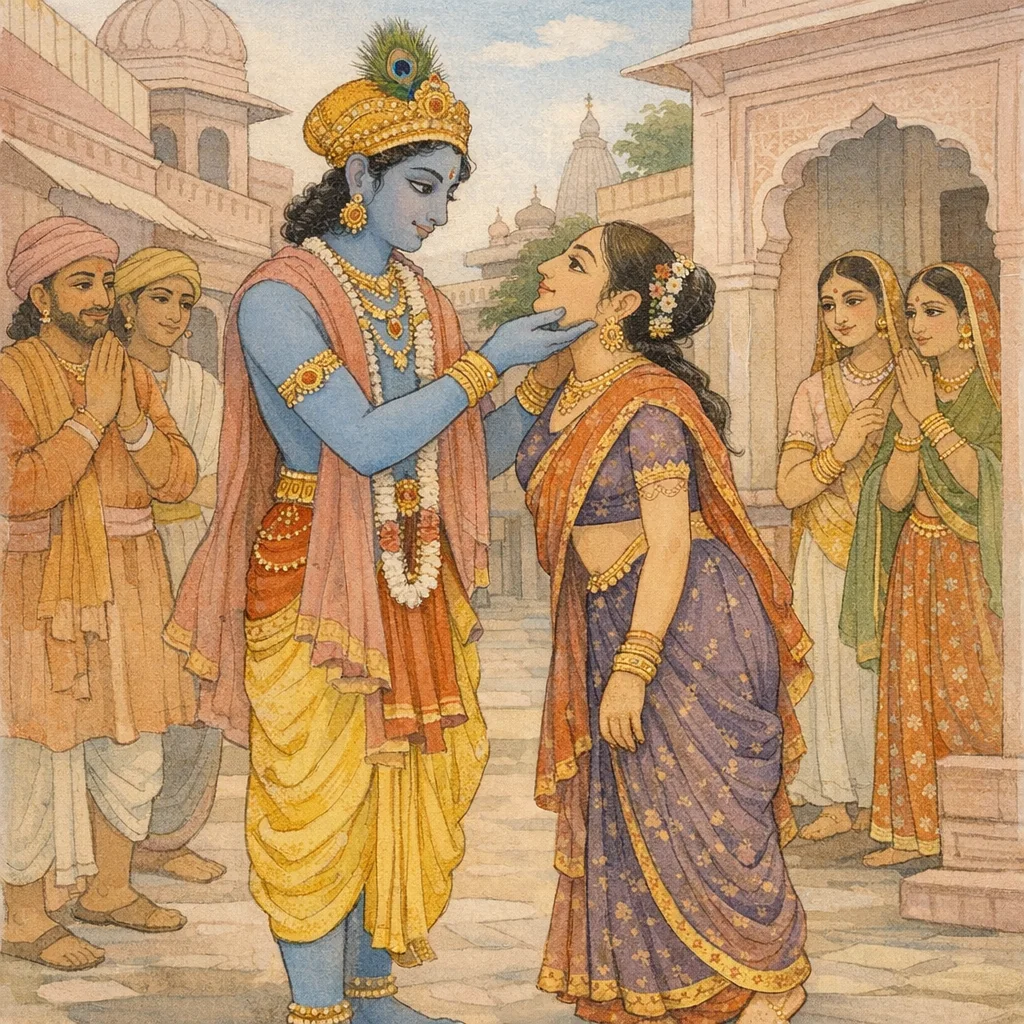
Parashara narrates: Krishna meets Kubja, accepts her sandalwood paste, and straightens her, granting her beauty. Then, Krishna and Balarama break the great bow in the hall. Kamsa sets the elephant Kuvalayapida and wrestlers at the gate. Entering the arena after killing the elephant, the brothers are hailed as Vishnu's avatars. In the wrestling match, Krishna kills Chanura and Balarama kills Mushtika. When Kamsa orders the death of Vasudeva, Krishna leaps onto the dais, kills Kamsa, and drags his body. Finally, he bows to his parents, who praise him as the Supreme Lord Vishnu.
Shlokas
Verse 1
राजमार्गे ततः कृष्णः सानुलेपनभाजनाम् ददर्श कुब्जाम् आयान्तीं नवयौवनगोचराम्
Then, upon the royal road, Śrī Kṛṣṇa saw Kubjā approaching, bearing a vessel of fragrant unguents; the bloom of fresh youth made her catch the eye.
Verse 2
ताम् आह ललितं कृष्णः कस्येदम् अनुलेपनम् भवत्या नीयते सत्यं वदेन्दीवरलोचने
Then Kṛṣṇa, speaking with playful tenderness, said: “For whom do you carry this fragrant unguent? Speak the truth, O lotus-eyed one.”
Verse 3
सकामेनैव सा प्रोक्ता सानुरागा हरिं प्रति प्राह सा ललितं कुब्जा तद्दर्शनबलात्कृता
As though stirred by Kāma himself, and filled with longing toward Hari, Kubjā—seemingly transformed by the power of beholding Him—spoke in gentle, playful words.
Verse 4
कान्त कस्मान् न जानासि कंसेनाभिनियोजिताम् नैकवक्रेति विख्याताम् अनुलेपनकर्मणि
Beloved, how do You not know her—commissioned by Kaṁsa, famed as ‘Naikavakrā’, and skilled in the art of anointing with unguents?
Verse 5
नान्यपिष्टं हि कंसस्य प्रीतये ह्य् अनुलेपनम् भवत्य् अहम् अतीवास्य प्रसादधनभाजनम्
Nothing pleases Kaṁsa so much as the anointing with this paste; and I, above all, have become a vessel fit to receive the wealth of his ‘favor’.
Verse 6
सुगन्धम् एतद् राजार्हं रुचिरं रुचिरानने आवयोर् गात्रसदृशं दीयताम् अनुलेपनम्
O lovely-faced one, grant us this fragrant and splendid unguent, fit for a king; it accords with the beauty of our bodies and is worthy to be worn upon our limbs.
Verse 7
श्रुत्वैतद् आह सा कुब्जा गृह्यताम् इति सादरम् अनुलेपनं च ददौ गात्रयोग्यम् अथोभयोः
Hearing this, Kubjā replied with reverence, “Please accept it,” and she respectfully offered the unguent fit for anointing the limbs, providing it for them both.
Verse 8
भक्तिच्छेदानुलिप्ताङ्गौ ततस् तौ पुरुषर्षभौ सेन्द्रचापौ विराजेतां सितकृष्णाव् इवाम्बुदौ
Then those two bull-like heroes among men, their bodies as though marked with the traces of devotion’s trials, shone forth like two clouds—one white and one dark—each arched with a rainbow as if bearing Indra’s bow.
Verse 9
ततस् तां चिबुके शौरिर् उल्लापनविधानवित् उत्पाट्य तोलयाम् आस द्व्यङ्गुलेनाग्रपाणिना
Then Śauri, fully skilled in the art of playful teasing, caught her by the chin and, lifting her up, held her poised as though weighing her, using only two fingers of his hand.
Verse 10
चकर्ष पद्भ्यां च तदा ऋजुत्वं केशवो ऽनयत् ततः सा ऋजुतां प्राप्ता योषिताम् अभवद् वरा
Then Keśava drew her with his feet and led her into straightness. Thereupon she became upright and, among women, the most excellent—by the sovereign touch of the Lord who sets right what is bent and broken.
Verse 11
विलासललितं प्राह प्रेमगर्भभरालसम् वस्त्रे प्रगृह्य गोविन्दं व्रज गेहं ममेति वै
With playful grace she spoke—her voice slow and weighty with love’s fullness; and, catching Govinda by his garment, she said, “Come, go to my house in Vraja.”
Verse 12
आयास्ये भवतीगेहम् इति तां प्रहसन् हरिः विससर्ज जहासोच्चै रामस्यालोक्य चाननम्
Smiling, Hari said to her, “I shall come to your home,” and dismissed her. Then, looking upon Rāma’s face, he laughed aloud.
Verse 13
भक्तिच्छेदानुलिप्ताङ्गौ नीलपीताम्बरौ च तौ धनुःशालां ततो यातौ चित्रमाल्योपशोभितौ
Smeared upon their limbs with the marks of devotion, and clad in blue and yellow garments, the two then proceeded to the bow-hall, adorned with variegated garlands.
Verse 14
आयोगवं धनूरत्नं ताभ्यां पृष्टैस् तु रक्षिभिः आख्याते सहसा कृष्णो गृहीत्वापूरयद् धनुः
When the guards, questioned by the two, pointed out that jewel among bows—Āyogava—Kṛṣṇa at once seized it and, in an instant, strung and drew the bow to its full stretch.
Verse 15
ततः पूरयता तेन भज्यमानं बलाद् धनुः चकार सुमहाशब्दं मथुरा येन पूरिता
Then, as he drew it to its full stretch, the bow—strained by his sheer might—broke with a vast, thunderous report, so that all Mathurā seemed filled with that sound.
Verse 16
अनुयुक्तौ ततस् तौ तु भग्ने धनुषि रक्षिभिः रक्षिसैन्यं निकृत्योभौ निष्क्रान्तौ कार्मुकालयात्
Then those two, pressed hard by the rākṣasas, found their bow broken. Yet, having cut down the rākṣasa host, the pair—undaunted—made their way out from the armory-house.
Verse 17
अक्रूरागमवृत्तान्तम् उपलभ्य तथा धनुः भग्नं श्रुत्वाथ कंसो ऽपि प्राह चाणूरमुष्टिकौ
When Kaṁsa came to know the tidings of Akrūra’s arrival, and then heard that the great bow had been broken, he too spoke—addressing Cāṇūra and Muṣṭika.
Verse 18
गोपालदारकौ प्राप्तौ भवद्भ्यां तौ ममाग्रतः मल्लयुद्धे निहन्तव्यौ मम प्राणहरौ हि तौ
“Those two cowherd boys have arrived. In my very presence, you must strike them down in the wrestlers’ combat—for they are, indeed, the takers of my life.”
Verse 19
नियुद्धे तद्विनाशेन भवद्भ्यां तोषितो ह्य् अहम् दास्याम्य् अभिमतान् कामान् नान्यथैतन् महाबलौ
“By your destruction of him in fair combat, I am indeed well-pleased with you both. I shall grant the desires you most cherish—this shall not be otherwise, O mighty ones.”
Verse 20
न्यायतो ऽन्यायतो वापि भवद्भ्यां तौ ममाहितौ हन्तव्यौ तद्वधाद् राज्यं सामान्यं वो भविष्यति
Whether by lawful means or by unlawful means—those two, who have become my enemies, must be slain by you. By their death, the kingdom will become a common possession for you both.
Verse 21
इत्य् आदिश्य स तौ मल्लौ ततश् चाहूय हस्तिपम् प्रोवाचोच्चैस् त्वया मल्लसमाजद्वारि कुञ्जरः
Thus instructing the two wrestlers, he then summoned the royal elephant and cried aloud: “At the very gate of the wrestlers’ arena, O tusker, you must confront them.”
Verse 22
स्थाप्यः कुवलयापीडस् तेन तौ गोपदारकौ घातनीयौ नियुद्धाय रङ्गद्वारम् उपागतौ
By his command the elephant Kuvalayāpīḍa was stationed as a living barricade, and those two cowherd boys were to be slain. Thus, for the appointed combat, they approached the gate of the arena.
Verse 23
तम् अप्य् आज्ञाप्य दृष्ट्वा च मञ्चान् सर्वान् उपाकृतान् आसन्नमरणः कंसः सूर्योदयम् उदैक्षत
Having issued those further orders and seeing all the viewing platforms prepared, Kaṃsa—his death now near—fixed his gaze upon the sunrise.
Verse 24
ततः समस्तमञ्चेषु नागरः स तदा जनः राजमञ्चेषु चारूढाः सह भृत्यैर् महीभृतः
Then the townspeople took their places upon all the tiers of seats; and the kings, ascending the royal platforms with their attendants, sat in due order.
Verse 25
मल्लप्राश्निकवर्गश् च रङ्गमध्यसमीपतः कृतः कंसेन कंसो ऽपि तुङ्गमञ्चे व्यवस्थितः
By Kaṃsa’s command, the wrestlers and their attendants were stationed near the middle of the arena; and Kaṃsa himself took his place upon a lofty dais.
Verse 26
अन्तःपुराणां मञ्चाश् च तथान्ये परिकल्पिताः अन्ये च वारमुख्यानाम् अन्ये नागरयोषिताम्
Separate daises and platforms were arranged: some for the women of the inner palace, others for the foremost courtesans, and others for the women of the city—each seated according to her station and custom.
Verse 27
नन्दगोपादयो गोपा मञ्चेष्व् अन्येष्व् अवस्थिताः अक्रूरवसुदेवौ च मञ्चप्रान्ते व्यवस्थितौ
Nanda and the other cowherd leaders took their seats upon the raised platforms, while Akrūra and Vasudeva stood at the edge—hearts intent on the līlā of Śrī Hari, who upholds the world’s order.
Verse 28
नागरीयोषितां मध्ये देवकी पुत्रगृद्धिनी अन्तकाले ऽपि पुत्रस्य द्रक्ष्यामि रुचिरं मुखम्
Among the noble women of the city, Devakī—yearning for her son—declares: “Even at the final hour, I shall behold my son’s radiant, beautiful face.”
Verse 29
वाद्यमानेषु तूर्येषु चाणूरे चातिवल्गति हाहाकारपरे लोके आस्फोटयति मुष्टिके
As the trumpets and instruments blared, Chāṇūra leapt about with fierce agility; and amid the people’s alarmed cries, Muṣṭika cracked his fists, flaunting his brutal strength.
Verse 30
हत्वा कुवलयापीडं हस्त्यारोहप्रचोदितम् मदासृगनुलिप्ताङ्गौ गजदन्तवरायुधौ
Having slain Kuvalayāpīḍa, the elephant driven on by its rider, Kṛṣṇa and Balarāma were smeared with rut and blood; taking the tusks as splendid weapons, they stood forth in irresistible might.
Verse 31
मृगमध्ये यथा सिम्हौ गर्वलीलावलोकिनौ प्रविष्टौ सुमहारङ्गं बलभद्रजनार्दनौ
Like two lions amid a herd of deer, casting proud and playful glances, Balarāma and Janārdana entered the vast royal arena, fearless and unshaken.
Verse 32
हाहाकारो महाञ् जज्ञे सर्वमञ्चेष्व् अनन्तरम् कृष्णो ऽयं बलभद्रो ऽयम् इति लोकस्य विस्मयात्
At once a great clamour rose through all the tiers, as the astonished people cried, “This is Krishna! This is Balabhadra!”
Verse 33
सो ऽयं येन हता घोरा पूतना सा निशाचरी क्षिप्तं तु शकटं येन भग्नौ च यमलार्जुनौ
He is the very One who slew the dreadful night-roaming Pūtanā, who hurled away the cart, and who shattered the twin Arjuna trees—this is that same Hari.
Verse 34
सो ऽयं यः कालियं नागं ननर्तारुह्य बालकः धृतो गोवर्धनो येन सप्तरात्रं महागिरिः
He is the very One who, though only a boy, climbed upon Kāliya the serpent-king and danced; and who held aloft mighty Govardhana for seven nights—this is that same Hari.
Verse 35
अरिष्टो धेनुकः केशी लीलयैव महात्मना निहता येन दुर्वृत्ता दृश्यतां सो ऽयम् अच्युतः
Ariṣṭa, Dhenuka, and Keśī—those wicked foes—were slain by that great-souled One as if in mere play. Behold: this is Acyuta.
Verse 36
अयं चास्य महाबाहुर् बलभद्रो ऽग्रजो ऽग्रतः प्रयाति लीलया योषिन्मनोनयननन्दनः
And behold—before Him goes His elder brother Balabhadra, mighty-armed, moving ahead in effortless līlā, a delight to the eyes and hearts of women.
Verse 37
अयं स कथ्यते प्राज्ञैः पुराणार्थावलोकिभिः गोपालो यादवं वंशं मग्नम् अभ्युद्धरिष्यति
This very one—so declare the wise who behold the inner purport of the Purāṇas—is Gopāla; and he shall raise up the Yādava line, sunk in decline.
Verse 38
अयं स सर्वभूतस्य विष्णोर् अखिलजन्मनः अवतीर्णो महीम् अंशो नूनं भारहरो भुवः
This indeed is that very Viṣṇu—the indwelling Lord of all beings, the source of every birth—who has descended upon the Earth as a portion of His own being, surely to remove the world’s burden.
Verse 40
महोत्सवम् इवासाद्य पुत्राननविलोकनम् युवेव वसुदेवो ऽभूद् विहायाभ्यागतां जराम्
As though he had come upon a great festival, Vasudeva—upon gazing again upon the faces of his sons—became as if young once more, casting off the old age that had crept upon him.
Verse 41
विस्तारिताक्षियुगलो राजान्तःपुरयोषितः नागरस्त्रीसमूहश् च द्रष्टुं न विरराम तम्
With eyes widened in wonder, the women of the royal inner chambers—and the gathered women of the city as well—could not cease from gazing upon him.
Verse 42
सख्यः पश्यत कृष्णस्य मुखम् अत्यरुणेक्षणम् गजयुद्धकृतायासस्वेदाम्बुकणिकाचितम्
Friends, behold Kṛṣṇa’s face—his eyes intensely reddened, and his countenance speckled with tiny beads of sweat and water born of the exertion of battling the elephant.
Verse 43
विकासिशरदम्भोजम् अवश्यायजलोक्षितम् परिभूय स्थितं जन्म सफलं क्रियतां दृशः
Like an autumn lotus newly opened yet beaded with dew, this life stands amid the world’s disregard; let your gaze make it meaningful—let this birth be fulfilled by seeing rightly.
Verse 44
श्रीवत्साङ्कं महद्धाम बालस्यैतद् विलोक्यताम् विपक्षक्षपणं वक्षो भुजयुग्मं च भामिनि
O passionate one, behold this child’s supreme radiance: the Śrīvatsa mark upon his chest, the breast that destroys opposing forces, and the pair of mighty arms as well.
Verse 45
किं न पश्यसि कुन्देन्दुमृणालधवलाननम् बलभद्रम् इमं नीलपरिधानम् उपागतम्
Why do you not see him—this Balabhadra who has come here—his face pale and radiant like jasmine, the moon, and the white lotus-stalk, now arrived in blue garments?
Verse 46
वल्गता मुष्टिकेनैतच् चाणूरेण तथा सखि क्रियते बलभद्रस्य हास्यम् एतद् विलोक्यताम्
Friend, look: as Muṣṭika prances about, and Cāṇūra too, they are only making Balabhadra laugh—behold it well.
Verse 47
सख्यः पश्यत चाणूरं नियुद्धार्थम् अयं हरिः समुपैति न सन्त्य् अत्र किं वृद्धा युक्तकारिणः
Friends, look—this Hari is advancing toward Cāṇūra for a regulated duel! Are there no elders here, no prudent and right-minded men, who will act?
Verse 48
क्व यौवनोन्मुखीभूतसुकुमारतनुर् हरिः क्व वज्रकठिनाभोगशरीरो ऽयं महासुरः
How could Hari—whose tender body has only just turned toward youth—be compared with this great Asura, whose massive frame is hard and dense like a thunderbolt vajra?
Verse 49
इमौ सुललितौ रङ्गे वर्तेते नवयौवनौ दैतेयमल्लाश् चाणूरप्रमुखास् त्व् अतिदारुणाः
These two move in the arena with effortless grace, radiant in the freshness of youth; yet the Daitya-born wrestlers—led by Cāṇūra—are exceedingly fierce.
Verse 50
नियुद्धप्राश्निकानां तु महान् एष व्यतिक्रमः यद् बालबलिनोर् युद्धं मध्यस्थैः समुपेक्ष्यते
For those appointed to oversee a regulated duel, this is a grave transgression: that the combat between a mere boy and a powerful warrior is calmly ignored by the arbiters standing in the middle as witnesses.
Verse 52
बलभद्रो ऽपि चास्फोट्य ववल्ग ललितं यदा पदे पदे तदा भूमिर् यन् न शीर्णा तद् अद्भुतम्
Balabhadra too, cracking his limbs in sportive flourish, leapt about with playful grace; yet at every step it was a wonder indeed that the earth itself did not split apart.
Verse 53
चाणूरेण ततः कृष्णो युयुधे ऽमितविक्रमः नियुद्धकुशलो दैत्यो बलभद्रेण मुष्टिकः
Then Kṛṣṇa, of immeasurable prowess, engaged Cāṇūra in skilled wrestling combat; and the demon Muṣṭika, expert in the wrestler’s art, grappled with Balabhadra (Balarāma).
Verse 54
संनिपातावधूतैस् तु चाणूरेण समं हरिः क्षेपणैर् मुष्टिभिश् चैव कीलवज्रनिपातनैः
Then Hari, locked with Cāṇūra, was shaken by their mutual charges—hurled by powerful throws, hammered by fists, and felled again and again by blows like iron stakes and thunderbolts; yet the Supreme Lord’s resolve remained unshaken.
Verse 55
पादोद्धूतैः प्रमृष्टैश् च तयोर् युद्धम् अभून् महत्
With stamping feet and with limbs rubbing and grappling, a great battle arose between the two.
Verse 56
अशस्त्रम् अतिघोरं तत् तयोर् युद्धं सुदारुणम् बलप्राणविनिष्पाद्यं समाजोत्सवसंनिधौ
Weaponless, yet terrifying beyond measure, was that battle—cruel and relentless, draining strength and very life-breath—fought in the midst of the assembled crowd at the public festival.
Verse 57
यावद् यावच् च चाणूरो युयुधे हरिणा सह प्राणहानिम् अवापाग्र्यां तावत् तावल् लवाल् लवम्
So long as Cāṇūra continued to wrestle with Hari, for just so long—moment after moment—he drew near to the crowning fate: the loss of life; before the Supreme Lord, even mighty strength endures only for an instant.
Verse 58
कृष्णो ऽपि युयुधे तेन लीलयैव जगन्मयः खेदाच् चालयता कोपान् निजशेखरकेसरम्
Kṛṣṇa too fought with him, yet only as divine play, for He is the Lord who pervades the whole universe. And when the opponent, pressed by fatigue, shook his head in anger, the mane-like locks upon His crested crown were tossed about.
Verse 59
बलक्षयं विवृद्धिं च दृष्ट्वा चाणूरकृष्णयोः वारयाम् आस तूर्याणि कंसः कोपपरायणः
Seeing Cāṇūra’s strength ebb away while Kṛṣṇa’s prowess only grew, Kaṃsa—given over to wrath—ordered the instruments to be silenced.
Verse 60
मृदङ्गादिषु तूर्येषु प्रतिषिद्धेषु तत्क्षणात् खे संगतान्य् अवाद्यन्त देवतूर्याण्य् अनेकशः
When the earthly instruments—mṛdaṅgas and the like—were forbidden, at that very instant in the open sky many divine instruments of the gods gathered and resounded again and again.
Verse 61
जय गोविन्द चाणूरं जहि केशव दानवम् इत्य् अन्तर्धानगा देवास् तदोचुर् अतिहर्षिताः
“Victory to You, Govinda! Strike down Cāṇūra! Slay the demon, O Keśava!”—thus cried the gods, hidden from sight, overflowing with joy.
Verse 62
चाणूरेण चिरं कालं क्रीडित्वा मधुसूदनः उत्पाट्य भ्रामयाम् आस तद्वधाय कृतोद्यमः
Having sported with Cāṇūra for a long while, Madhusūdana, intent on his death, tore him up, lifted him, and whirled him around.
Verse 63
भ्रामयित्वा शतगुणं दैत्यमल्लम् अमित्रजित् भूमाव् आस्फोटयाम् आस गगने गतजीवितम्
Having whirled the Daitya-wrestler a hundredfold, the Conqueror of foes hurled him down upon the earth—so that, even while his body was still aloft, life had already departed from him.
Verse 64
भूमाव् आस्फोटितस् तेन चाणूरः शतधाव्रजत् रक्तस्रावमहापङ्कां चकार स तदा भुवम्
Slammed down upon the earth by Him, Cāṇūra was shattered into a hundred fragments; and then, pouring out blood, he turned the ground into a vast mire of gore.
Verse 65
बलदेवो ऽपि तत्कालं मुष्टिकेन महाबलः युयुधे दैत्यमल्लेन चाणूरेण यथा हरिः
At that very moment, mighty Baladeva too engaged in combat with the powerful wrestler Muṣṭika—just as Hari (Krishna), the Supreme Lord, fought with the demon-wrestler Cāṇūra.
Verse 66
सो ऽप्य् एनं मुष्टिना मूर्ध्नि वक्षस्य् आहत्य जानुना पातयित्वा धरापृष्ठे निष्पिपेष गतायुषम्
He too struck him—first with a clenched fist upon the head and the chest—then, driving him down with his knee, he hurled him onto the earth’s surface and crushed him there, until his span of life was spent.
Verse 67
कृष्णस् तोशलकं भूयो मल्लराजं महाबलम् वाममुष्टिप्रहारेण पातयाम् आस भूतले
Then Kṛṣṇa, once again, struck down Tośalaka—the mighty king among wrestlers—bringing him to the ground with a crushing blow of His left fist.
Verse 68
चाणूरे निहते मल्ले मुष्टिके विनिपातिते नीते क्षयं तोशलके सर्वे मल्लाः प्रदुद्रुवुः
When the wrestler Cāṇūra had been slain, when Muṣṭika had been struck down, and when Tośalaka had been brought to his end, all the remaining wrestlers fled in panic.
Verse 69
ववल्गतुस् तदा रङ्गे कृष्णसंकर्षणाव् उभौ समानवयसो गोपान् बलाद् आकृष्य हर्षितौ
Then, in the arena, both Kṛṣṇa and Saṅkarṣaṇa sprang and sported about, and—seizing the cowherd boys of their own age by sheer strength—drew them toward themselves.
Verse 70
कंसो ऽपि कोपरक्ताक्षः प्राहोच्चैर् व्यापृतान् नरान् गोपाव् एतौ समाजौघान् निष्क्राम्येतां बलाद् इतः
Kamsa too—his eyes reddened with rage—shouted aloud to his attendants who stood ready for action: “Drive these two cowherd boys out from this gathered assembly at once, by force, from here!”
Verse 71
नन्दो ऽपि गृह्यतां पापो निगडैर् आयसैर् इह अवृद्धार्हेण दण्डेन वसुदेवो ऽपि हन्यताम्
“Seize that sinner Nanda as well—bind him here with iron fetters. And let Vasudeva too be put to death with a punishment unfit for the aged.”
Verse 72
वल्गन्ति गोपाः कृष्णेन ये चेमे सहिताः पुरः गावो ह्रियन्ताम् एतेषां यच् चास्ति वसु किंचन
“These cowherds who are strutting about—along with Kṛṣṇa—and who stand here in front: let their cows be driven away, and whatever little wealth they possess be seized as well.”
Verse 73
एवम् आज्ञापयानं तु प्रहस्य मधुसूदनः उत्प्लुत्यारुह्य तं मञ्चं कंसं जग्राह वेगतः
As Kaṃsa issued his commands, Madhusūdana—Śrī Kṛṣṇa, smiling in calm mastery—leapt up, mounted the dais, and swiftly seized Kaṃsa.
Verse 74
केशेष्व् आकृष्य विगलत्किरीटम् अवनीतले कंसं स पातयाम् आस तस्योपरि पपात च
Grabbing Kaṃsa by the hair—his crown slipping away—he hurled him to the ground and then fell upon him, utterly overpowering him.
Verse 75
निःशेषजगदाधारगुरुणा पततोपरि कृष्णेन त्याजितः प्राणान् उग्रसेनात्मजो नृपः
Struck down from above by Kṛṣṇa—mighty support of the entire universe—the king Kaṃsa, son of Ugrasena, relinquished his life-breath.
Verse 76
मृतस्य केशेषु तदा गृहीत्वा मधुसूदनः चकर्ष देहं कंसस्य रङ्गमध्ये महाबलः
Then Madhusūdana, mighty in strength, seized the dead Kaṃsa by the hair and dragged his body through the middle of the arena.
Verse 77
गौरवेणातिमहता परिखा तेन कृष्यता कृता कंसस्य देहेन वेगेनेव महाम्भसः
Dragged by that mighty pull, Kaṃsa’s heavy body gouged a deep trench in the ground—like a rushing flood carving its own channel by sheer force.
Verse 78
कंसे गृहीते कृष्णेन तद्भ्राताभ्यागतो रुषा सुनामा बलभद्रेण लीलयैव निपातितः
When Kaṃsa was seized by Kṛṣṇa, his brother Sunāmā rushed in, blazing with wrath; yet Balabhadra felled him effortlessly, as though in mere play.
Verse 79
ततो हाहाकृतं सर्वम् आसीत् तद् रङ्गमण्डलम् अवज्ञया हतं दृष्ट्वा कृष्णेन मथुरेश्वरम्
Then the whole arena-circle erupted in cries of alarm; for they saw the lord of Mathurā struck down by Kṛṣṇa as though in utter disregard, and at once the spectacle turned to tumult.
Verse 80
कृष्णो ऽपि वसुदेवस्य पादौ जग्राह सत्वरः देवक्याश् च महाबाहुर् बलदेवसहायवान्
Kṛṣṇa too, without delay, bowed down and clasped the feet of Vasudeva; and that mighty-armed Lord—supported by Balarāma—likewise honored Devakī with reverent devotion.
Verse 81
उत्थाप्य वसुदेवस् तं देवकी च जनार्दनम् स्मृतजन्मोक्तवचनौ ताव् एव प्रणतौ स्थितौ
Raising up Janārdana, Vasudeva and Devakī—recalling the circumstances of His birth and the words spoken then—remained before Him, standing with heads bowed in reverence.
Verse 82
प्रसीद सीदतां देव देवानां वरद प्रभो तथावयोः प्रसादेन कृतोद्धारश् च केशव
Be gracious, O Lord; come to the aid of those who are distressed. O Master, bestower of boons even upon the gods: by Your favor alone, O Keśava, our deliverance has been accomplished.
Verse 83
आराधितो यद् भगवान् अवतीर्णो गृहे मम दुर्वृत्तनिधनार्थाय तेन नः पावितं कुलम्
Because the Blessed Lord, truly worshipped, has descended into my own household to destroy the wicked, by that very deed our lineage has been made holy and purified.
Verse 84
त्वम् अन्तः सर्वभूतानां सर्वभूतेष्व् अवस्थितः प्रवर्तेते समस्तात्मंस् त्वत्तो भूतभविष्यती
You dwell within all beings, abiding in every creature as the inner ruler. O Soul of all, from You alone the entire moving universe is set into motion; what has been and what is yet to come arises from You.
Verse 85
यज्ञैस् त्वम् इज्यसे नित्यं सर्वदेवमयाच्युत त्वम् एव यज्ञो यष्टा च यज्ञानां परमेश्वरः
O Acyuta, ever comprised of all the gods, You are worshipped always through sacrifices; for You alone are the sacrifice itself, the one who performs it, and the supreme Lord who presides over all sacrificial rites.
Verse 86
सापह्नवं मम मनो यद् एतत् त्वयि जायते देवक्याश् चात्मजप्रीत्या तद् अत्यन्तविडम्बना
That my mind should feel this tender, possessive love toward You—as though You were merely my own son—arising from Devakī’s motherly affection: this is indeed the deepest irony.
Verse 87
क्व कर्ता सर्वभूतानाम् अनादिनिधनो भवान् क्व मे मनुष्यकस्यैषा जिह्वा पुत्रेति वक्ष्यति
Where are You—the beginningless and endless Maker of all beings—and where am I, a mere human? How could this tongue of mine ever again utter the word “my son”?
Verse 88
जगद् एतज् जगन्नाथ संभूतम् अखिलं यतः कया युक्त्या विना मायां सो ऽस्मत्तः संभविष्यति
O Jagannātha, Lord of the universe, from whom this whole cosmos has arisen—by what reasoning could He ever come into being from us, apart from His own Māyā?
Verse 89
यस्मिन् प्रतिष्ठितं सर्वं जगत् स्थावरजङ्गमम् स कोष्ठोत्सङ्गशयनो मनुष्याज् जायते कथम्
He in whom this entire universe—both the immovable and the moving—stands established: how could that very One, the Lord who reclines upon the cosmic couch, be born from a mere human being?
Verse 90
स त्वं प्रसीद परमेश्वर पाहि विश्वम् अंशावतारकरणैर् न ममासि पुत्रः आब्रह्मपादपम् अयं जगद् एतद् ईश त्वत्तो विमोहयसि किं परमेश्वरात्मन्
Be gracious, O Supreme Lord—protect the universe. By Your own acts of partial manifestation and descent, You are not truly my son. This whole world, from Brahmā down to the lowest, is Yours alone; O Supreme Self, why do You bewilder me with delusion?
Verse 91
मायाविमोहितदृशा तनयो ममेति कंसाद् भयं कृतम् अपास्तभयातितीव्रम् नीतो ऽसि गोकुलम् इतो ऽतिभयाकुलस्य वृद्धिं गतो ऽसि मम नास्ति ममत्वम् ईश
My sight, deluded by Your Māyā, clung to the thought, “He is my son,” and so I fashioned fierce fear of Kaṃsa. Therefore You were carried from here to Gokula; and I, shaken by excessive dread, have only grown in anxiety. O Lord, in truth there is no ‘mine-ness’ in me—no claim of possession over You.
Verse 92
कर्माणि रुद्रमरुदश्विशतक्रतूनां साध्यानि यानि न भवन्ति निरीक्षितानि त्वं विष्णुर् ईश जगताम् उपकारहेतोः प्राप्तो ऽसि नः परिगतं विगतो हि मोहः
The works of Rudra, the Maruts, the Aśvins, and Śatakratu (Indra)—even those achievements deemed ‘to be accomplished’—do not reach fulfillment unless they are overseen. You, O Vishnu, Lord of the worlds, have come to us for the welfare of all beings; our delusion has been dispelled, and clear understanding has returned.
Frequently Asked Questions
Narratively it is an act of grace (अनुग्रह) that reverses deformity; symbolically it depicts Bhagavān’s power to restore ‘ṛjutā’—order and rightness—turning a Kamsa-linked service into a bhakti-occasion.
They assert Vishnu as Antaryāmin of all beings and as the source of past and future (भूतभविष्यती), and identify him as sacrifice, sacrificer, and Lord of sacrifice—thereby uniting efficient causality (nimitta) and sustaining material order (upādāna in the sense of all-pervasive support).