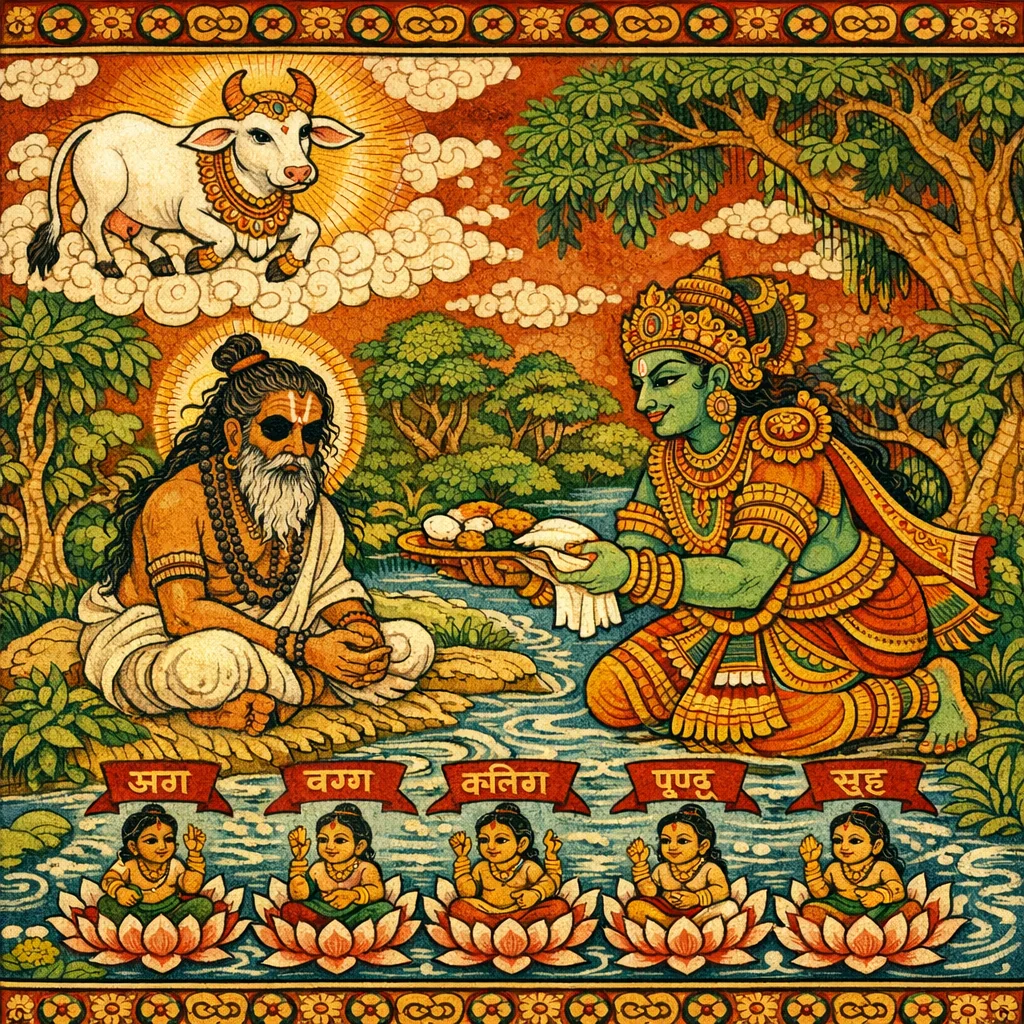
Adhyaya 48: Dynastic Genealogies: Paurava–Anu Lines, Bali–Dīrghatamas Episode, and the Origins of Anga–Vanga Regions
वंशानुचरितं—औशीनर-शिबि-बलि-दीर्घतमसां कथा
Speaker: Sūta, Ṛṣis (Munis)
Sūta continues the dynastic recital: Turvasu’s line is folded into the Paurava lineage through Yayāti’s jarā-saṃkramaṇa (transfer of old age). He enumerates successive kings with their realms, then turns to Druhyu’s descendants (Gandhāra; the famed Āraṭṭa horses) and to Anu’s line culminating in Uśīnara and Śibi, naming the territories of Śibi’s sons. The ṛṣis interrupt to ask how Bali’s five sons were born and who fathered them. Sūta replies with the Dīrghatamas episode—Bṛhaspati’s desire, a womb-born rebuke, a curse bringing “long darkness,” Vṛṣabha’s teaching of go-dharma, Bali’s rescue of Dīrghatamas, and the begetting of kṣetraja sons through Sudeṣṇā: Aṅga, Vaṅga, Suhma, Puṇḍra, Kaliṅga. The chapter then resumes Anga’s royal succession down to Karṇa, and ends by resolving another query: Karṇa’s ‘sūta’ identity is explained through his adoption by Adhiratha.
Key Concepts
Shlokas in Adhyaya 48
Verse 1
*सूत उवाच तुर्वसोस्तु सुतो गर्भो गोभानुस्तस्य चात्मजः गोभानोस्तु सुतो वीरस् त्रिसारिरपराजितः //
Sūta said: From Turvasu was born a son named Garbha; and his son was Gobhānu. From Gobhānu was born the heroic son Trisāri, the unconquered.
Verse 2
करंधमस्तु त्रैसारिर् भरतस्तस्य चात्मजः दुष्यन्तः पौरवस्यापि तस्य पुत्रो ह्य् अकल्मषः //
Now, Karaṃdhama was (born) to Traisāri; and Bharata was his son. Duṣyanta too was a descendant of Paurava; and his son was Akalmaṣa (the Blameless).
Verse 3
एवं ययातिशापेन जरासंक्रमणे पुरा तुर्वसोः पौरवं वंशं प्रविवेश पुरा किल //
Thus, in the ancient account of the transference of old age, through Yayāti’s curse, Turvasu is said to have entered the Paurava lineage.
Verse 4
दुष्यन्तस्य तु दायादो वरूथो नाम पार्थिवः वरूथात्तु तथाण्डीरः संधानस्तस्य चात्मजः //
Now, Duṣyanta’s heir was a king named Varūtha. From Varūtha came Āṇḍīra, and his son was Saṃdhāna.
Verse 5
पाण्ड्यश्च केरलश्चैव चोलः कर्णस्तथैव च तेषां जनपदाः स्फीताः पाण्ड्याश्चोलाः सकेरलाः //
The Pāṇḍyas and the Keralas, the Colas, and likewise the Karṇas—these are flourishing provinces; thus are counted the prosperous lands of the Pāṇḍyas and Colas, together with the Keralas.
Verse 6
द्रुह्योस्तु तनयौ शूरौ सेतुः केतुस्तथैव च सेतुपुत्रः शरद्वांस्तु गन्धारस्तस्य चात्मजः //
Druhyu had two valiant sons—Setu and Ketu. Setu’s son was Śaradvān, and Gandhāra was the son of Śaradvān.
Verse 7
ख्यायते यस्य नाम्नासौ गन्धारविषयो महान् आरट्टदेशजास्तस्य तुरगा वाजिनां वराः //
That great territory of Gandhāra is celebrated by his name; and the horses born in the land of Āraṭṭa are said to be the finest among steeds.
Verse 8
गन्धारपुत्रो धर्मस्तु घृतस्तस्यात्मजो ऽभवत् घृताच्च विदुषो जज्ञे प्रचेतास्तस्य चात्मजः //
From Gandhāra was born Dharma; his son was Ghṛta. From the wise Ghṛta was born Pracetā, who in turn was Ghṛta’s son.
Verse 9
प्रचेतसः पुत्रशतं राजानः सर्व एव ते म्लेच्छराष्ट्राधिपाः सर्वे उदीचीं दिशम् आश्रिताः //
All those kings—the one hundred sons of Pracetasa—became rulers over Mleccha kingdoms, and all of them were established in the northern direction.
Verse 10
अनोश्चैव सुता वीरास् त्रयः परमधार्मिकाः सभानरश्चाक्षुषश्च परमेषुस् तथैव च //
And Anu too had three heroic sons, supremely righteous—Sabhānara, Cākṣuṣa, and likewise Parameṣu.
Verse 11
सभानरस्य पुत्रस्तु विद्वान्कोलाहलो नृपः कोलाहलस्य धर्मात्मा संजयो नाम विश्रुतः //
Now, Sabhānara’s son was the learned king Kolāhala; and Kolāhala’s son, the righteous-hearted one, was renowned by the name Saṃjaya.
Verse 12
संजयस्याभवत्पुत्रो वीरो नाम पुरंजयः जनमेजयो महाराज पुरंजयसुतो ऽभवत् //
Sañjaya had a son, the valiant one named Puraṃjaya; and King Janamejaya was born as the son of Puraṃjaya.
Verse 13
जनमेजयस्य राजर्षेर् महाशालो ऽभवत्सुतः आसीद् इन्द्रसमो राजा प्रतिष्ठितयशाभवत् //
To the royal sage Janamejaya was born a son named Mahāśāla. He became a king equal to Indra, and his fame stood firmly established.
Verse 14
महामनाः सुतस्तस्य महाशालस्य धार्मिकः सप्तद्वीपेश्वरो जज्ञे चक्रवर्ती महामनाः //
From that righteous Mahāśāla was born a son named Mahāmanā—virtuous and law-abiding—who became a universal emperor (cakravartin), sovereign over the seven continents (saptadvīpa).
Verse 15
महामनास्तु द्वौ पुत्रौ जनयामास विश्रुतौ उशीनरं च धर्मज्ञं तितिक्षुं चैव ताव् उभौ //
Mahāmanā begot two renowned sons—Uśīnara, who was a knower of dharma, and Titikṣu; both were celebrated.
Verse 16
उशीनरस्य पत्न्यस्तु पञ्च राजर्षिसम्भवाः भृशा कृशा नवा दर्शा या च देवी दृषद्वती //
King Uśīnara had five wives, born in the line of royal seers: Bhṛśā, Kṛśā, Navā, Darśā, and the divine Dṛṣadvatī.
Verse 17
उशीनरस्य पुत्रास्तु तासु जाताः कुलोद्वहाः तपसा ते तु महता जाता वृद्धस्य धार्मिकाः //
From those wives, sons were born to Uśīnara—upholders of the family line. Through great austerity (tapas), they became the righteous offspring of the elder (ancestor), renowned for their dharma.
Verse 18
भृशायास्तु नृगः पुत्रो नवाया नव एव च कृशायास्तु कृशो जज्ञे दर्शायाः सुव्रतो ऽभवत् दृषद्वत्याः सुतश्चापि शिबिर् औशीनरो नृपः //
From Bhṛśā was born the son Nṛga; from Navā, indeed, was born Nava. From Kṛśā, Kṛśa was born; from Darśā, Suvrata came to be. And from Dṛṣadvatī too was born Śibi, the king of the Auśīnara line.
Verse 19
शिबेस्तु शिबयः पुत्राश् चत्वारो लोकविश्रुताः पृथुदर्भः सुवीरश्च केकयो भद्रकस्तथा //
Now, Śibi had four sons, renowned throughout the world: Pṛthudarbha, Suvīra, Kekaya, and likewise Bhadraka.
Verse 20
तेषां जनपदाः स्फीताः केकया भद्रकास्तथा सौवीराश्चैव पौराश्च नृगस्य केकयास्तथा //
Among their territories were flourishing realms—Kekaya and Bhadraka, as well as Sauvīra and Paurava; and likewise (there were) the Kekayas connected with King Nṛga.
Verse 21
सुव्रतस्य तथाम्बष्ठा कृशस्य वृषला पुरी नवस्य नवराष्ट्रं तु तितिक्षोस्तु प्रजां शृणु //
And of Suvrata (was) the people or settlement called Ambaṣṭhā; of Kṛśa, the city named Vṛṣalā; of Nava, the region called Navarāṣṭra. Now hear, as well, about the progeny of Titikṣu.
Verse 22
तितिक्षुरभवद्राजा पूर्वस्यां दिशि विश्रुतः बृहद्रथः सुतस्तस्य तस्य सेनो ऽभवत्सुतः //
King Titikṣu arose, renowned in the eastern quarter. His son was Bṛhadratha, and Bṛhadratha’s son was Sena.
Verse 23
सेनस्य सुतपा जज्ञे सुतपस्तनयो बलिः जातो मानुषयोन्यां तु क्षीणे वंशे प्रजेच्छया //
From Sena was born Sutapā; and from Sutapā was born Bali. When the royal line had dwindled, Bali was born into human birth through the will to obtain progeny for the continuation of the lineage.
Verse 24
महायोगी तु स बलिर् बद्धो बन्धैर्महात्मना पुत्रानुत्पादयामास क्षेत्रजान्पञ्च पार्थिवान् //
That Bali, a great yogin, though bound by the bonds laid upon him by the noble one, nevertheless caused five sons to be born—sons begotten through the kṣetra-method—who became kings upon the earth.
Verse 25
अङ्गं स जनयामास वङ्गं सुह्मं तथैव च पुण्ड्रं कलिङ्गं च तथा बालेयं क्षेत्रमुच्यते बालेया ब्राह्मणाश्चैव तस्य वंशकराः प्रभो //
He begot sons named Aṅga, Vaṅga, Suhma, Puṇḍra, and Kaliṅga; and likewise there is the region known as Bāleya. And the Bāleya Brāhmaṇas, O Lord, are indeed the continuers of his lineage.
Verse 26
बलेश्च ब्रह्मणा दत्तो वरः प्रीतेन धीमतः महायोगित्वमायुश्च कल्पस्य परिमाणकम् //
And to Bali, the wise Brahmā—being pleased—granted a boon: supreme yogic mastery, and a life-span enduring for the full measure of a Kalpa.
Verse 27
संग्रामे चाप्यजेयत्वं धर्मे चैवोत्तमा मतिः त्रैकाल्यदर्शनं चैव प्राधान्यं प्रसवे तथा //
In battle there is also invincibility; in matters of dharma, an excellent and upright understanding; the ability to perceive the three times—past, present, and future; and likewise preeminence in progeny and childbirth.
Verse 28
जयं चाप्रतिमं युद्धे धर्मे तत्त्वार्थदर्शनम् चतुरो नियतान्वर्णान् स वै स्थापयिता प्रभुः //
Unmatched victory in war, and in dharma the insight into the true purport of reality—he is indeed the sovereign Lord who firmly establishes the four regulated social orders (varṇas).
Verse 29
तेषां च पञ्च दायादा वङ्गाङ्गाः सुह्मकास्तथा पुण्ड्राः कलिङ्गाश्च तथा अङ्गस्य तु निबोधत //
From them arose five heirs—Vanga, Anga, Suhma, Pundra, and Kalinga. Now hear, in particular, about Anga.
Verse 30
*मुनय ऊचुः कथं बलेः सुता जाताः पञ्च तस्य महात्मनः किंनाम्नी महिषी तस्य जनिता कतम ऋषिः //
The sages said: “How were the five sons of that great-souled Bali born? What was the name of his chief queen, and which sage was their begetter (father)?”
Verse 31
कथं चोत्पादितास्तेन तन्नः प्रब्रूहि पृच्छताम् माहात्म्यं च प्रभावं च निखिलेन वदस्व तत् //
How, indeed, were they brought into being by him? Tell us—who are asking—about that. Also declare, in full, its greatness and its power.
Verse 32
*सूत उवाच अथोशिज इति ख्यात आसीद्विद्वानृषिः पुरा पत्नी वै ममता नाम बभूवास्य महात्मनः //
Sūta said: In ancient times there was a learned sage renowned by the name Athośija; and the wife of that great-souled one was indeed called Mamatā.
Verse 33
उशिजस्य यवीयान्वै भ्रातृपत्नीमकामयत् बृहस्पतिर्महातेजा ममतामेत्य कामतः //
Bṛhaspati, the greatly radiant one, came to Mamatā and, impelled by passion, desired the wife of Uśij’s younger brother.
Verse 34
उवाच ममता तं तु देवरं वरवर्णिनी अन्तर्वत्न्यस्मि ते भ्रातुर् ज्येष्ठस्य तु विरम्यताम् //
Mamatā, fair-complexioned, said to her brother-in-law: “I am pregnant by your elder brother; therefore desist.”
Verse 35
अयं तु मे महाभाग गर्भः कुप्येद्बृहस्पते औशिजो भ्रातृजन्यस्ते सोपाङ्गं वेदमुद्गिरन् //
“But, O greatly fortunate one—O Bṛhaspati—this embryo of mine would become agitated. Then Auśija, your kinsman born from your brother’s line, would utter the Veda together with its subsidiary disciplines.”
Verse 36
अमोघरेतास्त्वं चापि न मां भजितुमर्हसि अस्मिन्न् एवं गते काले यथा वा मन्यसे प्रभो //
“O Lord, your seed is unfailing; yet at this time, when matters have come to this pass, you need not approach me—act as you deem fit, O Master.”
Verse 37
एवमुक्तस्तथा सम्यग् बृहत्तेजा बृहस्पतिः कामात्मा स महात्मापि न मनः सो ऽभ्यवारयत् //
Thus addressed, Bṛhaspati of vast radiance—though great-souled—became driven by desire and could not restrain his own mind.
Verse 38
संबभूवैव धर्मात्मा तया सार्धमकामया उत्सृजन्तं तु तद्रेतोवाचं गर्भो ऽभ्यभाषत //
That righteous-souled man indeed came to be with her, though she had no desire; and as he was discharging his semen, the embryo spoke forth in words.
Verse 39
भो तात वाचामधिप द्वयोर्नास्तीह संस्थितिः अमोघरेतास्त्वं चापि पूर्वं चाहमिहागतः //
“O dear one—O lord of speech—there is no abiding here for the two of us. You, whose seed is unfailing, have come; and I too arrived here earlier.”
Verse 40
सो ऽशपत्तं ततः क्रुद्ध एवमुक्तो बृहस्पतिः पुत्रं ज्येष्ठस्य वै भ्रातुर् गर्भस्थं भगवानृषिः //
Then, angered at being addressed in that manner, the venerable sage Bṛhaspati pronounced a curse—upon the unborn son in the womb of his elder brother.
Verse 41
यस्मात्त्वमीदृशे काले गर्भस्थो ऽपि निषेधसि मामेवमुक्तवांस्तस्मात् तमो दीर्घं प्रवेक्ष्यसि //
“Since, at such a time, you—though still in the womb—have opposed me and spoken to me in this manner, therefore you shall enter long darkness.”
Verse 42
ततो दीर्घतमा नाम शापादृषिरजायत अतो ऽंशजो बृहत्कीर्तिर् बृहस्पतिरिवौजसा //
Thereafter, as the result of the curse, a sage named Dīrghatamas was born; and from his lineage arose the famed Bṛhatkīrti—mighty in splendor, like Bṛhaspati himself.
Verse 43
ऊर्ध्वरेतास्ततो ऽसौ वै वसते भ्रातुराश्रमे स धर्मान्सौरभेयांस्तु वृषभाच्छ्रुतवांस्ततः //
Thereafter, living as a strict brahmacārin (one who has raised the vital seed upward), he dwelt in his brother’s āśrama; and from Vṛṣabha he then heard and learned the dharmas known as the Saurabheya traditions.
Verse 44
तस्य भ्राता पितृव्यो यश् चकार भरणं तदा तस्मिन्निवसतस्तस्य यदृच्छातस्तु वै वृषः //
Then his paternal uncle—the brother of his father—undertook his maintenance and support. And while he was living there, a bull happened to come there of its own accord.
Verse 45
यज्ञार्थमाहृतान्दर्भांश् चचार सुरभीसुतः जग्राह तं दीर्घतमाः शृङ्गयोस्तु चतुष्पदम् //
The son of Surabhī wandered about, carrying the darbha-grass that had been brought for the sacrifice (yajña). Then Dīrghatamas seized that four-footed creature by its horns.
Verse 46
तेनासौ निगृहीतश्च न चचाल पदात्पदम् ततो ऽब्रवीद्वृषस्तं वै मुञ्च मां बलिनां वर //
Restrained by him, the other did not move even a step. Then that bull said, “Release me, O best among the strong!”
Verse 47
न मयासादितस्तात बलवांस्त्वत्समः क्वचित् मम चान्यः समो वापि न हि मे बलसंख्यया मुञ्च तातेति च पुनः प्रीतस्ते ऽहं वरं वृणु //
“My dear son, nowhere have I ever met a strong one equal to you; nor is there any other who is my equal by measure of strength. So, dear one, release me.” Then, being pleased with you, he said again: “Choose a boon.”
Verse 48
एवमुक्तो ऽब्रवीदेनं जीवन्मे त्वं क्व यास्यसि एष त्वां न विमोक्ष्यामि परस्वादं चतुष्पदम् //
Thus addressed, it said to him: “So long as I am alive, where will you go? I will not release you—O four-footed creature whose taste is for another’s flesh!”
Verse 49
*वृषभ उवाच नास्माकं विद्यते तात पातकं स्तेयमेव च भक्ष्याभक्ष्यं तथा चैव पेयापेयं तथैव च //
Vṛṣabha said: “Dear one, for us there exists neither sin nor theft; likewise there is no distinction of what should or should not be eaten, and similarly no distinction of what should or should not be drunk.”
Verse 50
द्विपदां बहवो ह्य् एते धर्म एष गवां स्मृतः कार्याकार्ये न वागम्यागमनं च तथैव च //
Many indeed are these duties for two-footed beings (humans); but for cattle this is declared to be their dharma: in matters of what should and should not be done, there is no question of speech, nor of ‘going’ and ‘not going’ as deliberate moral choice.
Verse 51
*सूत उवाच गवां धर्मं तु वै श्रुत्वा संभ्रान्तस्तु विसृज्य तम् शक्त्यान्नपानदानात्तु गोपतिं संप्रसादयत् //
Sūta said: Having heard the sacred duty concerning cattle, he became deeply stirred; and releasing him, he then, according to his means, pleased the lord and protector of the cows by gifts of food and drink.
Verse 52
प्रसादिते गते तस्मिन् गोधर्मं भक्तितस्तु सः मनसैव समादध्यौ तन्निष्ठस्तत्परो हि सः //
When that one had been graciously satisfied and had departed, he—out of devotion—mentally embraced the dharma taught there, remaining firmly established in it and wholly devoted to it.
Verse 53
ततो यवीयसः पत्नीं गौतमस्याभ्यपद्यत कृतावलेपां तां मत्वा सो ऽनड्वानिव न क्षमः //
Then he approached the wife of the younger Gautama. Taking her to be acting in pride and self-will, he grew intolerant—like an unyoked bull—unable to restrain himself.
Verse 54
गोधर्मं तु परं मत्वा स्नुषां तामभ्यपद्यत निर्भर्त्स्य चैनं रुद्ध्वा च बाहुभ्यां सम्प्रगृह्य च //
But regarding the cow’s dharma as supreme, he rushed toward that daughter-in-law; and after rebuking him, she restrained him and firmly seized him with her arms.
Verse 55
भाव्यमर्थं तु तं ज्ञात्वा माहात्म्यात्तमुवाच सा विपर्ययं तु त्वं लब्ध्वा अनड्वानिव वर्तसे //
Knowing the matter that was destined to occur, she spoke to him in consideration of his greatness: “But you, having fallen into a perverse understanding, behave like an unbroken bull.”
Verse 56
गम्यागम्यं न जानीषे गोधर्मात्प्रार्थयन्सुताम् दुर्वृत्तं त्वां त्यजाम्यद्य गच्छ त्वं स्वेन कर्मणा //
You do not know what is permissible and what is forbidden—since, contrary to righteous conduct, you have sought a daughter. Today I renounce you for your wicked behavior; go and meet the consequences of your own deeds.
Verse 57
काष्ठे समुद्गे प्रक्षिप्य गङ्गाम्भसि समुत्सृजत् यस्मात्त्वमन्धो वृद्धश्च भर्तव्यो दुरधिष्ठितः //
Placing him in a wooden chest, she cast him into the waters of the Gaṅgā, saying: “Because you are blind and old—hard to manage—you must be maintained as a burden.”
Verse 58
तमुह्यमानं वेगेन स्रोतसो ऽभ्याशमागतः जग्राह तं स धर्मात्मा बलिर् वैरोचनिस्तदा //
Then, as he was being swept along by the force of the river-current, the righteous Bali, son of Virocana, came near and seized hold of him.
Verse 59
अन्तःपुरे जुगोपैनं भक्ष्यभोज्यैश्च तर्पयन् प्रीतश्चैव वरेणैव च्छन्दयामास वै बलिम् //
He kept him safely within the inner palace quarters, gratifying him with foods and delicacies; and being pleased, he indeed won over Bali by granting him a boon.
Verse 60
तस्माच्च स वरं वव्रे पुत्रार्थे दानवर्षभः संतानार्थं महाभागभार्यायां मम मानद पुत्रान्धर्मार्थतत्त्वज्ञान् उत्पादयितुमर्हसि //
Therefore that bull among the Dānavas chose a boon for the sake of sons: “O bestower of honor, be pleased to beget, through my noble wife, sons for my lineage—sons who know the true principles of dharma and artha.”
Verse 61
एवमुक्तो ऽथ देवर्षिस् तथास्त्वित्युक्तवान् प्रभुः स तस्य राजा स्वां भार्यां सुदेष्णां नाम प्राहिणोत् अन्धं वृद्धं च तं ज्ञात्वा न सा देवी जगाम ह //
Thus addressed, the divine seer replied, “So be it.” Thereupon that king sent his own wife, named Sudeṣṇā. But when the queen learned that the man was blind and aged, she did not go.
Verse 62
शूद्रां धात्रेयिकां तस्माव् अन्धाय प्राहिणोत्तदा तस्यां कक्षीवदादींश्च शूद्रयोनाव् ऋषिर् वशी //
Therefore, at that time he sent a Śūdra woman—Dhātreyikā—to Andha; and through her, the self-controlled seer begot Kakṣīvān and others, born from a Śūdra womb.
Verse 63
जनयामास धर्मात्मा शूद्रान् इत्येवमादिकम् उवाच तं बली राजा दृष्ट्वा कक्षीवदादिकान् //
The righteous one thus begot the Śūdras and others. Seeing Kakṣīvat and the rest, King Bali spoke to him accordingly.
Verse 64
*राजोवाच प्रवीणान् ऋषिधर्मस्य चेश्वरान् ब्रह्मवादिनः विद्वान् प्रत्यक्षधर्माणां बुद्धिमान् वृत्तिमाञ्छुचीन् //
The king said: “(One should seek) those who are skilled—masters of the sages’ dharma—teachers who expound Brahman, learned in the directly knowable principles of righteousness, intelligent, of good conduct, and pure.”
Verse 65
ममैव चेति होवाच तं दीर्घतमसं बलिः नत्युवाच मुनिस्तं वै ममैवमिति चाब्रवीत् //
Bali said to the sage Dīrghatamas, “He is mine indeed.” The muni, bowing in reverence, replied, “Yes—he is yours indeed,” and spoke accordingly.
Verse 66
उत्पन्नाः शूद्रयोना तु भवच्छन्दे सुरोत्तम अन्धं वृद्धं च मां ज्ञात्वा सुदेष्णा महिषी तव प्राहिणोद् अवमानान्मे शूद्रां धात्रेयिकां नृप //
“Indeed, by your own wish, O best of the gods, I was born from a Śūdra womb. When Sudeṣṇā, your queen, learned that I was blind and aged, O king, she sent to me in contempt a Śūdra wet-nurse, a daughter of Dhātreya.”
Verse 67
ततः प्रसादयामास बलिस् तमृषिसत्तमम् बलिः सुदेष्णां तां भार्यां भर्त्सयामास दानवः //
Thereupon Bali sought to appease that foremost of sages. Yet that Dānava Bali went on to rebuke his wife Sudeṣṇā.
Verse 68
पुनश्चैनाम् अलंकृत्य ऋषये प्रत्यपादयत् तां स दीर्घतमा देवीं तथा कृतवतीं तदा //
Then again, having adorned her, he presented her to the Ṛṣi; and at that time Dīrghatamā indeed accepted the Goddess—thus it was done accordingly.
Verse 69
दध्ना लवणमिश्रेण त्व् अभ्यक्तं मधुकेन तु लिह माम् अजुगुप्सन्ती आपादतलमस्तकम् ततस्त्वं प्राप्स्यसे देवि पुत्रान्वै मनसेप्सितान् //
Smeared with curd mixed with salt, and with honey as well, you should lick me—without disgust—from the soles of the feet up to the head. Then, O goddess, you will obtain sons truly desired by your heart.
Verse 70
तस्य सा तद्वचो देवी सर्वं कृतवती तदा तस्य सापानम् आसाद्य देवी परिहरत्तदा //
Hearing his words, the Goddess did everything accordingly. Then, when the occasion of his curse arose, she warded it off at that very time.
Verse 71
तामुवाच ततः सो ऽथ यत्ते परिहृतं शुभे विनापानं कुमारं तु जनयिष्यसि पूर्वजम् //
Then he spoke to her: “Auspicious one, that which was withheld from you—you shall give birth to a son, Vināpāna, an elder-born, born first.”
Verse 72
*सुदेष्णोवाच नार्हसि त्वं महाभाग पुत्रं मे दातुमीदृशम् तोषितश्च यथाशक्ति प्रसादं कुरु मे प्रभो //
Sudeṣṇā said: “O greatly fortunate one, you ought not to give away my son in this manner. Since you have been pleased—as far as I was able—grant me your favor, O lord.”
Verse 73
*दीर्घतमा उवाच तवापचाराद्देव्येष नान्यथा भविता शुभे नैव दास्यति पुत्रस्ते पौत्रौ वै दास्यते फलम् //
Dīrghatamas said: “O auspicious lady, because of your offence, this will indeed come to pass and cannot be otherwise: your son will not grant you the fruit; rather, the result will come to you through your grandsons.”
Verse 74
तस्यापानं विना चैव योग्यभावो भविष्यति तस्माद् दीर्घतमाङ्गेषु कुक्षौ स्पृष्ट्वेदम् अब्रवीत् //
“Even without apāna, the downward-moving breath, it will still become fit for the task.” Therefore, touching his own belly with his long limbs, he spoke these words.
Verse 75
प्राशितं यद्यदङ्गेषु न सोपस्थं शुचिस्मिते तेन तिष्ठन्ति ते गर्भे पौर्णमास्याम् इवोडुराट् //
Whatever food is taken in nourishes the limbs, yet not the region of the loins. O pure-smiling one, by that order of nourishment they remain established in the womb, like the lordly moon on the night of the full moon.
Verse 76
भविष्यन्ति कुमारास्तु पञ्च देवसुतोपमाः तेजस्विनः सुवृत्ताश्च यज्वानो धार्मिकाश्च ते //
There will be five sons, like the sons of the gods—radiant, of excellent conduct, performers of sacrifices (yajña), and truly righteous in dharma.
Verse 77
*सूत उवाच तदंशस्तु सुदेष्णाया ज्येष्ठः पुत्रो व्यजायत अङ्गस्तथा कलिङ्गश्च पुण्ड्रः सुह्मस्तथैव च //
Sūta said: From that lineage, Sudeshṇā gave birth to her eldest son; and the others were born as well—Aṅga, Kaliṅga, Puṇḍra, and likewise Suhma.
Verse 78
वङ्गराजस्तु पञ्चैते बलेः पुत्राश्च क्षेत्रजाः इत्येते दीर्घतमसा बलेर्दत्ताः सुतास्तथा //
These five—known as the kings of Vanga—were Bali’s sons, born as kṣetrajā offspring. Thus the sage Dīrghatamas bestowed these sons upon Bali as his own sons.
Verse 79
प्रतिष्ठामागतानां हि ब्राह्मण्यं कारयंस्ततः ततो मानुषयोन्यां स जनयामास वै प्रजाः //
Indeed, once they had become settled and established, he caused the Brahminical order to be instituted. Thereafter, through human generation in the human womb, he truly brought forth progeny.
Verse 80
ततस्तं दीर्घतमसं सुरभिर्वाक्यमब्रवीत् विचार्य यस्माद्गोधर्मं प्रमाणं ते कृतं विभो //
Then Surabhī spoke these words to Dīrghatamas: “O mighty one, since you have reflected and established the dharma concerning cows as the authoritative standard of right conduct…”
Verse 81
शक्त्या चानन्ययास्मासु तेन प्रीतास्मि ते ऽनघ तस्मात्तुभ्यं तमो दीर्घम् आघ्रायापनुदामि वै //
O sinless one, because you have relied on Me with unwavering devotion and with all your strength, I am pleased with you. Therefore, for your sake, I truly dispel the long-standing darkness, as though breathing it in and driving it away.
Verse 82
बार्हस्पत्यस्तथैवैष पाप्मा वै तिष्ठति त्वयि जरां मृत्युं तमश्चैव आघ्रायापनुदामि ते //
This Bārhaspatya affliction—this very sinfulness—has indeed settled upon you. By sniffing it out and driving it away, I remove from you old age, death, and darkness as well.
Verse 83
सद्यः स घ्रातमात्रस्तु असितो मुनिसत्तमः आयुष्मांश्च वपुष्मांश्च चक्षुष्मांश्च ततो ऽभवत् //
Immediately, by that mere act of smelling, Asita—the most excellent of sages—became endowed with long life, a sound and radiant body, and clear sight.
Verse 84
गो ऽभ्याहते तमसि वै गौतमस्तु ततो ऽभवत् काक्षीवांस्तु ततो गत्वा सह पित्रा गिरिव्रजम् //
When the darkness was struck down by the Cow, then Gautama was born. Thereafter Kākṣīvān went, together with his father, to Girivraja.
Verse 85
दृष्ट्वा स्पृष्ट्वा पितुर्वै स ह्य् उपविष्टश्चिरं तपः ततः कालेन महता तपसा भावितस्तु सः //
Having seen and touched his father, he then sat down and undertook austerity (tapas) for a long time; and in the course of great time, he became matured and inwardly transformed by that mighty tapas.
Verse 86
विधूय मातृजं कायं ब्राह्मण्यं प्राप्तवान्विभुः ततो ऽब्रवीत्पिता तं वै पुत्रवानस्म्यहं त्वया //
Casting off the body derived from his mother, the mighty one attained the state of Brahminhood. Then his father said to him indeed: “Through you, I am (truly) possessed of a son.”
Verse 87
सत्पुत्रेण तु धर्मज्ञ कृतार्थो ऽहं यशस्विना मुक्त्वात्मानं ततो ऽसौ वै प्राप्तवान्ब्रह्मणः क्षयम् //
“O knower of dharma, through a virtuous and renowned son I have become fulfilled.” Having then relinquished the self (i.e., giving up the body), he indeed attained Brahman—reaching the state where all decay comes to an end.
Verse 88
ब्राह्मण्यं प्राप्य काक्षीवान् सहस्रमसृजत्सुतान् कौष्माण्डा गौतमाश्चैव स्मृताः काक्षीवतः सुताः //
Having attained Brahminhood, Kākṣīvān begot a thousand sons. Among them, the Kauṣmāṇḍas and the Gautamas are remembered as the sons of Kākṣīvān.
Verse 89
इत्येष दीर्घतमसो बलेर्वैरोचनस्य च समागमो वः कथितः संततिश्चोभयोस्तथा //
Thus, I have related to you the meeting of Dīrghatamas and Bali Vairocana, and likewise the line of descendants that arose from them both.
Verse 90
बलिस्तानभिनन्द्याह पञ्च पुत्रानकल्मषान् कृतार्थः सो ऽपि धर्मात्मा योगमायावृतः स्वयम् //
Having welcomed and approved Bali’s seat, he spoke of the five stainless sons. That righteous-souled one too, his purpose fulfilled, remained veiled by his own yogic māyā (yogamāyā).
Verse 91
अदृश्यः सर्वभूतानां कालापेक्षः स वै प्रभुः तत्राङ्गस्य तु दायादो राजासीद्दधिवाहनः //
Invisible to all beings, that Lord acted in accordance with time. Thereafter, as Aṅga’s heir, the king named Dadhivāhana ruled.
Verse 92
दधिवाहनपुत्रस्तु राजा दिविरथः स्मृतः आसीद् दिविरथापत्यं विद्वान्धर्मरथो नृपः //
The son of Dadhivāhana was the king remembered as Diviratha. From Diviratha’s lineage arose the wise ruler Dharmaratha.
Verse 93
स हि धर्मरथः श्रीमांस् तेन विष्णुपदे गिरौ सोमः शुक्रेण वै राज्ञा सह पीतो महात्मना //
For he was the illustrious king Dharmaratha; on that Vishnupada Mountain, Soma (the Moon) was indeed drunk together with Śukra by that great-souled ruler.
Verse 94
अथ धर्मरथस्याभूत् पुत्रश्चित्ररथः किल तस्य सत्यरथः पुत्रस् तस्माद्दशरथः किल //
Then, it is said, Dharmaratha had a son named Citraratha. His son was Satyaratha, and from him, it is said, was born Daśaratha.
Verse 95
लोमपाद इति ख्यातस् तस्य शान्ता सुताभवत् अथ दाशरथिर् वीरश् चतुरङ्गो महायशाः //
He was renowned by the name Lomapāda. His daughter was Śāntā. Then there was the heroic Dāśarathi—possessing the fourfold army and of great fame.
Verse 96
ऋष्यशृङ्गप्रसादेन जज्ञे स्वकुलवर्धनः चतुरङ्गस्य पुत्रस्तु पृथुलाक्ष इति स्मृतः //
By the grace of Ṛṣyaśṛṅga there was born Svakulavardhana, the increaser of his own lineage. And the son of Caturaṅga is remembered as Pṛthulākṣa.
Verse 97
पृथुलाक्षसुतश्चापि चम्पनामा बभूव ह चम्पस्य तु पुरी चम्पा पूर्वं या मालिनी भवत् //
And Pṛthulākṣa’s son was indeed named Campa. Campa’s city was called Campā—earlier it had been known as Mālinī.
Verse 98
पूर्णभद्रप्रसादेन हर्यङ्गो ऽस्य सुतो ऽभवत् यज्ञे विभाण्डकाच्चास्य वारणः शत्रुवारणः //
By the grace (boon) of Pūrṇabhadra, Haryaṅga was born as his son; and from Vibhāṇḍaka, in a sacrificial rite (yajña), there was also born to him Vāraṇa—one who repels enemies.
Verse 99
अवतारयामास महीं मन्त्रैर्वाहनमुत्तमम् हर्यङ्गस्य तु दायादो जातो भद्ररथः किल //
By sacred mantras he caused the excellent mount to descend upon the earth. And it is said that Bhadraratha was born as the heir of Haryaṅga.
Verse 100
अथ भद्ररथस्यासीद् बृहत्कर्मा जनेश्वरः बृहद्भानुः सुतस्तस्य तस्माज्जज्ञे महात्मवान् //
Then, from Bhadraratha there arose the lord of men named Bṛhatkarmā. His son was Bṛhadbhānu; from him was born a great-souled king.
Verse 101
बृहद्भानुस्तु राजेन्द्रो जनयामास वै सुतम् नाम्ना जयद्रथं नाम तस्माद्बृहद्रथो नृपः //
King Bṛhadbhānu indeed begot a son named Jayadratha; and from him was born the king Bṛhadratha.
Verse 102
आसीद्बृहद्रथाच्चैव विश्वजिज्जनमेजयः दायादस्तस्य चाङ्गो वै तस्मात्कर्णो ऽभवन्नृपः //
From Bṛhadratha was born Viśvajit Janamejaya. His heir was indeed Aṅga, and from him King Karṇa came to be.
Verse 103
कर्णस्य वृषसेनस्तु पृथुसेनस्तथात्मजः एते ऽङ्गस्यात्मजाः सर्वे राजानः कीर्तिता मया विस्तरेणानुपूर्व्याच्च पूरोस्तु शृणुत द्विजाः //
Karna’s son was Vṛṣasena, and another son was Pṛthusena. Thus, all these kings—descendants of Aṅga—have been recounted by me in detail and in due order. Now, O twice-born ones, listen also to the lineage of Pūru.
Verse 104
*ऋषय ऊचुः कथं सूतात्मजः कर्णः कथमङ्गस्य चात्मजः एतद् इच्छामहे श्रोतुम् अत्यन्तकुशलो ह्य् असि //
The sages said: “How is Karṇa the son of a sūta (charioteer), and how is he also the son of Aṅga? We wish to hear this—indeed, you are exceedingly skilled in narration.”
Verse 105
*सूत उवाच बृहद्भानुसुतो जज्ञे राजा नाम्ना बृहन्मनाः तस्य पत्नीद्वयं ह्य् आसीच् छैब्यस्य तनये ह्य् उभे यशोदेवी च सत्या च तयोर्वंशं च मे शृणु //
Sūta said: From Bṛhadbhānu was born a king named Bṛhanmanā. He had two wives; both were daughters of Chaibya—Yaśodevī and Satyā. Now hear from me the lineage that came from them.
Verse 106
जयद्रथं तु राजानं यशोदेवी ह्य् अजीजनत् सा बृहन्मनसः सत्या विजयं नाम विश्रुतम् //
Yaśodevī bore the king Jayadratha. From Bṛhanmanā, Satyā gave birth to a son renowned by the name Vijaya.
Verse 107
विजयस्य बृहत्पुत्रस् तस्य पुत्रो बृहद्रथः बृहद्रथस्य पुत्रस्तु सत्यकर्मा महामनाः //
Vijaya had a son named Bṛhatputra; his son was Bṛhadratha. And Bṛhadratha’s son was Satyakarmā, a great-souled man.
Verse 108
सत्यकर्मणो ऽधिरथः सूतश्चाधिरथः स्मृतः यः कर्णं प्रतिजग्राह तेन कर्णस्तु सूतजः तच्चेदं सर्वमाख्यातं कर्णं प्रति यथोदितम् //
Adhiratha—also remembered as a sūta (charioteer)—was the son of Satyakarman. Since it was he who received and reared Karṇa, Karṇa is therefore spoken of as the son of a sūta. Thus has this entire account concerning Karṇa been related, exactly as stated.
Frequently Asked Questions
Adhyāya 48 primarily preserves dynastic memory (vaṃśa) while teaching that dharma is both normative and contextual: transgression (desire-driven acts leading to curses) produces bondage, yet adherence to a recognized dharma—here framed as go-dharma—enables restoration and social order. It also legitimizes political origins by linking kings and regions to sanctioned forms of progeny (kṣetraja) and to adoption, showing how identity labels (like ‘sūta-putra’) can arise from social circumstance rather than biological birth alone.
This chapter is overwhelmingly Genealogy (Paurava, Druhyu, Anu, Uśīnara, Śibi, Anga lines) with strong Dharma content: curse ethics, go-dharma discourse, kṣetraja progeny rules, and ideals of kingship (invincibility, dharmic insight, establishing varṇas). It is not a Vāstu-śāstra chapter; instead it functions as a political-sacred map of janapadas and royal legitimacy.
Sūta explains that Bali Vairocana desired heirs and received a boon through the sage Dīrghatamas. The five sons—Aṅga, Vaṅga, Suhma, Puṇḍra, Kaliṅga—are described as kṣetrajā offspring, begotten by Dīrghatamas through Bali’s queen Sudeṣṇā, thereby providing a purāṇic charter for the eastern polities associated with those names.
The chapter resolves this by stating that in the Anga succession a king named Satyakarmā had a son Adhiratha, remembered as a sūta (charioteer). Because Adhiratha accepted and raised Karṇa, Karṇa is called sūta-putra by adoption/guardianship, while the narrative also maintains Karṇa’s placement within the Anga-related royal genealogy being recited.
Go-dharma is presented through Vṛṣabha (from Surabhī’s line), who explains that cattle do not bear the same moral categories of sin/theft or edible/inedible as humans; their dharma is defined differently. Dīrghatamas, shaken by this teaching, adopts it devotionally, and Surabhī later removes his ‘long darkness’ (curse-affliction), restoring vitality and sight. The episode illustrates purāṇic ethics: dharma varies by being and station, and sincere alignment with a recognized dharma can transform fate.
Read Matsya Purana in the Vedapath app
Scan the QR code to open this directly in the app, with audio, word-by-word meanings, and more.