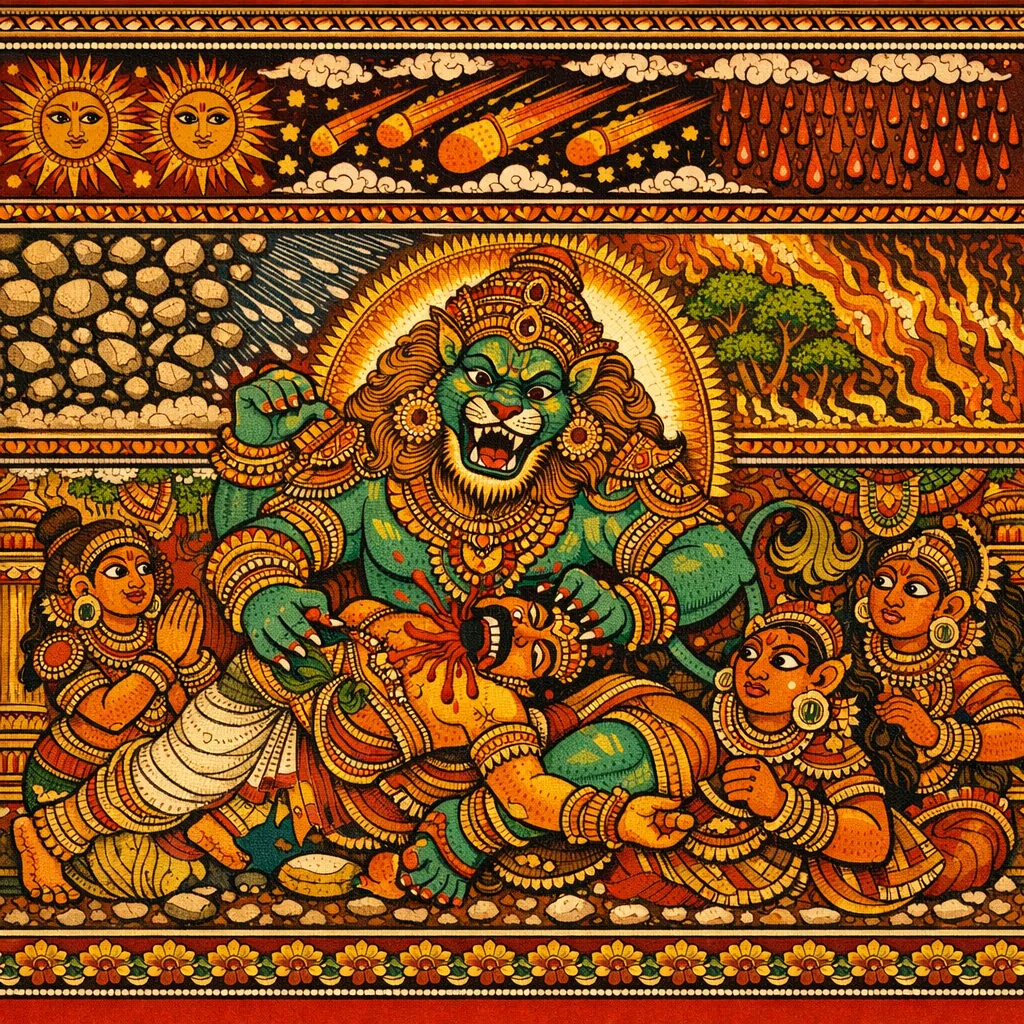
Adhyaya 163: Narasimha’s Victory over Hiraṇyakaśipu and the Catalogue of Apocalyptic Omens
नृसिंहविजयः—हिरण्यकशिपुवधः तथा युगान्तोत्पातवर्णनम्
Speaker: Sūta, Devas (collective hymn), Narrative focus: Narasiṃha (Hari/Vishnu) and Hiraṇyakaśipu
Sūta describes daitya–dānava hosts with terrifying, animal-like faces assaulting the lion-formed Lord Narasiṃha. Their arrows and cakras fail; the Lord swallows the discs and, with a roar, shatters a blazing spear. The daityas then unleash stone-hail and torrential rain, yet by māyā it falls from the sides and does not touch Him. A fire-and-wind illusion arises but is quenched by Indra with rain-clouds; dense darkness spreads, yet the Lord shines like the Sun. Apocalyptic omens (utpātas) multiply—violent winds, abnormal grahas, multiple suns, meteors, blood-rain, out-of-season fruiting, crying images, reversed rivers—foretelling Hiraṇyakaśipu’s doom. The daitya-king charges Narasiṃha and is torn apart by the Lord’s sharp claws, “assisted by Oṁ.” Cosmic order returns; devas and sages praise Him as the supreme, primeval Puruṣa and affirm the future worship of the Narasiṃha form. Hari installs the radiant Narasiṃha manifestation and departs to His abode.
Key Concepts
Shlokas in Adhyaya 163
Verse 1
*सूत उवाच खराः खरमुखाश्चैव मकराशीविषाननाः ईहामृगमुखाश्चान्ये वराहमुखसंस्थिताः //
Sūta said: “Some are (like) wild asses—indeed, ass-faced; some have the faces of makaras and of venomous serpents; others are īhāmṛga-faced, and some are formed with the face of a boar.”
Verse 2
बालसूर्यमुखाश्चान्ये धूमकेतुमुखास्तथा अर्धचन्द्रार्धवक्त्राश्च अग्निदीप्तमुखास्तथा //
Others are described with faces like the rising (young) sun; others with faces like a comet; others with half-moon, half-formed faces; and others with faces blazing like fire.
Verse 3
हंसकुक्कुटवक्त्राश्च व्यादितास्या भयावहाः सिंहास्या लेलिहानाश्च काकगृध्रमुखास्तथा //
Some bore the faces of swans and cocks; others, with gaping mouths, were terrifying. Some had lion faces with tongues lolling out, and others had the faces of crows and vultures as well.
Verse 4
द्विजिह्वका वक्रशीर्षास् तथोल्कामुखसंस्थिताः महाग्राहमुखाश्चान्ये दानवा बलदर्पिताः //
Some Dānavas were double-tongued; some had twisted heads; others had faces set like blazing meteors; and still others bore the mouths of gigantic crocodiles—Dānavas made arrogant by their own strength.
Verse 5
शैलसंवर्ष्मणस् तस्य शरीरे शरवृष्टिभिः अवध्यस्य मृगेन्द्रस्य न व्यथां चक्रुराहवे //
In battle, showers of arrows caused no pain to that lion-king—invulnerable—whose body was as hard as a mountain.
Verse 6
एवं भूयो ऽपरान्घोरान् असृजन्दानवेश्वराः मृगेन्द्रस्योपरि क्रुद्धा निःश्वसन्त इवोरगाः //
Thus, again, the lords of the Dānavas unleashed other dreadful (weapons/missiles), raging against the lord of beasts (the lion), hissing as if they were serpents breathing out in fury.
Verse 7
ते दानवशरा घोरा दानवेन्द्रसमीरिताः विलयं जग्मुराकाशे खद्योता इव पर्वते //
Those dreadful arrows of the Dānavas, discharged at the command of the lord of the Dānavas, vanished into the sky—like fireflies disappearing against a mountain.
Verse 8
ततश्चक्राणि दिव्यानि दैत्याः क्रोधसमन्विताः मृगेन्द्रायासृजन्नाशु ज्वलितानि समन्ततः //
Then the Daityas, filled with rage, swiftly hurled divine discus-weapons at the lion-king (Mṛgendra), blazing on every side.
Verse 9
तैरासीद्गगनं चक्रैः संपतद्भिरितस्ततः युगान्ते संप्रकाशद्भिश् चन्द्रादित्यग्रहैरिव //
With those whirling discs hurtling in every direction, the sky was filled—shining at the end of the age like the moon, the sun, and the planets blazing forth.
Verse 10
तानि सर्वाणि चक्राणि मृगेन्द्रेण महात्मना ग्रस्तान्युदीर्णानि तदा पावकार्चिःसमानि वै //
Then that great-souled lion-king swallowed all those discus-weapons; and at that moment they flared up, blazing like tongues of fire.
Verse 11
तानि चक्राणि वदने विशमानानि भान्ति वै मेघोदरदरीष्वेव चन्द्रसूर्यग्रहा इव //
Those discus-emblems, set upon the face, indeed shine forth—like the moon, the sun, and the planets appearing within the clefts of cloud-filled ravines.
Verse 12
हिरण्यकशिपुर्दैत्यो भूयः प्रासृजदूर्जिताम् शक्तिं प्रज्वलितां घोरां धौतशस्त्रतडित्प्रभाम् //
Then the Daitya Hiraṇyakaśipu once again hurled forth a mighty spear—blazing, terrifying, and gleaming like lightning upon a polished weapon.
Verse 13
तामापतन्तीं सम्प्रेक्ष्य मृगेन्द्रः शक्तिमुज्ज्वलाम् हुंकारेणैव रौद्रेण बभञ्ज भगवांस्तदा //
Seeing that blazing spear-weapon rushing toward him, the Lord—lion among beasts—then shattered it merely with a fierce, wrathful roar.
Verse 14
रराज भग्ना सा शक्तिर् मृगेन्द्रेण महीतले सविस्फुलिङ्गा ज्वलिता महोल्केव दिवश्च्युता //
Shattered by the Lion-like hero, that spear (śakti) lay upon the earth, blazing with sparks—shining like a great meteor fallen down from the sky.
Verse 15
नाराचपङ्क्तिः सिंहस्य प्राप्ता रेजे ऽविदूरतः नीलोत्पलपलाशानां मालेवोज्ज्वलदर्शना //
A row of iron arrows, having reached the lion, shone from not far away—bright to behold, like a garland made of blue-lotus petals.
Verse 16
स गर्जित्वा यथान्यायं विक्रम्य च यथासुखम् तत्सैन्यम् उत्सारितवांस् तृणाग्राणीव मारुतः //
Roaring aloud as was proper, and advancing with effortless prowess, he drove that army away—like the wind scattering the tips of grass.
Verse 17
ततो ऽश्मवर्षं दैत्येन्द्रा व्यमृजन्त नभोगताः नगमात्रैः शिलाखण्डैर् गिरिशृङ्गैर्महाप्रभैः //
Then the lords of the Daityas, moving through the sky, unleashed a rain of stones—hurling mountain-sized boulders and brilliantly massive peaks and crags.
Verse 18
तदश्मवर्षं सिंहस्य महन्मूर्धनि पातितम् दिशो दश विकीर्णा वै खद्योतप्रकरा इव //
That hail of stones was hurled down upon the lion’s great head; and it scattered in all ten directions, like a swarm of fireflies.
Verse 19
तदाश्मौघैर् दैत्यगणाः पुनः सिंहमरिंदमम् छादयांचक्रिरे मेघा धाराभिरिव पर्वतम् //
Then the hosts of Daityas once again covered over that lion-like, enemy-crushing hero with torrents of stones—just as rain-clouds veil a mountain with streaming downpours.
Verse 20
न च तं चालयामासुर् दैत्यौघा देवसत्तमम् भीमवेगो ऽचलश्रेष्ठं समुद्र इव मन्दरम् //
Yet the rushing hosts of Daityas could not make that best of the gods so much as stir—steadfast and supreme like the loftiest mountain, as the ocean (cannot dislodge) Mandara.
Verse 21
ततो ऽश्मवर्षे विहते जलवर्षमनन्तरम् धाराभिरक्षमात्राभिः प्रादुरासीत्समन्ततः //
Then, when the shower of stones had subsided, immediately afterward a rain of water appeared on every side, falling in streams as thick as an axle.
Verse 22
नभसः प्रच्युता धारास् तिग्मवेगाः समन्ततः आवृत्य सर्वतो व्योम दिशश्चोपदिशस्तथा //
From the sky, torrents fell—driven with piercing force on every side—so that the whole firmament was veiled everywhere, along with all the directions and the intermediate quarters as well.
Verse 23
धारा दिवि च सर्वत्र वसुधायां च सर्वशः न स्पृशन्ति च ता देवं निपतन्त्यो ऽनिशं भुवि //
The streams are everywhere in the sky and everywhere upon the earth; yet, O Deva, as they fall unceasingly to the ground, they do not touch You.
Verse 24
बाह्यतो ववृषुर्वर्षं नोपरिष्टाच्च ववृषुः मृगेन्द्रप्रतिरूपस्य स्थितस्य युधि मायया //
By his māyā, while he stood in battle in the form of a lion, they poured down a rain only from the outer side—yet they did not shower it from above.
Verse 25
हते ऽश्मवर्षे तुमुले जलवर्षे च शोषिते सो ऽसृजद्दानवो मायाम् अग्निवायुसमीरिताम् //
When the fierce hail of stones had been destroyed and the tumultuous rain of water had been dried up, that Dānava then unleashed an illusion (māyā), driven onward by fire and wind.
Verse 26
महेन्द्रस्तोयदैः सार्धं सहस्राक्षो महाद्युतिः महता तोयवर्षेण शमयामास पावकम् //
Then Mahendra—Sahasrākṣa, the great-lustrous Indra—together with the rain-bearing (clouds), quenched the fire by a mighty downpour of water.
Verse 27
तस्यां प्रतिहतायां तु मायायां युधि दानवः असृजद्घोरसंकाशं तमस्तीव्रं समन्ततः //
But when that illusion was checked in battle, the Dānava unleashed all around a fierce-looking, intensely thick darkness.
Verse 28
तमसा संवृते लोके दैत्येष्वात्तायुधेषु च स्वतेजसा परिवृतो दिवाकर इवाबभौ //
When the world was shrouded in darkness and the Daityas had seized their weapons, he—encircled by his own radiance—shone forth like the Sun.
Verse 29
त्रिशिखां भ्रुकुटीं चास्य ददृशुर्दानवा रणे ललाटस्थां त्रिशूलाङ्कां गङ्गां त्रिपथगामिव //
In the battle, the Dānavas beheld upon his brow a three-crested furrow of frown—marked with the sign of a trident—like the Gaṅgā herself flowing in the three paths.
Verse 30
ततः सर्वासु मायासु हतासु दितिनन्दनाः हिरण्यकशिपुं दैत्यं विवर्णाः शरणं ययुः //
Then, when all their magical illusions had been destroyed, the sons of Diti—pale and shaken—went for refuge to the Daitya Hiraṇyakaśipu.
Verse 31
ततः प्रज्वलितः क्रोधात् प्रदहन्निव तेजसा तस्मिन्क्रुद्धे तु दैत्येन्द्रे तमोभूतमभूज्जगत् //
Then, inflamed with anger and blazing as if burning everything with his radiance—when that lord of the Daityas grew wrathful, the whole world became shrouded in darkness.
Verse 32
आवहः प्रवहश्चैव विवहो ऽथ ह्युदावहः परावहः संवहश्च महाबलपराक्रमाः //
Āvaha, Pravaha, Vivaha, and also Udāvaha; likewise Parāvaha and Saṃvaha—these are (winds) of great strength and mighty force.
Verse 33
तथा परिवहः श्रीमान् उत्पातभयशंसिनः इत्येवं क्षुभिताः सप्त मरुतो गगनेचराः //
Likewise, the splendid wind called Parivaha—foretelling fear through ominous portents—thus, the seven sky-roaming winds (Maruts) become violently agitated.
Verse 34
ये ग्रहाः सर्वलोकस्य क्षये प्रादुर्भवन्ति वै ते सर्वे गगने दृष्टा व्यचरन्त यथासुखम् //
Those celestial bodies that indeed manifest at the time of the world’s dissolution—all of them were seen in the sky, moving about freely at will.
Verse 35
अयोगतश्चाप्यचरन् मार्गं निशि निशाचरः सग्रहः सह नक्षत्रैर् आकापतिररिंदमः //
And the night-wanderer (the Moon), moving out of due order, traversed its path by night—together with the planets and the constellations—O subduer of foes.
Verse 36
विवर्णतां च भगवान् गतो दिवि दिवाकरः कृष्णं कबन्धं च तथा लक्ष्यते सुमहद्दिवि //
In the sky, the revered Sun too has turned pale; and in the heavens a vast black ‘kabandha’—a headless, trunk-like apparition—is likewise seen.
Verse 37
अमुञ्चच्चार्चिषां वृन्दं भूमिवृत्तिर् विभावसुः गगनस्थश्च भगवान् अभीक्ष्णं परिदृश्यते //
Vibhāvasu (the Sun), moving in his orbit around the earth, kept releasing clusters of blazing rays; and that revered lord, stationed in the sky, was repeatedly seen (thus) again and again.
Verse 38
सप्त धूम्रनिभा घोराः सूर्या दिवि समुत्थिताः सोमस्य गगनस्थस्य ग्रहास्तिष्ठन्ति शृङ्गगाः //
Seven dreadful, smoke-hued suns arise in the sky; and the planets stand upon the Moon, which is stationed in the firmament, as though perched on its horns.
Verse 39
वामे तु दक्षिणे चैव स्थितौ शुक्रबृहस्पती शनैश्चरो लोहिताङ्गो ज्वलनाङ्गसमद्युतिः //
On the left and on the right stand Venus and Bṛhaspati (Jupiter); and Śanaiścara (Saturn) is reddish-limbed, shining with a fiery-bodied brilliance.
Verse 40
समं समधिरोहन्तः सर्वे ते गगनेचराः शृङ्गाणि शनकैर्घोरा युगान्तावर्तिनो ग्रहाः //
All those heavenly wanderers (the planets), moving in the sky, rise into an even alignment; terrifying, they slowly lift up their ‘horns’—for these are the grahas that turn and churn at the end of the age (yugānta).
Verse 41
चन्द्रमाश्च सनक्षत्रैर् ग्रहैः सह तमोनुदः चराचरविनाशाय रोहिणीं नाभ्यनन्दत //
The Moon too—dispeller of darkness—together with the stars and planets, did not delight in Rohiṇī, as if bent upon the destruction of all that moves and all that is unmoving.
Verse 42
गृहीतो राहुणा चन्द्र उल्काभिरभिहन्यते उल्काः प्रज्वलिताश्चन्द्रे विचरन्ति यथासुखम् //
When the Moon is seized by Rāhu, it is struck by blazing meteors; those fiery meteors then move about upon the Moon, roaming there as they please.
Verse 43
देवानामपि यो देवः सो ऽप्यवर्षत शोणितम् अपतन्गगनादुल्का विद्युद्रूपा महास्वनाः //
Even that god who is the God of the gods rained down blood; and from the sky fell blazing meteors, lightning-shaped and thunderous.
Verse 44
अकाले च द्रुमाः सर्वे पुष्पन्ति च फलन्ति च लताश्च सफलाः सर्वा ये चाहुर्दैत्यनाशनम् //
Out of season, all the trees blossom and bear fruit; and all the creepers too become fruit-laden—these are said to be signs announcing the destruction of the Daityas.
Verse 45
फलैः फलान्यजायन्त पुष्पैः पुष्पं तथैव च उन्मीलन्ति निमीलन्ति हसन्ति च रुदन्ति च //
From fruits, other fruits were strangely produced; from blossoms, blossoms likewise arose. They would open and close of themselves—appearing to laugh and to weep.
Verse 46
विक्रोशन्ति च गम्भीरा धूमयन्ति ज्वलन्ति च प्रतिमाः सर्वदेवानां वेदयन्ति महद्भयम् //
The images of all the gods cry out in a deep voice; they smoke and even blaze—thus they foretell a great fear (calamity).
Verse 47
आरण्यैः सह संसृष्टा ग्राम्याश्च मृगपक्षिणः चक्रुः सुभैरवं तत्र महायुद्धमुपस्थितम् //
There, the wild creatures mingled with the tame, and the beasts and birds together raised a dreadful clamour—an omen that a great battle had come upon that place.
Verse 48
नद्यश्च प्रतिकूलानि वहन्ति कलुषोदकाः न प्रकाशन्ति च दिशो रक्तरेणुसमाकुलाः //
The rivers flow contrary to their natural course, their waters turned foul; and the directions themselves do not appear clear, being choked with red dust.
Verse 49
वानस्पत्यो न पूज्यन्ते पूजनार्हाः कथंचन वायुवेगेन हन्यन्ते भज्यन्ते प्रणमन्ति च //
Even when they are in every way worthy of worship, trees are not (always) worshipped; for they are struck by the force of the wind, they break, and they bend down as if in obeisance.
Verse 50
यदा च सर्वभूतानां छाया न परिवर्तते अपराह्णगते सूर्ये लोकानां युगसंक्षये //
And when, for all beings, the shadow no longer shifts—though the sun has moved into the afternoon—then, at the end of the age, the worlds approach dissolution.
Verse 51
तदा हिरण्यकशिपोर् दैत्यस्योपरि वेश्मनः भाण्डागारायुधागारे निविष्टमभवन्मधु //
Then, above the mansion of the Daitya Hiraṇyakaśipu—within the storehouse and the armoury—Madhu took up his position.
Verse 52
असुराणां विनाशाय सुराणां विजयाय च दृश्यन्ते विविधोत्पाता घोरा घोरनिदर्शनाः //
For the destruction of the Asuras and for the victory of the Devas, many kinds of dreadful portents are seen—terrifying signs that foretell a terrible outcome.
Verse 53
एते चान्ये च बहवो घोरोत्पाताः समुत्थिताः दैत्येन्द्रस्य विनाशाय दृश्यन्ते कालनिर्मिताः //
These—and many other—terrifying portents have arisen; they are seen as wrought by Time itself, for the destruction of the lord of the Daityas.
Verse 54
मेदिन्यां कम्पमानायां दैत्येन्द्रेण महात्मना महीधरा नागगणा निपेतुरमितौजसः //
As the Earth shook under the onslaught of the great-souled lord of the Daityas, mighty mountain-bearers and hosts of Nāgas, of immeasurable strength, fell down.
Verse 55
विषज्वालाकुलैर्वक्त्रैर् विमुञ्चन्तो हुताशनम् चतुःशीर्षाः पञ्चशीर्षाः सप्तशीर्षाश्च पन्नगाः //
Serpents—four-headed, five-headed, and seven-headed—filled their mouths with venomous flames and were spewing forth blazing fire.
Verse 56
वासुकिस्तक्षकश्चैव कर्कोटकधनंजयौ एलामुखः कालियश्च महापद्मश्च वीर्यवान् //
Vāsuki and Takṣaka as well; Karkoṭaka and Dhanaṃjaya; Elāmukha and Kāliya; and the mighty Mahāpadma—these are the powerful Nāgas (serpent-lords).
Verse 57
सहस्रशीर्षा नागो वै हेमतालध्वजः प्रभुः शेषो ऽनन्तो महाभागो दुष्प्रकम्प्यः प्रकम्पितः //
The thousand-headed serpent—Lord Śeṣa, the infinite Ananta—majestic and sovereign, bearing a banner like a golden palm, was stirred; he, who is ordinarily unshakable, became shaken.
Verse 58
दीप्तान्यन्तर्जलस्थानि पृथिवीधरणानि च तदा क्रुद्धेन महता कम्पितानि समन्ततः //
Then, by that mighty wrath, the earth-supporting mountains—those situated within the waters—were set ablaze and shaken on every side.
Verse 59
नागास्तेजोधराश्चापि पातालतलचारिणः हिरण्यकशिपुर्दैत्यस् तदा संस्पृष्टवान्महीम् //
The Nāgas—radiant bearers of power—who move about in the subterranean realms of Pātāla, and the Daitya Hiraṇyakaśipu as well, at that time came into contact with (i.e., pressed upon/affected) the Earth.
Verse 60
संदष्टौष्ठपुटः क्रोधाद् वाराह इव पूर्वजः नदी भागीरथी चैव सरयूः कौशिकी तथा //
Clenching his lips in anger, like a boar, the elder spoke—(then he mentioned) the rivers Bhāgīrathī (Gaṅgā), Sarayū, and likewise Kauśikī.
Verse 61
यमुना त्वथ कावेरी कृष्णवेणा च निम्नगा सुवेणा च महाभागा नदी गोदावरी तथा //
Yamunā, and also Kāverī; Kṛṣṇaveṇā, the river Nimgā; Suveṇā, the greatly blessed one; and likewise the river Godāvarī.
Verse 62
चर्मण्वती च सिन्धुश्च तथा नदनदीपतिः कमलप्रभवश्चैव शोणो मणिनिभोदकः //
There is the Carmanvatī, and the Sindhu; likewise the lord of rivers, the Nadanadīpati; also the Kamalaprabhava; and the Śoṇa, whose waters gleam like jewels.
Verse 63
नर्मदा शुभतोया च तथा वेत्रवती नदी गोमती गोकुलाकीर्णा तथा पूर्वसरस्वती //
The Narmadā, whose waters are auspicious; the river Vetravatī; the Gomati—thronged with cowherd-settlements—and likewise the ancient (eastern) Sarasvatī.
Verse 64
मही कालमही चैव तमसा पुष्पवाहिनी जम्बूद्वीपं रत्नवटं सर्वरत्नोपशोभितम् //
In Jambūdvīpa there are (regions named) Mahī and Kālamahī, as well as Tamasā and Puṣpavāhinī; and there is Ratnavaṭa—adorned with every kind of jewel.
Verse 65
सुवर्णप्रकटं चैव सुवर्णाकरमण्डितम् महानदं च लौहित्यं शैलकाननशोभितम् //
He also described Suvarṇaprakaṭa, adorned with mines of gold; and the great river Lauhitya, made splendid by its mountains and forest-groves.
Verse 66
पत्तनं कोशकरणम् ऋषिवीरजनाकरम् मागधाश्च महाग्रामा मुण्डाः शुङ्गास्तथैव च //
A ‘pattana’ (market-town) is a maker of treasury revenue, a gathering-place of sages and heroes; so too are the Magadhas—great villages—and likewise the Muṇḍas and the Śuṅgas.
Verse 67
सुह्मा मल्ला विदेहाश्च मालवाः काशिकोसलाः भवनं वैनतेयस्य दैत्येन्द्रेणाभिकम्पितम् //
Suhmā, the Mallā-s, the Videha-s, the Mālava-s, and the peoples of Kāśī and Kosala—(all were shaken); and the abode of Vainateya (Garuḍa) was violently convulsed by the lord of the Dānavas (the Daitya-king).
Verse 68
कैलासशिखराकारं यत्कृतं विश्वकर्मणा रक्ततोयो महाभीमो लौहित्यो नाम सागरः //
There is a sea named Lauhitya—terrifying and vast—whose waters are red; it is said to have been fashioned by Viśvakarman, shaped like the peak of Mount Kailāsa.
Verse 69
उदयश्च महाशैल उच्छ्रितः शतयोजनम् सुवर्णवेदिकः श्रीमान् मेघपङ्क्तिनिषेवितः //
And (there is) the great mountain Udaya, rising to a height of a hundred yojanas—splendid, with golden terraces/altars, and attended by ranks of clouds.
Verse 70
भ्राजमानो ऽर्कसदृशैर् जातरूपमयैर्द्रुमैः शालैस्तालैस्तमालैश्च कर्णिकारैश्च पुष्पितैः //
It shone brilliantly, with trees that were like the sun—made, as it were, of gold—among them śāla trees, tāla palms, tamāla trees, and karṇikāras all in bloom.
Verse 71
अयोमुखश्च विख्यातः पर्वतो धातुमण्डितः तमालवनगन्धश्च पर्वतो मलयः शुभः //
Ayomukha is renowned as a mountain adorned with mineral ores; and the auspicious Malaya mountain is fragrant with the scent of tamāla groves.
Verse 72
सुराष्ट्राश्च सबाह्लीकाः शूराभीरास्तथैव च भोजाः पाण्ड्याश्च वङ्गाश्च कलिङ्गास्ताम्रलिप्तकाः //
Also (are mentioned) the people of Saurāṣṭra, along with the Bāhlīkas; likewise the Śūras and Ābhīras; the Bhojas; the Pāṇḍyas; the Vaṅgas; the Kaliṅgas; and those of Tāmraliptā.
Verse 73
तथैवौण्ड्राश्च पौण्ड्राश्च वामचूडाः सकेरलाः क्षोभितास्तेन दैत्येन सदेवाश्चाप्सरोगणाः //
Likewise, the Oṇḍras and the Pauṇḍras, the Vāmacūḍas and the Keralas—along with the gods and the hosts of Apsarās—were all thrown into agitation by that Daitya.
Verse 74
अगस्त्यभवनं चैव यदगम्यं कृतं पुरा सिद्धचारणसंघश्च विप्रकीर्णं मनोहरम् //
And also the dwelling of Agastya—made in ancient times as a place hard to approach—was charming, with hosts of Siddhas and Cāraṇas scattered about.
Verse 75
विचित्रनानाविहगं सुपुष्पितमहाद्रुमम् जातरूपमयैः शृङ्गैर् अप्सरोगणनादितम् //
A great tree, richly in bloom, thronged with many kinds of wondrous birds—its peaks adorned with horns (spire-like projections) made of gold—resounding with the songs of hosts of Apsarās.
Verse 76
गिरिपुष्पितकश्चैव लक्ष्मीवान्प्रियदर्शनः उत्थितः सागरं भित्त्वा विश्रामश्चन्द्रसूर्ययोः रराज सुमहाशृङ्गैर् गगनं विलिखन्निव //
And Giripuṣpitaka too—splendid, auspicious, and pleasing to behold—rose up, as though splitting the ocean; a place of repose for the Moon and the Sun, it shone with its lofty peaks as if it were scratching the very sky.
Verse 77
चन्द्रसूर्यांशुसंकाशैः सागराम्बुसमावृतैः विद्युत्वान्सर्वतः श्रीमान् आयतः शतयोजनम् //
Resplendent like the rays of the moon and the sun, encircled by ocean-like waters, flashing with brilliance on every side, it extends to a length of a hundred yojanas.
Verse 78
विद्युतां यत्र संपाता निपात्यन्ते नगोत्तमे ऋषभः पर्वतश्चैव श्रीमान्वृषभसंज्ञितः //
On that foremost of mountains, where the flashes of lightning are seen to strike and fall, there is also the splendid mountain Ṛṣabha, renowned by the name Vṛṣabha.
Verse 79
कुञ्जरः पर्वतः श्रीमान् यत्रागस्त्यगृहं शुभम् विशालाक्षश्च दुर्धर्षः सर्पाणामालयः पुरी //
There is the illustrious mountain named Kuñjara, where stands the auspicious hermitage of Agastya. There too is the unassailable city called Viśālākṣa—an abode of the serpents (Nāgas).
Verse 80
तथा भोगवती चापि दैत्येन्द्रेणाभिकम्पिता महासेनो गिरिश्चैव पारियात्रश्च पर्वतः //
Likewise Bhogavatī too was shaken by the lord of the Daityas; and so also were the mountain Mahāsena and the Pāriyātra range.
Verse 81
चक्रवांश्च गिरिश्रेष्ठो वाराहश्चैव पर्वतः प्राग्ज्यौतिषपुरं चापि जातरूपमयं शुभम् //
“(There is) Cakravān, the foremost of mountains; and also the Varāha Mountain; and likewise the auspicious city of Prāgjyotiṣa, resplendent as though made of gold.”
Verse 82
यस्मिन्वसति दुष्टात्मा नरको नाम दानवः मेघश्च पर्वतश्रेष्ठो मेघगम्भीरनिःस्वनः //
In that region dwells the wicked-souled demon named Naraka; and there too is the foremost of mountains, Megha, whose reverberation is deep like thunder-clouds.
Verse 83
षष्टिस्तत्र सहस्राणि पर्वतानां द्विजोत्तमाः तरुणादित्यसंकाशो मेरुस्तत्र महागिरिः //
O best of the twice-born, there are sixty thousand mountains there; and among them stands the great mountain Meru, radiant like the newly risen sun.
Verse 84
यक्षराक्षसगन्धर्वैर् नित्यं सेवितकंदरः हेमगर्भो महाशैलस् तथा हेमसखो गिरिः //
Its caves are constantly frequented by Yakṣas, Rākṣasas, and Gandharvas. There is also the great mountain called Hemagarbha (“Golden-womb”), and likewise the peak named Hemasakha (“Companion of Gold”).
Verse 85
कैलासश्चैव शैलेन्द्रो दानवेन्द्रेण कम्पितः हेमपुष्करसंछन्नं तेन वैखानसं सरः //
And Mount Kailāsa, the foremost of mountains, was shaken by the lord of the Dānavas; and because of that, the Vaikhānasa lake became covered with golden lotuses.
Verse 86
कम्पितं मानसं चैव हंसकारण्डवाकुलम् त्रिशृङ्गपर्वतश्चैव कुमारी च सरिद्वरा //
He also described the trembling (wind-stirred) Mānasa Lake, filled with swans and kāraṇḍava ducks; likewise Triśṛṅga Mountain, and the excellent river named Kumārī.
Verse 87
तुषारचयसंछन्नो मन्दरश्चापि पर्वतः उशीरबिन्दुश्च गिरिश् चन्द्रप्रस्थस्तथाद्रिराट् //
Also (there is) the mountain Mandara, covered with heaps of snow; and the peaks named Uśīrabindu, Giri, Candraprastha, and Adrīrāṭ as well.
Verse 88
प्रजापतिगिरिश्चैव तथा पुष्करपर्वतः देवाभ्रपर्वतश्चैव तथा वै रेणुको गिरिः //
Likewise (there are) Prajāpati Mountain, and also Puṣkara Mountain; Devābhra Mountain as well, and indeed the mountain called Reṇuka.
Verse 89
क्रौञ्चः सप्तर्षिशैलश्च धूम्रवर्णश्च पर्वतः एते चान्ये च गिरयो देशा जनपदास्तथा //
Krauñca, Saptarṣi-śaila, and the mountain called Dhūmravarṇa—these, and many other mountains, as well as regions and settled countries (janapadas), are thus enumerated.
Verse 90
नद्यः ससागराः सर्वाः सो ऽकम्पयत दानवः कपिलश्च महीपुत्रो व्याघ्रवांश्चैव कम्पितः //
That Dānava shook all the rivers together with the oceans; Kapila, the earth-born (son of the Earth), and Vyāghravāṃśa as well were set trembling.
Verse 91
खेचराश्च सतीपुत्राः पातालतलवासिनः गणस्तथा परो रौद्रो मेघनामाङ्कुशायुधः //
There are also the sky-roaming beings, the sons of Satī, and those dwelling in the nether regions (Pātāla). Likewise, another fierce (raudra) gaṇa is mentioned—Megha by name—whose weapon is a goad (aṅkuśa).
Verse 92
ऊर्ध्वगो भीमवेगश्च सर्व एवाभिकम्पिताः गदी शूली करालश्च हिरण्यकशिपुस्तदा //
Then Hiraṇyakaśipu—rushing upward with terrifying force—made them all tremble: the mace-bearer, the trident-bearer, and even the fierce (warriors).
Verse 93
जीमूतघनसंकाशो जीमूतघननिःस्वनः जीमूतघननिर्घोषो जीमूत इव वेगवान् //
He looked like a dense mass of rain-clouds; his sound was like the rumbling of heavy clouds; his roar was like the crash of storm-clouds—swift and forceful, like a cloud driven by the wind.
Verse 94
देवारिर्दितिजो वीरो नृसिंहं समुपाद्रवत् समुत्पत्य ततस्तीक्ष्णैर् मृगेन्द्रेण महानखैः तदोंकारसहायेन विदार्य निहतो युधि //
The heroic Diti-born foe of the gods rushed toward Narasiṃha. Then the Lion-lord sprang up and, with his sharp, mighty claws—assisted by the sacred syllable Oṁ—tore him apart and slew him in battle.
Verse 95
मही च कालश्च शशी नभश्च ग्रहाश्च सूर्यश्च दिशश्च सर्वाः नद्यश्च शैलाश्च महार्णवाश्च गताः प्रसादं दितिपुत्रनाशात् //
Earth and Time, the Moon and the sky, the planets and the Sun, and all the directions—along with the rivers, the mountains, and the great ocean—returned to calm and well-being when Diti’s son was destroyed.
Verse 96
ततः प्रमुदिता देवा ऋषयश्च तपोधनाः तुष्टुवुर्नामभिर्दिव्यैर् आदिदेवं सनातनम् //
Then the gods, filled with joy, and the sages rich in austerity praised the eternal Primeval Lord, extolling Him with divine names.
Verse 97
यत्त्वया विहितं देव नारसिंहमिदं वपुः एतदेवार्चयिष्यन्ति परावरविदो जनाः //
O Lord, this Narasiṃha-form that has been ordained by you—this very form will be worshipped by people who understand the higher and the lower (i.e., the supreme and the worldly realities).
Verse 98
*देवा ऊचुः भवान्ब्रह्मा च रुद्रश्च महेन्द्रो देवसत्तमः भवान्कर्ता विकर्ता च लोकानां प्रभवो ऽव्ययः //
The Devas said: “You are Brahmā, and you are Rudra; you are Mahendra, O best among the gods. You are the maker and the reshaper; you are the imperishable source from which the worlds arise.”
Verse 99
परां च सिद्धिं च परं च देवं परं च मन्त्रं परमं हविश्च परं च धर्मं परमं च विश्वं त्वामाहुरग्र्यं पुरुषं पुराणम् //
You are proclaimed to be the supreme attainment and the highest perfection; the highest God; the highest mantra and the foremost sacrificial offering; the highest Dharma and the very supreme universe. They declare you to be the foremost, primeval Person (Puruṣa), the Ancient One.
Verse 100
परं शरीरं परमं च ब्रह्म परं च योगं परमां च वाणीम् परं रहस्यं परमां गतिं च त्वामाहुरग्र्यं पुरुषं पुराणम् //
You are declared to be the supreme Body, the supreme Brahman; the highest Yoga and the highest sacred utterance. You are the supreme secret and the supreme Goal—men proclaim you as the foremost, primeval Person (the Ancient Puruṣa).
Verse 101
एवं परस्यापि परं पदं यत् परं परस्यापि परं च देवम् परं परस्यापि परं च भूतं त्वामाहुरग्र्यं पुरुषं पुराणम् //
Thus (you are) that supreme state beyond even the beyond; the supreme Deity beyond even the supreme; the highest Being beyond even the highest—therefore they proclaim you as the foremost, the Primeval Person (Puruṣa).
Verse 102
परं परस्यापि परं रहस्यं परं परस्यापि परं महत्त्वम् परं परस्यापि परं महद्यत् त्वामाहुरग्र्यं पुरुषं पुराणम् //
You are the supreme mystery even beyond the supreme; you are the highest greatness even beyond the highest. You are the transcendent ‘Great’ beyond all greatness—therefore the sages call you the foremost, primeval Person (Puruṣa), the Ancient One.
Verse 103
परं परस्यापि परं निधानं परं परस्यापि परं पवित्रम् परं परस्यापि परं च दान्तं त्वामाहुरग्र्यं पुरुषं पुराणम् //
You are called the foremost, primeval Person—higher than even the highest: the supreme repository, the supreme purifier, and the supreme self-controlled One, transcending all that is transcendent.
Verse 104
एवमुक्त्वा तु भगवान् सर्वलोकपितामहः स्तुत्वा नारायणं देवं ब्रह्मलोकं गतः प्रभुः //
Having spoken thus, the Blessed Lord—the Grandsire of all the worlds—praised the god Nārāyaṇa and then the sovereign went to Brahmaloka.
Verse 105
ततो नदत्सु तूर्येषु नृत्यन्तीष्वप्सरःसु च क्षीरोदस्योत्तरं कूलं जगाम हरिरीश्वरः //
Then, as the musical instruments resounded and the Apsarases danced, Lord Hari—the Supreme Lord—went to the northern shore of the Ocean of Milk (Kṣīroda).
Verse 106
नारसिंहं वपुर्देवः स्थापयित्वा सुदीप्तिमत् पौराणं रूपमास्थाय प्रययौ गरुडध्वजः //
Having established the radiant Narasiṃha form, the Lord—bearing Garuḍa as His banner—then assumed His ancient, primeval form and departed.
Verse 107
अष्टचक्रेण यानेन भूतयुतेन भास्वता अव्यक्तप्रकृतिर्देवः स्वस्थानं गतवान्प्रभुः //
Then the Lord—the god whose nature is the Unmanifest—departed to His own abode, mounted upon a radiant, eight-wheeled chariot attended by elemental beings.
Frequently Asked Questions
The chapter teaches that adharma-backed power and magical force (daitya māyā, weapons, and terror) ultimately collapse before the divine principle that restores cosmic order. Narasiṃha’s invulnerability, radiance, and decisive act against Hiraṇyakaśipu are framed as the re-establishment of balance, after which nature, time, and the directions return to calm. The devas’ hymn further instructs that the Lord transcends functional deities (Brahmā, Rudra, Indra) and is the supreme Puruṣa worthy of worship—specifically affirming Narasiṃha worship for those who know both higher and worldly realities.
This adhyāya is primarily Dharma and theistic cosmology, not Vāstu or genealogy. It focuses on (1) divine kingship of the cosmos—Hari as the imperishable source and regulator; (2) the dharmic defeat of tyranny (Hiraṇyakaśipu); and (3) an extensive utpāta catalogue (cosmic omens: winds, planets, multiple suns, meteors, blood-rain, abnormal flora, crying icons, reversed rivers) used as purāṇic diagnostics for imminent destruction of the daityas.
The text lists yugānta-like portents: violent named winds (Āvaha, Pravaha, Vivaha, Udāvaha, Parāvaha, Saṃvaha, Parivaha), abnormal planetary movements and alignments, the Sun turning pale, a black kabandha apparition, seven smoke-hued suns, meteors striking and roaming on the Moon when seized by Rāhu, blood-rain, lightning-like blazing meteors, out-of-season flowering and fruiting (even fruits-from-fruits), images of gods crying/smoking/blazing, wild and tame animals mingling in fearful uproar, rivers flowing contrary with foul waters, red dust obscuring directions, trees breaking and bending as if bowing, and a fixed shadow at improper time—together signaling the daitya-king’s downfall.
After the daitya-king rushes at Narasiṃha with terrifying force, the Lord springs up and tears him apart with sharp, mighty claws (mahā-nakha). The verse explicitly adds that the act is ‘assisted by Oṁ’ (oṃkāra-sahāya), emphasizing mantra-shakti and divine authority in the slaying.