Adhyaya 29
Śoka-śamana: Kṛṣṇa’s Consolation and Nārada’s Exempla to Sṛñjaya (Chapter 29)
Upa-parva: Śoka-nivāraṇa (Grief-Removal) Exempla Cycle within Śānti Parva
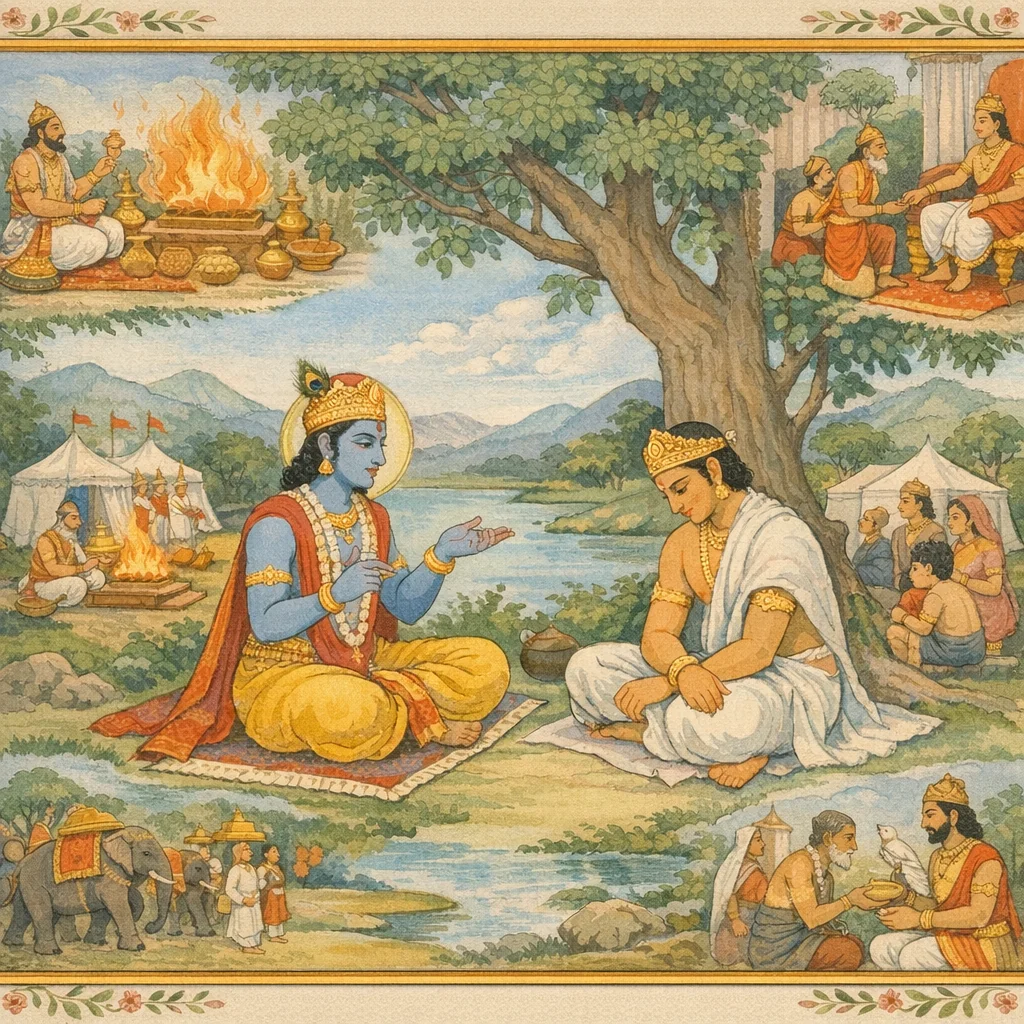
Vaiśaṃpāyana reports that as Yudhiṣṭhira remains silent and consumed by grief, Arjuna addresses Kṛṣṇa (Hṛṣīkeśa) urging him to console the king and remove his sorrow. Kṛṣṇa approaches Yudhiṣṭhira with intimate authority and begins a consolatory argument: do not allow grief to emaciate the body; those who fell did so facing the opponent, without retreat, and thus attained an honored end. He then shifts from immediate reassurance to didactic method, introducing an ancient narrative in which Nārada counsels King Sṛñjaya, who mourns his son. Nārada’s strategy is comparative and archival: he lists renowned rulers (e.g., Marutta, Suhotra/Vaitithi, Aṅga/Bṛhadratha, Śibi, Bharata, Rāma Dāśarathi, Bhagīratha, Dilīpa, Māndhātṛ, Yayāti, Ambarīṣa, Śaśabindu, Gaya, Rantideva, Sagara, Pṛthu) celebrated for extraordinary rites, generosity, and governance, yet all subject to death. The repeated refrain—do not grieve for the son more than for these exemplars—functions as cognitive reorientation: grief is not denied but contextualized within universal mortality. The chapter closes with Sṛñjaya affirming attentiveness and requesting grace, after which Nārada asserts the capacity to restore the son, indicating a forthcoming extraordinary resolution within the exemplum frame.
Chapter Arc: अर्जुन, माधव से विनती करता है—धर्मपुत्र युधिष्ठिर ज्ञाति-वध के शोक-सागर में डूब गए हैं; उन्हें आश्वासन दीजिए, उन्हें फिर से धर्म की ओर उठाइए। → कृष्ण (नारद-स्मृति/उपदेश-परंपरा के सहारे) शोक के विरुद्ध दृष्टांतों की माला खोलते हैं—मरुत्त के यज्ञ की अतुल दक्षिणाएँ, शिबि की कीर्ति, अम्बरीष-नाभागि की दान-परंपरा, अग्नि से वर-प्राप्ति, और शशबिन्दु जैसे महाबली का भी मृत्यु से न बच पाना। हर कथा एक ही चोट करती है: वैभव, यज्ञ, दान, पुत्र—कुछ भी अनित्य को रोक नहीं सकता। → उपदेश का शिखर तब आता है जब ‘मा पुत्रमनुतप्यथा:’ का कठोर-करुण वाक्य बार-बार गूंजता है—सृंजय जैसे शोकाकुल पिता को भी समझाया जाता है कि पुत्र-शोक में डूबना धर्म नहीं; मृत्यु अटल है, और पुण्य-मार्ग शोक से नहीं, कर्तव्य से पुष्ट होता है। देव-रूपिण शिशु के जन्म-दृश्य और देवताओं की विस्मय-वाणी (‘किमयं धास्यतीति’) भी इसी बोध को तेज करती है कि अद्भुत जन्म भी अंत को नहीं टालता। → कृष्ण का निष्कर्ष—शोक को धर्म-चिंतन में रूपांतरित करो: दान, यज्ञ, सत्य, और कर्तव्य-पालन ही मन को स्थिर करते हैं; ‘प्राप्ति-लाभ’ और ‘व्यायाम-अलाभ’ जैसे शब्दार्थ-भेद भी संकेत देते हैं कि मनुष्य का श्रम/उपाय सीमित है, फल अनिश्चित—इसलिए आसक्ति छोड़कर धर्म में स्थित होना चाहिए। → युधिष्ठिर को शांति देने के लिए दृष्टांतों की यह धारा आगे भी बहनी है—अभी और राजर्षियों के उदाहरण शेष हैं, जिनसे शोक का अंतिम ग्रंथि-भेदन होगा।
Shlokas
Verse 1
ऑपन-आ करा छा अर: > नीलकण्ठने 'प्राप्ति' का अर्थ 'लाभ” और “व्यायाम” का अर्थ उसके विपरीत “अलाभ' किया है। एकोनत्रिशो<5 ध्याय: श्रीकृष्णके द्वारा नारद-सूृंजय-संवादके रूपमें सोलह राजाओंका उपाख्यान संक्षेपमें सुनाकर युधिष्ठिरके शोकनिवारणका प्रयत्न वैशम्पायन उवाच अव्याहरति राजेन्द्रे धर्मपुत्रे युधिष्ठिरे । गुडाकेशो हृषीकेशम भ्यभाषत पाण्डव:,वैशम्पायनजी कहते हैं--जनमेजय! सबके समझाने-बुझानेपर भी जब धर्मपुत्र महाराज युधिष्छिर मौन ही रह गये, तब पाण्डुपुत्र अर्जुनने भगवान् श्रीकृष्णसे कहा
Vaiśampāyana said: O Janamejaya, when King Yudhiṣṭhira—the son of Dharma—remained silent and would not speak despite the efforts to counsel him, then the Pāṇḍava Arjuna (Guḍākeśa) addressed Śrī Kṛṣṇa (Hṛṣīkeśa), seeking a way to relieve Yudhiṣṭhira’s grief and restore him to righteous resolve.
Verse 2
अर्जुन उवाच ज्ञातिशोकाभिसंतप्तो धर्मपुत्र: परंतप: । एष शोकार्णवे मग्नस्तमाश्वासय माधव
Arjuna said: “Dharma’s son, the scorcher of foes, is tormented by grief for his kinsmen. He has sunk into an ocean of sorrow—O Mādhava, comfort and console him.”
Verse 3
अर्जुन बोले--माधव! शत्रुओंको संताप देनेवाले ये धर्मपुत्र युधिष्ठिर स्वयं भाई- बन्धुओंके शोकसे संतप्त हो शोकके समुद्रमें डूब गये हैं, आप इन्हें धीरज बँधाइये ।। सर्वे सम ते संशयिता: पुनरेव जनार्दन | अस्य शोकं महाबाहो प्रणाशयितुमरहसि
Arjuna said: “O Mādhava, Dharmaputra Yudhiṣṭhira—who once made the foes burn—now burns with grief for brothers and kinsmen and has sunk into an ocean of sorrow. Steady him with fortitude. O Janārdana, we are again beset by doubt; O mighty-armed one, you ought to dispel this grief of his.”
Verse 4
महाबाहु जनार्दन! हम सब लोग पुनः महान् संशयमें पड़ गये हैं। आप इनके शोकका नाश कीजिये ।। वैशम्पायन उवाच एवमुक्तस्तु गोविन्दो विजयेन महात्मना । पर्यवर्तत राजानं पुण्डरीकेक्षणोडच्युत:,वैशम्पायनजी कहते हैं--राजन्! महामना अर्जुनके ऐसा कहनेपर अपनी महिमासे कभी च्युत न होनेवाले कमलनयन भगवान् गोविन्द राजा युधिष्ठिरकी ओर घूमे--उनके सम्मुख हुए
Arjuna said: “O mighty-armed Janārdana, we have all once again fallen into great doubt. Destroy his grief.” Vaiśampāyana said: Thus addressed by the great-souled Vijaya (Arjuna), Govinda—lotus-eyed, Acyuta, never fallen from his divine majesty—turned toward King Yudhiṣṭhira and faced him.
Verse 5
अनतिक्रमणीयो हि धर्मराजस्य केशव: । बाल्यात् प्रभृति गोविन्द: प्रीत्या चाभ्यधिको<र्जुनात्,धर्मराज युधिष्ठिर भगवान् श्रीकृष्णकी आज्ञाका कभी उल्लंघन नहीं कर सकते थे; क्योंकि श्रीकृष्ण बाल्यावस्थासे ही उन्हें अर्जुनसे भी अधिक प्रिय थे
Vaiśampāyana said: For Dharmarāja Yudhiṣṭhira, Keśava was one whose command could not be transgressed. From childhood onward Govinda was dear to him—indeed, in affection even dearer than Arjuna. Thus Yudhiṣṭhira, grounded in dharma and reverence, would not violate Śrī Kṛṣṇa’s directive.
Verse 6
सम्प्रगृह्य महाबाहुर्भुजं चन्दनभूषितम् । शैलस्तम्भोपमं शौरिरुवाचाभिविनोदयन्,महाबाहु गोविन्दने युधिष्ठिरकी पत्थरके बने हुए खम्भे-जैसी चन्दनचर्चित भुजाको हाथमें लेकर उनका मनोरंजन करते हुए इस प्रकार बोलना आरम्भ किया
Vaiśampāyana said: Then the mighty-armed Śauri (Kṛṣṇa), taking in his hand that sandalwood-anointed arm—firm like a pillar of stone—began to speak, gently diverting and cheering Yudhiṣṭhira.
Verse 7
शुशुभे वदनं तस्य सुदष्ट्र चारुलोचनम् । व्याकोशमिव विस्पष्टं पद्म सूर्य इबोदिते,उस समय सुन्दर दाँतों और मनोहर नेत्रोंसे युक्त उनका मुखारविन्द सूर्योदयके समय पूर्णतः विकसित हुए कमलके समान शोभा पा रहा था
Vaiśampāyana said: His face—adorned with fine teeth and beautiful eyes—shone splendidly, like a lotus fully opened and clearly revealed at sunrise.
Verse 8
वायुदेव उवाच मा कृथा: पुरुषव्याप्र शोकं त्वं गात्रशोषणम् । नहि ते सुलभा भूयो ये हतास्मिन् रणाजिरे,भगवान् श्रीकृष्ण बोले--पुरुषसिंह! तुम शोक न करो। शोक तो शरीरको सुखा देनेवाला होता है। इस समरांगणमें जो वीर मारे गये हैं, वे फिर सहज ही मिल सकें, यह सम्भव नहीं है
Vāyu said: “O mighty man, do not give yourself to grief. Grief dries up the limbs and wastes the body. Those heroes who were slain on this battlefield cannot be found again with ease; it is not possible for them to return.”
Verse 9
स्वप्नलब्धा यथा लाभा वितथा: प्रतिबोधने । एवं ते क्षत्रिया राजन ये व्यतीता महारणे,राजन! जैसे सपनेमें मिले हुए धन जगनेपर मिथ्या हो जाते हैं, उसी प्रकार जो क्षत्रिय महासमरमें नष्ट हो गये हैं, उनका दर्शन अब दुर्लभ है
Vāyu said: “O King, just as gains obtained in a dream prove false upon waking, so too those kṣatriyas of yours who have passed away in the great battle are now beyond reach—no longer to be seen or recovered.”
Verse 10
सर्वेडप्यभिमुखा: शूरा विजिता रणशोभिन: । नैषां कश्चित् पृष्ठतो वा पलायन वापि पातित:
All of them were brave warriors who faced the enemy head-on and prevailed amid the splendor of battle. Not a single one among them was struck down from behind, nor did any fall in flight.
Verse 11
संग्राममें शोभा पानेवाले वे सभी शूरवीर शत्रुका सामना करते हुए पराजित हुए हैं। उनमेंसे कोई भी पीठपर चोट खाकर या भागता हुआ नहीं मारा गया है ।। सर्वे त्यक्त्वा55त्मन: प्राणात् युद्ध्वा वीरा महामृधे । शस्त्रपूता दिवं प्राप्ता न तान् शोचितुमहसि,सभी वीर महायुद्धमें जूझते हुए अपने प्राणोंका परित्याग करके अस्त्र-शस्त्रोंसे पवित्र हो स्वर्गलोकमें गये हैं, अतः तुम्हें उनके लिये शोक नहीं करना चाहिये
Vāyu said: “Those heroes, the glory of the battlefield, fell while facing the foe; none was slain by a wound from behind, and none died in flight. All of them fought in the great war and gave up their lives; purified by their weapons and their warrior-duty, they have attained heaven. Therefore you should not grieve for them.”
Verse 12
क्षत्रधर्मरता: शूरा वेदवेदाडगपारगा: । प्राप्ता वीरगतिं पुण्यां तानू न शोचितुमरहसि
Vāyu said: “They were heroic men devoted to the kṣatriya’s dharma, and they had mastered the Vedas together with their auxiliary disciplines. Having attained the holy destiny of heroes, you ought not to grieve for them.”
Verse 13
अनत्रैवोदाहरन्तीममितिहासं पुरातनम्
Here itself I shall cite an ancient traditional account as an illustration, to clarify the point being taught.
Verse 14
सुखदुः:खैरहं त्वं च प्रजा: सर्वाश्न संजय
Vāyu said: “O Sañjaya, both you and I—and indeed all beings—are bound up with pleasure and pain.”
Verse 15
महाभाग्यं पुरा राज्ञां कीर्त्यमानं मया शृणु
Hear from me an account, celebrated since ancient times, of the great good fortune of kings—held up as a remembered example of what righteous conduct can bring.
Verse 16
मृतान् महानुभावांस्त्व॑ श्रुव्वैव पृथिवीपतीन्
Having heard that those great-souled kings—lords of the earth—have died, you are struck by the weight of that news. The line evokes the ethical shock of mortality and the sobering recognition that even the most powerful rulers are not beyond death.
Verse 17
क्रूरग्रहाभिशमनमायुर्वर्धनमुत्तमम्
“It is the finest remedy for pacifying harsh, afflicting planetary influences, and it is supremely life-enhancing.”
Verse 18
आविक्षितं मरुत्तं च मृतं सृज्जय शुश्रुम,'सृंजय! हमने सुना है कि अविक्षितके पुत्र वे राजा मरुत्त भी मर गये, जिन महात्मा नरेशके यज्ञमें इन्द्र तथा वरुणसहित सम्पूर्ण देवता और प्रजापतिगण बृहस्पतिको आगे करके पधारे थे
Vāyu said: “Sṛñjaya, we have heard that Āvikṣita’s son, King Marutta, has also died. At the sacrifice of that great-souled ruler, all the gods—together with Indra and Varuṇa—and the hosts of Prajāpatis came in attendance, placing Bṛhaspati at their head.”
Verse 19
यस्य सेन्द्रा: सवरुणा बृहस्पतिपुरोगमा: । देवा विश्वसृजो राज्ञो यज्ञमीयुर्महात्मन:,'सृंजय! हमने सुना है कि अविक्षितके पुत्र वे राजा मरुत्त भी मर गये, जिन महात्मा नरेशके यज्ञमें इन्द्र तथा वरुणसहित सम्पूर्ण देवता और प्रजापतिगण बृहस्पतिको आगे करके पधारे थे
“To the sacrifice of that great-souled king came the gods—together with Indra and Varuṇa—having Bṛhaspati at their head; and the Prajāpatis, the world-creators, went there as well.”
Verse 20
महाभारत &७७ स्वयं श्रीकृष्ण शोकमग्न युधिष्ठिरको समझा रहे हैं यः स्पर्थयायजच्छक्रं देवराजं पुरंदरम् शक्रप्रियैषी यं विद्वान् प्रत्याचष्ट बृहस्पति:
Vāyu said: “He who, out of rivalry and ambition, performed sacrifices to win over Śakra—Indra, the king of the gods and slayer of fortresses—was, though learned, reproved and checked by Bṛhaspati, for he sought what was dear to Indra.”
Verse 21
यस्मिन् प्रशासति महीं नृपतौ राजसत्तम | अकृष्टपच्या पृथिवी विबभौ चैत्यमालिनी,नृपश्रेष्ठ) राजा मरुत्त जब इस पृथ्वीका शासन करते थे, उस समय यह बिना जोते-बोये ही अन्न पैदा करती थी और समस्त भूमण्डलमें देवालयोंकी माला-सी दृष्टिगोचर होती थी, जिससे इस पृथ्वीकी बड़ी शोभा होती थी
Vāyu said: “When that best of kings ruled the earth, the land yielded its produce without being ploughed or sown. The whole world appeared adorned like a garland of sacred shrines, and thus the earth shone with exceptional beauty.”
Verse 22
आविक्षितस्य वै सत्रे विश्वेदवा: सभासद: । मरुतः परिवेष्टार: साध्याश्नासन् महात्मन:,“महामना मरुत्तके यज्ञमें विश्वेदेवणण सभासद थे और मरुद्गण तथा साध्यगण रसोई परोसनेका काम करते थे
Vāyu said: “In the sacrificial session (satra) of Āvikṣit, the Viśvedevas sat as members of the assembly. The Maruts served as attendants who distributed the offerings and food, while the Sādhyas partook of the meal—thus revealing the extraordinary sanctity and grandeur of that great-souled patron’s rite, where even divine beings assumed orderly roles in support of a properly conducted sacrifice.”
Verse 23
मरुद्गणा मरुत्तस्य यत् सोममपिबंस्तत: । देवान् मनुष्यान् गन्धर्वानत्यरिच्यन्त दक्षिणा:
Vāyu said: “When the hosts of Maruts drank the Soma at Marutta’s sacrifice, the sacrificial gifts (dakṣiṇās) became so abundant that they surpassed even what was given to the gods, to human beings, and to the Gandharvas.”
Verse 24
“मरुदगणोंने मरुत्तके यज्ञमें उस समय खूब सोमरसका पान किया था। राजाने जो दक्षिणाएँ दी थीं, वे देवताओं, मनुष्यों और गन्धर्वोंके सभी यज्ञोंसे बढ़कर थीं ।। स चेन्ममार सूंजय चतुर्भद्रतरस्त्वया । पुत्रात् पुण्यतरश्वैव मा पुत्रमनुतप्यथा:,'सृंजय! धर्म, ज्ञान, वैराग्य तथा ऐश्वर्य--इन चारों बातोंमें राजा मरुत्त तुमसे बढ़- चढ़कर थे और तुम्हारे पुत्रसे भी अधिक पुण्यात्मा थे। जब वे भी मर गये, तब औरोंकी क्या बात है? अतः तुम अपने पुत्रके लिये शोक न करो
Vāyu said: “At that time, in Marutta’s sacrifice, the hosts of the Maruts drank Soma in abundance. The gifts (dakṣiṇās) that the king bestowed surpassed those given in the sacrifices of gods, humans, and Gandharvas alike. Yet even that King Marutta—who excelled you, Sṛñjaya, in the four auspicious excellences (dharma, knowledge, dispassion, and lordly prosperity), and who was even more meritorious than your son—has also died. If such a one has passed away, what need is there to speak of others? Therefore, do not grieve for your son.”
Verse 25
सुहोत्रं चैवातिथिनं मृतं सूंजय शुश्रुम । यस्मिन् हिरण्यं ववृषे मघवा परिवत्सरम्,'सृंजय! अतिथिसत्कारके प्रेमी राजा सुहोत्र भी जीवित नहीं रहे, ऐसा सुननेमें आया है। उनके राज्यमें इन्द्रने एक वर्षतक सोनेकी वर्षा की थी
Vāyu said: “O Sṛñjaya, we have heard that King Suhotra—renowned for loving and honoring guests—has indeed passed away. In his realm, Maghavān (Indra) once caused gold to rain down for an entire year.”
Verse 26
सत्यनामा वसुमती यं प्राप्पासीज्जनाधिपम् । हिरण्यमवहन् नद्यस्तस्मिज्जनपदेश्वरे,“राजा सुहोत्रको पाकर पृथ्वीका वसुमती नाम सार्थक हो गया था। जिस समय वे जनपदके स्वामी थे, उन दिनों वहाँकी नदियाँ अपने जलके साथ-साथ सुवर्ण बहाया करती थीं
Vāyu said: “The earth truly became worthy of her name ‘Vasumatī’ (the Possessor of wealth) when she attained that lord of men. While he ruled as sovereign of that realm, the rivers there carried gold along with their waters.”
Verse 27
कूर्मान् कर्कटकान् नक्रान् मकराञ्छिंशुकानपि । नदीष्वपातयद् राजन् मघवा लोकपूजित:,“राजन! लोकपूजित इन्द्रने सोनेके बने हुए बहुत-से कछुए, केकड़े, नाके, मगर, सूँस और मत्स्य उन नदियोंमें गिराये थे
Vāyu said: “O King, Maghavān (Indra), revered by the worlds, caused many creatures—tortoises, crabs, crocodiles, makaras, and river-dolphins—to be cast into those rivers.”
Verse 28
इस प्रकार श्रीमह्याभारत शान्तिपर्वके अन्तर्गत राजधर्मानुशासनपर्वमें व्यासवाक्यविषयक अट्ठाईसवाँ अध्याय पूरा हुआ,हिरण्यान् पातितान् दृष्टवा मत्स्यान्ू मकरकच्छपान् । सहस्रशो5थ शतशस्ततो<5स्मयदथो5तिथि:
Thus, in the Mahābhārata, within the Śānti Parva, in the Rājadharmānuśāsana Parva, the twenty-eighth chapter concerning Vyāsa’s words came to its close. Seeing heaps of gold cast down, along with fish, crocodiles, and turtles, the guest was struck with wonder—first in thousands of ways, then again in hundreds—at what had occurred.
Verse 29
“उन नदियोंमें सैकड़ों और हजारोंकी संख्यामें सुवर्णमय मत्स्यों, ग्राहों और कछुओंको गिराया गया देख अतिथिप्रिय राजा सुहोत्र आश्वर्यचकित हो उठे थे ।। तद्धिरण्यमपर्यन्तमावृतं कुरुजाड्ले । ईजानो वितते यज्ञे ब्राह्मणेभ्य: समार्पयत्,“वह अनन्त सुवर्णराशि कुरुजांगल देशमें छा गयी थी। राजा सुहोत्रने वहाँ यज्ञ किया और उसमें वह सारी धनराशि ब्राह्मणोंमें बाँट दी इति श्रीमहाभारते शान्तिपर्वणि राजधर्मानुशासनपर्वणि षोडशराजोपाख्याने एकोनत्रिंशो5ध्याय:
Seeing hundreds and thousands of golden fish, crocodiles, and turtles being cast down into the rivers, King Suhotra—renowned for honoring guests—was struck with wonder. That boundless mass of gold spread across the land of Kurujāṅgala. There Suhotra performed a grand sacrifice, and, as the rite was duly extended, he presented that entire treasure to the brāhmaṇas as dakṣiṇā, sacrificial gifts.
Verse 30
स चेन्ममार सूंजय चतुर्भद्रतरस्त्वया । पुत्रात् पुण्यतरश्वैव मा पुत्रमनुतप्यथा:
Vāyu said: “If that one has died, O Suñjaya, he was fourfold more fortunate than you. Indeed, he was even more meritorious than a son. Therefore, do not grieve for your son.”
Verse 31
अड़ूं बृहद्रथं चैव मृतं संजय शुश्रुम,ईजानो वितते यज्ञे दक्षिणामत्यकालयत् । 'सूृंजय! अंगदेशके राजा बृहद्रथकी भी मृत्यु हुई थी, ऐसा हमने सुना है। उन्होंने यज्ञ करते समय अपने विशाल यज्ञमें दस लाख श्वेत घोड़े और सोनेके आभूषणोंसे भूषित दस लाख कन्याएँ दक्षिणारूपमें बाँटी थीं
Vāyu said: “Sañjaya, we have heard that Bṛhadratha, the king of Aṅga, has also died. While performing a grandly extended sacrifice, he distributed an extraordinary dakṣiṇā, giving away vast gifts—white horses in the hundreds of thousands and maidens adorned with golden ornaments.”
Verse 32
यः सहस्न॑ सहस्राणां श्वेतानश्वानवासृजत् । सहस्र॑ च सहस्राणां कन्या हेमपरिष्कृता:
Vāyu-deva said: “He who released thousands upon thousands of white horses, and likewise bestowed thousands upon thousands of maidens adorned with gold.”
Verse 33
यः सहस््रं सहस्राणां गजानां पद्ममालिनाम्
Vāyu said: “He who can contend with thousands upon thousands of elephants, adorned with garlands of lotus…”
Verse 34
ईजानो वितते यज्ञे दक्षिणामत्यकालयत् । “इसी प्रकार यजमान बूृहद्रथने उस विस्तृत यज्ञमें सुवर्णमय कमलोंकी मालाओंसे अलंकृत दस लाख हाथी भी दक्षिणामें बाँटे थे || ३३ $ ।। शतं शतसहस्राणि वृषाणां हेममालिनाम्
Vāyu said: “While performing a grand and fully expanded sacrifice, the sacrificer bestowed gifts beyond measure. He distributed hundreds of thousands of bulls adorned with garlands of gold as sacrificial fees (dakṣiṇā).”
Verse 35
गवां सहस्रानुचरं दक्षिणामत्यकालयत् । उन्होंने उस यज्ञमें एक करोड़ सुवर्णमालाधारी गाय, बैल और उनके सहस्रों सेवक दक्षिणारूपमें दिये थे ।। अड्गस्य यजमानस्य तदा विष्णुपदे गिरौ
Vāyu said: “He then arranged an extraordinary sacrificial fee—cattle in the thousands together with their attendants—bestowing them as dakṣiṇā. Thus, for that sacrificer Aṅga, the rite was performed at Viṣṇupada on the mountain, marked by lavish generosity.”
Verse 36
अमाद्यदिन्द्र: सोमेन दक्षिणाभिद्धिजातय: । “यजमान अंग जब विष्णुपद पर्वतपर यज्ञ कर रहे थे, उस समय इन्द्र वहाँ सोमरस पीकर मतवाले हो उठे थे और दक्षिणाओंसे ब्राह्मणोंपर भी आनन्दोन्माद छा गया था ।। ३५ हर यस्य यज्ञेषु राजेन्द्र शतसंख्येषु वै पुरा
Vāyu said: “Indra became intoxicated with Soma, and the twice-born (Brahmins) too were exhilarated by the gifts of dakṣiṇā.”
Verse 37
देवान् मनुष्यान् गन्धर्वानत्यरिच्यन्त दक्षिणा: | 'राजेन्द्र! प्राचीन कालमें अंगराजने ऐसे-ऐसे सौ यज्ञ किये थे और उन सबमें जो दक्षिणाएँ दी गयी थीं, वे देवताओं, गन्धर्वों और मनुष्योंके यज्ञोंसे बढ़ गयी थीं ।। न जातो जनिता नानन््य: पुमान् यः सम्प्रदास्यति
Vāyu said: “O king of kings! In ancient times the king of Aṅga performed a hundred such sacrifices, and the dakṣiṇās given in them surpassed the offerings in the sacrifices of gods, Gandharvas, and men. No other man—neither born nor yet to be born—will be able to bestow gifts in such a manner.”
Verse 38
स चेन्ममार सृंजय चतुर्भद्रतरस्त्वया
Vāyu said: “If Sṛñjaya has indeed died, then you are the one who is fourfold more fortunate (or blessed) than he.”
Verse 39
शिबिमौशीनरं चैव मृतं सृंजय शुश्रुम
O Sṛñjaya, we have indeed heard that Śibi Auśīnara has died—thus even that famed exemplar of righteousness was not exempt from mortality.
Verse 40
महता रथघोषेण पृथिवीमनुनादयन्
With a mighty roar of the chariot, he made the earth resound.
Verse 41
यावदद्य गवाश्चव॑ स्थादारण्यै: पशुभि: सह
Vāyu said: “So long as, even today, the cows still remain—together with the wild creatures of the forest.”
Verse 42
न वोढारं धुरं तस्य कश्रिन्मेने प्रजापति:,“सूृंजय! प्रजापति ब्रह्माने इन्द्रके तुल्य पराक्रमी उशीनरपुत्र राजा शिबिके सिवा सम्पूर्ण राजाओंमें भूत या भविष्यकालके दूसरे किसी राजाको ऐसा नहीं माना, जो शिबिका कार्यभार वहन कर सकता हो
Vāyu said: “For that burden, Prajāpati found no other bearer. O Sṛñjaya, King Śibi—the son of Uśīnara—was as mighty as Prajāpati Brahmā and Indra. Among all kings of the past and those yet to come, he judged that there was no other ruler who could carry the responsibility embodied in Śibi’s deed.”
Verse 43
न भूतं न भविष्यं च सर्वराजसु सूंजय । अन्यत्रौशीनराच्छैब्याद् राजर्षेरिन्द्रविक्रमात्,“सूृंजय! प्रजापति ब्रह्माने इन्द्रके तुल्य पराक्रमी उशीनरपुत्र राजा शिबिके सिवा सम्पूर्ण राजाओंमें भूत या भविष्यकालके दूसरे किसी राजाको ऐसा नहीं माना, जो शिबिका कार्यभार वहन कर सकता हो
Vāyu said: “O Sūṃjaya, among all kings there has been none in the past, nor will there be any in the future, except the Auśīnara—King Śibi, the Śaibya—who, a royal seer of Indra-like prowess, was truly capable of bearing that burden.”
Verse 44
अदक्षिणमयज्वानं मा पुत्रमनुतप्यथा: । स चेन्ममार सूंजय चतुर्भद्रतरस्त्वया । पुत्रात् पुण्यतरश्वैव मा पुत्रमनुतप्यथा:,“सृंजय! राजा शिबि पूर्वोक्त चारों कल्याणकारी बातोंमें तुमसे बहुत बढ़े-चढ़े थे। तुम्हारे पुत्रसे भी अधिक पुण्यात्मा थे। जब वे भी मर गये तब दूसरेकी कया बात है, अतः तुम अपने पुत्रके लिये शोक मत करो। उसने न तो कोई यज्ञ किया था, न दक्षिणा ही दी थी; अतः उस पुत्रके लिये शोक नहीं करना चाहिये
Vāyudeva said: “Do not grieve for your son who performed no sacrifice and gave no sacrificial fee. If even that king Śibi of old—O Sṛñjaya—who was fourfold more auspicious and virtuous than you, and indeed more meritorious than your son, has died, then what is there to be said of anyone else? Therefore, do not sorrow for your son.”
Verse 45
भरतं चैव दौष्यन्तिं मृतं संजय शुश्रुम । शाकुन्तलं महात्मानं भूरिद्रविणसंचयम्,'सूंजय! दुष्यन्त और शकुन्तलाके पुत्र महाधनी महामनस्वी भरत भी मृत्युके अधीन हो गये, यह हमने सुना था
Vāyu said: “O Sañjaya, we have heard that Bharata—son of Duṣyanta and Śakuntalā—though a great-souled man and a vast gatherer of wealth, has also fallen under the power of death.”
Verse 46
यो बद्ध्वा त्रिशतं चाश्वान् देवेभ्यो यमुनामनु । सरस्वती विंशतिं च गड्ामनु चतुर्दश,“उन महातेजस्वी दुष्यन्तकुमार भरतने पूर्वकालमें देवताओंकी प्रसन्नताके लिये यमुनाके तटपर तीन सौ, सरस्वतीके तटपर बीस और गंगाके तटपर चौदह घोड़े बाँधकर उतने-उतने अश्वमेध यज्ञ किये थे।* उन्होंने अपने जीवनमें एक सहस्र अश्वमेध और सौ राजसूय यज्ञ सम्पन्न किये थे
Vāyu said: “He who, for the satisfaction of the gods, once bound three hundred horses on the bank of the Yamunā, twenty on the bank of the Sarasvatī, and fourteen on the bank of the Gaṅgā—that mighty, radiant Bharata, son of Duṣyanta, performed so many Aśvamedha sacrifices. In his life he is remembered as having completed a thousand Aśvamedhas and a hundred Rājasūyas.”
Verse 47
अश्वमेधसहस्रेण राजसूयशतेन च । इष्टवान् स महातेजा दौष्यन्तिर्भरत: पुरा,“उन महातेजस्वी दुष्यन्तकुमार भरतने पूर्वकालमें देवताओंकी प्रसन्नताके लिये यमुनाके तटपर तीन सौ, सरस्वतीके तटपर बीस और गंगाके तटपर चौदह घोड़े बाँधकर उतने-उतने अश्वमेध यज्ञ किये थे।* उन्होंने अपने जीवनमें एक सहस्र अश्वमेध और सौ राजसूय यज्ञ सम्पन्न किये थे
Vāyu said: “In ancient times, that mighty and radiant Bharata, son of Duṣyanta, performed sacrifices—indeed, a thousand Aśvamedhas and a hundred Rājasūyas.”
Verse 48
भरतस्य महत् कर्म सर्वराजसु पार्थिवा: । खं मर्त्या इव बाहुभ्यां नानुगन्तुमशक्नुवन्,'जैसे मनुष्य दोनों भुजाओंसे आकाशको तैर नहीं सकते, उसी प्रकार सम्पूर्ण राजाओंमें भरतका जो महान् कर्म है, उसका दूसरे राजा अनुकरण न कर सके
Vāyu said: “Among all kings on earth, Bharata’s achievement was so great that other rulers could not emulate it—just as mortal men, with their two arms, cannot swim through the sky.”
Verse 49
परं सहस्राद् यो बद्धान् हयान् वेदीर्वितत्य च । सहस्र॑ं यत्र पद्मानां कण्वाय भरतो ददौ,“उन्होंने सहस्रसे भी अधिक घोड़े बाँधे और यज्ञ-वेदियोंका विस्तार करके अश्वमेध यज्ञ किये। उसमें भरतने आचार्य कण्वको एक हजार सुवर्णके बने हुए कमल भेंट किये
Vāyu said: “He bound more than a thousand horses and, having spread out the sacrificial altars, performed Aśvamedha sacrifices. In that rite, Bharata presented to the preceptor Kaṇva a thousand lotus-flowers made of gold.”
Verse 50
स चेन्ममार सूंजय चतुर्भद्रतरस्त्वया । पुत्रात् पुण्यतरश्वैव मा पुत्रमनुतप्यथा:,'सृंजय! वे साम, दान, दण्ड और भेद--इन चार कल्याणमयी नीतियों अथवा धर्म, ज्ञान, वैराग्य और ऐश्वर्य--इन चार मंगलकारी गुणोंमें तुमसे बहुत बढ़े हुए थे। तुम्हारे पुत्रकी अपेक्षा भी अधिक पुण्यात्मा थे। जब वे भी मर गये, तब दूसरा कौन जीवित रह सकता है। अतः तुम्हें अपने मरे हुए पुत्रके लिये शोक नहीं करना चाहिये
Vāyu said: “If those who were fourfold more auspicious and accomplished than you, O Sṛñjaya—indeed, even more meritorious than your own son—have themselves died, then who in this world can remain alive? Therefore you should not grieve for your departed son.”
Verse 51
रामं॑ दाशरथिं चैव मृतं सूंजय शुश्रुम । योडन्वकम्पत वै नित्यं प्रजा: पुत्रानिवौरसान्,'सूंजय! सुननेमें आया है कि दशरथनन्दन भगवान् श्रीरामजी भी यहाँसे परम धामको चले गये थे, जो सदा अपनी प्रजापर वैसी ही कृपा रखते थे, जैसे-पिता अपने औरस पुत्रोंपर रखता है
Vāyu said: “O Sṛñjaya, we have heard that Rāma, the son of Daśaratha, also departed from this world to the supreme abode; he was ever compassionate toward his subjects, as a father is toward his own true-born sons.”
Verse 52
विधवा यस्य विषये नानाथा: काश्चनाभवन् | सदैवासीत् पितृसमो रामो राज्यं यदन्वशात्,“उनके राज्यमें कोई भी स्त्री अनाथ-विधवा नहीं हुई। श्रीरामचन्द्रजीने जबतक राज्यका शासन किया, तबतक वे अपनी प्रजाके लिये सदा ही पिताके समान कृपालु बने रहे
In his realm, no woman ever became destitute as a widow, bereft of support. For as long as Rāma governed the kingdom, he remained unfailingly compassionate toward his subjects, caring for them like a father.
Verse 53
कालवर्षी च पर्जन्य: सस्यानि समपादयत् । नित्यं सुभिक्षमेवासीद् रामे राज्यं प्रशासति
The rains fell in their proper season, and Parjanya, the rain-god, brought the crops to full fruition. While Rāma governed the kingdom, there was ever abundance and prosperity—an image of righteous rule in which nature itself upholds the people’s welfare.
Verse 54
“'मेघ समयपर वर्षा करके खेतीको अच्छे ढंगसे सम्पन्न करता था--उसे बढ़ने और फ़ूलने-फलनेका अवसर देता था। रामके राज्य-शासनकालमें सदा सुकाल ही रहता था (कभी अकाल नहीं पड़ता था) ।। प्राणिनो नाप्सु मज्जन्ति नान्यथा पावको5दहत् । रुजाभयं न तत्रासीद् रामे राज्यं प्रशासति,“रामके राज्यका शासन करते समय कभी कोई प्राणी जलमें नहीं डूबते थे, आग अनुचितरूपसे कभी किसीको नहीं जलाती थी तथा किसीको रोगका भय नहीं होता था
When Rāma governed the kingdom, the clouds rained in due season and husbandry prospered. No creature drowned in water; fire did not burn anyone in an unnatural or wrongful way; and there was no fear of disease. The verse portrays an ideal reign in which nature and society are harmonized under righteous rule, so that ordinary sources of danger cease to threaten living beings.
Verse 55
आसन् वर्षसहस्रिण्यस्तथा वर्षसहस्रका: । अरोगा: सर्वसिद्धार्था रामे राज्यं प्रशासति
For thousands upon thousands of years, while Rāma governed the kingdom, the people lived free from disease and want, their aims fulfilled and their lives prospering—an image of righteous rule where the king’s dharma becomes the well-being of all.
Verse 56
“श्रीरामचन्द्रजी जब राज्यका शासन करते थे, उन दिनों हजार वर्षतक जीनेवाली स्त्रियाँ और सहस्रों वर्षतक जीवित रहनेवाले पुरुष थे। किसीको कोई रोग नहीं सताता था, सभीके सारे मनोरथ सिद्ध होते थे ।। नान्यो<न्येन विवादो<भूत् सत्रीणामपि कुतो नृणाम् । धर्मनित्या: प्रजाश्वासन् रामे राज्यं प्रशासति
Vāyu said: When Śrī Rāmacandra ruled the kingdom, women lived for a thousand years and men for many thousands. No disease afflicted anyone, and every person’s wishes were fulfilled. There were no quarrels among one another—how much less among men, if not even among women. The people lived steadily in dharma, while Rāma governed the realm.
Verse 57
'स्त्रियोंमें भी परस्पर विवाद नहीं होता था; फिर पुरुषोंकी तो बात ही क्या है? श्रीरामके राज्य-शासनकालमें समस्त प्रजा सदा धर्ममें तत्पर रहती थी ।। संतुष्टा: सर्वसिद्धार्था निर्भया: स्वैरचारिण: । नरा: सत्यव्रताश्चासन् रामे राज्यं प्रशासति,'श्रीरामचन्द्रजी जब राज्य करते थे, उस समय सभी मनुष्य संतुष्ट, पूर्णकाम, निर्भय, स्वाधीन और सत्यव्रती थे
Vāyu-deva said: When Śrī Rāma governed the kingdom, the people lived in a state of exemplary order. Even among women there was no mutual quarrel—how much less among men. Under Rāma’s rule, all were continually devoted to dharma: content, fulfilled in their aims, free from fear, able to move and act without oppression, and steadfast in vows of truth.
Verse 58
नित्यपुष्पफलाश्चैव पादपा निरुपद्रवा: । सर्वा द्रोणदुघा गावो रामे राज्यं प्रशासति,'श्रीरामके राज्यशासनकालमें सभी वृक्ष बिना किसी विघ्न-बाधाके सदा फले-फूले रहते थे और समस्त गौएँ एक-एक दोन दूध देती थीं
Vāyu said: When Rāma was ruling the kingdom, the trees were ever laden with blossoms and fruits, free from all affliction; and all the cows yielded a full droṇa-measure of milk.
Verse 59
स चतुर्दशवर्षाणि बने प्रोष्य महातपा: । दशाश्वमेधान् जारूथ्यानाजहार निरर्गलान्,“महातपस्वी श्रीरामने चौदह वर्षोतक वनमें निवास करके राज्य पानेके अनन्तर दस ऐसे अश्वमेध यज्ञ किये, जो सर्वथा स्तुतिके योग्य थे तथा जहाँ किसी भी याचकके लिये दरवाजा बंद नहीं होता था
Vāyu said: The great ascetic Rāma dwelt in the forest for fourteen years; and after regaining the kingdom, he performed ten Aśvamedha sacrifices, wholly worthy of praise, never closing his doors to any supplicant.
Verse 60
युवा श्यामो लोहिताक्षो मातज़् इव यूथप: । आजानुबाहु: सुमुख: सिंहस्कन्धो महाभुज:,“श्रीरामचन्द्रजी नवयुवक और श्याम वर्णवाले थे। उनकी आँखोंमें कुछ-कुछ लालिमा शोभा देती थी। वे यूथयति गजराजके समान शक्तिशाली थे। उनकी बड़ी-बड़ी भुजाएँ घुटनोंतक लंबी थीं। उनका मुख सुन्दर और कंधे सिंहके समान थे
Vāyu said: “Rāma was youthful and dark-complexioned, with eyes tinged with a gentle redness. He was powerful like the leader of an elephant herd. His arms were long, reaching to his knees; his face was handsome; his shoulders were like a lion’s, and his arms were mighty.”
Verse 61
दशवर्षसहस्राणि दशवर्षशतानि च । अयोध्याधिपतिर्भुत्वा रामो राज्यमकारयत्,'श्रीरामने अयोध्याके अधिपति होकर ग्यारह हजार वर्षोतक राज्य किया था
Vāyu-deva said: “For ten thousand years and a further ten hundred years, Rāma—having become the lord of Ayodhyā—caused the kingdom to be governed.”
Verse 62
स चेन्ममार सूंजय चतुर्भद्रतरस्त्वया । पुत्रात् पुण्यतरश्वैव मा पुत्रमनुतप्यथा:,“सृंजय! वे चारों कल्याणकारी गुणोंमें तुमसे बढ़े-चढ़े थे और तुम्हारे पुत्रसे भी अधिक पुण्यात्मा थे। जब वे भी यहाँ रह न सके, तब दूसरोंकी क्या बात है? अतः तुम्हें अपने पुत्रके लिये शोक नहीं करना चाहिये
Vāyu said: “O Sṛñjaya, if those men—endowed with fourfold auspicious virtues, superior to you, and even more meritorious than your son—could not remain here in this world, then what can be said of others? Therefore, you should not grieve for your son.”
Verse 63
भगीरथं च राजानं मृतं सूंजय शुश्रुम । यस्येन्द्रो वितते यज्ञे सोम॑ पीत्वा मदोत्कट:
Vāyu said: “O Sūṃjaya, we have heard that King Bhagīratha too has died—he at whose fully extended sacrifice Indra, after drinking Soma, became fiercely intoxicated.”
Verse 64
असुराणां सहस्राणि बहूनि सुरसत्तम: । अजयदू बाहुवीर्येण भगवान् पाकशासन:
Vāyu said: “That foremost of the gods—Bhagavān Pākaśāsana (Indra)—by the strength of his arms overcame many thousands of Asuras.”
Verse 65
“सूृंजय! राजा भगीरथ भी कालके गालमें चले गये, ऐसा हमने सुना है। जिनके विस्तृत यज्ञमें सोम पीकर मदोन्मत्त हुए सुरश्रेष्ठ भगवान् पाकशासन इन्द्रने अपने बाहुबलसे कई सहस््र असुरोंको पराजित किया ।। यः: सहस्र॑ं सहस्राणां कन्या हेमविभूषिता: । ईजानो वितते यज्ञे दक्षिणामत्यकालयत्,“जिन्होंने यज्ञ करते समय अपने विशाल यज्ञमें सोनेके आभूषणोंसे विभूषित दस लाख कन्याओंका दक्षिणारूपमें दान किया था
Vāyu said: “O Sṛñjaya, we have heard that King Bhagīratha has passed on in due course of time. In his expansive sacrifice, after drinking Soma and becoming exhilarated, the foremost of the gods—Indra, the Lord known as Pākaśāsana—by the strength of his own arms subdued many thousands of Asuras. That king, while performing a vast sacrifice, arranged as sacrificial fees a thousand thousands of maidens, adorned with golden ornaments.”
Verse 66
सर्वा रथगता: कन्या रथा: सर्वे चतुर्युजः । शतं शतं रथे नागा: पद्मिनो हेममालिन:,“वे सभी कन्याएँ अलग-अलग रथमें बैठी हुई थीं। प्रत्येक रथमें चार-चार घोड़े जुते हुए थे। हर एक रथके पीछे सोनेकी मालाओंसे विभूषित तथा मस्तकपर कमलके चिह्लोंसे अलंकृत सौ-सौ हाथी थे
Vāyu said: “All the maidens were seated in chariots. Every chariot was drawn by four horses. And behind each chariot were a hundred elephants—of the ‘Padmin’ type—adorned with garlands of gold and marked with lotus-emblems upon their heads.”
Verse 67
सहस्रमश्वा एकैकं हस्तिनं पृष्ठतो<न्वयु: । गवां सहस्रमश्वे5श्वे सहस्त्रं गव्यजाविकम्,'प्रत्येक हाथीके पीछे एक-एक हजार घोड़े, हर एक घोड़के पीछे हजार-हजार गायें और एक-एक गायके साथ हजार-हजार भेड़-बकरियाँ चल रही थीं
Vāyu said: “Behind each elephant followed a thousand horses. Behind each horse followed a thousand cows; and with each cow moved a thousand sheep and goats.”
Verse 68
उपह्वरे निवसतो यस्याड्के निषसाद ह । गड़ा भागीरथी तस्मादुर्वशी चाभवत् पुरा,“तटके निकट निवास करते समय गंगाजी राजा भगीरथकी गोदमें आ बैठी थीं। इसलिये वे पूर्वकालमें भागीरथी और उर्वशी नामसे प्रसिद्ध हुईं
Vāyu said: “While he dwelt near the riverbank, Gaṅgā once sat upon his lap. Therefore, from that ancient incident she became renowned by the names Bhāgīrathī and Urvaśī.”
Verse 69
भूरिदक्षिणमि क्ष्वाकुं यजमानं भगीरथम् | त्रिलोकपथगा गड्डा दुहितृत्वमुपेयुषी,“'त्रिपथगामिनी गंगाने पुत्रीभावको प्राप्त होकर पर्याप्त दक्षिणा देनेवाले इक्ष्वाकुवंशी यजमान भगीरथको अपना पिता माना
Vāyu said: “Gaṅgā, who courses through the path of the three worlds, having assumed the status of a daughter, accepted Bhagīratha—an Ikṣvāku prince and a sacrificer renowned for giving abundant priestly gifts—as her father.”
Verse 70
स चेन्ममार सूंजय चतुर्भद्रतरस्त्वया । पुत्रात् पुण्यतरश्वैव मा पुत्रमनुतप्यथा:
Vāyu said: “If that one has died, O Suñjaya, he has met a fourfold auspicious end—more blessed than you. Indeed, he is even more meritorious than a son. Therefore, do not grieve for your son.”
Verse 71
सूंजय! वे पूर्वोक्त चारों बातोंमें तुमसे बहुत बढ़े-चढ़े थे और तुम्हारे पुत्रसे अधिक पुण्यात्मा थे, जब वे भी कालसे न बच सके तो दूसरोंके लिये क्या कहा जा सकता है? अतः तुम अपने पुत्रके लिये शोक न करो ।। दिलीप॑ च महात्मानं मृतं सूंजय शुश्रुम । यस्य कर्माणि भूरीणि कथयन्ति द्विजातय:,“सूृंजय! महामना राजा दिलीप भी मरे थे, यह सुननेमें आया है। उनके महान् कर्मोंका आज भी ब्राह्मणलोग वर्णन करते हैं
Vāyu said: “Sūñjaya, those men spoken of earlier surpassed you greatly in all four respects and were more meritorious than your son. If even they could not escape Time, what can be said of others? Therefore do not grieve for your son. We have heard, Sūñjaya, that the great-souled king Dilīpa too died—yet the twice-born still recount his many noble deeds.”
Verse 72
य इमां वसुसम्पूर्णा वसुधां वसुधाधिप: । ददौ तस्मिन् महायस्ञे ब्राह्मणेभ्य: समाहित:,“एकाग्रचित्त हुए उन नरेशने अपने उस महायज्ञमें रतन और धनसे परिपूर्ण इस सारी पृथ्वीका ब्राह्मणोंके लिये दान कर दिया था
With single-pointed composure, that lord of the earth, in that great sacrifice, bestowed upon the Brahmins this entire earth—abounding in treasures and wealth.
Verse 73
यस्येह यजमानस्य यज्ञे यज्ञे पुरोहित: । सहस्रं वारणान् हैमान् दक्षिणामत्यकालयत्,“यजमान दिलीपके प्रत्येक यज्ञमें पुरोहितजी सोनेके बने हुए एक हजार हाथी दक्षिणारूपमें पाकर उन्हें अपने घर ले जाते थे
Vāyu said: “For that patron of sacrifices, at each and every rite the officiating priest received as dakṣiṇā a thousand golden elephants, and carried them away to his own home.”
Verse 74
यस्य यज्ञे महानासीद् यूप: श्रीमान् हिरण्मय: । त॑ देवा: कर्म कुर्वाणा: शक्रज्येष्ठा उपाश्रयन्,“उनके यज्ञमें सोनेका बना हुआ कालियुक्त बहुत बड़ा यूप शोभा पाता था। यज्ञकर्म करते हुए इन्द्र आदि देवता सदा उसी यूपका आश्रय लेकर रहते थे
In whose sacrifice there stood a magnificent, towering sacrificial post—splendid and made of gold. While performing the rites, the gods, with Indra as their foremost, continually took refuge in that very yūpa, treating it as the central support and sanctified axis of the ritual action.
Verse 75
चषाले यस्य सौवर्णे तस्मिन् यूपे हिरण्मये । ननुतुर्देवगन्धर्वा: घट सहस्रनाणि सप्तधा,“उनके उस सुवर्णमय यूपमें जो सोनेका चषाल (घेरा) बना था, उसके ऊपर छ: हजार देवगन्धर्व नृत्य किया करते थे। वहाँ साक्षात् विश्वावसु बीचमें बैठकर सात स्वरोंके अनुसार वीणा बजाया करते थे। उस समय सब प्राणी यही समझते थे कि ये मेरे ही आगे बाजा बजा रहे हैं
Vāyu said: “Upon that golden sacrificial post, encircled with a golden caṣāla, hosts of Devas and Gandharvas danced in manifold measures. There, Viśvāvasu himself sat in the midst and played the vīṇā in accord with the seven notes. In that wondrous rite, every being felt as though the music were being performed for him alone.”
Verse 76
अवादयतू तत्र वीणां मध्ये विश्वावसु: स्वयम् । सर्वभूतान्यमन्यन्त मम वादयतीत्ययम्,“उनके उस सुवर्णमय यूपमें जो सोनेका चषाल (घेरा) बना था, उसके ऊपर छ: हजार देवगन्धर्व नृत्य किया करते थे। वहाँ साक्षात् विश्वावसु बीचमें बैठकर सात स्वरोंके अनुसार वीणा बजाया करते थे। उस समय सब प्राणी यही समझते थे कि ये मेरे ही आगे बाजा बजा रहे हैं
Vāyu said: “There, Viśvāvasu himself sat in the midst and played the vīṇā. As his music sounded, all beings imagined, each in their own heart, ‘He is playing for me alone.’”
Verse 77
एतद् राज्ञो दिलीपस्य राजानो नानुचक्रिरे । यस्येभा हेमसंछन्ना: पथि मत्ता: सम शेरते,“राजा दिलीपके इस महान् कर्मका अनुसरण दूसरे राजा नहीं कर सके। उनके सुनहरे साज-बाज और सोनेके आभूषणोंसे सजे हुए मतवाले हाथी रास्तेपर सोये रहते थे। सत्यवादी शतधन्वा महामनस्वी राजा दिलीपका जिन लोगोंने दर्शन किया था, उन्होंने भी स्वर्गलोकको जीत लिया
Vāyu said: “Other kings could not emulate this deed of King Dilīpa. His elephants—covered in golden trappings—would lie down on the road in their intoxicated might, unafraid and unchallenged.”
Verse 78
राजानं शतथधन्वानं दिलीपं सत्यवादिनम् | ये5पश्यन् सुमहात्मानं तेडपि स्वर्गजितो नरा:,“राजा दिलीपके इस महान् कर्मका अनुसरण दूसरे राजा नहीं कर सके। उनके सुनहरे साज-बाज और सोनेके आभूषणोंसे सजे हुए मतवाले हाथी रास्तेपर सोये रहते थे। सत्यवादी शतधन्वा महामनस्वी राजा दिलीपका जिन लोगोंने दर्शन किया था, उन्होंने भी स्वर्गलोकको जीत लिया
Vāyu said: “King Dilīpa, famed as Śatadhanvā and steadfast in truth, was a great-souled ruler. Those who beheld that noble king—even by the mere act of seeing him—won heaven.”
Verse 79
त्रयः शब्दा न जीर्यन्ते दिलीपस्य निवेशने । स्वाध्यायघोषो ज्याघोषो दीयतामिति वै त्रय:,“महाराज दिलीपके भवनमें वेदोंके स्वाध्यायका गम्भीर घोष, शूरवीरोंके धनुषकी टंकार तथा “दान दो” की पुकार--ये तीन प्रकारके शब्द कभी बंद नहीं होते थे
Vāyu said: “In King Dilīpa’s residence, three sounds never faded away: the deep recitation of Vedic study, the twang of warriors’ bowstrings, and the repeated call, ‘Let it be given!’”
Verse 80
स चेन्ममार सूंजय चतुर्भद्रतरस्त्वया । पुत्रात् पुण्यतरश्चैव मा पुत्रमनुतप्यथा:,'सूंजय! वे राजा दिलीप चारों कल्याणकारी गुणोंमें तुमसे बढ़कर थे। तुम्हारे पुत्रसे भी अधिक पुण्यात्मा थे। जब वे भी मर गये तो दूसरोंकी क्या बात है? अतः तुम्हें अपने मरे हुए पुत्रके लिये शोक नहीं करना चाहिये
Vāyu said: “O Suṃjaya, even King Dilīpa—endowed with four auspicious excellences and in every way more blessed than you—has passed away; indeed, he was even more meritorious than your own son. If such a righteous king could not escape death, what need is there to speak of others? Therefore, do not grieve for your departed son.”
Verse 81
मान्धातारं यौवनाश्वं मृतं संजय शुश्रुम । य॑ देवा मरुतो गर्भ पितु: पार््चादपाहरन्,'सूृंजय! जिन्हें मरुत् नामक देवताओंने गर्भावस्थामें पिताके पार्श्रभागको फाड़कर निकाला था, वे युवनाश्वके पुत्र मान्धाता भी मृत्युके अधीन हो गये, यह हमारे सुननेमें आया है
Vāyu said: “O Saṃjaya, we have heard that Māndhātā, the son of Yuvanāśva—whom the Maruts drew forth from the womb by rending his father’s side while he was yet in gestation—also came under the dominion of death.”
Verse 82
समृद्धों युवनाश्वस्य जठरे यो महात्मन: । पूषदाज्योद्धव: श्रीमांस्त्रितोकविजयी नृप:,“त्रिलोकविजयी श्रीमान् राजा मान्धाता पृषदाज्य (दधिमिश्रित घी जो पुत्रोत्पत्तिके लिये तैयार करके रखा गया था) से उत्पन्न हुए थे। वे अपने पिता महामना युवनाश्वके पेटमें ही पले थे
Vāyu said: “That illustrious king—prosperous and renowned as the conqueror of the three worlds—arose from the consecrated oblation of pṛṣadājya, ghee mixed with curd prepared for begetting a son, and was sustained within the womb (belly) of the great-souled Yuvanāśva.”
Verse 83
य॑ं दृष्टवा पितुरुत्सज़े शयानं देवरूपिणम् । अन्योन्यमन्रुवन् देवा: कमयं धास्यतीति वै,“जब वे शिशु-अवस्थामें पिताके पेटसे पैदा हो उनकी गोदमें सो रहे थे, उस समय उनका रूप देवताओंके बालकोंके समान दिखायी देता था। उस अवस्थामें उन्हें देखकर देवता आपसमें बात करने लगे “यह मातृहीन बालक किसका दूध पीयेगा”
Seeing the child asleep in his father’s lap, radiant in a form like that of the gods, the deities spoke among themselves: “Whose milk will this motherless infant drink?”
Verse 84
मामेव धास्यतीत्येवमिन्द्रो5थाभ्युपपद्यत । मान्धातेति ततस्तस्य नाम चक्रे शतक्रतु:,“यह सुनकर इन्द्र बोल उठे “मां धाता--मेरा दूध पीयेगा।” जब इन्द्रने इस प्रकार उसे पिलाना स्वीकार कर लिया, तबसे उन्होंने ही उस बालकका नाम “मान्धाता” रख दिया
Hearing this, Indra consented and declared, “He will suckle me alone.” When Indra—Śatakratu, lord of a thousand sacrifices—thus agreed to nourish the child, he bestowed upon him the name “Māndhātā.”
Verse 85
ततस्तु पयसो धारां पुष्टिहेतोर्महात्मन: । तस्यास्ये यौवनाश्व॒स्य पाणिरिन्द्रस्य चास्रवत्,“तदनन्तर उस महामनस्वी बालक युवनाश्वकुमारकी पुष्टिके लिये उसके मुखमें इन्द्रके हाथसे दूधकी धारा झरने लगी
Then, for the nourishment of that great-souled child Yauvanāśva, a stream of milk began to flow into his mouth—issuing from Indra’s own hand.
Verse 86
तं पिबन् पाणिमिन्द्रस्य शतमद्ला व्यवर्धत । स आसीदू द्वादशसमो द्वादशाहेन पार्थिव:,“इन्द्रके उस हाथको पीता हुआ वह बालक एक ही दिनमें सौ दिनके बराबर बढ़ गया। बारह दिनोंमें राजकुमार मान्धाता बारह वर्षकी अवस्थावाले बालकके समान हो गये
Drinking from Indra’s hand, the child grew with astonishing speed, as though a hundred days had passed in a single day. Thus, within twelve days, the royal prince Māndhātṛ became like a boy of twelve years.
Verse 87
तमिमं पृथिवी सर्वा एकाह्ला समपद्यत । धर्मात्मानं महात्मानं शूरमिन्द्रसमं युधि
Then the whole earth, as if in a single day, came to accept him—righteous in spirit, great-souled, heroic, and in battle the equal of Indra.
Verse 88
“राजा मान्धाता बड़े धर्मात्मा और महामनस्वी थे। युद्धमें इन्द्रके समान शौर्य प्रकट करते थे। यह सारी पृथ्वी एक ही दिनमें उनके अधिकारमें आ गयी थी ।। यश्चाज्ारं तु नृपतिं मरुत्तमसितं गयम् | अड़ू बृहद्र॒थं चैव मान्धाता समरेडजयत्
Vāyu said: King Māndhātā was profoundly righteous and great-souled. In battle he displayed valor equal to Indra’s. In a single day the whole earth came under his authority. He also defeated in war the kings Marutta, Asita, Gaya, and Bṛhadratha—showing that sovereignty, when grounded in dharma and disciplined power, can subdue even renowned rulers.
Verse 89
“मान्धाताने समरांगणमें राजा अंगार, मरुत्त, असित, गय तथा अंगराज बृहद्रथको भी पराजित कर दिया था ।। यौवनाश्वो यदाज्ारं समरे प्रत्ययुध्यत । विस्फारैर्धनुषो देवा द्यौरभेदीति मेनिरे
Vāyu said: In the field of battle, King Māndhātṛ overcame mighty rulers—Aṅgāra, Marutta, Asita, Gaya, and even Bṛhadratha, the king of Aṅga. And when Yauvanāśva fought back in that war, the gods, hearing the thunderous twang of his bowstring, believed that the very sky was being split. The passage highlights royal prowess as a force that can subdue rival kings, while also implying an ethical ideal of kṣatriya valor—steadfastness and fearlessness under the gaze of the gods.
Verse 90
“जिस समय युवनाश्वपुत्र मान्धाताने रणभूमिमें राजा अड्भारके साथ युद्ध किया था, उस समय देवताओंने ऐसा समझा कि “उनके धनुषकी टंकारसे सारा आकाश ही फट पड़ा है! ८९ ।। यत्र सूर्य उदेति सम यत्र च प्रतितिष्ठति । सर्व तद् यौवनाश्चस्य मान्धातु: क्षेत्रमुच्यते,“जहाँ सूर्य उदय होते हैं वहाँसे लेकर जहाँ अस्त होते हैं वहाँतकका सारा देश युवनाश्वपुत्र मान्धाताका ही राज्य कहलाता था
Vāyu said: When Māndhātā, the son of Yuvanāśva, fought King Aḍbhāraka on the battlefield, the gods felt as though the very sky had been split by the thunderous twang of his bow. From where the sun rises to where it sets, all that land was spoken of as the realm of Māndhātā, Yuvanāśva’s son—an image of sovereign power grounded in heroic prowess and the awe it inspires even among the gods.
Verse 91
अश्वमेधशतेनेष्टवा राजसूयशतेन च । अददादू रोहितान् मत्स्यान् ब्राह्मणेभ्यो विशाम्पते,'प्रजानाथ! उन्होंने सौ अश्वमेध तथा सौ राजसूय यज्ञ करके दस योजन लंबे तथा एक योजन ऊँचे बहुत-से सोनेके रोहित नामक मत्स्य बनवाकर ब्राह्मणोंको दान किये थे। ब्राह्मणोंके ले जानेसे जो बच गये, उन्हें दूसरे लोगोंने बाँठ लिया
Vāyu said: “Having performed a hundred Aśvamedha sacrifices and also a hundred Rājasūya sacrifices, that lord of the people gave to the Brāhmaṇas ‘rohita’ fishes. These were fashioned of gold—many in number—measuring ten yojanas in length and one yojana in height. Of those that remained after the Brāhmaṇas had taken their share, other people divided up the rest.” The passage highlights royal generosity expressed through grand ritual and lavish gifting, while also hinting at how surplus wealth is redistributed once the primary recipients have been satisfied.
Verse 92
हैरण्यान् योजनोत्सेधानायतान् दशयोजनम् | अतिरिक्तान द्विजातिभ्यो व्यभजंस्त्वितरे जना:,'प्रजानाथ! उन्होंने सौ अश्वमेध तथा सौ राजसूय यज्ञ करके दस योजन लंबे तथा एक योजन ऊँचे बहुत-से सोनेके रोहित नामक मत्स्य बनवाकर ब्राह्मणोंको दान किये थे। ब्राह्मणोंके ले जानेसे जो बच गये, उन्हें दूसरे लोगोंने बाँठ लिया
Vāyu said: “They had fashioned many golden fish called Rohita—ten yojanas in length and one yojana in height—and, after performing a hundred Aśvamedha sacrifices and a hundred Rājasūya sacrifices, they gave them away in charity to the Brāhmaṇas. Whatever remained after the Brāhmaṇas had taken their share was then divided among the other people.”
Verse 93
स चेन्ममार सूंजय चतुर्भद्रतरस्त्वया । पुत्रात् पुण्यतरश्वैव मा पुत्रनुतप्यथा:
Vāyu said: “If that one has died, O Suñjaya, he has met a fourfold more auspicious end than you. Indeed, he is even more meritorious than a son. Therefore, do not grieve over him as ‘my son.’”
Verse 94
“सूंजय! राजा मान्धाता चारों कल्याणमय गुणोंमें तुमसे बढ़े-चढ़े थे और तुम्हारे पुत्रसे भी अधिक पुण्यात्मा थे। जब वे भी मारे गये, तब तुम्हारे पुत्रकी क्या बिसात है? अतः तुम उसके लिये शोक न करो ।। ययातिं नाहुष॑ चैव मृतं सूंजय शुश्रुम । य इमां पृथिवीं कृत्स्नां विजित्य सहसागराम्,“सूंजय! नहुषपुत्र राजा ययाति भी जीवित न रह सके--यह हमने सुना है। उन्होंने समुद्रोंसहित इस सारी पृथ्वीको जीतकर शम्यापातके- द्वारा पृथ्वीको नाप-नापकर यज्ञकी वेदियाँ बनायीं, जिनसे भूतलकी विचित्र शोभा होने लगी। उन्हीं वेदियोंपर मुख्य-मुख्य यज्ञोंका अनुष्ठान करते हुए उन्होंने सारी भारतभूमिकी परिक्रमा कर डाली
Vāyu said: “Sūñjaya, King Māndhātā surpassed you in every auspicious virtue, and was even more meritorious than your son. If even such men have perished, what standing can your son claim? Therefore, do not grieve for him. We have heard, Sūñjaya, that even Yayāti, son of Nahusha, did not remain alive—he who conquered this entire earth together with its encircling seas.”
Verse 95
शम्यापातेनाभ्यतीयाद् वेदीभिभ्षित्रयन् महीम् । ईजान: क्रतुभिर्मुख्यै: पर्यगच्छद् वसुन्धराम्,“सूंजय! नहुषपुत्र राजा ययाति भी जीवित न रह सके--यह हमने सुना है। उन्होंने समुद्रोंसहित इस सारी पृथ्वीको जीतकर शम्यापातके- द्वारा पृथ्वीको नाप-नापकर यज्ञकी वेदियाँ बनायीं, जिनसे भूतलकी विचित्र शोभा होने लगी। उन्हीं वेदियोंपर मुख्य-मुख्य यज्ञोंका अनुष्ठान करते हुए उन्होंने सारी भारतभूमिकी परिक्रमा कर डाली
Vāyu said: “By the rite called śamyāpāta he measured out the earth, adorning it with sacrificial altars. Performing the foremost sacrifices, he then went about the whole land. Thus did King Yayāti, son of Nahuṣa—of whom we have heard that he could not remain long in life—having conquered the entire earth together with its seas, mark it with altars and traverse it in the course of his great ritual acts.”
Verse 96
इष्टवा क्रतुसहस्रेण वाजपेयशतेन च । तर्पयामास विष्रेन्द्रांस्त्रेभि: काउचनपर्वतै:,उन्होंने एक हजार श्रौतयज्ञों और सौ वाजपेय यज्ञोंका अनुष्ठान किया तथा श्रेष्ठ ब्राह्मणोंको सोनेके तीन पर्वत दान करके पूर्णतः संतुष्ट किया
Vāyu said: “Having performed a thousand Vedic sacrificial rites and a hundred Vājapeya sacrifices, he fully gratified the foremost of brāhmaṇas by gifting them three mountains of gold.”
Verse 97
व्यूढेनासुरयुद्धेन हत्वा दैतेयदानवान् | व्यभजत् पृथिवीं कृत्स्नां ययातिर्नहुषात्मज:,“नहुषपुत्र ययातिने व्यूह-रचनायुक्त आसुर युद्धके द्वारा दैत्यों और दानवोंका संहार करके यह सारी पृथ्वी अपने पुत्रोंको बाँट दी थी
Vāyu said: “Having slain the Daityas and Dānavas in a battle arrayed in the Asura-style formation, Yayāti—the son of Nahuṣa—then apportioned the entire earth.”
Verse 98
अन्त्येषु पुत्रान् निक्षिप्य यदुद्र॒द्युपुरोगमान् । पुरुं राज्येडभिषिच्याथ सदार: प्राविशद् वनम्,“उन्होंने किनारेके प्रदेशोंपर अपने तीन पुत्र यदु, द्रह्मु तथा अनुको स्थापित करके मध्य भारतके राज्यपर पूरुको अभिषिक्त किया; फिर अपनी स्त्रियोंके साथ वे वनमें चले गये
Having installed his sons in the frontier regions—foremost among them Yadu and Druhyu—he then anointed Pūru to rule the central kingdom. Thereafter, accompanied by his wives, he entered the forest.
Verse 99
स चेन्ममार सूंजय चतुर्भद्रतरस्त्वया । पुत्रात् पुण्यतरश्वैव मा पुत्रमनुतप्यथा:,'सूृंजय! वे तुम्हारी अपेक्षा चारों कल्याणमय गुणोंमें बढ़े हुए थे और तुम्हारे पुत्रसे भी अधिक पुण्यात्मा थे। जब वे भी मर गये तो तुम्हारा पुत्र किस गिनतीमें है? अत: तुम उसके लिये शोक न करो
Vāyu said: “O Suñjaya, if even those who were more richly endowed than you with the four auspicious virtues, and who were indeed more meritorious than your son, have met with death—then what special claim can your son have against mortality? Therefore, do not grieve for your son.”
Verse 100
अम्बरीषं च नाभागं मृतं सूंजय शुश्रुम । यं प्रजा वव्रिरे पुण्यं गोप्तारं नृपसत्तमम्,“सृंजय! हमने सुना है कि नाभागके पुत्र अम्बरीष भी मृत्युके अधीन हो गये थे। उन नृपश्रेष्ठ अम्बरीषको सारी प्रजाने अपना पुण्यमय रक्षक माना था
Vāyu said: “O Sṛñjaya, we have heard that Ambarīṣa, the son of Nābhāga, also came under the power of death. All the people had chosen that most excellent of kings—Ambarīṣa—as their righteous and beneficent protector.”
Verse 101
य: सहस्र॑ सहस्राणां राज्ञामयुतयाजिनाम् । ईजानो वितते यज्ञे ब्राह्मणेभ्य: सुसंहित:,'ब्राह्मणोंके प्रति अनुराग रखनेवाले राजा अम्बरीषने यज्ञ करते समय अपने विशाल यज्ञमण्डपमें दस लाख ऐसे राजाओंको उन ब्राह्मणोंकी सेवामें नियुक्त किया था, जो स्वयं भी दस-दस हजार यज्ञ कर चुके थे
Vāyu said: “That king—well-disposed and firmly devoted to the Brāhmaṇas—while performing a vast and elaborate sacrifice, appointed multitudes upon multitudes of kings, themselves seasoned sacrificers, to serve and attend upon the Brāhmaṇas.”
Verse 102
नैतत् पूर्वे जनाश्षक्रुर्न करिष्यन्ति चापरे । इत्यम्बरीषं नाभागिमन्वमोदन्त दक्षिणा:
Vāyu said: “People of former times were not capable of doing this, nor will those of later times be able to do it. Saying so, the sacrificial gifts (dakṣiṇās) expressed their approval of Ambarīṣa, the son of Nābhāga.”
Verse 103
“उन यज्ञकुशल ब्राह्मणोंने नाभागपुत्र अम्बरीषकी सराहना करते हुए कहा था कि 'ऐसा यज्ञ न तो पहलेके राजाओंने किया है और न भविष्यमें होनेवाले ही करेंगे” ।। शतं राजसहस्राणि शतं राजशतानि च । सर्वेडश्वमेधैरीजानास्ते<न्वयुर्दक्षिणायनम्
Vāyu said: “Those Brahmins skilled in sacrifice praised Ambarīṣa, son of Nābhāga, declaring: ‘Such a sacrifice has neither been performed by kings of the past, nor will kings of the future perform it.’ Indeed, a hundred thousand royal hosts and hundreds upon hundreds of kings—having all performed Aśvamedha sacrifices—followed the southern course (dakṣiṇāyana) and, in due time, passed away.”
Verse 104
“उनके यज्ञमें एक लाख दस हजार राजा सेवाकार्य करते थे। वे सभी अश्वमेधयज्ञका फल पाकर दक्षिणायनके पश्चात् आनेवाले उत्तरायणमार्गसे ब्रह्मलोकमें चले गये थे ।। स चेन्ममार सूंजय चतुर्भद्रतरस्त्वया । पुत्रात् पुण्यतरश्वैव मा पुत्रमनुतप्यथा:,“सूृंजय! राजा अम्बरीष चारों कल्याणकारी गुणोंमें तुमसे बढ़कर थे और तुम्हारे पुत्रसे बहुत अधिक पुण्यात्मा भी थे। जब वे भी जीवित न रह सके तो दूसरेके लिये क्या कहा जा सकता है? अतः तुम अपने मरे हुए पुत्रके लिये शोक न करो
In his sacrifice, one hundred and ten thousand kings served in attendance. Having obtained the merit of the Aśvamedha, they all departed to Brahmaloka by the northern path (uttarāyaṇa) that comes after the sun’s southern course (dakṣiṇāyana). Vāyu said: “O Sṛñjaya, King Ambarīṣa was endowed with four auspicious virtues in a measure greater than yours, and he was far more meritorious than your son as well. If even he did not remain alive, what can be said of others? Therefore do not grieve for your departed son.”
Verse 105
शशबिन्दुं चैत्ररथं मृतं शुश्रुम संजय । यस्य भार्यासहसत्राणां शतमासीन्महात्मन:
Vāyu said: “O Sañjaya, we have heard that Śaśabindu and Caitraratha have died—those great-souled ones of whom it is said that a hundred thousand wives belonged to them. Even such famed and powerful kings, surrounded by immense worldly prosperity, were not exempt from death; thus one should not cling to pride or possession, but reflect on the impermanence that governs all embodied life.”
Verse 106
हिरण्यकवचा: सर्वे सर्वे चोत्तमधन्विन:,“वे सभी राजकुमार सुवर्णमय कवच धारण करनेवाले और उत्तम धनुर्धर थे। एक-एक राजकुमारको अलग-अलग सौ-सौ कन्याएँ ब्याही गयी थीं। प्रत्येक कन्याके साथ सौ-सौ हाथी प्राप्त हुए थे। हर एक हाथीके पीछे सौ-सौ रथ मिले थे
Vāyu said: “All of them wore golden cuirasses, and every one of them was an excellent archer.” The verse highlights royal prosperity and martial readiness—external signs of power that, in the wider ethical frame of the Śānti Parva, invite reflection on how wealth and military excellence should be governed by dharma rather than pride or excess.
Verse 107
शतं कन्या राजपुत्रमेकैकं॑ पृथगन्वयु: । कन्यां कनन््यां शतं नागा नागं॑ नागं शतं रथा:,“वे सभी राजकुमार सुवर्णमय कवच धारण करनेवाले और उत्तम धनुर्धर थे। एक-एक राजकुमारको अलग-अलग सौ-सौ कन्याएँ ब्याही गयी थीं। प्रत्येक कन्याके साथ सौ-सौ हाथी प्राप्त हुए थे। हर एक हाथीके पीछे सौ-सौ रथ मिले थे
Vāyu said: “A hundred maidens were given, each to a different prince. With each maiden came a hundred elephants; and with each elephant, a hundred chariots.” The verse underscores the scale of royal wealth and the social practice of measuring status through lavish marital gifts, hinting at how prosperity and power can multiply into vast material display.
Verse 108
रथे रथे शतं चाश्वा देशजा हेममालिन: । अश्वे अश्वे शतं गावो गवां तद्घदजाविकम्,"प्रत्येक रथके साथ सुवर्णमालाधारी सौ-सौ देशीय घोड़े थे। हर एक अश्वके साथ सौ गायें और एक-एक गायके साथ सौ-सौ भेड़-बकरियाँ प्राप्त हुई थीं
Vāyu said: “With each chariot there were a hundred local-bred horses adorned with golden garlands. With each horse came a hundred cows, and with each cow there followed a further hundred sheep and goats.” The passage underscores the immense scale of gifts and wealth distributed, highlighting the ethic of lavish dāna (generosity) and the social ideal of supporting dependents through abundance.
Verse 109
एतद् धनमपर्यन्तमश्वमेधे महामखे । शशबिन्दुर्महाराज ब्राह्मणे भ्य: समार्पयत्
Vāyu said: “At that great Aśvamedha sacrifice, King Śaśabindu presented this immeasurable wealth in full as a gift to the Brāhmaṇas.”
Verse 110
“महाराज! राजा शशबिन्दुने यह अनन्त धनराशि अश्वमेध नामक महायज्ञमें ब्राह्मणोंको दान कर दी थी ।। स चेन्ममार सूंजय चतुर्भद्रतरस्त्वया । पुत्रात् पुण्यतरश्वैव मा पुत्रमनुतप्यथा:,'सूृंजय! वे चारों कल्याणकारी गुणोंमें तुमसे बढ़े-चढ़े थे और तुम्हारे पुत्रसे बहुत अधिक पुण्यात्मा भी थे। जब वे भी मृत्युसे बच न सके, तब तुम्हारे पुत्रके लिये क्या कहा जाय? अतः तुम्हें अपने मरे हुए पुत्रके लिये शोक नहीं करना चाहिये
Vāyu said: “O great king! King Śaśabindu once gave away an immeasurable heap of wealth to the Brahmins as a gift in the great sacrifice called the Aśvamedha. Yet even he met with death. O Śuñjaya, those who were more richly endowed than you with four auspicious virtues—and who were far more meritorious than your son—could not escape mortality. What, then, can be said about your son? Therefore you should not grieve for your departed child.”
Verse 111
गयं॑ चामूर्तरयसं मृतं शुश्रुम संजय । यः स वर्षशतं राजा हुतशिष्टाशनो5भवत्,“सूंजय! सुननेमें आया है कि अमूर्तरयाके पुत्र राजा गयकी भी मृत्यु हुई थी। उन्होंने सौ वर्षोतक होमसे अवशिष्ट अन्नका ही भोजन किया
Vāyu said: “O Saṃjaya, we have heard that King Gaya, the son of Amūrtarayas, also met with death. That king, for a full hundred years, lived on nothing but the food that remained after offerings in sacrifice—sustaining himself by what was left over from the sacred rite.”
Verse 112
यस्मै वद्ठिवरर प्रादात् ततो वव्रे वरान् गयः । ददतो यो3क्षयं वित्तं धर्मे श्रद्धा च वर्धताम्
To the one to whom the Fire-god granted a boon, Gaya thereupon chose his own boons: “May the wealth I give in the cause of dharma become inexhaustible, and may my faith in righteousness ever increase.”
Verse 113
लेभे च कामांस्तान् सर्वान् पावकादिति न: श्रुतम्,'सुना है कि उन्हें अग्निदेवसे वे सभी मनोवाञ्छित फल प्राप्त हो गये थे। उन्होंने एक हजार वर्षोतक बारंबार दर्श, पौर्णमास, चातुर्मास्य तथा अश्वमेध यज्ञोंका अनुष्ठान किया था
Vāyu said: “We have heard that he obtained all those desired boons from Pāvaka (Agni). It is said that he repeatedly performed the Darśa and Paurṇamāsa rites, the Cāturmāsya sacrifices, and even the Aśvamedha—continuing such sacrificial observances for a thousand years.”
Verse 114
दर्शैश्न पूर्णमासैश्न चातुर्मास्यै: पुनः पुन: । अयजद्धयमेधेन सहसत्रं परिवत्सरान्,'सुना है कि उन्हें अग्निदेवसे वे सभी मनोवाञ्छित फल प्राप्त हो गये थे। उन्होंने एक हजार वर्षोतक बारंबार दर्श, पौर्णमास, चातुर्मास्य तथा अश्वमेध यज्ञोंका अनुष्ठान किया था
Vāyu said: “Again and again he performed the new-moon and full-moon sacrifices, as well as the seasonal Cāturmāsya rites; and for a thousand years he kept offering the Aśvamedha sacrifice.”
Verse 115
शतं गवां सहस्नाणि शतमश्चृतराणि च । उत्थायोत्थाय वै प्रादात् सहस्नं परिवत्सरान्,वे हजार वर्षोतक प्रतिदिन सबेरे उठ-उठकर एक-एक लाख गौओं और सौ-सौ खच्चरोंका दान करते थे
Vāyu said: “Rising again and again each morning, he kept giving away hundreds of thousands of cows, and also hundreds of mules, and he continued this practice for a thousand years.”
Verse 116
तर्पयामास सोमेन देवान् वित्तिरद्धिजानपि । पितृन् स्वधाभि: कामैश्न स्त्रिय: स पुरुषर्षभ,'पुरुषप्रवर! इन्होंने सोमरसके द्वारा देवताओंको, धनके द्वारा ब्राह्मणोंको, श्राद्धकर्मसे पितरोंको और कामभोगद्वारा स्त्रियोंको तृप्त किया था
Vāyu said: “O bull among men, foremost of persons—he satisfied the gods with Soma, the twice-born (brāhmaṇas) with wealth, the ancestors with offerings of svadhā in śrāddha rites, and women with the enjoyments of desire.”
Verse 117
सौवर्णी पृथिवीं कृत्वा दशव्यामां द्विरायताम् । दक्षिणामददद् राजा वाजिमेधे महाक्रतौ,“राजा गयने महायज्ञ अश्वमेधमें दस व्याम (पचास हाथ) चौड़ी और इससे दूनी लंबी सोनेकी पृथ्वी बनवाकर दक्षिणारूपसे दान की थी
Vāyu said: “Having caused a ‘golden earth’ to be made—ten vyāmas in breadth and twice that in length—the king bestowed it as the sacrificial fee (dakṣiṇā) in the great rite of the Aśvamedha.”
Verse 118
यावत्य: सिकता राजन् गज़जायां पुरुषर्षभ । तावतीरेव गा: प्रादादामूर्तरयसो गय:
Vāyu said: “O King, O best of men, as many grains of sand as there are in Gajajā, so many cows did Gaya—whose gifts were made with full, tangible substance—bestow.”
Verse 119
“पुरुषप्रवर नरेश! गंगाजीमें जितने बालूके कण हैं, अमूर्तरयाके पुत्र गयने उतनी ही गौओंका दान किया था ।। स चेन्ममार सूंजय चतुर्भद्रतरस्त्वया । पुत्रात् पुण्यतरश्वैव मा पुत्रमनुतप्यथा:,'सूृंजय! वे चारों कल्याणकारी गुणोंमें तुमसे बढ़े-चढ़े थे और तुम्हारे पुत्रसे बहुत अधिक पुण्यात्मा भी थे। जब वे भी मर गये तो तुम्हारे पुत्रकी क्या बात है? अतः तुम उसके लिये शोक न करो
Vāyu said: “O foremost of men, O king! As many grains of sand as there are in the Gaṅgā, so many cows did Gaya, the son of Amūrtarayā, once give away in charity. Yet even he died, O Sṛñjaya—though he surpassed you in four auspicious virtues and was far more meritorious than your son. If such a one could not escape death, what then of your son? Therefore, do not grieve for him.”
Verse 120
रन्तिदेवं च सांकृत्यं मृतं संजय शुश्रुम । सम्यगाराध्य य: शक्राद् वरं लेभे महातपा:
Vāyu said: “O Saṃjaya, we have heard that both King Rantideva and Sāṃkṛti have passed away—yet that great ascetic, by rightly worshipping and fully satisfying Śakra (Indra), obtained a boon from him.”
Verse 121
अन्न च नो बहु भवेदतिथींश्व लभेमहि । श्रद्धा च नो मा व्यगमन्मा च याचिष्म कंचन
Vāyu said: “May we have abundant food, and may we obtain worthy guests to receive. May our faith never depart from us, and may we never have to beg from anyone.”
Verse 122
'सूंजय! संकृतिके पुत्र राज रन्तिदेव भी कालके गालमें चले गये, यह हमारे सुननेमें आया है। उन महातपस्वी नरेशने इन्द्रकी अच्छी तरह आराधना करके उनसे यह वर माँगा कि “हमारे पास अन्न बहुत हो, हम सदा अतिथियोंकी सेवाका अवसर प्राप्त करें, हमारी श्रद्धा दूर न हो और हम किसीसे कुछ भी न माँगें' ।। उपातिष्ठन्त पशव: स्वयं त॑ संशितव्रतम् । ग्राम्यारण्या महात्मानं रन्तिदेवं यशस्विनम्,“कठोर व्रतका पालन करनेवाले, यशस्वी महात्मा राजा रन्तिदेवके पास गाँवों और जंगलोंके पशु अपने-आप यज्ञके लिये उपस्थित हो जाते थे
Vāyu said: “O Sūñjaya, we have heard that King Rantideva, the son of Saṅkṛti, has also departed to the abode of Kāla (Death). That great ascetic king, having duly worshipped Indra, asked him for this boon: ‘May there be abundant food in our house; may we always obtain the opportunity to serve guests; may our faith not fall away; and may we never have to beg anything from anyone.’ And so it came to pass that animals—both domestic and wild—would of their own accord present themselves for sacrifice before the illustrious, great-souled Rantideva, who was steadfast in severe vows.”
Verse 123
महानदी चर्मराशेरुत्क्लेदात् ससृजे यतः । ततकश्चर्मण्वतीत्येवं विख्याता सा महानदी,“वहाँ भीगी चर्मराशिसे जो जल बहता था, उससे एक विशाल नदी प्रकट हो गयी, जो चर्मण्वती (चम्बल) के नामसे विख्यात हुई
From the oozing moisture of a heap of hides there issued a great stream; thus that mighty river became renowned by the name Carmaṇvatī (the Chambal). The account underscores how acts rooted in cruelty and impurity can leave enduring marks upon the landscape and collective memory, turning a place into a lasting moral warning.
Verse 124
ब्राह्मणेभ्यो ददौ निष्कान् सदसि प्रतते नृपः । तुभ्यं निष्क तुभ्यं निष्कमिति क्रोशन्ति वै द्विजा:
Vāyu said: “In the fully assembled royal court, the king distributed niṣkas (gold ornaments/coins) to the Brahmins. And the twice-born kept crying out, ‘A niṣka for you! A niṣka for you!’—as the gifts were being apportioned.”
Verse 125
अन्वाहार्योपकरणं द्रव्योपकरणं च यत्,“बुद्धिमान् राजा रन्तिदेवके उस यज्ञमें अन्वाहार्य अग्निमें आहुति देनेके लिये जो उपकरण थे तथा द्रव्य-संग्रहके लिये जो उपकरण-घड़े, पात्र, कड़ाहे, बटलोई और कठौते आदि सामान थे, उनमेंसे कोई भी ऐसा नहीं था, जो सोनेका बना हुआ न हो
In the sacrifice of the wise King Rantideva, both the implements for offering oblations (āhuti) into the anvāhārya fire and the vessels for gathering wealth—jars, cups, cauldrons, cooking-pots, bowls, and the like—were such that not a single one was not made of gold.
Verse 126
मृतान् महानुभावांस्त्व॑ श्रुत्वैव पृथिवीपतीन् । क्षत्रिय-धर्ममें तत्पर रहनेवाले, वेद-वेदांगोंके पारंगत वे शूरवीर नरेश पुण्यमयी वीर- गतिको प्राप्त हुए हैं। पहलेके मरे हुए महानुभाव भूपतियोंका चरित्र सुनकर तुम्हें अपने उन बन्धुओंके लिये भी शोक नहीं करना चाहिये,घटा: पात्र्य:ः कटाहानि स्थाल्यश्न पिठराणि च । नासीत् किंचिदसौवर्ण रन्तिदेवस्थ धीमत: “बुद्धिमान् राजा रन्तिदेवके उस यज्ञमें अन्वाहार्य अग्निमें आहुति देनेके लिये जो उपकरण थे तथा द्रव्य-संग्रहके लिये जो उपकरण-घड़े, पात्र, कड़ाहे, बटलोई और कठौते आदि सामान थे, उनमेंसे कोई भी ऐसा नहीं था, जो सोनेका बना हुआ न हो
Vāyu said: “Having heard of the deaths of those great-souled kings of the earth, you should not grieve. Those heroic rulers—steadfast in the kṣatriya’s duty and accomplished in the Vedas and their auxiliaries—attained a blessed, warrior’s destiny. Hearing the conduct of the great kings of old who have already passed away, you ought not to lament even for your own departed kinsmen. And in the sacrifice of the wise King Rantideva, there was not a single vessel—jars, cups, cauldrons, cooking-pots, or bowls—that was not made of gold.”
Verse 127
सांकृते रन्तिदेवस्य यां रात्रिमवसन् गृहे । आलकभ्यन्त शतं गाव: सहस्राणि च विंशति:,'संकृतिके पुत्र राजा रन्तिदेवके घरमें जिस रातको अतिथियोंका समुदाय निवास करता था, उस समय उन्हें बीस हजार एक सौ गौएँ छूकर दी जाती थीं
Vāyu said: “On that night when a multitude of guests stayed in the house of King Rantideva, son of Saṅkṛti, a hundred and twenty thousand cows were presented (to them), being bestowed in abundance.”
Verse 128
तत्र सम सूदा: क्रोशन्ति सुमृष्टमणिकुण्डला: । सूप॑ं भूयिष्ठमश्री ध्वं नाद्य भोज्यं यथा पुरा,“वहाँ विशुद्ध मणिमय कुण्डल धारण किये रसोइये पुकार-पुकारकर कहते थे कि “आपलोग खूब दाल-भात खाइये। आजका भोजन पहले जैसा नहीं है, अर्थात् पहलेकी अपेक्षा बहुत अच्छा है”
There the cooks, wearing well-polished gem-set earrings, cried out again and again: “Eat your fill of rice and broth! Today’s fare is not as it was before—indeed, it is far better than in former days.”
Verse 129
स चेन्ममार सृंजय चतुर्भद्रतरस्त्वया । पुत्रात् पुण्यतरश्चैव मा पुत्रमनुतप्यथा:,'सूृंजय! रन्तिदेव तुमसे पूर्वोक्त चारों गुणोंमें बढ़े-चढ़े थे और तुम्हारे पुत्रसे बहुत अधिक पुण्यात्मा थे। जब वे भी मर गये तो तुम्हारे पुत्रकी क्या बात है? अतः तुम उसके लिये शोक न करो
O Sṛñjaya, even Rantideva—who surpassed you in the four virtues spoken of earlier and was far more meritorious than your son—has died. If such a man has passed away, what then is to be said of your son? Therefore, do not grieve for your child.
Verse 130
सगरं च महात्मान॑ मृतं शुश्रुम संजय । ऐक्ष्वांकं पुरुषव्याप्रमतिमानुषविक्रमम्
O Sañjaya, we have heard that the great-souled Sagara has died—born in the Ikṣvāku line, a tiger among men, with a heroic mind and prowess beyond ordinary human measure.
Verse 131
'सृंजय! इक्ष्वाकुवंशी पुरुषसिंह महामना सगर भी मरे थे, ऐसा सुननेमें आया है। उनका पराक्रम अलौकिक था ।। षष्टि: पुत्रसहस्राणि यं यान्तमनुजम्मिरे । नक्षत्रराजं वर्षान्ति व्यभ्रे ज्योतिर्गणा इव,'जैसे वर्षकि अन्त (शरद) में बादलोंसे रहित आकाशके भीतर तारे नक्षत्रराज चन्द्रमाका अनुसरण करते हैं, उसी प्रकार राजा सगर जब युद्ध आदिके लिये कहीं यात्रा करते थे, तब उनके साठ हजार पुत्र उन नरेशके पीछे-पीछे चलते थे
Vāyu said: “O Sṛñjaya, it is heard that even the great-souled Sagara, a lion among men of the Ikṣvāku line, has passed away. His valor was extraordinary. As, at the end of the rainy season, when the sky is free of clouds, the hosts of lights—the stars—follow the lord of stars, the Moon, so too, whenever King Sagara set forth, his sixty thousand sons would follow behind him.”
Verse 132
एकच्छत्रा मही यस्य प्रतापादभवत् पुरा । यो<श्वमेधसहस्त्रेण तर्पयामास देवता:,'पूर्वकालमें राजाके प्रतापसे एकछत्र पृथ्वी उनके अधिकारमें आ गयी थी। उन्होंने एक सहस्र अश्वमेध यज्ञ करके देवताओंको तृप्त किया था
Vāyu said: “In former times, by the sheer force of his majesty, the earth came under a single sovereign’s rule. And by performing a thousand Aśvamedha sacrifices, he satisfied the gods.”
Verse 133
यः प्रादात् कनकस्तम्भं प्रासादं सर्वकाउ्चनम् | पूर्ण पद्मदलाक्षीणां स्त्रीणां शयनसंकुलम्,'राजाने सोनेके खंभोंसे युक्त पूर्णतः सोनेका बना हुआ महल, जो कमलके समान नेत्रोंवाली सुन्दरी स्त्रियोंकी शय्याओंसे सुशोभित था, तैयार कराकर योग्य ब्राह्मणोंको दान किया। साथ ही नाना प्रकारकी भोगसामग्रियाँ भी प्रचुरमात्रामें उन्हें दी थीं। उनके आदेशसे ब्राह्मणोंने उनका सारा धन आपसमें बाँट लिया था
Vāyu-deva said: “He who bestowed as a gift a palace furnished with golden pillars—entirely made of gold—filled with couches attended by women whose eyes were like full-blown lotus petals. Having caused such a splendid residence to be prepared, he donated it to worthy brāhmaṇas, and also supplied them abundantly with many kinds of enjoyments and provisions. By his command, the brāhmaṇas then divided all that wealth among themselves.”
Verse 134
द्विजातिभ्यो<नुरूपेभ्य: कामांश्न विविधान् बहून् । यस्यादेशेन तद् वित्त व्यभजन्त द्विजातय:,'राजाने सोनेके खंभोंसे युक्त पूर्णतः सोनेका बना हुआ महल, जो कमलके समान नेत्रोंवाली सुन्दरी स्त्रियोंकी शय्याओंसे सुशोभित था, तैयार कराकर योग्य ब्राह्मणोंको दान किया। साथ ही नाना प्रकारकी भोगसामग्रियाँ भी प्रचुरमात्रामें उन्हें दी थीं। उनके आदेशसे ब्राह्मणोंने उनका सारा धन आपसमें बाँट लिया था
Vāyu said: “To the worthy twice-born he provided many and varied objects of enjoyment, suited to them. By his command, the twice-born then apportioned and shared that wealth among themselves.”
Verse 135
खानयामास य: कोपात् पृथिवीं सागराड्किताम् । यस्य नाम्ना समुद्रश्न सागरत्वमुपागत:,“एक समय क्रोधमें आकर उन्होंने समुद्रसे चिह्नित सारी पृथ्वी खुदवा डाली थी। उन्हींके नामपर समुद्रकी 'सागर' संज्ञा हो गयी
Vāyu said: “In a single surge of anger, he had the entire earth—marked by the ocean—dug up. And it is from his very name that the sea came to be known by the designation ‘Sāgara.’”
Verse 136
सूंजयं पुत्रशोकार्त यथायं नारदो<ब्रवीत् | इस विषयमें एक प्राचीन इतिहासका उदाहरण दिया जाता है, जैसा कि इन देवर्षि नारदजीने पुत्र-शोकसे पीड़ित हुए राजा सूंजयसे कहा था,स चेन्ममार सूंजय चतुर्भद्रतरस्त्वया । पुत्रात् पुण्यतरश्वैव मा पुत्रमनुतप्यथा: 'सूंजय! वे चारों कल्याणकारी गुणोंमें तुमसे बढ़े हुए थे। तुम्हारे पुत्रसे बहुत अधिक पुण्यात्मा थे। जब वे भी मर गये, तब तुम्हारे पुत्रकी क्या बात है? अतः तुम उसके लिये शोक न करो
Vāyudeva said: “In this matter an ancient precedent is cited—just as the divine sage Nārada once spoke to King Suñjaya, who was tormented by grief for his son. ‘Suñjaya, even those four—more auspicious and excellent than you—have died; and they were far more meritorious than your son. If such persons too have passed away, what then of your son? Therefore do not grieve for him.’”
Verse 137
राजानं च पृथुं वैन्यं मृतं शुश्रुम संजय । यमभ्यषिज्चन् सम्भूय महारण्ये महर्षय:,'सूंजय! वेनके पुत्र महाराज पृथुको भी अपने शरीरका त्याग करना पड़ा था, ऐसा हमने सुना है। महर्षियोंने महान् वनमें एकत्र होकर उनका राज्याभिषेक किया था
Vāyu said: “O Sañjaya, we have heard that King Pṛthu, the son of Vena, met his end (laid down his body). Then, assembling together in the great forest, the great seers consecrated him—installing him as king.”
Verse 138
प्रथयिष्यति वै लोकान् पृथुरित्येव शब्दित: । क्षताद् यो वै त्रायतीति स तस्मात् क्षत्रिय: स्मृत:,“ऋषियोंने यह सोचकर कि सब लोकोंमें धर्मकी मर्यादा प्रथित (स्थापित) करेंगे, उनका नाम पृथु रखा था। वे क्षत अर्थात् दुःखसे सबका त्राण करते थे, इसलिये क्षत्रिय कहलाये
The ṛṣis, thinking, “He shall spread and establish the bounds of dharma throughout all the worlds,” gave him the name Pṛthu. And because he rescued all from kṣata—suffering—therefore he is remembered as a Kṣatriya.
Verse 139
पृथुं वैन्यं प्रजा दृष्टवा रक्ता: स्मेति यदब्रुवन् । ततो राजेति नामास्यथ अनुरागादजायत,“वेननन्दन पृथुको देखकर समस्त प्रजाओंने एक साथ कहा कि “हम इनमें अनुरक्त हैं इस प्रकार प्रजाका रञज्जन करनेके कारण ही उनका नाम 'राजा' हुआ
When the people beheld Pṛthu Vainya, son of Vena, they spoke as if with one voice, “We are attached to him.” From that very affection (anurāga), and because he delighted and won over the subjects, the name “Rājā” (king) arose for him—one who pleases and holds the people in loyal regard.
Verse 140
अकृष्ट पच्या पृथिवी पुटके पुटके मधु । सर्वा द्रोणदुघा गावो वैन्यस्यासन् प्रशासत:,“पृथुके शासनकालमें पृथ्वी बिना जोते ही धान्य उत्पन्न करती थी, वृक्षोंके पुट-पुटमें मधु (रस) भरा था और सारी गौएँ एक-एक दोन दूध देती थीं
In the time of King Pṛthu Vainya’s righteous rule, the earth yielded crops without being ploughed; every cluster of trees held honey-like sap; and all the cows gave a full droṇa-measure of milk.
Verse 141
अरोगा: सर्वसिद्धार्था मनुष्या अकुतो भया: । यथाभिकाममवसन क्षेत्रेषु च गृहेषु च
People were free from disease, their aims were fully accomplished, and they lived without fear from any quarter. They dwelt as they wished—both in the fields and in their homes.
Verse 142
“मनुष्य नीरोग थे। उनकी सारी कामनाएँ सर्वथा परिपूर्ण थीं और उन्हें कभी किसी चीजसे भय नहीं होता था। सब लोग इच्छानुसार घरों या खेतोंमें रह लेते थे ।। आपस्तस्तम्भिरे चास्य समुद्रमभियास्यत: । सरितश्नानुदीर्यन्त ध्वजभड़श्न नाभवत्
In that age, human beings were free from disease. All their desires were completely fulfilled, and they never felt fear of anything. Everyone lived as they wished—either in their homes or out in the fields. Even the waters stood still and did not surge toward the ocean; the rivers did not overflow, and there was no breaking of banners—no sign of disorder or calamity.
Verse 143
“जब वे समुद्रकी ओर यात्रा करते, उस समय उसका जल स्थिर हो जाता था। नदियोंकी बाढ़ शान्त हो जाती थी। उनके रथकी ध्वजा कभी भग्न नहीं होती थी ।। हैरण्यांस्त्रिनलोत्सेधान् पर्वतानेकविंशतिम् । ब्राह्मणेभ्यो ददौ राजा यो<श्वमेथधे महामखे,'राजा पृथुने अश्वमेध नामक महायज्ञमें चार सौ हाथ ऊँचे इक्कीस सुवर्णमय पर्वत ब्राह्मणोंको दान किये थे
Vāyu said: Whenever they journeyed toward the ocean, its waters would become calm; the flooding of rivers would subside; and the banner on their chariot would never be broken. That same king—Pr̥thu—at a great Aśvamedha sacrifice, bestowed upon the Brahmins twenty-one mountains of gold, each rising to the height of four hundred hands.
Verse 144
स चेन्ममार सूंजय चतुर्भद्रतरस्त्वया । पुत्रात् पुण्यतरश्वैव मा पुत्रमनुप्यथा:,'सूृंजय! वे चारों कल्याणकारी गुणोंमें तुमसे बढ़े-चढ़े थे और तुम्हारे पुत्रकी अपेक्षा बहुत अधिक पुण्यात्मा भी थे। जब वे भी मर गये तो तुम्हारे पुत्रकी क्या बात है? अतः तुम अपने मरे हुए पुत्रके लिये शोक न करो
Vāyu said: “O Sūñjaya, if those who were endowed with fourfold auspicious qualities—superior even to you—and who were far more meritorious than your son have nevertheless died, then what is there to be said about your son? Therefore, do not grieve for your departed child.”
Verse 145
कि वा तूष्णीं ध्यायसे सूंजय त्वं न मे राजन् वाचमिमां शृणोषि । न चेन्मोघं विप्रलप्तं ममेदं पथ्य॑ मुमूर्षोरिव सुप्रयुक्तम्,'सूृंजय! तुम चुपचाप क्या सोच रहे हो। राजन! मेरी इस बातको क्यों नहीं सुनते हो? जैसे मरणासन्न पुरुषके ऊपर अच्छी तरह प्रयोगमें लायी हुई ओषधि व्यर्थ जाती है, उसी प्रकार मेरा यह सारा प्रवचन निष्फल तो नहीं हो गया?”
Vāyu said: “Why do you sit in silence, O Sūñjaya, lost in thought? O King, why do you not listen to these words of mine? Let it not be that my counsel has been spoken in vain—like a well-administered medicine that proves useless when applied to one already at the point of death.”
Verse 146
अविमुक्ता मरिष्यामस्तत्र का परिदेवना । 'सृंजय! मैं, तुम और ये समस्त प्रजावर्गके लोग कोई भी सुख और दु:खोंके बन्धनसे मुक्त नहीं हुए हैं तथा एक दिन हम सब लोग मरेंगे भी। फिर इसके लिय शोक क्या करना है?,यृंजय उवाच शृणोमि ते नारद वाचमेनां विचित्रार्था स्रजमिव पुण्यगन्धाम् । राजर्षीणां पुण्यकृतां महात्मनां कीर्त्या युक्तानां शोकनिर्णाशनार्थाम् सृंजयने कहा--नारद! पवित्र गन्धवाली मालाके समान विचित्र अर्थसे भरी हुई आपकी इस वाणीको मैं सुन रहा हूँ। पुण्यात्मा महामनस्वी और कीर्तिशाली राजर्षियोंके चरित्रसे युक्त आपका यह वचन सम्पूर्ण शोकोंका विनाश करनेवाला है
Vāyu said: “We are not freed from the bonds of pleasure and pain; we too will die. In that case, what room is there for lamentation?”
Verse 147
न ते मोघं विप्रलप्तं महर्षे दृष्टवैवाहं नारद त्वां विशोक: | शुश्रूषे ते वचन ब्रह्मवादिन् न ते तृप्याम्यमृतस्थेव पानात्,महर्षि नारद! आपने जो कुछ कहा है, आपका यह उपदेश व्यर्थ नहीं गया है। आपका दर्शन करके ही मैं शोकरहित हो गया हूँ। ब्रह्मवादी मुने! मैं आपका यह प्रवचन सुनना चाहता हूँ और अमृतपानके समान उससे तृप्त नहीं हो रहा हूँ
Yṛñjaya said: “O great seer Nārada, your words have not been spoken in vain. By the very sight of you I have become free from grief. O expounder of Brahman, I wish to listen to your discourse; like one drinking nectar, I do not feel satisfied by it.”
Verse 148
अमोघदर्शिन् मम चेत् प्रसाद॑ संतापदग्धस्य विभो प्रकुर्या: । सुतस्य सञ्जीवनमद्य मे स्यात् तव प्रसादात् सुतसड़मश्च,प्रभो! आपका दर्शन अमोघ है। मैं पुत्रशोकके संतापसे दग्ध हो रहा हूँ। यदि आप मुझपर कृपा करें तो मेरा पुत्र फिर जीवित हो सकता है और आपके प्रसादसे मुझे पुनः पुत्र- मिलनका सुख सुलभ हो जायगा
Yṛñjaya said: “O Lord of unfailing vision, I am scorched by the torment of grief for my son. If you would extend your grace to me, then today my son could be restored to life; and by your favor I would again attain the joy of reunion with him.”
Verse 149
नारद उवाच यस्ते पुत्रो गमितो5यं विजात: स्वर्णष्लीवी यमदात् पर्वतस्ते | पुनस्तु ते पुत्रमहं ददामि हिरण्यनाभं वर्षमहस्रिणं च,नारदजी कहते हैं--राजन! तुम्हारे यहाँ जो यह सुवर्णष्ठीवी नामक पुत्र उत्पन्न हुआ था और जिसे पर्वत मुनिने तुम्हें दिया था, वह तो चला गया। अब मैं पुनः हिरण्यनाभ नामक एक पुत्र दे रहा हूँ, जिसकी आयु एक हजार वर्षोंकी होगी
Narada said: “O king, the son born to you—named Suvarṇaṣṭhīvī—whom the sage Parvata had given you, has now departed. Therefore I now grant you another son, named Hiraṇyanābha, who will live for a thousand years.”
Verse 156
गच्छावधानं नृपते ततो दु:खं प्रहास्यसि । “नरेश्वर! मैं पूर्ववर्ती राजाओंके महान् सौभाग्यका वर्णन करता हूँ। सुनो और सावधान हो जाओ। इससे तुम्हारा दुःख दूर हो जायगा
Vāyu said: “Attend carefully, O king; then you will cast off your sorrow. I shall describe to you the great good fortune of the kings of old—listen with focused mind, and your grief will be dispelled.”
Verse 166
शममानय संतापं शृणु विस्तरशश्न मे । “मरे हुए महानुभाव भूपतियोंके नाम सुनकर ही तुम अपने मानसिक संतापको शान्त कर लो और मुझसे विस्तारपूर्वक उन सबका परिचय सुनो
Vāyu said: “Bring your inner anguish to rest and listen to me in detail. Merely by hearing the names of those great-souled kings who have passed away, let your mental torment be calmed; and then hear from me, at length, the full account and identification of them all.”
Verse 176
अग्रिमाणां क्षितिभुजामुपादानं मनोहरम् । “उन पूर्ववर्ती राजाओंका श्रवण करनेयोग्य मनोहर वृत्तान्त बहुत ही उत्तम, क्रूर ग्रहोंको शान्त करनेवाला और आयुको बढ़ानेवाला है
Vāyu said: “The captivating account of the earlier kings—worthy of being heard—is excellent in every way; it pacifies harsh planetary influences and is said to increase one’s span of life.”
Verse 203
संवर्तो याजयामास यवीयान् स बृहस्पते: । उन्होंने देवराज इन्द्रसे स्पर्धा रखनेके कारण अपने यज्ञ-वैभवद्वारा उन्हें पराजित कर दिया था। इन्द्रका प्रिय चाहनेवाले बृहस्पतिजीने जब उनका यज्ञ करानेसे इन्कार कर दिया, तब उन्हींके छोटे भाई संवर्तने मरुत्तका यज्ञ कराया था
Vāyu said: “Saṃvarta, the younger brother of Bṛhaspati, served as the officiating priest and conducted the sacrifice. Because he rivaled Indra, he overcame the lord of the gods through the splendor and power of that sacrificial rite. When Bṛhaspati—seeking Indra’s welfare—refused to officiate, it was his younger brother Saṃvarta who performed King Marutta’s sacrifice.”
Verse 303
अदक्षिणमयज्वान श्वैत्य संशाम्य मा शुच: । 'श्वेतपुत्र सुंजय! वे धर्म, ज्ञान, वैराग्य और ऐश्वर्य--इन चारों कल्याणकारी गुणोंमें तुमसे बढ़-चढ़कर थे और तुम्हारे पुत्रसे भी अधिक पुण्यात्मा थे। जब वे भी मर गये, तब दूसरोंकी क्या बात है? अतः तुम अपने पुत्रके लिये शोक न करो। उसने न तो कोई यज्ञ किया था और न दक्षिणा ही बाँटी थी, अतः उसके लिये शोक न करो, शान्त हो जाओ
Vāyudeva said: “O Śvaitya, calm yourself; do not grieve. Those four—Dharma, Knowledge, Dispassion, and Sovereign Power—were more eminent than you in auspicious qualities, and even more meritorious than your son; yet even they passed away. What then is there to say of others? Therefore do not mourn for your son. He neither performed sacrifices nor gave sacrificial fees; for him, do not lament—be at peace.”
Verse 323
ईजानो वितते यज्ञे दक्षिणामत्यकालयत् । 'सूृंजय! अंगदेशके राजा बृहद्रथकी भी मृत्यु हुई थी, ऐसा हमने सुना है। उन्होंने यज्ञ करते समय अपने विशाल यज्ञमें दस लाख श्वेत घोड़े और सोनेके आभूषणोंसे भूषित दस लाख कन्याएँ दक्षिणारूपमें बाँटी थीं
Vāyu said: “While performing a grandly expanded sacrifice, he distributed the sacrificial fees (dakṣiṇā) in extraordinary measure. O Sṛñjaya, we have heard that King Bṛhadratha of Aṅgadeśa met his death; and at the time of his sacrifice he gave away, as dakṣiṇā, ten lakhs of white horses and ten lakhs of maidens adorned with golden ornaments.”
Verse 376
यदद्गः प्रददौ वित्तं सोमसंस्थासु सप्तसु । “अंगराजने सातों सोम-संस्थाओंमें* जो धन दिया था, उतना जो दे सके, ऐसा दूसरा न तो कोई मनुष्य पैदा हुआ है और न पैदा होगा
Vāyu said: “The wealth that Aṅga (the king of Aṅga) bestowed in the seven Soma-sacrificial sessions—no other human has been born, nor will be born, who could give in equal measure.”
Verse 386
पुत्रात् पुण्यतरश्वैव मा पुत्रमनुतप्यथा: । 'सूंजय! पूर्वोक्त चारों कल्याणकारी गुणोंमें वे बृहद्रथ तुमसे बहुत बढ़े-चढ़े थे और तुम्हारे पुत्रसे भी अधिक पुण्यात्मा थे। जब वे भी मर गये तो दूसरोंकी क्या बात है? अतः तुम अपने पुत्रके लिये संतप्त न होओ
Vāyu said: “There are those who were even more meritorious than your son; therefore do not grieve for him. O Sañjaya, the earlier-mentioned four auspicious virtues were present in Bṛhadratha in a far greater measure than in you, and he was more righteous even than your son. Yet he too has died—what then need be said of others? Therefore, do not torment yourself with sorrow for your son.”
Verse 396
य इमां पृथिवीं सर्वा चर्मवत्समवेष्टयत् । सृंजय! जिन्होंने इस सम्पूर्ण पृथ्वीको चमड़ेकी भाँति लपेट लिया था (सर्वथा अपने अधीन कर लिया था), वे उशीनरपुत्र राजा शिबि भी मरे थे, यह हमने सुना है
Vāyu said: “O Sṛñjaya, we have heard that even King Śibi, the son of Uśīnara—who encompassed and held the whole earth as though wrapping it in leather, bringing it entirely under his control—also met death. Thus, even the mightiest sovereigns are not exempt from mortality.”
Verse 406
एकच्छत्रां महीं चक्रे जैत्रेणेकरथेन य: । “वे अपने रथकी गम्भीर ध्वनिसे पृथ्वीको प्रतिध्वनित करते हुए एकमात्र विजयशील रथके द्वारा इस भूमण्डलका एकछत्र शासन करते थे
Vāyu said: “He brought the earth under a single sovereign rule, conquering it by means of one victorious chariot alone.” The line evokes the ideal of unrivaled prowess and complete political supremacy, as though a single war-chariot could stand for total dominion.
Verse 413
तावती: प्रददौ गा: स शिविरौशीनरो<ध्वरे । “आज संसारमें जंगली पशुओंसहित जितने गाय-बैल और घोड़े हैं, उतनी संख्यामें उशीनरपुत्र शिबिने अपने यज्ञमें केवल गौओंका दान किया
Vāyu said: “In that sacrifice, Śibi, the son of Uśīnara, gave away cows in such an immense number—equal to all the cows, bulls, and horses that exist in the world, including those among wild creatures.” The statement extols Śibi’s extraordinary generosity and the dharmic ideal of selfless giving through yajña.
Verse 1123
मनो मे रमतां सत्ये त्वत्प्रसादादू हुताशन । “एक समय अमग्निदेवने उन्हें वर माँगनेके लिये कहा, तब राजा गयने ये वर माँगे, “अग्निदेव! आपकी कृपासे दान करते हुए मेरे पास अक्षय धनका भंडार भरा रहे। धर्ममें मेरी श्रद्धा बढ़ती रहे और मेरा मन सदा सत्यमें ही अनुरक्त रहे”
King Gaya prayed: “O Agni-deva, by your grace, may I possess an inexhaustible treasury even as I give in charity; may my faith in dharma ever increase; and may my mind delight always in truth.”
Verse 1246
सहसंर॑ तुभ्यमित्युक्त्वा ब्राह्मणान् सम्प्रपद्यते । “राजा अपने विशाल यज्ञमें ब्राह्मणोंको सोनेके निष्क दिया करते थे। वहाँ द्विजलोग पुकार-पुकारकर कहते कि “ब्राह्मणो! यह तुम्हारे लिये निष्क है, यह तुम्हारे लिये निष्क है' परंतु कोई लेनेवाला आगे नहीं बढ़ता था। फिर वे यह कहकर कि “तुम्हारे लिये एक सहस्र निष्क है', लेनेवाले ब्राह्मणोंको उपलब्ध कर पाते थे
Vāyu said: Having declared, “A thousand (niṣkas) for you,” the king would then succeed in drawing the brāhmaṇas forward. In that great sacrifice, gold niṣkas were being offered, and the twice-born would call out repeatedly, “Brāhmaṇas! This niṣka is for you, this niṣka is for you,” yet none stepped ahead to accept. Only when the gift was amplified—“a thousand for you”—did recipients come forward. The episode shows how the purity of giving and the restraint of the worthy can be tested by the magnitude of temptation, and how generosity can overcome hesitation without coercion.
Verse 10536
सहस्ं तु सहस्राणां यस्यासन् शाशबिन्दवा: । 'सूृंजय! हम सुनते हैं कि चित्ररथके पुत्र शशबिन्दु भी मृत्युसे अपनी रक्षा न कर सके। उन महामना नरेशके एक लाख रानियाँ थीं और उनके गर्भसे राजाके दस लाख पुत्र उत्पन्न हुए थे
Vāyu said: “O Sṛñjaya, we hear that even Śaśabindu, the son of Citraratha, could not protect himself from Death. That great-souled king had a hundred thousand queens, and from their wombs ten million sons were born to him—yet even such vast power and progeny did not become a refuge against mortality.”
Frequently Asked Questions
The dilemma is whether a ruler may yield to debilitating grief after duty-bound conflict, or must regulate sorrow to preserve discernment and fulfill ongoing obligations to subjects and social order.
Grief is moderated through recognition of universal mortality and the dignity of duty; exemplary lives and deaths function as evidence that loss is a condition of worldly existence, not a singular injustice.
Yes: the transition from Kṛṣṇa’s direct consolation to an embedded ‘ancient narrative’ (itihāsa) signals a pedagogic technique—authoritative exempla are deployed to stabilize emotion and ground ethical reasoning within tradition.