Adhyaya 4
सप्तद्वीप-समुद्र-प्रमाणम्: प्लक्षादि-द्वीपवर्णनं, लोकालोक-सीमा, चन्द्र-समुद्र-वृद्धिक्षयः
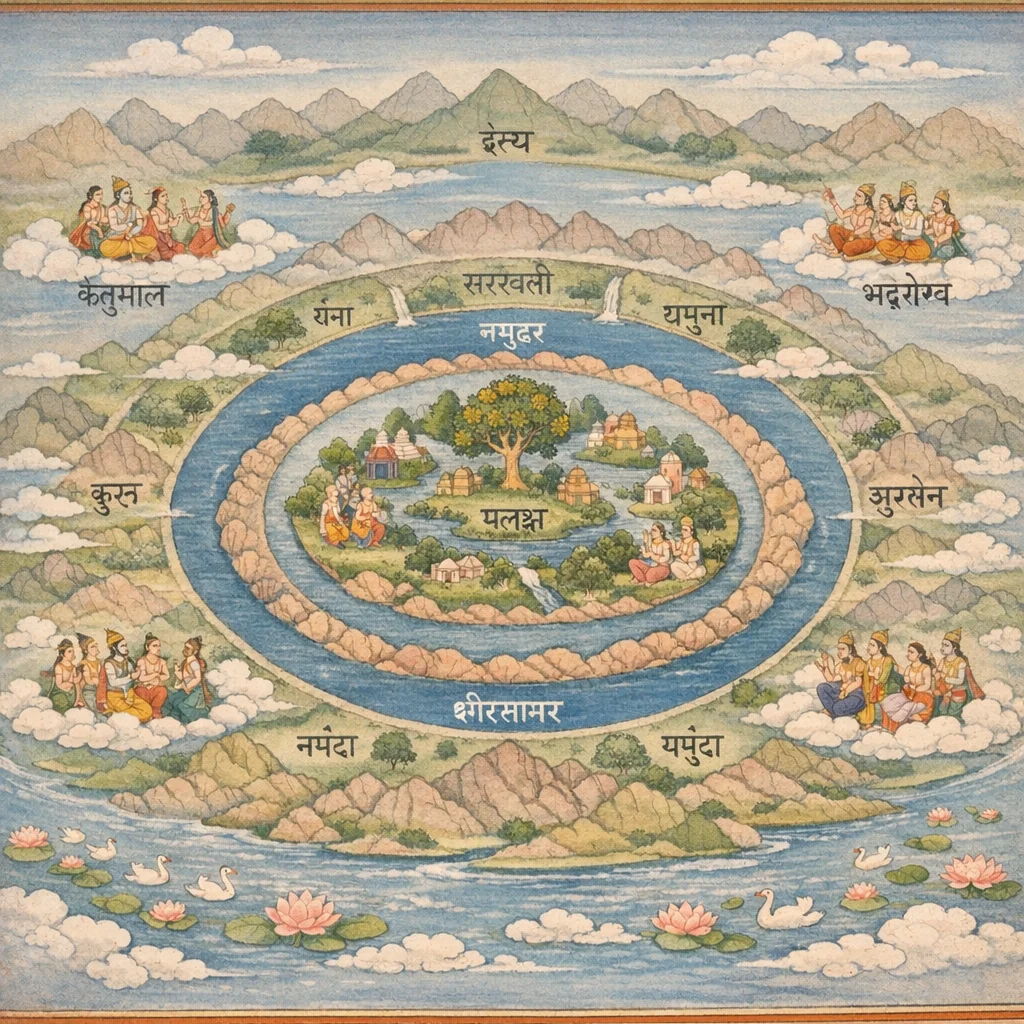
Maitreya hears as Parāśara continues the concentric design of Bhū-maṇḍala: beyond Jambū’s salt ocean lies Plakṣadvīpa, twice Jambū’s measure, with its seven varṣas and rulers, boundary mountains, and purifying rivers, where a Tretā-like order prevails with varṇa–āśrama discipline and Soma-form worship of Hari. The account then moves outward through Śālmaladvīpa, Kuśadvīpa, Krauñcadvīpa, Śākadvīpa, and Puṣkaradvīpa, repeatedly giving the doubling of measures, the sevenfold mountains/rivers/regions, and region-specific modes of worship of Janārdana (as Brahmā-form, Rudra-form, Sūrya-form, and the like). In Puṣkara, Mānasottara divides the island into two varṣas and its distinctive social condition is noted. Next come the sweet-water ocean, the lifeless golden land, and Lokāloka mountain as the boundary of the manifest worlds. The chapter ends with the sea’s rise and fall in harmony with the Moon and the total extent of the earth-system within the brahmāṇḍa shell, affirming Viṣṇu’s regulated cosmic sovereignty.
Shlokas
Verse 1
क्षारोदेन यथा द्वीपो जम्बूसंज्ञो ऽभिवेष्टितः संवेष्ट्य क्षारम् उदधिं प्लक्षद्वीपस् तथा स्थितः
As Jambūdvīpa is encircled by the ocean of salt, so Plakṣadvīpa stands beyond it, surrounding that salt sea in a vast ring. Thus the worlds are arranged in concentric order, upheld by the cosmic sovereignty of the Supreme Lord Viṣṇu.
Verse 2
जम्बूद्वीपस्य विस्तारः शतसाहस्रसंमितः स एवं द्विगुणो ब्रह्मन् प्लक्षद्वीप उदाहृतः
The breadth of Jambūdvīpa is declared to be a hundred thousand yojanas; and, O Brāhmaṇa, Plakṣadvīpa is taught to be exactly twice that measure.
Verse 3
सप्त मेधातिथेः पुत्राः प्लक्षद्वीपेश्वरस्य वै ज्येष्ठः शान्तभयो नाम शिशिरस् तदनन्तरः
Medhātithi, the lord of Plakṣadvīpa, indeed had seven sons. The eldest was named Śāntabhaya, and after him came Śiśira.
Verse 4
सुखोदयस् तथानन्दः शिवः क्षेमक एव च ध्रुवश् च सप्तमस् तेषां प्लक्षद्वीपेश्वरा हि ते
The other rulers are named Sukhodaya, Ānanda, Śiva, and Kṣemaka; and Dhruva is counted as the seventh. Indeed, these are the sovereign lords of Plakṣadvīpa.
Verse 5
पूर्वं शान्तभयं वर्षं शिशिरं सुखदं तथा आनन्दं च शिवं चैव क्षेमकं ध्रुवम् एव च
In due order (the regions/varṣas) are: first Pūrvā, then Śāntabhaya; next Varṣa and Śiśira, and likewise Sukhada. Thereafter come Ānanda and Śiva, then Kṣemaka, and finally Dhruva—thus their sequence is firmly set.
Verse 6
मर्यादाकारकास् तेषां तथान्ये वर्षपर्वताः सप्तैव तेषां नामानि शृणुष्व मुनिसत्तम
Those mountains establish the boundaries and sacred order of those regions; and there are other varṣa-mountains as well that mark the divisions of the varṣas. Hear now, O best of sages, the seven names of those boundary-mountains.
Verse 7
गोमेदश् चैव चन्द्रश् च नारदो दुन्दुभिस् तथा सोमकः सुमनाः शैलो वैभ्राजश् चैव सप्तमः
Gomeda and Candra, Nārada and Dundubhi; Somaka, Sumanas, Śaila, and Vaibhrāja—these are the seven names (of the boundary-mountains).
Verse 8
वर्षाचलेषु रम्येषु वर्षेष्व् एतेषु चानघाः वसन्ति देवगन्धर्वसहिताः सततं प्रजाः
In these varṣas, adorned with delightful boundary-mountains, blameless beings dwell continually—together with the devas and the gandharvas.
Verse 9
तेषु पुण्या जनपदाश् चिराच् च म्रियते जनः नाधयो व्याधयो वापि सर्वकालसुखं हि तत्
Among those regions are sacred and meritorious lands, where people die only after a long span of years. There, neither inner afflictions nor bodily diseases prevail; indeed, it is happiness at all times.
Verse 10
तेषां नद्यश् च सप्तैव वर्षाणां तु समुद्रगाः नामतस् ताः प्रवक्ष्यामि श्रुताः पापं हरन्ति याः
And of those seven varṣas there are likewise seven rivers, all flowing onward to the ocean. I shall now declare them by name—rivers whose very hearing washes away sin.
Verse 11
अनुतप्ता शिखी चैव विपाशा त्रिदिवा क्रमुः अमृता सुकृता चैव सप्तैतास् तत्र निम्नगाः
There too flow seven sacred rivers—Anutaptā and Śikhī; Vipāśā and Tridivā; Kramu; and also Amṛtā and Sukṛtā—seven descending streams that sustain that region as they course onward.
Verse 12
एते शैलास् तथा नद्यः प्रधानाः कथितास् तव क्षुद्रनद्यस् तथा शैलास् तत्र सन्ति सहस्रशः ताः पिबन्ति सदा हृष्टा नदीर् जनपदास् तु ते
Thus I have declared to you the principal mountains and the great rivers. Yet in that same land there exist, by the thousand, lesser streams and lesser ranges; and the realms and their peoples, ever gladdened, continually drink of those rivers.
Verse 13
अपसर्पिणी न तेषां वै न चैवोत्सर्पिणी द्विज न त्व् एवास्ति युगावस्था तेषु स्थानेषु सप्तसु
O twice-born one, in those seven abodes there is neither the declining course of time nor its ascending course; indeed, the condition of the Yugas does not exist there at all.
Verse 14
त्रेतायुगसमः कालः सर्वदैव महामते प्लक्षद्वीपादिषु ब्रह्मञ् शाकद्वीपान्तिकेषु वै
O wise Brahman, in Plakṣa-dvīpa and the other islands, and likewise in the regions bordering Śāka-dvīpa, time is ever of the measure of the Tretā-yuga.
Verse 15
पञ्चवर्षसहस्राणि जना जीवन्त्य् अनामयाः धर्मः पञ्चस्व् अथैतेषु वर्णाश्रमविभागशः
For five thousand years people live free from affliction; and in that condition dharma stands firm in fivefold measure, upheld according to the ordered distinctions of varṇa and āśrama.
Verse 16
वर्णाश् च तत्र चत्वारस् तान् निबोध वदामि ते
Within that ordained order there are four varṇas; understand them well—now I shall declare them to you.
Verse 17
आर्यकाः कुरराश् चैव विविंशा भाविनश् च ये विप्रक्षत्रियवैश्यास् ते शूद्राश् च मुनिसत्तम
O best of sages, the Āryakas, the Kurarāś, and those known as the Viviṃśas—along with the groups that would arise in the future—came to include Brāhmaṇas, Kṣatriyas, Vaiśyas, and also Śūdras.
Verse 18
जम्बूवृक्षप्रमाणस् तु तन्मध्ये सुमहांस् तरुः प्लक्षस् तन्नामसंज्ञो ऽयं प्लक्षद्वीपो द्विजोत्तम
In its very center stands a mighty tree, vast in measure like the Jambū tree. That great tree is called Plakṣa; and from its name, O best of the twice-born, this realm is known as Plakṣa-dvīpa.
Verse 19
इज्यते तत्र भगवांस् तैर् वर्णैर् आर्यकादिभिः सोमरूपी जगत्स्रष्टा सर्वः सर्वेश्वरो हरिः
There, the Blessed Lord is worshipped by those classes—beginning with the Āryakas—He who abides as Soma, the Creator of the universe, the All that pervades all, Hari, the Supreme Lord of every lord.
Verse 20
प्लक्षद्वीपप्रमाणेन प्लक्षद्वीपः समावृतः तथैवेक्षुरसोदेन परिवेषानुकारिणा
Encircled in measure equal to the continent of Plakṣa itself, Plakṣa-dvīpa is surrounded—likewise—by an ocean of sugarcane-juice, forming a ring around it like a halo.
Verse 21
इत्य् एष तव मैत्रेय प्लक्षद्वीप उदाहृतः संक्षेपेण मया भूयः शाल्मलं मे निशामय
Thus, O Maitreya, I have succinctly described to you the Plakṣa continent. Now listen again, as I in turn relate to you Śālmala-dvīpa.
Verse 22
शाल्मलस्येश्वरो वीरो वपुष्मांस् तत्सुताञ् छृणु येषां तु नामसंज्ञानि सप्त वर्षाणि तानि वै
The sovereign of Śālmaladvīpa is the heroic and radiant Vapuṣmān. Now hear of his sons, after whose very names the seven varṣas there are known.
Verse 23
श्वेतो ऽथ हरितश् चैव जीमूतो रोहितस् तथा वैद्युतो मानसश् चैव सुप्रभश् च महामुने
“Śveta, then Harita; Jīmūta and likewise Rohita; Vaidyuta and Mānasa; and also Suprabha—these are their names, O great sage.”
Verse 24
शाल्मलेन समुद्रो ऽसौ द्वीपेनेक्षुरसोदकः विस्तारद्विगुणेनाथ सर्वतः संवृतः स्थितः
That ocean—whose waters are the very essence of sugarcane juice—is encircled on every side by the Śālmala continent, which surrounds it with a breadth twice as great.
Verse 25
तत्रापि पर्वताः सप्त विज्ञेया रत्नयोनयः वर्षाभिव्यञ्जकास् ते तु तथा सप्तैव निम्नगाः
There too one should know seven mountains—sources of precious gems—by which the varṣas are distinguished; and likewise there are exactly seven rivers flowing through the lowlands.
Verse 26
कुमुदश् चोन्नतश् चैव तृतीयश् च बलाहकः द्रोणो यत्र महौषध्यः स चतुर्थो महीधरः
Kumuda and Unnata are two mountains; the third is Balāhaka. Droṇa—where the great medicinal herbs are found—is the fourth mountain, the bearer that upholds the earth.
Verse 27
कङ्कस् तु पञ्चमः षष्ठो महिषः सप्तमस् तथा ककुद्मान् पर्वतवरः सरिन्नामानि मे शृणु
Kanka is the fifth; Mahisha the sixth; and the seventh is Kakudmān, the finest among mountains. Now hear from me the names of the rivers.
Verse 28
योनी तोया वितृष्णा च चन्द्रा शुक्ला विमोचनी निवृत्तिः सप्तमी तासां स्मृतास् ताः पापशान्तिदाः
They are remembered as seven rivers: Yonī, Toyā, Vitṛṣṇā, Candrā, Śuklā, Vimocanī, and the seventh, Nivṛtti—sacred waters said to pacify sin.
Verse 29
श्वेतं च हरितं चैव जीमूतं रोहितं तथा वैद्युतं मानसं चैव सुप्रभं चातिशोभनम् सप्तैतानि तु वर्षाणि चातुर्वर्ण्ययुतानि वै
Śveta and Harita, Jīmūta and Rohita; likewise Vaidyuta and Mānasa; and Suprabha, exceedingly radiant—these are the seven Varṣas (regions). In these lands, indeed, the fourfold order of varṇas is found.
Verse 30
शाल्मले ये तु वर्णाश् च वसन्त्य् एते महामुने कपिलाश् चारुणाः पीताः कृष्णाश् चैव पृथक् पृथक्
O great sage, the varṇas (peoples) dwelling in Śālmaladvīpa are distinct: some are kapila (tawny), some aruna (ruddy), some pīta (yellow), and some kṛṣṇa (black), each set apart in its own kind.
Verse 31
ब्राह्मणाः क्षत्रिया वैश्याः शूद्राश् चैव यजन्ति तम् भगवन्तं समस्तस्य विष्णुम् आत्मानम् अव्ययम् वायुभूतं मखश्रेष्ठैर् यज्विनो यज्ञसंस्थितम्
Brāhmaṇas, Kṣatriyas, Vaiśyas, and Śūdras alike worship that Blessed Lord—Viṣṇu, the imperishable Self of all. Present as the very life-breath, He is established in sacrifice, and the foremost sacrificers honour Him through the highest yajñas.
Verse 32
देवानाम् अत्र सांनिध्यम् अतीव सुमनोरमे शाल्मलिश् च महावृक्षो नाम निर्वृतिकारकः
In that exceedingly delightful and mind-enchanting region, the presence of the gods is felt close at hand; and there stands the great tree called Śālmali, a bestower of deep contentment and repose.
Verse 33
एष द्वीपः समुद्रेण सुरोदेन समावृतः विस्ताराच् छाल्मलस्यैव समेन तु समन्ततः
This continent (dvīpa) is encircled by the ocean of surā; and in its full extent it is, on every side, equal in measure to Śālmala-dvīpa.
Verse 34
सुरोदकः परिवृतः कुशद्वीपेन सर्वतः शाल्मलस्य तु विस्ताराद् द्विगुणेन समन्ततः
Encircling all around lies the ocean of surā, and it is girdled everywhere by Kuśadvīpa—whose extent on every side is twice that of Śālmaladvīpa.
Verse 35
ज्योतिष्मतः कुशद्वीपे सप्त पुत्रान् शृणुष्व तान्
Now hear of the seven sons of Jyotiṣmān in Kuśadvīpa—listen as I recount them to you in due order.
Verse 36
उद्भिदो वेणुमांश् चैव स्वैरथो लम्बनो धृतिः प्रभाकरो ऽथ कपिलस् तन्नामा वर्षपद्धतिः
Udbhida, Veṇumāṃśa, Svairatha, Lambana, Dhṛti, Prabhākara, and Kapila—these are the names set in order in the sequence of the varṣas (regions).
Verse 37
तस्यां वसन्ति मनुजाः सह दैतेयदानवैः तथैव देवगन्धर्वयक्षकिंपुरुषादयः
In that very region dwell human beings together with the Daityas and Dānavas; and there also reside the Devas, Gandharvas, Yakṣas, Kimpuruṣas, and others besides.
Verse 38
वर्णास् तत्रापि चत्वारो निजानुष्ठानतत्पराः दमिनः शुष्मिणः स्नेहा मन्देहाश् च महामुने
O great sage, there too are four classes, each intent upon the observance of its own ordained duties: the Damina, the Śuṣmin, the Sneha, and the Mandeha.
Verse 39
ब्राह्मणाः क्षत्रिया वैश्याः शूद्राश् चानुक्रमोदिताः
Brahmins, Kṣatriyas, Vaiśyas, and Śūdras—thus are they declared in due sequence.
Verse 40
यथोक्तकर्मकर्तृत्वात् स्वाधिकारक्षयाय ते तत्र ते तु कुशद्वीपे ब्रह्मरूपं जनार्दनम् यजन्तः क्षपयन्त्य् उग्रम् अधिकारफलप्रदम्
Because they perform the rites exactly as enjoined, they do so to exhaust their own limited entitlement to results. There, in Kuśadvīpa, they worship Janārdana in the form of Brahmā; and by that worship they burn away the fierce force that dispenses the fruits of worldly qualification and karmic privilege.
Verse 41
विद्रुमो हेमशैलश् च द्युतिमान् पुष्पवांस् तथा कुशेशयो हरिश् चैव सप्तमो मन्दराचलः
These mountains are Vidrumā and Hemaśaila; Dyutimān and Puṣpavān; Kuśeśaya and Hari; and as the seventh, the great Mandarācala.
Verse 42
वर्षाचलास् तु सप्तैते तत्र द्वीपे महामुने नद्यश् च सप्त तासां तु शृणु नामान्य् अनुक्रमात्
O great sage, within that continent there are seven mountain-ranges marking the varṣas; and there are seven rivers—now hear their names in due order.
Verse 43
धूतपापा शिवा चैव पवित्रा संमतिस् तथा विद्युद् अम्भा मही चान्या सर्वपापहरास् त्व् इमाः
Dhūtapāpā, Śivā, Pavitrā, and Saṃmati; also Vidyut, Ambhā, and Mahī—these rivers are said to remove every sin.
Verse 44
अन्याः सहस्रशस् तत्र क्षुद्रनद्यस् तथाचलाः कुशद्वीपे कुशस्तम्बः संज्ञया तस्य तत् स्मृतम्
There are also thousands upon thousands of minor rivers there, and likewise mountains. In Kuśa-dvīpa, a clump of sacred kuśa-grass is remembered as its distinctive sign and name.
Verse 45
तत्प्रमाणेन स द्वीपो घृतोदेन समावृतः घृतोदश् च समुद्रो वै क्रौञ्चद्वीपेन संवृतः
By that very measure, the continent is encircled by the ocean of Ghṛtoda (clarified butter); and that ghee-ocean, in turn, is surrounded by the continent called Krauñca-dvīpa.
Verse 46
क्रौञ्चद्वीपो महाभाग श्रूयतां चापरो महान् कुशद्वीपस्य विस्ताराद् द्विगुणो यस्य विस्तरः
O noble one, now hear of another vast realm—the great Krauñca-dvīpa—whose breadth is said to be twice the expanse of Kuśa-dvīpa.
Verse 47
क्रौञ्चद्वीपे द्युतिमतः पुत्राः सप्त महात्मनः तन्नामानि च वर्षाणि तेषां चक्रे महीपतिः
In Krauñca-dvīpa, there were seven noble-souled sons of Dyutimān; and the sovereign established the land-divisions (varṣas) bearing their very names.
Verse 48
कुशलो मनुगश् चोष्णः पीवरो ऽथान्धकारकः मुनिश् च दुन्दुभिश् चैव सप्तैते तत्सुता मुने
“Kuşala, Manuga, Oṣṇa, Pīvara, and then Andhakāraka—along with Muni and Dundubhi: O sage, these seven were his sons.”
Verse 49
तत्रापि देवगन्धर्वसेविताः सुमनोरमाः वर्षाचला महाबुद्धे तेषां नामानि मे शृणु
There too, O great-minded one, are delightful regional mountains, frequented and attended by Devas and Gandharvas. Now hear from me their names.
Verse 50
क्रौञ्चश् च वामनश् चैव तृतीयश् चान्धकारकः चतुर्थो रत्नशैलश् च स्वाहिनी हयसंनिभः
“There is the mountain Krauñca, and likewise Vāmana; the third is Andhakāraka; the fourth is Ratnaśaila; and Svāhinī, resembling a horse in form.”
Verse 51
दिवावृत् पञ्चमश् चात्र तथान्यः पुण्डरीकवान् दुन्दुभिश् च महाशैलो द्विगुणास् ते परस्परम् द्वीपा द्वीपेषु ये शैला यथा द्वीपानि ते तथा
Here are also named the fifth mountain, Divāvṛt, another called Puṇḍarīkavān, and the great peak Dundubhi. Each range is twice the extent of the one before it; and as the dvīpas increase in measure from one to the next, so too do the mountains within those dvīpas increase accordingly.
Verse 52
वर्षेष्व् एतेषु रम्येषु वर्षशैलवरेषु च निवसन्ति निरातङ्काः सह देवगणैः प्रजाः
In these delightful varṣas, and among the excellent mountains of those lands, the beings of the world dwell free from fear and affliction, together with the hosts of gods—according to the harmonious order of Viṣṇu’s sovereignty.
Verse 53
पुष्कराः पुष्कला धन्यास् तिष्याख्याश् च महामुने ब्राह्मणाः क्षत्रिया वैश्याः शूद्राश् चानुक्रमोदिताः
O great sage, the groups known as Puṣkara, Puṣkala, Dhanya, and those called Tiṣya are spoken of; and in due sequence the four varṇas—Brāhmaṇas, Kṣatriyas, Vaiśyas, and Śūdras—are also declared, each arising within the ordained pattern of the world.
Verse 54
ते तत्र नद्यो मैत्रेय याः पिबन्ति शृणुष्व ताः सप्त प्रधानाः शतशस् तत्रान्याः क्षुद्रनिम्नगाः
O Maitreya, hear now of the rivers there—those whose waters are drunk. Seven are the principal streams, and besides them are hundreds more, other lesser rivers that flow down into the lowlands.
Verse 55
गौरी कुमुद्वती चैव संध्या रात्रिर् मनोजवा ख्यातिश् च पुण्डरीका च सप्तैता वर्षनिम्नगाः
Gaurī, Kumudvatī, Sandhyā, Rātri, Manojavā, Khyāti, and Puṇḍarīkā—these seven are renowned as the rivers that flow through the varṣas.
Verse 56
अत्रापि वर्णैर् भगवान् पुष्कराद्यैर् जनार्दनः यागै रुद्रस्वरूपस्थ इज्यते यज्ञसंनिधौ
Here too, according to the ordained social orders beginning with Puṣkara and the rest, Bhagavān Janārdana is worshipped by sacrificial rites; for in the very presence of the yajña He abides in the form of Rudra and receives the oblation, while remaining the Supreme Lord who pervades all ritual action.
Verse 57
क्रौञ्चद्वीपः समुद्रेण दधिमण्डोदकेन तु आवृतः सर्वतः क्रौञ्चद्वीपतुल्येन मानतः
Krauñca-dvīpa is enclosed on every side by an ocean of dadhimaṇḍa-water, like whey from curds; and that surrounding sea is, in its measure, equal to Krauñca-dvīpa itself.
Verse 58
दधिमण्डोदकश् चापि शाकद्वीपेन संवृतः क्रौञ्चद्वीपस्य विस्ताराद् द्विगुणेन महामुने
O great sage, the ocean of dadhimaṇḍa-water is likewise encircled by Śākadvīpa, whose breadth is twice the extent of Krauñca-dvīpa.
Verse 59
शाकद्वीपेश्वरस्यापि भव्यस्य सुमहात्मनः सप्तैव तनयास् तेषां ददौ वर्षाणि सप्त सः
Bhavya, the great-souled lord of Śākadvīpa, had indeed seven sons; and to those sons he allotted seven varṣas (regional divisions), establishing their respective domains.
Verse 60
जलदश् च कुमारश् च सुकुमारो मणीचकः कुसुमोदः सुमोदाकिः सप्तमश् च महाद्रुमः
Their names were Jalada and Kumāra; also Sukumāra and Maṇīcaka; Kusumoda and Sumodāki; and as the seventh, Mahādruma.
Verse 61
तत्संज्ञान्य् एव तत्रापि सप्त वर्षाण्य् अनुक्रमात् तत्रापि पर्वताः सप्त वर्षविच्छेदकारिणः
There too, in proper order, are seven varṣas bearing those very names; and there too are seven mountain ranges that mark the boundaries between the varṣas.
Verse 62
पूर्वस् तत्रोदयगिरिर् जलधारस् तथापरः तथा रैवतकः श्यामस् तथैवाम्भोगिरिर् द्विज आम्बिकेयस् तथा रम्यः केसरी पर्वतोत्तमः
There, to the east, stands Mount Udayagiri; likewise are Jaladhāra and Aparā; also Raivataka and Śyāma; and, O twice-born, Ambhogiri; then Āmbikeya and Ramya; and the excellent mountain Keśarī—these are named among the eminent ranges.
Verse 63
शाकस् तत्र महावृक्षः सिद्धगन्धर्वसेवितः यत्पत्रवातसंस्पर्शाद् आह्लादो जायते परः
There stands the mighty Śāka tree, attended and revered by Siddhas and Gandharvas; and from the mere touch of the breeze that has passed through its leaves, a surpassing gladness arises within the heart.
Verse 64
तत्र पुण्या जनपदाश् चातुर्वर्ण्यसमन्विताः नद्यश् चात्र महापुण्याः सर्वपापभयापहाः
There, the provinces are holy and harmoniously endowed with the four social orders; and there too the rivers are supremely sacred—dispelling every fear and washing away all sin.
Verse 65
सुकुमारी कुमारी च नलिनी वेणुका च या इक्षुश् च धेनुका चैव गभस्ती सप्तमी तथा
“They are named Sukumārī, Kumārī, Nalinī, and Veṇukā; likewise Ikṣu and Dhenukā; and Gabhasṭī as the seventh—thus are they enumerated.”
Verse 66
अन्यास् त्व् अयुतशस् तत्र क्षुद्रनद्यो महामुने महीधरास् तथा सन्ति शतशो ऽथ सहस्रशः
O great sage, besides these there are tens of thousands of lesser rivers there; and likewise mountains that uphold the earth—by the hundreds, indeed by the thousands.
Verse 67
ताः पिबन्ति मुदा युक्ता जलदादिषु ये स्थिताः वर्षेषु ते जनपदाः स्वर्गाद् अभ्येत्य मेदिनीम्
Those waters, joined with the life-giving clouds and the rest, are drunk with gladness by the people wherever they dwell in the several varṣas; thus those lands seem as though descended from heaven to earth, upheld by the celestial order that Viṣṇu sustains.
Verse 68
धर्महानिर् न तेष्व् अस्ति न संघर्षः परस्परम् मर्यादाव्युत्क्रमो वापि तेषु देशेषु सप्तसु
In those seven realms there is no decline of dharma, nor any conflict among one another. None transgresses proper bounds—within those seven regions, the limits of conduct are not overstepped.
Verse 69
मगाश् च मागधाश् चैव मानसा मन्दगास् तथा मगा ब्राह्मणभूयिष्ठा मागधाः क्षत्रियास् तु ते वैश्यास् तु मानसास् तेषां शूद्रास् तेषां तु मन्दगाः
There were also the Magas, the Māgadhas, the Mānasas, and likewise the Mandagas. Of these, the Magas were predominantly of brahminical standing; the Māgadhas were of kṣatriya rank; the Mānasas were vaiśyas; and among them, the Mandagas were regarded as śūdras.
Verse 70
शाकद्वीपे तु तैर् विष्णुः सूर्यरूपधरो मुने यथोक्तैर् इज्यते सम्यक् कर्मभिर् नियतात्मभिः
But in Śākadvīpa, O sage, those people worship Viṣṇu as He who bears the form of the Sun; with disciplined minds they adore Him rightly, performing the prescribed rites exactly as enjoined.
Verse 71
शाकद्वीपस् तु मैत्रेय क्षीरोदेन समन्ततः शाकद्वीपप्रमाणेन वलयेनेव वेष्टितः
O Maitreya, Śākadvīpa is encircled on every side by the Ocean of Milk, which—equal in measure to Śākadvīpa itself—encloses it like a ring.
Verse 72
क्षीराब्धिः सर्वतो ब्रह्मन् पुष्कराख्येन वेष्टितः द्वीपेन शाकद्वीपात् तु द्विगुणेन समन्ततः
O Brahmin, the Ocean of Milk is encompassed on every side by the continent called Puṣkara—encircling it all around, and extending to twice the measure of Śāka-dvīpa.
Verse 73
पुष्करे सवनस्यापि महावीरो ऽभवत् सुतः धातकिश् च तयोस् तत्र द्वे वर्षे नामचिह्निते महावीरं तथैवान्यद् धातकीखण्डसंज्ञितम्
In Puṣkara-dvīpa too, Sāvana had a son named Mahāvīra, and another named Dhātaki. There, two regions (varṣas) are marked by their very names—one called Mahāvīra, and the other renowned as Dhātakīkhaṇḍa.
Verse 74
एकश् चात्र महाभाग प्रख्यातो वर्षपर्वतः मानसोत्तरसंज्ञो वै मध्यतो वलयाकृतिः
And here, O noble one, there is a single celebrated mountain that marks the divisions of the regions: it is known as Mānasottara, and it stands in the very middle, shaped like a circular ring.
Verse 75
योजनानां सहस्राणि ऊर्ध्वं पञ्चाशद् उच्छ्रितः तावद् एव च विस्तीर्णः सर्वतः परिमण्डलः
Rising upward to a height of fifty thousand yojanas, it is of the same measure in breadth as well—perfectly circular on every side, encompassed uniformly in all directions.
Verse 76
पुष्करद्वीपवलयं मध्येन विभजन्न् इव स्थितो ऽसौ तेन विच्छिन्नं जातं वर्षद्वयं मुने
O sage, that lofty mountain stands as though cleaving the ring of Puṣkara-dvīpa through its very middle; by it the land is cut apart, and thus two great varṣas come to be.
Verse 77
वलयाकारम् एकैकं तयोर् वर्षं तथा गिरिः
Each of the two—both the varṣa and the encircling mountain—stands as a distinct ring-shaped belt, set one after another in ordered formation.
Verse 78
दश वर्षसहस्राणि तत्र जीवन्ति मानवाः निरामया विशोकाश् च रागद्वेषविवर्जिताः
There, human beings live for ten thousand years—free from disease and untouched by sorrow—having cast aside attachment and aversion.
Verse 79
अधमोत्तमौ न तेष्व् आस्तां न वध्यवधकौ द्विज नेर्ष्यासूया भयं रोषो दोषो लोभादिको न च
O twice-born one, among them there is no notion of ‘lower’ and ‘higher’; there are neither those to be slain nor slayers. Neither envy nor malice arises; fear and anger are absent; and no fault such as greed exists at all.
Verse 80
महावीरं बहिर् वर्षं धातकीखण्डम् अन्ततः मानसोत्तरशैलस्य देवदैत्यादिसेवितम्
Outside lies the continent called Dhātakīkhaṇḍa; and beyond it, at the far limit by Mount Mānasottara, is the region known as Mahāvīra-varṣa—a holy boundary revered and frequented by gods, Dānavas, and other beings.
Verse 81
सत्यानृते न तत्रास्तां द्वीपे पुष्करसंज्ञिते न तत्र नद्यः शैला वा द्वीपे वर्षद्वयान्विते
In the island called Puṣkara, neither truth nor untruth is held as a dividing line. There are no rivers and no mountains; that dvīpa consists of only two regions (varṣas).
Verse 82
तुल्यवेषास् तु मनुजा देवैस् तत्रैकरूपिणः
There, human beings wear the same attire as the gods; in that realm they appear of a single, godlike form.
Verse 83
वर्णाश्रमाचारहीनं धर्माचरणवर्जितम् त्रयीवार्तादण्डनीतिशुश्रूषारहितं च यत्
That state is truly deficient: where the disciplines of varṇa and āśrama are absent, where the practice of dharma is forsaken, and where there is no reverent regard for the threefold Vedic way, for livelihood (vārttā), and for dandanīti—the principles of governance and punishment that uphold society.
Verse 84
वर्षद्वयं तु मैत्रेय भौमः स्वर्गो ऽयम् उत्तमः सर्वस्य सुखदः कालो जरारोगादिवर्जितः पुष्करे धातकीषण्डे महावीरे च वै मुने
But, O Maitreya, two regions (varṣas) are renowned as an excellent heaven upon the earth itself. There time bestows happiness on all, free from old age, disease, and the like: in Puṣkara, in Dhātakīkhaṇḍa, and also in Mahāvīra, O sage.
Verse 85
न्यग्रोधः पुष्करद्वीपे ब्रह्मणः स्थानम् उत्तमम् तस्मिन् निवसति ब्रह्मा पूज्यमानः सुरासुरैः
In Puṣkara-dvīpa stands the Nyagrodha (the cosmic banyan), the most exalted abode of Brahmā. There Brahmā dwells, revered and worshipped alike by the devas and the asuras.
Verse 86
स्वादूदकेनोदधिना पुष्करः परिवेष्टितः समेन पुष्करस्यैव विस्तारान् मण्डलात् तथा
Then Puṣkara-dvīpa is encircled by an ocean of sweet water; and that ocean, like a circular belt, is in breadth equal to Puṣkara itself.
Verse 87
एवं द्वीपाः समुद्रैस् तु सप्त सप्तभिर् आवृताः द्वीपश् चैव समुद्रश् च समानौ द्विगुणौ परौ
Thus the continents are encircled—seven and seven—by the oceans. Each continent and its bordering ocean are equal in extent; yet each successive pair beyond them is twice the measure of the one before.
Verse 88
पयांसि सर्वदा सर्वसमुद्रेषु समानि वै न्यूनातिरिक्तता तेषां कदाचिन् नैव जायते
The waters, indeed, are ever the same in all the oceans; for them there is never—at any time—either diminution or excess.
Verse 89
स्थालीस्थम् अग्निसंयोगाद् उद्रेकि सलिलं यथा तथेन्दुवृद्धौ सलिलम् अम्भोधौ मुनिसत्तम
O best of sages, just as water in a vessel swells when it comes into contact with fire, so too, when the Moon waxes, the waters in the ocean rise and increase.
Verse 90
अन्यूनानतिरिक्ताश् च वर्धन्त्य् आपो ह्रसन्ति च उदयास्तमयेष्व् इन्दोः पक्षयोः शुक्लकृष्णयोः
In the Moon’s bright and dark fortnights, at its risings and settings, the waters—neither falling short nor exceeding their ordained measure—alternately swell and subside.
Verse 91
दशोत्तराणि पञ्चैव अङ्गुलानां शतानि वै अपां वृद्धिक्षयौ दृष्टौ सामुद्रीणां महामुने
O great sage, the oceanic waters are observed to rise and fall by five hundred and ten aṅgulas—such is their measured increase and decrease.
Verse 92
भोजनं पुष्करद्वीपे तत्र स्वयम् उपस्थितम् षड्रसं भुञ्जते विप्र प्रजाः सर्वाः सदैव हि
In Puṣkara-dvīpa, O brāhmaṇa, food is found there of itself—ever present. All beings partake of that nourishment, endowed with the six tastes, at all times.
Verse 93
स्वादूदकस्य पुरतो दृश्यते ऽलोकसंस्थितिः द्विगुणा काञ्चनी भूमिः सर्वजन्तुविवर्जिता
Beyond the ocean of sweet water there is seen another arrangement of worlds: a golden expanse of earth, twice in measure, wholly devoid of living beings.
Verse 94
लोकालोकस् ततः शैलो योजनायुतविस्तृतः उच्छ्रायेणापि तावन्ति सहस्राण्य् अचलो हि सः
Beyond that lies the mountain called Lokāloka—spreading across ten thousand yojanas; and in height, too, it rises by just as many thousands. Truly, it stands unmoving.
Verse 95
ततस् तमः समावृत्य तं शैलं सर्वतः स्थितम् तमश् चाण्डकटाहेन समन्तात् परिवेष्टितम्
Then darkness (tamas) spread forth and completely covered that mountain on every side; and that very darkness, in turn, was encircled all around by the shell of the cosmic egg (brahmāṇḍa), like a vast enclosing cauldron.
Verse 96
पञ्चाशत्कोटिविस्तारा सेयम् उर्वी महामुने सहैवाण्डकटाहेन सद्वीपाब्धिमहीधरा
O great sage, this broad Earth extends for fifty crores in measure—together with the enclosing shell of the cosmic egg, with its continents and oceans, and with the mountains that uphold the world.
Verse 97
सेयं धात्री विधात्री च सर्वभूतगुणाधिका आधारभूता सर्वेषां मैत्रेय जगताम् इति
“This Power is indeed the Sustainer and the Ordainer; she surpasses all beings in excellence of qualities, and she stands as the very foundation of all worlds—so it is, O Maitreya.”
Frequently Asked Questions
Plakṣa presents Hari worshipped as Soma; Kuśa depicts Janārdana worshipped in Brahmā-form; Krauñca depicts worship in Rudra-form in yajña; Śāka depicts Viṣṇu worshipped as Sūrya—illustrating one Bhagavān received through different upāsanā-modes without compromising His supremacy.
Lokāloka is the boundary mountain beyond the sweet-water ocean and a lifeless golden expanse; it marks the limit of the illuminated, inhabited world-order. Beyond it is tamas (darkness) and then the enclosing brahmāṇḍa shell—indicating a cosmological edge where manifest order ceases.
By repeatedly describing fixed measures, boundaries (maryādā), regulated time, and harmonized social dharma (varṇa–āśrama), the text presents the cosmos as an ethical-theological system sustained by Viṣṇu, not a value-neutral geography.