Adhyaya 12
ध्रुवस्य तपः — देवमायाविघ्नाः, विष्णोर्दर्शनम्, स्तुतिः, ध्रुवस्थानप्रदानम्
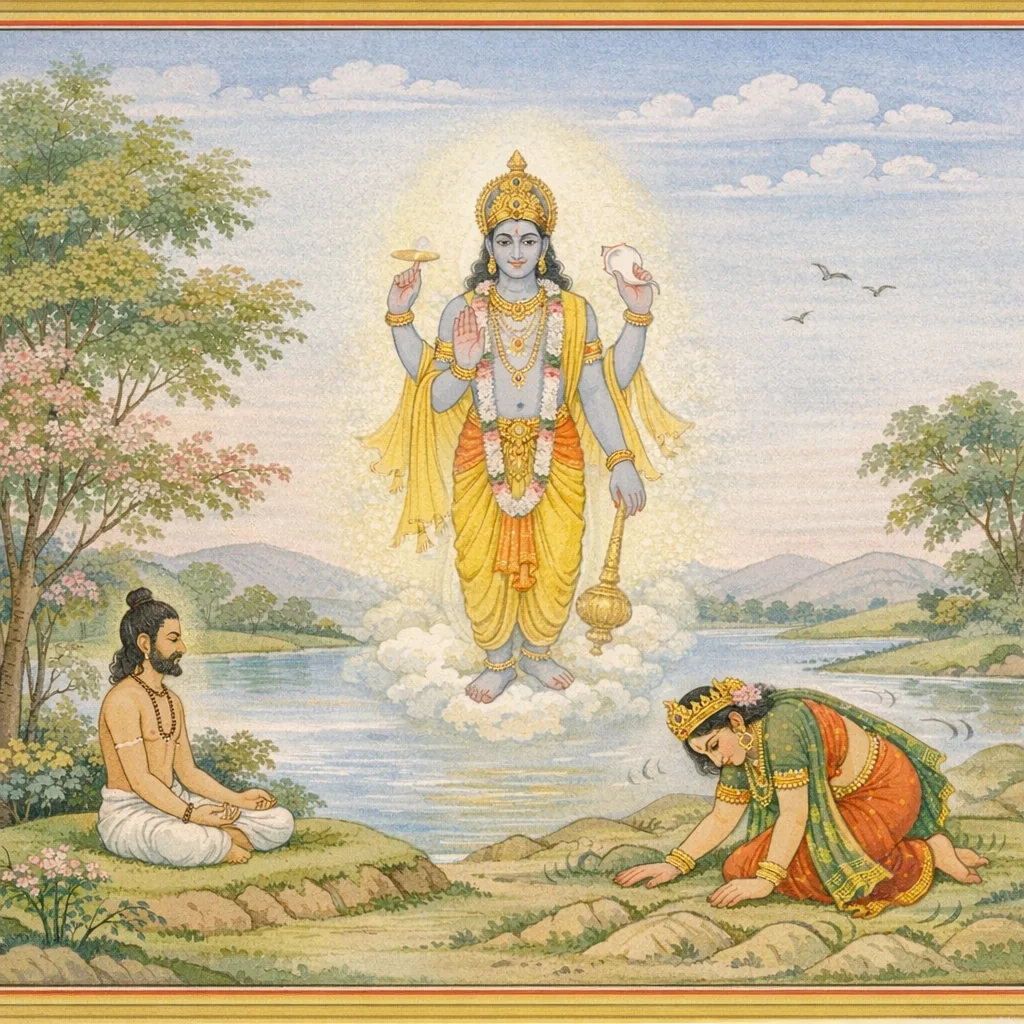
Parāśara continues teaching Maitreya by recounting Dhruva’s sādhana in Madhuvana on the Yamunā, a tīrtha graced by Hari’s nearness. Dhruva’s meditation becomes so one-pointed that the stability of the cosmos is shaken; the devas try to break his samādhi through māyā—first by an emotional appeal in Sunīti’s form, then by terrifying rākṣasa visions. But with his mind fixed on Govinda, these disturbances fall outside the reach of the senses. Alarmed, the devas take refuge in Hari; Viṣṇu promises to grant Dhruva’s desire and appears in a four-armed form. Dhruva asks for the boon of being able to praise the Lord; touched by the conch, he gains divine insight and offers a great stuti, declaring Viṣṇu to be the elements, the inner faculties, and the transcendent Reality beyond Pradhāna and Puruṣa—the cause of the universe. Viṣṇu grants Dhruva the imperishable Dhruva-sthāna above all worlds and even above the Saptarṣis, and elevates Sunīti as well; the chapter ends with a phalaśruti on reciting Dhruva’s ascent.
Shlokas
Verse 1
निशम्यैतद् अशेषेण मैत्रेय नृपतेः सुतः निर्जगाम वनात् तस्मात् प्रणिपत्य स तान् ऋषीन्
Having heard all of this in full, O Maitreya, the king’s son came out from that forest; and approaching those sages, he bowed down before them in reverence.
Verse 2
कृतकृत्यम् इवात्मानं मन्यमानस् ततो द्विज मधुसंज्ञं महापुण्यं जगाम यमुनातटम्
Then, O twice-born, deeming himself as one whose purpose was fulfilled, he went to the supremely meritorious bank of the Yamunā, to the region known as Madhu.
Verse 3
पुनश् च मधुसंज्ञेन दैत्येनाधिष्ठितं यतः ततो मधुवनं नाम्ना ख्यातम् अत्र महीतले
And again, since this very region on earth was once ruled and occupied by the Daitya named Madhu, it became renowned in the mortal world as Madhuvana—“the forest of Madhu.”
Verse 4
हत्वा च लवणं रक्षो मधुपुत्रं महाबलम् शत्रुघ्नो मधुरां नाम पुरीं यत्र चकार वै
And having slain Lavaṇa—the mighty rākṣasa, the son of Madhu—Śatrughna established there a city famed as Madhurā.
Verse 5
यत्र वै देवदेवस्य सांनिध्यं हरिमेधसः सर्वपापहरे तस्मिंस् तपस् तीर्थे चकार सः
There—where the presence of Hari, the God of gods, is truly near—at that sacred ford of austerity that removes every sin, he performed tapas.
Verse 6
मरीचिमिश्रैर् मुनिभिर् यथोद्दिष्टम् अभूत् तथा आत्मन्य् अशेषदेवेशं स्थितं विष्णुम् अमन्यत
Just as it had been taught by the sages beginning with Marīci, so it came to be: within his own self he recognized Viṣṇu abiding there—the Lord of all the gods without remainder.
Verse 7
अनन्यचेतसस् तस्य ध्यायतो भगवान् हरिः सर्वभूतगतो विप्र सर्वभावगतो ऽभवत्
O brāhmaṇa, as he meditated with an undivided, exclusive mind, the Blessed Lord Hari became manifest as the Inner Ruler of all beings, pervading every creature and every state of existence.
Verse 8
मनस्य् अवस्थिते तस्य विष्णौ मैत्रेय योगिनः न शशाक धरा भारम् उद्वोढुं भूतधारिणी
O Maitreya, when that yogin’s mind became firmly established in Viṣṇu, the Earth—though bearer of all beings—could no longer sustain that weight.
Verse 9
वामपादस्थिते तस्मिन् ननामार्धेन मेदिनी द्वितीयं च ननामार्धं क्षितेर् दक्षिणतः स्थिते
When He stood firm with His left foot, the Earth bowed by one half; and when He stood to the Earth’s right side, she bowed again by the other half, submitting entirely.
Verse 10
पादाङ्गुष्ठेन संपीड्य यदा स वसुधां स्थितः तदा सा वसुधा विप्र चचाल सह पर्वतैः
O brāhmaṇa, when He stood upon the Earth and pressed it down with the great toe of His foot, the ground—together with its mountains—began to tremble and move.
Verse 11
नद्यो नदाः समुद्राश् च संक्षोभं परमं ययुः तत्क्षोभाद् अमराः क्षोभं परं जग्मुर् महामुने
Rivers, streams, and the oceans surged into supreme agitation; and from that upheaval, O great sage, even the immortals were driven into still greater disquiet.
Verse 12
यामा नाम तदा देवा मैत्रेय परमाकुलाः इन्द्रेण सह संमन्त्र्य ध्यानभङ्गं प्रचक्रमुः
Then, O Maitreya, the gods called the Yāmas, thrown into great agitation, conferred with Indra and set about breaking his meditation.
Verse 13
कूष्माण्डा विविधै रूपैर् महेन्द्रेण महामुने समाधिभङ्गम् अत्यन्तम् आरब्धाः कर्तुम् आतुराः
O great sage, urged on by Mahendra, the Kūṣmāṇḍas assumed many forms and, with fierce intensity, set about shattering the steadiness of his samādhi.
Verse 14
सुनीतिर् नाम तन्माता सास्रा तत्पुरतः स्थिता पुत्रेति करुणां वाचम् आह मायामयी तदा
Then Sunīti, his mother, stood before him in tears and, overcome by māyā, spoke in tender compassion, “My son…”.
Verse 15
पुत्रकास्मान् निवर्तस्व शरीरव्ययदारुणात् निर्बन्धतो मया लब्धो बहुभिस् त्वं मनोरथैः
My child, turn back from this dreadful wasting of your body. I obtained you only after long insistence and with countless cherished hopes—do not cast yourself into ruin.
Verse 16
दीनाम् एकां परित्यक्तुम् अनाथां न त्वम् अर्हसि सपत्नीवचनाद् वत्स अगतेस् त्वं गतिर् मम
My child, you must not abandon me—alone, helpless, and without refuge—merely because of a co-wife’s words. For one who has no other way, you alone are my way; you are my only shelter.
Verse 17
क्व च त्वं पञ्चवर्षीयः क्व चैतद् दारुणं तपः निवर्त्यतां मनः कष्टान् निर्बन्धात् फलवर्जितात्
You are only five years old—how can you undertake such dreadful austerity? Turn your mind back from this harsh, relentless striving, an insistence that seems bereft of fruit.
Verse 18
कालः क्रीडनकानां ते तदन्ते ऽध्ययनस्य च ततः समस्तभोगानां तदन्ते चेष्यते तपः
For people, time itself becomes a toy: first it is spent in play, then in study; thereafter in tasting worldly enjoyments—and when even that is exhausted, at last they turn toward austerity.
Verse 19
कालः क्रीडनकानां यस् तव बालस्य पुत्रक तस्मिंस् त्वम् इत्थं तपसि किं नाशायात्मनो रतः
My son, a child’s time is meant for playthings. Why then are you intent on austerity like this, as though bent on your own undoing?
Verse 20
मत्प्रीतिः परमो धर्मो वयोवस्थाक्रियाक्रमम् अनुवर्तस्व मा मोहं निवर्तास्माद् अधर्मतः
“My satisfaction is the highest dharma. Therefore, follow the rightful sequence of duties appropriate to each age and stage of life. Do not succumb to delusion; turn back from this path of unrighteousness.”
Verse 21
परित्यजति वत्साद्य यद्य् एतन् न भवांस् तपः त्यक्ष्याम्य् अहम् अपि प्राणांस् ततो वै पश्यतस् तव
“If you do not abandon this austerity—this renunciation that begins with casting off even one’s own child—then I too shall abandon my very life-breath, and that before your eyes.”
Verse 22
स तां विलपतीम् एवं बाष्पव्याकुललोचनाम् समाहितमना विष्णौ पश्यन्न् अपि न दृष्टवान्
Though she wailed thus, her eyes clouded and shaken with tears, he—his mind gathered and absorbed in Lord Viṣṇu—did not truly see her, even while looking.
Verse 23
वत्स वत्स सुघोराणि रक्षांस्य् एतानि भीषणे वने ऽभ्युद्यतशस्त्राणि समायान्त्य् अपगम्यताम्
“Child—my child! In this dreadful forest, these most terrifying rākṣasas, with weapons raised, are rushing toward us. Come—let us withdraw at once.”
Verse 24
इत्य् उक्त्वा प्रययौ साथ रक्षांस्य् आविर्बभुस् ततः अभ्युद्यतोग्रशस्त्राणि ज्वालामालाकुलैर् मुखैः
Having spoken thus, he departed at once. Then the rākṣasas suddenly manifested—brandishing dreadful weapons, their faces wreathed in garlands of flame.
Verse 25
ततो नादान् अतीवोग्रान् राजपुत्रस्य ते पुरः मुमुचुर् दीप्तशस्त्राणि भ्रामयन्तो निशाचराः
Then the night-roaming demons, whirling their blazing weapons, let loose terribly fierce battle-cries right before the prince.
Verse 26
शिवाश् च शतशो नेदुः सज्वालकवलैर् मुखैः त्रासाय तस्य बालस्य योगयुक्तस्य सर्वतः
All around him, hundreds of jackals howled—faces gaping like blazing mouths—seeking to terrify that boy; yet he remained steadfast, absorbed in yoga, unmoved on every side.
Verse 27
हन्यतां हन्यताम् एष छिद्यतां छिद्यताम् अयम् भक्ष्यतां भक्ष्यतां चायम् इत्य् ऊचुस् ते निशाचराः
“Kill him—kill him! Cut him down—cut him down! Devour him—devour him!”—thus cried the night-roaming demons, maddened with violent fury as they closed in upon him.
Verse 28
ततो नानाविधान् नादान् सिंहोष्ट्रमकराननाः त्रासाय राजपुत्रस्य नेदुस् ते रजनीचराः
Then those night-roaming beings—whose faces were like lions, camels, and makaras—raised many kinds of terrifying cries to strike dread into the prince’s heart.
Verse 29
रक्षांसि तानि ते नादाः शिवास् तान्य् आयुधानि च गोविन्दासक्तचित्तस्य ययुर् नेन्द्रियगोचरम्
Those fiends, their cries, the ominous portents, and even their weapons—before one whose mind was wholly fastened upon Govinda—slipped beyond the reach of the senses, as though they had never been.
Verse 30
एकाग्रचेताः सततं विष्णुम् एवात्मसंश्रयम् दृष्टवान् पृथिवीनाथपुत्रो नान्यत् कथंचन
With his mind gathered into one-pointed steadiness, the prince—the son of the lord of the earth—beheld Vishnu alone, the very refuge of his own self, and nothing else whatsoever.
Verse 31
ततः सर्वासु मायासु विलीनासु पुनः सुराः संक्षोभं परमं जग्मुस् तत्पराभवशङ्किताः
Then, when all those illusory contrivances had dissolved away, the gods once again fell into extreme agitation, haunted by the fear that their cause might end in defeat.
Verse 32
ते समेत्य जगद्योनिम् अनादिनिधनं हरिम् शरण्यं शरणं यातास् तपसा तस्य तापिताः
Scorched by the heat of His austerity, they gathered together and sought refuge in Hari—the womb of the universe, without beginning or end, the true Protector worthy of surrender.
Verse 33
देवदेव जगन्नाथ परेश पुरुषोत्तम ध्रुवस्य तपसा तप्तास् त्वां वयं शरणं गताः
O God of gods, Lord of the world, Supreme Ruler, Purushottama—scorched by the heat of Dhruva’s austerities, we have come to You for refuge.
Verse 34
दिने दिने कलाशेषैः शशाङ्कः पूर्यते यथा तथायं तपसा देव प्रयात्य् ऋद्धिम् अहर्निशम्
As the moon is filled day by day by the remaining digits of its waxing phases, so too does he—O Deva—by austerity advance unceasingly, day and night, toward ever-greater attainment and prosperity.
Verse 35
औत्तानपादितपसा वयम् इत्थं जनार्दन भीतास् त्वां शरणं यातास् तपसस् तं निवर्तय
O Janārdana, afflicted by the austerity of Uttānapāda’s son, we are afraid and have come to You for refuge; restrain him from that tapas.
Verse 36
न विद्मः किं स शक्रत्वं किं सूर्यत्वम् अभीप्सति वित्तपाम्बुपसोमानां साभिलाषः पदेषु किम्
We do not know what he truly seeks—Indra’s lordship or the Sun’s radiant sovereignty. What longing could he have for such posts, coveted by those who thirst for wealth, water, and even Soma?
Verse 37
तद् अस्माकं प्रसीदेश हृदयाच् छल्यम् उद्धर उत्तानपादतनयं तपसः संनिवर्तय
Therefore, O Lord, be gracious to us. Pluck from our hearts the thorn of sorrow, and turn back Dhruva, the son of Uttānapāda, from his severe austerities.
Verse 38
नेन्द्रत्वं न च सूर्यत्वं नैवाम्बुपधनेशताम् प्रार्थयत्य् एष यं कामं तं करोम्य् अखिलं सुराः
He asks neither Indra’s sovereignty nor the station of the Sun, nor even lordship over the ocean and its hidden treasures. Whatever desire he seeks, that I shall grant in full—O gods.
Verse 39
यात देवा यथाकामं स्वस्थानं विगतज्वराः निवर्तयाम्य् अहं बालं तपस्य् आसक्तमानसम्
Depart, O gods, each to your own abode as you desire—your fevered distress now stilled. As for me, I shall turn back the boy whose mind is ardently fixed upon austerity.
Verse 40
इत्य् उक्ता देवदेवेन प्रणम्य त्रिदशास् ततः प्रययुः स्वानि धिष्ण्यानि शतक्रतुपुरोगमाः
Thus addressed by the God of gods, the celestials bowed in reverence; and then, with Śatakratu (Indra) at their head, they departed to their own radiant abodes.
Verse 41
भगवान् अपि सर्वात्मा तन्मयत्वेन तोषितः गत्वा ध्रुवम् उवाचेदं चतुर्भुजवपुर् हरिः
Pleased by Dhruva’s complete absorption in Him, the Blessed Lord—Hari, the Inner Self of all—approached the boy in His four-armed form and spoke these words to him.
Verse 42
औत्तानपादे भद्रं ते तपसा परितोषितः वरदो ऽहम् अनुप्राप्तो वरं वरय सुव्रत
O son of Uttānapāda, blessings be upon you. Pleased by your austerities, I have come as the bestower of boons. O steadfast in sacred vows—choose the boon you desire.
Verse 43
बाह्यार्थनिरपेक्षं ते मयि चित्तं यद् आहितम् तुष्टो ऽहं भवतस् तेन तद् वृणीष्व वरं परम्
Because your mind has been set upon Me, free from dependence on outward objects, I am pleased with you. Therefore, choose the highest boon.
Verse 44
श्रुत्वेत्थं गदितं तस्य देवदेवस्य बालकः उन्मीलिताक्षो ददृशे ध्यानदृष्टं हरिं पुरः
Having thus heard the words of the God of gods, the child opened his eyes and beheld Hari before him—the Lord he had seen inwardly in meditation, now manifest in his presence.
Verse 45
शङ्खचक्रगदाशार्ङ्गवरासिधरम् अच्युतम् किरीटिनं समालोक्य जगाम शिरसा महीम्
Beholding the imperishable Lord Acyuta—crowned, and bearing the conch, discus, mace, Śārṅga bow, and the excellent sword—he bowed down, letting his head touch the earth.
Verse 46
रोमाञ्चिताङ्गः सहसा साध्वसं परमं गतः स्तवाय देवदेवस्य स चक्रे मानसं ध्रुवः
In an instant, Dhruva’s body thrilled with rapture and he was seized by overwhelming awe; then, to praise the God of gods, he formed within his heart a hymn of devotion.
Verse 47
किं वदामि स्तुताव् अस्य केनोक्तेनास्य संस्तुतिः इत्य् आकुलमतिर् देवं तम् एव शरणं ययौ
What can I say in His praise? By whose words could His glory ever be spoken as it deserves? Thus, with a mind overwhelmed, he went for refuge in that very God alone.
Verse 48
भगवन् यदि मे तोषं तपसा परमं गतः स्तोतुं तद् अहम् इच्छामि वरम् एनं प्रयच्छ मे
O Blessed Lord, if through my austerities I have truly attained Your supreme satisfaction, then I long to praise You; grant me this boon.
Verse 49
ब्रह्माद्यैर् वेदवेदज्ञैर् ज्ञायते यस्य नो गतिः तं त्वां कथम् अहं देव स्तोतुं शक्ष्यामि बालकः
Even Brahmā and the foremost knowers of the Veda cannot fathom Your ultimate course or limit. How then could I—only a child—have the power to praise You adequately, O Deva?
Verse 50
त्वद्भक्तिप्रवणं ह्य् एतत् परमेश्वर मे मनः स्तोतुं प्रवृत्तं त्वत्पादौ तत्र प्रज्ञां प्रयच्छ मे
O Supreme Lord, my mind is inclined toward devotion to You; it has set itself to praise Your feet. Therefore grant me the true understanding by which I may hymn You rightly.
Verse 51
शङ्खप्रान्तेन गोविन्दस् तं पस्पर्श कृताञ्जलिम् उत्तानपादतनयं द्विजवर्य जगत्पतिः
Then Govinda—the Lord of the worlds—O best of the twice-born, touched with the tip of His conch the son of Uttānapāda, who stood with folded hands.
Verse 52
अथ प्रसन्नवदनः तत्क्षणान् नृपनन्दनः तुष्टाव प्रणतो भूत्वा भूतधातारम् अच्युतम्
Then, his face bright with serenity, the prince at that very moment bowed in reverence and praised Acyuta, the imperishable Lord, sustainer and ordainer of all beings.
Verse 53
भूमिर् आपो ऽनलो वायुः खं मनो बुद्धिर् एव च भूतादिर् आदिप्रकृतिर् यस्य रूपं नतो ऽस्मि तम्
I bow to Him whose very form is earth, water, fire, wind, and ether; whose form is also mind and intellect—He who is the origin of beings and the primal Nature itself.
Verse 54
शुद्धः सूक्ष्मो ऽखिलव्यापी प्रधानात् परतः पुमान् यस्य रूपं नमस् तस्मै पुरुषाय गुणात्मने
Pure, subtle, all-pervading—beyond Pradhāna stands the Supreme Person. To that Puruṣa, the very ground and essence of all qualities, I bow in reverence.
Verse 55
भूरादीनां समस्तानां गन्धादीनां च शाश्वतः बुद्ध्यादीनां प्रधानस्य पुरुषस्य च यः परः
Eternally beyond the whole aggregate of elements beginning with earth, beyond the sensory qualities beginning with scent, beyond the inner instruments beginning with intellect, and beyond both Pradhāna and Puruṣa—He is the highest Reality.
Verse 56
तं ब्रह्मभूतम् आत्मानम् अशेषजगतः पतिम् प्रपद्ये शरणं शुद्धं त्वद्रूपं परमेश्वर
O Parameśvara, I take refuge in that Self become Brahman, Lord of the entire universe; I surrender to the pure sanctuary that is Your very form.
Verse 57
बृहत्त्वाद् बृंहणत्वाच् च यद् रूपं ब्रह्मसंज्ञितम् तस्मै नमस् ते सर्वात्मन् योगिचिन्त्याविकारवत्
Salutations to You, O All-Self—whose form is called “Brahman” for its boundless vastness and for its power to make all things grow and expand; immutable, yet contemplated by yogins in inward meditation.
Verse 58
सहस्रशीर्षा पुरुषः सहस्राक्षः सहस्रपात् सर्वव्यापी भुवः स्पर्शाद् अत्यतिष्ठद् दशाङ्गुलम्
The Cosmic Person—of a thousand heads, a thousand eyes, and a thousand feet—pervades all; having encompassed the earth on every side, He yet stands beyond it, transcending it by ‘ten fingers’.
Verse 59
यद् भूतं यच् च वै भव्यं पुरुषोत्तम तद् भवान् त्वत्तो विराट् स्वराट् सम्राट् त्वत्तश् चाप्य् अधिपूरुषः
Whatever has been, and whatever shall be, O Puruṣottama—That is You. From You arise the Cosmic Form (Virāṭ), the Self-sovereign Lord (Svarāṭ), the Universal Emperor (Samrāṭ), and from You also proceeds the Primal Over-Person (Adhipūruṣa).
Verse 60
अत्यरिच्यत सो ऽधश् च तिर्यग् ऊर्ध्वं च वै भुवः त्वत्तो विश्वम् इदं जातं त्वत्तो भूतभविष्यती
You overflow beyond the world—below, across, and above. From You this entire universe has arisen; from You it endures through what has been and what will yet be.
Verse 61
त्वद्रूपधारिणश् चान्तः सर्वभूतम् इदं जगत् त्वत्तो यज्ञः सर्वहुतः पृषदाज्यं पशुर् द्विधा
This entire universe of beings bears Your form, and You abide within it as the indwelling Lord. From You arises the sacrifice itself—its total oblation (sarvahuta), its offerings mixed with curds and ghee, and the victim, in its twofold aspect.
Verse 62
त्वत्त ऋचो ऽथ सामानि त्वत्तश् छन्दांसि जज्ञिरे त्वत्तो यजूंष्य् अजायन्त त्वत्तो ऽश्वाश् चैकतोदतः
From You arise the Ṛk hymns and the Sāman chants; from You the Vedic metres are born. From You come forth the Yajus formulas, and from You too spring the horses, with single and with double rows of teeth.
Verse 63
गावस् त्वत्तः समुद्भूतास् त्वत्तो ऽजा अवयो मृगाः त्वन्मुखाद् ब्राह्मणा बाह्वोस् त्वत्तः क्षत्रम् अजायत
From You arose the cattle; from You were born the goats, the sheep, and the wild creatures. From Your mouth came forth the Brāhmaṇas, and from Your arms the Kṣatriya power was born—thus all orders of life emerge from the Supreme Person.
Verse 64
वैश्यास् तवोरुजाः शूद्रास् तव पद्भ्यां समुद्गताः अक्ष्णोः सूर्यो ऽनिलः प्राणाच् चन्द्रमा मनसस् तव
From Your thighs arise the Vaiśyas; from Your feet the Śūdras come forth. From Your eyes is born the Sun; from Your life-breath, the Wind; and from Your mind, the Moon—thus all orders, cosmic and human, emerge as expressions of You alone.
Verse 65
प्राणो ऽन्तःसुषिराज् जातो मुखाद् अग्निर् अजायत नाभितो गगनं द्यौश् च शिरसः समवर्तत दिशः श्रोत्रात् क्षितिः पद्भ्यां त्वत्तः सर्वम् अभूद् इदम्
From Your inner cavities arose the life-breath; from Your mouth fire was born. From Your navel came the expanse of space, and from Your head the heavens took form. From Your ears emerged the directions, and from Your feet the earth—thus, from You alone, all this universe has come to be.
Verse 66
न्यग्रोधः सुमहान् अल्पे यथा बीजे व्यवस्थितः संयमे विश्वम् अखिलं बीजभूते तथा त्वयि
Just as the vast nyagrodha (banyan) tree abides, subtle and contained, within a tiny seed—so too, at the time of restraint and dissolution, the entire universe rests within You as seed, for You are its seed and causal ground.
Verse 67
बीजाद् अङ्कुरसंभूतो न्यग्रोधः स समुच्छ्रितः विस्तारं च यथा याति त्वत्तः सृष्टौ तथा जगत्
Just as from a seed a sprout arises, and from that sprout the banyan grows lofty and spreads wide, so too—at the time of creation—this entire universe comes forth from You and expands.
Verse 68
यथा हि कदली नान्या त्वक्पत्रान् नाथ दृश्यते एवं विश्वस्य नान्यस् त्वं त्वत्स्थायीश्वर दृश्यते
Just as, O Lord, a banana plant is not seen as anything apart from its sheathing layers of bark and leaves, so too this entire universe is not seen as other than You; for it stands established in You, and You alone are perceived as its abiding Sovereign.
Verse 69
ह्लादिनी संधिनी संवित् त्वय्य् एका सर्वसंस्थितौ ह्लादतापकरी मिश्रा त्वयि नो गुणवर्जिते
The powers of bliss (hlādinī), of sustenance and cohesion (sandhinī), and of consciousness (saṃvit) abide in You as one—O support and ground of all. Yet in us they appear as a mingled force, producing both delight and torment; but in You, who are free from the guṇas, they are not so divided or tainted.
Verse 70
पृथग्भूतैकभूताय भूतभूताय ते नमः प्रभूतभूतभूताय तुभ्यं भूतात्मने नमः
Salutations to You—who, though appearing as the many distinct beings, are in truth the one Being; salutations to You, the very source and ground of all that exists. Salutations to You, who are the abundant reality pervading all beings; salutations to You, the Inner Self of every creature.
Verse 71
व्यक्तप्रधानपुरुषविराट् संराट् स्वराट् तथा विभाव्यते ऽन्तःकरणे पुरुषेष्व् अक्षयो भवान्
You, the Imperishable One, are contemplated within the inner instrument of all beings—as the manifest universe, as Pradhāna (primordial nature), as Puruṣa (the indwelling Spirit), as Virāṭ (the cosmic form), and as the sovereign Lord: emperor over all, self-ruling and supreme.
Verse 72
सर्वस्मिन् सर्वभूतस् त्वं सर्वः सर्वस्वरूपधृक् सर्वं त्वत्तस् ततश् च त्वं नमः सर्वात्मने ऽस्तु ते
In all things, and as the Inner Ruler within all beings, You abide. You are the All, bearing every form. From You all proceeds, and having proceeded, all rests in You. Salutations to You, the Self of all.
Verse 73
सर्वात्मको ऽसि सर्वेश सर्वभूतस्थितो यतः कथयामि ततः किं ते सर्वं वेत्सि हृदि स्थितम्
You are the Self of all, the Lord of all, for You abide within every being. What then can I tell You? Seated in the heart, You already know everything.
Verse 74
सर्वात्मन् सर्वभूतेश सर्वसत्त्वसमुद्भव सर्वभूतो भवान् वेत्ति सर्वसत्त्वमनोरथम्
O Self of all, Lord of all beings, source from whom every living existence arises: You, present as all beings, know the hidden intent and desire that moves the mind of every creature.
Verse 75
यो मे मनोरथो नाथ सफलः स त्वया कृतः तपश् च तप्तं सफलं यद् दृष्टो ऽसि जगत्पते
O Lord, the longing within my heart has been fulfilled by You. My austerities too have borne their true fruit, O Master of the worlds, for I have beheld You and received Your darśana.
Verse 76
तपसस् तत् फलं प्राप्तं यद् दृष्टो ऽहं त्वया ध्रुव मद्दर्शनं हि विफलं राजपुत्र न जायते
O Dhruva, you have attained the true fruit of your austerities, for you have beheld Me. O prince, My darśana is never futile—no one beholds Me in vain.
Verse 77
वरं वरय तस्मात् त्वं यथाभिमतम् आत्मनः सर्वं संपद्यते पुंसां मयि दृष्टिपथं गते
Therefore choose a boon—whatever your own heart most desires. For when I come within a person’s field of vision, everything becomes attainable; by merely beholding Me, all aims are fulfilled.
Verse 78
भगवन् सर्वभूतेश सर्वस्यास्ते भवान् हृदि किम् अज्ञातं तव स्वामिन् मनसा यन् मयेप्सितम्
O Blessed Lord, Sovereign of all beings—you abide in the heart of everyone. What could possibly be unknown to You, my Master, of that which I seek within my mind?
Verse 79
तथापि तुभ्यं देवेश कथयिष्यामि यन् मया प्रार्थ्यते दुर्विनीतेन हृदयेनातिदुर्लभम्
Yet even so, O Lord of the gods, I shall tell You what I entreat—though it is exceedingly difficult to obtain, for my heart is undisciplined.
Verse 80
किं वा सर्वजगत्स्रष्टः प्रसन्ने त्वयि दुर्लभम् त्वत्प्रसादफलं भुङ्क्ते त्रैलोक्यं मघवान् अपि
O Creator of all the worlds—when You are gracious, what could ever remain unattainable? Even Maghavān (Indra) enjoys the three worlds only as the fruit of Your favor.
Verse 81
नैतद् राजासनं योग्यम् अजातस्य ममोदरात् इति गर्वाद् अवोचन् मां सपत्नी मातुर् उच्चकैः
“This royal throne is not fit for one who has not been born from my womb!”—so, in arrogance, my mother’s co-wife spoke to me aloud, wounding me with her pride.
Verse 82
आधारभूतं जगतः सर्वेषाम् उत्तमोत्तमम् प्रार्थयामि प्रभो स्थानं त्वत्प्रसादाद् अतो ऽव्ययम्
O Lord, by Your grace alone I seek that imperishable Station—the supreme of all that is supreme, the very foundation upon which the whole universe rests.
Verse 83
यत् त्वया प्रार्थितं स्थानम् एतत् प्राप्स्यति वै भवान् त्वयाहं तोषितः पूर्वम् अन्यजन्मनि बालक
The station you have prayed for—truly, you shall attain it. For you have pleased Me before as well, O child, in another birth.
Verse 84
त्वम् आसीर् ब्राह्मणः पूर्वं मय्य् एकाग्रमतिः सदा मातापित्रोश् च शुश्रूषुर् निजधर्मानुपालकः
Formerly, you were a brāhmaṇa—your mind always gathered into single-pointed devotion toward Me; you served your mother and father with reverence, and you steadfastly upheld your own ordained duty.
Verse 85
कालेन गच्छता मित्रं राजपुत्रस् तवाभवत् यौवने ऽखिलभोगाढ्यो दर्शनीयोज्ज्वलाकृतिः
As time moved on, O friend, your son—born a prince—came into his youth: richly endowed with every enjoyment, radiant in presence, and beautiful to behold.
Verse 86
तत्सङ्गात् तस्य ताम् ऋद्धिम् अवलोक्यातिदुर्लभाम् भवेयं राजपुत्रो ऽहम् इति वाञ्छा त्वया कृता
Through association with him, and upon beholding that exceedingly rare prosperity of his, you formed the desire: “May I become a prince, a king’s son.”
Verse 87
ततो यथाभिलषिता प्राप्ता ते राजपुत्रता उत्तानपादस्य गृहे जातो ऽसि ध्रुव दुर्लभे
Therefore, O Dhruva—rare indeed—your longed-for state as a prince has been attained: you have been born in the house of King Uttānapāda.
Verse 88
अन्येषां तद् वरं स्थानं कुले स्वायम्भुवस्य यत्
For all others, that is held to be the most excellent station: to belong to the lineage of Svāyambhuva Manu.
Verse 89
तस्यैतद् अपरं बाल येनाहं परितोषितः माम् आराध्य नरो मुक्तिम् अवाप्नोत्य् अविलम्बितम्
And further, child, this is the supreme secret by which I am fully pleased: by worshipping Me, a man attains liberation without delay.
Verse 90
मय्य् अर्पितमना बाल किम् उ स्वर्गादिकं पदम् त्रैलोक्याद् अधिके स्थाने सर्वताराग्रहाश्रयः भविष्यति न संदेहो मत्प्रसादाद् भवान् ध्रुव
O child, with your mind wholly offered to Me, what need have you of a mere station such as heaven? By My grace, O Dhruva, there is no doubt: you shall attain a realm higher than the three worlds, becoming the steadfast support and refuge of all stars and planets.
Verse 91
सूर्यात् सोमात् तथा भौमात् सोमपुत्राद् बृहस्पतेः सितार्कतनयादीनां सर्वर्क्षाणां तथा ध्रुव
From the Sun, from the Moon, and likewise from Mars; from the Moon’s son (Mercury) and from Bṛhaspati (Jupiter); from the son of Sītā (Venus) and the son of Arka (Saturn), and from all the constellations as well—Dhruva stands apart as the fixed pivot of their order.
Verse 92
सप्तर्षीणाम् अशेषाणां ये च वैमानिकाः सुराः सर्वेषाम् उपरि स्थानं तव दत्तं मया ध्रुव
Above all the Seven Sages without exception, and above even the celestial gods who roam in their vimānas, O Dhruva, I have granted you a station higher than them all.
Verse 93
केचिच् चतुर्युगं यावत् केचिन् मन्वन्तरं सुराः तिष्ठन्ति भवतो दत्ता मया वै कल्पसंस्थितिः
Some of the gods endure for as long as a cycle of four yugas, while others last for an entire Manvantara. Such is the allotted duration of their station in a Kalpa—an ordinance I have declared to you.
Verse 94
सुनीतिर् अपि ते माता त्वदासन्नातिनिर्मला विमाने तारका भूत्वा तावत्कालं निवत्स्यति
And Sunīti too—your mother—made utterly pure by her nearness to you, shall dwell for that same span of time in a celestial car, transformed into a shining star.
Verse 95
ये च त्वां मानवाः प्रातः सायं च सुसमाहिताः कीर्तयिष्यन्ति तेषां च महत् पुण्यं भविष्यति
And those human beings who, with a well-collected mind, will praise you morning and evening—great spiritual merit shall indeed arise for them.
Verse 96
एवं पूर्वं जगन्नाथाद् देवदेवाज् जनार्दनात् वरं प्राप्य ध्रुवं स्थानम् अध्यास्ते स महामतिः
Thus, long ago, having received a boon from Janārdana—the Lord of the universe, the God of gods—that great-souled Dhruva attained the steadfast station called “Dhruva,” and even now abides enthroned in that immutable realm.
Verse 97
तस्याभिमानम् ऋद्धिं च महिमानं निरीक्ष्य च देवासुराणाम् आचार्यः श्लोकम् अत्रोशना जगौ
Beholding his pride, his swelling prosperity, and his imposing grandeur, Śukra—the preceptor of both Devas and Asuras—uttered here a verse of admonition.
Verse 98
अहो ऽस्य तपसो वीर्यम् अहो ऽस्य तपसः फलम् यद् एनं पुरतः कृत्वा ध्रुवं सप्तर्षयः स्थिताः
Ah, what power lies in his austerity—ah, what fruit his penance has borne! For the Seven Sages, placing Dhruva before them, have stood with him as their foremost point.
Verse 99
ध्रुवस्य जननी चेयं सुनीतिर् नाम सूनृता अस्याश् च महिमानं कः शक्तो वर्णयितुं भुवि
This indeed is Dhruva’s mother—Sunīti by name—steadfast in truth and noble in speech. And who on this earth is capable of fully describing her greatness?
Verse 100
त्रैलोक्याश्रयतां प्राप्तं परं स्थानं स्थिरायति स्थानं प्राप्ता परं कृत्वा या कुक्षिविवरे ध्रुवम्
Having attained the supreme station that becomes the support of the three worlds, he abides there in unshakable steadiness. Reaching that highest state, he was established as Dhruva—fixed and enduring—the steadfast pivot of the cosmos.
Verse 101
यश् चैतत् कीर्तयेन् नित्यं ध्रुवस्यारोहणं दिवि सर्वपापविनिर्मुक्तः स्वर्गलोके महीयते
Whoever continually recites this account of Dhruva’s ascent to the heavens is freed from all sins and is honored in the world of heaven.
Verse 102
स्थानभ्रंशं न चाप्नोति दिवि वा यदि वा भुवि सर्वकल्याणसंयुक्तो दीर्घकालं च जीवति
He does not fall from his rightful station—whether in heaven or upon the earth. Endowed with every auspicious good, he lives long.
Frequently Asked Questions
Dhruva’s tapas generates a spiritual ‘heat’ that affects cosmic order; fearing loss of their stations, the devas deploy māyā to create vighnas. The narrative teaches that even divine powers are subordinate to Hari and that true absorption in Govinda makes such disturbances a-sensory (not grasped by the indriyas).
Dhruva-sthāna is the imperishable, exalted station granted by Viṣṇu—higher than the three worlds and even above the Saptarṣis—functioning as a fixed cosmic pivot (support for grahas, tārās, and nakṣatras) and as a theological symbol of steadfast bhakti rewarded by divine grace.