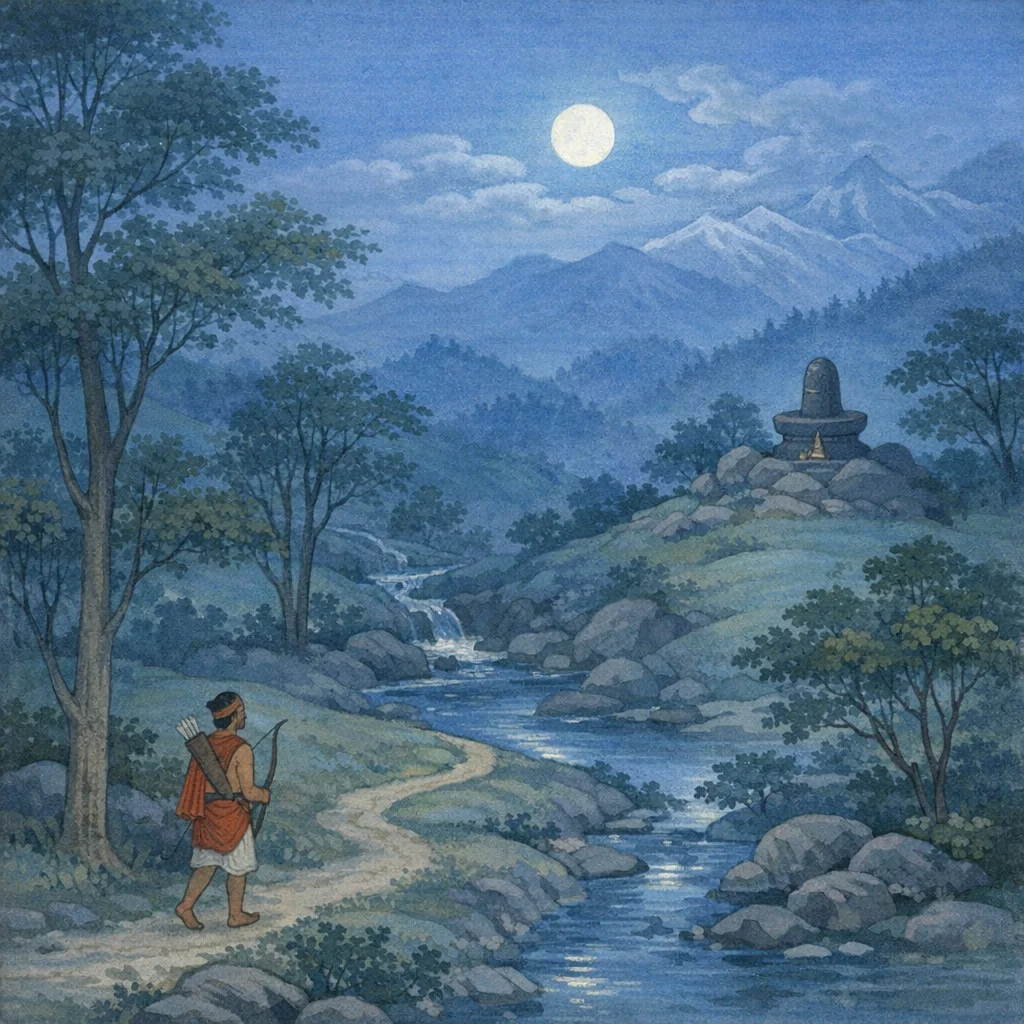
Niṣādasya Bhillasya Itihāsaḥ — Śivarātri-vrata-prabhāvaḥ (The Hunter’s Account and the Efficacy of the Śivarātri Observance)
This chapter begins with the ṛṣis asking Sūta to explain in full the “uttama-vrata” mentioned earlier—who first performed it, and what supreme fruit is gained even when it is observed unknowingly (ajñānataḥ). Sūta replies with an ancient itihāsa about a niṣāda/bhilla hunter whose life is steeped in violence, theft, and the absence of auspicious deeds. A decisive turn comes in ritual time: Śivarātri arrives without the hunter’s awareness. Driven by his family’s hunger, he enters the forest to hunt; yet by the working of fate (daiva-yoga) he finds no prey as the sun sets, and he is overcome with distress. The inner teaching reveals the saving logic of Śaiva ritual temporality: mere contact with Śivarātri—through circumstances that bring wakefulness, restraint, and nearness to Śiva’s sacred order—can become a means of pāpa-kṣaya (destruction of sin) and spiritual uplift, showing Purāṇic anugraha (grace) operating through the vrata’s structure rather than prior moral qualification.
Shlokas
Verse 1
ऋषय ऊचुः । सूत ते वचनं श्रुत्वा परानन्दं वयं गताः । विस्तरात्कथय प्रीत्या तदेव व्रतमुत्तमम्
The sages said: “O Sūta, on hearing your words we have attained supreme bliss. Please, out of affection, narrate in detail that very excellent vow—this highest observance (vrata).”
Verse 2
कृतं पुरा तु केनेह सूतैतद्व्रतमुत्तमम् । कृत्वाप्यज्ञानतश्चैव प्राप्तं किं फलमुत्तमम्
“Who, in former times, performed this excellent vow here, O Sūta? And even if it is undertaken unknowingly, what supreme fruit is obtained from performing it?”
Verse 3
सूत उवाच । श्रूयतामृषयस्सर्वे कथयामि पुरातनम् । इतिहासं निषादस्य सर्वपापप्रणाशनम्
Sūta said: “O sages, all of you, listen. I shall narrate an ancient account—the story of a Niṣāda—which brings about the destruction of all sins.”
Verse 4
पुरा कश्चिद्वने भिल्लो नाम्ना ह्यासीद्गुरुद्रुहः । कुटुम्बी बलवान्क्रूरः क्रूरकर्मपरायणः
Long ago, in a forest, there lived a Bhilla (tribal hunter) by name Gurudruha. He was a householder, strong and fierce, ever devoted to cruel deeds.
Verse 5
निरन्तरं वने गत्वा मृगान्हन्ति स्म नित्यशः । चौर्य्यं च विविधं तत्र करोति स्म वने वसन्
He would go ceaselessly into the forest and, day after day, kill deer; and dwelling there in the woods, he would also commit theft of many kinds.
Verse 6
बाल्यादारभ्य तेनेह कृतं किंचिच्छुभं नहि । महान्कालो व्यतीयाय वने तस्य दुरात्मनः
From childhood onward, he had not performed even the slightest auspicious deed in this world. A long span of time passed for that wicked-minded one, dwelling in the forest.
Verse 7
कदाचिच्छिवरात्रिश्च प्राप्तासीत्तत्र शोभना । न दुरात्मा स्म जानाति महद्वननिवासकृत्
Once, the auspicious Night of Śiva—Śivarātri—arrived there in all its splendor; yet that evil-minded one, dwelling in the great forest, did not recognize its sacredness.
Verse 8
एतस्मिन्समये भिल्लो मात्रा पित्रा स्त्रिया तथा । प्रार्थितश्च क्षुधाऽविष्टैर्भक्ष्यं देहि वनेचर
At that very time, the Bhilla, a dweller of the forest, was entreated by his mother, his father, and likewise by his wife—tormented by hunger—saying, “O ranger of the woods, give us something to eat.”
Verse 9
इति संप्रार्थितः सोऽपि धनुरादाय सत्वरम् । जगाम मृगहिंसार्थं बभ्राम सकलं वनम्
Thus entreated, he swiftly took up his bow and went forth to hunt deer; roaming about, he wandered through the entire forest.
Verse 10
दैवयोगात्तदा तेन न प्राप्तं किंचिदेव हि । अस्तप्राप्तस्तदा सूर्यस्स वै दुःखमुपागतः
By the mere turn of destiny, he obtained nothing at all at that time. And as the sun was about to set, he indeed fell into sorrow.
Verse 11
किं कर्तव्यं क्व गंतव्यं न प्राप्तं मेऽद्य किंचन । बालाश्च ये गृहे तेषां किं पित्रोश्च भविष्यति
“What am I to do now, and where should I go? Today I have obtained nothing at all. And those little children who are at home—what will become of them, and what will become of their parents?”
Verse 12
मदीयं वै कलत्रं च तस्याः किंचिद्भविष्यति । किंचिद्गृहीत्वा हि मया गंतव्यं नान्यथा भवेत्
“She is indeed my wife, and some share of her wealth belongs to me. Therefore I must depart only after taking something; it cannot be otherwise.”
Verse 13
इत्थं विचार्य स व्याधो जलाशय समीपगः । जलावतरणं यत्र तत्र गत्वा स्वयं स्थितः
Having reflected in this way, the hunter went near the reservoir of water. Going to the spot where there was a descent into the water, he stationed himself there.
Verse 14
अवश्यमत्र कश्चिद्वै जीवश्चैवागमिष्यति । तं हत्वा स्वगृहं प्रीत्या यास्यामि कृतकार्यकः
“Surely some living being will come here. Having slain him, I shall return to my own house with satisfaction, my purpose accomplished.”
Verse 15
इति मत्वा स वै वृक्षमेकं बिल्वेतिसंज्ञकम् । समारुह्य स्थितस्तत्र जलमादाय भिल्लकः
Thinking thus, Bhillaka climbed a certain tree known as the bilva and remained stationed there, taking water in his hand.
Verse 16
कदा यास्यति कश्चिद्वै कदा हन्यामहं पुनः । इति बुद्धिं समास्थाय स्थितोऽसौ क्षुत्तृषान्वितः
Thinking, “When will someone come? When shall I strike again?”, he stood there with his mind fixed on that resolve, afflicted by hunger and thirst.
Verse 17
तद्रात्रौ प्रथमे यामे मृगी त्वेका समागता । तृषार्ता चकिता सा च प्रोत्फालं कुर्वती तदा
That night, in the first watch, a single doe came there. Tormented by thirst and startled with fear, she began to leap about restlessly at that time.
Verse 18
तां दृष्ट्वा च तदा तेन तद्वधार्थमथो शरः । संहृष्टेन द्रुतं विष्णो धनुषि स्वे हि संदधे
Seeing her then, Viṣṇu—delighted and acting swiftly—set an arrow upon his own bow, intent on slaying her.
Verse 19
इत्येवं कुर्वतस्तस्य जलं बिल्वदलानि च । पतितानि ह्यधस्तत्र शिवलिंगमभूत्ततः
As he continued thus, the water and the bilva leaves fell down below; and there, from that very spot, a Śiva-liṅga manifested.
Verse 20
यामस्य प्रथमस्यैव पूजा जाता शिवस्य च । तन्महिम्ना हि तस्यैव पातकं गलितन्तदा
During the very first watch of the night, worship of Lord Śiva was performed. By the sheer glory of that worship, his sin melted away at once.
Verse 21
तत्रत्यं चैव तच्छब्दं श्रुत्वा सा हरिणी भिया । व्याधं दृष्ट्वा व्याकुला हि वचनं चेदमब्रवीत्
Hearing that sound there, the doe became afraid. Seeing the hunter, she grew agitated and spoke these words.
Verse 22
मृग्युवाच । किं कर्तुमिच्छसि व्याध सत्यं वद ममाग्रतः । तच्छुत्वा हरिणीवाक्यं व्याधो वचनमब्रवीत्
The doe said: “Hunter, what do you wish to do? Speak the truth before me.” Having heard the words of the doe, the hunter then replied.
Verse 23
कुटुम्बं पोषितं नित्यं कृत्वा पापान्यनेकशः । एवं पापानि हा कृत्वा का गतिर्मे भविष्यति
“I have continually maintained my family, and in doing so I have committed many sins. Alas—having wrought such sinful deeds, what destiny will befall me?”
Verse 24
किं करोमि क्व गच्छामि ह्युपायं रचयाम्यहम् । इत्थं विचार्यं सा तत्र वचनं चेदमब्रवीत्
“What shall I do? Where shall I go? Indeed, how can I devise a means (to proceed)?” Thinking thus, she then spoke these words there.
Verse 25
मृग्युवाच । मन्मांसेन सुखं ते स्याद्देहस्यानर्थकारिणः । अधिकं किं महत्पुण्यं धन्याहं नात्र संशयः
Mṛgī said: “May you find satisfaction through my flesh—though this body is but a maker of misfortune. What greater, lofty merit could there be? Blessed am I—of this there is no doubt.”
Verse 27
परं तु शिशवो मेऽद्य वर्तंते स्वाश्रमेऽखिलाः । भगिन्यै तान्समर्प्यैव प्रायास्ये स्वामिनेऽथ वा
Yet all my children are now in my own hermitage. Having entrusted them to my sister, I shall depart—indeed, I will go to my Lord.
Verse 28
न मे मिथ्यावचस्त्वं हि विजानीहि वनेचर । आयास्येह पुनश्चेह समीपं ते न संशयः
Know for certain, O forest-dweller, that my words are not false. I shall come here again, and I shall indeed return to your presence—of this there is no doubt.
Verse 29
स्थिता सत्येन धरणी सत्येनैव च वारिधिः । सत्येन जलधाराश्च सत्ये सर्वम्प्रतिष्ठितम्
By Truth the earth stands firm; by Truth indeed the ocean endures. By Truth the streams of water flow—upon Truth everything in the world is established.
Verse 30
सूत उवाच । इत्युक्तोऽपि तया व्याधो न मेने तद्वचो यदा । तदा सुविस्मिता भीता वचनं साब्रवीत्पुनः
Sūta said: Though she spoke to him thus, when the hunter did not accept her words, she—utterly astonished and afraid—spoke again.
Verse 31
मृग्युवाच । शृणु व्याध प्रवक्ष्यामि शपथं हि करोम्यहम् । आगच्छेयं यथा ते न समीपं स्वगृहाद्गता
The doe said: “Listen, O hunter; I shall declare it—I swear an oath. May I not return to your presence from my own home.”
Verse 32
ब्राह्मणो वेदविक्रेता सन्ध्याहीनस्त्रिकालकम् । स्त्रियस्स्वस्वामिनो ह्याज्ञां समुल्लंघ्य क्रियान्विताः
A brāhmaṇa who sells the Vedas, one who neglects the three daily Sandhyā rites, and women who, though engaged in religious acts, transgress the command of their own husbands—these are declared as offenders against proper dharma.
Verse 33
कृतघ्ने चैव यत्पापं तत्पापं विमुखे हरे । द्रोहिणश्चैव यत्पापं तत्पापं धर्मलंघने
Whatever sin belongs to one who is ungrateful—that very sin falls upon the person who turns away from Lord Hara (Śiva). And whatever sin belongs to a betrayer—that very sin falls upon the one who transgresses dharma.
Verse 34
विश्वासघातके तच्च तथा वै छलकर्तरि । तेन पापेन लिम्पामि यद्यहं नागमे पुनः
“If I do not return again, then may I be stained by that very sin—of betraying trust and of deceitful conduct.”
Verse 35
इत्याद्यनेकशपथान्मृगी कृत्वा स्थिता यदा । तदा व्याधस्य विश्वस्य गच्छेति गृहमब्रवीत्
After making him swear many oaths in this manner, she remained there, having taken the form of a doe. Then she said to that hunter Viśva, “Go home.”
Verse 36
मृगी हृष्टाजलं पीत्वा गता स्वाश्रममण्डलम् । तावच्च प्रथमो यामस्तस्य निद्रां विना गतः
Having joyfully drunk the water, the doe went back to the precincts of her own hermitage. Meanwhile, the first watch of the night passed for him without any sleep.
Verse 37
तदीया भगिनी या वै मृगी च परिभाविता । तस्या मार्गं विचिन्वन्ती ह्याजगाम जलार्थिनी
Then her sister—indeed the doe—who had been distressed, came seeking water, searching about for her path.
Verse 38
तां दृष्ट्वा च स्वयं भिल्लोऽकार्षीद्बाणस्य कर्षणम् । पूर्ववज्जलपत्राणि पतितानि शिवोपरि
On seeing her, the hunter himself drew back his arrow. Just as before, the water-soaked leaves fell upon Śiva.
Verse 39
यामस्य च द्वितीयस्य तेन शंभोर्महात्मनः । पूजा जाता प्रसंगेन व्याधस्य सुखदायिनी
Then, during the second yāma, by a providential turn of events, that hunter worshiped the great-souled Lord Śambhu, and that worship became for him a source of joy and spiritual merit.
Verse 40
मृगी सा प्राह तं दृष्ट्वा किं करोषि वनेचर । पूर्ववत्कथितं तेन तच्छ्रुत्वाह मृगी पुनः
Seeing him, the doe said, “O dweller of the forest, what are you doing?” He replied just as before; and hearing his words, the doe spoke again.
Verse 41
मृग्युवाच । धन्याहं श्रूयतां व्याध सफलं देहधारणम् । अनित्येन शरीरेण ह्युपकारो भविष्यति
The doe said, “Blessed am I. Listen, O hunter—my bearing of this body has become fruitful. Even with this impermanent body, a sacred service and benefit will now be accomplished.”
Verse 42
परन्तु मम बालाश्च गृहे तिष्ठन्ति चार्भकाः । भर्त्रे तांश्च समर्प्यैव ह्यागमिष्याम्यहं पुनः
“However, my young children are at home—still only little ones. After entrusting them to my husband, I shall return here again.”
Verse 43
व्याध उवाच । त्वया चोक्तं न मन्येहं हन्मि त्वां नात्र संशयः । तच्छुत्वा हरिणी प्राह शपथं कुर्वती हरे
The hunter said: “I do not accept what you have said. I will kill you—of this there is no doubt.” Hearing that, the doe spoke, making a solemn oath: “O hunter.”
Verse 44
मृग्युवाच । शृणु व्याध प्रवक्ष्यामि नागच्छेयं पुनर्यदि । वाचा विचलितो यस्तु सुकृतं तेन हारितम्
The doe said: “Listen, O hunter—I shall speak. If I do not return again, know this: whoever wavers through speech and breaks his pledged word, by him his stored-up merit is squandered away.”
Verse 45
परिणीता स्त्रियं हित्वा गच्छत्यन्यां च यः पुमान् । वेदधर्मं समुल्लंघ्य कल्पितेन च यो व्रजेत्
That man who abandons his lawfully wedded wife and goes to another woman, and who—overstepping the Vedic rule of dharma—acts by notions of his own making, strays from the ordained path and falls into adharma.
Verse 46
विष्णुभक्तिसमायुक्तः शिवनिन्दां करोति यः । पित्रोः क्षयाहमासाद्य शून्यं चैवाक्रमेदिह
Whoever, even while devoted to Viṣṇu, engages in reviling Śiva—when the decline of his ancestral line befalls him, he comes to ruin here itself and falls into emptiness, a spiritual barrenness.
Verse 47
कृत्वा च पारतापं हि करोति वचनं पुनः । तेन पापेन लिंपामि नागच्छेयं पुनर्यदि
“Having indeed committed this grievous wrongdoing, he speaks again with assurances. By that very sin I am defiled—if I were to go there again.”
Verse 48
सूत उवाच । इत्युक्तश्च तया व्याधो गच्छेत्याह मृगीं च सः । सा मृगी च जलं पीत्वा हृष्टाऽगच्छत्स्वमाश्रमम्
Sūta said: Thus addressed by her, the hunter told the doe, “Go.” And the doe, having drunk the water, went joyfully back to her own āśrama (hermitage).
Verse 49
तावद्द्वितीयो यामो वै तस्य निद्रां विना गतः । एतस्मिन्समये तत्र प्राप्ते यामे तृतीयके
Thus, for him the second watch of the night passed without sleep. And at that very time, when the third watch arrived there, the next event unfolded.
Verse 50
ज्ञात्वा विलंबं चकितस्तदन्वेषणतत्परः । तद्यामे मृगमद्राक्षीज्जलमार्गगतं ततः
Realizing the delay, and struck with concern, he became intent on searching. Then, at that very watch of the night, he saw the deer moving along a watery course, like a stream-path.
Verse 51
पुष्टं मृगं च तं दृष्ट्वा हृष्टो वनचरस्स वै । शरं धनुषि संधाय हन्तुं तं हि प्रचक्रमे
Seeing that well-nourished deer, the forest-dweller became delighted. Fitting an arrow to his bow, he at once set about to kill it.
Verse 52
तदैवं कुर्वतस्तस्य बिल्वपत्राणि कानिचित् । तत्प्रारब्धवशाद्विष्णो पतितानि शिवोपरि
Just then, as he was doing so, a few bilva leaves—impelled by the force of that destined course of events—fell from Viṣṇu and landed upon Śiva.
Verse 53
तेन तृतीययामस्य तद्रात्रौ तस्य भाग्यतः । पूजा जाता शिवस्यैव कृपालुत्वं प्रदर्शितम्
By his good fortune, during that night in the third watch, the worship of Lord Śiva was performed; and thereby Śiva’s compassion was clearly revealed.
Verse 54
श्रुत्वा तत्र च तं शब्दं किं करोषीति प्राह सः । कुटुम्बार्थमहं हन्मि त्वां व्याधश्चेति सोब्रवीत्
Hearing that sound there, he said, “What are you doing?” The hunter replied, “For the sake of my family, I kill—you too—because I am a hunter.”
Verse 55
तच्छ्रुत्वा व्याधवचनं हरिणो हृष्टमानसः । द्रुतमेव च तं व्याधं वचनं चेदमब्रवीत्
Hearing the hunter’s words, the deer became joyful at heart. Without delay, he addressed that hunter and spoke these words.
Verse 56
हरिण उवाच । धन्योहं पुष्टिमानद्य भवत्तृप्तिर्भविष्यति । यस्यांगं नोपकाराय तस्य सर्वं वृथा गतम्
Hariṇa said: “Blessed am I, and today I am truly nourished—your hunger shall be satisfied. For the body of one that is not employed for the good of others, everything is wasted and in vain.”
Verse 57
यो वै सामर्थ्ययुक्तश्च नोपकारं करोति वै । तत्सामर्थ्यं भवेद्व्यर्थं परत्र नरकं व्रजेत्
One who is endowed with ability yet does not render help—indeed, that very ability becomes fruitless; and hereafter, such a person goes to hell.
Verse 58
परन्तु बालकान् स्वांश्च समर्प्य जननीं शिशून् । आश्वास्याप्यथ तान् सर्वानागमिष्याम्यहं पुनः
“But first, having entrusted my own children—those infants—to their mother, and having comforted them all, I shall return again.”
Verse 59
इत्युक्तस्तेन स व्याधो विस्मितोतीव चेतसि । मनाक् शुद्धमनानष्टपापपुंजो वचोऽब्रवीत्
Thus addressed by him, the hunter became deeply astonished in his heart. His mind grew somewhat purified, his heap of sins began to dissolve, and he then spoke these words.
Verse 60
व्याध उवाच । ये ये समागताश्चात्र तेते सर्वे त्वया यथा । कथयित्वा गता ह्यत्र नायान्त्यद्यापि वंचकाः
The hunter said: “All those who came here—each and every one—have been spoken to by you, as is fitting, and then they went away. Yet even now those deceivers do not return here.”
Verse 61
त्वं चापि संकटे प्राप्तो व्यलीकं च गमिष्यसि । मम सञ्जीवनं चाद्य भविष्यति कथं मृग
You too have fallen into peril and will be brought to shame. And how, O deer, can my reviving—my return to life—happen today?
Verse 62
मृग उवाच । शृणु व्याध प्रवक्ष्यामि नानृतं विद्यते मयि । सत्येन सर्वं ब्रह्माण्डं तिष्ठत्येव चराचरम्
The deer said: “Listen, O hunter; I shall speak. There is no falsehood in me. By truth indeed this entire universe—moving and unmoving—stands sustained.”
Verse 63
यस्य वाणी व्यलीका हि तत्पुण्यं गलितं क्षणात् । तथापि शृणु वै सत्यां प्रतिज्ञां मम भिल्लक
He whose speech is false—his merit melts away in an instant. Even so, O Bhillaka, listen to my truthful vow.
Verse 64
सन्ध्यायां मैथुने घस्रे शिवरात्र्यां च भोजने । कूटसाक्ष्ये न्यासहारे संध्याहीने द्विजे तथा
Sexual union at the time of the Sandhyā rites, eating during the daytime on Śivarātri, giving false testimony, misappropriating entrusted deposits, and likewise a twice-born who neglects the Sandhyā worship—these are acts of grave fault in the discipline taught for devotees of Śiva.
Verse 65
शिवहीनं मुखं यस्य नोपकर्ता क्षमोऽपि सन् । पर्वणि श्रीफलस्यैव त्रोटनेऽभक्ष्यभक्षणे
Even if one is otherwise capable, a person whose mouth is devoid of Śiva’s remembrance cannot truly be of help—just as, on an auspicious day, cracking a coconut yet eating what should not be eaten becomes a hollow, improper act.
Verse 66
असंपूज्य शिवं भस्मरहितश्चान्नभुक् च यः । एतेषां पातकं मे स्यान्नागच्छेयं पुनर्यदि
“If I were to eat without first worshipping Lord Śiva, or if I were to partake of food while bereft of the sacred ash (bhasma), then the sin of such acts would fall upon me—may I never return to such a state again.”
Verse 67
शिव उवाच । इति श्रुत्वा वचस्तस्य गच्छ शीघ्रं समाव्रज । स व्याधेनैवमुक्तस्तु जलं पीत्वा गतो मृगः
Śiva said: “Thus, having heard his words—‘Go, return quickly.’” So, when the hunter spoke in this way, the deer drank the water and went away.
Verse 68
ते सर्वे मिलितास्तत्र स्वाश्रमे कृतसुप्रणाः । वृत्तांतं चैव तं सर्वं श्रुत्वा सम्यक् परस्परम्
All of them assembled there in their own hermitage, having formed a firm and auspicious resolve. Then, having properly heard from one another the entire account of those events, they became fully informed.
Verse 69
गन्तव्यं निश्चयेनेति सत्यपाशेन यंत्रिताः । आश्वास्य बालकांस्तत्र गन्तुमुत्कण्ठितास्तदा
Bound fast by the noose of truth—thinking, “We must go there, certainly”—they reassured the children there and, filled with eager longing, made ready to depart.
Verse 70
मृगी ज्येष्ठा च या तत्र स्वामिनं वाक्यमब्रवीत् । त्वां विना बालका ह्यत्र कथं स्थास्यंति वै मृग
There, the eldest doe spoke to her lord: “O stag, without you, how indeed will the little ones remain here and survive?”
Verse 71
प्रथमं तु मया तत्र प्रतिज्ञा च कृता प्रभो । तस्मान्मया च गन्तव्यं भवद्भ्यां स्थीयतामिह
O Lord, first I made a sacred vow there. Therefore I must go; you two should remain here.
Verse 72
इति तद्वचनं श्रुत्वा कनिष्ठा वाक्यमब्रवीत् । अहं त्वत्सेविका चाद्य गच्छामि स्थीयतां त्वया
Hearing those words, the younger one replied: “I am your attendant; today I shall go. You should remain here.”
Verse 73
तच्छ्रुत्वा च मृगः प्राह गम्यते तत्र वै मया । भवत्यौ तिष्ठतां चात्र मातृतः शिशुरक्षणम्
Hearing this, the deer said, “Truly, I shall go there. You two remain here, and from the mother’s side protect the young one.”
Verse 74
तत्स्वामिवचनं श्रुत्वा मेनाते तन्न धर्मतः । प्रोचुः प्रीत्या स्वभर्तारं वैधव्ये जीवितं च धिक्
Hearing her husband’s words, Menā did not accept them as righteous dharma. With affection she spoke to her husband: “Fie upon a life lived in widowhood!”
Verse 75
बालानाश्वास्य तांस्तत्र समर्प्य सहवासिनः । गतास्ते सर्व एवाशु यत्रास्ते व्याधसत्तमः
After consoling the children and entrusting them there to their co-dwellers’ care, they all hurried at once to the place where the foremost of hunters was staying.
Verse 76
ते बाला अपि सर्वे वै विलोक्यानुसमागताः । एतेषां या गतिः स्याद्वै ह्यस्माकं सा भवत्विति
Even the children, having seen what had occurred, all gathered together and said: “Whatever destiny—whatever spiritual end—may befall these devotees, may that very same state become ours as well.”
Verse 77
तान् दृष्ट्वा हर्षितो व्याधो बाणं धनुषि संदधे । पुनश्च जलपत्राणि पतितानि शिवोपरि
Seeing them, the hunter rejoiced and set an arrow upon his bow. And once again, water-soaked leaves fell down upon Śiva (from above Him).
Verse 78
तेन जाता चतुर्थस्य पूजा यामस्य वै शुभा । तस्य पापन्तदा सर्वं भस्मसादभवत् क्षणात्
By that act, the auspicious worship of the fourth yāma (watch of the night) was duly fulfilled; and at that very moment all his sins were instantly reduced to ashes.
Verse 79
मृगी मृगी मृगश्चोचुश्शीघ्रं वै व्याधसत्तम । अस्माकं सार्थकं देहं कुरु त्वं हि कृपां कुरु
The doe, the she-deer, and the stag cried out: “Quickly, O best of hunters! Show compassion; make our bodies meaningful—grant us your mercy.”
Verse 80
शिव उवाच । इति तेषां वचश्श्रुत्वा व्याधो विस्मयमागतः । शिवपूजाप्रभावेण ज्ञानं दुर्लभमाप्तवान्
Lord Śiva said: “Thus, having heard their words, the hunter was filled with wonder; and by the power of worshipping Śiva, he attained that rare jñāna—spiritual knowledge difficult to obtain.”
Verse 81
एते धन्या मृगाश्चैव ज्ञानहीनास्सुसंमताः । स्वीयेनैव शरीरेण परोपकरणे रताः
Blessed indeed are these deer—though devoid of doctrinal learning, they are truly admirable—for with their very bodies they remain devoted to serving the welfare of others.
Verse 82
मानुष्यं जन्म संप्राप्य साधितं किं मयाधुना । परकायं च संपीड्य शरीरं पोषितं मया
“Having attained a human birth, what spiritual attainment have I achieved even now? By afflicting another’s body, I have merely nourished my own body.”
Verse 84
कां वा गतिं गमिष्यामि पातकं जन्मतः कृतम् । इदानीं चिंतयाम्येवं धिग्धिक् च जीवनं मम
“What destiny will I ever reach, when sin has been committed by me from birth? Now I reflect thus—fie, fie upon my very life.”
Verse 85
इति ज्ञानं समापन्नो बाणं संवारयंस्तदा । गम्यतां च मृगश्रेष्ठा धन्याः स्थ इति चाब्रवीत्
Thus having attained true understanding, he then restrained his arrow and said, “Go your way, O best of deer; you are blessed.”
Verse 86
शिव उवाच । इत्युक्ते च तदा तेन प्रसन्नश्शंकरस्तदा । पूजितं च स्वरूपं हि दर्शयामास संमतम्
Śiva said: When he had spoken thus, Śaṅkara was pleased. Then, being duly worshipped, the Lord revealed His own gracious and approved form.
Verse 87
संस्पृश्य कृपया शंभुस्तं व्याधं प्रीतितोऽब्रवीत् । वरं ब्रूहि प्रसन्नोऽस्मि व्रतेनानेन भिल्लक
Moved by compassion, Śambhu (Lord Śiva) touched that hunter and joyfully said: “Speak your boon. By this observance, O Bhillaka, I am pleased with you.”
Verse 88
व्याधोऽपि शिवरूपं च दृष्ट्वा मुक्तोऽभवत्क्षणात् । पपात शिवपादाग्रे सर्वं प्राप्तमिति बुवन्
Even the hunter, upon beholding Śiva’s very form, was liberated in an instant. Falling at the forefront of Śiva’s feet, he spoke: “I have attained everything.”
Verse 89
शिवोऽपि सुप्रन्नात्मा नाम दत्वा गुहेति च । विलोक्य तं कृपादृष्ट्या तस्मै दिव्यान्वरानदात्
Śiva too, being wholly gracious in nature, bestowed upon him the name “Suprannātmā” and also called him “Guha.” Then, looking upon him with a compassionate glance, He granted him divine boons.
Verse 90
शिव उवाच । शृणु व्याधाद्य भोगांस्त्वं भुंक्ष्व दिव्यान्यथेप्सितान् । राजधानीं समाश्रित्य शृंगवेरपुरे पराम्
Śiva said: “Listen, O hunter. From today onward, enjoy celestial pleasures according to your desire, taking refuge in that supreme royal city at Śṛṅgaverapura.”
Verse 91
अनपाया वंशवृद्धिश्श्लाघनीयः सुरैरपि । गृहे रामस्तव व्याध समायास्यति निश्चितम्
O hunter, your lineage will increase without decline—worthy of praise even by the gods. And it is certain that Rāma will come to your home.
Verse 92
करिष्यति त्वया मैत्री मद्भक्तस्नेहकारकः । मत्सेवासक्तचेतास्त्वं मुक्तिं यास्यसि दुर्लभाम्
Through you, friendship shall be established—one that awakens tender love for My devotees. With your mind devoted to My service, you shall attain that liberation (mokṣa) which is difficult to obtain.
Verse 93
एतस्मिन्नंतरे ते तु कृत्वा शंकरदर्शनम् । सर्वे प्रणम्य सन्मुक्तिं मृगयोनेः प्रपेदिरे
Meanwhile, having obtained the blessed vision of Śaṅkara, they all bowed down in reverence and attained true liberation—being released from rebirth in the womb of an animal.
Verse 94
विमानं च समारुह्य दिव्यदेहा गतास्तदा । शिवदर्शनमात्रेण शापान्मुक्ता दिवं गताः
Then they mounted a celestial vimāna and went forth with radiant, divine bodies. By the mere darśana of Lord Śiva, they were freed from the curse and ascended to heaven.
Verse 95
व्याधेश्वरः शिवो जातः पर्वते ह्यर्बुदाचले । दर्शनात्पूजनात्सद्यो भुक्तिमुक्तिप्रदायकः
On the Arbuda mountain, Lord Śiva manifested as Vyādheśvara. By merely beholding Him and worshipping Him, one quickly attains both bhukti (worldly fulfillment) and mukti (liberation).
Verse 96
व्याधोपि तद्दिनान्नूनं भोगान्स सुरसत्तम । भुक्त्वा रामकृपां प्राप्य शिवसायुज्यमाप्तवान्
Even that hunter, O best of the gods, on that very day surely enjoyed heavenly delights; and, having attained the grace of Rāma, he obtained śiva-sāyujya—liberating union with Śiva.
Verse 97
अज्ञानात्स व्रतञ्चैतत्कृत्वा सायुज्यमाप्तवान् । किं पुनर्भक्तिसंपन्ना यान्ति तन्मयतां शुभाम्
Even performed unknowingly, he undertook this vow and attained sāyujya—union with Śiva. How much more, then, do those endowed with devotion attain the auspicious state of tanmayatā, complete absorption in Him.
Verse 98
विचार्य्य सर्वशास्त्राणि धर्मांश्चैवाप्यनेकशः । शिवरात्रिव्रतमिदं सर्वोत्कृष्टं प्रकीर्तितम्
Having duly examined all the śāstras and the many paths of dharma, this vow of Śivarātri is proclaimed to be the most excellent of all.
Verse 99
व्रतानि विविधान्यत्र तीर्थानि विविधानि च । दानानि च विचित्राणि मखाश्च विविधास्तथा
Here there are many kinds of sacred vows and many kinds of holy pilgrimage-places; there are also wondrous forms of charitable giving, and likewise many varieties of sacrificial rites.
Verse 100
तपांसि विविधान्येव जपाश्चैवाप्य नेकशः । नैतेन समतां यान्ति शिवरात्रिव्रतेन च
Even diverse austerities and countless forms of japa do not attain equality with the vow of Śivarātri; they do not match the merit and spiritual efficacy of observing the Śivarātri vrata.
Verse 101
तस्माच्छुभतरं चैतत्कर्तव्यं हितमीप्सुभिः । शिवरात्रिव्रतन्दिव्यं भुक्ति मुक्तिप्रदं सदा
Therefore, those who seek true welfare should certainly observe this supremely auspicious practice—the divine vow of Śivarātri—for it ever bestows both worldly enjoyment and final liberation.
Verse 102
एतत्सर्वं समाख्यातं शिवरात्रिव्रतं शुभम् । व्रतराजेति विख्यातं किमन्यच्छ्रोतुमिच्छसि
Thus I have fully explained the auspicious vow of Śivarātri, renowned as the king of vows. What else do you wish to hear?
Frequently Asked Questions
The chapter advances a theological argument via an itihāsa: a morally compromised hunter becomes the narrative test-case to show that Śivarātri-vrata possesses intrinsic purificatory efficacy, such that even inadvertent alignment with its disciplines can generate transformative merit.
The forest (vana) represents unmanaged instinctual life, while the arrival of Śivarātri functions as sacral time interrupting ordinary karma. ‘Daiva-yoga’ signals providential convergence, and the hunter’s enforced restraint and wakefulness (implied by the night setting and failed hunt) model how vrata-structure can redirect agency from harm to purification.
Rather than emphasizing a named iconographic form, the adhyāya highlights Śiva’s functional manifestation as Vrata-adhīśa—the lord who becomes accessible through Śivarātri’s ritual-temporal presence—foregrounding grace and purification over visual theophany.