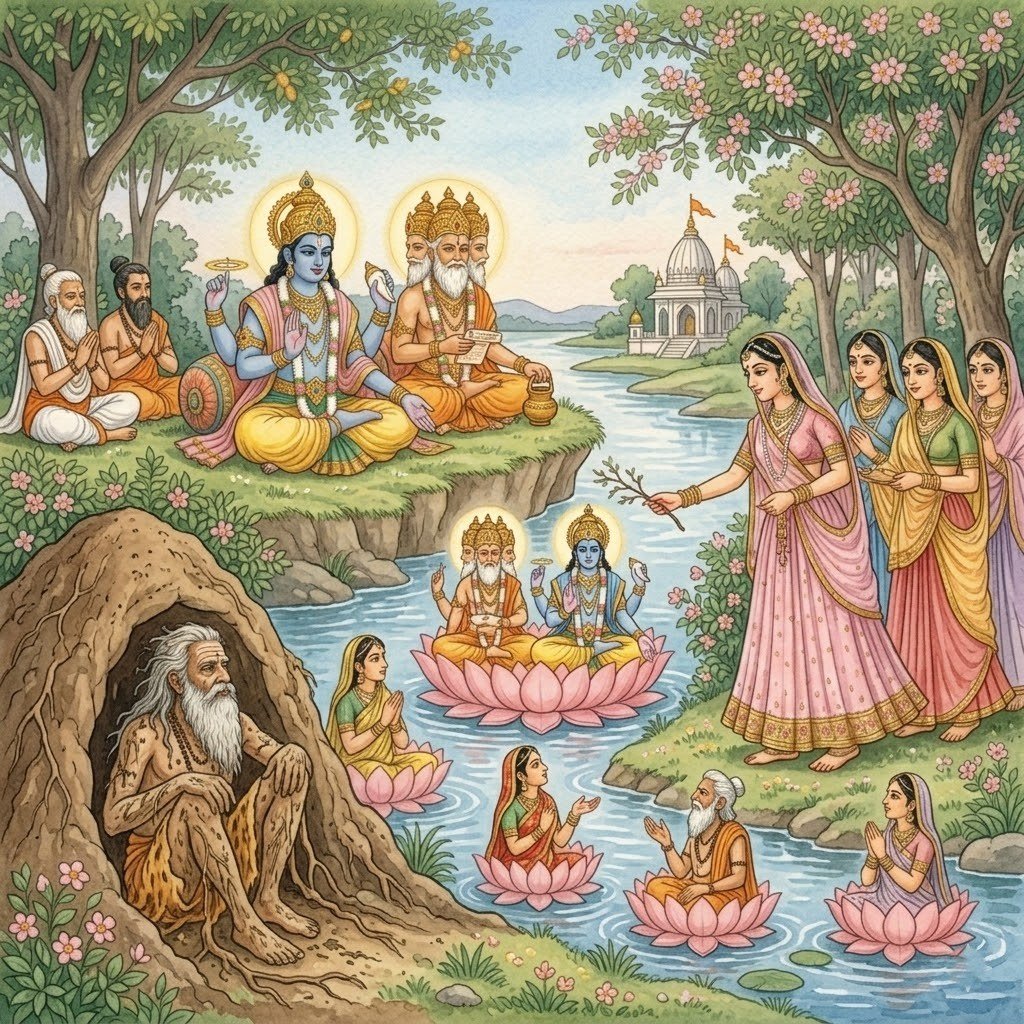
Book of the Earth (Sacred Geography & Moral Narratives)
The Section on the Earth
The Bhūmi-khaṇḍa of the Padma Purāṇa frames dharma on an “earthly” stage: sacred places, social duties, and exemplary narratives that translate theology into lived conduct. Rather than offering cosmogenesis alone, it maps merit (puṇya) onto geography and relationships—especially the ethics of family obligation, gifts (dāna), vows (vrata), and pilgrimage (tīrtha-yātrā). Sacred sites such as Dvārakā become moral coordinates where devotion is practiced and tested. Its storytelling often unfolds through layered transmissions (Sūta to the sages; or older authorities such as Vyāsa and Brahmā), validating variant traditions and reconciling doubts. Theologically, it binds bhakti to concrete dharma: devotion is proven through duty to parents, teachers, ancestors (pitṛs), and guests, while Viṣṇu’s grace remains the final horizon of liberation. A distinctive feature is its parable-like episodes—sometimes severe or paradoxical—meant to sharpen discernment between true righteousness and mere ritualism. In this chapter-unit, the narrative pivots between Prahlāda’s Vaiṣṇava identity as a model of innate devotion and the “Śivaśarmā” episode, where filial obedience, māyā (illusion), and sacrificial self-offering become a moral crucible.
Adhyayas in Bhumi Khanda
Adhyaya 1
Prologue to the Śivaśarmā Narrative with the Prahlāda Tradition (Variant-Resolution Frame)
The chapter begins with the sages presenting Sūta a doctrinal doubt: why Purāṇic hearings differ regarding Prahlāda and the attainment of the Vaiṣṇava state. To settle the conflict, the text appeals to authorized transmission—Brahmā (Vedhas) spoke to Vyāsa, and Vyāsa’s account, recited by Sūta, clarifies the matter. The narration then turns to an exemplum concerning Śivaśarmā of Dvārakā and his five sons—Yajñaśarman, Vedaśarman, Dharmaśarmā, Viṣṇuśarmā, and Somaśarmā—each learned in śāstra and marked by distinct devotional leanings, especially strong pitṛ-bhakti. Through māyā-based stratagems, Śivaśarmā tests and redirects their devotion, intensifying the filial ordeal. At its height, Vedaśarman is drawn into a demand that culminates in self-decapitation as an extreme proof of obedience and debt-release. The episode frames the moral inquiry to follow: what true dharma is when bhakti, illusion, and violence intersect, and how devotion and duty are ranked within Purāṇic ethics.
Adhyaya 2
The Account of Śivaśarman (Dharmaśarmā’s Tapas, Dharma’s Boon, and the Amṛta Mission)
The chapter centers on Dharmaśarmā’s urgent resolve, empowered by truth and sustained tapas, which draws near personified Dharma and brings about a direct exchange. Dharma affirms the potency of self-restraint, purity, truthfulness, and austerity, and grants the boon that Dharmaśarmā’s brother Vedaśarmā will regain life. A petitioner’s prayer then links dharma with bhakti: devotion at a father’s feet, delight in righteousness, and finally mokṣa—revealing a hierarchy of aims (bhakti → dharma → liberation). When Vedaśarmā rises and speaks, the brothers return to their father, Śivaśarmā. A new tension follows: Śivaśarmā, absorbed in thought and longing for disease-destroying amṛta, commands Viṣṇuśarmā to go to Indra’s realm and fetch the nectar, setting the next movement of the narrative in motion.
Adhyaya 3
The Narrative of Śivaśarman: Indra’s Obstacles, Menakā’s Mission, and the Triumph of Pitṛ-Devotion
As Viṣṇuśarmā journeys toward Indra’s realm to seek help for his father Śivaśarman, Indra—afraid of ascetic power—sends the apsaras Menakā to obstruct him. In Nandana she appears, sings seductively, and begs for refuge, but Viṣṇuśarmā recognizes Indra’s snare and departs, declaring that the conquest of desire must stand at the very beginning of tapas. Again and again obstacles and terrifying forms arise, yet they are dissolved by the brāhmaṇa’s tejas. Enraged, Viṣṇuśarmā threatens to depose Indra; Indra submits, praises his steadfast devotion to his father, and grants amṛta and the boon of unwavering pitṛ-bhakti. The nectar restores well-being, and the household discourse extols virtuous sons and the dignity of mothers. At last Viṣṇu, bearing conch, discus, and mace, arrives upon Garuḍa; the four sons attain a Vaiṣṇava form and enter the supreme abode. The further glory of Somaśarman is also proclaimed.
Adhyaya 4
The Episode of Śivaśarmā: Testing Somaśarmā through Service and Truth
Śivaśarmā entrusts Somaśarmā with a pot of “amṛta” (nectar) and departs for pilgrimage and austerity. In time he returns to test his son through māyā, appearing as a leper in misery and displaying distressing forms meant to shake his resolve. Somaśarmā answers with compassion and unwavering guru-sevā: he cleans impurities, carries and removes filth, arranges tīrtha-bathing, offerings, and daily honors. Even when harshly rebuked and struck by his father, he remains free of anger and continues his service. When the pot seems emptied by illusion, Somaśarmā invokes satya and the truth of his devoted conduct. By the power of truth and dharma, the vessel fills again, revealing that inner integrity and faithful service—under Viṣṇu’s grace—overcome affliction and restore auspiciousness.
Adhyaya 5
The Consecration (Anointing) of Indra
PP.2.5 weaves together two arcs: a teaching on liberation and a theological legitimation of Indra’s kingship. It declares that the rare Vaiṣṇava abode is not won by austerity alone; samādhi and true knowledge reach fulfillment only through Viṣṇu’s grace. Somaśarman’s tapas at Śāligrāma, his fear at death, and his karmic rebirth in an Asura line are recounted, followed by the recovery of insight when he is born as Prahlāda, remembering the earlier Śivaśarman narrative. Nārada consoles Prahlāda’s mother Kamalā with a prophecy of rebirth and eventual rise to Indra-status. The sages then ask how Indra’s sovereignty began; Sūta explains that after the Devas’ victory over the Asuras, the gods petition Mādhava. Viṣṇu ordains a devotee’s ascent as Aditi’s son Suvrata/Vasudatta, lists Indra’s epithets, and narrates the birth celebrations and the formal abhiṣeka that establishes cosmic stability under Vaiṣṇava sanction.
Adhyaya 6
Diti’s Lament (On the Fall of the Daityas and the Futility of Grief)
Danu approaches Diti, bowed down with grief, offers reverence, and asks why a mother of many sons laments so bitterly. Their dialogue turns to the Devas–Asuras conflict: Aditi’s boon is fulfilled, Indra’s sovereignty is secured for her son, and the splendor of the Daityas and Dānavas fades. A war account follows in which Viṣṇu, bearing discus and conch, destroys the demon hosts—like fire consuming dry grass, like moths perishing in flame. Diti collapses in sorrow, but a consoling, instructive voice reframes the loss as the fruit of adharma and one’s own fault, warning that grief diminishes merit and obstructs liberation, and urging her to return to composure and happiness.
Adhyaya 7
Self-Knowledge and the Allegory of the Five Elements & Senses (Karma, Association, and Rebirth)
The chapter begins with grief and the breaking of worldly ties, then turns to metaphysical consolation: Kaśyapa and Mahādeva (Śiva) teach that earthly kinship is impermanent, and that one becomes one’s own refuge through dharma and right conduct. A moral law is stressed—hostility breeds enemies, friendliness breeds friends—and, like a farmer’s seed, action (karma) yields fruit of its own kind. The narrative then becomes an allegory: Ātman meets five radiant “brahmins,” revealed as the five constituents/elements and the functions of the senses. Jñāna (Wisdom) and Dhyāna (Meditation) warn that even association with these roots of suffering leads to bondage and rebirth; yet association occurs. The Self becomes embodied, enters the womb, and laments delusion and pain, while the fivefold beings justify their role in embodiment and seek friendship with Ātman, showing how attachment and identification propel saṃsāra.
Adhyaya 8
Womb-Suffering and the Path to Liberation (Dialogue of Wisdom, Meditation, and Discernment)
PP.2.8 portrays saṃsāra as an inner captivity beginning in the womb: the embryo suffers, forgets its knowledge at birth, and becomes ensnared by māyā, kinship, and sense-objects. Personified aids—Jñāna (Wisdom), Dhyāna (Meditation), Vītarāga (Dispassion), and Viveka (Discernment)—appear as rescuers and teachers. Śiva’s instruction to Devī emphasizes bodily pain and the metaphysical tragedy of the ātman’s forgetfulness. A philosophical interlude debates nakedness, shame (lajjā), and social propriety, turning toward non-dual intimations and the Puruṣa–Prakṛti framework. The chapter ends with practical yogic counsel—steadiness like a windless lamp, solitude, moderation, and self-meditation—promising attainment of Viṣṇu’s supreme abode.
Adhyaya 9
Instruction on Dharma and Truth as Viṣṇu’s Own Nature (with Teaching on Impermanence and Detachment)
The chapter opens with Kaśyapa describing how the wise self, through meditation, withdraws from the fivefold activity of the elements. Since the body is ultimately abandoned and there is no enduring bond between prāṇa and the body, attachments to wealth, spouse, and children are to be understood as impermanent. The teaching then turns to theistic ethics: the Supreme Brahman is Viṣṇu, also named Brahmā and Rudra—the creator, protector, and dissolver—and His very form is Dharma. Dharma and satya (truth) uphold the gods; Viṣṇu’s grace attends those who practice and protect them, while the corruption of truth and righteousness brings sin and destruction. In the end, Diti accepts the counsel to abandon delusion and take refuge in dharma. Kaśyapa consoles her, and she regains composure.
Adhyaya 10
Description of the Demons’ Austerities (Why the Gods Won)
After being routed in battle, the Dānavas approach their father Kaśyapa and ask why the devas—though few—still prevail. Kaśyapa turns them from mere physical strength to moral causality: victory follows satya and dharma, tapas and self-restraint, and the support of Viṣṇu as an ally; reliance on brute force and unrighteous alliances leads to decline. The chapter lays out a didactic chain of puṇya and pāpa, truth as refuge, and austerity as a means to stability and success. It then shows the asura response: Hiraṇyakaśipu and Hiraṇyākṣa urge fierce tapas for domination and anti-Vaiṣṇava hostility, while Bali warns that enmity with Viṣṇu is ruinous and offers counsel shaped by nīti (statecraft). The majority reject Bali and undertake harsh mountain austerities, driven by fasting, resolve, and enmity.
Adhyaya 11
Prologue to the Suvrata Narrative: Revā (Narmadā) and Vāmana-tīrtha; Greed, Anxiety, and the Ethics of Trust
The sages ask Sūta to recount the story of the great-souled Suvrata—his lineage, his austerities, and how he propitiated Hari. Sūta agrees to narrate a sacred Vaiṣṇava account and sets it in an earlier age on the bank of the Revā (Narmadā), at Vāmana-tīrtha. The chapter introduces Somaśarmā, a Kauśika-gotra brāhmaṇa, distressed by poverty and the lack of a son. His wife Sumanā, portrayed as an ascetic-minded counselor within the household, warns that anxiety corrodes spiritual merit and teaches a moral allegory: greed is the seed of sin, delusion its root, falsehood its trunk, and ignorance its fruit. It then offers social-ethical instruction on relationships, debts, and duties, emphasizing the grave karmic consequences of misappropriating a deposited trust. In this way, it prepares the ground for the Suvrata-centered exemplum that follows.
Adhyaya 12
Marks of the Debt-Bound/Enemy Son, Filial Dharma, Detachment, and the Durvāsā–Dharma Episode
Chapter PP.2.12 first sets out a moral typology of harmful kinship by describing the “debt-bound” or enemy-like son—deceptive, greedy, abusive to his parents, and negligent of śrāddha and charity. In contrast, it praises the ideal son who, from childhood through adulthood, delights his parents, serves them, and fulfills the rites and duties of care. The teaching then turns to vairāgya (detachment): wealth and relationships are impermanent, and one departs alone; therefore one should take refuge in dharma and cultivate virtue. In the embedded episode, Dharma appears with personified virtues and addresses Durvāsā’s anger; yet Durvāsā still curses Dharma into degraded births, later understood as Dharma’s incarnations (Yudhiṣṭhira, Vidura) and as the dharmic trial of Hariścandra. The chapter closes by reaffirming karma: deeds shape birth and death, and puṇya is grown through disciplined ethical limbs.
Adhyaya 13
The Integrated Dharma-Discipline: Celibacy, Austerity, Charity, Observances, Forgiveness, Purity, Non-violence, Peace, Non-stealing, Self-restraint, and Guru-service
Chapter 13 opens with Somaśarmā asking for a detailed definition of brahmacarya. The teaching distinguishes the disciplined conduct of a householder—approaching one’s own wife in the proper season and safeguarding the virtue of the lineage—from the renunciant’s brahmacarya rooted in detachment, meditation, and knowledge. It then unfolds a compact dharma-catechism: tapas as freedom from greed and sexual transgression; satya as unwavering understanding; dāna, especially the gift of food, as life-sustaining merit; niyama as worship and vowed discipline; kṣamā as non-retaliation; śauca as inner and outer purity; ahiṁsā as careful non-harm; śānti as steadfast peace; asteya as non-stealing in thought, word, and deed; dama as sense-control; and śuśrūṣā as service to the guru. The chapter concludes by promising heaven and non-rebirth to steadfast practitioners, returning to the couple’s dialogue.
Adhyaya 14
Dharma as the Cause of Prosperity and the Signs of a Righteous Death
In PP.2.14, Somaśarmā asks Sumana how she has come to know a supremely meritorious teaching of dharma. Sumana grounds her authority in her father Cyavana of the Bhārgava line and recounts an embedded episode with Vedaśarmā of the Kauśika line. Cyavana grieves over childlessness and the threat of a broken lineage; an arriving siddha is duly honored and teaches that dharma is the foundation that yields a son, wealth, grain, and marital well-being. Somaśarmā then inquires about death and rebirth as governed by Dharma. Sumana describes the righteous person’s “good death”: departure without pain or bewilderment, amid sacred sound and praise, and under the holiness of places—by tīrtha-logic extending even to liminal sites. Summoned by Dharmarāja, remembering Janārdana, and leaving through the “tenth gate,” one is met by celestial conveyances, enjoys heavenly realms, and is reborn when merit is exhausted.
Adhyaya 15
Signs at the Death of Sinners and the Approach of Yama’s Messengers
Somaśarmā asks Sumana to explain the signs that attend the death of sinners. Sumana says she will recount what she heard from a Siddha, and the chapter turns to a stark moral-eschatological portrayal of the sinner’s final hour. It depicts the sinner’s degraded surroundings and conduct, and the appearance of punitive beings in terrifying, Bhairava-like forms, roaring aloud. Yama’s messengers bind and beat the sinner, while the text names paradigmatic sins: theft, violating another’s wife, wrongful appropriation of wealth, retracting gifts once given, and improper acceptance of gifts. As death approaches, the sins are said to “rise” to the throat, bringing choking, rattling breath, tremors, cries for one’s family, fainting, and delusion. In the end, the sinner is taken along the downward course and led away by Yama’s agents.
Adhyaya 16
Exposition of Sin and Merit (Sumanas Episode: Yama’s Realm and Rebirths)
Chapter PP.2.16 portrays the harsh “moral geography” of the afterlife for sinners. The wicked are dragged over burning coals, scorched by heat like twelve suns, driven through shade-less mountains, beaten by Yama’s messengers, and then tormented by freezing winds. The sinner is taken to dreadful strongholds and finally beholds Dharmarāja (Yama), dark and terrifying, with Citragupta present amid a realm crowded with disease. Yama strikes the “thorn of dharma” with heavy mallets; the torment is said to endure for a thousand yugas, with repeated “cooking” in many hells, even entering a hellish womb among worms. The chapter then turns to karmic rebirth: repeated births among dogs and other animals, and even among marginalized human communities, are listed as consequences of sin. At the close, Mahādeva announces further instruction on the dreadful experiences at death and hints at explaining another deity.
Adhyaya 17
Narrative of Sumanā: The Quest for a Worthy Son and the Karmic Roots of Poverty
Somaśarmā asks how to obtain a son who is omniscient and virtuous. On Sumanā’s advice he goes to the Gaṅgā’s bank, offers reverent prostrations to Vasiṣṭha, and is welcomed by the sages and invited to state his doubt. He inquires into the cause of poverty and why happiness through children does not arise. Vasiṣṭha defines a “worthy son” as one who is truthful, learned in scripture, charitable, self-controlled, devoted to meditation on Viṣṇu, and obedient and loving toward his parents. Vasiṣṭha then explains the karmic root: in a former birth the questioner, overcome by greed, neglected giving, worship, and śrāddha, and hoarded wealth—therefore poverty has come in this life. The chapter concludes that prosperity, a spouse, and the continuance of lineage arise only by the grace of Viṣṇu.
Adhyaya 18
The Sumanā Narrative: Vaiṣṇava Hospitality, Āṣāḍha Śukla Ekādaśī, and the Rise to Brāhmaṇahood
PP.2.18 (Sumanopākhyāna) teaches how karmic destiny and social-spiritual standing can be transformed through dharma illumined by bhakti. Somaśarmā asks Vasiṣṭha how he attained brāhmaṇahood after abandoning a śūdra condition, and Vasiṣṭha recounts an episode from a former life. A virtuous Vaiṣṇava brāhmaṇa arrives as a wandering guest, and a householder family—wife Sumanā and their sons—offers him lodging, reverent welcome, foot-washing, food, and gifts. On the auspicious Āṣāḍha bright-fortnight Ekādaśī, when Hṛṣīkeśa enters yogic sleep, they keep vigil with worship, song, and fasting; afterward they perform pāraṇa and continue with dāna to brāhmaṇas. The chapter links these deeds to purification from past hoarding and craving, teaching that saintly association, the Ekādaśī vrata, and devotion to Govinda bestow truth, righteousness, worthy lineage, and attainment of the highest abode.
Adhyaya 19
Sumanā and Somaśarmā: Tapas at the Kapilā–Revā Confluence and the Theophany of Hari
Somaśarmā and his wife Sumanā arrive at the sacred confluence of the Kapilā and Revā (Narmadā). They bathe, make offerings to the devas and the pitṛs, and begin austere tapas, sustained by mantra-japa to Nārāyaṇa and Śiva. As Somaśarmā deepens his meditation on Vāsudeva through the twelve-syllabled mantra, fearsome obstacles arise in succession—serpents, wild beasts, spirits, storms, and threatening apparitions. Unshaken, he repeatedly takes refuge in Hari, invoking divine forms—especially Nṛhari/Narasiṃha—through stotra-like declarations of śaraṇāgati. Pleased by such unwavering devotion, Hṛṣīkeśa manifests and offers a boon. A long विजय/namaskāra hymn follows, praising the Lord’s attributes and avatāras (from Matsya through Buddha and beyond), and ends with a plea for compassion across all births.
Adhyaya 20
Origin of Suvrata (Boon, Sacred Ford, and the Birth Narrative)
Chapter PP.2.20 begins with Hari (Viṣṇu), pleased by Somaśarmā’s austerity, truthfulness, and purifying hymn, offering him a boon. Somaśarmā asks for a liberative end and, in dharmic practicality, a son devoted to Viṣṇu—one who will remove poverty, redeem the lineage, and sustain the family line. Hari grants the boon and vanishes like a dream. Somaśarmā and his wife Sumanā then go to a sacred tīrtha on the Revā (Narmadā), in a highly meritorious region linked with Amarakantaka and the Kapilā–Revā confluence. A divine procession appears—white elephant and celestial attendants—and Sumanā is adorned and ritually installed amid Vedic chants. Sumanā conceives and gives birth to a child marked with divine signs; the devas rejoice, and the child is named “Suvratā.” The household prospers, rites and pilgrimages continue, and the narrative turns toward the observance of the Suvrata vow.
Adhyaya 21
The Sumanā Episode: Suvrata’s Childhood Devotion and All-Activity Remembrance of Hari
Vyāsa asks Brahmā for the full account of Suvrata. Brahmā narrates a sacred life in which Suvrata, even from the womb, beholds Nārāyaṇa and grows into a child whose very play is unbroken Hari-smaraṇa. He calls his companions by divine names—Keśava, Mādhava, Madhusūdana—sings Kṛṣṇa with rhythm and melody, and utters refuge-formulas like stotra. The chapter universalizes remembrance: in study, laughter, sleep, travel, mantra, knowledge, and good deeds, one should keep Hari present. Household acts become worship—food is regarded as Viṣṇu, offerings are made, and rest is taken with Kṛṣṇa in mind. The narrative then turns to tīrthas: Suvrata dwells on Vaiḍūrya mountain near the Siddheśvara-liṅga and practices austerity on the southern bank of the Narmadā, joining Vaiṣṇava devotion with a Śaiva sacred space.
Adhyaya 22
The Narrative of Suvrata: Tapas, Surrender-Prayer, and Cyclical Time
The chapter opens with an inquiry into Suvrata’s former birth and the merit of his devotion. Brahmā recounts a lineage beginning in Vaidīśā: from Ṛtadhvaja’s line come Rukmāṅgada and his son Dharmāṅgada, renowned for extreme filial piety and Vaiṣṇava righteousness. For the purity of his dharma, Viṣṇu leads him bodily to the Vaiṣṇava abode. After an immense celestial sojourn, he descends by Viṣṇu’s grace as Suvrata, son of Somaśarmā. Near Siddheśvara in the Vaiḍūrya mountains he performs severe tapas and one-pointed meditation. Pleased, Keśava appears with Lakṣmī and offers a boon; Suvrata answers with stotra-like supplications, begging rescue from saṃsāra. The narrative then links personal destiny to cosmic recurrence: yugas, Manus, and kalpas repeat, explaining the reappearance of names and roles across cycles. In the end, Suvrata is raised—as Vasudatta—to Indra’s rank.
Adhyaya 23
Bala: The Rise and Slaying of the Dānava (and the Devas’ Restoration)
The sages praise this sin-dispelling account and ask Sūta to explain creation and dissolution; Sūta promises a detailed narration whose hearing grants profound knowledge. The discourse then turns to the deva–daitya cycle: after Viṣṇu destroys Hiraṇyakaśipu and Hiraṇyākṣa through his avatāras (Narasiṃha and Varāha), the devas regain their stations and yajña flourishes again. Diti, grieving her slain sons, approaches Kaśyapa and asks for a world-conquering son; the boon is granted, and Bala is born, named, initiated, and trained in brahmacarya and Vedic discipline. Danu urges Bala to avenge the asura line by slaying Indra and the gods. Aditi warns Indra, and Indra—fearful yet resolute—strikes Bala down during twilight worship on the bank of the Sindhu/by the seashore, restoring deva rule and peace.
Adhyaya 24
The Deception of Vṛtra
After Diti laments the death of her sons, Kaśyapa’s wrath reaches its height and takes form as a blazing, fearsome being known as Vṛtra, born with the purpose of slaying Indra. Indra, alarmed by Vṛtra’s might and preparations, sends the Seven Sages to seek a truce and propose shared sovereignty. Vṛtra accepts friendship grounded in truth, yet the narrative highlights Indra’s habit of searching for faults and exploiting loopholes. Indra then secretly schemes for Vṛtra’s ruin by sending Rambhā to delude him. The scene shifts to a richly described celestial pleasure-grove, where Vṛtra, stirred by time and desire, draws near—setting the moral tension between proclaimed friendship and concealed treachery.
Adhyaya 25
The Slaying of Vṛtrāsura (Vṛtra’s Death, Indra’s Sin, and Brahmin Censure)
Chapter PP.2.25 tells how Vṛtra, in the sacred forest of Nandana, becomes infatuated with the apsaras Rambhā. In their exchange he consents to a relationship marked by control and possession, and a decisive transgression involving liquor follows; intoxicated and stripped of discernment, Vṛtra is struck down by Indra with the vajra. The triumph at once turns into an ethical crisis. Indra is declared tainted by a brahmahatyā-like sin, and the brāhmaṇas censure him for killing through breached trust. Indra defends his deed as necessary to protect the devas, the brāhmaṇas, yajña, and dharma by removing a “thorn” that harmed the sacrifice. The chapter closes with Brahmā and the devas addressing the brāhmaṇas, signaling judgment, conciliation, and the restoration of cosmic order after the obstacle to righteousness is removed.
Adhyaya 26
The Origin of the Maruts (Diti’s Penance and Indra’s Intervention)
After Indra slays Diti’s sons Bala and Vṛtra, Diti, overwhelmed by grief, undertakes a long austerity to obtain a son who could kill Indra. Kaśyapa grants the boon, but only on the condition that she maintain unwavering purity and discipline for one hundred years. Fearing what may be born, Indra infiltrates her dwelling disguised as a brāhmaṇa “son,” serving Diti outwardly with humility while secretly waiting for a lapse. When Diti lies down without washing her feet, Indra seizes upon the breach and strikes the embryo with the vajra—cutting it first into seven, and then each part into seven again—thus bringing forth forty-nine Maruts. The chapter ends by reaffirming that Hari (Viṣṇu) orders beings into their proper groups and stations. A phalaśruti is added: hearing and understanding this account brings purification and leads to the realm of Viṣṇu.
Adhyaya 27
The Royal Consecration (Cosmic Appointments and Directional Guardians)
This chapter sets forth the sacred logic of authority. Pṛthu, son of Vena, receives royal consecration (abhiṣeka) as a universal ruler, and Brahmā is shown ordering creation through formal appointments across the various domains. Soma, Varuṇa, Kubera, Dakṣa, Prahlāda, and Yama are granted jurisdictional kingships, while Śiva is affirmed as lord over diverse spirit-hosts and gaṇas. Himavān is declared foremost among mountains, and Sāgara is established as an unsurpassed tīrtha embodying the merit of all pilgrimage-sites. Citraratha is set over the Gandharvas; Vāsuki and Takṣaka over the nāgas; Airāvata and Uccaiḥśravas among elephants and horses; Garuḍa among birds; the lion among beasts; the bull among cattle; and the plakṣa among trees. Brahmā then appoints the guardians of the directions, naming rulers for each quarter. The chapter ends with a phalaśruti: hearing it with devotion yields Aśvamedha-like merit and brings worldly auspiciousness.
Adhyaya 28
The Birth of King Pṛthu: Vena’s Fall, the Sages’ Churning, and Earth’s Surrender
The sages ask to hear again the account of King Pṛthu’s birth and how the Earth was “milked” by various beings. The narrator lays down strict rules of transmission—this teaching is for the faithful—and proclaims its phalaśruti: hearing or reciting it destroys sins gathered over many births and benefits all varṇas. In the lineage, Aṅga begets Vena through Sunīthā. Vena rejects Vedic dharma, forbids study, sacrifice, and giving, and proclaims himself to be Viṣṇu/Brahmā/Rudra. The enraged sages restrain him and churn his body: from the left thigh arise the Niṣādas and other marginalized groups; from the right emerges the radiant Pṛthu, anointed by gods and brāhmaṇas. Under Pṛthu, abundance and ritual order return. Later, when famine strikes and Earth withholds her produce, Pṛthu pursues Bhūdevī as she shifts forms, until she finally surrenders. As Dhātrī/Vasundharā she pleads for non-violence toward women and cows, and instructs him in rightful means to sustain the world. Pṛthu prepares to answer her appeal.
Adhyaya 29
Narrative of King Pṛthu: Chastising and Milking the Earth
PP.2.29 sets forth a paradigm of rājadharma through King Pṛthu’s confrontation with Earth (Vasundharā), who is depicted as withholding sustenance and thereby harming beings. The text declares that punitive force against a “tormentor of the world” is not sinful when exercised for the welfare of all. Earth, fearful, assumes the form of a cow, wounded by arrows, and submits to righteous rule. Pṛthu levels mountains and uneven land to restore order, then inaugurates prosperity by “milking” Earth—first drawing forth grains and food and establishing the sacrificial food-cycle that satisfies gods and ancestors and returns as rain and crops. The chapter then catalogs other “milkings” by many classes of beings—devas, Pitṛs, nāgas, asuras, yakṣas, rākṣasas, gandharvas, as well as mountains and trees—culminating in hymnic praise of Earth as the wish-fulfilling cosmic Mother, abundant like Mahālakṣmī. It ends with śravaṇa-phala: hearing this account purifies and leads to Viṣṇu’s realm.
Adhyaya 30
Episode of Vena: The Power of Association and Revā (Narmadā) Tīrtha
The chapter begins with the ṛṣis asking how the sinful king Vena came to ruin and what end he attained. Sūta answers through a layered narration, framing an older discourse between Pulastya and Bhīṣma. The teaching centers on saṅga (association): virtue spreads by contact with the virtuous, and sin spreads by contact with the sinful—through seeing, speaking, touching, sitting, and eating together. It then illustrates tīrtha-prabhāva in an episode at Revā (the Narmadā), where violent hunters and even animals fall into the holy waters—especially at an Amāvāsyā conjunction—are purified, and reach a higher destination. The narrative turns back to Vena’s taint and the karmic governance under Yama/Mṛtyu. Sunīthā, daughter of Mṛtyu, is introduced; her misconduct toward the ascetic Suśaṅkha brings a curse that foreshadows the birth of a son who will revile the gods and the brāhmaṇas, thus setting Vena’s moral genealogy in place.
Adhyaya 31
The Episode Leading to Vena: Aṅga Learns the Cause of Indra’s Sovereignty
Seeing Indra’s prosperity and splendor, King Aṅga longs to obtain a righteous son equal to Indra. Returning home, he bows to his father, Sage Atri, and asks what merit and former austerity brought about Indra’s sovereignty and abundance. Atri praises the question and recounts Indra’s prior cause: long ago a learned brāhmaṇa named Suvrata pleased Kṛṣṇa/Hṛṣīkeśa through tapas and devotion. Reborn as Puṇyagarbha to Aditi and Kaśyapa, he became Indra by the grace of Viṣṇu. The teaching culminates in bhakti: Govinda is pleased by heartfelt devotion and contemplative meditation, and when satisfied grants every aim—including a son like Indra. Accepting this counsel, Aṅga bows and sets out toward Mount Meru, thus preparing the ground for the episode of Vena.
Adhyaya 32
The Bestowal of Boons upon Aṅga
The chapter opens with a radiant portrayal of Mount Meru—jewel-bright slopes, sandalwood shade, the resonance of Vedic sound, and celestial music and dance—while the holy Gaṅgā emerges there, abundant in tīrthas that sanctify. Within this sacred setting, the sage Aṅga, virtuous son of Atri, enters a secluded cave on the Gaṅgā’s holy bank and performs long austerities (tapas), restraining the senses and meditating continuously on Hṛṣīkeśa. The Lord tests him through obstacles, yet Aṅga remains fearless and spiritually luminous. Viṣṇu then manifests in a splendid form—bearing conch, discus, mace, and lotus, seated upon Garuḍa—and invites him to choose a boon. Aṅga asks for a son of exceptional dharmic qualities, one who will uphold the lineage and protect the worlds. Janārdana grants the boon, instructs him to marry a virtuous maiden, and then disappears.
Adhyaya 33
The Account of Sunīthā (within the Vena Narrative)
In PP.2.33, the sages ask how Sunīthā came to her plight through Suśaṅkha’s curse and what karmic deeds caused it. Sūta recounts her return to her father’s abode, where an elder preceptor rebukes her for a grave sin: having a peaceful person, established in dharma, beaten. The instruction sets out a careful ethic of violence and culpability: striking the innocent brings heavy pāpa and results in a wicked son; yet self-defense against an aggressor is also considered, along with warnings against punishment wrongly assigned. The chapter then turns to purification—satsanga, truthfulness, knowledge, and yogic meditation—likened to fire refining gold and tīrtha-waters cleansing within and without. Sunīthā embraces ascetic solitude, and later her companions counsel her to abandon destructive worry, preparing for her reply.
Adhyaya 34
The Vena Episode (Sunīthā’s Lament, Counsel on Fault, and the Turn toward Māyā-vidyā)
Within Sūta’s recitation, Sunīthā recounts her sorrow: a sage’s curse has thrown her marriage prospects into crisis. Though virtuous, devas and sages warn that she will bear a future sinful son who would corrupt the lineage, using “one-drop” analogies—liquor in Gaṅgā-water, sour gruel in milk—to show how moral taint spreads. When a proposed alliance is refused, Sunīthā resolves to go to the forest for austerities (tapas), accepting the rejection as karmic consequence. Her friends (sakhyaḥ), including Rambhā and other apsarās, answer with exempla that even gods carry faults—Brahmā’s crooked speech, Indra’s transgressions, Śiva’s skull-bearing, Kṛṣṇa’s curse, and Yudhiṣṭhira’s untruth—therefore hope and remedy remain. They enumerate ideal feminine virtues and promise aid. Then Rambhā and the apsarās bestow a deluding vidyā (māyā-vidyā), and Sunīthā meets an ascetic brāhmaṇa of Atri’s line, setting the stage for the next turn of the narrative.
Adhyaya 35
Counsel to Sunīthā in the Vena Narrative: Boon for a Righteous Son and the Seed–Fruit Law of Karma
Chapter 35, within the Vena-upākhyāna, frames a scene of counsel to a woman later identified as Sunīthā, weaving lineage, aspiration, and karmic causality. Rambhā recalls the primordial line of Brahmā, Prajāpati, and Atri, and tells how Aṅga, beholding Indra’s splendor, conceived the wish for an Indra-like son. The narrative turns to devotional resolve: worship of Hṛṣīkeśa through tapas and observances, leading to a boon-request and Viṣṇu’s gift of a son who destroys sin and upholds dharma. The addressee is urged to accept a worthy husband; even a prior curse is said to lose its force once a dharma-propagating son is born. A central Purāṇic ethic is stated: the fruit arises according to the “seed” sown—everything resembles its cause. Sunīthā reflects and assents to the truth of this instruction.
Adhyaya 36
The Vena Episode: Sunīthā’s Māyā, Aṅga’s Enchantment, and the Birth of Vena
With the aid of the apsaras Rambhā, Sunīthā resolves to delude a brāhmaṇa-ascetic through spell-knowledge and māyā. Assuming an unrivaled divine form, she appears on Mount Meru amid jeweled caves, celestial trees, and enchanting music, singing and playing the vīṇā upon a swing. Aṅga, absorbed in meditation on Janārdana, is drawn out by the song, struck by Kāma, and bewildered. When he approaches and asks her identity, Rambhā introduces Sunīthā as the auspicious daughter of Mṛtyu, seeking a righteous husband. A binding pledge is made, and Aṅga marries Sunīthā by the Gāndharva rite. From their union Vena is born, raised, and instructed. When the world suffers for lack of a protector, the Prajāpatis and ṛṣis consecrate Vena to kingship; Sunīthā, spoken of as Dharma’s daughter, urges him toward dharma, and the people prosper under righteous rule.
Adhyaya 37
Episode of King Vena: Deceptive Doctrine, Compassion, and the Contest over Dharma
The ṛṣis ask how King Vena, once great-souled, could become sinful, and the narration turns to the power of a curse and to Vena’s ensuing moral collapse. A deceptive ascetic bearing mendicant emblems approaches Vena. Questioned about his name, dharma, the Veda, austerity, and truth, the visitor—revealed as Pātaka, Sin personified—poses as an authority and teaches a doctrine that rejects core Vedic observances: svāhā and svadhā, śrāddha, and sacrifice. He advances a materialist account of body and self and mocks ancestral offerings. The exchange sharpens into dispute over animal sacrifice and the meaning of true dharma, until the text reasserts that compassion and the protection of beings are indispensable marks of dharma. Vena’s contempt for the Veda and for dāna (charity) is shown to arise from repeated instruction by the sinful deceiver.
Adhyaya 38
Vena’s Fall into Adharma and the Prelude to Pṛthu’s Birth
PP.2.38 recounts King Vena’s slide into adharma: rejecting the Veda, he causes sacrifice (yajña) and brāhmaṇical study to collapse, and in self-deification demands exclusive worship, so that sin spreads through his realm. The seven ṛṣis, sons of Brahmā, admonish him to protect the three worlds through dharma; Vena replies arrogantly that he himself is Dharma and must alone be adored. The sages, enraged, pursue him; though he hides in an anthill, they seize him and perform a mythic “churning” of his body. From his left hand arises a fearsome Niṣāda-chief (Barbara), and from his right hand later emerges Pṛthu, the restorer who “milks” the Earth to bring forth prosperity. The chapter closes by linking Vena’s eventual rehabilitation and ascent to a Vaiṣṇava abode to Pṛthu’s merit and to Viṣṇu’s overarching restorative power.
Adhyaya 39
The Episode of Vena: Purification, the ‘Vāsudevābhidhā’ Hymn, and the Dharma of Charity (Times, Tīrthas, Worthy Recipients)
The Ṛṣis ask how the sinful King Vena attained heaven. Sūta replies that by the company of sages sin is, as it were, churned out from the body. Vena performs austerities at Tṛṇabindu’s hermitage on the southern bank of the Revā, pleases Viṣṇu, and seeks the highest boon—bodily ascent to Viṣṇu’s abode together with his parents—being turned from delusion to devotion. The chapter then shifts to doctrine: the sin-destroying hymn called Vāsudevābhidhā, taught in an earlier precedent to Brahmā, declaring Viṣṇu’s all-pervasion and the names arising from His emanations. From this it unfolds applied dharma—charity’s supremacy, proper daily and occasional times, the nature of tīrthas (rivers and sanctifying places), and the marks of worthy recipients (pātras) and those to be avoided—culminating in śraddhā, faithful trust, as the decisive principle that makes giving bear fruit.
Adhyaya 40
Fruits of Occasional (Festival-Specific) Charity — The Vena Episode
Chapter 40 turns from daily giving to naimittika-dāna—charity performed on great sacred occasions (mahā-parva) and at tīrthas. Viṣṇu answers King Vena by describing graded fruits for major gifts such as an elephant, chariot, or horse, as well as land and cows, garments with gold, ornaments, and ritual offerings like a ghee-filled golden pot worshipped with Vedic mantras and the sixteenfold service (ṣoḍaśopacāra). The chapter repeatedly emphasizes the worthy recipient (pātra, a fit brāhmaṇa), śraddhā, discreet giving without display, and the right time and place as multipliers of merit. Such gifts are said to yield kingship, prosperity, learning, and ultimately residence in Vaikuṇṭha. It closes with a warning: attachment, greed, and māyā cause heirs to forget charity, leading to misery on Yama’s path; therefore one should give freely while still alive.
Adhyaya 41
The Deeds of Sukalā (Vena Episode): Husband as Tīrtha & Pativratā-Dharma
Vena asks Śrī Viṣṇu how intimate relations—son, wife, parents, and guru—can be called “tīrtha,” sacred fords. Viṣṇu answers with a Vārāṇasī exemplum: the merchant Kṛkala and his pativratā wife Sukalā. The chapter teaches a Purāṇic vision of relational holiness: for a married woman, the husband embodies tīrthas and merit, and serving him yields fruits equal to pilgrimage to Prayāga, Puṣkara, and Gayā. Fearing the hardships of travel for Sukalā, Kṛkala departs alone; Sukalā discovers his absence, laments, undertakes austerities, and debates with friends who offer worldly or detached consolations. The conclusion reaffirms strī-dharma as fidelity and companionship, portraying the husband as the wife’s protector, guru, and deity, and it prepares the transition to another exemplum (Sudevā).
Adhyaya 42
Sukalā’s Account: Ikṣvāku and Sudevā; the Boar’s Resolve and the Dharma of Battle
Prompted by her companions, Sukalā begins a royal-ethical tale: in Ayodhyā, the Manu-line king Ikṣvāku weds the truth-speaking Sudevā and rules in righteousness. While hunting in the forest near the Gaṅgā groves, he comes upon the boar-king Kola/Varāha with his herd. The boar fears sinful hunters, yet senses in the king a quasi-divine presence, like Keśava/Viṣṇu embodied. Torn between flight and resistance, he argues that battle is a kṣatriya’s heroic duty and even a self-offering: to die in such combat is to attain Viṣṇu’s realm. Śūkarī laments the social ruin that follows a leader’s fall, while the sons insist on filial duty and the hellish consequence of abandoning parents. The chapter culminates in the herd’s dharma-guided resolve to stand in battle array as the royal hunter draws near.
Adhyaya 43
Sukalā’s Narrative (within the Vena Episode): Varāha, Ikṣvāku, and the Dharma of Battle
Sukalā recounts a martial hunting episode: boars gather in force, and the hunters under Ikṣvāku—Manu’s son and ruler of Ayodhyā/Kośala—advance with a fourfold army toward Meru and the Gaṅgā. The chapter pauses for an ornate sacred-geography tableau of Meru—its divine groves, beings, minerals, and tīrtha-like waters—then returns to battle. Varāha, surrounded by boars and his mate, is assailed with missiles, nooses, and volleys, and heavy slaughter falls on both sides. The narrative then turns to instruction on the dharma of battle, in a didactic voice reminiscent of Śiva and Pārvatī: not turning back is great merit, retreat is disgrace, and heroic death yields heavenly reward. With resolve renewed, Ikṣvāku charges the lone roaring boar.
Adhyaya 44
The Deeds of Sukalā in the Vena Narrative: Battle, Liberation of the Boar-King, and Gandharva-Kingship
After his army is routed by a powerful boar-leader, the king is seized by wrath and advances with bow and a time-like arrow. Kolavara, the swift and fierce boar-king, disrupts the assault; the king’s horse is distressed and falls, and the battle shifts into a chariot encounter. Roaring, the boar-chief strikes down Kośala’s troops left without chariots, until the righteous King Hita finally kills him with a mace. At death the boar-king attains Hari’s abode, and the devas honor him with showers of flowers, sandal and saffron rain, and celestial rejoicing. Then his transformed divine form, four-armed, appears; he ascends in a vimāna, revered by Indra. Casting off the former body, he becomes king of the Gandharvas—signifying liberation and exaltation, divinely affirmed as the dharmic culmination of his deeds.
Adhyaya 45
The Account of Sukalā in the Vena Episode: The Sow, the Sons, and Royal Restraint
Chapter 45 (PP.2.45) recounts a fierce encounter in which hunters pursue a sow. Seeing her mate and kin slain, she resolves both to attain her husband’s heavenly state and to shield her four offspring. A moral crisis is voiced: the eldest son refuses to flee, condemning self-preservation that abandons one’s parents, and the narrative explicitly warns of hell for such desertion. Though losses mount on the battlefield, the king restrains himself and will not kill the female, citing the gods’ declaration that killing a woman is a grievous sin. Yet the hunter Jhārjhara wounds her; she retaliates with terrible force, causing heavy casualties, until she is finally struck down. The chapter weaves rājadharma (royal restraint), family-duty ethics, and the tragic cost of violence.
Adhyaya 46
The Vena Episode and the Sukalā Narrative: The Speaking Sow, Pulastya’s Curse, and Indra’s Appeal
The chapter opens with compassion for a fallen sow devoted to her young. Astonishingly, she speaks refined Sanskrit, and the king with his beloved Sudevā asks who she is and what karmic history has brought her to such a state. Śūkarī unfolds a layered account: the master-singer Vidyādhara (Raṅgavidyādhara) meets the sage Pulastya on Mount Meru, and a dispute arises over the power of song versus ascetic concentration, tapas, and restraint of the senses. When the singer, taking boar-form, harasses the meditating brāhmaṇa, Pulastya curses him to enter a sow’s womb. The cursed one appeals to Indra, and Śakra approaches Pulastya as mediator seeking release. Pulastya grants conditional forgiveness in accord with Indra’s plea, foretelling a Manu-line king, Ikṣvāku, as part of the karmic resolution. The chapter then turns toward Śūkarī’s own confession of former wrongdoing, extending the teaching of moral causality across rebirth.
Adhyaya 47
The Story of Sudevā and Śivaśarman (within the Sukalā Narrative): Pride, Neglect, and Household Discipline
The chapter opens with wonder that the sow Śūkarī speaks polished Sanskrit, prompting questions about the source of her learning and her former life. In response, Sudevā’s voice emerges, recounting her past-life story. Born in Śrīpura of Kaliṅga to the brāhmaṇa Vasudatta, Sudevā was famed for beauty and swollen with pride. She was married to the learned but orphaned brāhmaṇa Śivaśarman, praised for restraint; yet she confesses that vanity and wanton company led her into neglect and cruelty, grieving her family and driving Śivaśarman to abandon the household. The narrative then turns to explicit instruction on household duty: affection without training ruins children and harms those under one’s care, and daughters should not be kept unmarried. Thus the chapter frames domestic discipline as part of dharma and prepares for the continuation of the tale beyond this point.
Adhyaya 48
The Story of Sukalā (Episode: Ugrasena and Padmāvatī’s Return to Vidarbha)
Set between Mathurā and Vidarbha, the chapter portrays Ugrasena as an ideal Yādava king, and briefly defines true kingship as mastery of dharma and worldly aims, Vedic learning, strength, generosity, and sound discernment. In Vidarbha, Satyaketu’s daughter Padmākṣī/Padmāvatī—praised for truthfulness and womanly virtues—is married to Ugrasena, and the narrative emphasizes the couple’s mutual affection and harmony. Later, Satyaketu and the queen yearn to see their daughter and send messengers requesting her return. Ugrasena rejoices and respectfully sends Padmāvatī back. In her father’s house she is honored with gifts and lives happily, roaming familiar places with friends; the text notes how rare such ease is in one’s parental home compared to the in-laws, and thus describes her carefree, unburdened conduct.
Adhyaya 49
The Account of Sukalā (Vena-Episode Continuation): Padmāvatī, Gobhila’s Deception, and the Threat of a Curse
Chapter 49 opens with an extended sacred-landscape tableau: a mountain forest thick with śāla, tāla, tamāla, coconut, areca, citrus, champaka, pāṭala, aśoka, and bakula, and a lotus pond alive with birds, bees, and sweet sounds. Into this tīrtha-like serenity comes Padmāvatī, the princess of Vidarbha, sporting with her companions. Within the tale—framed with quoted words of Viṣṇu—Gobhila is introduced, a daitya connected with Vaiśravaṇa. Seeing Padmāvatī, he is seized by desire and resolves to obtain her through māyā: he assumes Ugrasena’s form and stages alluring music. Though Padmāvatī is praised as pātivratā, she becomes vulnerable to deception; she is led into seclusion and violated. The chapter closes in moral outrage: Sukalā/Padmāvatī’s grief hardens into a resolve to curse Gobhila. The episode stands as a warning against lust, disguise, and the precariousness of social and religious vows when assailed by deceit.
Adhyaya 50
Dialogue of Gobhila and Padmāvatī: Daitya Obstruction vs. the Power of Pativratā Dharma
PP.2.50 presents a moral confrontation: Gobhila, a Daitya soldier of Paulastya, openly admits predatory “Daitya conduct” (seizing wealth and women) while paradoxically boasting of mastery in Veda-śāstra and the arts. The narrative broadens into a critique of demonic obstruction—beings who watch for brāhmaṇa faults and sabotage tapas and yajña—yet concedes that they cannot endure the spiritual radiance of Hari, a virtuous brāhmaṇa, or a chaste, devoted wife (pativratā). Against this backdrop Gobhila turns didactic, naming as non-abandonable pillars: steadfastness to the sacred fire and agnihotra (agnihotra/agni), obedience and purity in service, and filial duty to one’s parents. The chapter then warns sternly against abandoning one’s husband, branding the transgressive woman a puṃścalī, while Padmāvatī defends her innocence, having been deceived by one who assumed the husband’s form. The episode closes with Gobhila’s departure and Padmāvatī’s sorrow, sharply contrasting dharma’s norms with asuric coercion.
Adhyaya 51
Sukalā’s Episode: Padmāvatī’s Crisis, the Speaking Embryo (Kālanemi), and Sudevā’s Begging at Śivaśarmā’s House
After Gobhila departs, Padmāvatī weeps; her companions question her and escort her back to her parents. They conceal her fault, and in time she is reunited with Ugrasena in Mathurā. A dreadful pregnancy then arises: the embryo becomes a cosmic terror. As Padmāvatī seeks abortifacients, the garbha speaks, teaching the determinism of karma—medicines and mantras are only instruments—and reveals itself as the Dānava Kālanemi, reborn to pursue enmity with Viṣṇu. Ten years later Kaṃsa is born; the narration adds that when Vāsudeva slays him, he attains liberation. The chapter then turns to the Sukalā/Sudevā strand: admonitions about a daughter’s proper residence and the disgrace of a family culminate in a disgraced woman’s exile, hunger, and begging. She reaches the prosperous home of the brāhmaṇa Śivaśarmā; Maṅgalā and Śivaśarmā feed her with compassion, and her identity begins to be recognized, preparing the next chapter’s disclosure.
Adhyaya 52
Sudevā’s Ascent to Heaven (Merit, Hospitality, and Release from Hell)
PP.2.52 presents a dharma-parable on hospitality and the peril of neglecting one who is worthy. A woman arrives disguised as a mendicant and is honored with bathing, clothing, food, and ornaments—hospitality praised as the most pleasing act. The tale then turns to confession and karmic dread: the suffering speaker recalls failing in reverence—no washing of the feet, no service—dying in grief, being seized by Yama’s messengers, enduring hell-torments, and falling into degrading rebirths in animal wombs. Seeking deliverance, the afflicted one appeals to Queen Sudevā and to Devī. King Ikṣvāku is revealed as Viṣṇu and Sudevā as Śrī; her satī-dharma becomes a cosmic tīrtha. Devī grants the merit of a year, the petitioner is transfigured into a radiant divine form, and ascends to heaven, praising Sudevā’s grace.
Adhyaya 53
The Tale of Sukalā: Testing Pativratā Fidelity and the Body-as-House Teaching
Chapter PP.2.53 opens with Sukalā’s existential doubt about the worth of worldly enjoyment without her husband. Viṣṇu affirms that pativratā-dharma—sacred fidelity and devoted service to one’s husband—is the highest duty and refuge for women. Indra (Śakra), wishing to test or unsettle her steadfastness, summons Kāma (Manmatha), who boasts of his power and explains how desire takes residence in the body. Indra assumes an attractive human form and sends a female messenger (dūtī) to persuade Sukalā; she declares herself Kṛkala’s wife and recounts his pilgrimage and her sorrow in separation. The chapter then turns into an extended teaching that refutes sensuality: youth passes like a house’s brief “youth,” and the body is impermanent and impure. Aging, disease, and decay dismantle the illusion of beauty, culminating in metaphysical reflection on the one Self (Ātman) abiding within many bodies and the call to transcend desire through discernment and dharma.
Adhyaya 54
The Account of Sukalā (within the Vena Episode): Truth-Power and the Testing of a Devoted Wife
Chapter PP.2.54 continues Sukalā’s account within the Vena episode, setting divine pride against human dharma. Indra perceives in a woman’s words and conduct an extraordinary power of satya and yogic clarity, while Kāma (Manmatha) boasts that he can break her pativratā steadfastness. Voices in the scene sharpen the challenge—some warn that her truth and righteous life make her unconquerable, others mock that no “mere woman” can resist. The narrative then turns to the devoted wife at home, absorbed in meditation on her husband’s feet like a yogin of steady mind. Kāma assumes a dazzling form and arrives with Indra and his retinue, yet her discernment remains unshaken; her truthfulness is likened to water on a lotus leaf, shining like a pearl. The chapter ends with her resolve to test and verify the visitor’s real nature, affirming satya as an unbreakable inner rope.
Adhyaya 55
The Power of a Chaste Woman: Indra and Kāma Confront Satī’s Radiance
Chapter 55 portrays a moral and spiritual confrontation: Indra and Kāma (Desire) seek to overpower or bewilder a supremely chaste woman (satī). Her true armor is meditation grounded in truth, and the narrative proclaims that chastity and pativratā-dharma can defeat coercion and delusion. Kāma is reminded of his former offense against Śiva and of his bodiless state as Anaṅga, with a warning that enmity toward great souls brings suffering and the loss of beauty. The exemplars of Anasūyā and Sāvitrī magnify the incomparable radiance of the faithful wife, able to restrain cosmic powers and even reverse death’s outcome. Though Indra offers counsel toward restraint, Kāma persists, commissioning Prīti and devising a plan involving Sukalā, the virtuous Vaiśya’s wife, and a Nandana-like grove. As the divine party advances, the limits of desire are tested against dharma.
Adhyaya 56
Kāma and Indra’s Attempt to Shatter Chastity; the ‘Abode of Satya’ and the Ethics of the Virtuous Home
PP.2.56 portrays a moral crisis centered on the household as an abode of satya (truth) and puṇya (merit). Kāma (Manmatha), accompanied by Indra, seeks to shatter chastity and domestic order, and the narrative recalls earlier precedents where desire entered even exalted settings (Viśvāmitra–Menakā; Ahalyā). The chapter extols the virtuous home—marked by forgiveness, peace, self-restraint, compassion, service to the guru, and devotion—which draws Viṣṇu with Lakṣmī and even the devas. At the crucial moment, Prajñā, “Wisdom,” moving as a bird-omen, announces the husband’s return and steadies Sukalā’s resolve. Dharmarāja/Yama then determines to curb Kāma’s radiance and bring about his downfall, teaching that chastity and truth are guarded not by force alone, but by discernment, auspicious signs, and steadfast dharma within the gṛhastha sphere.
Adhyaya 57
The Tale of Sukalā: Illusion, Desire, and the Testing of a Chaste Wife (within the Vena Cycle)
Within the Bhūmi-khaṇḍa’s Vena-linked narrative stream, this chapter presents a moral and psychological test focused on Sukalā’s chaste devotion and on the workings of māyā and desire. The Earth (Bhūmi), “in sport” (krīḍā), assumes a Satī-like form and approaches a virtuous wife; the truth-grounded reply declares the husband to be a woman’s foremost “fortune” (strī-bhāgya). Sukalā’s lament over abandonment is set beside a śāstric generalization that upholds the husband as the center of a wife’s auspicious destiny. The scene then shifts to a dazzling, Nandana-like forest and a sin-destroying tīrtha, where illusion draws Sukalā into a pleasure-saturated realm. Indra and Kāma enter; Kāma explains how desire operates through remembered forms and mental fixation, and how he may take on forms to bewilder. The chapter culminates with Kusumāyudha preparing to strike a chaste wife with his arrows, foregrounding the ethical stakes of kāma set against steadfast dharma.
Adhyaya 58
The Account of Sukalā: Chastity Overcomes Kāma and an Indra-like Trial
Sukalā, a virtuous Vaiśya wife and steadfast pativratā, enters a divine forest associated with Kāma. Though the grove is steeped in fragrance and pleasure, she remains untouched; like wind carrying scent, nearness to temptation does not mean inward consent. Kāma’s emissaries—Rati and Prīti among them—try to persuade her, but Sukalā declares that her only desire is her husband. She names her “guards” as embodied virtues—Truth, Dharma, purity, self-restraint, and clear understanding—an inner fortress that even Indra cannot conquer. When Indra urges Kāma to contend by his own strength, the gods withdraw, fearing curse and defeat. Sukalā returns home, and her household becomes sanctified like a confluence of tīrthas and sacrifices, revealing the merit-power of pativratā-dharma.
Adhyaya 59
The Sukalā Account in the Vena Episode: Krikala, Pilgrimage, and the Primacy of Wifely-Dharma
Kṛkala returns joyfully after visiting many tīrthas, convinced that his life and his ancestors’ destiny are secured. A divine rebuke follows: Brahmā (Pitāmaha) appears, binds the Pitṛs, and declares that Kṛkala lacks the highest merit; another imposing figure adds that the pilgrimage has borne no fruit. Grief-stricken, Kṛkala asks why his merit has failed and why the Pitṛs are bound. Dharma explains the fault: he abandoned his pure, virtuous wife, and performing rites—especially śrāddha—without her makes merit futile. The chapter extols the wife as the householder’s indispensable partner, teaching that when she is honored the home itself becomes a confluence of tīrthas. Thus dharma without the wife is incomplete and fruitless, while proper household order satisfies the Pitṛs and sustains sacrificial life.
Adhyaya 60
The Account of Sukalā and the Greatness of Nārī-tīrtha (Wife-Assisted Śrāddha and Pitṛ-Liberation)
Kṛkala asks Dharmarāja how to gain spiritual success and liberate his ancestors. Dharma tells him to return home, comfort his devoted wife Sukalā, and perform śrāddha with her participation, declaring that dharma (and even artha) reaches fulfillment in the gṛhastha order, where the housewife is essential for true ritual competence. Kṛkala returns, and Sukalā welcomes him with auspicious rites. Together they perform a meritorious śrāddha in a temple, remembering tīrthas and worshipping the gods. The Pitṛs and Devas arrive in celestial vehicles; sages and the divine triad praise the couple, especially Sukalā’s truthfulness. Boons are offered, and the couple ask for enduring devotion, dharma, and attainment of the Vaiṣṇava world together with their ancestors. The chapter ends by naming the place Nārī-tīrtha and promising fruits to listeners: removal of sin, prosperity, learning, victory, and blessings upon one’s lineage.
Adhyaya 61
Vena’s Inquiry into Pitṛ-tīrtha: Pippala’s Austerity, the Vidyādhara Boon, and the Crane’s Rebuke of Pride
Chapter 61 begins with Vena asking Viṣṇu to teach him about Pitṛ-tīrtha, praised as “supreme for the deliverance of sons.” Within this inquiry-frame, the narrative turns to models of reverence and right conduct. Sukarmā, son of Kuṇḍala in Kurukṣetra, is commended for tireless guru-sevā and respectful behavior, alongside the injunction to serve and honor one’s mother and father. The main account follows the brāhmaṇa Pippala, son of Kaśyapa, who performs extreme tapas in Daśāraṇya for millennia, enduring serpents, anthills, and the hardships of the elements. Pleased, the gods grant him a boon and the status of a Vidyādhara. When pride and the wish for universal mastery arise in him, Sārasa the crane rebukes him, declaring that austerity without right intention is not dharma, and that power is not the measure of truth. The chapter closes by directing Pippala toward deeper knowledge beyond his deluded self-assessment.
Adhyaya 62
The Glory of the Mother-and-Father Tīrtha (Within the Vena Episode)
Viṣṇu recounts a visit to Kuṇḍala’s hermitage, where Sukarmā is seen seated at his mother’s and father’s feet, exemplary in devoted service to parents. Pippala arrives and is honored with the traditional rites of hospitality—āsana, pādya, and arghya—leading to a dialogue on the source of Sukarmā’s knowledge and power. The devas are invoked; they appear and offer boons, yet Sukarmā turns all requests toward bhakti and toward his parents’ attainment of the Vaiṣṇava realm. The teaching then widens into praise of the Supreme’s ineffability and an embedded cosmic theophany: Janārdana upon Śeṣa, Mārkaṇḍeya’s wandering, and Devī revealed as Mahāmāyā/Kālarātri. The chapter concludes that daily, hands-on service to mother and father is itself the supreme tīrtha and the very essence of dharma, surpassing austerities, sacrifices, and pilgrimages.
Adhyaya 63
The Glory of the Mother-and-Father Sacred Ford (Mātāpitṛ-tīrtha-māhātmya)
Chapter 63, within the Veno-upākhyāna, teaches that serving one’s living mother and father is itself the supreme tīrtha and a complete act of dharma. It praises the son who lovingly tends parents afflicted with leprosy and illness, declaring that such care pleases Viṣṇu and opens the way to the Vaiṣṇava realm. In contrast, it condemns sons who abandon aged or diseased parents, describing hells and degrading rebirths—dog, swine, serpent, and fierce beasts such as tiger or bear—as karmic results. The chapter then reframes Vedic learning, austerity, sacrifice, charity, and pilgrimage as fruitless without honoring mother and father, affirming that reverence to parents gives rise to true knowledge, yogic attainment, and an auspicious destiny.
Adhyaya 64
Yayāti’s Summons to Heaven and the Teaching on Old Age, the Five-Element Body, and Self–Body Discernment
The chapter begins with a question about Yadu’s supreme happiness and Ruru’s sinful consequence, leading Sukarmā to recount the purifying history of Nahuṣa and King Yayāti. Yayāti’s exceptionally dharmic rule, sacrificial rites, and lavish charity are praised, stirring Indra’s anxiety that the king might surpass him. Nārada affirms Yayāti’s virtues, and Indra sends Mātali to summon the king to heaven. Yayāti asks how one can abandon the five-element body and still reach the realm earned by merit. Mātali explains the subtle divine body and then teaches on the body’s elemental makeup, the inevitability of old age, the inner “fire,” hunger and disease, and the destructive cycle of lust that drains vitality. The section culminates in discernment between Self and body: the Ātman departs while the body decays, and even merit cannot halt senescence.
Adhyaya 65
Greatness of the Mother-and-Father Tīrtha (within the Vena Episode)
In PP.2.65, a didactic dialogue unfolds as King Yayāti asks why a body that has “protected dharma” does not ascend to heaven. Mātali, the divine charioteer, replies by distinguishing the Ātman from the five elements, teaching that the elements do not truly unite; at old age and death they disperse and return to their own spheres. The chapter sustains an earth–body analogy: as earth softens when moistened and is then pierced by ants and mice, so the body develops swellings, eruptions, worms, and painful tumors. The ethical-philosophical conclusion is that the body’s earthly portion remains on earth, and mere conjunction of breath/life does not qualify it for heaven—spiritual ascent pertains to the Ātman and to merit, not to the perishable body. The colophon identifies it as the “Greatness of the Mother-and-Father Tīrtha” within the Vena episode.
Adhyaya 66
Pitṛmātṛtīrtha Greatness & the Discourse on Embodiment: Karma, Birth, Impurity, and Dispassion
In PP.2.66, framed within the Bhūmi-khaṇḍa narration, Pulastya teaches through an opening exchange between Yayāti and Mātali on how bodies fall and arise again in accordance with karma. The discourse then lays out birth-types, food and digestion, bodily formation, embryology, and the pains of gestation and birth. It turns to the body’s inherent impurity and censures reliance on external cleanliness alone, declaring inner disposition (bhāva) to be the decisive purifier. Surveying suffering across life-stages and across realms—earth, heaven, and hell—it undermines pride in power and prosperity. The chapter culminates in the liberating sequence: nirveda (disenchantment) → virāga (dispassion) → jñāna (knowledge) → liberation. A closing colophon links the teaching to the greatness of Pitṛmātṛtīrtha within the Vena episode, placing the philosophy in a tīrtha-mahātmya setting.
Adhyaya 67
Pitṛ-tīrtha Context: Marks of Sin, Śrāddha Discipline, and Karmic Ripening (in Yayāti’s Narrative)
Chapter 67 (PP.2.67), set within King Yayāti’s narrative and the Pitṛ-tīrtha episode, turns from a royal encounter to a didactic catalogue of pāpa and the karmic ripening of its results. Mātali identifies marks of sinful conduct: reviling the Veda and brahmacarya, harming sādhus, abandoning kula-ācāra, and showing disrespect to parents and kin. A major portion lays down discipline for śrāddha and dāna—whom to invite, how to examine brāhmaṇas by lineage and conduct, and the demerit incurred by neglecting worthy recipients or withholding dakṣiṇā. The chapter then broadens to mahāpātakas and brahma-hatyā-like sins, theft, sexual transgressions, cruelty to cows, and royal abuse of power, describing post-mortem punishments under Yama while affirming expiation (prāyaścitta) as dharma’s corrective means.
Adhyaya 68
Fruits of Righteousness: Charity, Faith, and the Path to Yama
Chapter PP.2.68 turns from the consequences of unrighteousness to the rewards of righteousness. It teaches that all embodied beings—regardless of age, sex, or condition—must inevitably travel to Yama’s realm, where Citragupta and other impartial examiners review and weigh one’s good and evil deeds. It then lists dharmic acts that ease this passage and uplift one’s posthumous course: compassionate conduct and a “gentle path,” and above all dāna (charitable giving)—footwear, umbrella, clothing, palanquin, seats, as well as the founding of gardens, temples, hermitages (āśramas), and halls for the destitute. A strong emphasis is placed on śraddhā (faithful intention): even the smallest gift, even a tiny coin, yields great merit when offered with faith to worthy and needy brāhmaṇas, explicitly linked to śrāddha contexts and assured spiritual fruit.
Adhyaya 69
The Teaching on Śiva-Dharma and the Supremacy of Food-Giving (within the Pitṛtīrtha–Yayāti Episode)
Chapter 69 defines Śiva-dharma as a many-branched tradition rooted in Śiva and lived through karma-yoga, stressing non-violence (ahiṃsā), purity, and the welfare of all beings, and setting forth a tenfold foundation of core virtues. It teaches that devotees attain Śivapura/Rudraloka, where enjoyments differ according to merit—especially the worthiness of the recipient and the giver’s faith. It distinguishes liberation through jñāna-yoga from rebirth driven by attachment to enjoyment, urging dispassion and true knowledge of Śiva. The chapter then exalts anna-dāna, the gift of food: food sustains the body, the instrument for all puruṣārthas, and is identified with Prajāpati, Viṣṇu, and Śiva. It explains offerings for the departed and the consequences of cruelty, concluding with a comparative account of destinations—Śiva’s city, Vaikuṇṭha, Brahmaloka, and Indraloka.
Adhyaya 70
Description of Yama’s Torments and the Discernment of Sin and Merit
This chapter, introduced by Mātali and continued in a descriptive narrative voice, sets forth a fierce catalogue of punishments within Yama’s domain. Sinners—especially grave offenders such as brāhmaṇa-slayers—are portrayed enduring many torments: burning in dung-fire, assaults by predators and venomous beings, crushing beneath elephants and horned beasts, and harassment by ḍākinīs and rākṣasas. Disease is added to their suffering, and judgment is pictured through a “great balance,” while cosmic violence rages around them—howling winds, rain of boulders, thunderbolts, meteors, embers, and dust-storms. The passage ends with a Dharma-teaching, declaring that the discernment between puṇya and pāpa has been explained, within the wider narrative frame of Vena, Pitṛ-tīrtha, and Yayāti.
Adhyaya 71
Yayāti and Mātali on the Order of Divine Worlds, the Merit of Śiva’s Name, and the Unity of Śiva and Viṣṇu
The chapter opens with Yayāti affirming renewed faith after hearing a discerning account of dharma and adharma. A question is then put to Mātali about the famed numbers, gradations, and attainments of the gods’ worlds. Mātali sets forth a hierarchy of sovereignties and realms—through classes such as Rākṣasas, Gandharvas, and Yakṣas, rising to the domains of Indra, Soma, and Brahmā, and culminating in Śivapura—linking these attainments to tapas, yogic discipline, and inherited splendor. The teaching then turns to bhakti: salutations to Śiva, and even incidental utterance of Śiva’s name, bestow powerful, unfailing merit and evoke images of celestial ascent—a divine chariot and stars in myriad forms. Finally, non-difference is proclaimed: Śaiva and Vaiṣṇava forms are one essence; Śiva is in Viṣṇu and Viṣṇu in Śiva, and the triad Brahmā–Viṣṇu–Maheśvara is spoken of as a single embodied reality. Sukarma closes by noting Mātali’s silence after instructing Yayāti.
Adhyaya 72
Yayāti and Mātali: Embodiment, Dharma as Rejuvenation, and the Medicine of Kṛṣṇa’s Name
Prompted by Pippala’s question, Sūkarma recounts King Yayāti’s reply to Mātali, Indra’s charioteer and messenger. Yayāti refuses both to abandon his body and to return to heaven, insisting that embodied life and prāṇa sustain one another, and that true attainment is not won through isolation or by rejecting embodiment. He recasts the body as a field for dharma: sin gives rise to disease and old age, while truthfulness, charity, worship, and disciplined meditation—especially twilight remembrance of Hṛṣīkeśa and the utterance of Kṛṣṇa’s Name—serve as the supreme “medicine” that destroys faults and renews vitality. He declares that, though many years have passed, his youthful radiance endures. Therefore he resolves not to seek heaven elsewhere but to “create heaven here,” making the earth heaven-like through tapas, right intention, and Hari’s grace. Mātali departs to report this to Indra, who then reflects on how to bring Yayāti to heaven; later verses briefly invoke Sūta as a hearer, revealing the layered Purāṇic transmission.
Adhyaya 73
Yayāti’s Proclamation: Spreading the Nectar of the Divine Name (All-Vaiṣṇava Gift)
Pippala asks Sukarma what Yayāti did after Indra’s messenger departed. Sukarma replies that the king’s son reflected, then summoned envoys and commanded them to proclaim, across lands and islands, a dharma-aligned injunction. The proclamation urges exclusive worship of Madhusūdana through bhakti, together with jñāna and meditation, ritual worship, tapas, yajña, and dāna, joined to renunciation of sense-objects. Viṣṇu is to be perceived everywhere—in the dry and the moist, in moving and unmoving beings, in clouds and earth, and within one’s own body as life itself. Gifts are to be offered to Nārāyaṇa with hospitality and offerings to the pitṛs; disobedience to the command is censured. The envoys spread this order as the highest “nectar,” especially the nectar of the divine Name—Keśava, Śrīnivāsa, Padmanātha, Rāma—whose recitation removes faults and culminates in liberation for the disciplined Vaiṣṇava student.
Adhyaya 74
Yayāti’s Proclamation of Hari-Worship and the Ideal Vaiṣṇava Society (in the Mata–Pitri Tirtha Cycle)
Chapter 74 portrays a dharmic model of kingship grounded in public devotion to Viṣṇu. Sukarma issues the royal proclamation that Hari is to be worshiped everywhere, by whatever means one can—through dāna (giving), yajña (sacrifice), tapas (austerity), pūjā, and focused bhakti. The narrative then describes the enduring civilizational results: universal Vaiṣṇava practice—japa, kīrtana, and stotra—together with purity of body, mind, and speech. Under a dharma-knowing king identified as Yayāti, society flourishes and people are freed from sorrow, disease, and anger. The vision extends into outward culture: auspicious door-signs (śaṅkha, svastika, padma), temples and tulasī in homes, music and devotional arts, and constant chanting of Viṣṇu’s names—Hari, Keśava, Mādhava, Govinda, Narasiṃha, Rāma, and Kṛṣṇa. The colophon links this ideal Vaiṣṇava order to the Mata–Pitri Tīrtha account within the Vena narrative stream.
Adhyaya 75
Yayāti’s Vaiṣṇava Rule and the Earth Made Like Vaikuṇṭha (with Viṣṇu Name-Invocation)
The chapter opens with a concentrated Vaiṣṇava invocation, layering sacred names and avatāra-forms of Viṣṇu—Kṛṣṇa, Rāma, Nārāyaṇa, Narasiṃha; Keśava, Padmanābha, Vāsudeva; and Matsya, Kūrma, Varāha, Vāmana. It then portrays a society permeated by nāma-kīrtana, where people of every station sing Hari’s praise. Through Vaiṣṇava influence the earth becomes like a counterpart of Vaikuṇṭha: disease, aging, and death recede, while charity (dāna), sacrifice (yajña), knowledge, and meditation flourish. Yayāti, descendant of Nahuṣa, is held up as the exemplary Vaiṣṇava ruler whose merit brings the worlds into a shared благополучие. Yama’s messengers are driven back by Viṣṇu’s attendants and report this anomaly to Dharmarāja, who reflects on the king’s conduct and dharma. The colophon places the chapter within the wider Yayāti narrative and a tīrtha-related thread.
Adhyaya 76
The Story of Yayāti: Indra and Dharmarāja on Vaiṣṇava Dharma and the ‘Heavenizing’ of Earth
Sauri arrives in heaven with messengers and meets Indra, who honors Dharmarāja with arghya and asks how this crisis began. Dharmarāja recounts King Yayāti’s astonishing merit, declaring that the “son of Nahuṣa,” by steadfast Vaiṣṇava dharma, has made earth’s mortals resemble immortals—free from disease, falsehood, desire, and sin—so that Bhūrloka has become like a Vaikuṇṭha on earth. A speaker laments the loss of rank through karmic ruin and urges Indra to act for the world’s welfare. Indra explains that he had earlier summoned the great king, but Yayāti refused heavenly pleasures, vowing instead to make the earth like heaven through righteous protection. Wary of the king’s dharma-power, Dharmarāja presses Indra to bring him to heaven. Indra then calls Kāma-deva and the Gandharvas, who mount a dazzling performance—songs of Vāmana and the entrance of Jarā (Old Age)—to enchant and delude the king, drawing him toward the heavenly realm.
Adhyaya 77
The Account of King Yayāti: Kāmasaras, Rati’s Tears, and the Birth of Aśrubindumatī (within the Mātā–Pitṛ Tīrtha Narrative)
In PP.2.77, King Yayāti, son of Nahūṣa, is caught in Kāma’s enchantment and inwardly overwhelmed by both old age and desire. Chasing a wondrous four-horned golden deer, he is drawn into a Nandana-like forest and to a vast sanctified lake called Kāmasaras. Celestial music leads him to a radiant woman, and his longing intensifies. Through the account of Viśālā, Varuṇa’s daughter, the lake is linked to Rati’s grief after Śiva burned Kāma, and to Śiva’s conditional restoration of Kāma’s life. From Rati’s tears arise personified afflictions—old age, separation, sorrow, burning anguish, fainting, lovesickness, madness, and death—followed by auspicious qualities, culminating in a lotus-born maiden, Aśrubindumatī. Yayāti seeks union, but is told that his fault is old age. He is advised to transfer kingship (and youth) to a son, setting up the classic Yayāti motif of exchanging youth and age as a dharma problem framed by tīrtha power and moral causality.
Adhyaya 78
The Yayāti Episode (with the Glory of Mātā–Pitṛ Tīrtha)
In PP.2.78, King Yayāti, though burdened by old age, is tormented by desire. He asks his sons to take on his infirmity and give him their youth. The sons question his sudden unrest, and Yayāti admits that dancers and a certain woman have inflamed his mind. When Turu, and later Yadu, refuse to accept old age, Yayāti—angered—utters severe curses that reshape their dhārmic standing and the future disposition of their descendants, even to mleccha-associated outcomes; for Yadu there is also partial consolation, with a prediction of purification through a manifestation of Mahādeva. Pūru, however, accepts the burden and is granted the kingdom, while Yayāti regains youthful vigor and pursues sense pleasures. With Viśālā’s mediation he gains access to the desired woman and the matter of “fault” is discussed. The chapter instructs on filial duty, royal restraint, the destabilizing force of desire, and the long karmic shadow of curses, anchored in the glory of Mātā–Pitṛ Tīrtha.
Adhyaya 79
Yayāti Ensnared by Desire: Gandharva Marriage, Aśvamedha, and the Demand to See the Worlds
In PP.2.79, the Yayāti cycle moves forward through a debate on co-wives and the danger of rivalry within the household. With cutting metaphors—like sandalwood encircled by serpents—the narrative exposes the king’s vulnerability when desire and domestic discord close in. Yayāti then enters a Gandharva-style union with Aśrubindumatī, also linked to Kāma’s lineage, and time passes in prolonged pleasure, marking his delusion. Stirred by her “pregnancy-craving,” she compels him to perform an Aśvamedha; the king entrusts the preparations to his virtuous son and completes the rite with lavish gifts. After the yajña, she asks for a greater marvel still: to behold the worlds of Indra, Brahmā, Śiva, and Viṣṇu. A discourse follows on what embodied humans can attain and what may be reached through tapas, dāna, and yajña, while praising Yayāti’s exceptional kṣatriya potency.
Adhyaya 80
Yayāti, Yadu’s Refusal, and the Merit of the Mother–Father Tīrtha
Prompted by Pippala’s question, Sukarma recounts the turmoil in King Yayāti’s household after he brings Kāmakanyā home. Devayānī, inflamed by jealousy, angrily curses her own sons, and her rivalry with Śarmiṣṭhā grows sharper. Kāmajā learns of their hostile intent and reports it to the king. In fury, Yayāti commands Yadu to execute Śarmiṣṭhā and Devayānī. Yadu refuses, declaring that killing one’s mother is a grievous sin and that they are without fault; the narrative’s counsel affirms that mothers—and likewise women protected by dharma—must not be slain. Angered by this disobedience, Yayāti curses Yadu and departs; the chapter ends by re-centering life on austerity, truth, and meditation on Viṣṇu, and by linking the episode to the sanctity and merit of the Mother–Father tīrtha.
Adhyaya 81
Yayāti Episode: Indra’s Anxiety, the Messenger Motif, and a Discourse on Time (Kāla) and Karma
Chapter 81 begins with Sukarma asking why Indra fears the great-souled King Yayāti, son of Nahuṣa, famed for prowess and merit. Indra answers by sending the apsaras Menakā as a messenger to summon the king, setting in motion a courtly, dramatic episode in which Aśrubindumatī, a female interlocutor, binds Yayāti to truth and dharma. The narrative then turns to sustained instruction: Time (kāla) and karma rule embodied life, shaping destiny and suffering, and even the conditions of birth and death. The text stresses the inevitability of karmic fruition, the limits of human contrivance, and the shadow-like persistence of one’s deeds. Facing anxiety and the ripening of past actions, Yayāti reflects inwardly on fate and the law of works. In the end he seeks refuge in Hari—Kṛṣṇa/Madhusūdana—and offers a supplicatory prayer for protection.
Adhyaya 82
The Yayāti Episode: Succession and Royal Dharma Instructions to Pūru
Within the Bhūmi-khaṇḍa’s account of Yayāti, a divine fair-faced lady consoles the righteous king, contrasting worldly fear and delusion with the promise of divine audience. Yayāti replies that leaving for heaven could bring social disorder: the people may suffer and dharma may decline. He summons his son Pūru, praised as a knower of dharma, and proposes an extraordinary succession: the father gives his old age to the son and regains youth, while also transferring the kingdom and its instruments of rule. A sustained teaching on rāja-dharma follows—protect the subjects, punish the wicked, honor brāhmaṇas, guard the treasury and mantra secrecy, avoid hunting and adultery, give in charity, worship Hṛṣīkeśa, remove oppressors, and preserve lineage and śāstric discipline. Yayāti then ascends to heaven, and the chapter closes within the Vena episode and a named tīrtha setting.
Adhyaya 83
Yayāti’s Ascent to Heaven (and Entry into Vaikuṇṭha)
Chapter 83 recounts King Yayāti’s departure after installing Pūru as sovereign. In an extraordinary act of loyalty to dharma and devotion to Viṣṇu, his subjects—across the four varṇas—choose to accompany him. Their procession is explicitly Vaiṣṇava, bearing conch-and-disc emblems, tulasī, and white banners. Yayāti is welcomed in turn by Indra and by Brahmā (Dhātṛ), and then honored by Śiva (Śaṅkara) in Umā’s presence. Śiva teaches the non-difference of Śiva and Viṣṇu and authorizes Yayāti’s onward journey to the supreme Vaiṣṇava realm. The text then describes Vaikuṇṭha’s splendor at length; before Nārāyaṇa, Yayāti asks not for pleasures but for perpetual service (sevā). Viṣṇu grants him residence in His world with the queen, and Yayāti abides eternally in the highest Vaiṣṇava abode.
Adhyaya 84
Description of the Greatness of the Mother-and-Father Tīrtha
Chapter 84 exalts one’s mother and father (and the guru) as living tīrthas: devoted service to them yields extraordinary merit. Through exempla—Yayāti’s sons Pūru and Turu, and Yadu and Turu under a curse—it teaches that a father’s favor or anger powerfully shapes a lineage, and that answering a parent’s call with reverence is comparable in fruit to bathing in the Gaṅgā. Acts of service—washing the feet of the worthy, massaging the teacher, and providing food, clothing, and bathing—are declared equal to pilgrimage, even to Aśvamedha-level merit. The chapter also issues grave warnings: reviling parents leads to Raurava hell, neglecting aged parents brings suffering, and reviling one’s guru is proclaimed beyond expiation. Closing within the Vena narrative frame, it stresses daily worshipful conduct toward mother, father, and teacher as the foundation of knowledge, prosperity, and spiritual ascent.
Adhyaya 85
The Glory of Guru-Tīrtha: The Guru as Supreme Pilgrimage (Prelude: Cyavana and the Parable Cycle)
Chapter 85 turns from earlier teachings on bhāryā-tīrtha, pitṛ-tīrtha, and mātṛ-tīrtha to the doctrine of Guru-tīrtha: for the disciple, the guru is the supreme pilgrimage-place and the most immediate source of visible spiritual fruit. Through images of the sun, moon, and lamp, the guru is praised as the one who continually dispels the darkness of ignorance. An exemplum then unfolds: the sage Cyavana, seeking true knowledge, undertakes wide pilgrimages to great rivers and liṅga-sites, especially Narmadā/Amarakaṇṭaka and Oṁkāra. Resting beneath a banyan, he meets a parrot family whose filial devotion frames a further tale (Plakṣadvīpa), marked by repeated widowhood and a destructive svayaṃvara. Thus the chapter binds outward tīrtha-yātrā to the inward, decisive “crossing” made possible by the guru.
Adhyaya 86
The Sin of Breaking Households: Citrā’s Past Karma and the Remedy of Hari’s Name and Meditation
Kuṃjala tells Ujjvala of Citrā’s former life in Vārāṇasī. Though wealthy, she turned to adharma: she maligned others and became a go-between who shattered marriages—explicitly branded gṛhabhaṅga, a breaker of households. Her deeds lead to social ruin, violence, and death; and after dying she endures Yama’s punishments and hells such as Raurava, revealing the severe ripening of karma. Yet a strand of merit appears. In another episode she hospitably serves a renunciant siddha—washing his feet and offering seat, food, and water. That single act grants her a lofty birth as Divyādevī, daughter of King Divodāsa, though residual sin still brings widowhood and sorrow. The chapter then turns to the remedy and the path of release: purification through meditation on Hari, japa, homa, and vows, above all the Name of Viṣṇu/Kṛṣṇa. It teaches a twofold dhyāna—formless and with form—and uses the lamp metaphor: as a flame consumes its oil, so Hari’s remembrance burns away karmic residue.
Adhyaya 87
Vows of Hari and the Hundred Names of Suputra (Viṣṇu/Kṛṣṇa): Ritual Metadata and Fruits of Japa
Chapter 87 lists several Vaiṣṇava vows (vratas)—including Ekādaśī observances, Aśūnyaśayana, and Janmāṣṭamī—declaring their power to destroy sin and bestow purity. It then presents the “Hundred Names of Suputra” as an excellent Viṣṇu/Kṛṣṇa śatanāma, supplying the ritual preliminaries (ṛṣi, chandas, devatā, and viniyoga). A sequence of salutations follows, worshiping Hari through many sacred epithets such as Keśava, Nārāyaṇa, Narasiṃha, Rāma, Govinda, and others. In the phalaśruti, steadfast japa at the three sandhyās—especially before Tulasī and Śālagrāma, and during Kārtika and Māgha—is said to grant purification and merits equal to great sacrifices, bring benefit to one’s ancestors, and lead the devotee to Viṣṇu’s abode.
Adhyaya 88
The Aśūnyaśayana Vow: Expiation, Viṣṇu’s Theophany, and Liberation for Divyā Devī
Kuṃjala instructs his son Ujjvala in a fourfold Vaiṣṇava discipline—vrata, stotra, jñāna, and dhyāna—centered on Viṣṇu and embodied in the vow called Aśūnyaśayana (“not sleeping alone”). He sends Ujjvala to rescue a princess burdened by grievous sin. Ujjvala journeys to a radiant mountain in Plakṣadvīpa, adorned with rivers, divine musicians, and celestial beings. There he finds Divyā Devī weeping in widowhood, which she understands as the ripening of past karma. In compassion, Ujjvala appears as the great bird Mahāpakṣī, draws out her story, and prescribes expiation: meditation on Hṛṣīkeśa and recitation of Viṣṇu’s hundred names, together with disciplined observance of the vow. After years of austerity, Viṣṇu manifests, affirms the essential unity of the Trimūrti, and grants Divyā Devī purified devotion and servanthood in Vaikuṇṭha; thus she ascends to the supreme Vaiṣṇava realm.
Adhyaya 89
Glory of Guru-tīrtha: Mānasarovara Marvels and the Revā Confluence
Within the Bhūmi-khaṇḍa’s layered narration, Kuñjala questions his son Samujjvala about an unprecedented marvel. Samujjvala recounts a sacred tract near Mānasarovara, thronged with ṛṣis and apsarases, where swans (haṃsas) of varied hues assemble and four fearsome women suddenly appear. The account then turns to the Vindhya: a hunter and his wife discover a sin-destroying confluence on the northern bank of the Revā (Narmadā). Bathing there transforms them into radiant, divine-bodied beings who ascend in a Vaiṣṇava conveyance. Four dark swans also bathe and are purified, while the dark women—identified as Dhārtarāṣṭras—die at once upon bathing and proceed to Yama’s realm, prompting Samujjvala’s questions on karmic causality, purity, and the tīrtha’s power.
Adhyaya 90
The Deeds of Cyavana (in the Context of Guru-tirtha Glorification)
PP.2.90 begins with Sūta conveying Kuñjala’s vow to narrate an account that destroys doubt and eradicates sin. The scene then shifts to Indra’s celestial court, where Nārada arrives and is duly honored with arghya, pādya, and a seat. A question arises about the differing power of tīrthas to remove the gravest transgressions—brahmahatyā, surāpāna, gohatyā, hiraṇyasteya, and other mahāpātakas. Indra summons the earth’s tīrthas, who appear embodied, radiant, and adorned, as rivers and great kṣetras are named: Gaṅgā, Narmadā, Prayāga, Puṣkara, Vārāṇasī, Prabhāsa, Avantī, Naimiṣa, and more. Pressed by Indra to identify a mahātīrtha that can destroy even the most dreadful sins without prāyaścitta, the assembled tīrthas affirm their general sin-destroying merit yet mark limits regarding the worst offenses, while extolling exceptional centers—especially Prayāga, Puṣkara, Argha-tīrtha, and Vārāṇasī. The chapter closes with Indra’s hymn of praise and a colophon linking the episode to the Vena narrative and the glorification of Guru-tīrtha.
Adhyaya 91
Indra’s Purification and the Limits of Pilgrimage: Four Sinners Seek Release
Kuñjala recounts Indra’s downfall: burdened by brahmahatyā and the transgression of approaching what must not be approached (Ahalyā), Indra is forsaken and undertakes severe austerities (tapas) to remove his stain. The gods, sages (ṛṣis), and semi-divine beings then perform his abhiṣeka and lead him through the great tīrthas—Vārāṇasī, Prayāga, Puṣkara, and Argha/Cārgha-tīrtha—until he is purified. Indra grants boons that magnify these sacred places and bless Mālava with prosperity and merit. The chapter turns to a didactic exemplum: four grievous sinners (a brahmin-slayer, a guru-killer, an illicit-union offender, and a liquor-drinker/cow-killer) wander to many tīrthas yet find no release, showing the limits of pilgrimage without the proper prāyaścitta. At last they set out toward Mount Kālañjara, seeking a higher expiatory resolution.
Adhyaya 92
Glory of Guru-tīrtha and the Kubjā Confluence: How Festival Bathing Removes Grave Sin
A band of men weighed down by grievous sins languish at Kālañjara, until a renowned Siddha questions their sorrow and prescribes a purifying pilgrimage. For the Amāvāsyā–Soma conjunction (Amāsoma) he extols the foremost tīrthas—Prayāga, Puṣkara, Arghatīrtha, and Vārāṇasī—promising liberation through bathing in the sacred Gaṅgā. Yet the narrative warns that pilgrimage alone may not suffice: even after bathing at many excellent tīrthas, sin can still cling unless one reaches the decisive locus of expiation. The sinners and their associated tīrthas are likened to swans wandering in distress, and grave transgressions are named outright—brahmahatyā, guru-hatyā, surāpāna, and illicit sex. Final purification is attained at the Kubjā confluence on the Revā (Narmadā), praised as the meritorious essence of all sacred fords. Other Revā-sites—Oṃkāra, Māhiṣmatī, and more—are likewise celebrated for destroying sin and bestowing prosperity.
Adhyaya 93
The Marvel at Ānandakānana: A Lake-Vision and a Karmic Parable (Prabhāsa / Guru-tīrtha Context)
The chapter opens with Kuṃjala asking Vijvala about an unprecedented wonder witnessed during their travels. Vijvala describes Ānandakānana on the northern slope of Mount Meru, an opulent divine forest inhabited by gods, Siddhas, and Apsarases. At its center lies a spotless lake, vast like an ocean and crowded with holy waters and lotus blooms. A radiant couple arrives by vimāna, bathes, and then violently strikes one another so that two corpses fall on the bank; yet their forms remain unchanged, and the bodies reconstitute. In a shocking karmic tableau, the pair repeatedly tear and consume the flesh of the corpses, laughing and crying out 'Give! Give!'. This episode is narrated by the sage Pulastya to Bhīṣma within the broader context of the Prabhāsa narrative.
Adhyaya 94
Karmic Causality, Fate, and the Supremacy of Food-Charity (within Guru-tīrtha Glorification)
Chapter 94 teaches that karma alone governs embodied life: as deeds are done, their fruits inevitably ripen, shaping one’s birth, lifespan, wealth, learning, and the experience of pleasure and pain. Through craft metaphors—metal in fire, gold in molds, a potter’s clay—and images of inevitability—like a shadow that follows or a calf finding its mother—it declares that past action cannot be undone by strength or intellect. It then turns to lived dharma in a narrative set in the Cōḻa country: King Subāhu, a devoted Vaiṣṇava, is instructed by his priest Jaimini on the difficulty and greatness of dāna. The teaching culminates in the exaltation of anna-dāna, the gift of food, as the foremost charity for welfare in this world and the next, within the wider glorification of Guru-tīrtha and the Vena–Cyavana narrative cycle.
Adhyaya 95
Qualities and Faults of Heaven; Karma-Bhumi vs Phala-Bhumi; Turning to Viṣṇu’s Supreme Abode
King Subāhu asks Jaimini to describe the nature of heaven. Jaimini portrays svarga as filled with divine groves, wish-fulfilling trees, celestial vehicles, and a life free from hunger, disease, and death, inhabited by the virtuous—truthful, compassionate, and disciplined. He then explains svarga’s defects: merit (puṇya) is spent through enjoyment, higher striving may cease, and envy arises at others’ prosperity, opening the way to downfall. The chapter sets forth the doctrinal contrast: Earth is karma-bhūmi, where actions are performed, while heaven is phala-bhūmi, where their results are consumed. Therefore Subāhu rejects charity or sacrifice pursued for heavenly rewards and resolves to worship Viṣṇu through meditation. The teaching affirms that righteous yajña and dāna, rightly oriented, lead to Viṣṇu’s supreme realm beyond pralaya, and that hearing this account dissolves sin and fulfills one’s aims.
Adhyaya 96
Karmas Leading to Hell and Heaven (Ethical Catalog of Destinies)
Adhyaya 96, framed as instruction within the Bhūmi-khaṇḍa, offers a twofold inventory of dharma and its destinations. It first lists deeds that lead to naraka (hell): greedily abandoning brāhmaṇa duties, atheism and hypocrisy, theft—especially from brāhmaṇas—, false and harmful speech, adultery, violence, destroying public water resources, neglecting guests and the worship of ancestors and deities, corrupting the āśrama order, and failing to contemplate Viṣṇu. It then turns to the causes of svarga (heaven): truthfulness, tapas (austerity), charity, homa, purity, devotion to Vāsudeva, service to parents and teachers, nonviolence, and public welfare works such as wells and shelters. Compassion even toward small creatures and pilgrimage rites—such as offering piṇḍa at the Gaṅgā, Puṣkara, and Gayā—are praised. The close affirms karmic causality and hints that benevolence toward others brings liberation near.
Adhyaya 97
Annadāna and the Obstruction of Viṣṇu-Darśana; Vāmadeva’s Teaching and the Vāsudeva Stotra Prelude
King Subāhu, though devoted to Viṣṇu and even having reached Viṣṇu’s realm, is seized by hunger and thirst and fails to obtain Viṣṇu-darśana. Vāmadeva explains that devotion shown only through rites and praise is incomplete without annadāna and allied gifts—food and offerings to brāhmaṇas, guests, ancestors, and the gods—performed as consecrated service to Viṣṇu. Teaching through the metaphor of the “field” (brāhmaṇa-kṣetra), Vāmadeva sets forth karmic causality: as one sows, so one reaps. Because Subāhu neglected food-gifts and observances such as Ekādaśī discipline, he must endure their fruit, culminating in the shocking image of consuming his own flesh. Personified Prajñā and Śraddhā laugh, exposing greed and delusion as the root of the obstruction. The chapter closes by pointing to the remedy through right instruction and practice, especially the great Vāsudeva hymn, which destroys grave sins and leads toward liberation.
Adhyaya 98
Manifestation of the Śrī Vāsudeva Hymn in the Glory of Guru-tīrtha (Cyavana Narrative within the Vena Episode)
After Vijvala receives Kuñjala’s auspicious instruction, Kuñjala proclaims a hymn to Hari centered on the saving Name “Vāsudeva,” praised as a gateway to liberation and a giver of peace and prosperity. Vijvala is then told to approach King Subāhu and truthfully recount the king’s grievous sin. The scene shifts to Ānandakānana, where Subāhu arrives in a celestial chariot marked by pleasure yet strangely lacking food and water, revealing karmic retribution. A confrontation arises over a merciless act involving a corpse, leading to ethical admonition and inquiry into dharma. Subāhu and his devoted queen respond with wonder and reverence toward the bird-sage. Vijvala identifies himself and states the stotra-viniyoga: Nārada as seer, Anuṣṭubh as metre, Oṃkāra as deity, and “Oṃ namaḥ bhagavate vāsudevāya” as the mantra. The chapter then unfolds an extended stotra blending Praṇava/Oṃkāra theology with surrender to Vāsudeva, and concludes by placing the episode within the glorification of Guru-tīrtha in the Vena cycle.
Adhyaya 99
The Glory of the Vāsudeva Hymn: Boons, Japa across the Yugas, and Ascent to Vaikuṇṭha
After hearing an ancient hymn that destroys sin, the king becomes purified and radiant despite his hardships. Hari—Viṣṇu as Vāsudeva, Keśava, Murāri—appears with His divine retinue; sages and gods gather and sing Vedic praises. Offered a boon, the king replies with humility, taking refuge in the Lord, and first asks benefit for his wife Vijvalā. Hari proclaims the decisive power of the Name “Vāsudeva” to annihilate even great sins and grants enjoyment in His own realm. The chapter then sets out the hymn’s discipline: the time required for japa in each yuga (instant in Kṛta, a month in Tretā, six months in Dvāpara, a year in Kali), rules for daily repetition, and its use in śrāddha, tarpaṇa, homa, sacrifice, and protection in danger. Examples—Indra’s release from brahmahatyā and nāgas and other beings attaining siddhi—confirm its efficacy; at last the king and queen ascend to Hari amid celestial celebration, and the colophon places the chapter within the Vena narrative, Guru-tīrtha, and the account of Cyavana.
Adhyaya 100
The Cyavana Narrative (within the Glory of Guru-tīrtha, in the Vena Episode)
On the bank of the Narmadā, the son Vijvala approaches his father Kuñjala and recounts the glory of the Vāsudevābhidhāna hymn, telling how Viṣṇu Himself appeared and granted a boon. Kuñjala rejoices, embraces him, and praises the holiness of aiding a righteous king through the glorification of Vāsudeva. The frame then reaffirms the authority of transmission: Pulastya tells Bhīṣma that he has fully related the conduct of these great-souled persons in Cyavana’s presence. In the Vena episode’s didactic turn, Vaiṣṇava knowledge is likened to nectar served in a conch—hearing it increases faith rather than bringing satiety. A request is made to narrate Kuñjala’s further deeds and the “fourth son,” and the Blessed Lord agrees to tell Kuñjala’s story. The chapter ends with a phalaśruti: devotional listening yields merit equal to the gift of a thousand cows.
Adhyaya 101
The Glory of Kailāsa, the Gaṅgā Lake, and Ratneśvara (Entry into the Kuñjala–Kapiñjala Narrative)
Sūta opens the chapter by presenting an auspicious, sin-destroying account once narrated by Hṛṣīkeśa. The narrative then enters the Kuñjala–Kapiñjala episode: Kuñjala summons his son Kapiñjala and asks what extraordinary sight he encountered while seeking food. Kapiñjala begins a vivid tīrtha-style portrayal of Kailāsa—its radiant whiteness, jewels, forests, divine beings, and Śiva’s temple—depicting the mountain as a concentrated “heap of merit.” He describes the descent of the Gaṅgā, a vast lake upon Kailāsa, and a sorrowful celestial maiden whose tears give rise to lotus-flowers that drift into a cavern-stream. Ratneśvara/Maheśvara is named as abiding on Ratnā mountain, and an ascetic of extreme devotion to Śiva is introduced. The section ends with Kapiñjala requesting an explanation, preparing for the wise Kuñjala to speak next.
Adhyaya 102
Vision of Nandana Grove: The Glory of the Wish-Fulfilling Tree and the Birth of Aśokasundarī
Within the Bhūmi-khaṇḍa’s layered narration, Pārvatī longs to behold the finest forest, and Śiva—surrounded by vast hosts of gaṇas—leads her into the celestial Nandana grove. The chapter lingers over sacred topography: trees and blossoms, birds, tanks, and divine beings, portraying Nandana as a realm overflowing with merit (puṇya). Pārvatī then notices an extraordinary auspicious feature tied to supreme merit. Śiva responds by teaching a hierarchy of what is “foremost” and reveals the Kalpadruma, the wish-fulfilling tree that grants the gods their desires. Testing its power, Pārvatī receives a beautiful daughter, later named Aśokasundarī, destined to wed King Nahuṣa. The colophon places the chapter within the Vena episode and the praise of Guru-tīrtha, linking celestial vision with the merit of pilgrimage.
Adhyaya 103
Aśokasundarī and Huṇḍa: Chastity, Karma, and the Foretold Rise of Nahuṣa
In Nandana, Aśokasundarī—Śiva’s daughter, also called Niścalā—sports in delight when Huṇḍa, son of Vipracitti, becomes enamored and seeks her hand. The Devī upholds pativratā-dharma and declares that her marriage is divinely ordained with Nahuṣa of the Lunar line, foretelling the birth of a son who will carry forward the royal destiny. Huṇḍa rejects the prophecy, argues from youth and age, and by māyā deceives her into his city upon Meru. There the Devī’s wrath takes form as a curse and a vow of austerity on the banks of the Gaṅgā, revealing karma and the inevitability of what is fated. Huṇḍa then consults his minister Kampana to forestall Nahuṣa’s coming. The narration turns to Āyu’s sorrow at having no heir and his meeting with Dattātreya, whose paradoxical ascetic bearing tests devotion and ends in a boon that secures the destined lineage.
Adhyaya 104
Indumatī’s Auspicious Dream and the Prophecy of a Viṣṇu-Portioned Son
After the blessed sage Dattātreya departs, King Āyu returns to his city and enters Indumatī’s prosperous home. By eating the fruit granted through Dattātreya’s words, Indumatī conceives. She beholds an extraordinary dream: a radiant, four-armed figure like Viṣṇu, clad in white and bearing conch, mace, discus, and sword. The deity honors her with ritual bathing and ornaments, places a lotus in her hand, and then departs. Indumatī tells Āyu of the dream, and the king consults his preceptor Śaunaka. Śaunaka connects the vision to Dattātreya’s earlier boon and prophesies a son endowed with a portion of Viṣṇu—mighty like Indra/Upendra—who will uphold dharma, strengthen the Lunar dynasty, and master archery and the Vedas.
Adhyaya 105
The Birth and Preservation of Nahuṣa (Guru-tīrtha Greatness within the Vena Episode)
A prophecy foretells the birth of a hero destined to end Huṇḍa, casting sorrow and dread upon those entangled in the fate it announces. Queen Indumatī’s pregnancy is shielded by the radiance of Viṣṇu, so that Huṇḍa’s terrifying occult arts cannot prevail. After a hundred years she gives birth to a luminous son. Yet Huṇḍa, entering the palace through a wicked maidservant, abducts the newborn and commands his wife Vipulā to have the child cooked. Compassion awakens in the cook and the maid Sairandhrī; they secretly substitute meat and rescue the infant, carrying him to Vasiṣṭha’s hermitage. The sages discern the boy’s royal marks, receive him with reverence, and Vasiṣṭha names him Nahuṣa, performs the birth rites, and later trains him in Veda, dharma, kingship, and archery—revealing karma, dharma, and the protecting grace of the guru as the chapter’s spiritual axis.
Adhyaya 106
The Lament of King Āyū and Indumatī: The Abduction/Loss of the Child and Karmic Reflection
Chapter 106 portrays the sudden loss/abduction of the child of King Āyū and Indumatī (daughter of Svarbhānu). The mother’s lament rises into self-scrutiny: she ascribes the calamity to wrongdoing in a former birth—breach of trust, deceit, or an offense against a child—and asks whether ritual obligations were neglected, such as Vaiśvadeva hospitality and offerings consecrated by Brahmins. The narrative also recalls Dattātreya’s boon of a virtuous, unconquerable son, sharpening the crisis: how can an obstacle arise against a blessing already granted? Indumatī faints in grief; Āyū, shaken, weeps and doubts the power of austerity and charity before destiny. The colophon places the chapter within the Vena account, the glorification of Gurutīrtha, the Cyavana narrative, and the Nāhuṣa episode.
Adhyaya 107
Narada Consoles King Āyu: Prophecy of the Son’s Return and Future Sovereignty
The chapter focuses on easing grief through revealed knowledge. The devarṣi Nārada comes from heaven to King Āyu, questions the cause of his sorrow, and reframes the abduction of the king’s son as an event that will ultimately prove auspicious and safe. Nārada then gives a prophetic assurance: the king will have—or regain—an extraordinary son, omniscient, skilled in the arts, and endowed with godlike qualities, who will return, even accompanied by Śiva’s daughter. By innate splendor and meritorious deeds, the son will equal Indra and attain Indra-like sovereignty. After consoling the king and (elsewhere) the queen, Nārada departs. Āyu informs the queen; joy replaces despair, and the narrative stresses the imperishability of tapas and the boon granted by Dattātreya. The chapter closes by linking this episode to the wider Bhūmi-khaṇḍa frame: Vena’s episode, the glorification of Guru-tīrtha, Cyavana’s narrative, and the account of Nāhuṣa.
Adhyaya 108
The Nahusha Episode: Aśokasundarī’s Austerity and Huṇḍa’s Doom
Vasiṣṭha summons Nahuṣa and sends him into the forest to gather provisions. When Nahuṣa returns, he hears the Cāraṇas’ reports, which unveil a hidden crisis of lineage and a disruption wrought by a demon, prompting him to ask who Vāyu, Indumatī, Aśokasundarī, and he himself truly are, and what cause lies beneath. Vasiṣṭha explains that King Āyu and Indumatī are Nahuṣa’s parents. Aśokasundarī, daughter of Śiva, performs severe tapas on the bank of the Gaṅgā, for by divine ordinance Nahuṣa is destined to be her husband. But the Dānava lord Huṇḍa, inflamed with desire, demands her hand and abducts her, and is cursed to die by Nahuṣa’s hand. Vasiṣṭha further reveals that Nahuṣa too was once abducted but was protected and brought to the hermitage; now he must slay Huṇḍa, free the captive, and unite with Aśokasundarī, restoring dharmic order.
Adhyaya 109
The Aśokasundarī–Nahuṣa Episode: Demon Stratagems, Protection by Merit, and Lineage Prophecy
Chapter 109 continues the Aśokasundarī–Nahuṣa episode. The daitya/dānava Huṇḍa boasts that he has devoured Āyu’s son—the newborn Nahuṣa—and urges Aśokasundarī to abandon her destined husband. She replies as a Śiva-born ascetic, speaking from tapas and satya, threatening a curse and affirming that truth and austerity safeguard long life. The narrative then teaches that prior merit (puṇya) protects the righteous even amid poison, weapons, fire, spells, and imprisonment. Vidvara, a Kinnara messenger and a devotee of Viṣṇu, consoles Aśokasundarī: Nahuṣa lives, guarded by divine providence and karmic merit; he is being trained in the forest by the ascetic Satyeka and will later slay Huṇḍa. The chapter concludes with a projection of royal lineage—Yayāti; his sons Turu, Puru, Uru, and Yadu; and Yadu’s descendants—linking personal virtue, divine ordering, and dynastic continuity.
Adhyaya 110
The Devas Arm Nahuṣa: Divine Weapons, Mātali’s Chariot, and the March Against Huṇḍa
After taking leave of the sages—especially Vasiṣṭha—Nahuṣa sets out to confront the Dānava Huṇḍa. The sages bless him, and the devas rejoice with drums and a rain of flowers. Indra and the gods bestow celestial weapons and astras. At the devas’ request, Indra commands his charioteer Mātali to bring a bannered chariot to carry the king into battle, and he explicitly commissions Nahuṣa to slay the sinful Huṇḍa. Gladdened by divine favor and Vasiṣṭha’s grace, Nahuṣa vows victory. The Lord appears bearing conch, discus, and mace, and further astras are granted—Śiva’s trident, Brahmā’s weapon, Varuṇa’s noose, Indra’s thunderbolt, Vāyu’s spear, and Agni’s missile. Nahuṣa mounts the radiant chariot and advances toward the enemy’s position with Mātali.
Adhyaya 111
Nahuṣa’s Departure and the Splendor of Mahodaya (City-and-Forest Description)
As Nahuṣa sets out with heroic resolve, Kuñjala recounts—within the wider Bhūmi-khaṇḍa narrative frame—how celestial women, apsarases and kinnarīs, appear and sing auspicious songs, while gandharva women gather in wonder and curiosity. The focus then turns to a splendid cityscape: Mahodaya, a city said to be associated even with the wicked Huṃḍa, yet adorned like Indra’s Nandana with pleasure-groves, jeweled ramparts, watchtowers, moats, lotus-filled waters, and Kailāsa-like mansions. Beholding its prosperity, Nahuṣa enters a wondrous forest at the city’s edge with Mātali and reaches a riverbank where gandharvas sing and sūtas and māgadhas praise him. The chapter ends as he hears a sweet kinnara song, highlighting royal glory framed by celestial beauty and performative eulogy.
Adhyaya 112
Gurutīrtha Māhātmya (within the Nahuṣa Episode): Celestial Song, Divine Splendor, and Reflective Doubt
Within the Bhūmi-khaṇḍa’s layered tīrtha narrative, a celestial performance stirs inner disturbance in Śambhu’s daughter, and she rises with a firm ascetic resolve, seeking steadiness through tapas. A prince-like figure then appears, blazing with divine radiance—fragrances, garlands, ornaments, garments, and auspicious marks adorning him. Astonished onlookers speculate: is he a deva, a Gandharva, a Nāga’s son, a Vidyādhara, or even Indra sporting his power? The questioning sharpens into further identifications—Śiva, Kāma (Manobhava), Pulastya, or Kubera—unfolding the Purāṇic motif of “divine ambiguity,” where extraordinary beauty tests discernment. As Samā reflects, a beauty-sovereign lady arrives with Rambhā and companions; smiling and lightly laughing, she addresses Śambhu’s daughter. The colophon places this chapter within the Vena narrative, the glorification of Gurutīrtha, the account of Cyavana, and the Nahuṣa episode.
Adhyaya 113
Within the Greatness of Guru-tīrtha: The Episode of Nahuṣa and Aśokasundarī (in the Cyavana account)
Chapter 113 unfolds the tension between tapas (austerity) and desire through Aśokasundarī’s steadfastness and the mind’s fickleness. Rambhā warns that even thinking of a man can diminish penance, while Aśokasundarī (Śiva-nandinī, named as Śiva’s daughter) declares her tapas unshaken despite Nahuṣa’s longing. The narrative weaves in instruction on the ātman as eternal Brahman and on delusion’s noose binding embodied beings. It then turns to a dharmic resolution: Nahuṣa is affirmed as her destined husband, and caution is urged regarding other men. A messenger sequence follows as Rambhā approaches Nahuṣa. He accepts the truth of the account (said to be known through Vasiṣṭha) but postpones union until he slays the Dānava Huṇḍa. The colophon places the episode within the Vena narrative and the greatness of Guru-tīrtha, linking personal dharma with tīrtha-centered sanctity.
Adhyaya 114
Nahusha’s Challenge to Hunda and the Mustering of Battle
After Kuṃjala recounts what he has heard, Huṃḍa receives the envoy’s report and flares up in wrath. He commands a swift scout to discover who the man is that speaks with Rambhā, who in this episode is styled as Śiva’s daughter. Laghudānava approaches Nahuṣa in his seclusion and questions him about his identity, purpose, and fearlessness before Huṃḍa. Nahuṣa proclaims himself the son of King Āyurbali and a destroyer of the Daityas; the narrative also recalls his childhood abduction by Huṃḍa and presents Rambhā’s austerity as directed toward Huṃḍa’s death. When the emissary returns with Nahuṣa’s threat, Huṃḍa resolves to cut out the “disease” that has grown through neglect. He musters the fourfold army and advances on Indra-like chariots; the gods watch from the sky as weapons fall in volleys. Nahuṣa answers with the thunder of his bow and a terrifying roar that shatters the Dānava host’s courage.
Adhyaya 115
The Battle of Nahuṣa and Huṇḍa (within the Guru-tīrtha Glorification Episode)
Within the wider Bhūmi-khaṇḍa cycle—connected to the glorification of Guru-tīrtha and the Cyavana–Nahuṣa narrative—this chapter recounts a climactic battlefield encounter. Nahuṣa, son of Āyu, scatters the Dānavas with sun-bright volleys of arrows; Huṇḍa, enraged, challenges him, and a direct duel begins. With Mātali driving the chariot, Nahuṣa and Huṇḍa trade devastating blows. Huṇḍa briefly collapses, then rises again through battle-fury, wounds Nahuṣa’s side, and damages the chariot, banner, and horses. Nahuṣa answers with superior archery: he disables Huṇḍa’s chariot and weapons, severs his arm, and finally strikes him down. The devas, Siddhas, and Cāraṇas rejoice as order is restored. The narration closes by reaffirming this chapter’s place within the Guru-tīrtha glorification and the account of Nahuṣa.
Adhyaya 116
The Marriage of Nahuṣa and Aśokasundarī at Vasiṣṭha’s Hermitage (within the Gurutīrtha Glorification)
Aśokasundarī, portrayed as a tapasvinī and the gods’ appointed lawful wife, approaches the hero Nahuṣa and asks for marriage as an act of dharma. Nahuṣa agrees, grounding his assent in guru-vākya, and rides with Rambhā in a chariot to Vasiṣṭha’s āśrama. After reporting his victory in battle and the slaying of the demon, Vasiṣṭha rejoices and solemnizes the marriage at an auspicious tithi and lagna before the sacred fire and brāhmaṇas, then sends the couple to meet Nahuṣa’s parents. Meanwhile Menikā consoles Indumatī with news of the son’s victorious return; the royal household prepares celebration and remembers Viṣṇu. The chapter ends by extolling Vaiṣṇava liberation and, in a Śiva–Devī aside, recalling Dattātreya and a Viṣṇu-aṃśa son destined to destroy the Dānavas, linking family restoration with cosmic dharma.
Adhyaya 117
The Deeds of Nahuṣa: Entry into Nāgāhvaya, Reunion with Parents, and Royal Consecration
Nahuṣa returns on Indra’s divine chariot with Saraṃbhā and Aśokasundarī, entering the splendid city of Nāgāhvaya amid a Vedic ritual soundscape of chants, music, and auspicious cries, and among a righteous people. He reunites with his parents, Āyu and Indumatī—bowing, receiving their blessings, and embracing them with affection likened to a cow and calf. Nahuṣa recounts his abduction, his marriage, and the battle in which Huṇḍa is slain, bringing great joy to his mother and father. He then conquers the earth, offers it to his father, and upholds the Rājasūya and other sacrifices, along with gifts, vows, and disciplines. The gods and perfected beings consecrate Nahuṣa as king at Nāgāhvaya; later Āyu ascends to higher realms through his merit and his son’s radiance. The concluding phalaśruti declares that hearing this account grants enjoyment and, in the end, attainment of Viṣṇu’s abode.
Adhyaya 118
Viṣṇu’s Māyā and the Stratagem Against Vihuṇḍa (with the Kāmodā–Gaṅgādvāra motif)
The chapter opens with a poignant tīrtha-scene at the Gaṅgā’s mouth: a noble woman weeps, and her tears fall into the river as divine lotuses and fragrant flowers. Inquiry follows—who are the woman and the ascetic-like man gathering lotuses for Śiva’s worship? Śiva questions Devī about the lament, and a “sin-destroying” account is set forth. The daitya lineage is then told: Huṇḍa is slain by Nahuṣa; his son Vihuṇḍa performs fierce tapas, becomes a terror to gods and brāhmaṇas, and vows revenge. The devas seek refuge in Viṣṇu, and Janārdana promises to destroy Vihuṇḍa through his māyā. In Nandana, Viṣṇu manifests an incomparable woman—Māyā—who ensnares Vihuṇḍa with desire and sets a condition: worship Śaṅkara with seven crores of rare flowers born of Kāmodā, and garland her. Unable to find the “Kāmodā tree,” Vihuṇḍa consults Śukra, who reveals Kāmodā as an apsaras whose laughter produces fragrant blossoms; she dwells at Gaṅgādvāra, where a city named Kāmoda is said to stand. Śukra advises a stratagem to make her laugh, thus furthering Viṣṇu’s design to undo the demon through the entanglement of ritual, eros, and tīrtha-linked floral merit.
Adhyaya 119
The Kāmodā Episode: Ocean-Churning Maiden, Tulasī Identity, and the Merit of Proper Flower-Offerings
The chapter begins by praising a wondrous source of divine flowers born from Kāmodā’s joy and laughter, teaching that Śaṅkara (Śiva) is swiftly pleased when worship is offered with gladness and fragrant offerings. Asked about the flower’s special power and Kāmodā’s true identity, Kuṁjala recounts the churning of the ocean, from which four maiden-treasures arise—Sulakṣmī, Vāruṇī, Jyeṣṭhā, and Kāmodā. Linked with vāruṇī/foam and the waves of amṛta, Kāmodā is foretold to become Tulasī, eternally dear to Viṣṇu; even a single tulasī leaf offered to Kṛṣṇa is extolled. The narrative then warns that worship with scentless or improper flowers brings sorrow. A new episode follows: Kṛṣṇa sends Nārada to delude the sinful Vihuṇḍa, who seeks Kāmodā’s flowers to win a woman. Nārada redirects him to flowers borne by the Gaṅgā, and then proceeds toward Kāmodā, pondering how to still her tears.
Adhyaya 120
Entering Kāmodā and the Doctrine of Dreams, Sleep, and the Self
Nārada is said to behold a divine city called Kāmoda, thronged with gods and directed toward the fulfillment of desires. Entering Kāmodā’s dwelling, he is honored and asks after her welfare; she replies that she prospers by Viṣṇu’s grace and requests instruction. A troubling dream and the delusion it brings become the occasion for extended teaching: human dreams are classified by the doṣas—vāta, pitta, kapha, and their combination—while the gods are described as free from sleep and dreaming; dreams seen at dawn are singled out as efficacious. The discourse then turns to the Self and prakṛti, the tattvas, the five elements, prāṇa and udāna, the workings of sleep as Mahāmāyā, karmic impressions, and the reason the dream arose, concluding that outcomes unfold according to Viṣṇu’s will.
Adhyaya 121
The Tale of Kāmodā and Vihuṇḍa: Tear-Born Lotuses on the Gaṅgā and the Ethics of Worship
Chapter 121 begins with a theological question: if the universe dissolves into the One Self and saṃsāra is māyā, why would Hari enter transmigration at all. Nārada answers through a karmic account: at Bhṛgu’s sacrifice, a vow to safeguard the rite became entangled with Indra’s command and the Dānavas’ ruin of the yajña, leading Bhṛgu to curse that Hari must undergo ten births. The scene then shifts to the bank of the Gaṅgā, where a grieving maiden’s tears fall into the river and become lotuses. Vihuṇḍa, a Dānava deluded by Viṣṇu’s māyā and driven by desire, gathers these sorrow-born lotuses for worship, and Devī/Śrī offers an ethical rebuke: the fruit of worship accords with the worshipper’s bhāva—intention and inner disposition—and with the moral quality of what is offered. Disguised as a brāhmaṇa, Devī confronts the demon; when he turns violent, she slays him. Cosmic well-being is restored, and the chapter reaffirms karma, right intention, and the integrity of sacred rites.
Adhyaya 122
Dialogue with the Parrot-Sage: Lineage, Ignorance, and the Vow of Learning
PP.2.122 opens with a framed instruction that points to Kuñjala, a parrot whose “wings are righteousness,” prompting a learned brāhmaṇa to question him beneath a banyan tree. Astonished by the bird’s mastery of dharma, the vipra suspects he may be a deity, gandharva, vidyādhara, or a siddha living under a curse. Kuñjala recognizes the brāhmaṇa’s lineage and begins a disclosure that moves from cosmic genealogy—Brahmā → Prajāpati → Bhṛgu, with Cyavana named in the Bhārgava line—into an intimate family account. A brāhmaṇa named Vidyādhara has three sons; among them Dharmaśarmā, the narrator, is ignorant and falls into disgrace. The chapter traces the moral psychology of shame, parental counsel, and the austerity of learning as a vow. In the end, a perfected yogin/siddha arrives at the shrine, and his questioning becomes the doorway to higher knowledge and liberation-oriented inquiry.
Adhyaya 123
The Nature of Knowledge, the Guru as Living Tīrtha, and the Law of Final Remembrance
Chapter PP.2.123 opens with an inquiry into jñāna (knowledge): it is said to be bodiless, without limbs or sense-organs, yet the supreme light that destroys darkness and reveals the Supreme Abode. The teaching then turns practical, prescribing peace, restraint of the senses, moderation, solitude, and discernment as the inner conditions by which knowledge arises. A narrative exemplum follows: Kuṃjala recounts how delusion and harmful association led to a fall into animal birth, while the Guru’s grace and inner yoga restored stainless knowledge. The chapter culminates in the law that one’s final state of mind shapes the next birth, and it exalts the Guru as the highest “moving tīrtha,” a living place of pilgrimage. Viṣṇu/Hari then concludes the episode, directing Vena toward sacrifice and charity, and promising liberation through divine grace.
Adhyaya 124
The Episode of Vena: Pṛthu’s Counsel, Royal Proclamation, and Brahmā’s Boon
After Viṣṇu vanishes from sight, Vena’s anxiety turns into instruction and reconciliation with Pṛthu. Pṛthu is praised as the son whose virtues restore a lineage that had been compromised. The chapter then sets forth practical rajadharma: provisions are gathered, Veda-knowing brāhmaṇas are invited, and a strict proclamation is issued—no sin is to be committed through the three modes of action (mind, speech, body), with severe punishment, even death, for transgression. Pṛthu entrusts governance and withdraws to the forest for intense tapas, enduring a symbolic hundred years. Pleased, Brahmā asks his purpose; Pṛthu seeks a boon that his father not be stained by the sins of the subjects, invoking Viṣṇu as the unseen chastiser. Brahmā grants purification, affirms that Vena was chastised by Viṣṇu and by Pṛthu, and Pṛthu returns to kingship; under Vainya’s rule, even the intention to sin is deterred, and society reforms through righteous conduct.
Adhyaya 125
Vena Episode Conclusion: Pṛthu’s Merit and the Greatness of Hearing the Padma Purāṇa in Kali-yuga
The chapter concludes the Vena–Pṛthu account by affirming Pṛthu’s Viṣṇu-aligned kingship and the prosperity he draws forth from the Earth through dharmic rule, restoring fertility and order for all beings. It then turns from royal exemplum to the theology of scripture: hearing and reciting the Bhūmi-khaṇḍa and the Padma Purāṇa is praised as sin-destroying and as equal in merit to great Vedic sacrifices, including the Aśvamedha—especially in Kali-yuga, when such rites are said to wane. A dialogue addresses obstacles to Purāṇa-hearing—disbelief, greed, fault-finding, and social disruption—and prescribes remedies: a Vaiṣṇava homa with specific hymns/mantras, worship of the Grahas and auxiliary deities, and charity; for the poor, Ekādaśī fasting and worship of Viṣṇu. It culminates in the claim that sequential hearing of all five khaṇḍas yields immense merit and liberation.