Adhyaya 63
The Glory of the Mother-and-Father Sacred Ford (Mātāpitṛ-tīrtha-māhātmya)
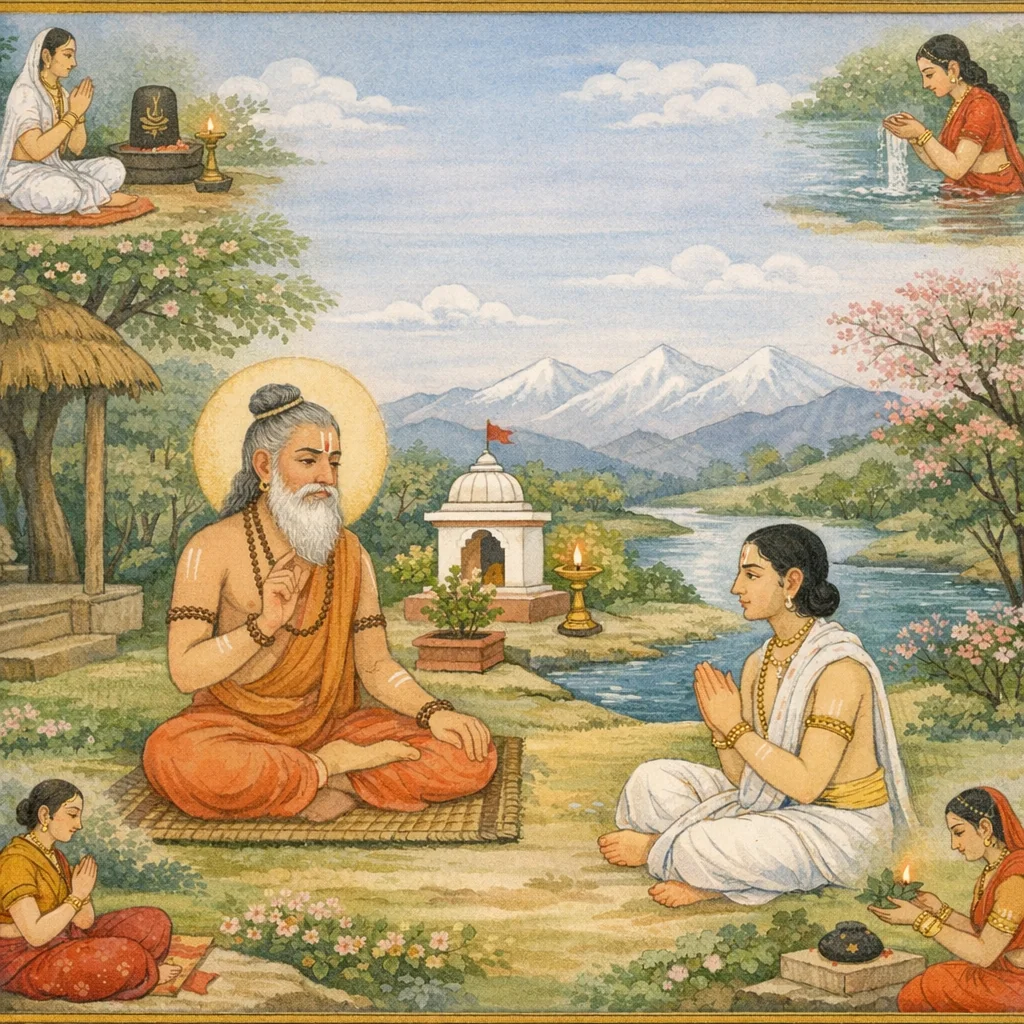
Chapter 63, within the Veno-upākhyāna, teaches that serving one’s living mother and father is itself the supreme tīrtha and a complete act of dharma. It praises the son who lovingly tends parents afflicted with leprosy and illness, declaring that such care pleases Viṣṇu and opens the way to the Vaiṣṇava realm. In contrast, it condemns sons who abandon aged or diseased parents, describing hells and degrading rebirths—dog, swine, serpent, and fierce beasts such as tiger or bear—as karmic results. The chapter then reframes Vedic learning, austerity, sacrifice, charity, and pilgrimage as fruitless without honoring mother and father, affirming that reverence to parents gives rise to true knowledge, yogic attainment, and an auspicious destiny.
Shlokas
Verse 1
सुकर्मोवाच । तयोश्चापि द्विजश्रेष्ठ मातापित्रोश्च स्नातयोः । पुत्रस्यापि हि सर्वांगे पतंत्यंबुकणा यदा
Sukarma said: O best of the twice-born, when that rite is performed—even for the mother and father who have bathed, and indeed for the son as well—when water-drops fall upon his whole body—
Verse 2
सर्वतीर्थसमं स्नानं पुत्रस्यापि सुजायते । पतितं विकलं वृद्धमशक्तं सर्वकर्मसु
For a son, bathing in this manner becomes equivalent to bathing at all sacred tīrthas. It benefits even one who is fallen, impaired, aged, and incapable in all duties.
Verse 3
व्याधितं कुष्ठिनं तातं मातरं च तथाविधाम् । उपाचरति यः पुत्रस्तस्य पुण्यं वदाम्यहम्
I shall declare the merit of that son who lovingly tends his sick father afflicted with leprosy, and his mother who is in the same condition.
Verse 4
विष्णुस्तस्य प्रसन्नात्मा जायते नात्र संशयः । प्रयाति वैष्णवं लोकं यदप्राप्यं हि योगिभिः
For him, Viṣṇu becomes gracious and well-pleased—of this there is no doubt. He goes to the Vaiṣṇava realm, truly unattainable even for yogins.
Verse 5
पितरौ विकलौ दीनौ वृद्धावेतौ गुरू सुतः । महागदेन संप्राप्तौ परित्यजति पापधीः
When his parents become infirm, wretched, and aged, and are struck by a grave disease, the wicked-minded son abandons them.
Verse 6
पुत्रो नरकमाप्नोति दारुणं कृमिसंकुलम् । वृद्धाभ्यां च समाहूतो गुरूभ्यामिह सांप्रतम्
A son falls into a dreadful hell swarming with worms, and is now, at this very moment, being summoned here by the two elders—his venerable superiors.
Verse 7
न प्रयाति सुतो भूत्वा तस्य पापं वदाम्यहम् । विष्ठाशी जायते मूढो ग्रामघ्रोणी न संशयः
Even after becoming a son, he does not proceed on the proper path; I shall declare his sin. He is born dull-witted, an eater of filth, and a village swine—of this there is no doubt.
Verse 8
यावज्जन्मसहस्रं तु पुनः श्वा चाभिजायते । पुत्रगेहेस्थितौ वृद्धौ माता च जनकस्तथा
For as many as a thousand births, one is born again as a dog; and likewise the aged mother and father remain lodged in the son’s house.
Verse 9
अभोजयित्वा तावन्नं स्वयमत्ति च यः सुतः । मूत्रं विष्ठां स भुंजीत यावज्जन्मसहस्रकम्
That son who eats for himself without first feeding them that same food shall eat urine and excrement for a thousand births.
Verse 10
कृष्णसर्पो भवेत्पापी यावज्जन्मशतद्वयम् । मातरंपितरं वृद्धमवज्ञाय प्रवर्त्तते
A sinful person becomes a black serpent for two hundred births if he behaves with contempt toward his aged mother and father.
Verse 11
ग्राहोपि जायते दुष्टो जन्मकोटिशतैरपि । तावेतौ कुत्सते पुत्रः कटुकैर्वचनैरपि
Even after hundreds of crores of births, a son may be born wicked; and that very son reviles those two (his parents) even with harsh words.
Verse 12
स च पापी भवेद्व्याघ्रः पश्चादृक्षः प्रजायते । मातरंपितरं पुत्रो यो न मन्येत दुष्टधीः
That sinful person becomes a tiger and afterwards is born as a bear—namely, the wicked-minded son who does not honor his mother and father.
Verse 13
कुंभीपाके वसेत्तावद्यावद्युगसहस्रकम् । नास्ति मातृसमं तीर्थं पुत्राणां च पितुः समम्
One would dwell in the hell called Kumbhīpāka for as many as a thousand yugas. There is no sacred tīrtha equal to a mother, and for children there is none equal to a father.
Verse 14
तारणाय हितायैव इहैव च परत्र च । तस्मादहं महाप्राज्ञ पितृदेवं प्रपूजये
For deliverance and welfare—here in this world and in the world beyond—therefore, O greatly wise one, I worship the divine Pitṛs, the ancestral deities.
Verse 15
मातृदेवं सर्वदेव योगयोगी तथाभवम् । मातृपितृप्रसादेन संजातं ज्ञानमुत्तमम्
I regarded my mother as a deity—indeed, as all the gods; thus I became a master of yoga. Through the grace of my mother and father, the highest knowledge arose in me.
Verse 16
त्रिलोकीयं समस्ता तु संयाता मम वश्यताम् । अर्वाचीनगतिं जाने देवस्यास्य महात्मनः
Indeed, all beings in the three worlds have come under my control. Yet I understand the onward course of this great-souled divine one.
Verse 17
वासुदेवस्य तस्यैव पराचीनां महामते । सर्वं ज्ञानं समुद्भूतं पितृमातृप्रसादतः
O great-minded one, from that very Vāsudeva among those of former times, all knowledge arose—by the grace of father and mother.
Verse 18
को न पूजयते विद्वान्पितरं मातरं तथा । सांगोपांगैरधीतैस्तैः श्रुतिशास्त्रसमन्वितैः
What learned person would not honor his father and likewise his mother—endowed with study of the Veda along with its auxiliaries, and furnished with the teachings of śruti and śāstra?
Verse 19
वेदैरपि च किं विप्रा पिता येन न पूजितः । माता न पूजिता येन तस्य वेदा निरर्थकाः
O brāhmaṇas, what use are even the Vedas to one who does not honor his father? For one who does not honor his mother, the Vedas become meaningless.
Verse 20
यज्ञैश्च तपसा विप्र किं दानैः किं च पूजनैः । प्रयाति तस्य वैफल्यं न माता येन पूजिता
O brāhmaṇa, what is the use of sacrifices and austerities—what of gifts and acts of worship? All becomes fruitless for the one who has not honored the Mother.
Verse 21
न पिता पूजितो येन जीवमानो गृहे स्थितः । एष पुत्रस्य वै धर्मस्तथा तीर्थं नरेष्विह
If a man does not honor his father while he is still alive and living at home, he fails in the son’s true duty; for people here, service to the living father is itself a tīrtha, a sacred place of pilgrimage.
Verse 22
एष पुत्रस्य वै मोक्षस्तथा जन्मफलं शुभम् । एष पुत्रस्य वै यज्ञो दानमेव न संशयः
Indeed, this is the son’s liberation (mokṣa) and the auspicious fruit of his birth. For the son, this is truly a sacrifice (yajña) and also a gift (dāna); of this there is no doubt.
Verse 23
पितरं पूजयेन्नित्यं भक्त्या भावेन तत्परः । तस्य जातं समस्तं तद्यदुक्तं पूर्वमेव हि
One should always worship and honor one’s father with devotion (bhakti) and heartfelt reverence, wholly dedicated to him; for all that is born from him is indeed as was stated earlier.
Verse 24
दानस्यापि फलं तेन तीर्थस्यापि न संशयः । यज्ञस्यापि फलं प्राप्तं माता येनाप्युपासिता
He who has worshipped and served his mother attains the fruit of charity; likewise, without doubt, the fruit of pilgrimages to sacred tīrthas; and the fruit of sacrifices as well, for his mother has been duly honored.
Verse 25
पिता येन सुभक्त्या च नित्यमेवाप्युपासितः । तस्य सर्वा सुसंसिद्धा यज्ञाद्याः पुण्यदाः क्रियाः
For one who continually worships and serves his father with sincere devotion, all merit-bestowing acts—beginning with sacrifices—become perfectly accomplished.
Verse 26
एतदर्थं समाज्ञातं धर्मशास्त्रं श्रुतं मया । पितृभक्तिपरो नित्यं भवेत्पुत्रो हि पिप्पल
For this very purpose I have duly learned and heard the Dharma-śāstra. Therefore, O Pippala, a son should always be devoted to reverent devotion toward his father.
Verse 27
तुष्टे पितरि संप्राप्तं यदुराज्ञा पुरा सुखम् । रुष्टे पितरि च प्राप्तं महत्पापं पुरा शृणु
Hear now: long ago King Yadu attained happiness when his father was pleased; but when his father was angered, he incurred great sin.
Verse 28
रुरुणा पौरवेणापि पित्रा शप्तेन भूतले । एवं ज्ञानं मया चाप्तं द्वावेतौ यदुपासितौ
Thus, upon the earth, even Ruru of the Paurava line—when cursed by his father—came to this understanding. In this way I too have obtained this knowledge: that it was these two whom he revered and served.
Verse 29
एतयोश्च प्रसादेन प्राप्तं फलमनुत्तमम्
By the grace of these two, an unsurpassed reward was obtained.
Verse 63
इति श्रीपद्मपुराणे भूमिखंडे वेनोपाख्याने मातापितृतीर्थमाहात्म्ये त्रिषष्टितमोऽध्यायः
Thus ends the sixty-third chapter—on the glory of the Mother-and-Father Sacred Ford (Mātāpitṛ-tīrtha)—in the Veno-upākhyāna, within the Bhūmi-khaṇḍa of the revered Padma Purāṇa.