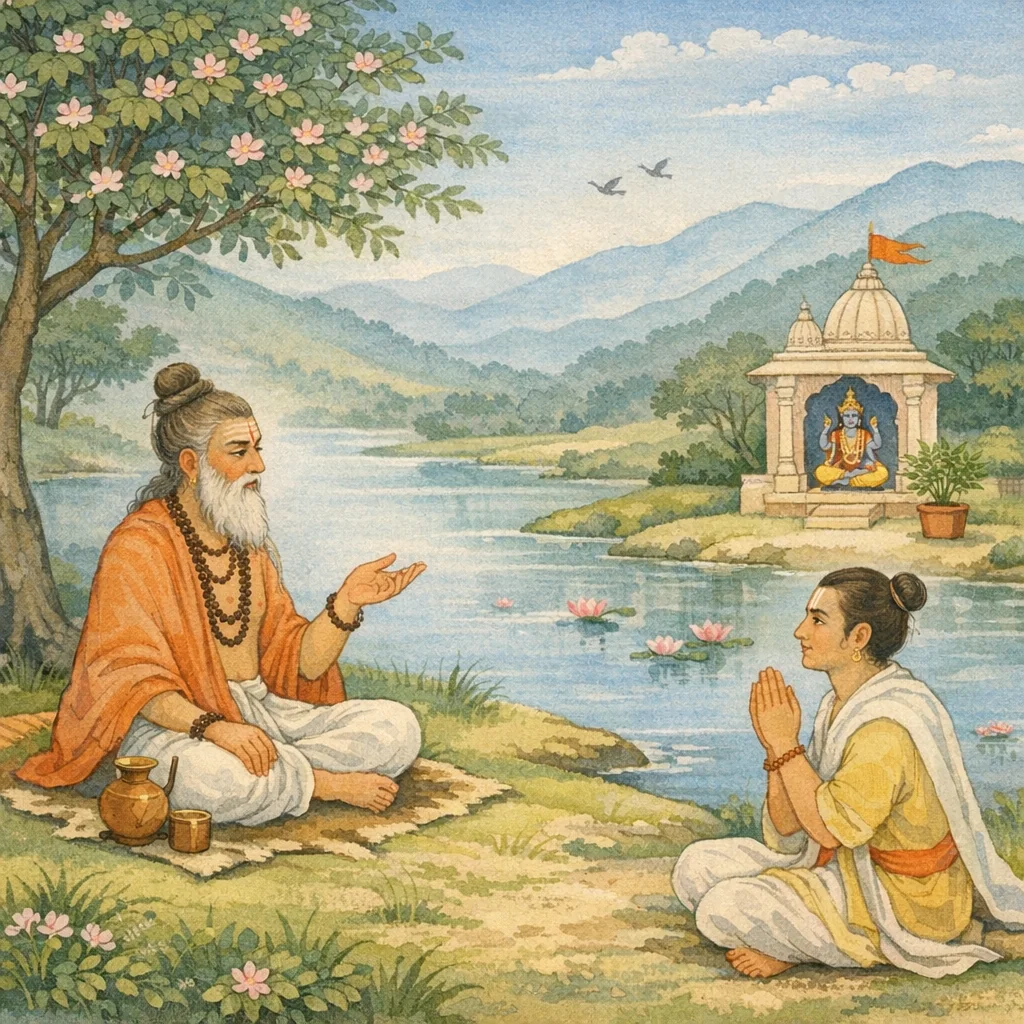
Adhyaya 109
The Aśokasundarī–Nahuṣa Episode: Demon Stratagems, Protection by Merit, and Lineage Prophecy
Chapter 109 continues the Aśokasundarī–Nahuṣa episode. The daitya/dānava Huṇḍa boasts that he has devoured Āyu’s son—the newborn Nahuṣa—and urges Aśokasundarī to abandon her destined husband. She replies as a Śiva-born ascetic, speaking from tapas and satya, threatening a curse and affirming that truth and austerity safeguard long life. The narrative then teaches that prior merit (puṇya) protects the righteous even amid poison, weapons, fire, spells, and imprisonment. Vidvara, a Kinnara messenger and a devotee of Viṣṇu, consoles Aśokasundarī: Nahuṣa lives, guarded by divine providence and karmic merit; he is being trained in the forest by the ascetic Satyeka and will later slay Huṇḍa. The chapter concludes with a projection of royal lineage—Yayāti; his sons Turu, Puru, Uru, and Yadu; and Yadu’s descendants—linking personal virtue, divine ordering, and dynastic continuity.
Shlokas
Verse 1
कुंजल उवाच । प्रणिपत्य प्रसाद्यैव वशिष्ठं तपतां वरम् । आमंत्र्य निर्जगामाथ बाणपाणिर्धनुर्धरः
Kuñjala said: Having bowed down and duly pleased Vasiṣṭha, the foremost among ascetics, the bowman—arrow in hand—took leave of him and then departed.
Verse 2
एणस्य मांसं सुविपाच्यभोजितं बालस्तया रक्षित एव बुद्ध्या । आयोः सुपुत्रः सगुणः सुरूपो देवोपमो देवगुणैश्च युक्तः
Having well-cooked the flesh of the antelope and fed it to her, the child was indeed protected by her wise resolve. Thus Āyu obtained an excellent son—virtuous, handsome, godlike, and endowed with divine qualities.
Verse 3
तेनैव मांसेन सुसंस्कृतेन मृष्टेन पक्वेन रसानुगेन । तमेव दैत्यं परिभाष्य सूदो दुष्टं सुहर्षेण व्यभोजयत्तदा
Then, with that very meat—well-prepared, cleansed, cooked, and seasoned to suit the taste—the cook, after addressing that wicked Daitya, gladly served it to him at that time.
Verse 4
बुभुजे दानवो मांसं रसस्वादुसमन्वितम् । हर्षेणापि समाविष्टो जगामाशोकसुंदरीम्
The Dānava ate the meat, rich with delicious flavor. Filled with joy, he then went to Aśokasundarī.
Verse 5
तामुवाच ततस्तूर्णं कामोपहतचेतनः । आयुपुत्रो मया भद्रे भक्षितः पतिरेव ते
Then, his mind overwhelmed by lust, he quickly spoke to her: "O auspicious one, I have devoured the son of Āyu, who was indeed your husband."
Verse 6
मामेव भज चार्वंगि भुंक्ष्व भोगान्मनोनुगान् । किं करिष्यसि तेन त्वं मानुषेण गतायुषा
Worship me alone, O fair-limbed beauty; enjoy pleasures that delight your heart. What use have you for that human whose life has already ended?
Verse 7
प्रत्युवाच समाकर्ण्य शिवकन्या तपस्विनी । भर्ता मे दैवतैर्दत्तो अजरो दोषवर्जितः
Hearing this, the ascetic daughter of Śiva replied: "My husband was granted to me by the gods—he is ageless and free from all defects."
Verse 8
तस्य मृत्युर्न वै दृष्टो देवैरपि महात्मभिः । एवमाकर्ण्य तद्वाक्यं दानवो दुष्टचेष्टितः
"Even the great-souled gods have not foreseen his death." Hearing her words, the demon of wicked deeds reacted.
Verse 9
तामुवाच विशालाक्षीं प्रहस्यैव पुनः पुनः । अद्यैव भक्षितं मांसमायुपुत्रस्य सुंदरि
Laughing again and again, he said to the large-eyed beauty: "O beautiful one, this very day the flesh of Āyu's son has been devoured."
Verse 10
जातमात्रस्य बालस्य नहुषस्य दुरात्मनः । एवमाकर्ण्य सा वाक्यं कोपं चक्रे सुदारुणम्
Hearing such words about Nahusha—wicked at heart though only newly born—she was seized by a most dreadful wrath.
Verse 11
प्रोवाच सत्यसंस्था सा तपसा भाविता पुनः । तप एव मया तप्तं मनसा नियमेन वै । आयुसुतश्चिरायुश्च सत्येनैव भविष्यति
Established in truth, she spoke again, strengthened by austerity: “Tapas alone have I performed—within the mind, through self-restraint. And my son Āyusuta shall indeed be long-lived by truth alone.”
Verse 12
इतो गच्छ दुराचार यदि जीवितुमिच्छसि । अन्यथा त्वामहं शप्स्ये पुनरेव न संशयः
Go from here, you wicked one, if you wish to live; otherwise I shall curse you—again—of this there is no doubt.
Verse 13
एवमाकर्णितं तस्याः सूदेन नृपतिं प्रति । परित्यज्य महाराज एतामन्यां समाश्रय
Having thus heard her account, the sūta addressed the king: “O great king, abandon this woman and take refuge in another (that is, accept another wife).”
Verse 14
सूदेन प्रेषितो दैत्यः स हुंडः पापचेतनः । निर्जगाम त्वरायुक्तः स स्वां भार्यां प्रियां प्रति
Dispatched by Sūda, that demon Huṇḍa—sinful in mind—set out at once in haste, making for his own beloved wife.
Verse 15
चेष्टितं नैव जानाति दास्या सूदेन यत्कृतम् । तस्यै निवेदितं सर्वं प्रियायै वृत्तमेव च
She does not know at all the deed the charioteer carried out through the maidservant. Yet everything was reported to her—indeed the whole account—to his beloved.
Verse 16
सूत उवाच । अशोकसुंदरी सा च महता तपसा किल । दुःखशोकेन संतप्ता कृशीभूता तपस्विनी
Sūta said: That Aśokasundarī, it is said, undertook great austerities; scorched by sorrow and grief, the ascetic woman became emaciated.
Verse 17
चिंतयंती प्रियं कांतं तं ध्यायति पुनः पुनः । किं न कुर्वंति वै दैत्या उपायैर्विविधैरपि
Thinking of her beloved husband, she meditates on him again and again. What indeed will the Daityas not do, even by employing various stratagems?
Verse 18
उपायज्ञाः सदा बुद्ध्या उद्यमेनापि सर्वदा । वर्तंते दनुजश्रेष्ठा नानाभावैश्च सर्वदा
Ever mindful of stratagems, and always applying intelligence and effort, the foremost among the Dānava-born continually proceed in many different ways.
Verse 19
मायोपायेन योगेन हृताहं पापिना पुरा । तथा स घातितः पुत्र आयोश्चैव भविष्यति
Formerly, by a deceptive stratagem, I was abducted by a sinful man. In the same way, that son too will be slain—and his lifespan will likewise come to an end.
Verse 20
यं दृष्ट्वा दैवयोगेन भवितारमनामयम् । उद्यमेनापि पश्येत किं वा नश्यति वा न वा
Having seen that person—by a providential conjunction—who is destined to be free from affliction, one should still look on with one’s own effort, considering: “Will anything be lost, or will it not be lost?”
Verse 21
किं वा स उद्यमः श्रेष्ठः किं वा तत्कर्मजं फलम् । भाविभावः कथं नश्येत्ततो वेदः प्रतिष्ठति
What, indeed, is the highest endeavor, and what is the fruit born of that action? How can what is destined to occur be averted? On this the authority of the Veda is established.
Verse 22
विशेषो भावितो देवैः स कथं चान्यथा भवेत् । एवमेवं महाभागा चिंतयंती पुनः पुनः
“A special outcome has been brought about by the gods—how could it possibly turn out otherwise?” Thus, again and again, that noble lady kept reflecting in this way.
Verse 23
किन्नरो विद्वरो नाम बृहद्वंशोमहातनुः । सनाभ्योर्धनरः कायः पक्षाभ्यां हि विवर्जितः
There was a Kinnara named Vidvara, broad-shouldered and of mighty build. From the navel upward his body was human, and he was indeed without wings.
Verse 24
द्विभुजो वंशहस्तस्तु हारकंकणशोभितः । दिव्यगंधानुलिप्तांगो भार्यया सह चागतः
Two-armed, holding a bamboo staff in his hand, adorned with a necklace and bracelets, his body anointed with divine fragrance—he arrived together with his wife.
Verse 25
तामुवाच निरानंदां स सुतां शंकरस्यहि । किमर्थं चिंतसे देवि विद्वरं विद्धि चागतम्
Seeing Śaṅkara’s daughter bereft of joy, he said to her: “Goddess, why do you worry? Know that a learned and excellent man has arrived.”
Verse 26
किन्नरं विष्णुभक्तं मां प्रेषितं देवसत्तमैः । दुःखमेवं न कर्तव्यं भवत्या नहुषं प्रति
I am a Kinnara, a devotee of Viṣṇu, sent by the best of the gods. You should not inflict such suffering upon Nahuṣa in this way.
Verse 27
हुंडेन पापचारेण वधार्थं तस्य धीमतः । कृतमेवाखिलं कर्म हृतश्चायुसुतः शुभे
O auspicious lady, by Huṇḍa—one of sinful conduct—everything required for killing that wise man was carried out; and Āyu’s son, too, was abducted.
Verse 28
स तु वै रक्षितो देवैरुपायैर्विविधैरपि । हुंड एवं विजानाति आयुपुत्रो हृतो मया
“But he was indeed protected by the gods, even by various stratagems. Huṇḍa thus came to understand: ‘Āyu’s son has been taken away by me.’”
Verse 29
भक्षितस्तु विशालाक्षि इति जानाति वै शुभे । भवतां श्रावयित्वा हि गतोसौ दानवोऽधमः
“Indeed, O large-eyed auspicious one, he knows (and will say), ‘I have been devoured.’ After informing you (of this), that vile demon has gone away.”
Verse 30
स्वेनकर्मविपाकेन पुण्यस्यापि महायशाः । पूर्वजन्मार्जितेनैव तव भर्त्ता स जीवति
O highly renowned one, by the ripening of the fruit of his own deeds—even of meritorious ones—your husband still lives, sustained solely by what he amassed in a former birth.
Verse 31
पुण्यस्यापि बलेनैव येषामायुर्विनिर्मितम् । स्वर्जितस्य महाभागे नाशमिच्छंति घातकाः
O greatly fortunate one, for those whose lifespan is fashioned solely by the power of merit—even killers do not wish for the destruction of what has been earned by oneself.
Verse 32
दुष्टात्मानो महापापाः परतेजोविदूषकाः । तेषां यशोविनाशार्थं प्रपंचंति दिने दिने
Wicked-souled and greatly sinful people, who tarnish the splendor of others, fabricate schemes day after day with the aim of destroying their reputation.
Verse 33
नानाविधैरुपायैस्ते विषशस्त्रादिभिस्ततः । हंतुमिच्छंति तं पुण्यं पुण्यकर्माभिरक्षितम्
Then they sought to kill that righteous man by many different means—by poison, weapons, and the like—yet he was protected by his own meritorious deeds.
Verse 34
पापिनश्चैव हुंडाद्या मोहनस्तंभनादिभिः । पीडयंति महापापा नानाभेदैर्बलाविलैः
Sinful people—such as the Huṇḍas and others—those greatly wicked ones, torment others through delusion, paralysis, and the like, employing many kinds of forceful and deceptive methods.
Verse 35
सुकृतस्य प्रयोगेण पूर्वजन्मार्जितेन हि । पुण्यस्यापि महाभागे पुण्यवंतं सुरक्षितम्
Indeed, by the power of merit amassed in a former birth, O greatly fortunate one, even a virtuous person is kept safe and protected by that very puṇya.
Verse 36
वैफल्यं यांति तेषां वै उपायाः पापिनां शुभे । यंत्रतंत्राणि मंत्राश्च शस्त्राग्निविषबंधनाः
O auspicious one, all the contrivances of sinful people indeed come to nothing—whether devices and rites, mantras, or attempts with weapons, fire, poison, or imprisonment.
Verse 37
रक्षयंति महात्मानं देवपुण्यैः सुरक्षितम् । कर्तारो भस्मतां यांति स वै तिष्ठति पुण्यभाक्
The merits of the devas protect the great-souled one, well-guarded by divine virtue; the perpetrators are reduced to ashes, while he remains established as a sharer in merit.
Verse 38
आयुपुत्रस्य वीरस्य रक्षका देवताः शुभे । पुण्यस्य संचयं सर्वे तपसां निधिमेव तु
O auspicious lady, the devas themselves are the protectors of that heroic son of Āyu; he is a treasury of tapas and truly an accumulation of all merit.
Verse 39
तस्माच्च रक्षितो वीरो नहुषो बलिनां वरः । सत्येन तपसा तेन पुण्यैश्च संयमैर्दमैः
Therefore the heroic Nahuṣa—foremost among the mighty—was protected by that man’s truthfulness and tapas, and by his meritorious restraints, discipline, and self-control.
Verse 40
मा कृथा दारुणं दुःखं मुंच शोकमकारणम् । स हि जीवति धर्मात्मा मात्रा पित्रा विना वने
Do not yield to such dreadful sorrow; abandon this causeless grief. For that righteous-souled one is indeed alive, dwelling in the forest without his mother and father.
Verse 41
तपोवनेव सत्येकस्तपस्वि परिपालितः । वेदवेदांगतत्त्वज्ञो धनुर्वेदस्य पारगः
In the forest of austerities there was an ascetic named Satyeka, carefully reared and protected—one who knew the true principles of the Vedas and the Vedāṅgas, and who had mastered Dhanurveda, the sacred science of archery.
Verse 42
यथा शशी विराजेत स्वकलाभिः स्वतेजसा । तथा विराजते सोऽपि स्वकलाभिः सुमध्यमे
Just as the moon shines splendidly by its own radiance together with its own phases, so too does he shine, endowed with his own excellences, O slender-waisted one.
Verse 43
विद्याभिस्तु महापुण्यैस्तपोभिर्यशसा तथा । राजते परवीरघ्नो रिपुहा सुरवल्लभः
Adorned with supremely meritorious knowledge, with austerities, and with fame as well, he shines forth—slayer of hostile heroes, destroyer of foes, beloved of the gods.
Verse 44
हुंडं निहत्य दैत्येंद्रं त्वामेवं हि प्रलप्स्यते । त्वया सार्द्धं स्त्रिया चैव पृथिव्यामेकभूपतिः
After slaying Huṇḍa, lord of the asuras, he will indeed speak to you thus: “Together with you—and with this woman as well—he shall become the sole ruler upon the earth.”
Verse 45
भविष्यति महायोगी यथा स्वर्गे तु वासवः । त्वं तस्मात्प्राप्स्यसे भद्रे सुपुत्रं वासवोपमम्
He will become a great yogin, like Vāsava (Indra) in heaven. Therefore, O auspicious one, you will obtain a noble son comparable to Vāsava.
Verse 46
ययातिं नामधर्मज्ञं प्रजापालनतत्परम् । तथा कन्याशतं चापि रूपौदार्यगुणान्वितम्
There was a (king) named Yayāti, one who knew dharma and was devoted to protecting his subjects; and there were also a hundred maidens, endowed with beauty, generosity, and virtues.
Verse 47
यासां पुण्यैर्महाराज इंद्रलोकं प्रयास्यति । इंद्रत्वं भोक्ष्यते देवि नहुषः पुण्यविक्रमः
O great king, by the merit of those deeds, Nahuṣa—mighty through the power of his virtue—will go to Indra’s world; O Goddess, he will enjoy the very sovereignty of Indra.
Verse 48
ययातिर्नाम धर्मात्मा आत्मजस्ते भविष्यति । प्रजापालो महाराजः सर्वजीवदयापरः
A righteous son named Yayāti will be born to you—O great king—a protector of the people, devoted to compassion toward all living beings.
Verse 49
तस्य पुत्रास्तु चत्वारो भविष्यंति महौजसः । बलवीर्यसमोपेता धनुर्वेदस्य पारगाः
He will have four sons, endowed with great vigor—possessing strength and valor, and fully accomplished in the science of archery.
Verse 50
प्रथमश्च तुरुर्नाम पुरुर्नाम द्वितीयकः । उरुर्नाम तृतीयश्च चतुर्थो वीर्यवान्यदुः
The first was named Turu; the second was named Puru; the third was named Uru; and the fourth, they declared, was the mighty Yadu.
Verse 51
एवं पुत्रा महावीर्यास्तेजस्विनो महाबलाः । भविष्यंति महात्मानः सर्वतेजः समन्विताः
Thus the sons will be of great valor—radiant, immensely strong, great-souled, and endowed with every kind of splendor.
Verse 52
यदोश्चैव सुता वीराः सिंहतुल्यपराक्रमाः । तेषां नामानि भद्रं ते गदतः शृणु सांप्रतम्
And the sons of Yadu were valiant heroes, with prowess like lions. Now hear from me, O fortunate one, as I recount their names.
Verse 53
भोजश्च भीमकश्चापि अंधकः कुञ्जरस्तथा । वृष्णिर्नाम सुधर्मात्मा सत्याधारो भविष्यति
Bhoja and Bhīmaka, Andhaka and Kuñjara as well—there will also arise one named Vṛṣṇi, righteous in nature and established upon truth.
Verse 54
षष्ठस्तु श्रुतसेनश्च श्रुताधारस्तु सप्तमः । कालदंष्ट्रो महावीर्यः समरे कालजिद्बली
The sixth was Śrutasena, and the seventh was Śrutādhāra. Kāladaṃṣṭra—of great valor—was mighty, a conqueror of Death (Time) in battle.
Verse 55
यदोः पुत्रा महावीर्या यादवाख्या वरानने । तेषां तु पुत्राः पौत्रास्ते भविष्यंति सहस्रशः
O fair-faced lady, the mighty sons of Yadu shall be known as the Yādavas; and from them shall arise sons and grandsons in their thousands.
Verse 56
एवं नहुषवंशो वै तव देवि भविष्यति । दुःखमेवं परित्यज्य सुखेनानुप्रवर्तय
Thus, O goddess, the lineage of Nahuṣa shall indeed become yours. Therefore, abandon this sorrow and proceed onward in happiness.
Verse 57
समेष्यति महाप्राज्ञस्तव भर्ता शुभानने । निहत्य दानवं हुंडं त्वामेवं परिणेष्यति
O fair-faced one, your husband—most wise—will come. After slaying the demon Huṇḍa, he will marry you in this manner.
Verse 58
दुःखजातानि सोष्णानि नेत्राभ्यां हि पतंति च । अश्रूणि चेंदुमत्याश्च संमार्जयति मानदः
Born of sorrow and warm, tears indeed fell from her eyes; and Mānada gently wiped away the tears of Indumatī.
Verse 59
आयोश्च दुःखमुद्धृत्य स्वकुलं तारयिष्यति । सुखिनं पितरं कृत्वा प्रजापालो भविष्यति
He will remove the suffering of the afflicted and deliver his own lineage; having made his forefathers happy, he will become a protector of the people.
Verse 60
एतत्ते सर्वमाख्यातं देवानां कथनं शुभे । दुःखं शोकं परित्यज्य सुखेन परिवर्त्तय
O auspicious one, I have told you all—this account as spoken by the Devas. Cast off sorrow and grief, and turn with ease toward happiness.
Verse 61
अशोकसुंदर्युवाच । कदा ह्येष्यति मे भर्त्ता विहितो दैवतैर्यदि । सत्यं वद स्वधर्मज्ञ मम सौख्यं विवर्द्धय
Aśokasundarī said: “If the Devas have truly ordained a husband for me, when will my lord come? Speak the truth, O knower of your own dharma, and increase my happiness.”
Verse 62
विद्वर उवाच । अचिराद्द्रक्ष्यसि भर्तारं त्वमेवं शृणु सुंदरि । एवमुक्त्वा जगामाथ गंधर्वो विबुधालयम्
Vidvara said: “Before long you will behold your husband—hear this, O beautiful one.” Having spoken thus, the Gandharva departed for the abode of the Devas.
Verse 63
अशोकसुंदरी सा च तपस्तेपे हि तत्र वै । कामं क्रोधं परित्यज्य लोभं चापि शिवात्मजा
And Aśokasundarī indeed performed tapas there, renouncing desire, anger, and also greed—she, the daughter of Śiva.
Verse 109
इति श्रीपद्मपुराणे भूमिखंडे वेनोपाख्याने गुरुतीर्थमाहात्म्ये च्यवनचरित्रे नाहुषाख्याने नवाधिकशततमोऽध्यायः
Thus ends the one-hundred-and-ninth chapter of the Śrī Padma Purāṇa, in the Bhūmi-khaṇḍa—within the episode of Vena, the glorification of the Guru-tīrtha, the narrative of Cyavana, and the account of Nahuṣa.