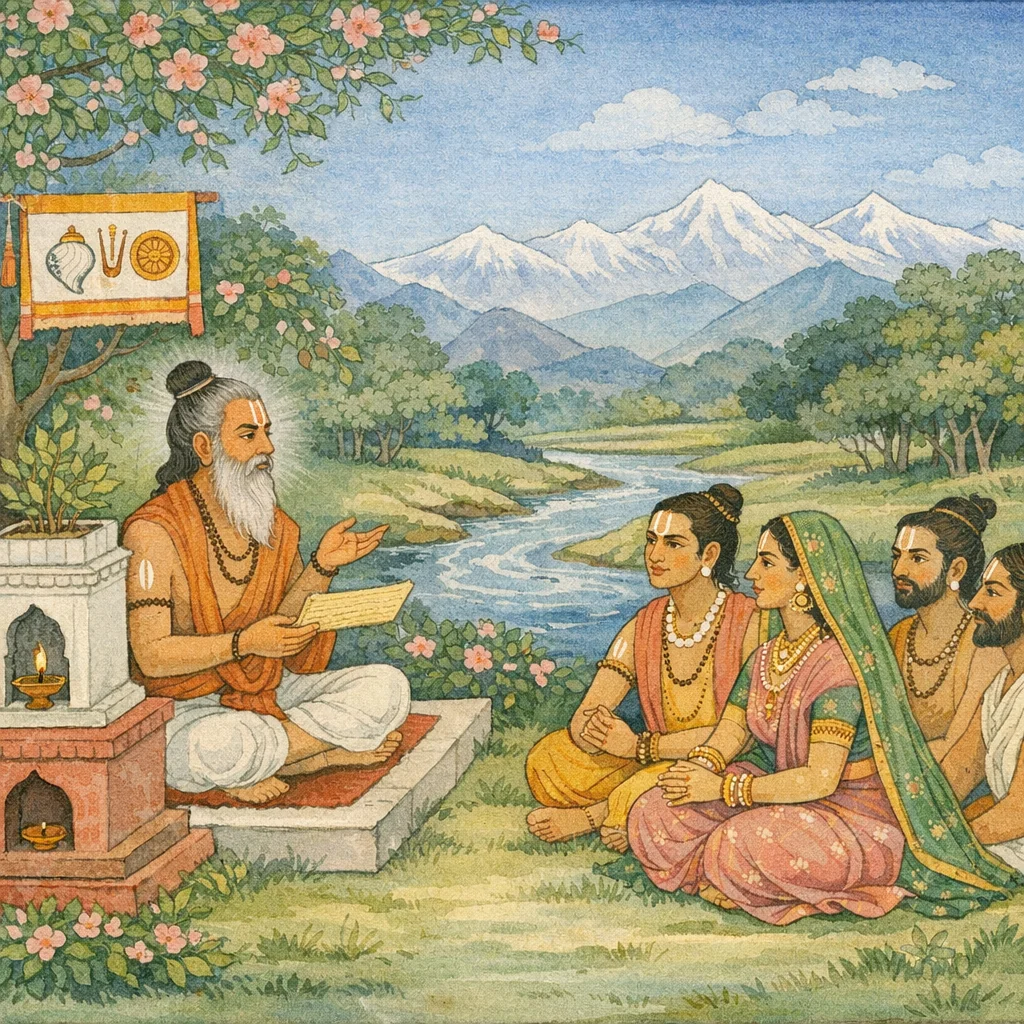
Adhyaya 22
The Narrative of Suvrata: Tapas, Surrender-Prayer, and Cyclical Time
The chapter opens with an inquiry into Suvrata’s former birth and the merit of his devotion. Brahmā recounts a lineage beginning in Vaidīśā: from Ṛtadhvaja’s line come Rukmāṅgada and his son Dharmāṅgada, renowned for extreme filial piety and Vaiṣṇava righteousness. For the purity of his dharma, Viṣṇu leads him bodily to the Vaiṣṇava abode. After an immense celestial sojourn, he descends by Viṣṇu’s grace as Suvrata, son of Somaśarmā. Near Siddheśvara in the Vaiḍūrya mountains he performs severe tapas and one-pointed meditation. Pleased, Keśava appears with Lakṣmī and offers a boon; Suvrata answers with stotra-like supplications, begging rescue from saṃsāra. The narrative then links personal destiny to cosmic recurrence: yugas, Manus, and kalpas repeat, explaining the reappearance of names and roles across cycles. In the end, Suvrata is raised—as Vasudatta—to Indra’s rank.
Shlokas
Verse 1
व्यास उवाच । प्रश्नमेकं महाभाग करिष्ये सांप्रतं वद । त्वयैव पूर्वमुक्तं हि सुव्रतं च प्रतीश्वरम्
Vyāsa said: O greatly fortunate one, I shall now ask a single question—tell me. For earlier you yourself spoke of the excellent observance (suvrata) and of devotion to the Supreme Lord.
Verse 2
पूर्वाभ्यासेन संध्यायन्नारायणमनामयम् । कस्यां ज्ञात्यां समुत्पन्नः सुव्रतः पूर्वजन्मनि
By the force of prior practice, meditating at the twilight prayers (sandhyā) on Nārāyaṇa, the disease-free Lord—in which family line was Suvrata born in his former life?
Verse 3
तन्मे त्वं सांप्रतं ब्रूहि कथमाराधितो हरिः । अनेनापि स देवेश कोयं पुण्यसमाविलः
So now, please tell me: how was Hari worshipped and propitiated? And by this act as well, that Lord of the gods—what is this that is filled with merit (puṇya)?
Verse 4
ब्रह्मोवाच । वैदिशे नगरे पुण्ये सर्वऋद्धिसमाकुले । तत्र राजा महातेजा ऋतध्वजसुतो बली
Brahmā said: In the sacred city of Vaidishā, filled with every prosperity, there lived a mighty king of great splendor—the powerful son of Ṛtadhvaja.
Verse 5
तस्यात्मजो महाप्राज्ञो रुक्मभूषणविश्रुतः । संध्यावली तस्य भार्या धर्मपत्नी यशस्विनी
His son was a man of great wisdom, renowned for golden ornaments. His wife was Sandhyāvalī—his lawful, virtuous spouse, celebrated and illustrious.
Verse 6
तस्यां पुत्रं समुत्पाद्य स आत्मसदृशं ततः । तस्य धर्मांगदं नाम चकार नृपनंदनः
Having begotten a son in her—one who resembled himself—the prince then gave that child the name Dharmāṅgada.
Verse 7
सर्वलक्षणसंपन्नः पितृभक्तिपरायणः । रुक्मांगदस्य तनयो योयं भगवतां वरः
Endowed with every auspicious mark and wholly devoted to honoring his father, he is the son of Rukmāṅgada—the best among the Lord’s blessed devotees.
Verse 8
पितुः सौख्याय येनापि मोहिन्यै तु शिरो ददे । वैष्णवेन च धर्मेण पितृभक्त्या तु तस्य हि
For his father’s happiness, he even offered his own head to Mohinī—indeed, through Vaiṣṇava righteousness and through devotion to his father.
Verse 9
सुप्रसन्नो हृषीकेशः सकायो वैष्णवं पदम् । नीतस्तु सर्वधर्मज्ञो वैष्णवः सात्वतां वरः
Hṛṣīkeśa (Viṣṇu), fully pleased, led him—still in bodily form—to the Vaiṣṇava abode. That Vaiṣṇava, knower of all dharma, was indeed the best among the Sātvatas.
Verse 10
धर्मांगदो महाप्राज्ञः प्रज्ञाज्ञानविशारदः । तत्रस्थो वै महाप्राज्ञो धर्मोसौ धर्मभूषणः
Dharmāṅgada was profoundly wise, highly discerning, and skilled in insight and knowledge. Present there indeed was the great sage Dharma himself—an ornament of righteousness.
Verse 11
दिव्यान्मनोनुगान्भोगान्मोदमानः प्रभुंजति । पूर्णे युगसहस्रांते धर्मो वै धर्मभूषणः
Rejoicing, he enjoys divine pleasures that accord with his mind. At the completion of a thousand yugas, Dharma—adorned with righteousness—indeed prevails.
Verse 12
तस्मात्पदात्परिभ्रष्टो विष्णोश्चैव प्रसादतः । सुव्रतो नाम मेधावी सुमनानंदवर्द्धनः
Having fallen from that position, yet by the very grace of Viṣṇu, there was a wise man named Suvrata—one who increased the joy of Sumanā.
Verse 13
सोमशर्मस्य तनयः श्रेष्ठो भगवतां वरः । तपश्चचार मेधावी विष्णुध्यानपरोभवत्
Somaśarman’s son—excellent, foremost among the devotees of the Lord—performed austerities with great intelligence and became wholly devoted to meditation on Viṣṇu.
Verse 14
कामक्रोधादिकान्दोषान्परित्यज्य द्विजोत्तमः । संयम्यचैन्द्रियं वर्गं तपस्तेपे निरंतरम्
Having cast aside the faults that begin with desire and anger, the best of the twice-born restrained the host of senses and practiced austerity unceasingly.
Verse 15
वैडूर्यपर्वतश्रेष्ठे सिद्धेश्वरस्य सन्निधौ । एकीकृत्य मनश्चायं संयोज्य विष्णुना सह
At the foremost of the Vaiḍūrya mountains, in the presence of Siddheśvara, he made his mind one-pointed and united himself with Viṣṇu.
Verse 16
एवं वर्षशतं स्थित्वा ध्यानेनास्य महात्मनः । सुप्रसन्नो जगन्नाथः शंखचक्रगदाधरः
Thus, after he had remained for a hundred years in meditation upon that great-souled one, the Lord of the universe—bearing conch, discus, and mace—became exceedingly pleased.
Verse 17
तस्मै वरं ददावन्यं सलक्ष्म्या सह केशवः । भोभोः सुव्रत धर्मात्मन्बुध्यस्व विबुधांवर
Then Keśava, together with Lakṣmī, granted him another boon and said: “Ho! Ho! O man of good vows, O righteous-souled one—awake, O best among the wise.”
Verse 18
वरं वरय भद्रं ते कृष्णोऽहं ते समागतः । एवमाकर्ण्य मेधावी विष्णोर्वाक्यमनुत्तमम्
“Choose a boon—blessings to you. I am Kṛṣṇa; I have come to you.” Hearing these unsurpassed words of Viṣṇu, the wise man then replied.
Verse 19
हर्षेण महताविष्टो दृष्ट्वा देवं जनार्दनम् । बद्धांजलिपुटो भूत्वा प्रणाममकरोत्तदा
Overwhelmed with great joy upon seeing the Lord Janārdana, he joined his hands in reverence and at once bowed down.
Verse 20
सुव्रत उवाच । संसारसागरमतीव महासुदुःखजालोर्मिभिर्विविधमोहचयैस्तरंगैः । संपूर्णमस्ति निजदोषगुणैस्तु प्राप्तस्तस्मात्समुद्धर जनार्दनमाशुदीनम्
Suvrata said: This ocean of worldly existence is exceedingly filled with waves that are vast nets of intense sorrow, and with billows formed from heaps of various delusions. I am wholly caught in it by my own faults and dispositions; therefore, O Janārdana, quickly lift up this afflicted one.
Verse 21
कर्मांबुदे महति गर्जतिवर्षतीव विद्युल्लतोल्लसतिपातकसंचयैर्मे । मोहांधकारपटलैर्मम नास्ति दृष्टिर्दीनस्य तस्य मधुसूदन देहि हस्तम्
In the vast cloud of my karma, which thunders and pours down, lightning flashes as heaps of my sins. Covered by layers of the darkness of delusion, I have no sight. To me, the helpless one—O Madhusūdana—extend Your hand.
Verse 22
इति श्रीपद्मपुराणे पंचपंचाशत्सहस्रसंहितायां भूमिखंडे ऐंद्रे सुव्रतो । पाख्यानंनाम द्वाविंशोऽध्यायः
Thus, in the Śrī Padma Purāṇa—within the “Fifty-five-thousand-verse Compendium,” in the Bhūmi-khaṇḍa, in the Aindra section—ends the twenty-second chapter, called “The Narrative of Suvrata.”
Verse 23
संसारवृक्षमतिजीर्णमपीह उच्चं मायासुकंदकरुणा बहुदुःखशाखम् । जायादिसंगच्छदनं फलितं मुरारे तत्राधिरूढपतितं भगवन्हि रक्ष
O Murāri, this lofty tree of worldly existence—though worn and ancient—has illusion for its trunk and is full of many branches of sorrow. Its canopy is formed by attachments such as wife and the rest, and it bears fruit. I have climbed it and fallen—O Lord, protect me from it indeed.
Verse 24
दुःखानलैर्विविधमोहमयैः सुधूमैः शोकैर्वियोगमरणांतिक सन्निभैश्च । दग्धोस्मि कृष्ण सततं मम देहि मोक्षं ज्ञानांबुदैः समभिषिंच सदैव मां त्वम्
I am burned unceasingly, O Kṛṣṇa, by the fires of suffering—thick with the smoke of manifold delusions—and by griefs like separation, dreadful as the approach of death. Grant me mokṣa, liberation, and ever bathe me in the rain-clouds of true knowledge.
Verse 25
घोरांधकारपटले महतीव गर्ते संसारनाम्निपतितं सततं हि कृष्ण । त्वं सत्कृपो मम हि दीनभयातुरस्य तस्माद्विरज्यशरणं तव आगतोस्मि
O Kṛṣṇa, again and again I have fallen into this world called saṃsāra, like a vast pit veiled in dreadful darkness. You are truly compassionate to me, wretched and afflicted by fear; therefore, renouncing all else, I have come seeking refuge in You alone.
Verse 26
त्वामेव ये नियतमानसभावयुक्ता ध्यायंति ज्ञानमनसा पदवीं लभंते । नत्वैव पादयुगलं च महासुपुण्यं यद्देवकिन्नरगणाः परिचिंतयंति
Those who, with disciplined and intent minds, meditate on You with an intellect illumined by knowledge attain the supreme state. And having bowed to Your pair of feet—most auspicious and supremely meritorious—which even the hosts of devas and kinnaras continually contemplate, they are blessed.
Verse 27
नान्यं वदामि न भजामि न चिंतयामि त्वत्पादपद्मयुगलं सततं नमामि । कामं त्वमेव मम पूरय मेद्य कृष्ण दूरेण यातु मम पातकसंचयस्ते
I speak of no other, I worship no other, I think of no other; I constantly bow to Your pair of lotus-feet. Fulfil my desire—you alone—O pure Kṛṣṇa; may the accumulated heap of my sins go far away from me.
Verse 28
दासोस्मि देव तव किंकरजन्मजन्म त्वत्पादपद्मयुगलं सततं स्मरामि
O Lord, I am Your servant, Your attendant birth after birth; I ever remember Your pair of lotus-feet.
Verse 29
यदि कृष्ण प्रसन्नोसि देहि मे सुवरं प्रभो । मन्मातापितरौ कृष्ण सकायौ मंदिरे नय
O Lord Kṛṣṇa, if You are pleased, grant me a most excellent boon: O Kṛṣṇa, take my mother and father—together with their bodies—into Your divine abode.
Verse 30
आत्मनश्च महादेव मयासह न संशयः । श्रीकृष्ण उवाच । एवं ते परमं कार्यं भविष्यति न संशयः
O Mahādeva, there is no doubt concerning you yourself and me together. Śrī Kṛṣṇa said: Thus, your supreme purpose shall indeed be fulfilled—without doubt.
Verse 31
तस्य तुष्टो हृषीकेशो भक्त्या तस्य प्रतोषितः । प्रयातौ वैष्णवं लोकं दाहप्रलयवर्जितौ
Pleased with him, Hṛṣīkeśa—fully gratified by his devotion—granted that the two departed to the Vaiṣṇava world, a realm free from the cataclysms of burning and dissolution.
Verse 32
सुव्रतेन समं तौ द्वौ सुमना सोमशर्मकौ । यावत्कल्पद्वयं प्राप्तं तावत्स सुव्रतो द्विजः
Those two—Sumanā and Somaśarmā—remained equal in status with Suvrata; and for as long as two kalpas endured, that brāhmaṇa Suvrata continued to be so established.
Verse 33
बुभुजे बुभुजे दिव्यांल्लोकांश्चैव महामते । देवकार्यार्थमत्रैव काश्यपस्य गृहं पुनः
O great sage, he enjoyed—indeed enjoyed—those celestial worlds; and then, to accomplish the gods’ purpose, he returned once more, here itself, to the house of Kaśyapa.
Verse 34
अवतीर्णो महाप्राज्ञो वचनात्तस्य चक्रिणः । ऐंद्रं पदं हि यो भुंक्ते विष्णोश्चैव प्रसादतः
That greatly wise one descended in obedience to the command of the discus-bearing Lord; and by Viṣṇu’s own grace, he truly enjoys the rank of Indra.
Verse 35
वसुदत्तेति विख्यातः सर्वदेवैर्नमस्कृतः । ऐंद्रं पदं हि यो भुंक्ते सांप्रतं वासवो दिवि
He is renowned by the name Vasudatta, revered by all the gods; for he now enjoys Indra’s rank, becoming Vāsava in heaven.
Verse 36
एतत्ते सर्वमाख्यातं सृष्टिसंबंधकारणम् । अन्यदेवं प्रवक्ष्यामि यदेव परिपृच्छसि
All this has been explained to you—the causal basis connected with creation. Now I shall explain further exactly what you are asking about.
Verse 37
व्यास उवाच । धर्माङ्गदो महाप्राज्ञो रुक्माङ्गदसुतो बली । आद्ये कृतयुगे जातः सृष्टिकाले स वासवः
Vyāsa said: Dharmāṅgada—highly wise and mighty, the son of Rukmāṅgada—was born in the earliest Kṛta Yuga; at the time of creation he became Vāsava (Indra).
Verse 38
तत्कथं देवदेवेश अन्यो धर्माङ्गदो भुवि । अन्यो रुक्मांङ्गदो राजा किं चायं त्रिदशाधिपः
How then, O Lord of the gods, is there another Dharmāṅgada on earth? And another king named Rukmāṅgada? And who is this ruler of the thirty-three gods (Indra) here?
Verse 39
एतन्मे संशयं जातं तद्भवान्वक्तुमर्हति । ब्रह्मोवाच । हंत ते कथयिष्यामि सर्वसंदेहनाशनम्
A doubt has arisen in me; you are fit to explain it. Brahmā said: “Well then—I shall tell you, in a way that destroys all doubts.”
Verse 40
देवस्य लीलासृष्ट्यर्थे वर्तते द्विजसत्तम । यथा वाराश्च पक्षाश्च मासाश्च ऋतवो यथा
O best of Brahmins, it functions for the sake of the Lord’s playful act of creation—just as days, fortnights, months, and seasons proceed in their order.
Verse 41
संवत्सराश्च मनवस्तथा यांति युगाः पुनः । पश्चात्कल्पः समायाति व्रजाम्येवं जनार्दनम्
Years pass away, and so do the Manus; the yugas too roll on again and again. Thereafter the kalpa arrives in due course—thus do I go to Janārdana (the Lord).
Verse 42
अहमेव महाप्राज्ञ मयि यांति चराचराः । पुनः सृजति योगात्मा पूर्ववद्विश्वमेव हि
I alone am the ultimate ground; into me all moving and unmoving beings dissolve. Then the Yogic Self again creates this entire universe, exactly as before.
Verse 43
पुनरहं पुनर्वेदाः पुनस्ते देवता द्विजाः । तथा भूपाश्च ते सर्वे स्वचरित्रसमाविलाः
Again and again—so do I, so do the Vedas, and so do those deities and Brahmins. Likewise, all those kings too, each absorbed in the accounts of their own deeds.
Verse 44
प्रभवंति महाभाग विद्वांस्तत्र न मुह्यति । पूर्वकल्पे महाभागो यथा रुक्मांगदो नृपः
They come to fruition, O great-souled one; the wise are not deluded there. So it was in a former kalpa, O noble one—just as it befell the illustrious king Rukmāṅgada.
Verse 45
तथा धर्मांगदश्चायं संजातः ख्यातिमान्द्विजः । रामादयो महाप्राज्ञा ययातिर्नहुषस्तथा
Likewise was born this renowned twice-born one named Dharmāṅgada; and so too were the greatly wise ones beginning with Rāma, as well as Yayāti and Nahuṣa.
Verse 46
मन्वादयो महात्मानः प्रभवंति लयंति च । ऐंद्रं पदं प्रभुंजंति राजानो धर्मतत्पराः
The great souls beginning with the Manus come into being and also pass away; and kings devoted to dharma attain and enjoy the rank of Indra.
Verse 47
यथा धर्मांगदो वीरः प्रभुंजति महत्पदम् । एवं वेदाश्च देवाश्च पुराणाः स्मृतिपूर्वकाः
Just as the heroic Dharmāṅgada attains the supreme state, so too the Vedas and the gods—and the Purāṇas as well—are to be understood in harmony with the Smṛti tradition.
Verse 48
एतत्तु सर्वमाख्यातं तवाग्रे द्विजसत्तम । चरितं सुव्रतस्याथ पुण्यं सुगतिदायकम्
O best among the twice-born, I have now related all this before you—the sacred, meritorious account of Suvrata, which bestows a blessed destiny.
Verse 49
अव्यक्तं तु महाभाग प्रब्रवीमि तवाग्रतः
But, O greatly fortunate one, I shall explain to you the Unmanifest, here in your very presence.