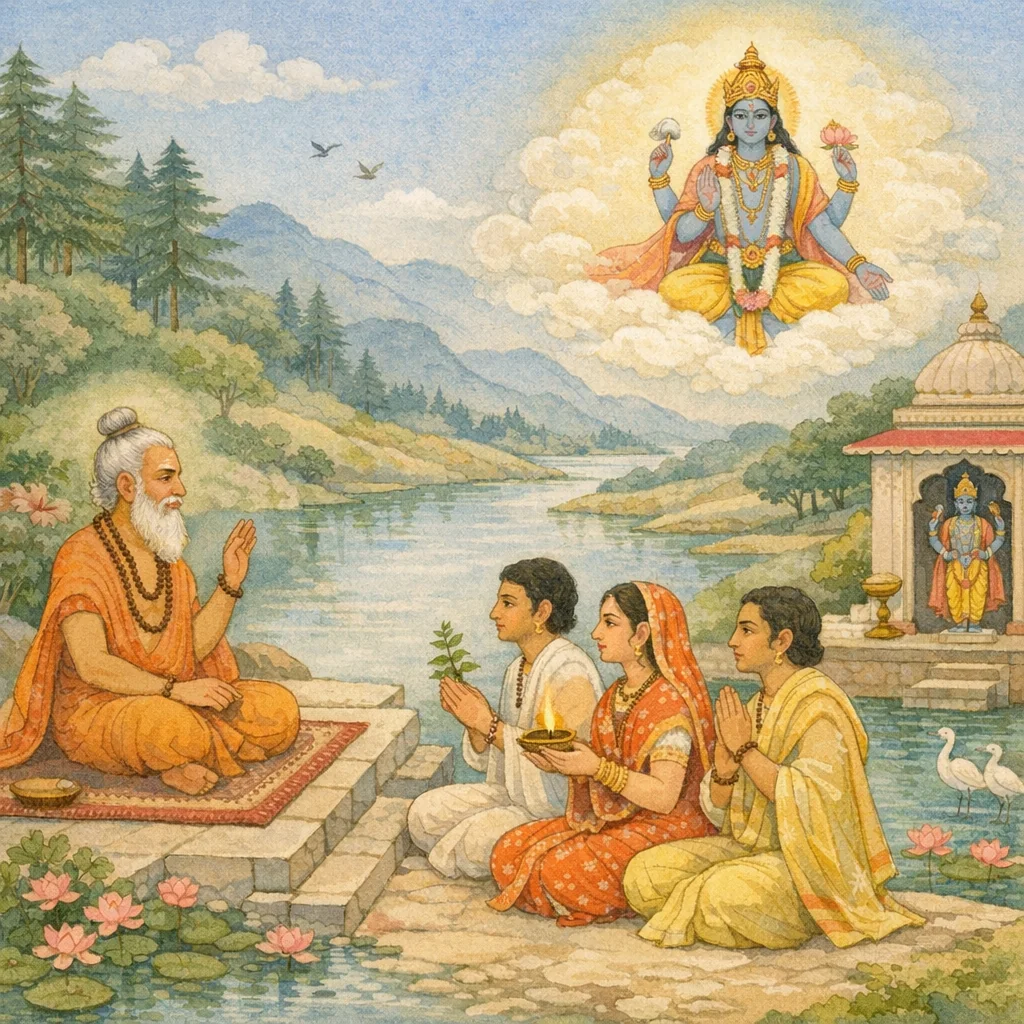
Adhyaya 29
Narrative of King Pṛthu: Chastising and Milking the Earth
PP.2.29 sets forth a paradigm of rājadharma through King Pṛthu’s confrontation with Earth (Vasundharā), who is depicted as withholding sustenance and thereby harming beings. The text declares that punitive force against a “tormentor of the world” is not sinful when exercised for the welfare of all. Earth, fearful, assumes the form of a cow, wounded by arrows, and submits to righteous rule. Pṛthu levels mountains and uneven land to restore order, then inaugurates prosperity by “milking” Earth—first drawing forth grains and food and establishing the sacrificial food-cycle that satisfies gods and ancestors and returns as rain and crops. The chapter then catalogs other “milkings” by many classes of beings—devas, Pitṛs, nāgas, asuras, yakṣas, rākṣasas, gandharvas, as well as mountains and trees—culminating in hymnic praise of Earth as the wish-fulfilling cosmic Mother, abundant like Mahālakṣmī. It ends with śravaṇa-phala: hearing this account purifies and leads to Viṣṇu’s realm.
Shlokas
Verse 1
पृथुरुवाच । हते चैव महापापे एकस्मिन्पापचारिणि । लोकाः सुखेन जीवंति साधवः पुण्यदर्शिनः
Pṛthu said: When that great sinner—one lone wrongdoer—has been slain, people live at ease, and the righteous, who discern merit, flourish.
Verse 2
तस्मादेकं प्रहर्तव्यं पापिष्ठं पापचेतनम् । तस्मात्त्वां हि हनिष्यामि सर्वसत्त्वप्रणाशिनीम्
Therefore, one must strike down this most wicked creature, evil-minded as it is. Therefore, I shall indeed kill you—you who are the destroyer of all beings.
Verse 3
त्वया बीजानि सर्वाणि लुप्तान्येतानि सांप्रतम् । ग्रासं कृत्वा स्थिरीभूत्वा प्रजां हत्वा क्व यास्यसि
By you, all these seeds have now been destroyed. Having devoured them and become firmly established, and after killing the creatures—where will you go?
Verse 4
हते पापे दुराचारे सुखं जीवंतिसाधवः । तस्मात्पापं प्रहंतव्यं सत्यमेवं न संशयः
When sin and wicked conduct are destroyed, the righteous live happily. Therefore sin must be struck down—this is the truth; there is no doubt.
Verse 5
पालितव्यं प्रयत्नेन यस्माद्धर्मः प्रवर्द्धते । भवत्या तु महत्पापं प्रजासंक्षयकारकम्
It must be protected with effort, for through it dharma increases. But by you a great sin is being committed—one that brings about the destruction of the people.
Verse 6
एकस्यार्थेन यो हन्यादात्मनो वा परस्य वा । लोकोपतापकं हत्वा न भवेत्तस्य पातकम्
If someone kills for the sake of another’s interest—whether for his own benefit or for another’s—then, having slain one who is a tormentor of the world, no sin accrues to him.
Verse 7
सुखमेष्यंति बहवो यस्मिंस्तु निहते शुभे । वसुधे निहते दुष्टे पातकं नोपपातकम्
When that auspicious one is slain, many will attain happiness. But when the wicked Vasudhā is slain, it is no sin at all—nor even a minor offence.
Verse 8
प्रजानिमित्तं त्वामेव हनिष्यामि न संशयः । यदि मे पुण्यसंयुक्तं वचनं न करिष्यति
For the sake of the people, I will strike you down—there is no doubt—if you do not carry out my righteous command.
Verse 9
जगतोऽस्य हितार्थाय साधु चैव वसुंधरे । हनिष्ये त्वां शितैर्बाणैर्मद्वाक्यात्तु पराङ्मुखीम्
O Vasundharā, Mother Earth, for the welfare of this world—and rightly so—I shall strike you with sharp arrows, since you have turned away from my command.
Verse 10
स्वीयेन तेजसा चैव पुण्यां त्रैलोक्यवासिनीम् । प्रजां चैव धरिष्यामि धर्मेणापि न संशयः
By my own spiritual radiance, I shall surely uphold this holy populace that dwells throughout the three worlds; and I shall sustain the people through dharma—of this there is no doubt.
Verse 11
मच्छासनं समास्थाय धर्मयुक्तं वसुंधरे । इमाः प्रजा आज्ञया मे संजीवय सदैव हि
O Earth, having taken up my rightful seat in accordance with dharma, sustain these creatures by my command—indeed, always.
Verse 12
एवं मे शासनं भद्रे अद्य यर्हि करिष्यसि । ततः प्रीतोऽस्मि ते नित्यं गोपायिष्यामि सर्वदा
O auspicious one, when you carry out this command of mine today, then I shall be ever pleased with you and will protect you at all times.
Verse 13
त्वामेव हि न संदेह अन्ये चैव नृपोत्तमाः । धेनुरूपेण सा पृथ्वी बाणांचितकलेवरा
Indeed, it is you—there is no doubt; and so too the other best of kings. That Earth, taking the form of a cow, had her body pierced and studded with arrows.
Verse 14
उवाचेदं पृथुं वैन्यं धर्माधारं महामतिम् । धरण्युवाच । तवादेशं महाराज सत्यपुण्यार्थसंयुतम्
Earth spoke these words to Pṛthu Vainya, the great-souled support of dharma: “O great king, your command is joined with truth, merit, and a noble purpose.”
Verse 15
प्रजानिमित्तमत्यर्थं विधास्यामि न संशयः । उद्यमेनापि पुण्येन उपायेन नरेश्वर
For the sake of the people, I shall surely accomplish this—without doubt—through righteous effort and by a fitting means, O king of men.
Verse 16
समारंभाः प्रसिद्ध्यंति पुण्याश्चैवाप्युपक्रमाः । उपायं पश्य राजेंद्र येन त्वं सत्यवान्भवेः
Endeavors succeed, and auspicious undertakings indeed bear fruit. Therefore, O king of kings, consider the means by which you may be true to your word, a speaker of truth.
Verse 17
धारयेथाः प्रजाश्चेमा येन सर्वाः प्रवर्द्धये । संलग्नाश्चोत्तमा बाणा ममांगे ते शिलाशिताः
“Uphold these creatures, so that all of them may flourish. Those excellent arrows, stone-tipped, are now lodged in my body.”
Verse 18
समुद्धर स्वयं राजंश्छल्यंति भृशमेव ते । समां कुरु महाराज तिष्ठेन्मयि यथा पयः
O king, lift it out yourself—your men are hurting me grievously. Make it level, O great king, so that the water may remain in me steadily.
Verse 19
सूत उवाच । धनुषोग्रेण ताञ्छैलान्नानारूपान्गुरूंस्तथा । उत्सारयंस्ततः सर्वां समरूपां चकार सः
Sūta said: With the tip of his bow he drove away those mountains—of many forms and immense weight—and then made the whole land even and uniform.
Verse 20
तदाप्रभृति ते शैला वृद्धिमापुर्द्विजोत्तमाः । तस्या अंगात्स्वयं बाणान्स्वकीयान्नृपनंदनः
From that time onward, O best of brāhmaṇas, those mountains began to increase in size. And the prince himself brought forth his own arrows from her very body (the Earth).
Verse 21
समुद्धृत्य ततो वैन्यः प्रीतेन मनसा तदा । गर्ताश्च कंदराश्चैव बाणाघातैः समीकृताः
Then Vainya, with a delighted mind, lifted up (the Earth); and the pits and ravines too were levelled by the impact of his arrows.
Verse 22
एवं पृथ्वद्यंसमां सर्वां चकार पुण्यवर्द्धनः । समीकृत्य महाभागो वत्सं तस्या व्यकल्पयत्
Thus Puṇyavardhana made the entire earth even and level; and that great-souled one, having set all in proper order, appointed a calf for her (the Earth).
Verse 23
मनुं स्वायंभुवं पूर्वं परिचिंत्य पुनः पुनः । अतीतेष्वथ सर्वेषु मन्वंतरेषु सत्तमाः
O best of the virtuous, having again and again reflected on the primordial Svāyambhuva Manu, one should contemplate him with regard to all the Manvantaras that have already passed.
Verse 24
विषमत्वं गता भूमिः पंथा नासीच्च कुत्रचित् । समानि विषमाण्येवं स्वयमासन्द्विजोत्तमाः
The earth had become uneven, and nowhere was there a proper path. Thus, in places level and in places rough, the best of the twice-born (brāhmaṇas) found themselves situated.
Verse 25
पूर्वं मनोश्चाक्षुषस्य प्राप्ते चैवांतरे तदा । जाते पूर्वविसर्गे च विषमे च धरातले
Formerly, when the Manvantara of Cākṣuṣa Manu had arrived, and when an earlier creation had come to pass—at a time when the surface of the earth was uneven—
Verse 26
ग्रामाणां च पुराणां च पत्तनानां तथैव च । देशानां क्षेत्रपन्नानां मर्यादा न हि दृश्यते
For villages, ancient settlements, and cities alike—and for regions and the tracts of sacred fields—their boundaries are not, indeed, seen.
Verse 27
कृषिर्नैव न वाणिज्यं न गोरक्षा प्रवर्तते । नानृतं भाषते कश्चिन्न लोभो न च मत्सरः
There is no farming, no trade, and no tending of cattle in practice; no one speaks falsehood, and there is neither greed nor envy.
Verse 28
नाभिमानं च वै पापं न करोति कदा किल । वैवस्वतस्य संप्राप्ते अंतरे द्विजसत्तम
Indeed, he never commits the sin of pride at any time, O best of twice-born; (this is said) in the interval when Vaivasvata has arrived (i.e., in the Vaivasvata Manvantara).
Verse 29
इति श्रीपद्मपुराणे पंचपंचाशत्सहस्रसंहितायां भूमिखंडे । पृथूपाख्याने एकोनत्रिंशोऽध्यायः
Thus ends the twenty-ninth chapter, the “Narrative of Pṛthu,” in the Bhūmi-khaṇḍa of the Śrī Padma Purāṇa, within the compilation of fifty-five thousand verses.
Verse 30
क्वचिद्भूमौ गिरौ क्वापि नदीतीरेषु वै तदा । कुंजेषु सर्वतीर्थेषु सागरस्य तटेषु च
Sometimes on open ground, sometimes on mountains, then upon riverbanks; in groves, at all sacred tīrthas, and also along the shores of the ocean.
Verse 31
निवासं चक्रिरे सर्वाः प्रजाः पुण्येन वै तदा । तासामाहारः संजातः फलमूलमधुस्तथा
Then, by virtue (puṇya), all the people established their dwellings; and their sustenance came to be fruits, roots, and honey as well.
Verse 32
महता कृच्छ्रेण तासामाहारश्च द्विजोत्तमाः । पृथुर्वैन्यः समालोक्य प्रजानां कष्टमेव हि
O best of brāhmaṇas, their sustenance was obtained only with great difficulty. Seeing the suffering of the people, Pṛthu Vainya beheld their plight.
Verse 33
स्वायंभुवो मनुर्वत्सः कल्पितस्तेन भूभुजा । स्वपाणिः कल्पितस्तेन पात्रमेवं महामते
O dear one, by that king Svāyambhuva Manu was appointed as the “calf”; and by him his own hand was appointed as the vessel—so it is, O great-minded one.
Verse 34
स पृथुः पुरुषव्याघ्रो दुदोह वसुधां तदा । सर्वसस्यमयं क्षीरं ससर्वान्नं गुणान्वितम्
Then Pṛthu—the tiger among men—milked the Earth, drawing forth a milk made of every kind of grain, complete as all food and endowed with excellent qualities.
Verse 35
तेन पुण्येन चान्नेन सुधाकल्पेन ताः प्रजाः । तृप्तिं नयंति देवान्वै प्रजाः पितॄंस्तथापरान्
By that meritorious food—nectar-like in its excellence—those people truly bring satisfaction to the gods, and likewise to the ancestors and to others as well.
Verse 36
प्रसादात्तस्य वैन्यस्य सुखं जीवंति ताः प्रजाः । देवेभ्यश्च पितृभ्यश्च दत्वा चान्नं प्रजास्ततः
By the grace of that king Vainya, those subjects live happily; and then the people, having offered food to the gods and to the ancestors, live in due order.
Verse 37
ब्राह्मणेभ्यो विशेषेणअतिथिभ्यस्तथैव च । पश्चाद्भुंजंति पुण्यास्ताः प्रजाः सर्वा द्विजोत्तमाः
After serving the brāhmaṇas—especially—and likewise the guests, those virtuous people, O best of the twice-born, eat only afterward.
Verse 38
यज्ञैश्चान्ये यजंत्येव तर्पयंति जनार्दनम् । तेन चान्नेन देवेशं तृप्तिं गच्छंति देवताः
Others indeed worship through sacrifices and thereby satisfy Janārdana; and by that food offered in sacrifice, the gods attain satisfaction in the Lord of the gods.
Verse 39
पुनर्वर्षति पर्जन्यः प्रेषितो माधवेन च । तस्मात्पुण्या महौषध्यः संभवंति सुपुण्यदाः
Then the rain-bearing cloud pours again, sent forth by Mādhava; from that arise sacred, mighty medicinal herbs, bestowing abundant merit.
Verse 40
सस्यजातानि सर्वाणि पृथुर्वैन्यः प्रजापतिः । तेनान्नेन प्रजाः सर्वा वर्तंतेऽद्यापि नित्यशः
All varieties of cultivated crops were brought forth by Pṛthu Vainya, the Prajāpati; and by that food all beings subsist—even to this day, continually.
Verse 41
ऋषिभिश्चैव मिलितैर्दुग्धा चेयं वसुंधरा । पुनर्विप्रैर्महाभाग्यैः सत्यवद्भिः सुरैस्तथा
Indeed, when the ṛṣis assembled together, this Earth was milked; and again by greatly fortunate, truth-speaking brāhmins, and likewise by the devas.
Verse 42
सोमो वत्सस्वरूपोभूद्दोग्धा देवगुरुः स्वयम् । ऊर्जं क्षीरं पयः कल्पं येन जीवंति चामराः
Soma became the calf in form, and the Guru of the devas himself became the milker. From that milking came nourishing milk—life-sustaining and fit for the age—by which the amara, the immortals, continue to live.
Verse 43
तेषां सत्येन पुण्येन सर्वे जीवंति जंतवः । सत्यपुण्ये प्रवर्तंते ऋषिदुग्धा वसुंधरा
By their truthfulness and sacred merit, all living beings survive. In truth and virtue the earth proceeds, nourished as though milked by the ṛṣis.
Verse 44
अथातः संप्रवक्ष्यामि यथा दुग्धा इयं धरा । पितृभिश्च पुरा वत्स विधिना येन वै तदा
Now I shall declare how this earth was once milked by the Pitṛs, the venerable ancestral beings, dear child, and by what prescribed method it was done in those ancient times.
Verse 45
सुपात्रं राजतं कृत्वा स्वधा क्षीरं सुधान्वितम् । परिकल्प्य यमं वत्सं दोग्धा चांतक एव सः
Having made a fine vessel of silver, and placing within it milk blended with the offering called svadhā and ambrosial essence, he appointed Yama as the calf; and Antaka (Death) himself became the milker.
Verse 46
नागैः सर्पैस्ततो दुग्धा तक्षकं वत्समेव च । अलाबुपात्रमादाय विषं क्षीरं द्विजोत्तमाः
Then the nāgas and serpents were milked, with Takṣaka made the calf; and the best of the twice-born, taking a gourd-vessel, drew forth poison as their milk.
Verse 47
नागानां तु तथा दोग्धा धृतराष्ट्रः प्रतापवान् । सर्पा नागा द्विजश्रेष्ठास्तेन वर्तंति चातुलाः
And for the Nāgas, the mighty Dhṛtarāṣṭra became the milker. O best of the twice-born, through him the serpents and Nāgas subsist, being greatly satisfied.
Verse 48
नागा वर्तंति तेनापि ह्यत्युग्रेण द्विजोत्तमाः । विषेण घोररूपेण सर्पाश्चैव भयानकाः
Therefore, O best of the twice-born, the nāgas too roam about, exceedingly fierce; and the serpents likewise are terrifying, with dreadful forms and venom.
Verse 49
तेनैव वर्तयंत्युग्रा महाकाया महाबलाः । तदाहारास्तदाचारास्तद्वीर्यास्तत्पराक्रमाः
By that alone they subsist—fierce beings, vast of body and great in strength; their food is of that kind, their conduct of that kind, their vigor of that kind, and their prowess of that kind.
Verse 50
अथातः संप्रवक्ष्यामि यथा दुग्धा वसुंधरा । असुरैर्दानवैः सर्वैः कल्पयित्वा द्विजोत्तमाः
Now I shall declare how the Earth was milked—after all the Asuras and Dānavas had made their preparations, O best among the twice-born.
Verse 51
पात्रमत्रान्नसदृशमायसं सर्वकामिकम् । क्षीरं मायामयं कृत्वा सर्वारातिविनाशनम्
Here an iron vessel was fashioned—matching the measure of the food and able to fulfill all desires; and the milk, made as if māyā by magic, became the destroyer of all foes.
Verse 52
तेषामभूत्स वै वत्सो विरोचनः प्रतापवान् । ऋत्विग्द्विमूर्द्धा दैत्यानां मधुर्दोग्धा महाबलः
Among them, the calf indeed was the illustrious Virocana, mighty in splendor; the priest for the Daityas was Dvimūrdhā, and the powerful Madhu was the milker.
Verse 53
तया हि मायया दैत्याः प्रवर्त्तंते महाबलाः । महाप्रज्ञा महाकाया महातेजः पराक्रमाः
Indeed, by that māyā the mighty Daityas are set into motion—of great intelligence, vast-bodied, blazing with power, and renowned for their valor.
Verse 54
तद्बलं पौरुषं तेषां तेन जीवंति दानवाः । तयैते माययाद्यापि सर्वमाया द्विजोत्तमाः
That strength—indeed their manly prowess—sustains the Dānavas; and by that very power of māyā they still, even today, delude all beings, O best of the twice-born.
Verse 55
प्रवर्तंते मितप्रज्ञास्ते तदेषामिदं बलम् । तथा तु दुग्धा यक्षैः सा सर्वाधारासु मेदिनी
Those of measured understanding set things in motion—this indeed is their strength. In the same way, the Earth, the support of all, was then milked by the Yakṣas.
Verse 56
इति शुश्रुम विप्रेंद्राः पुराकल्पे महात्मभिः । अंतर्धानमयं क्षीरमयस्पात्रे सुविस्तरे
Thus we heard, O best of brāhmaṇas, from great souls in an ancient age: a vessel made of milk, broad and well-spread, endowed with the power of concealment (invisibility).
Verse 57
वैश्रवणो महाप्राज्ञस्तदा वत्सः प्रकल्पितः । मणिधरस्य पिता पुण्यः प्राज्ञो बुद्धिमतां वरः
Then Vaiśravaṇa—of great wisdom—was appointed as Vatsa; the virtuous father of Maṇidhara, discerning and foremost among the intelligent.
Verse 58
दोग्धा रजतनाभस्तु तस्याश्चासीन्महामतिः । सर्वज्ञः सर्वधर्मज्ञो यक्षराजसुतो बली
Its milker was Rajatanābha; and there was also a great-minded one—omniscient, knower of all dharmas—Bali, the powerful son of the king of the Yakṣas.
Verse 59
अष्टबाहुर्महातेजा द्विशीर्षः सुमहातपाः । यक्षावर्तंत तेनापि सर्वदैव द्विजोत्तमाः
He was eight-armed, radiant with mighty splendor, and two-headed—endowed with formidable tapas. Because of him, O best of the twice-born (brāhmaṇas), the Yakṣas too kept ceaseless watch, ever moving on their rounds.
Verse 60
पुनर्दुग्धा इयं पृथ्वी राक्षसैश्च महाबलैः । तथा चैषा पिशाचैश्च सातुरैर्दग्धवारिभिः
Again this Earth has been “milked dry” by the mighty Rākṣasas, and likewise by the Piśācas—afflicted and parched, as though her waters had been burnt away.
Verse 61
उत्प्लुतं नृकपालं तं शावपात्रमयः कृतम् । सुप्रजां भोक्तुकामास्ते तीव्रकोपपराक्रमाः
That human skull sprang up before them and was fashioned into a vessel, a corpse-bowl. They—fierce with wrath and bold in assault—stood there, longing to consume the noble woman.
Verse 62
दोग्धा रजतनाभस्तु तेषामासीन्महाबलः । सुमाली नाम वत्सश्च शोणितं क्षीरमेव च
Among them, the mighty Rajatanābha served as the milker, and the calf was named Sumālī. What was drawn forth was blood—indeed, blood in place of milk.
Verse 63
रक्षांसि यातुधानाश्च पिशाचाश्च महाबलाः । यक्षास्तेन च जीवंति भूतसङ्घाश्च दारुणाः
By that do the mighty Rākṣasas, the Yātudhānas, and the Piśācas live; so too the Yakṣas, and the dreadful hosts of Bhūtas.
Verse 64
गंधर्वैरप्सरोभिश्च पुनर्दुग्धा वसुंधरा । कृत्वा वत्सं सुविद्वांसं तैश्च चित्ररथं पुनः
Again the Earth was milked by the Gandharvas and the Apsarases; and, making the most learned one their calf, they milked her once more—together with Citraratha.
Verse 65
दुदुहुः पद्मपात्रे तु गांधर्वं गीतसंकुलम् । सुरुचिर्नाम गंधर्वस्तेषामासीन्महामतिः
Into a lotus-cup they poured forth the celestial Gandharva music, abundant with song. Among them was a Gandharva named Suruci, a man of great intelligence.
Verse 66
दोग्धा पुण्यतमश्चैव तस्याश्च द्विजसत्तमाः । शुचिगीतं महात्मानः सुक्षीरं दुदुहुस्तदा
Then the most meritorious milkman, and the best of the twice-born—those great-souled ones—milked from her at that time excellent milk, pure and sweetly sung.
Verse 67
गंधर्वास्तेन जीवंति अन्याश्चाप्सरसस्तथा । पर्वतैश्च महापुण्यैर्दुग्धा चेयं वसुंधरा
By that nectar-like essence the Gandharvas live, and so too the Apsarases. And by the greatly meritorious mountains, this Earth has been, as it were, milked to yield her riches.
Verse 68
रत्नानि विविधान्येव ओषधीश्चामृतोपमाः । वत्सश्चैव महाभागो हिमवान्परिकल्पितः
Various kinds of jewels, and medicinal herbs comparable to nectar, and also the greatly fortunate calf—thus was Himavān (the Himalaya) duly appointed.
Verse 69
मेरुर्दोग्धा च संजातः पात्रं कृत्वा तु शैलजम् । तेन क्षीरेण संवृद्धाः शैलाः सर्वे महौजसः
Mount Meru became the milker, and a vessel born of the mountain was fashioned; nourished by that milk, all the mountains grew exceedingly mighty.
Verse 70
पुनर्दुग्धा महावृक्षैः पुण्यैः कल्पद्रुमादिभिः । पालाशं पात्रामानिन्युश्छिन्नदग्धप्ररोहणम्
Milked once again by the sacred great trees—such as the wish-fulfilling kalpa-trees—they brought forth a vessel of palāśa-wood, sprouting anew even after being cut down and burnt.
Verse 71
शालो दुदोह पुष्पांगः प्लक्षो वत्सोऽभवत्तदा । गुह्यकैश्चारणैः सिद्धैर्विद्याधरगणैस्तदा
Then the Śāla tree was milked, with Puṣpāṅga acting as the milker; and at that time the Plakṣa tree became the calf—while hosts of Guhyakas, Cāraṇas, Siddhas, and Vidyādharas were present.
Verse 72
दुग्धा चेयं सर्वधात्री सर्वकामप्रदायिनी । यं यमिच्छंति ये लोकाः पात्रवत्सविशेषणैः
This (cow) yields milk—the universal nourisher, the giver of every desired boon. Whatever people wish for, that indeed they obtain, according to the distinctions of the worthy vessel and the calf.
Verse 73
तैस्तैस्तेषां ददात्येव क्षीरं सद्भावमीदृशम् । इयं धात्री विधात्री तु इयं श्रेष्ठा वसुंधरा
To each and every one, she indeed gives milk—such is her benevolent disposition. This Earth is the sustainer and the ordainer; this Vasuṃdharā is the most excellent.
Verse 74
सर्वकामदुघा धेनुरियं पुण्यैरलंकृता । इयं ज्येष्ठा प्रतिष्ठा तु इयं सृष्टिरियं प्रजा
This is the wish-fulfilling cow, adorned with merits. She is indeed the eldest foundation; she is creation itself—she is the progeny, all beings.
Verse 75
पावनी पुण्यदा पुण्या सर्वसस्य प्ररोहिणी । चराचरस्य सर्वस्य प्रतिष्ठा योनिरेव च
She is the purifier—bestower of merit and herself holy—causing all crops to sprout. She is the foundation of all that moves and all that is still, and indeed the very womb, the source of everything.
Verse 76
महालक्ष्मीरियं विद्या सर्वविश्वमयी सदा । सर्वकामदुघा दोग्ध्री सर्वबीजप्ररोहिणी
This knowledge is Mahālakṣmī herself—ever pervading the whole universe; she is the milker that yields all desires, and the one who makes every seed sprout forth.
Verse 77
सर्वेषां श्रेयसां माता सर्वलोकधरा इयम् । पंचानामपि भूतानां प्रकाशो रूपमेव च
She is the mother of all that is auspicious; she upholds all the worlds. For the five elements too, she is the very radiance and the very form.
Verse 78
असीदियं समुद्रांता मेदिनीति परिश्रुता । मधुकैटभयोः कृत्स्ना मेदसा समभिप्लुता
This earth, bounded by the ocean, was indeed famed as ‘Medinī’; for it was wholly inundated with the fat (medas) of Madhu and Kaiṭabha.
Verse 79
तेनेयं मेदिनी नाम प्रोच्यते ब्रह्मवादिभिः । ततोभ्युपगमात्प्राज्ञ पृथोर्वैन्यस्य सत्तमाः
Therefore this earth is called Medinī by the expounders of Brahman; and, O wise one, because she accepted him, the best of men know her in connection with Pṛthu, the son of Vena.
Verse 80
दुहितृत्वमनुप्राप्ता देवी पृथ्वीति चोच्यते । तेन राज्ञा द्विजश्रेष्ठाः पालितेयं वसुंधरा
Having attained the status of a daughter, the goddess is called ‘Pṛthvī’. O best of the twice-born, by that king this Vasundharā (Earth) was protected.
Verse 81
ग्रामाधारं गृहाणां च पुरपत्तनमालिनी । सस्याकरवती स्फीता सर्वतीर्थमयी द्विजाः
O twice-born ones, it is the very support of villages and households, adorned with cities and market-towns; rich in fields and mines, prosperous—and embodying the sanctity of all sacred pilgrimage places.
Verse 82
एवं वसुमती देवी सर्वलोकमयी सदा । एवं प्रभावो राजेंद्रः पुराणे परिपठ्यते
Thus, the goddess Vasumatī (Earth) is ever pervaded by all the worlds. Thus, O best of kings, her greatness is recited in the Purāṇa.
Verse 83
पृथुर्वैन्यो महाभागः सर्वकर्मप्रकाशकः । यथा विष्णुर्यथा ब्रह्मा यथा रुद्रः सनातनः
Pṛthu, the son of Vena, was greatly fortunate, a revealer and illuminator of all righteous actions—like Viṣṇu, like Brahmā, like the eternal Rudra.
Verse 84
नमस्कार्यास्त्रयो देवा देवाद्यैर्ब्रह्मवादिभिः । ब्राह्मणैरृषिभिः सर्वैर्नमस्कार्यो नृपोत्तमः
The three gods are worthy of reverent salutation, as are the foremost among the devas and the expounders of Brahman. Likewise, all Brāhmaṇas and Ṛṣis are to be saluted—and so too the best of kings is worthy of salutation.
Verse 85
वर्णानामाश्रमाणां यः स्थापकः सर्वलोकधृक् । पार्थिवैश्च महाभागैः पार्थिवत्वमिहेप्सुभिः
He who establishes the social orders (varṇas) and the stages of life (āśramas), who upholds all worlds—by fortunate kings and other eminent rulers desiring sovereignty in this world, he is to be sought and honoured.
Verse 86
आदिराजो नमस्कार्यः पृथुर्वैन्यः प्रतापवान् । धनुर्वेदार्थिभिर्योधैः सदैव जयकांक्षिभिः
The primordial king, the mighty Pṛthu Vainya—worthy of reverence—was ever surrounded by warriors devoted to the science of archery (dhanurveda), always eager for victory.
Verse 87
नमस्कार्यो महाराजो वृत्तिदाता महीभृताम् । एवं पात्रविशेषाश्च मया ख्याता द्विजोत्तमाः
The great king—who grants livelihoods to the rulers of the earth—is worthy of reverent salutation. Thus, O best of the twice-born, I have explained the particular types of worthy recipients (for gifts).
Verse 88
वत्सानां सुविशेषाश्च दोग्धॄणां भवदग्रतः । क्षीरस्यापि विशेषं तु यथोद्दिष्टं हि भूभुजा
In your presence, O king, the special varieties of calves and the milkers shall be described, and also the distinguishing qualities of the milk—exactly as they were set forth by the ruler of the earth.
Verse 89
समाख्यातं तथाग्रे च भवतां वै यथार्थतः । धन्यं यशस्यमारोग्यं पुण्यं पापप्रणाशनम्
It has been rightly explained to you, exactly as it truly is. It is blessed, bestows fame, grants health, is full of merit, and destroys sins.
Verse 90
पृथोर्वैन्यस्य चरितं यः शृणोति द्विजोत्तमाः । तस्य भागीरथी स्नानमहन्यहनि जायते
O best of the twice-born, whoever listens to the account of Pṛthu Vainya—for him, day after day, arises the merit of bathing in the Bhāgīrathī (Gaṅgā).
Verse 91
सर्वपापविशुद्धात्मा विष्णुलोकं प्रयाति सः
Pure in spirit, cleansed of all sins, he attains the realm of Viṣṇu.