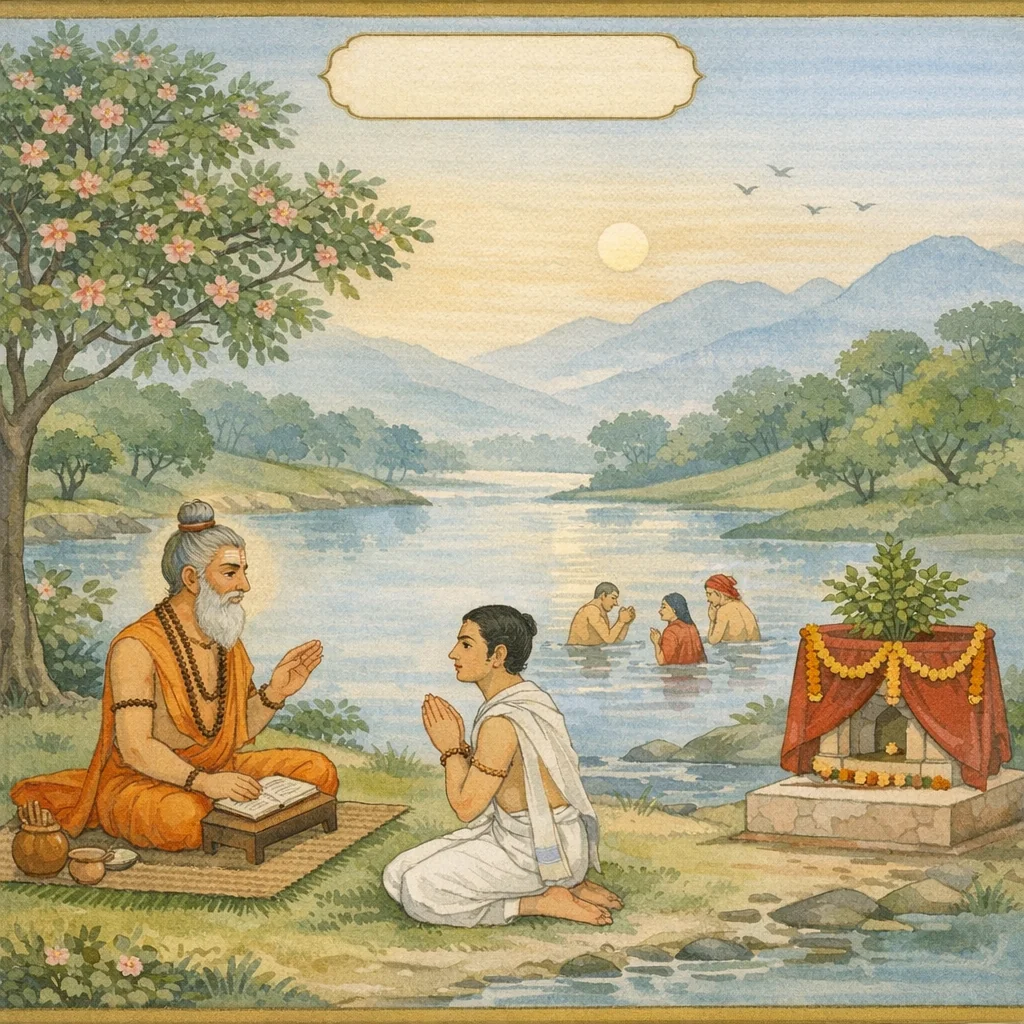
Adhyaya 73
Yayāti’s Proclamation: Spreading the Nectar of the Divine Name (All-Vaiṣṇava Gift)
Pippala asks Sukarma what Yayāti did after Indra’s messenger departed. Sukarma replies that the king’s son reflected, then summoned envoys and commanded them to proclaim, across lands and islands, a dharma-aligned injunction. The proclamation urges exclusive worship of Madhusūdana through bhakti, together with jñāna and meditation, ritual worship, tapas, yajña, and dāna, joined to renunciation of sense-objects. Viṣṇu is to be perceived everywhere—in the dry and the moist, in moving and unmoving beings, in clouds and earth, and within one’s own body as life itself. Gifts are to be offered to Nārāyaṇa with hospitality and offerings to the pitṛs; disobedience to the command is censured. The envoys spread this order as the highest “nectar,” especially the nectar of the divine Name—Keśava, Śrīnivāsa, Padmanātha, Rāma—whose recitation removes faults and culminates in liberation for the disciplined Vaiṣṇava student.
Shlokas
Verse 1
पिप्पल उवाच । गते तस्मिन्महाभागे दूत इंद्रस्य वै पुनः । किं चकार स धर्मात्मा ययातिर्नहुषात्मजः
Pippala said: When that greatly fortunate one had departed, the messenger of Indra came again. What then did that righteous Yayāti, the son of Nahuṣa, do?
Verse 2
सुकर्मोवाच । तस्मिन्गते देववरस्य दूते स चिंतयामास नरेंद्रसूनुः । आहूय दूतान्प्रवरान्स सत्वरं धर्मार्थयुक्तं वच आदिदेश
Sukarma said: When the messenger of the excellent deity had departed, the king’s son began to reflect. Quickly summoning his foremost envoys, he issued instructions in words aligned with dharma and practical purpose.
Verse 3
गच्छंतु दूताः प्रवराः पुरोत्तमे देशेषु द्वीपेष्वखिलेषु लोके । कुर्वंतु वाक्यं मम धर्मयुक्तं व्रजंतु लोकाः सुपथा हरेश्च
Let the foremost messengers go forth, O best of cities, to every land and island throughout the whole world. Let them proclaim my words, aligned with dharma, so that people may walk the good path—the path of Hari as well.
Verse 4
भावैः सुपुण्यैरमृतोपमानैर्ध्यानैश्च ज्ञानैर्यजनैस्तपोभिः । यज्ञैश्च दानैर्मधुसूदनैकमर्चंतु लोका विषयान्विहाय
With pure and greatly meritorious devotional feelings, like nectar, through meditation and spiritual knowledge, through worship and austerities, through yajñas and gifts, let people abandon sense-objects and worship Madhusūdana alone.
Verse 5
सर्वत्र पश्यंत्वसुरारिमेकं शुष्केषु चार्द्रेष्वपि स्थावरेषु । अभ्रेषु भूमौ सचराचरेषु स्वीयेषु कायेष्वपि जीवरूपम्
May they behold everywhere the one Enemy of the asuras (Viṣṇu): in the dry and in the moist, even among the immovable; in the clouds and on the earth, among all that moves and does not move, and even within their own bodies as the very form of life.
Verse 6
देवं तमुद्दिश्य ददंतु दानमातिथ्यभावैः परिपैत्रिकैश्च । नारायणं देववरं यजध्वं दोषैर्विमुक्ता अचिराद्भविष्यथ
Direct your gifts toward that Divine One: give in charity with the spirit of hospitality and with offerings to the ancestors. Worship Nārāyaṇa, the best of the gods; freed from faults, you will soon be purified.
Verse 7
यो मामकं वाक्यमिहैव मानवो लोभाद्विमोहादपि नैव कारयेत् । स शास्यतां यास्यति निर्घृणो ध्रुवं ममापि चौरो हि यथा निकृष्टः
Whoever, out of greed or delusion, does not carry out my command here and now—such a merciless one will surely be punished; for he is like a vile thief, even against me.
Verse 8
आकर्ण्य वाक्यं नृपतेश्च दूताःसंहृष्टभावाः सकलां च पृथ्वीम् । आचख्युरेवं नृपतेः प्रणीतमादेशभावं सकलं प्रजासु
Having heard the king’s words, the messengers—filled with joy—traveled across the whole earth and thus proclaimed among all people the complete purport of the king’s issued command.
Verse 9
विप्रादिमर्त्या अमृतं सुपुण्यमानीतमेवं भुवि तेन राज्ञा । पिबंतु पुण्यं परिवैष्णवाख्यं दोषैर्विहीनं परिणाममिष्टम्
Thus, upon the earth, that king brought this supremely meritorious nectar. Let brahmins and all other mortals drink this holy gift, called the “all-Vaiṣṇava” offering—faultless and yielding the desired fruit.
Verse 10
श्रीकेशवं क्लेशहरं वरेण्यमानंदरूपं परमार्थमेवम् । नामामृतं दोषहरं सुराज्ञा आनीतमस्त्येव पिबंतु लोकाः
Let people drink the nectar of the Name—Śrī Keśava—who removes affliction, who is supremely worthy, whose very nature is bliss, and who is the highest Truth. This Name-nectar, which destroys faults, has indeed been brought by the divine king.
Verse 11
सखड्गपाणिं मधुसूदनाख्यं तं श्रीनिवासं सगुणं सुरेशम् । नामामृतं दोषहरं सुराज्ञा आनीतमस्त्येव पिबंतु लोकाः
May people drink the nectar of His Name—of that Śrīnivāsa, Lord of the gods, known as Madhusūdana, sword in hand, the manifest Supreme (saguṇa). This Name-nectar that removes faults has been brought to the world by the gods’ command.
Verse 12
श्रीपद्मनाथं कमलेक्षणं च आधाररूपं जगतां महेशम् । नामामृतं दोषहरं सुराज्ञा आनीतमस्त्येव पिबंतु लोकाः
The holy Name—nectar-like—of Śrī Padmanātha, the lotus-eyed Lord, the very support of the worlds, the great Lord (Maheśa), which removes faults, has indeed been brought by the gods’ command; let all people drink of it.
Verse 13
पापापहं व्याधिविनाशरूपमानंददं दानवदैत्यनाशनम् । नामामृतं दोषहरं सुराज्ञा आनीतमस्त्येव पिबंतु लोकाः
It removes sin, takes the form of destroying disease, bestows bliss, and destroys the Dānavas and Daityas. This nectar of the Divine Name, which removes faults—brought by the command of the gods—has indeed arrived; let the people drink it.
Verse 14
यज्ञांगरूपं चरथांगपाणिं पुण्याकरं सौख्यमनंतरूपम् । नामामृतं दोषहरं सुराज्ञा आनीतमस्त्येव पिबंतु लोकाः
The nectar of the Name is here—brought by the command of the gods—pure as sacrifice itself, bearing the discus in its hand, a source of merit, bestowing happiness, and infinite in form; let the people indeed drink of it, for it removes all faults.
Verse 15
विश्वाधिवासं विमलं विरामं रामाभिधानं रमणं मुरारिम् । नामामृतं दोषहरं सुराज्ञा आनीतमस्त्येव पिबंतु लोकाः
Let people drink this nectar of the Name—brought by the king of the gods—which is the spotless refuge of the universe, the final rest, known as “Rāma,” the delighting Lord, Murāri, and the remover of faults.
Verse 16
आदित्यरूपं तमसां विनाशं बंधस्यनाशं मतिपंकजानाम् । नामामृतं दोषहरं सुराज्ञा आनीतमस्त्येव पिबंतु लोकाः
It is sun-formed, the destroyer of darkness; it shatters bondage and causes the lotus of understanding to bloom. This nectar of the Divine Name, which removes faults, has indeed been brought by the king of the gods—let the worlds drink it.
Verse 17
नामामृतं सत्यमिदं सुपुण्यमधीत्य यो मानव विष्णुभक्तः । प्रभातकाले नियतो महात्मा स याति मुक्तिं न हि कारणं च
This nectar of the Name is true and greatly meritorious. The person who studies it—being a devotee of Viṣṇu—disciplined and self-controlled in the early morning, that great soul attains liberation; there is no doubt about it.
Verse 73
इति श्रीपद्मपुराणे भूमिखंडे वेनोपाख्याने पितृतीर्थवर्णने ययाति । चरिते त्रिसप्ततितमोऽध्यायः
Thus ends the seventy-third chapter of the Bhūmi-khaṇḍa of the Śrī Padma Purāṇa, in the narrative of Vena, describing the Pitṛ-tīrtha, within the account of Yayāti.