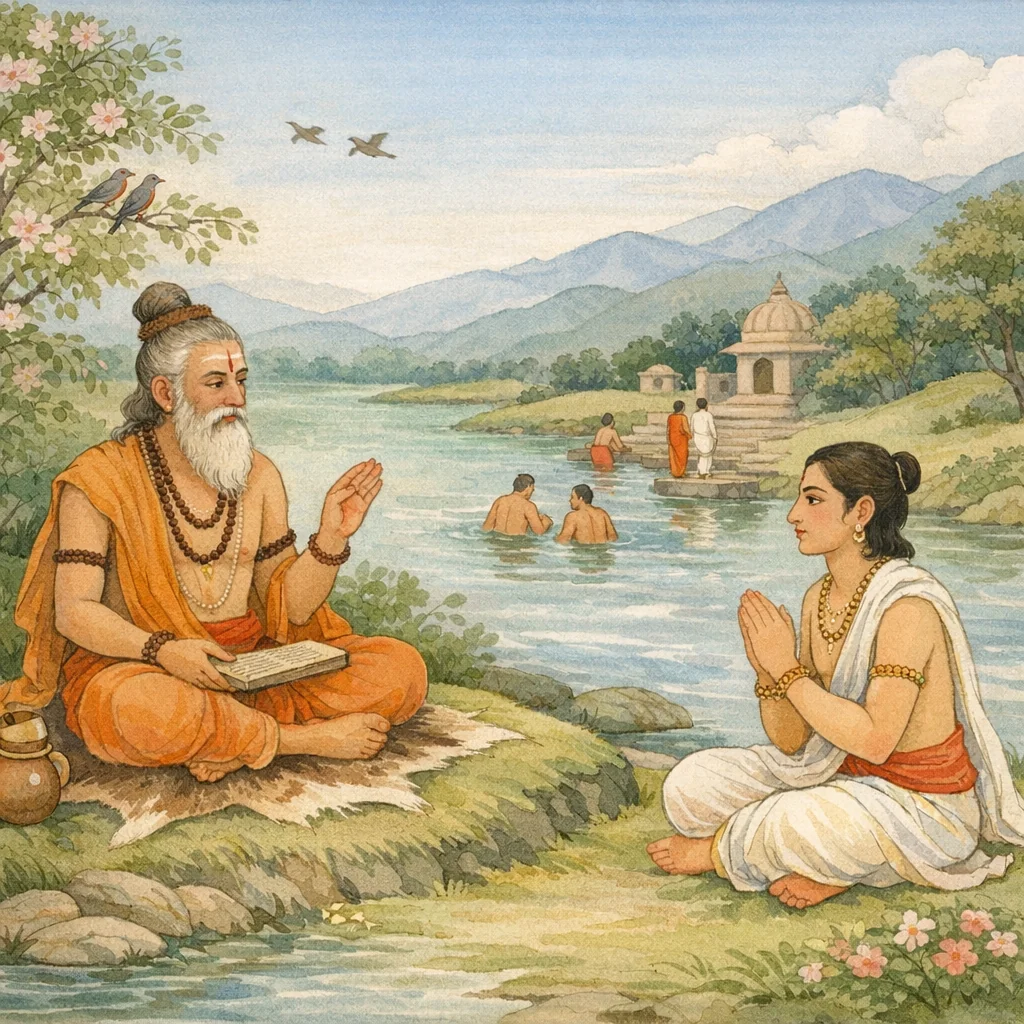
Adhyaya 7
Self-Knowledge and the Allegory of the Five Elements & Senses (Karma, Association, and Rebirth)
The chapter begins with grief and the breaking of worldly ties, then turns to metaphysical consolation: Kaśyapa and Mahādeva (Śiva) teach that earthly kinship is impermanent, and that one becomes one’s own refuge through dharma and right conduct. A moral law is stressed—hostility breeds enemies, friendliness breeds friends—and, like a farmer’s seed, action (karma) yields fruit of its own kind. The narrative then becomes an allegory: Ātman meets five radiant “brahmins,” revealed as the five constituents/elements and the functions of the senses. Jñāna (Wisdom) and Dhyāna (Meditation) warn that even association with these roots of suffering leads to bondage and rebirth; yet association occurs. The Self becomes embodied, enters the womb, and laments delusion and pain, while the fivefold beings justify their role in embodiment and seek friendship with Ātman, showing how attachment and identification propel saṃsāra.
Shlokas
Verse 1
दितिरुवाच । सत्यमुक्तं त्वया नाथ सर्वमेव न संशयः । भर्तृस्नेहं परित्यज्य गता सापत्न्यजं द्विज
Diti said: “What you have spoken is true, O lord; of all this there is no doubt. Having abandoned affection for her husband, she has gone to the son born of a co-wife, O twice-born one.”
Verse 2
अभिमानेन दुःखेन मानभंगेन सत्तम । महादुःखेन संतप्ता करिष्ये प्राणमोचनम्
O best of men, tormented by sorrow born of pride and by the shattering of my honor, scorched by overwhelming grief, I shall end my life.
Verse 3
कश्यप उवाच । श्रूयतामभिधास्यामि यथा शांतिर्भविष्यति । न कः कस्य भवेत्पुत्रो न माता न पिता शुभे
Kaśyapa said: “Listen—I shall explain how peace will come to be. O auspicious one, no one belongs to anyone as ‘son’; in the ultimate sense there is neither ‘mother’ nor ‘father.’”
Verse 4
न भ्राता बांधवः कस्य न च स्वजनबांधवाः । एवं संसारसंबंधो मायामोहसमन्वितः
For whom is a brother truly a lasting kinsman? Nor are relatives and one’s own people enduring bonds. Thus the ties of worldly existence are entangled with māyā and delusion.
Verse 5
स्वयमेव पिता देवि स्वयं माताथ बांधवाः । स्वयं स्वजनवर्गश्च स्वयं धर्मः सनातनः
O Goddess, one becomes one’s own father; one becomes one’s own mother and kinsmen. One becomes one’s own circle of relatives, and one becomes one’s own eternal Dharma.
Verse 6
आचारेण नरो देवि सुखित्वमुपजायते । अनाचारेण पापेन नाशं याति तथा ध्रुवम्
O Goddess, by proper conduct a person attains happiness; but through sinful misconduct, one surely goes to ruin.
Verse 7
क्रूरयोनिं प्रयात्येवं नरो देवि न संशयः । कर्मणा सत्यहीनेन महापापेन मोहतः
O Goddess, there is no doubt: thus a man is reborn into a cruel womb, driven by delusion, through a great sin—deeds that are devoid of truth.
Verse 8
रिपुत्वे वर्त्तते मर्त्यः प्राणिनां नित्यसंस्थितः । रिपवस्तस्य वर्तन्ते यत्र तत्र न संशयः
A mortal who constantly abides among living beings in a hostile disposition will surely have enemies everywhere—of this there is no doubt.
Verse 9
मैत्रेण वर्तते मर्त्यो यदा लोके प्रिये शुभे । तदा तस्य भवंत्येव मित्राः सर्वत्र भामिनि
O beloved auspicious lady, when a mortal conducts himself in the world with friendliness, then—O radiant one—friends surely arise for him everywhere.
Verse 10
कृषिकारो यदा देवि छन्नं बीजं सुसंस्थितम् । यादृशं तु भवत्येव तादृशं फलमश्नुते
O Goddess, when a farmer carefully covers and properly sets the seed, he indeed reaps a fruit exactly corresponding to what has been sown.
Verse 11
तथा तव च पुत्रैश्च साधुभिः स्पर्धितं सह । कर्मणस्तस्य तत्प्राप्तं फलं भुंक्ष्व सुसंस्थितम्
Likewise, you—together with your sons and the virtuous—strove in rivalry. Therefore, being firmly established, partake of the fruit that has now come to you as the result of that deed.
Verse 12
तव पुत्रा महाभागे तपः शांति विवर्जिताः । तेन पापेन ते सर्वे पतिता वै महत्पदात्
O greatly fortunate one, your sons are bereft of austerity and inner peace; by that sin they have all indeed fallen from the exalted state.
Verse 13
एवं ज्ञात्वा शमं गच्छ मुंच दुःखं सुखं तथा । कस्य पुत्राश्च मित्राणि कस्य स्वजन बांधवाः
Knowing thus, go to inner peace; release both sorrow and happiness. Whose are the sons and friends, and whose indeed are one’s own people and relatives?
Verse 14
आत्मकर्मानुसारेण सुखं जीवंति जंतवः । परार्थे चिंतनं देवि तत्त्वज्ञानेन पंडिताः
Creatures live happily according to their own actions (karma). But, O Goddess, the wise—through true knowledge of reality—turn their contemplation toward the good of others.
Verse 15
न कुर्वंति महात्मानो व्यर्थमेव न संशयः । पंचभूतात्मकं कायं केवलं संधिजर्जरम्
Great-souled persons do not engage in what is futile—of this there is no doubt—for the body is made of the five elements and is merely a structure worn down at its joints.
Verse 16
आत्ममित्रं कृतं तेन सर्वं देवि सुखाशया । आत्मा नाम महापुण्यः सर्वगः सर्वदर्शकः
O Goddess, in the hope of happiness he made his own Self his friend in every way. The Self indeed is supremely meritorious—present everywhere and seeing all.
Verse 17
सर्वसिद्धिस्तु सर्वात्मा सात्विकः सर्वसिद्धिदः । एवं सर्वमयो देवि भ्रमत्येको निरञ्जनः
He is truly the fulfillment of all siddhis, the Self of all, pure in sattva, and the giver of every perfection. Thus, O Goddess, though he pervades all as all, the One stainless Reality seems to wander.
Verse 18
भ्रमता निर्जने येन मूर्तिमंतो द्विजोत्तमाः । चत्वारो दर्शिताः पुण्या मूर्तिमंतो महौजसः
As he wandered in a lonely place, four supremely holy brahmins—radiant and embodied—were shown to him, mighty in splendor and manifest in form.
Verse 19
पंचमः श्वसनश्चैव पूर्वाणां मित्रमेव च । अथो आत्मा समायातो ज्ञानसाहाय्यमेव वा
The fifth is the Breath (Prāṇa) itself, truly the friend of those who came before; or else the Self has arrived—indeed, as an aid to knowledge.
Verse 20
स तान्दृष्ट्वा महात्मा वै ज्ञानमात्मा समब्रवीत् । ज्ञान पश्य अमी पंच मंत्रयंतः परस्परम्
Seeing them, the great-souled one addressed Jñāna and said: “O Jñāna, look—these five are consulting with one another.”
Verse 21
एतान्गत्वाब्रवीहि त्वं यूयं क इति पृच्छ ह । ज्ञानं वाक्यं परं श्रुत्वा सार्थं तस्य महात्मनः
Go to them and speak; ask, “Who are you?” Having heard the supreme, wisdom-filled words of that great-souled one, (learn) their true purpose.
Verse 22
तदाहात्मानमाराध्यमेतैः किं ते प्रयोजनम् । तत्त्वतो ब्रूहि मे देव सदा शुद्धोसि सर्वदा
Then he said: “With these, what purpose have you in worshipping your own Self? Tell me the truth, O Lord—for you are ever pure, always.”
Verse 23
आत्मोवाच । एते पंच महाभागा रूपवंतो मनस्विनः । गत्वा संदर्शयाम्येनानाभाष्ये ज्ञान श्रूयताम्
The Self said: “These five are greatly fortunate—handsome and strong-minded. I shall go and show them to you, and I shall address them. Let this teaching be heard.”
Verse 24
भव्यानेतान्प्रवक्ष्यामि पंचमीं गतिमागतान् । दूतत्वं गच्छ भो ज्ञान कुशलो दूतकर्मणि
“I shall now describe these noble ones who have attained the fifth state. Go, O Jñāna, and take up the role of a messenger—you are skilled in the duties of a messenger.”
Verse 25
ज्ञानमुवाच । त्वमात्मञ्छृणु मे वाक्यं सत्यं सत्यं वदाम्यहम् । एतेषां संगतिस्तात कार्या नैव त्वया कदा
Jñāna said: “O Self, listen to my words. I speak the truth—truth indeed. You must never, at any time, associate with these people.”
Verse 26
पंचानामपि शुद्धात्मन्न कार्यं शुभमिच्छता । भवतः संगतिं मोह इच्छत्येष महामते
O pure-souled one, for a person who seeks what is auspicious, association with even these five is not to be pursued. Yet this deluded one desires your company, O great-minded sage.
Verse 27
आत्मोवाच । एतेषां संगतिं ज्ञान कस्माद्वारयते भवान् । तन्मे त्वं कारणं ब्रूहि याथातथ्येन पंडित
The Self said: “O wise one, why do you, though endowed with knowledge, restrain association with these people? Tell me the cause of this—truthfully and as it truly is, O learned one.”
Verse 28
ज्ञानमुवाच । एतेषां संगमात्रात्तु महद्दुःखं भविष्यति । दुःखमूला हि पंचैव शोकसंतापकारकाः
Jñāna said: “From mere association with them, great suffering will arise. Indeed, there are five that are the very roots of suffering, bringing forth grief and torment.”
Verse 29
एवमस्तु महाप्राज्ञ करिष्ये वचनं तव । ज्ञानमाभाष्य स ह्यात्मा ध्यानेन सह संगतः
“So be it, O great sage; I shall act according to your word.” Having spoken of true knowledge, the inner Self became united with meditation (dhyāna).
Verse 30
कश्यप उवाच । ततः पंचैव ते तत्राद्राक्षुरात्मानमेव तम् । बुद्धिमूचुः समाहूय संगच्छात्मानमेव हि
Kaśyapa said: Then those five saw there none other than their very Self. Summoning their buddhi (understanding), they said: “Indeed, unite with the Self alone.”
Verse 31
दूतत्वं कुरु कल्याणि अस्माकमात्मना सह । पंचतत्त्वा महात्मानो विश्वस्यधारकाः शुभाः
“O auspicious one, take up the office of our messenger, together with our very selves. Those great-souled ones—formed of the five elements—are beneficent and uphold the universe.”
Verse 32
भवतो मैत्रमिच्छंति इत्याभाष्य महामतिम् । गत्वा बुद्धे त्वया कार्यं कर्तव्यं न इतो व्रज
Addressing the wise one, he said: “They desire friendship with you. Therefore go with discernment; do what must be done—do not depart from here.”
Verse 33
एवमस्तु महाभागा करिष्ये कार्यमुत्तमम् । एवमाभाषितं तेषां गत्वाऽहात्मानमेव तम्
“So be it, O noble ones; I shall accomplish this excellent task.” Having thus spoken to them, he went—he himself—to that very person.
Verse 34
अहं बुद्धिर्महाभाग भवंतं समुपागता । दूतत्वे महतां पार्श्वात्तेषां त्वं वचनं शृणु
I, Buddhi, O greatly fortunate one, have come to you. As a messenger from the side of the great ones, hear their message.
Verse 35
भवन्मैत्रीं समिच्छंति अक्षयां पंच आत्मकाः । कुरु मैत्रीं महाप्राज्ञ जहि ध्यानं सुदूरतः
The fivefold elements long for your imperishable friendship. O greatly wise one, cultivate friendship—cast off meditation and send it far away.
Verse 36
ध्यानमुवाच । न कर्तव्यं त्वया चात्मन्नैतेषां वै समागमम् । एषां संसर्गमात्रेण महुद्दुःखं भविष्यति
Dhyāna said: “O dear one, you must not associate with these people. By mere contact with them, great sorrow will arise.”
Verse 37
मया ज्ञानेन हीनस्त्वं कथं कर्म करिष्यति । एवमेव न कर्तव्यं तेषां चैव समागमम्
Devoid of the knowledge I have bestowed, how could you perform action in righteousness? Therefore, in this very manner, you should not associate with them at all.
Verse 38
गर्भवासं नयिष्यंति भवंतं नान्यथा विभो । ज्ञानेनैव मया हीनो अज्ञानं यास्यसि ध्रुवम्
They will surely lead you into dwelling in the womb—there is no other way, O mighty one. Deprived by me of knowledge, you will certainly fall into ignorance.
Verse 39
एवमुक्त्वा तमात्मानं विरराम महामतिम् । ततस्तामागतां बुद्धिमात्मा प्रोवाच निश्चितः
Having spoken thus to his own self, he—greatly wise—fell silent. Then, with firm resolve, the Self addressed that understanding which had arisen.
Verse 40
ज्ञानध्यानौ महात्मानौ मंत्रिणौ मम शोभनौ । तत्र यानं न मे युक्तं तद्बुद्धे किं करोम्यहम्
Knowledge and Meditation—those great-souled, splendid ministers of mine—are there; it is not fitting for me to go there. O wise one, what then am I to do?
Verse 41
एवं श्रुत्वा ततो बुद्धिस्तेषां पार्श्वे यशस्विनी । समाचष्ट समग्रं तत्कथनं ज्ञानध्यानयोः
Having heard thus, the illustrious Buddhi, standing beside them, then explained in full that discourse concerning spiritual knowledge and meditation.
Verse 42
ततस्ते पंचकाः सर्वे आत्मानं प्रतिजग्मिरे । मैत्रीमेव प्रतीच्छामो भवतो नित्यमेव हि
Then all those five returned to their own place. Truly, we seek only your friendship—always.
Verse 43
यस्माच्छुद्धोसि लोकेश तस्मात्त्वां समुपागताः । स्वयमेव विचार्यैव उत्तरं नः प्रदीयताम्
Because you are pure, O Lord of the worlds, we have approached you. After considering it yourself, please grant us your reply.
Verse 44
आत्मोवाच । यूयं पंचैव संप्राप्ता मम मैत्रं समिच्छथ । स्वीयं गुणं प्रभावं च कथयंतु ममाग्रतः
The Self said: “You five have indeed arrived, seeking my friendship. Tell me here before me your own virtues and your distinctive powers.”
Verse 45
भूमिरुवाच । सर्वकार्यस्य संस्थानं चर्ममांससमन्वितम् । अस्थिमूलदृढत्वं मे नखलोमसमन्वितम्
Bhūmi said: “My very structure, the basis of all activity, is furnished with skin and flesh; my firmness is rooted in bone, and I am endowed with nails and hair.”
Verse 46
प्रभावो हि महाप्राज्ञ कायमध्ये ममैव हि । नासिकागमनो गंधस्स मे भृत्यो महामनाः
O great sage, my potency indeed abides within the body itself. The fragrance that reaches the nose—he is my attendant, noble-minded and devoted.
Verse 47
आकाश उवाच । अहमाकाशकः प्राप्तो मम काये प्रभावकम् । श्रूयतामभिधास्यामि परब्रह्मस्वरूपिणम्
Ākāśa said: I, the Space-element, have come, manifesting my power within my own body. Listen; I shall describe the One whose very nature is the Supreme Brahman.
Verse 48
बाह्यांतरावकाशश्च शून्यस्थाने वसाम्यहम् । तत्रामात्यौ तु कर्णौ मे श्रवणार्थं प्रतिष्ठितौ
I dwell in the empty space that is both outside and within. There, my two ears stand stationed like attendants, appointed for the act of hearing.
Verse 49
वायुरुवाच । पंचरूपेण तिष्ठामि करोम्येवं शुभाशुभम् । चर्मकायेस्थितोमात्यः स्पर्शं संश्रयते गुणम्
Vāyu said: I abide in five forms and thus bring about what is auspicious and inauspicious. Dwelling in the body of skin, the sense of touch takes refuge in its quality.
Verse 50
तेज उवाच । काये संस्थः सदा नित्यं पाकयोगं करोम्यहम् । सबाह्याभ्यंतरं सर्वं द्रव्याद्रव्यं प्रदर्शये
Tejas said: Abiding always within the body, I constantly carry out the transformative process of digestion. I reveal everything—both external and internal—whether it is material substance or that which is not material.
Verse 51
शुक्रं मज्जा तथा लाला एवं त्वक्संधिसंस्थितम् । रुधिरं प्रेषयाम्येव कायमध्ये स्थितोस्म्यहम्
Semen, marrow, and saliva—likewise that which abides in the skin and joints—I send forth as blood; I indeed dwell within the middle of the body.
Verse 52
तत्र नेत्रावमात्यौ मे द्रव्यलब्धिप्रसाधकौ । एवं मयात्मव्यापारस्तवाग्रे कथितः परः
There, my two eyes are like ministers who accomplish the gaining of wealth. Thus, before you I have declared my own highest course of action and activity.
Verse 53
जलमुवाचः । सुतोषयाम्यहं नित्यममृतेन कलेवरम् । एवं मे तत्र व्यापारः कायपत्तनके प्रिये
Jala said: “I continually nourish and sustain the body with amṛta, the nectar. Thus, beloved, this is my function there—in the city called Kāyapattana.”
Verse 54
अमात्यं रसनां विद्धि रसास्वादकरीं पराम् । नासिकोवाच । सुगंधेन परां पुष्टिं कायस्यापि करोम्यहम्
Know the tongue to be the chief minister, supreme in bringing about the enjoyment of tastes. The Nose said: “By fragrance I bestow excellent nourishment even upon the body.”
Verse 55
दुर्गंधं तु परित्यज्य काये गंधं प्रदर्शये । बुद्धियुक्ता महाभाग तस्याभावेन भाविता
Casting away foul odor, I shall manifest fragrance in the body. O noble one, endowed with discernment, she was transformed by the very absence of that stench.
Verse 56
स्वामिकार्याय कायेस्मिन्नहं तिष्ठामि निश्चला । गंधं मम गुणं विद्धि द्विविधं यत्प्रवर्तितम्
For the sake of my master’s work, I remain steady within this body. Know that fragrance is my defining quality, and it operates in two distinct ways.
Verse 57
श्रवणावूचतुः । कार्याकार्यादिकं शब्दं लोकैरुक्तं शुभाशुभम् । शृणुयावः स्वकायस्थौ सत्यासत्ये प्रियाप्रिये
Śravaṇa said: “While abiding within our own bodies, we hear the words spoken by people about what ought and ought not to be done—about the auspicious and the inauspicious—about truth and falsehood, and about what is pleasing and displeasing.”
Verse 58
शब्दो हि मे गुणः प्रोक्तो मम व्यापारमेव हि । योजयामि न संदेहो यदा बुद्धिः प्रपूरयेत्
Sound is declared to be my attribute, and indeed it is my very function. When the intellect (buddhi) is fully filled and engaged, I set it in motion—of this there is no doubt.
Verse 59
त्वगुवाच । पंचरूपात्मको वायुः शरीरेस्मिन्व्यवस्थितः
The Skin said: The vital wind (vāyu), whose nature is fivefold, is established within this body.
Verse 60
सबाह्याभ्यंतरे चेष्टां तेषां जानामि तत्त्वतः । शीतोष्णमातपं वर्षं वायोः स्फुरणमेव च
I know, in truth, their activities—both outward and inward: cold and heat, sunshine and rain, and even the stirring of the wind.
Verse 61
सर्वं जानामि संस्पर्शं संगश्लेषादिकं नृणाम् । स्पर्श एव गुणो मह्यमेतत्सत्यं वदाम्यहम्
I know completely the nature of human touch—contact, embrace, and the like. For me, touch alone is the true quality; this I declare as the truth.
Verse 62
एवं हि ते समाख्यातो मया व्यापार एव हि । नेत्रे ऊचतुः । संसारे यानि रूपाणि भव्याभव्यानि सत्तम
Thus, indeed, I have explained to you this very function of ours. The two eyes said: “O best of beings, in this world whatever forms there are—auspicious and inauspicious…”
Verse 63
यदा प्रेरयते बुद्धिस्तदा पश्याव नान्यथा । वसावः कायमध्ये वै रूपं गुणमिहावयोः
When the buddhi impels us, then we see—never otherwise. Indeed, within the body, in this very realm, form and qualities belong to us as embodied beings.
Verse 64
एवं व्यापारसंबंधः कायमध्ये महामते । जिह्वोवाच । बुद्धियुक्ता अहं तात रसभेदान्विचारये
Thus is the connection of functions within the body, O great-minded one. The tongue said: “Endowed with buddhi, dear one, I shall analyze the different kinds of tastes.”
Verse 65
क्षारमम्लादिकं सर्वं नीरसं स्वादु चिंतये । व्यापारेण अनेनापि नित्ययुक्ता वसाम्यहम्
Whatever is salty, sour, and the like—even what is tasteless—I contemplate as sweet. By this very practice, I live ever disciplined and yoked to steadiness.
Verse 66
इन्द्रियाणां हि सर्वेषां बुद्धिरेषा प्रणायकः । एवं पंच समायातानींद्रियाणि प्रिये शृणु
Indeed, for all the senses, this buddhi is the leader and guide. Thus, hear, O beloved, about the five senses that have arisen together.
Verse 67
स्वीयानि यानि कर्माणि कथयंति पुनः पुनः । अथ बुद्धिः समायाता तमुवाच महामतिम्
As they kept recounting again and again the deeds that were their own, then Buddhi (Intelligence) came forward and spoke to that great-minded one.
Verse 68
मद्विहीनो यदा कायस्तदा नश्यति नान्यथा । तस्मात्त्वं मां समास्थाय वर्त्तयस्व महामते
When the body is without me, it perishes—there is no other way. Therefore, O great-minded one, taking refuge in me, carry on your course of life and duty.
Verse 69
अथ कर्म समायातमात्मानमिदमब्रवीत् । अहं कर्म महाप्राज्ञ तव पार्श्वं समागतम्
Then Karma, having arrived, spoke these words about himself: “I am Karma, O greatly wise one; I have come to your side.”
Verse 70
त्वां प्रेषयाम्यहं तेन पथा येनेह गच्छसि । एवमाकर्ण्य तत्सर्वमात्मा प्रोवाच तान्प्रति
“I send you by that very path by which you are going here.” Having thus heard everything, the Self (the inner ruler) spoke to them.
Verse 71
यूयं पंचात्मकैर्युक्ताः सर्वसाधारणाः किल । कस्मान्मैत्रं समिच्छंति तत्र पंचात्मकं प्रति
You are indeed endowed with the fivefold nature and are common to all. Why, then, do they seek friendship there—toward that which is also fivefold in essence?
Verse 72
ब्रुवंतु कारणं सर्वे ममाग्रे सर्वमेव तत् । पंचात्मका ऊचुः । अस्मत्संगप्रसंगेन पिंडमेव प्रजायते
“Let all of you declare before me the cause of all this.” The fivefold ones replied: “From the occasion of our conjunction, only a lump—an embryonic mass—is produced.”
Verse 73
तस्मिन्पिंडे महाबुद्धे भवान्वसति सुव्रतः । तिष्ठामो हि वयं सर्वे प्रसादात्तव तत्र हि
O great-minded one, within that mass you dwell, a keeper of noble vows. Truly, all of us remain there only by your grace.
Verse 74
एतस्मात्कारणान्मैत्रमिच्छामस्तव नित्यशः । आत्मोवाच । एवमस्तु महाभागा भवतां प्रियमेव च
“For this reason, we ever desire friendship with you.” The Self replied: “So be it, O fortunate ones; may what is dear to you truly come to pass.”
Verse 75
करिष्ये नात्र संदेहो मैत्रं हि प्रीतिकारणात् । वार्यमाणो महाभागो ज्ञानेनापि महात्मना
“I will do it—there is no doubt. For friendship arises from affection.” Yet even when restrained and counseled by that great-souled one, renowned for wisdom, the fortunate man remained resolved thus.
Verse 76
ध्यानेन च महात्मासौ तेषां संगतिमागतः । स तैः प्रमोहितस्तत्र रागद्वेषादिभिस्तदा
And through meditation that great-souled one came into their company; but there, at that time, he was deluded by them through attachment, aversion, and the like.
Verse 77
पंचतत्त्वसमायुक्तः कायित्वं गतवान्प्रभुः । यदा गर्भं समायातो विष्ठामूत्रसमाकुले
Endowed with the five elements, the Lord assumed embodied existence. When He entered the womb—filled with feces and urine—
Verse 78
दुर्गंधे पिच्छिलावर्ते पतितस्तैः स संयुतः । अंगेन व्याकुलीभूतः पंचात्मकानुवाच सः
Fallen into a foul-smelling, slimy whirlpool and entangled with them, his whole body became distressed; then he addressed the fivefold beings.
Verse 79
भोभोः पंचात्मकाः सर्वे शृणुध्वं वचनं मम । भवतां संप्रसंगेन महादुःखेन मोहितः
O you all who are constituted of the five elements, listen to my words. Through association with you, I have become deluded by great sorrow.
Verse 80
तत्रास्मिन्पिच्छिले घोरे पतितो हि महाभये । पंचात्मका ऊचुः । तावत्संस्थीयतां राजन्यावद्गर्भः प्रपूरयेत्
There, in that slippery and dreadful place, he had indeed fallen into great peril. The fivefold beings said: “O king, remain here for a while, until the womb is fully filled (i.e., until the gestation is completed).”
Verse 81
पश्चान्निर्गमनं ते वै भविष्यति न संशयः । अस्माकं हि भवान्स्वामी कायदेशे व्यवस्थितः
Afterwards, you will indeed depart—of this there is no doubt. For you are our lord, established here in the region of Kāya (the body).
Verse 82
राज्यमेवं प्रकर्तव्यं सुखभोक्ता भविष्यति । तेषां तद्वचनं श्रुत्वा आत्मा दुःखेन पीडितः
“The kingdom should be governed in this manner; then one will enjoy happiness.” Hearing their words, his inner self was afflicted with sorrow.
Verse 83
गंतुमिच्छन्नसौ तस्मात्पलायनपरोभवत्
Wishing to depart from there, he became intent on fleeing.