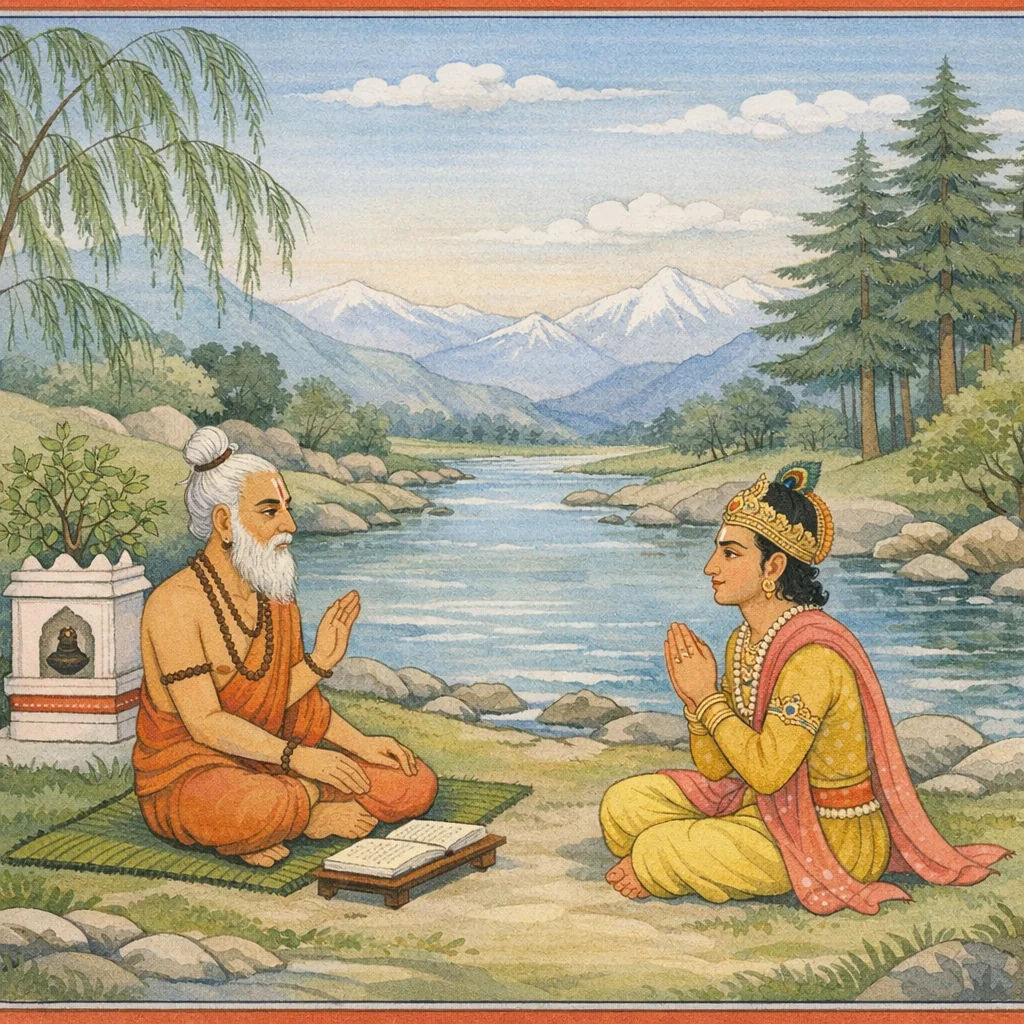
Adhyaya 3
The Narrative of Śivaśarman: Indra’s Obstacles, Menakā’s Mission, and the Triumph of Pitṛ-Devotion
As Viṣṇuśarmā journeys toward Indra’s realm to seek help for his father Śivaśarman, Indra—afraid of ascetic power—sends the apsaras Menakā to obstruct him. In Nandana she appears, sings seductively, and begs for refuge, but Viṣṇuśarmā recognizes Indra’s snare and departs, declaring that the conquest of desire must stand at the very beginning of tapas. Again and again obstacles and terrifying forms arise, yet they are dissolved by the brāhmaṇa’s tejas. Enraged, Viṣṇuśarmā threatens to depose Indra; Indra submits, praises his steadfast devotion to his father, and grants amṛta and the boon of unwavering pitṛ-bhakti. The nectar restores well-being, and the household discourse extols virtuous sons and the dignity of mothers. At last Viṣṇu, bearing conch, discus, and mace, arrives upon Garuḍa; the four sons attain a Vaiṣṇava form and enter the supreme abode. The further glory of Somaśarman is also proclaimed.
Shlokas
Verse 1
सूत उवाच । प्रस्थितस्तेन मार्गेण प्रविष्टो गगनांतरे । स दृष्टो देवदेवेन सहस्राक्षेण धीमता
Sūta said: Setting out by that route and entering the expanse of the sky, he was seen by the god of gods—the wise Thousand-eyed one, Indra.
Verse 2
उद्यमं तस्य वै ज्ञात्वा चक्रे विघ्नं सुराधिराट् । मेनिकांतामुवाचेदं गच्छ त्वं मम शासनात्
Knowing his resolute endeavor, the lord of the gods created an obstacle. Then he said to Menakā: “Go forth, by my command.”
Verse 3
इति श्रीपद्मपुराणे भूमिखंडे शिवशर्मोपाख्याने तृतीयोऽध्यायः
Thus ends the Third Chapter, the “Narrative of Śivaśarmā,” in the Bhūmi-khaṇḍa of the Śrī Padma Purāṇa.
Verse 4
तथा कुरुष्व भद्रं ते यथा नायाति मे गृहम् । एवमाकर्ण्य तद्वाक्यं मेनिका प्रस्थिता त्वरात्
“So act accordingly—may auspiciousness be yours—so that he does not come to my house.” Having heard those words, Menikā set out at once in haste.
Verse 5
सूत उवाच । रूपौदार्यगुणोपेता सर्वालंकारभूषिता । नंदनस्य वनस्यांते दोलायां समुपस्थिता
Sūta said: Endowed with beauty, grace, and excellent qualities, adorned with every ornament, she appeared at the edge of the Nandana grove, standing upon a swing.
Verse 6
सुस्वरेण प्रगायंती गीतं वीणास्वरोपमम् । तेन दृष्टा विशालाक्षी चतुरा चारुलोचना
Singing sweetly in a fine voice, her song was like the sound of a vīṇā. By him she was seen—large-eyed, clever, and lovely-eyed.
Verse 7
व्यवसायं ततो ज्ञात्वा तस्या विघ्नमनुत्तमम् । इंद्रेण प्रेषिता चैषा न च भद्रकरा भवेत्
Then, having understood her resolve, he recognized in her an unsurpassed obstruction: she had been sent by Indra, and she would not become a bringer of good.
Verse 8
एवं ज्ञात्वा जगामाथ सत्वरेण द्विजोत्तमः । तया दृष्टस्तथा पृष्टः क्व यास्यसि महामते
Having understood thus, the best of Brahmins set out in great haste. Seeing him, she asked, “O great-minded one, where are you going?”
Verse 9
विष्णुशर्मा तदोवाच मेनिकां कामचारिणीम् । इंद्रलोकं प्रयास्यामि पितुरर्थे त्वरान्वितः
Then Viṣṇuśarmā said to Menikā, who could go wherever she wished: “I shall set out for Indra’s world, swiftly, for my father’s sake.”
Verse 10
मेनिका विष्णुशर्माणं प्रत्युवाच प्रियं पुनः । कामबाणैः प्रभिन्नाहं त्वामद्य शरणं गता
Menikā again spoke affectionately to Viṣṇuśarmā: “Pierced by the arrows of desire, I have today come to you for refuge.”
Verse 11
रक्षस्व द्विजशार्दूल यदि धर्ममिहेच्छसि । यावद्धि त्वं मया दृष्टः कामाकुलितचेतसा
“Protect me, O tiger among Brahmins, if you truly desire righteousness here; for since I have seen you, my mind has been agitated by desire.”
Verse 12
कामानलेन संदग्धा तावदेव न संशयः । संभ्रांता कामसंतप्ता प्रसादसुमुखो भव
“Burned by the fire of desire—without doubt—agitated and scorched by passion, be gracious, and let your countenance be serene.”
Verse 13
विष्णुशर्मोवाच । चरित्रं देवदेवस्य विदितं मे वरानने । भवत्याश्चप्रजानामिनाहंचैतादृशःशुभे
Viṣṇuśarman said: “O fair-faced lady, the sacred deeds of the God of gods are known to me. Yet about you and your offspring, O auspicious one, I am not so well informed.”
Verse 14
भवत्यास्तेजसा रूपैरन्ये मुह्यंति शोभने । विश्वामित्रादयो देवि पुत्रोहं शिवशर्मणः
O beautiful one, others are bewildered by the radiant splendor of your forms. O Goddess, even sages such as Viśvāmitra are deluded; but I am the son of Śivaśarman.
Verse 15
योगसिद्धिं गतस्यापि तपः सिद्धस्य चाबले । कामादयो महादोषा आदावेव विनिर्जिताः
Even for one who has attained yogic powers, and even for an ascetic perfected in austerities, O gentle one, the great faults—desire and the rest—must be conquered at the very beginning.
Verse 16
अन्यं भज विशालाक्षि इंद्रलोकं व्रजाम्यहम् । एवमुक्त्वा जगामाथ त्वरितो द्विजसत्तमः
“Worship someone else, O large-eyed lady; I am going to Indra’s world.” Having spoken thus, the best of the twice-born brāhmaṇas departed in haste.
Verse 17
निष्फला मेनका जाता पृष्टा देवेन वज्रिणा । विभीषां दर्शयामास नानारूपां पुनः पुनः
Questioned by the god Vajrin (Indra), Menakā failed in her aim; again and again she displayed various terrifying forms.
Verse 18
यथानलेन संदग्धास्तृणानां संचया द्विजाः । भस्मीभूता भवंत्येव तथा तास्ता विभीषिकाः
O brāhmaṇas, just as heaps of dry grass, burned by fire, inevitably turn to ashes, so too those very terrors are reduced to nothing.
Verse 19
विप्रस्य तेजसा तस्य पितृभक्तस्य सत्तमाः । प्रलयं गतास्तु घोरास्ता दारुणा भीषिका द्विजाः
O best of the virtuous, by the spiritual radiance of that brāhmin—devoted to the Fathers (pitṛs)—those dreadful, cruel terrors, O twice-born ones, were driven into dissolution.
Verse 20
स विघ्नान्दर्शयामास सहस्राक्षः पुनः पुनः । तेजसाऽनाशयद्विप्रः स्वकीयेन महायशाः
Again and again, Sahasrākṣa (Indra) displayed obstacles; but the illustrious brāhmaṇa, by his own spiritual radiance, destroyed them.
Verse 21
एवं विघ्नान्बहूंस्तस्य इंद्रस्यापि महात्मनः । नाशयामास मेधावी तपसस्तेजसापि वा
Thus, the wise one destroyed the many obstacles raised by that great-souled Indra as well—by the radiance (power) of his austerities.
Verse 22
नष्टेषु तेषु विघ्नेषु दारुणेषु महत्सु च । ज्ञात्वा तस्य कृतान्विघ्नान्दारुणान्भीषणाकृतीन्
When those great and dreadful obstacles had been destroyed, they came to know that those terrifying, formidable impediments had been created by him.
Verse 23
अथ क्रुद्धो महातेजा विष्णुशर्मा द्विजोत्तमः । इंद्रं प्रति महाभागो रागरक्तांतलोचनः
Then Viṣṇuśarmā, the foremost of brāhmaṇas, radiant with great splendor, flared up in wrath; that blessed one, the corners of his eyes reddened with ardor, turned toward Indra.
Verse 24
इंद्र लोकादहं चेंद्रं पातयिष्यामि नान्यथा । निजधर्मे रतस्याद्य यो विघ्नं तु समाचरेत्
“I shall cast Indra down from Indra’s own world—there can be no other end—for whoever today raises an obstacle against one devoted to his own sacred dharma…”
Verse 25
तस्य दंडं प्रदास्यामि यो वै हन्यात्स हन्यते । एवमन्यं करिष्यामि देवानां पालकं पुनः
“I will mete out punishment to him: whoever strikes shall himself be struck in return. Thus shall I appoint another once more as the protector of the devas.”
Verse 26
एवं समुद्यतो विप्र इंद्रनाशाय सत्तमः । तावदेव समायातो देवेंद्रः पाकशासनः
Thus, O sage, the excellent brāhmaṇa rose up, intent upon Indra’s destruction. Just then Indra himself arrived—the lord of the devas, the chastiser of Pāka.
Verse 27
भो भो विप्र महाप्राज्ञ तपसा नियमेन च । दमेन सत्यशौचाभ्यां त्वत्समो नास्ति चापरः
“O revered brāhmaṇa, O greatly wise one—by your tapas and sacred observances, by self-restraint, and by truth and purity, none is your equal, nor is there anyone above you.”
Verse 28
अनया पितृभक्त्या ते जितोहं दैवतैः सह । ममापराधं त्वं सर्वं क्षंतुमर्हसि सत्तम
By this devotion of yours to your father, I—together with the gods—have been conquered. O best among the virtuous, forgive all my wrongdoing.
Verse 29
वरं वरय भद्रं ते दुर्लभं च ददाम्यहम् । विष्णुशर्मा तदोवाच देवराजं तथागतम्
“Choose a boon; blessings to you. I shall grant even what is difficult to obtain.” Then Viṣṇuśarmā spoke to the king of the gods who had thus arrived.
Verse 30
विप्रतेजो महेंद्रेद्रं असह्यं देवदैवतैः । पितृभक्तस्य देवेश दुःसहं सर्वथा विभो
O Lord of the gods, O all-pervading One: the spiritual radiance of a brāhmaṇa is unbearable even to the gods. Likewise, the power of one devoted to the Pitṛs (ancestors) is utterly impossible to oppose in any way.
Verse 31
तेजोभंगो न कर्त्तव्यो ब्राह्मणानां महात्मनाम् । पुत्रपौत्रैः समस्तैस्तु ब्रह्मविष्णुहरान्पुनः
One should never diminish the dignity and spiritual radiance of great-souled brāhmaṇas. And, together with one’s sons and grandsons, one should again and again honor Brahmā, Viṣṇu, and Hara (Śiva).
Verse 32
नाशयंते न संदेहो यदि रुष्टा द्विजोत्तमाः । नागच्छेद्यद्भवानद्य तदा राज्यमनुत्तमम्
There is no doubt: if the best of the twice-born (brāhmaṇas) become enraged, they can bring about ruin. If you do not go today, then the kingdom will indeed be unsurpassed—secure and excellent.
Verse 33
आत्मतपः प्रभावेण अन्यस्मै त्वं महात्मने । दातुकामस्तु संजातो रोषपूर्णेन चक्षुषा
By the power of your own austerity, you have become willing to bestow this upon another great-souled one—yet your eyes are filled with anger.
Verse 34
भवानद्य समायातो वरं दातुमिहेच्छसि । अमृतं देहि देवेंद्र पितृभक्तिं तथाचलाम्
You have come here today, wishing to grant a boon. O Indra, lord of the devas—grant me amṛta, the nectar of immortality, and also unwavering devotion to the ancestors.
Verse 35
एवंविधं वरं देहि यदि तुष्टोसि शत्रुहन् । एवं ददामि पुण्यं ते वरं चामृतसंयुतम्
“If you are pleased, O slayer of enemies, grant me a boon of this kind.” Thus addressed, he replied, “I grant you this meritorious boon, endowed with nectar-like, immortal benefit.”
Verse 36
एवमाभाष्य तं विप्रममृतं दत्तवान्स्वयम् । सकुंभं दत्तवांस्तस्मै प्रीयमाणेन चात्मना
Having thus spoken to that brāhmaṇa, he himself gave him the amṛta; and with a heart made joyful, he also gave him the vessel along with it.
Verse 37
अचला ते भवेद्विप्र भक्तिः पितरि सर्वदा । एवमाभाष्य तं विप्रं विसृज्य च सहस्रदृक्
“O brāhmaṇa, may your devotion to your father remain unwavering at all times.” Having spoken thus, the Thousand-Eyed One (Indra) dismissed him and departed.
Verse 38
प्रसन्नोभूच्च तद्दृष्ट्वा विप्रतेजः सुदुःसहम् । विष्णुशर्मा ततो गत्वा पितरं वाक्यमब्रवीत्
Seeing the brāhmaṇa’s unbearable radiance, he was filled with joy; then Viṣṇuśarmā went to his father and spoke these words.
Verse 39
तात इंद्रात्समानीतममृतं व्याधिनाशनम् । अनेनापि महाभाग नीरुजो भव सर्वदा
Dear father, this amṛta—brought from Indra—destroys disease. By it, O fortunate one, may you remain forever free from illness.
Verse 40
अमृतेन त्वमद्यैव परां तृप्तिमवाप्नुहि । एतद्वाक्यं महच्छ्रुत्वा शिवशर्मा सुतस्य हि
“With this amṛta, attain supreme satisfaction this very day.” Hearing these weighty words spoken concerning his son, Śivaśarmā…
Verse 41
सुतान्सर्वान्समाहूय प्रीयमाणेन चेतसा । पितृभक्ताः सुता यूयं मद्वाक्यपरिपालकाः
Summoning all his sons, with a heart full of affection, he said: “Sons, you are devoted to your father and you are keepers of my word.”
Verse 42
वरं वृणुध्वं सुप्रीताः पुत्रका दुर्लभं भुवि । एवमाभाषितं तस्य शुश्रुवुः सर्वसंमताः
“Choose a boon, dear sons—for I am well pleased—something rare upon the earth.” Thus addressed by him, they all, being in agreement, listened to his words.
Verse 43
ते सर्वे तु समालोच्य पितरं प्रत्यथाब्रुवन् । अस्माकं जीवताम्माता गता या यममंदिरम्
Then all of them, after consulting together, spoke to their father: “While we are still alive, our mother has gone to Yama’s abode.”
Verse 44
नीरुजा भवनाद्देवी प्रसादात्तव सुव्रता । भवान्पिता इयं माता जन्मजन्मांतरे पितः
By your grace, O Goddess, this virtuous woman has become free from illness. You are her father, and this one is her mother—indeed, across birth after birth you have been her father.
Verse 45
वयं सुता भवेमेति सर्वे पुण्यकृतस्तथा । शिवशर्मोवाच । अद्यैवापि मृता माता भवतां पुत्रवत्सला
“May we all become sons (to her),” thus spoke they all, doers of merit. Śivaśarmā said: “Even today your mother—so affectionate toward her sons—has died.”
Verse 46
जीवमाना सुहृष्टा सा एष्यते नात्र संशयः । एवमुक्ते शुभे वाक्ये ऋषिणा शिवशर्मणा
“She is alive and will return, delighted—of this there is no doubt.” When the sage Śivaśarman had spoken these auspicious words, …
Verse 47
तेषां माता समायाता प्रहृष्टा वाक्यमब्रवीत् । एतदर्थं समुत्पन्नं सुवीर्यं तनयं सुतम्
Their mother came there, delighted, and spoke these words: “For this very purpose has this son—Suvīrya—been born, my child.”
Verse 48
नराः सत्पुत्रमिच्छंति कुलवंशप्रभावकम् । स्त्रियो लोके महाभागाः सुपुण्याः पुण्यवत्सलाः
Men desire a virtuous son who increases the glory of family and lineage. In the world, women are most blessed—abounding in puṇya and devoted to dharma.
Verse 49
सुतमिच्छंति सर्वत्र पुण्यांगं पुण्यसाधकम् । कुक्षिं यस्या गतो गर्भः सुपुण्यः परिवर्त्तते
Everywhere people desire a son—one whose very body is puṇya and who becomes a means for accomplishing merit. The womb into which such an embryo enters is transformed into supreme auspiciousness.
Verse 50
पुण्यान्पुत्रान्प्रसूयेत सा नारी पुण्यभागिनी । कुलाचारं कुलाधारं पितृमातृप्रतारकम्
That woman who gives birth to virtuous sons is a sharer in puṇya. They uphold the family’s righteous conduct, support the lineage, and become deliverers of father and mother.
Verse 51
विना पुण्यैः कथं नारी संप्राप्नोति सुतोत्तमम् । न जाने कीदृशैः पुण्यैरेष भर्ता सुपुण्यभाक्
Without puṇya, how could a woman obtain such an excellent son? I do not know by what kinds of merits my husband has become so richly endowed with virtue.
Verse 52
संजातो धर्मवीर्योपि धर्मात्मा धर्मवत्सलः । यस्य वीर्यान्मया प्राप्ता यूयं पुत्रास्ततोधिकाः
He was born with strength rooted in dharma—virtuous in soul and affectionate toward dharma. From his potency I obtained you as sons, and you are even greater than he.
Verse 53
एवं पुण्यप्रभावोयं भवंतः पुण्यवत्सलाः । मम पुत्रास्तु संजाताः पितृभक्तिपरायणाः
Thus is the power of this merit. You all are lovers of dharma; and my sons have been born devoted, wholly dedicated to reverence for their father.
Verse 54
अहो लोकेषु पुण्यैश्च सुपुत्रः परिलभ्यते । एकैकशोधिकाः पंच मया प्राप्ता महाशयाः
Ah! In this world, by virtue and merit, a noble son is obtained. I have been blessed with five great-souled ones—each a purifier in his own right.
Verse 55
यज्वानः पुण्यशीलाश्च तपस्तेजः पराक्रमाः । एवं संवर्धितास्ते तु तया मात्रा पुनः पुनः
They were sacrificers, virtuous in conduct, endowed with the radiance born of tapas and with heroic prowess; thus were they nurtured and strengthened again and again by that mother.
Verse 56
हर्षेण महताविष्टाः प्रणेमुर्मातरं सुताः । पुत्रा ऊचुः । सुपुण्यैः प्राप्यते माता सन्माता सुपिता किल
Overwhelmed with great joy, the sons bowed to their mother. The sons said: “By very great merit one obtains a mother; indeed, a good mother and a good father are attained only through virtuous deeds.”
Verse 57
भवती पुण्यकृन्माता नो भाग्यैस्तु प्रवर्तिता । यस्या गर्भोदरं प्राप्य सुपुण्यैश्च प्रवर्द्धिताः
You are a mother who performs meritorious deeds; you are not driven merely by fate. Having entered the womb of such a mother, we have been nurtured and made to flourish through great virtues.
Verse 58
जन्मजन्मनि त्वं माता पिता चैव भविष्यथः । पितोवाच । शृणुध्वं मामकाः पुत्राः सुवरं पुण्यदायकम्
“In birth after birth, you shall indeed become mother and father.” The father said: “Hear me, my sons—my excellent utterance that bestows merit.”
Verse 59
मयि तुष्टे सुता भोगा ननु भुंजंतु चाक्षयान् । पुत्रा ऊचुः । यदि तात प्रसन्नोसि वरं दातुमिहेच्छसि
“If I am pleased, then surely my sons should enjoy imperishable delights.” The sons said: “If, dear father, you are satisfied and wish to grant a boon here…”
Verse 60
अस्मान्प्रेषय गोलोकं वैष्णवं दाहवर्जितम् । पितोवाच । गच्छध्वं वैष्णवं लोकं यूयं विगतकल्मषाः
“Send us to Goloka—the Vaiṣṇava realm, free from suffering.” The father said: “Go to the Vaiṣṇava world; you are now free from sin.”
Verse 61
मत्प्रसादात्तपोभिश्च पितृभक्त्यानया स्वया । एवमुक्ते तु तेनापि सुवाक्ये ऋषिणा ततः
“By my grace, by your austerities, and by this very devotion of yours to the ancestors…” When this was spoken, that ṛṣi too then continued, uttering noble words.
Verse 62
शंखचक्रगदापाणिर्गरुडारूढ आगतः । सपुत्रं शिवशर्माणमित्युवाच पुनः पुनः
Bearing in his hands the conch, discus, and mace, the Lord arrived mounted upon Garuḍa; and again and again he addressed Śivaśarman together with his son.
Verse 63
सपुत्रेण त्वयाद्यैव जितो भक्त्यास्मि वै द्विज । पुत्रैः सार्द्धं समागच्छ चतुर्भिः पुण्यकारिभिः
O brāhmaṇa, today you have truly conquered me through your devotion, together with your son. Come here with your four sons, doers of meritorious deeds.
Verse 64
अनया भार्यया सार्द्धं पुण्यया पतिकाम्यया । शिवशर्मोवाच । अमी गच्छंतु पुत्रा मे वैष्णवं लोकमुत्तमम्
Together with this virtuous wife of mine—devoted to her husband—Śivaśarman said: “May these my sons go to the supreme realm of Viṣṇu.”
Verse 65
कंचित्कालं तु नेष्यामि भूमौ वै भार्यया सह । अनेनापि सुपुत्रेण अंत्येन सोमशर्मणा
For some time, indeed, I shall live on the earth together with my wife—along with this virtuous son, the youngest, Somaśarman as well.
Verse 66
एवमुक्ते शुभे वाक्ये ऋषिणा सत्यभाषिणा । तानुवाचाथ देवेशः सुपुत्राञ्छिवशर्मणः
When the truth-speaking sage had thus spoken those auspicious words, the Lord of the gods then addressed them—the worthy sons of Śivaśarman.
Verse 67
गच्छंतु मोक्षदं लोकं दाहप्रलयवर्जितम् । एवमुक्ते ततो विप्राश्चत्वारः सत्यचेतसः
“Let them go to the world that bestows liberation, free from the cataclysms of burning and dissolution.” When this was said, the four brāhmaṇas, steadfast in truth, proceeded accordingly.
Verse 68
विष्णुरूपधराः सर्वे बभूवुस्तत्क्षणादपि । इंद्रनीलसमावर्णैः शंखचक्रगदाधराः
In that very instant, all of them assumed the form of Viṣṇu—dark as sapphire—bearing the conch, the discus, and the mace.
Verse 69
सर्वाभरणसौभाग्या विष्णुरूपा महौजसः । हारकंकणशोभाढ्या रत्नमालाभिशोभिताः
Auspicious with every ornament, in the form of Viṣṇu and possessed of great radiance; adorned with necklaces and bracelets, they shone, beautified by garlands of jewels.
Verse 70
सूर्यतेजःप्रतीकाशास्तेजोज्वालाभिरावृताः । प्रविष्टा वैष्णवं कायं पश्यतः शिवशर्मणः
Radiant like the sun’s splendor and enveloped in flames of blazing light, they entered the Vaiṣṇava body, before the very eyes of Śivaśarman.
Verse 71
दीपं दीपा यथा यांति तद्वल्लीना महामते । गतास्ते वैष्णवं धाम पितृभक्त्या द्विजोत्तमाः
O great-minded one, just as the flame of one lamp passes to another lamp, so those best of the twice-born, through devotion to their forefathers, have gone to the supreme abode of Viṣṇu.
Verse 72
प्रभावं तु प्रवक्ष्यामि सुसत्यं सोमशर्मणः
Now I shall declare the true and wondrous power—the glory—of Somaśarman.