Adhyaya 60
The Account of Sukalā and the Greatness of Nārī-tīrtha (Wife-Assisted Śrāddha and Pitṛ-Liberation)
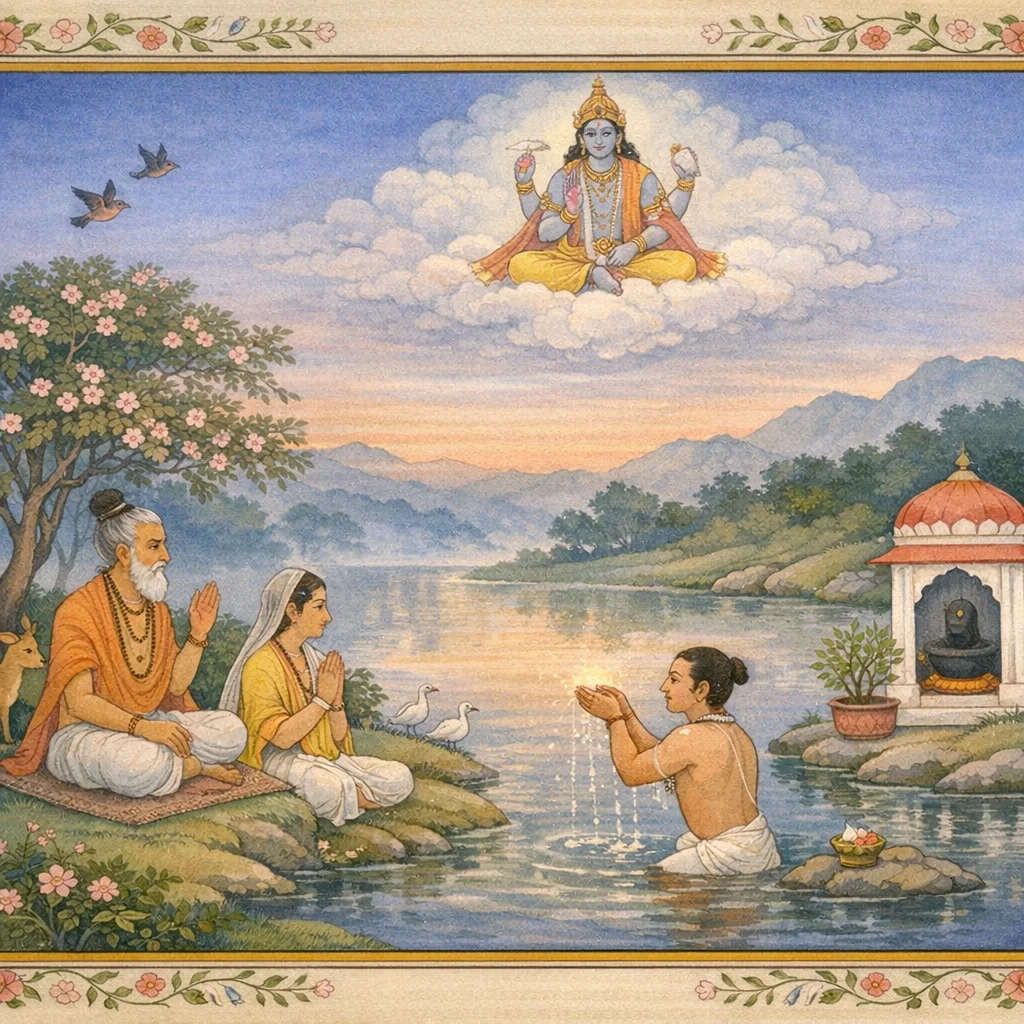
Kṛkala asks Dharmarāja how to gain spiritual success and liberate his ancestors. Dharma tells him to return home, comfort his devoted wife Sukalā, and perform śrāddha with her participation, declaring that dharma (and even artha) reaches fulfillment in the gṛhastha order, where the housewife is essential for true ritual competence. Kṛkala returns, and Sukalā welcomes him with auspicious rites. Together they perform a meritorious śrāddha in a temple, remembering tīrthas and worshipping the gods. The Pitṛs and Devas arrive in celestial vehicles; sages and the divine triad praise the couple, especially Sukalā’s truthfulness. Boons are offered, and the couple ask for enduring devotion, dharma, and attainment of the Vaiṣṇava world together with their ancestors. The chapter ends by naming the place Nārī-tīrtha and promising fruits to listeners: removal of sin, prosperity, learning, victory, and blessings upon one’s lineage.
Shlokas
Verse 1
कृकल उवाच । कथं मे जायते सिद्धिः कथं पितृविमोचनम् । एतन्मे विस्तरेणापि धर्मराज वदाधुना
Kṛkala said: “How may I attain spiritual accomplishment, and how may my ancestors be set free? O Dharmarāja, tell me this now—fully and in detail.”
Verse 2
धर्म उवाच । गच्छ गेहं महाभाग त्वां विना दुःखमाचरत् । संबोधय त्वं सुकलां स्वपत्नीं धर्मचारिणीम्
Dharma said: “Go home, fortunate one. Without you she has lived in sorrow. Console Sukalā—your own wife—who is devoted to righteous conduct.”
Verse 3
श्राद्धदानं गृहं गत्वा तस्या हस्तेन वै कुरु । स्मृत्वा पुण्यानि तीर्थानि यजस्व त्वं सुरोत्तमान्
Go to her house and perform the śrāddha offering by her own hand. Remembering the holy tīrthas, worship the most excellent of the gods.
Verse 4
तीर्थयात्राकृता सिद्धिस्तव चैव भविष्यति । भार्यां विना तु यो लोके धर्मं साधितुमिच्छति
The accomplishment born of pilgrimage to the sacred tīrthas will surely be yours as well. But in this world, whoever wishes to fulfill dharma without a wife—
Verse 5
स गार्हस्थ्यं विलोप्यैव एकाकी विचरेद्वनम् । विफलो जायते लोके तं न मन्यंति देवताः
If a man casts aside the householder’s life and wanders alone in the forest, he becomes fruitless in the world; the gods do not honor him.
Verse 6
यज्ञाः सिद्धिं तदायांति यदा स्याद्गृहिणी गृहे । एकाकी स समर्थो न धर्मार्थसाधनाय च
Sacrifices attain fulfillment when the wife is present in the home; for a man alone is not competent to accomplish the means of dharma and artha.
Verse 7
विष्णुरुवाच । एवमुक्त्वा च तं वैश्यं गतो धर्मो यथागतम् । कृकलोपि स धर्मात्मा स्वगृहं प्रतिप्रस्थितः
Viṣṇu said: Having spoken thus to that merchant, Dharma departed, returning the way he had come. And Kṛkala too—righteous at heart—set out again for his own home.
Verse 8
स्वगृहं प्राप्य मेधावी दृष्ट्वा तां च पतिव्रताम् । सार्थवाहेन तेनापि स्वस्थानं प्राप्य बुद्धिमान्
Having reached his own home, the intelligent man saw her, that devoted and faithful wife (pativratā); and that caravan-leader too—being wise—returned to his own place.
Verse 9
तया समागतं दृष्ट्वा भर्तारं धर्मकोविदम् । कृतं सुमंगलं पुण्यं भर्तुरागमने तदा
Seeing her husband—well-versed in dharma—return and arrive, she then performed auspicious and meritorious rites to celebrate his homecoming.
Verse 10
समाचष्ट स धर्मात्मा धर्मस्यापि विचेष्टितम् । समाकर्ण्य महाभागा भर्तुर्वाक्यं मुदावहम्
That righteous-souled man explained even the subtle workings of Dharma. Hearing her husband’s joy-bestowing words, the noble lady listened with attentive reverence.
Verse 11
धर्मवाक्यं प्रशस्याथ अनुमेने च तं तथा । विष्णुरुवाच । अथो स कृकलो वैश्यस्तया सार्धं सुपुण्यकम्
Praising the words of Dharma, he likewise gave his consent. Viṣṇu said: Then that vaiśya named Kṛkala, together with her, undertook a most meritorious act.
Verse 12
चकार श्रद्धया श्राद्धं देवतागृहसंस्थितः । पितरो देव गंधर्वा विमानैश्च समागताः
Seated within the Deity’s temple, he performed the śrāddha with faith; and the Pitṛs, together with the Devas and Gandharvas, arrived in celestial aerial cars.
Verse 13
तुष्टुवुस्तौ महात्मानौ दंपती मुनयस्तथा । अहं चापि तथा ब्रह्मा देव्यायुक्तो महेश्वरः
Then those two great souls—the husband and wife—were praised by the sages; and likewise by me, by Brahmā, and by Mahādeva (Maheśvara) accompanied by the Goddess.
Verse 14
सर्वे देवाः सगंधर्वा विमानैश्च समागताः । अहमेव ततो ब्रह्मा देव्यायुक्तो महेश्वरः
All the gods, together with the Gandharvas, arrived there in their celestial chariots. Then I myself appeared there as Brahmā, and as Maheśvara united with the Goddess.
Verse 15
सर्वे देवाः सगंधर्वास्तस्याः सत्येन तोषिताः । ऊचुश्च तौ महात्मानौ धर्मज्ञौ सत्यपंडितौ
All the gods, together with the Gandharvas, were pleased by her truthfulness; and they addressed those two great-souled ones—knowers of dharma and wise in truth.
Verse 16
भार्यया सह भद्रं ते वरं वरय सुव्रत । कृकल उवाच । कस्य पुण्यप्रसंगेन तपसश्च सुरोत्तमाः
“May it be well with you. Together with your wife, O man of good vows, choose a boon.” Kṛkala said: “By association with whose merit—and by what austerity—do even the best of the gods become attainable and propitiated?”
Verse 17
सभार्याय वरं दातुं भवंतो हि समागताः । इंद्र उवाच । एषा सती महाभागा सुकला चारुमंगला
“Indeed, you have assembled here to grant a boon to me together with my wife.” Indra said: “This virtuous lady is greatly fortunate—well-endowed in every part and possessed of lovely auspiciousness.”
Verse 18
अस्याः सत्येन तुष्टाः स्म दातुकामा वरं तव । समासेन तु तत्प्रोक्तं पूर्ववृत्तांतमेव च
Pleased with her truthfulness, we are ready to grant you a boon. In brief, that has been stated, along with the earlier account as well.
Verse 19
तस्याश्चरितमाहात्म्यं श्रुत्वा भर्ता स हर्षितः । तया सह स धर्मात्मा हर्षव्याकुललोचनः
Hearing the wondrous greatness of her conduct, her husband became delighted. That righteous man, together with her, his eyes trembling with joy, was overwhelmed with happiness.
Verse 20
ननाम देवताः सर्वा उवाच च पुनः पुनः । यदि तुष्टा महाभागा त्रयो देवाः सनातनाः
All the deities bowed down, and he spoke again and again: “If the three eternal gods, the greatly fortunate ones, are pleased…”
Verse 21
अन्ये च ऋषयः पुण्याः कृपां कृत्वा ममोपरि । जन्मजन्मनि देवानां भक्तिमेवं करोम्यहम्
And other holy sages, showing compassion toward me, granted me this boon: thus, in birth after birth, I practice devotion to the gods.
Verse 22
धर्मसत्यरतिः स्यान्मे भवतां हि प्रसादतः । पश्चाद्धि वैष्णवं लोकं सभार्यश्च पितामहैः
By your gracious favor, may I become devoted to dharma and truth; and afterwards may I attain the Vaiṣṇava world, together with my wife and with my forefathers.
Verse 23
गंतुमिच्छाम्यहं देवा यदि तुष्टा महौजसः । देवा ऊचुः । एवमस्तु महाभाग सर्वमेव भविष्यति
“O gods, I wish to depart, if the mighty ones are satisfied.” The gods said: “So be it, O noble one; everything shall indeed come to pass.”
Verse 24
पुष्पवृष्टिं ततश्चक्रुस्तयोरुपरि भूपते । जगुर्गीतं महापुण्यं ललितं सुस्वरं ततः
Then, O king, they caused a shower of flowers to fall upon the two of them; thereafter they sang a supremely meritorious song—graceful and sweet in tone.
Verse 25
गंधर्वा गीततत्त्वज्ञा ननृतुश्चाप्सरोगणाः । ततो देवाः सगंधर्वाः स्वंस्वं स्थानं नृपोत्तम
The Gandharvas, skilled in the true principles of song, and the hosts of Apsarases danced. Then the gods, together with the Gandharvas, returned to their respective abodes, O best of kings.
Verse 26
वरं दत्वा प्रजग्मुस्ते स्तूयमानाः पतिव्रताम् । नारीतीर्थं समाख्यातमन्यत्किंचिद्वदामि ते
Having granted her a boon, they departed, praising that devoted wife. The sacred ford called “Nārī-tīrtha” has thus been described; now I shall tell you something further.
Verse 27
एतत्ते सर्वमाख्यातं पुण्याख्यानमनुत्तमम् । यः शृणोति नरो राजन्सर्वपापैः प्रमुच्यते
Thus, O king, I have fully related to you this unsurpassed, meritorious narrative. Any man who listens to it is freed from all sins.
Verse 28
श्रद्धया शृणुते नारी सुकलाख्यानमुत्तमम् । सौभाग्येन तु सत्येन पुत्रपौत्रैर्न मुच्यते
A woman who listens with faith to the excellent account of Sukalā is blessed with good fortune; in truth, she is not deprived of sons and grandsons.
Verse 29
मोदते धनधान्येन सहभर्त्रा सुखी भवेत् । पतिव्रता भवेत्सा च जन्मजन्मनि नान्यथा
She rejoices in wealth and grain, and lives happily together with her husband. She indeed becomes devoted to her husband, in birth after birth—never otherwise.
Verse 30
ब्राह्मणो वेदविद्वांश्च क्षत्रियो विजयी भवेत् । धनधान्यं भवेच्चैव वैश्यगेहे न संशयः
A brāhmaṇa becomes learned in the Vedas; a kṣatriya becomes victorious; and in a vaiśya’s household there will surely be wealth and grain—of this there is no doubt.
Verse 31
धर्मज्ञो जायते राजन्सदाचारः सुखी भवेत् । शूद्र सुःखमवाप्नोति पुत्रपौत्रैः प्रवर्धते
O King, one becomes a knower of dharma; through good conduct one becomes happy. Even a Śūdra attains happiness and prospers through sons and grandsons.
Verse 32
विपुला जायते लक्ष्मीर्धनधान्यैरलंकृता
Abundant prosperity arises, adorned with wealth and grain.
Verse 60
इति श्रीपद्मपुराणे भूमिखंडे वेनोपाख्याने सुकलाचरित्रे षष्टितमोऽध्यायः
Thus ends the sixtieth chapter, the account of Sukalā, within the Vena-episode in the Bhūmi-khaṇḍa of the revered Padma Purāṇa.